
Produits
-

Elektor Digital 8-Bit-Mikrocontroller (PDF)
PIC und AVR verstehen In diesem Buch werden wir uns ausschließlich mit 8-Bit-Mikrocontrollern beschäftigen, und zwar mit Mikrocontrollern der 8-Bit-PIC- und der 8-Bit-AVR-Mikrocontroller-Linien. Bei der PIC-Familie handelt es sich dabei um PIC10, PIC12, PIC16 und PIC18; bei der AVR-Familie um ATtiny, ATmega und ATxmega. Die vorgestellten 8-Bit-Chips sind für sehr viele Anwendungen vollkommen ausreichend und preislich auch attraktiv. Durch die Lektüre des Buches erhalten Sie ein fundiertes Wissen über die genannten 8-Bit-Mikrocontroller, über ihre Architektur, ihre Pinbelegungen und über ihre Programmierung. Weil wir uns in diesem Buch mit den Grundlagen der Architektur der PICs und AVRs vertraut machen möchten, werden wir auch für alle PIC- und AVR-Anwendungen Assembler einsetzen, denn die Assembler-Sprache erlaubt es, die Technik im Detail kennenzulernen. Wenn man wirklich wissen möchte, was sich im Mikrocontroller abspielt, greift man zu Assembler. Damit hat man die beste Gelegenheit, sehr nah an den Kern zu kommen. Und wenn man schon einen Mikrocontroller-Typ kennengelernt und verstanden hat, ist es bei dem nächsten deutlich einfacher, auch wenn er von einem anderen Hersteller kommt. Bei anderen Programmiersprachen bleibt die Technik immer ziemlich tief versteckt. Die Assembler-Beispiele sind so einfach gestaltet, dass sie jeder mit den im Buch aufgezeigten Programmiertechniken erstellen kann. Weil es sich um einfache Beispiele handelt, werden wir sie alle auf einer universellen Lochrasterplatine realisieren. Manche sind auch auf einem Experimentier-Breadboard umsetzbar.
€ 32,80
Membres : € 29,52
-

Würth ABC des condensateurs (E-book)
Inhaler Couches de sol Ces chapitres contiennent les informations de base concernant l'intégration des champs électriques, l'autorisation de construction et le principe de câblage des condensateurs. Kenngrössen von Kondensatoren Les paramètres électriques et les caractéristiques de base des condensateurs ont été appris ici. Dies reicht von der eigentlichen Kapazität eines Kondensators bis hin zum Abhängigkeitsverhalten. Types de condensateurs Il existe des types de condensateurs existants et leurs propriétés développées. De manière plus détaillée, les condensateurs à film, à électrolyte et en céramique ont été examinés ici.
€ 8,99
Membres : € 8,09
-

Würth ABC du module de puissance (livre électronique)
Fonctions, construction et manipulation des modules de puissance L'« Abc du module d'alimentation » beinhaltet im ersten Schritt die wesentlichen Grundlagen, die bei der Auswahl und dem Einsatz eines Power Modules sind. Le livre décrit les aspects techniques et les mesures concernant le module d'alimentation ainsi que la construction et la technologie des messages. Inhaler Couches de sol Ces chapitres décrivent la connaissance de leurs capacités de marche et de leurs fonctions fondamentales. Il existe différentes options pour répondre aux besoins en énergie ainsi qu'aux modules d'alimentation requis. Mise à l'échelle des topologies Ici, les lecteurs qui ont utilisé des Power Modules avec des concepts de planification étendus, des topologies électriques et externes, ont été informés d'autres topologies techniques. Technologie, technologie de construction et de réglementation Une attention particulière est portée à la construction mécanique des modules de puissance, au flux naturel d'EMV ainsi qu'à la gestion de la chaleur. Ferner depuis ce chapitre Regelungs- und Schaltungstipps zu entnehmen. Messverfahren Assurer une communication efficace puisque l’utilisation de modules de puissance ne pose pas de problème. Dans ce chapitre, les méthodes de communication et les méthodes de messages ont été décrites. Manutention Il s'agissait des Punkte der Lagerung und den Umgang mit Power Modulen erläutert, ebenso wie deren Fertigungs- und Lötprozess. Prenez soin de vos modules de puissance Les différents paramètres et critères pour la configuration optimale d'un module de puissance se trouvent dans cette rubrique.
€ 8,99
Membres : € 8,09
-
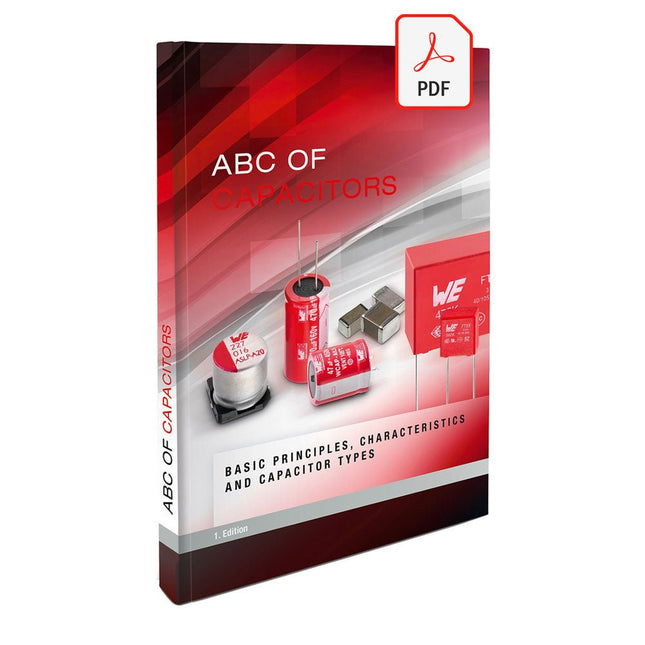
Würth ABC of Capacitors (E-book)
The author Stephan Menzel provides an introduction into capacitor technology and describes the wide range of capacitor types with their properties and parameters. Basic principles This chapter imparts basic knowledge on the relationships between the electric field, permittivity, as well as the structure and operating principles of a capacitor. Capacitor characteristics The electrical parameters and essential characteristics of a capacitor are explained in greater detail for the reader. This extends from the actual capacitance of a capacitor through to the interdependencies. Capacitor types Existing capacitor types and their characteristics are presented. Film, electrolyte and ceramic capacitors are considered in detail.
€ 8,99
Membres : € 8,09
-
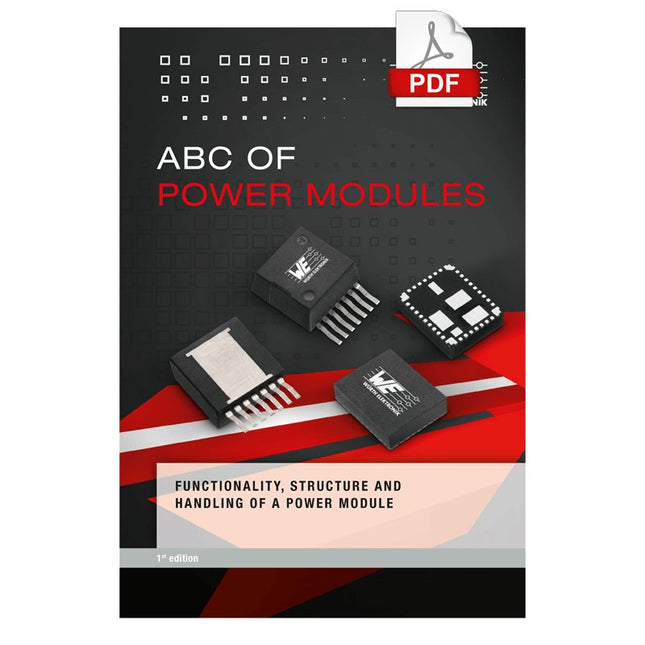
Würth Abc of Power Modules (E-book)
Fonctionnalité, structure et manipulation d'un module de puissance Pour les lecteurs débutant dans la gestion de l'énergie, l'« Abc des modules de puissance » contient les principes de base nécessaires à la sélection et à l'utilisation d'un module de puissance. Le livre décrit les relations et paramètres techniques liés aux modules de puissance et la base des techniques de calcul et de mesure. Contenu Les bases Ce chapitre décrit la nécessité d'un convertisseur de tension DC/DC et ses fonctionnalités de base. De plus, diverses possibilités de réalisation d'un régulateur de tension sont présentées et les avantages essentiels d'un module de puissance sont mentionnés. Topologies de circuits Les concepts de circuits, les topologies Buck et Boost très fréquemment utilisées avec les modules de puissance sont expliqués en détail et d'autres topologies de circuits sont introduites. Technologie, technologie de construction et de régulation La construction mécanique d'un module de puissance est présentée, qui a une influence significative sur la CEM et les performances thermiques. De plus, les méthodes de contrôle sont expliquées et des conseils de conception de circuit sont fournis dans ce chapitre. Méthodes de mesure Des résultats de mesure significatifs sont absolument nécessaires pour évaluer un module de puissance. Les points de mesure et méthodes de mesure pertinents sont décrits dans ce chapitre. Manutention Les aspects de stockage et de manipulation des modules de puissance sont expliqués, ainsi que leurs procédés de fabrication et de soudure. Sélection d'un module de puissance Les paramètres et critères importants pour la sélection optimale d'un module de puissance sont présentés dans cette section.
€ 8,99
Membres : € 8,09
-

Elektor Digital Abonnement Elektor Green
Apprenez, construisez et maîtrisez l'électronique – avec Elektor Projets, savoir-faire d'experts, accès aux archives et réductions exclusives – le tout dans un seul abonnement Vous souhaitez apprendre l’électronique, développer vos propres circuits et mieux comprendre les technologies modernes ? Depuis 65 ans, Elektor Magazine compte parmi les principales sources d’information pour les ingénieurs en électronique, les développeurs, les start-up et les entreprises. Avec un Abonnement Elektor Green, vous bénéficiez de : ✅ Le magazine international d'électronique Elektor (en format numérique) ✅ Accès aux archives d’Elektor avec 65 ans de savoir-faire en électronique ✅ Projets DIY, circuits testés, analyses approfondies et tutoriels ✅ Réductions exclusives réservées aux membres sur Elektor.fr Pourquoi Elektor ? Depuis 65 ans, Elektor est synonyme de connaissances approfondies en électronique, de projets concrets et de technologies innovantes. Des microcontrôleurs et systèmes embarqués à Raspberry Pi, Arduino et ESP32, jusqu’à l’IdO (IoT), l’IA, la mesure, l’audio, la RF et la robotique, Elektor couvre les principales plateformes et domaines d’application de l’électronique moderne. Que vous soyez débutant, maker ou professionnel, Elektor vous aide à passer au niveau supérieur. À qui s'adresse l'abonnement ? Débutants – Plongez dans l'univers de l'électronique grâce à des bases claires et à vos premiers projets Makers – Découvrez de nouveaux projets, des idées et de l'inspiration pour vos propres créations Professionnels et ingénieurs – Restez à la pointe des technologies modernes et approfondissez vos connaissances spécialisées Vos avantages en un coup d'œil Magazine (numérique) – Recevez chaque numéro en version numérique directement dans votre boîte mail 65 ans de savoir-faire en électronique – Accédez à tout moment aux vastes archives d'Elektor Pratique & projets – Concrétisez vos propres idées grâce à des instructions, des schémas de circuits et des tutoriels Réductions exclusives – Économisez sur chaque achat sur Elektor.fr Débloquez tous les avantages Elektor ! Abonnement Free Abonnement Green ❌ 8× magazine Elektor (édition numérique) au format PDF ✅ 8× magazine Elektor (édition numérique) au format PDF ❌ 12 mois d’accès aux archives complètes d’Elektor ✅ 12 mois d’accès aux archives complètes d’Elektor ❌ Accès à plus de 5 000 fichiers Gerber ✅ Accès à plus de 5 000 fichiers Gerber ❌ 10% de réduction pour les membres sur Elektor.fr ✅ 10% de réduction pour les membres sur Elektor.fr ✅ Lisez Elektor chaque vendredi matin ✅ Lisez Elektor chaque vendredi matin ℹ️ Vous préférez lire Elektor en version papier ? Découvrez ici tout ce qu'il faut savoir sur l'abonnement Elektor Gold (version papier).
€ 89,95 - € 169,95
-
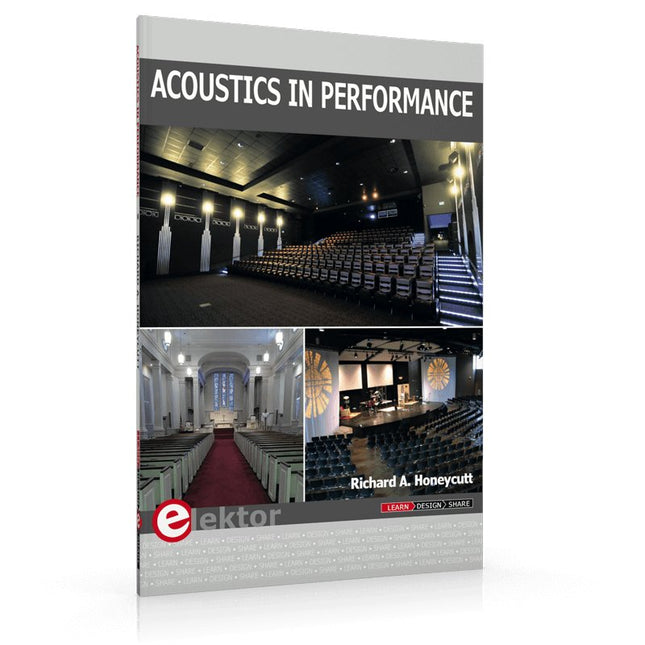
Elektor Publishing Acoustics in Performance
All you need to know about good acoustics and sound systems in performance and worship spaces! Everyone knows that the ability to hear music in balance and to understand speech is essential in any space used for performance or worship. Unfortunately, in the early 21st century, we find that buildings with good acoustics are the exception rather than the rule. Much of the fault leading to this result can be traced to the widespread perception that acoustics is a black art. In fact, scientific acoustics as developed in the last century is a well-defined engineering practice that can lead to predictable excellent results. A basic, non-engineering understanding of acoustics will help building owners, theater managers, ministers and teachers of music, performers, and other professionals to achieve their goals of excellent acoustics in venues with which they work. Performers having a basic understanding of acoustics will be able to make the most of the acoustics of the venue in which they perform. This book helps those responsible for providing good acoustics in performance and worship spaces to understand the variables and choices entailed in proper acoustic design for performance and worship. Practicing acoustical consultants will find the book a useful reference as well. The level of presentation is comfortable and straightforward without being simplistic. If correct acoustical principles are incorporated into the design, renovation, and maintenance of performance and worship venues, good acoustics will be the result.
€ 29,95
Membres : € 26,96
-
Elektor Digital Acoustics in Performance (E-book)
All you need to know about good acoustics and sound systems in performance and worship spaces! Everyone knows that the ability to hear music in balance and to understand speech is essential in any space used for performance or worship. Unfortunately, in the early 21st century, we find that buildings with good acoustics are the exception rather than the rule. Much of the fault leading to this result can be traced to the widespread perception that acoustics is a black art. In fact, scientific acoustics as developed in the last century is a well-defined engineering practice that can lead to predictable excellent results. A basic, non-engineering understanding of acoustics will help building owners, theater managers, ministers and teachers of music, performers, and other professionals to achieve their goals of excellent acoustics in venues with which they work. Performers having a basic understanding of acoustics will be able to make the most of the acoustics of the venue in which they perform. This book helps those responsible for providing good acoustics in performance and worship spaces to understand the variables and choices entailed in proper acoustic design for performance and worship. Practicing acoustical consultants will find the book a useful reference as well. The level of presentation is comfortable and straightforward without being simplistic. If correct acoustical principles are incorporated into the design, renovation, and maintenance of performance and worship venues, good acoustics will be the result.
€ 24,95
Membres : € 22,46
-

Great Scott Gadgets Boîtier en acrylique pour HackRF SDR
Ce boîtier en acrylique transparent est le boîtier officiel pour la carte HackRF One/Pro. Il peut remplacer le boîtier en plastique noir standard de la HackRF One. Instructions de montage Utilisez un médiator de guitare ou un spudger pour extraire le circuit de la carte HackRF One/Pro du boîtier en plastique noir. Insérez une vis longue dans chaque coin du panneau inférieur en acrylique. Fixez chaque vis longue avec un entretoise courte (5 mm) de l'autre côté du panneau. Placez le circuit de la carte HackRF One/Pro (face vers le haut) sur le dessus du panneau inférieur, en faisant passer les extrémités des vis longues à travers les trous de montage des coins de la carte. Fixez le circuit avec une entretoise longue (6 mm) dans chaque coin. Placez le panneau en acrylique supérieur sur le dessus de la carte, en alignant les découpes avec les connecteurs d'extension de la carte. Fixez chaque coin avec une vis courte. Remarque : Ne serrez pas trop fort ! Serrez uniquement à la main à chaque étape.
€ 19,95
Membres : € 17,96
-
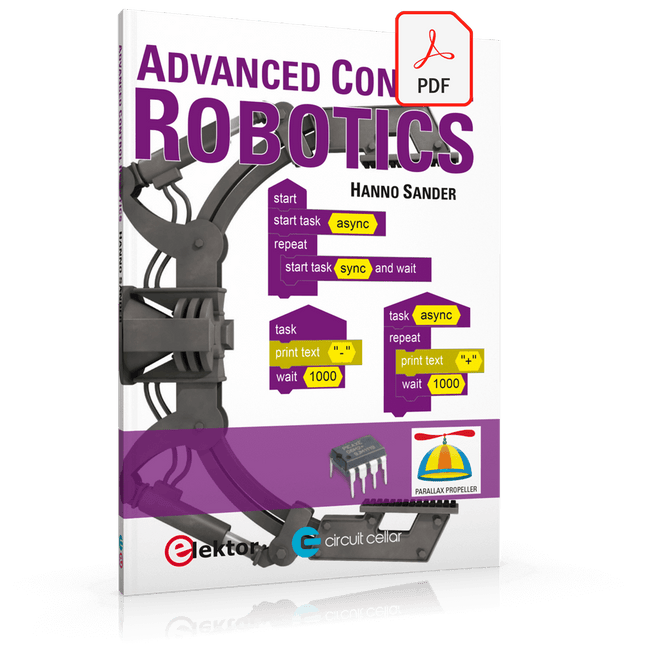
Elektor Digital Advanced Control Robotics (E-book)
If you enjoy DIY electronics, projects, software and robots, you’ll find this book intellectually stimulating and immediately useful. With the right parts and a little guidance, you can build robot systems that suit your needs more than overpriced commercial systems can. 20 years ago, robots based on simple 8-bit processors and touch sensors were the norm. Now, it’s possible to build multi-core robots that can react to their surroundings with intelligence. Today’s robots combine sensor readings from accelerometers, gyroscopes and computer vision sensors to learn about their environments. They can respond using sophisticated control algorithms and they can process data both locally and in the cloud. This book, which covers the theory and best practices associated with advanced robot technologies, was written to help roboticists, whether amateur hobbyist or professional, take their designs to the next level. As will be seen, building advanced applications does not require extremely costly robot technology. All that is needed is simply the knowledge of which technologies are out there and how best to use each of them. Each chapter in this book will introduce one of these different technologies and discuss how best to use it in a robotics application. On the hardware side, we’ll cover microcontrollers, servos, and sensors, hopefully inspiring you to design your own awe-inspiring, next-generation systems. On the software side, we’ll cover programming languages, debugging, algorithms, and state machines. We’ll focus on the Arduino, the Parallax Propeller, Revolution Education PICAXE and projects I’ve with which I’ve been involved, including the TBot educational robot, the PropScope oscilloscope, the 12Blocks visual programming language, and the ViewPort development environment. In addition, we’ll serve up a comprehensive introduction to a variety of essential topics, including output (e.g. LEDs, servo motors), and communication technologies (e.g. infrared, audio), that you can use to develop systems that interact to stimuli and communicate with humans and other robots. To make these topics as accessible as possible, handy schematics, sample code and practical tips regarding building and debugging have been included. Hanno Sander Christchurch, New Zealand
€ 24,95
Membres : € 22,46
-
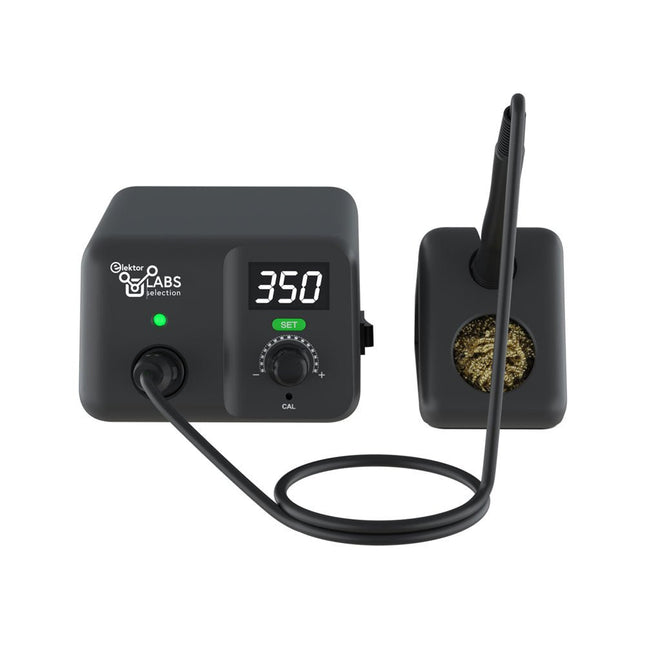
Eleshop AE970D station de soudage (80 W)
Station de soudage pour un brasage de précision avec panne à souder chauffée activement La station de fer à souder AE970D est un outil haute puissance de 80 W qui permet de chauffer et de souder rapidement. Sa large plage de température de 150-550°C peut répondre à tous vos besoins en matière de soudure. Grâce à sa pointe active intégrée plug-and-play de haute performance, l'AE970D peut atteindre le point de fusion en 9 secondes. La technologie brevetée de contrôle automatique de la température constante en boucle fermée garantit une grande stabilité, d'excellentes performances et une grande précision de brasage. Caractéristiques Puissance de 80 W pour un chauffage rapide. Plage de température étendue de 150 à 550°C pour répondre à tous vos besoins en matière de soudure. Pointe active intégrée plug-and-play haute performance, pouvant atteindre le point de fusion en 9 secondes. Technologie brevetée de contrôle automatique de la température constante en boucle fermée pour garantir une grande stabilité, d'excellentes performances et une grande précision. Spécifications Puissance 80 W Tension d’entrée 110 VAC / 230 VAC Tension de sortie 25 VAC Plage de température 150-550°C (302-1022°F) Elément chauffant Chauffage actif intégré de la série T80 Stabilité de la température ±1°C/±1,8°F (lorsque la température est >200°C/400°F) Résistance de la pointe à la terre <2 Ω Tension entre la pointe et la terre <2 mV Longueur du cordon d'alimentation 1 m Longueur du câble de la poignée 1.2 m Dimensions 148 x 120 x 85 mm Poids (unité principale) 1,33 kg Inclus Unité principale Fer à souder avec panne T80-D12 Support pour fer à souder Laine de laiton Manuel
€ 94,21
-

Elektor Digital Aktive und passive Filter (PDF)
Grundlagen und Simulation mit Multisim Analoge Filterschaltungen bilden die schaltungstechnischen Grundlagen in der Elektronik, Messtechnik, Nachrichtentechnik, Computertechnik usw. Die Bauelemente Widerstand, Kondensator und Spule sind die Grundlagen der passiven Filtertechnik. Filter haben Einfluss auf die Signalamplitude, die Signalform (zeitlicher Verlauf) und Signallaufzeit (Signalverlauf). Mit diesen Voraussetzungen werden Zweipole, Vierpole, Hoch- und Tiefpässe behandelt. Daraus resultieren Frequenz- und Phasengang, Dämpfung, Bandpass, Bandsperre und Doppel-T-Filter. Der Operationsverstärker arbeitet als Verstärker in der aktiven Filtertechnik. Erklärt werden in diesem Buch auch aktive Hoch- und Tiefpassfilter der 1., 2., 3. und höherer Ordnung, Unterschiede zwischen Gauß-, Bessel-, Butterworth- und Tschebyscheff-Funktionen, aktive Bandpass- und Bandsperrfilter, Allpassfilter und Universalfilter. Dieses Buch basiert auf dem bekannten Programm Multisim und Spice. Damit lassen sich alle Versuche simulieren.
€ 39,80
Membres : € 35,82
-

Elektor Digital Alimentation électrique autonome (PDF)
ÉLECTRICITÉ PHOTOVOLTAÏQUE = ÉLECTRICITÉ GRATUITE Nous sommes désormais plus qu'heureux de poursuivre nos recherches sur notre propre autonomie et de veiller à ce que notre production électrique photovoltaïque soit appropriée ! D'abord on en rêve, puis vient l'étape du calcul : comparer le coût du kilowattheure d'origine du nucléaire (environnement à partir de centimes d'euro) et le calcul du kilowattheure d'origine photovoltaïque (l'environnement de 22 centimes de l'euro*), et nous saurons où en sont nos motivations d'écocitoyens. Gérard Guihéneuf, l'auteur de ce nouveau livre, pense qu'il ne faut pas se contenter d'aligner chiffres et idées. La nouvelle approche du processus de création d'entreprise se base sur la compréhension et les dimensions des installations des bâtiments domestiques dans le domaine public en 2009 et sur l'actualité des techniques et pratiques de réponse aux questions qui se posent lors de l'électrification des le site isolé ! La conception de projets simples, comme un contexte domestique, et d'un commentaire électrique standard, comme un système d'énergie photovoltaïque, trois emplacements réguliers : un abri dans le jardin, un garage et un mobil-home. L'économie est spectaculaire lorsqu'il s'agit de composants électroniques et d'assemblages de certains constituants essentiels, car les régulateurs de charge, les onduleurs et les panneaux solaires ne suffisent pas à l'entretien autonome du site. Si vous souhaitez en savoir plus sur l'électrification professionnelle de votre chantier, vous pouvez en savoir plus sur les dimensions des éléments constitutifs sans sacrifier l'efficacité ! Vous pouvez également utiliser la copie du Gerber et du Sprint Layout pour les circuits imprimés de la livrée. *avec les batteries en cours de reconditionnement lors de la panne photovoltaïque en cours et dans les vingt-cinq
€ 24,95
Membres : € 22,46
-

Elektor Digital Analogtechnik in Theory und Praxis (E-book)
Mit seinem Buch möchte der Autor dem Einsteiger in die analoge Elektronik helfen, sich im Dschungel der oft verwirrenden Fachbegriffe zurecht zu finden, ohne ihn dabei mit abschreckenden Formeln zu verwirren. In der Absicht, dem Leser eine möglichst breite Themenpalette darzubieten, hat er auf allzu tiefschürfende Erläuterungen verzichtet und sich auf das Wesentliche konzentriert, wobei er es sich natürlich nicht nehmen ließ, seine Lieblingsthemen, Messtechnik und Musikelektronik mit Operationsverstärkern, in den Vordergrund zu stellen. Der Autor zeigt (nachdem er die Funktionsweise der bekanntesten elektronischen Bauelemente erklärt hat), dass sich hinter vielen komplexen Schaltungen immer wieder dieselben Grundelemente verbergen und verdeutlicht anhand zahlreicher Beispiele, wie man durch geschickte Kombination solcher „Module“ nahezu alle an die analoge Messtechnik gestellten Anforderungen erfüllen kann (Stichwort „Signalkonditionierung“), was besonders für Anwender von Mikrocontrollern im Bereich von Umweltmessungen interessant sein dürfte. Die zahlreichen Anekdoten aus der Zeit, in welcher sich der Autor selbst noch an die „Geheimnisse“ der Elektronik herantastete, sind der Beweis dafür, dass es sich hier in erster Linie nicht um ein mit Fachchinesisch und Formeln vollgestopftes Lehrbuch handelt, sondern um einen leichten und mit Humor gewürzten Überblick über die Themen, über die ein Newcomer Bescheid wissen sollte. Das Buch, das sich stellenweise fast wie ein Roman liest, wird abgerundet durch wertvolle, auf praktischen Erfahrungen basierende Tipps. Erfahrungen, die der Autor beim Ätzen von Platinen, beim Herstellen von Frontplatten und beim Bau von Gehäusen im Laufe der Zeit gesammelt hat. Kurzum: Ein Buch, das nicht nur Kenntnisse vermittelt, sondern den Leser auch zum Entwickeln eigener Schaltungen inspiriert.
€ 32,80
Membres : € 29,52
-
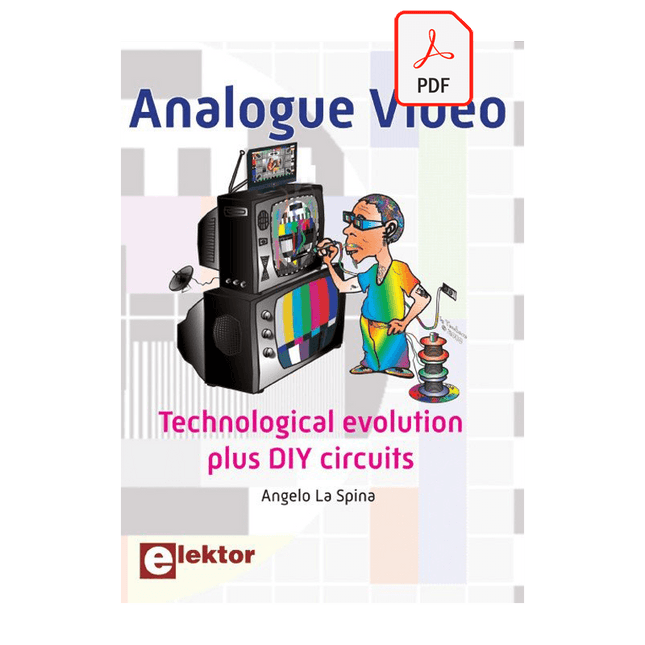
Elektor Digital Analogue Video (E-book)
This book is intended for electronics enthusiasts and professionals alike, who want a much deeper understanding of the incredible technology conquests over the pre-digital decades that created video. It details evolution of analogue video electronics and technology from the first electro-mechanical television, through advancements in Cathode Ray Tubes, transistor circuits and signal processing, up to the latest analogue, colour-rich TV, entertainment devices and calibration equipment. Key technological advances that enabled monochrome video and, eventually, colour are explained. The importance, compromises and techniques of maintaining crucial backward legacy compatibilities are described. The generation, signal processing and playback of analogue video signals in numerous capture, display, recording and playback devices together with operating principles and practices are examined. Technical and, often, political merits and deficiencies of key national and international video standards are highlighted. Several formats are shown to win and ultimately to co-exist. This book begins at fairly basic levels; concepts are introduced with human physiological perceptions of light and colour explained. This leads to the subject matter of luminance and chrominance; their equations and the circuits to process. There is full, detailed analysis of waveform shapes and timings inside video equipment and relevant popular connections e.g. S-video. Several analogue video projects which you can build yourself are also included in this book; with schematics, circuit board layouts and calibration steps to help you obtain the best results. The book makes use of many colour pages where the subject matter demands it (e.g. test cards). If you really want a deeper understanding of analogue video then this book is for you!
€ 24,95
Membres : € 22,46
-
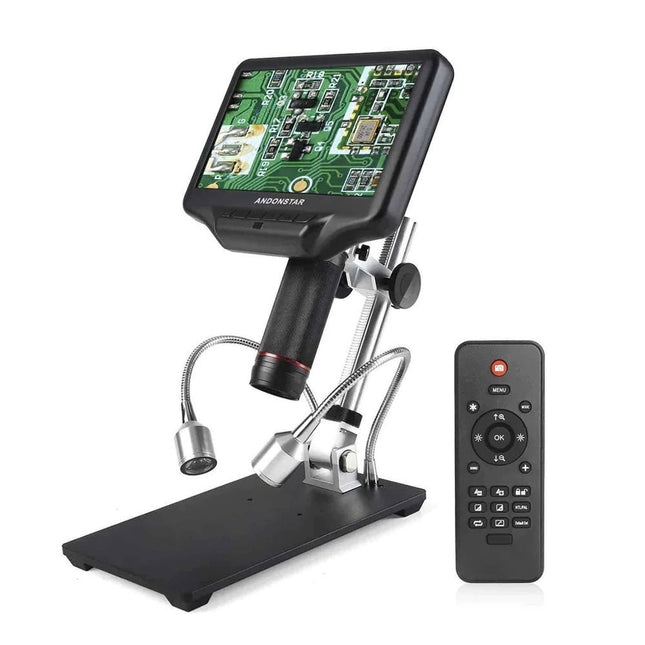
Andonstar Andonstar AD407 7" Microscope numérique HDMI
Examinez vos circuits avec une grande précision et soudez les plus petits CMS et éléments sans difficulté. Caractéristiques Le microscope numérique HDMI multifonctionnel présente les caractéristiques suivantes : Full HD, hauteur confortable, ergonomie améliorée, signaux de sortie multiples avec différentes résolutions. L'angle d'inclinaison du grand écran LCD est réglable. Livré avec une télécommande. Peut être utilisé de manière autonome. Spécifications Taille de l'écran 7 pouces (17,8 cm) Capteur d'image Capteur HD de 4 mégapixels Sortie vidéo UHD 2880x2160 (24fps)FHD 1920x1080 (60fps/30fps)HD 1280x720 (120fps) Format vidéo MP4 Magnification Jusqu'à 270 fois (moniteur HDMI 27 pouces) Résolution des photos Max. 12 MP (4032x3024) Format des photos JPG Plage de focalisation Minimum 5 cm Fréquence de trame Max. 120fps (sous 600 Lux de luminosité & HDP120) Interface vidéo HDMI Stockage Carte microSD, jusqu'à 32 Go Alimentation 5 V CC Source d'éclairage 2 LEDs avec le support Taille du support 20 x 12 x 19 cm Inclus 1x Microscope numérique Andonstar AD407 1x Support métallique 1x Support optique 1x Filtre UV 1x Télécommande IR 1x Câble de commutation 1x Adaptateur secteur 1x Câble HDMI 2x Vis 1x Tournevis 1x Manuel de l'utilisateur Téléchargements Manual Comparaison des modèles AD407 AD407 Pro AD409 AD409 Pro-ES Taille de l’écran 7 pouces (17,8 cm) 7 pouces (17,8 cm) 10,1 pouces (25,7 cm) 10,1 pouces (25,7 cm) Capteur d’image 4 MP 4 MP 4 MP 4 MP Sortie vidéo 2160p 2160p 2160p 2160p Interfaces HDMI HDMI USB, HDMI, WiFi USB, HDMI, WiFi Format vidéo MP4 MP4 MP4 MP4 Agrandissement Jusqu'à 270x Jusqu'à 270x Jusqu'à 300x Jusqu'à 300x Résolution photo Max. 4032x3024 Max. 4032x3024 Max. 4032x3024 Max. 4032x3024 Format photo< JPG JPG JPG JPG istance focale Min. 5 cm Min. 5 cm Min. 5 cm Min. 5 cm Fréquence d'images Max. 120f/s Max. 120f/s Max. 120f/s Max. 120f/s Storage carte microSD carte microSD carte microSD carte microSD Support PC Non Non Windows Windows Raccordement mobile Non Non WiFi + Mesure WiFi + Mesure Source d'alimentation 5 V DC 5 V DC 5 V DC 5 V DC Source lumineuse 2 LED avec le support 2 LED avec le support 2 LED avec le support 2 LED avec le support Endoscope Non Non Non Oui Taille du support 20 x 12 x 19 cm 20 x 18 x 32 cm 18 x 20 x 30 cm 18 x 20 x 32 cm Poids 1,6 kg 2,1 kg 2,2 kg 2,5 kg
€ 183,60
-

Andonstar Andonstar AD407 Pro 7" Microscope numérique HDMI
Le microscope Andonstar AD407 Pro convient à diverses applications telles que la soudure de CMS ou les travaux de réparation. Le microscope dispose d'un grand écran LCD réglable de 7 pouces et est livré avec une télécommande. Par rapport à AD407, l'AD407 Pro offre un support extra-haut, ce qui facilite encore plus le brasage des composants. Spécifications Taille de l’écran 7 pouces (17,8 cm) Capteur d’image 4 MP Sortie vidéo UHD 2880x2160 (24fps)FHD 1920x1080 (60fps/30fps)HD 1280x720 (120fps) Format vidéo MP4 Agrandissement Jusqu'à 270 fois (moniteur HDMI de 27 pouces) Résolution de la photo Max. 12 MP (4032x3024) Format photo JPG Plage de la mise au point Min. 5 cm Taux de rafraîchissement Max. 120fps Interface vidéo HDMI Stockage carte microSD (jusqu'à 64 Go) Source d’alimentation 5 V DC Source de lumière 2 LED avec le support Taille du support 20 x 18 x 32 cm Inclus 1x Microscope numérique Andonstar AD407 Pro 1x Support métallique avec 2 LED 1x Filtre UV (déjà assemblé dans l'objectif) 1x Télécommande IR 1x Câble de commutation 1x Adaptateur d'alimentation 1x Clé à molette 2 clips métalliques 1x Câble HDMI 1x Manuel Téléchargements Manuel Comparaison des modèles AD407 AD407 Pro AD409 AD409 Pro-ES Taille de l’écran 7 pouces (17,8 cm) 7 pouces (17,8 cm) 10,1 pouces (25,7 cm) 10,1 pouces (25,7 cm) Capteur d’image 4 MP 4 MP 4 MP 4 MP Sortie vidéo 2160p 2160p 2160p 2160p Interfaces HDMI HDMI USB, HDMI, WiFi USB, HDMI, WiFi Format vidéo MP4 MP4 MP4 MP4 Agrandissement Jusqu'à 270x Jusqu'à 270x Jusqu'à 300x Jusqu'à 300x Résolution photo Max. 4032x3024 Max. 4032x3024 Max. 4032x3024 Max. 4032x3024 Format photo< JPG JPG JPG JPG istance focale Min. 5 cm Min. 5 cm Min. 5 cm Min. 5 cm Fréquence d'images Max. 120f/s Max. 120f/s Max. 120f/s Max. 120f/s Storage carte microSD carte microSD carte microSD carte microSD Support PC Non Non Windows Windows Raccordement mobile Non Non WiFi + Mesure WiFi + Mesure Source d'alimentation 5 V DC 5 V DC 5 V DC 5 V DC Source lumineuse 2 LED avec le support 2 LED avec le support 2 LED avec le support 2 LED avec le support Endoscope Non Non Non Oui Taille du support 20 x 12 x 19 cm 20 x 18 x 32 cm 18 x 20 x 30 cm 18 x 20 x 32 cm Poids 1,6 kg 2,1 kg 2,2 kg 2,5 kg
€ 224,40
-

Andonstar Andonstar AD409 Max-ES 10,1" Microscope numérique HDMI (avec endoscope)
L'Andonstar AD409 Max-ES est doté d'une lentille métallique de haute qualité et d'un design de filtre UV unique. Fabriqué à partir de matériaux de qualité industrielle de premier ordre, il offre une précision et une durabilité inégalées, garantissant une expérience produit fiable. Le filtre UV placé devant la lentille métallique bloque la chaleur, la fumée et la poussière de soudure, protégeant ainsi la lentille et la rendant parfaite pour les professionnels du soudage et de la maintenance. L'AD409 Max-ES comprend une station Max surdimensionnée (46 x 37 x 47,5 cm) et un ensemble d'outils avancés, élargissant la zone de la station de soudage de 370%. Cette mise à niveau répond aux exigences des tâches de soudure professionnelles et offre un espace de travail suffisant pour les projets plus importants. Le porte-outils facile à utiliser maintient les outils à portée de main, garantissant qu'ils sont toujours accessibles. De plus, l'aide à la soudure grâce aux pinces rotatives simplifie les tâches de soudure et de réparation, améliorant ainsi l'efficacité et la commodité. L'endoscope offre une vue panoramique à 360°. Cela permet une observation claire des composants de tous les côtés et à l'intérieur des tuyaux, éliminant les angles morts et garantissant des inspections approfondies. Caractéristiques Lentille en métal de haute qualité et conception unique de filtre UV Nouvelle station Max Porte-outils et mains utiles pour le soudage faciles à utiliser Microscope avec endoscope, vue panoramique à 360° Le microscope numérique HDMI professionnel prend en charge plusieurs méthodes de sortie LED réglables à 8 niveaux Télécommande sans fil pratique Spécifications Taille de l’écran 10,1 pouces (1280x800) Capteur d’image 4 MP Sortie vidéo UHD 2880x2160 (24fps)FHD 1920x1080 (60fps/30fps)HD 1280x720 (120fps) Format vidéo MP4 Agrandissement Jusqu'à 300 fois (moniteur HDMI de 27 pouces) Résolution photo Max. 24 MP (5600x4200) Format de la photo JPG Plage de mise au point Min. 5 cm Fréquence d'images Max. 120fps Interface vidéo HDMI Stockage carte microSD (jusqu'à 64 Go) Support PC Windows, logiciel PC avec mesure Prise en charge des téléphones mobiles et des tablettes Prise en charge de la connexion WiFi et des mesures Source d'alimentation 5 V DC Source lumineuse 2 LED avec le support Endoscope Oui Taille du support 46 x 37 x 47,5 cm Inclus 1x Andonstar AD409 Max-ES Microscope numérique 1x Endoscope 1x Support avec 2 LED 1x Filtre UV (déjà assemblé dans l'objectif) 1x Tapis de soudure 1x Porteur 1x Colonne 1x Porte-outil 1x Coups de main à souder 1x Adaptateur d'alimentation 1x Câble d'alimentation 1x Câble HDMI 1x Câble USB 1x Télécommande IR 1x Manual Downloads Manuel Logiciel
€ 399,00€ 339,00Meilleur prix
-

Andonstar Andonstar AD409 Pro-ES 10,1" Microscope numérique HDMI (avec endoscope)
L'AD409 Pro-ES est un microscope numérique d'un pied extra-haut qui est également équipé d'un endoscope. Le microscope permet d'observer clairement les côtés des composants, l'intérieur des tuyaux, etc, ce qui permet une observation à 360° sans angle mort. Le microscope est également équipé d'une télécommande qui permet de basculer facilement entre les modes d'image suivants : deux lentilles, microscope et endoscope. Caractéristiques Lentille et barillet de mise au point en métal de haute qualité Microscope numérique HDMI professionnel prenant en charge plusieurs méthodes de sortie Microscope à souder avec support métallique Pro Filtre UV unique 8 niveaux d'éclairage LED réglables Télécommande sans fil pratique Logiciel de mesure professionnel Spécifications Taille de l’écran 10,1 pouces (25,7 cm) Capteur d’image 4 MP Sortie vidéo UHD 2880x2160 (24fps)FHD 1920x1080 (60fps/30fps)HD 1280x720 (120fps) Format vidéo MP4 Agrandissement Jusqu'à 300 fois (moniteur HDMI de 27 pouces) Résolution photo Max. 12 MP (4032x3024) Format de la photo JPG Plage de mise au point Min. 5 cm Fréquence d'images Max. 120fps Interface vidéo HDMI Stockage carte microSD (jusqu'à 64 Go) Support PC Windows, logiciel PC avec mesure Prise en charge des téléphones mobiles et des tablettes Prise en charge de la connexion WiFi et des mesures Source d'alimentation 5 V DC Source lumineuse 2 LED avec le support Endoscope Oui Taille du support 18 x 20 x 32 cm Inclus 1x Microscope numérique Andonstar AD409 Pro-ES 1x Endoscope 1x Support métallique avec 2 LED 1x Filtre UV (déjà assemblé dans l'objectif) 1x Télécommande IR 1x Câble de commutation 1x Adaptateur d'alimentation 1x Clé à molette 2x Clips métalliques 1x Câble HDMI 1x Manuel de l'utilisateur Télechargements Manuel Logiciel
€ 339,00€ 289,00Meilleur prix
-

Andonstar Andonstar ADSM302 5" Microscope numérique HDMI
L'Andonstar ADSM302 est un microscope numérique polyvalent doté d'un écran LCD 5 pouces intégré et d'une sortie HDMI pour des images d'une netteté exceptionnelle en Full HD (1080p). Avec un capteur de 3 mégapixels, un grossissement jusqu'à ~560x et deux lumières LED réglables, il rend visibles les détails les plus fins, ce qui le rend idéal pour l'inspection des circuits imprimés, les travaux de soudure, l'analyse des bijoux ou des insectes. Caractéristiques Moniteur LCD 5" réglable avec angle d'inclinaison réglable Capture vidéo et photo haute résolution Table large avec hauteur libre confortable Support métallique stable et lourd Support de levage haut (26 cm) Roues de réglage de la mise au point et de la hauteur Boutons sur le moniteur + télécommande Sorties AV, USB, HDMI Stockage sur carte SD <32 GB Spécifications Capteur d’image Capteur HD de 3 mégapixels Sortie vidéo 1080p Full HD (via HDMI)720p (via PC) Format vidéo Lecture en temps réel via HDMI sans enregistrementEnregistrement MJPEG via le logiciel PC/Mac Agrandissement Jusqu'à 560 fois (moniteur HDMI 22') Résolution photo 12M (voir les formats de pixels dans le tableau suivant) Format photo JPEG Plage de mise au point 5 à 22 cm Taux de rafraîchissement Jusqu'à 30 f/s sous une luminosité de 600 Lux Interface de sortie vidéo HDMI/AV Stockage Carte microSD, jusqu'à 32 Go Support PC Windows XP/7/8/10Logiciel PC avec mesureMacOS testé avec succès sous OSX avec OBSvoir la vidéo ci-dessous Source d’alimentation 5 V CC Source de lumière 2x LED avec le support Taille de l’écran 5 pouces (12,7 cm) Taille du support 20 x 12 x 26,5 cm Résolution Photos capturées 4032 x 3024 3648 x 2736 3264 x 2448 2592 x 1944 2048 x 1536 640 x 480 1920 x 1080 1280 x 960 1280 x 720* Vidéos 1920 x 1080 640 x 480* * (USB avec logiciel) Inclus 1x Andonstar ADSM302 Microscope numérique 1x Support métallique avec 2 LED 1x Câble USB 1x Câble HDMI 1x Adaptateur 1x Télécommande AI 1x Instructions Téléchargements Manuel Logiciel
€ 197,36
-

Andonstar Andonstar Max Station Upgrade Set pour les modèles AD409
Faites évoluer votre Andonstar AD409, AD409 Pro ou AD409 Pro-ES vers le modèle Max grâce à ce kit d'amélioration. La nouvelle station Max surdimensionnée offre un vaste espace de travail, ce qui la rend idéale pour les projets de plus grande envergure et pour les tâches de soudure professionnelles. Inclus 1x Support avec 2 LED 1x Tapis de réparation 1x Porteur 1x Colonne 1x Porte-outil 1x Coups de main à souder
€ 59,50
-

Elektor Digital Android (NL) | E-book
Steeds vaker komen we op smartphones en tablet-computers het besturingssysteem Android tegen. Het aantal toepassingsprogramma's – de zogenaamde applicaties of kortweg apps - waarmee de apparaten individueel aan de voorkeuren en wensen van de gebruiker kunnen worden aangepast, neemt van dag tot dag toe. En de steeds betere technische uitvoering en uitrusting van de apparaten maken het nu mogelijk toepassingen te 'draaien' waarvoor een paar jaar geleden nog een desktop-PC of speciale hardware vereist was. Inmiddels kan elke smartphone de exacte (geografische) positie bepalen, video's opnemen – en nog veel meer. Maar bij het individualiseren van onze smartphone hoeven we ons niet te beperken tot kant-en-klare applicaties! Het is namelijk helemaal niet zo moeilijk om zelf Android-apparaten te programmeren en eigen apps te schrijven. Dit boek vormt een inleiding tot het programmeren van apps voor Android-apparaten. De werking van het Android-systeem wordt op begrijpelijke manier uitgelegd en we zien stap voor stap hoe applicaties kunnen worden geprogrammeerd. Aan de hand van een groot aantal voorbeelden worden allerlei toepassingsmogelijkheden getoond. Het scala loopt van eenvoudige rekenprogramma's via het uitlezen van sensoren en GPS-data tot het programmeren van applicaties voor internetcommunicatie. Naast het schrijven van applicaties in de programmeertaal Java wordt in dit boek ook besproken hoe apps met behulp van Javascript of PHP-scripts kunnen worden geprogrammeerd.
€ 29,95
Membres : € 26,96
-

Elektor Digital Android Open Accessory (DE) | E-book
Accessoire ouvert Android (DE) | Livre électronique
€ 39,80
Membres : € 35,82
-

Elektor Publishing Apple Macintosh
20+ Macintosh Models, from 1984 to Today (History, Engineering, and Restoration) Apple is not like any other company. More than anyone else, it transformed technology into something people could desire, love, and even identify with—much like a luxury brand. Users were not only buying a tool; they were buying a vision, a way of life. At the center of this transformation stands the Macintosh. First introduced in 1984, it was radically different from everything before. With its graphical interface and mouse, it made computing approachable, even friendly. What now feels obvious—clicking on icons, dragging files, pointing instead of typing commands—was revolutionary at the time. The Macintosh not only changed the way people related to technology. The Macintosh forced the entire industry to rethink the way we use computers. This book tells that story through some of the most significant Macintosh models. Each one is presented not only in words but also in images, because these computers are more than technology—they are design icons, symbols of a unique vision. History, technical detail, and photography come together here, aiming to show each Macintosh as it truly deserves to be seen.
€ 79,95€ 64,95Meilleur prix


