
Produits
-
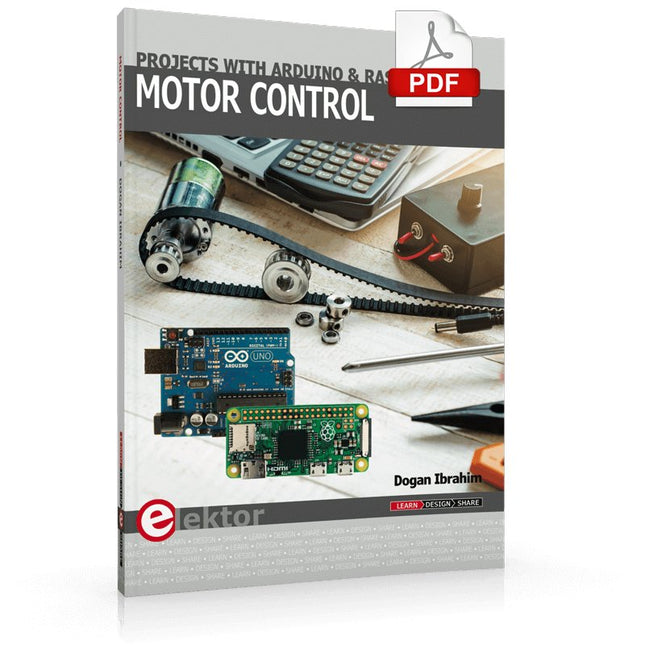
Elektor Digital Motor Control - Projects with Arduino & Raspberry Pi (E-book)
This book is about DC electric motors and their use in Arduino and Raspberry Pi Zero W based projects. The book includes many tested and working projects where each project has the following sub-headings: Title of the project Description of the project Block diagram Circuit diagram Project assembly Complete program listing of the project Full description of the program The projects in the book cover the standard DC motors, stepper motors, servo motors, and mobile robots. The book is aimed at students, hobbyists, and anyone else interested in developing microcontroller based projects using the Arduino Uno or the Raspberry Pi Zero W. One of the nice features of this book is that it gives complete projects for remote control of a mobile robot from a mobile phone, using the Arduino Uno as well as the Raspberry Pi Zero W development boards. These projects are developed using Wi-Fi as well as the Bluetooth connectivity with the mobile phone. Readers should be able to move a robot forward, reverse, turn left, or turn right by sending simple commands from a mobile phone. Full program listings of all the projects as well as the detailed program descriptions are given in the book. Users should be able to use the projects as they are presented, or modify them to suit to their own needs.
€ 29,95
Membres : € 26,96
-
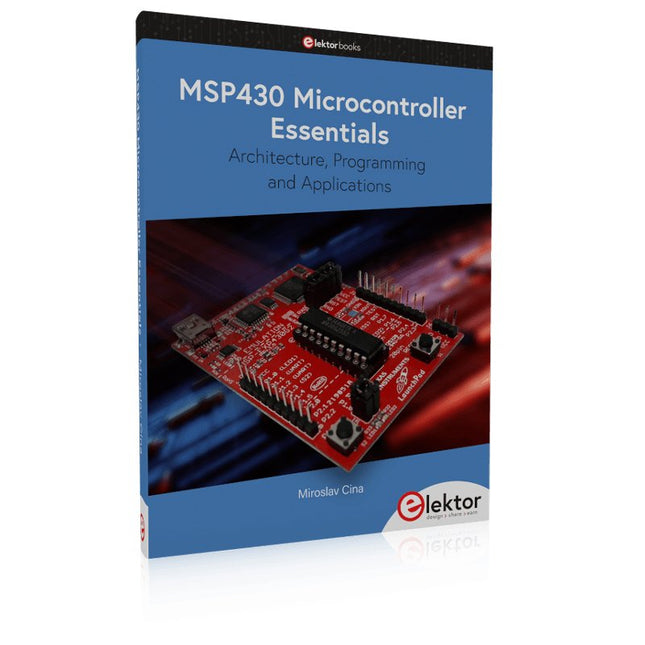
Elektor Publishing MSP430 Microcontroller Essentials
Architecture, Programming and Applications The MSP430 is a popular family of microcontrollers from Texas Instruments. In this book we will work with the smallest type, which is the powerful MSP430G2553. We will look at the capabilities of this microcontroller in detail, as it is well-suited for self-made projects because it is available in a P-DIP20 package. We will take a closer look at the microcontroller and then build, step by step, some interesting applications, including a 'Hello World' blinking LED and a nice clock application, which can calculate the day of the week based on the date. You also will learn how to create code for the MSP microcontroller in assembler. In addition to that, we will work with the MSP-Arduino IDE, which makes it quite easy to create fast applications without special in-depth knowledge of the microcontrollers. All the code used in the book is available for download from the Elektor website.
€ 39,95
Membres : € 35,96
-

Elektor Digital MSP430 Microcontroller Essentials (E-book)
Architecture, Programming and Applications The MSP430 is a popular family of microcontrollers from Texas Instruments. In this book we will work with the smallest type, which is the powerful MSP430G2553. We will look at the capabilities of this microcontroller in detail, as it is well-suited for self-made projects because it is available in a P-DIP20 package. We will take a closer look at the microcontroller and then build, step by step, some interesting applications, including a 'Hello World' blinking LED and a nice clock application, which can calculate the day of the week based on the date. You also will learn how to create code for the MSP microcontroller in assembler. In addition to that, we will work with the MSP-Arduino IDE, which makes it quite easy to create fast applications without special in-depth knowledge of the microcontrollers. All the code used in the book is available for download from the Elektor website.
€ 32,95
Membres : € 29,66
-
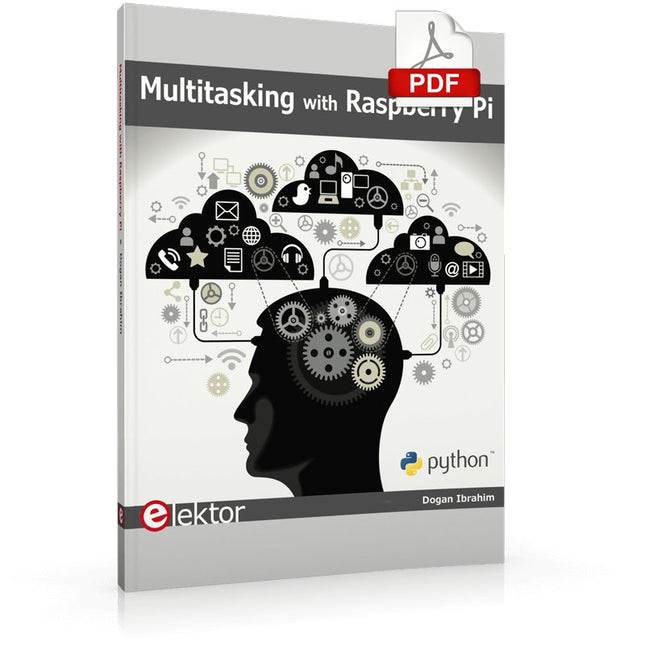
Elektor Digital Multitasking with Raspberry Pi (E-book)
Multitasking and multiprocessing have become a very important topic in microcontroller-based systems, namely in complex commercial, domestic, and industrial automation applications. As the complexity of projects grows, more functionalities are demanded from the projects. Such projects require the use of multiple inter-related tasks running on the same system and sharing the available resources, such as the CPU, memory, and input-output ports. As a result of this, the importance of multitasking operations in microcontroller-based applications has grown steadily over the last few years. Many complex automation projects now make use of some form of a multitasking kernel. This book is project-based and its main aim is to teach the basic features of multitasking using the Python 3 programming language on Raspberry Pi. Many fully tested projects are provided in the book using the multitasking modules of Python. Each project is described fully and in detail. Complete program listings are given for each project. Readers should be able to use the projects as they are, or modify them to suit their own needs. The following Python multitasking modules have been described and used in the projects: Fork Thread Threading Subprocess Multiprocessing The book includes simple multitasking projects such as independently controlling multiple LEDs, to more complex multitasking projects such as on/off temperature control, traffic lights control, 2-digit, and 4-digit 7-segment LED event counter, reaction timer, stepper motor control, keypad based projects, car park controller, and many more. The fundamental multitasking concepts such as process synchronization, process communication, and memory sharing techniques have been described in projects concerning event flags, queues, semaphores, values, and so on.
€ 32,95
Membres : € 29,66
-
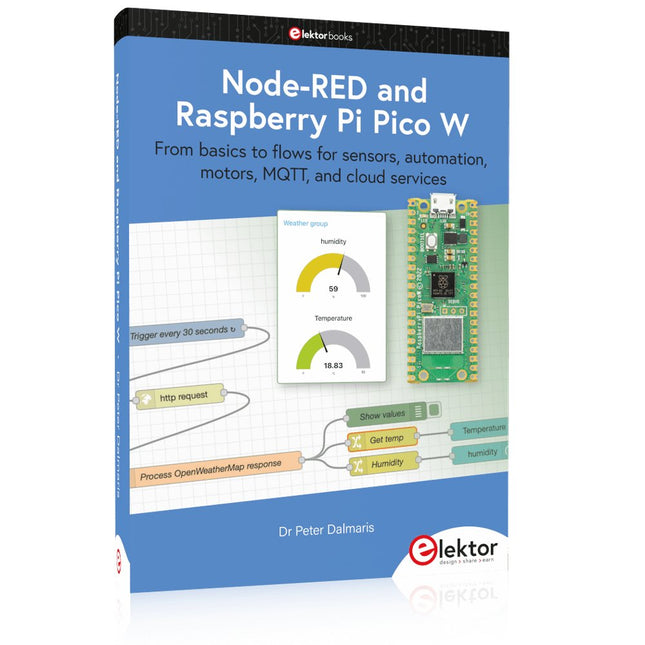
Elektor Publishing Node-RED and Raspberry Pi Pico W
From basics to flows for sensors, automation, motors, MQTT, and cloud services This book is a learning guide and a reference. Use it to learn Node-RED, Raspberry Pi Pico W, and MicroPython, and add these state-of-the-art tools to your technology toolkit. It will introduce you to virtual machines, Docker, and MySQL in support of IoT projects based on Node-RED and the Raspberry Pi Pico W. This book combines several elements into a platform that powers the development of modern Internet of Things applications. These elements are a flow-based server, a WiFi-enabled microcontroller, a high-level programming language, and a deployment technology. Combining these elements gives you the tools you need to create automation systems at any scale. From home automation to industrial automation, this book will help you get started. Node-RED is an open-source flow-based development tool that makes it easy to wire together devices, APIs, and online services. Drag and drop nodes to create a flowchart that turns on your lights at sunset or sends you an email when a sensor detects movement. Raspberry Pi Pico W is a version of the Raspberry Pi Pico with added 802.11n Wi-Fi capability. It is an ideal device for physical computing tasks and an excellent match to the Node-RED. Quick book facts Project-based learning approach. Assumes no prior knowledge of flow-based programming tools. Learn to use essential infrastructure tools in your projects, such as virtual machines, Docker, MySQL and useful web APIs such as Google Sheets and OpenWeatherMap. Dozens of mini-projects supported by photographs, wiring schematics, and source code. Get these from the book GitHub repository. Step-by-step instructions on everything. All experiments are based on the Raspberry Pi Pico W. A Wi-Fi network is required for all projects. Hardware (including the Raspberry Pi Pico W) is available as a kit. Downloads GitHub
€ 49,95
Membres : € 44,96
-
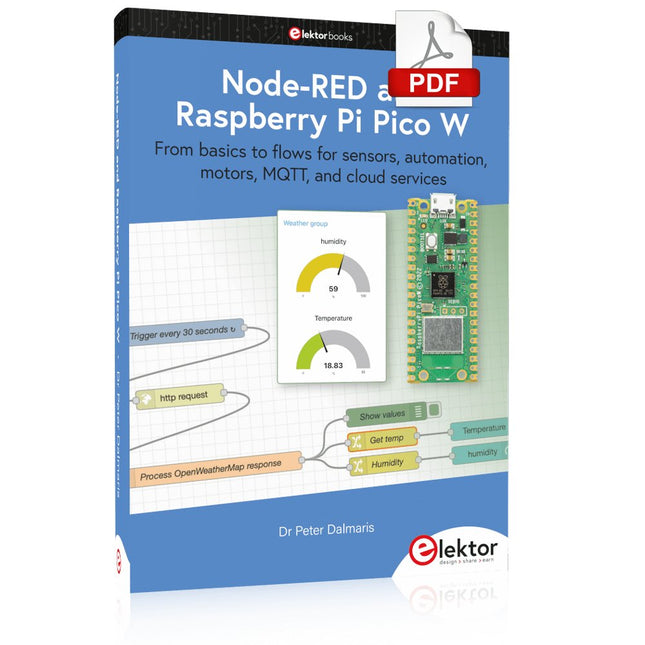
Elektor Digital Node-RED and Raspberry Pi Pico W (E-book)
From basics to flows for sensors, automation, motors, MQTT, and cloud services This book is a learning guide and a reference. Use it to learn Node-RED, Raspberry Pi Pico W, and MicroPython, and add these state-of-the-art tools to your technology toolkit. It will introduce you to virtual machines, Docker, and MySQL in support of IoT projects based on Node-RED and the Raspberry Pi Pico W. This book combines several elements into a platform that powers the development of modern Internet of Things applications. These elements are a flow-based server, a WiFi-enabled microcontroller, a high-level programming language, and a deployment technology. Combining these elements gives you the tools you need to create automation systems at any scale. From home automation to industrial automation, this book will help you get started. Node-RED is an open-source flow-based development tool that makes it easy to wire together devices, APIs, and online services. Drag and drop nodes to create a flowchart that turns on your lights at sunset or sends you an email when a sensor detects movement. Raspberry Pi Pico W is a version of the Raspberry Pi Pico with added 802.11n Wi-Fi capability. It is an ideal device for physical computing tasks and an excellent match to the Node-RED. Quick book facts Project-based learning approach. Assumes no prior knowledge of flow-based programming tools. Learn to use essential infrastructure tools in your projects, such as virtual machines, Docker, MySQL and useful web APIs such as Google Sheets and OpenWeatherMap. Dozens of mini-projects supported by photographs, wiring schematics, and source code. Get these from the book GitHub repository. Step-by-step instructions on everything. All experiments are based on the Raspberry Pi Pico W. A Wi-Fi network is required for all projects. Hardware (including the Raspberry Pi Pico W) is available as a kit. Downloads GitHub
€ 39,95
Membres : € 35,96
-
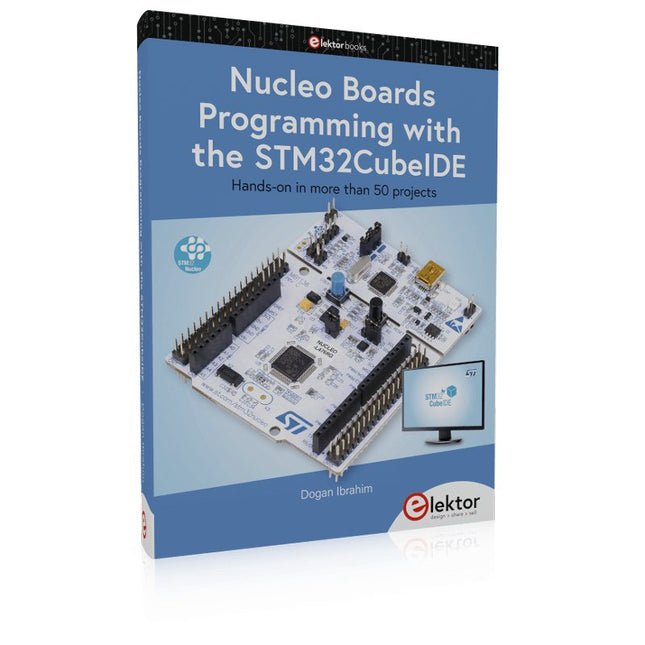
Elektor Publishing Nucleo Boards Programming with the STM32CubeIDE
Hands-on in more than 50 projects STM32 Nucleo family of processors are manufactured by STMicroelectronics. These are low-cost ARM microcontroller development boards. This book is about developing projects using the popular STM32CubeIDE software with the Nucleo-L476RG development board. In the early Chapters of the book the architecture of the Nucleo family is briefly described. The book covers many projects using most features of the Nucleo-L476RG development board where the full software listings for the STM32CubeIDE are given for each project together with extensive descriptions. The projects range from simple flashing LEDs to more complex projects using modules, devices, and libraries such as GPIO, ADC, DAC, I²C, SPI, LCD, DMA, analogue inputs, power management, X-CUBE-MEMS1 library, DEBUGGING, and others. In addition, several projects are given using the popular Nucleo Expansion Boards. These Expansion Boards plug on top of the Nucleo development boards and provide sensors, relays, accelerometers, gyroscopes, Wi-Fi, and many others. Using an expansion board together with the X-CUBE-MEMS1 library simplifies the task of project development considerably. All the projects in the book have been tested and are working. The following sub-headings are given for each project: Project Title, Description, Aim, Block Diagram, Circuit Diagram, and Program Listing for the STM32CubeIDE. In this book you will learn about STM32 microcontroller architecture; the Nucleo-L476RG development board in projects using the STM32CubeIDE integrated software development tool; external and internal interrupts and DMA; DEBUG, a program developed using the STM32CubeIDE; the MCU in Sleep, Stop, and in Standby modes; Nucleo Expansion Boards with the Nucleo development boards. What you need a PC with Internet connection and a USB port; STM32CubeIDE software (available at STMicroelectronics website free of charge) the project source files, available from the book’s webpage hosted by Elektor; Nucleo-L476RG development board; simple electronic devices such as LEDs, temperature sensor, I²C and SPI chips, and a few more; Nucleo Expansion Boards (optional).
€ 49,95
Membres : € 44,96
-

Elektor Digital Nucleo Boards Programming with the STM32CubeIDE (E-book)
Hands-on in more than 50 projects STM32 Nucleo family of processors are manufactured by STMicroelectronics. These are low-cost ARM microcontroller development boards. This book is about developing projects using the popular STM32CubeIDE software with the Nucleo-L476RG development board. In the early Chapters of the book the architecture of the Nucleo family is briefly described. The book covers many projects using most features of the Nucleo-L476RG development board where the full software listings for the STM32CubeIDE are given for each project together with extensive descriptions. The projects range from simple flashing LEDs to more complex projects using modules, devices, and libraries such as GPIO, ADC, DAC, I²C, SPI, LCD, DMA, analogue inputs, power management, X-CUBE-MEMS1 library, DEBUGGING, and others. In addition, several projects are given using the popular Nucleo Expansion Boards. These Expansion Boards plug on top of the Nucleo development boards and provide sensors, relays, accelerometers, gyroscopes, Wi-Fi, and many others. Using an expansion board together with the X-CUBE-MEMS1 library simplifies the task of project development considerably. All the projects in the book have been tested and are working. The following sub-headings are given for each project: Project Title, Description, Aim, Block Diagram, Circuit Diagram, and Program Listing for the STM32CubeIDE. In this book you will learn about STM32 microcontroller architecture; the Nucleo-L476RG development board in projects using the STM32CubeIDE integrated software development tool; external and internal interrupts and DMA; DEBUG, a program developed using the STM32CubeIDE; the MCU in Sleep, Stop, and in Standby modes; Nucleo Expansion Boards with the Nucleo development boards. What you need a PC with Internet connection and a USB port; STM32CubeIDE software (available at STMicroelectronics website free of charge) the project source files, available from the book’s webpage hosted by Elektor; Nucleo-L476RG development board; simple electronic devices such as LEDs, temperature sensor, I²C and SPI chips, and a few more; Nucleo Expansion Boards (optional).
€ 39,95
Membres : € 35,96
-
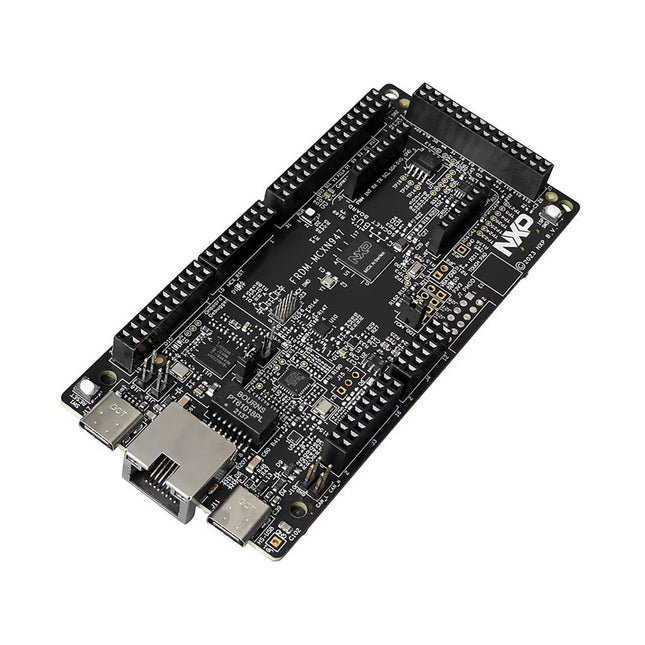
NXP Semiconductors Carte de développement NXP FRDM-MCXN947
The FRDM-MCXN947 is a compact and versatile development board designed for rapid prototyping with MCX N94 and N54 microcontrollers. It features industry-standard headers for easy access to the MCU's I/Os, integrated open-standard serial interfaces, external flash memory, and an onboard MCU-Link debugger. Spécifications Microcontroller MCX-N947 Dual Arm Cortex-M33 cores @ 150 MHz each with optimized performance efficiency, up to 2 MB dual-bank flash with optional full ECC RAM, External flash Accelerators: Neural Processing Unit, PowerQuad, Smart DMA, etc. Memory Expansion *DNP Micro SD card socket Connectivity Ethernet Phy and connector HS USB-C connectors SPI/I²C/UART connector (PMOD/mikroBUS, DNP) WiFi connector (PMOD/mikroBUS, DNP) CAN-FD transceiver Debug On-board MCU-Link debugger with CMSIS-DAP JTAG/SWD connector Sensor P3T1755 I³C/I²C Temp Sensor, Touch Pad Expansion Options Arduino Header (with FRDM expansion rows) FRDM Header FlexIO/LCD Header SmartDMA/Camera Header Pmod *DNP mikroBUS User Interface RGB user LED, plus Reset, ISP, Wakeup buttons Inclus 1x FRDM-MCXN947 Development Board 1x USB-C Cable 1x Quick Start Guide Téléchargements Datasheet Block diagram
-
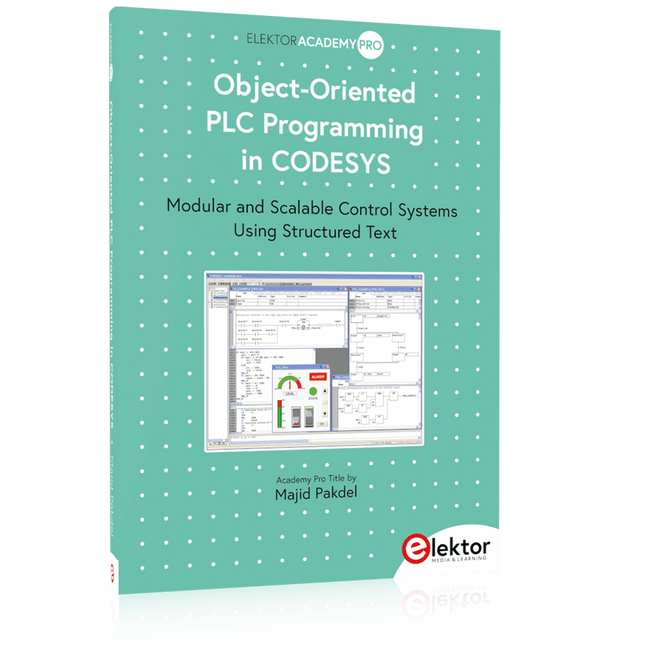
Elektor Publishing Object-Oriented PLC Programming in CODESYS
Modular and Scalable Control Systems Using Structured Text This book offers a structured and practical approach to modern PLC development using object-oriented principles. It is a guide for engineers, programmers, and students seeking to harness the power of object-oriented programming (OOP) in the context of industrial automation with PLCs. The content focuses on the CODESYS development environment and Structured Text (ST), both of which support modern programming techniques while maintaining compatibility with real-time automation requirements. Through step-by-step demos and instructional examples, it demonstrates how modular, reusable code can enhance development efficiency, simplify ongoing maintenance, and enable scalable and flexible control system architectures. Key topics include: Structured Text fundamentals: conditions, loops, arrays, and functions Object-oriented concepts: classes, methods, and inheritance Advanced techniques: polymorphism, interfaces, and access control Modular design with reusable components and structured program flow Implementation of finite state machines and scalable application design Built around instructional demos and clear explanations, this book helps readers develop maintainable and modern control software in the CODESYS environment using proven programming techniques.
€ 34,95
Membres : € 31,46
-

Elektor Digital Object-Oriented PLC Programming in CODESYS (E-book)
Modular and Scalable Control Systems Using Structured Text This book offers a structured and practical approach to modern PLC development using object-oriented principles. It is a guide for engineers, programmers, and students seeking to harness the power of object-oriented programming (OOP) in the context of industrial automation with PLCs. The content focuses on the CODESYS development environment and Structured Text (ST), both of which support modern programming techniques while maintaining compatibility with real-time automation requirements. Through step-by-step demos and instructional examples, it demonstrates how modular, reusable code can enhance development efficiency, simplify ongoing maintenance, and enable scalable and flexible control system architectures. Key topics include: Structured Text fundamentals: conditions, loops, arrays, and functions Object-oriented concepts: classes, methods, and inheritance Advanced techniques: polymorphism, interfaces, and access control Modular design with reusable components and structured program flow Implementation of finite state machines and scalable application design Built around instructional demos and clear explanations, this book helps readers develop maintainable and modern control software in the CODESYS environment using proven programming techniques.
€ 29,95
Membres : € 26,96
-
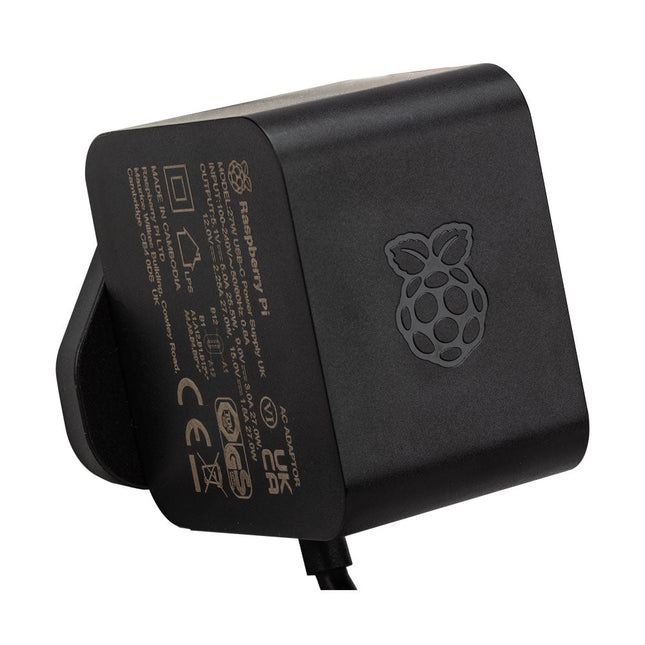
Raspberry Pi Foundation Alimentation officielle 27 W pour Raspberry Pi 5 (UE, noir)
L'alimentation USB-C Raspberry Pi 27 W PD est conçue spécifiquement pour alimenter le Raspberry Pi 5. Elle est également capable de délivrer 5 V/3 A, 9 V/3 A, 12 V/2,25 A, 15 V/1,8 A. .aux produits compatibles PD, ce qui en fait une alimentation efficace et rentable pour de nombreuses applications générales, telles que le chargement de smartphones et de tablettes. Caractéristiques Saisir 100-240 VCA Sortir 5 A à 5,1 V, 3 A à 9 V, 2,25 A à 12 V, 1,8 A à 15 V Connecteur USB-C Longueur 1,2 m Couleur Noir Région UE
-
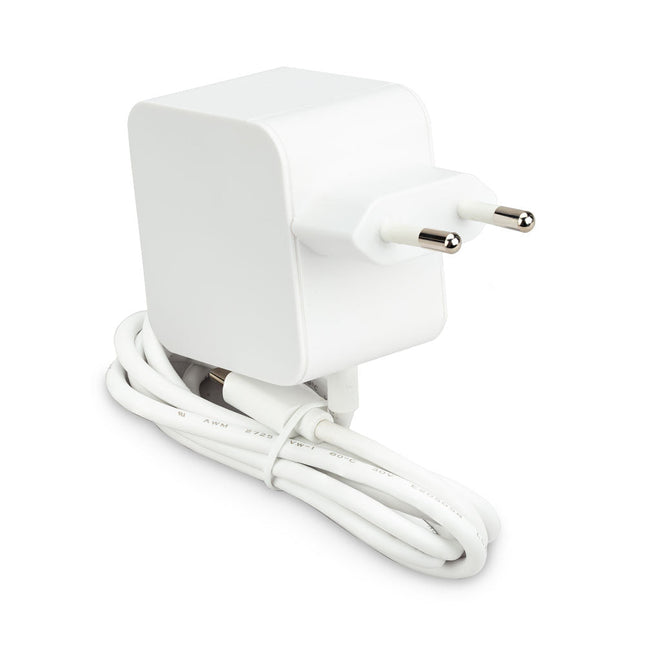
Raspberry Pi Foundation Alimentation officielle 27 W pour Raspberry Pi 5 (EU, blanc)
L'alimentation USB-C Raspberry Pi 27 W PD est conçue spécifiquement pour alimenter le Raspberry Pi 5. Elle est également capable de délivrer 5 V/3 A, 9 V/3 A, 12 V/2,25 A, 15 V/1,8 A. aux produits compatibles PD, ce qui en fait une alimentation efficace et rentable pour de nombreuses applications générales, telles que le chargement de smartphones et de tablettes. Caractéristiques Saisir 100-240 VCA Sortir 5 A à 5,1 V, 3 A à 9 V, 2,25 A à 12 V, 1,8 A à 15 V Connecteur USB-C Longueur 1,2 m Couleur Blanc Région UE
-

Arduino Câble USB-C officiel d'Arduino (2-en-1)
Maintenant, vous pouvez connecter vos cartes Arduino avec le câble USB officiel d'Arduino. Grâce à une connexion USB-C vers USB-C avec un adaptateur USB-A, ce câble USB de données peut facilement relier vos cartes Arduino à l'appareil de programmation de votre choix. Le câble USB d'Arduino possède une gaine tressée en nylon aux couleurs typiques d'Arduino, blanc et teal (bleu-vert). Les connecteurs ont une coque en aluminium qui protège votre câble tout en ayant un aspect élégant. Longueur : 100 cm Coque en aluminium avec logo Gaine tressée en nylon blanc et teal
€ 12,95
Membres : € 11,66
-
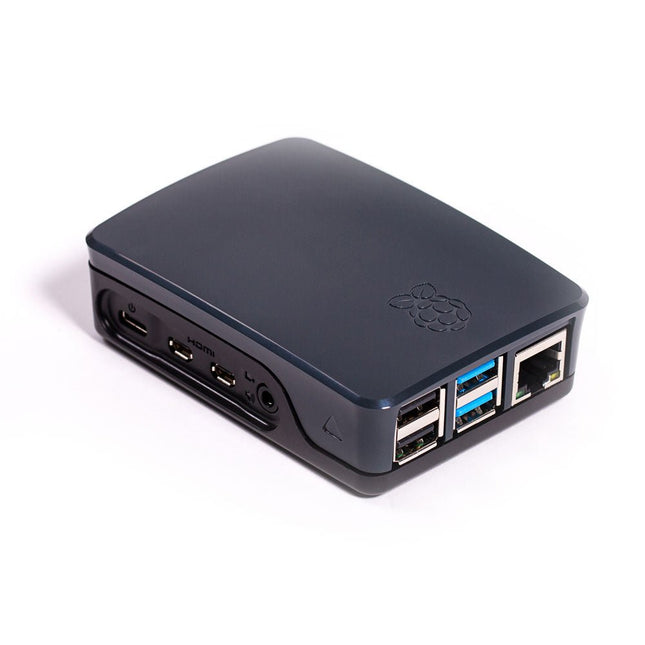
Raspberry Pi Foundation Boitier officiel pour Raspberry Pi 4 (noir/gris)
Boîtier officiel pour Raspberry Pi 4 (noir/gris)
-
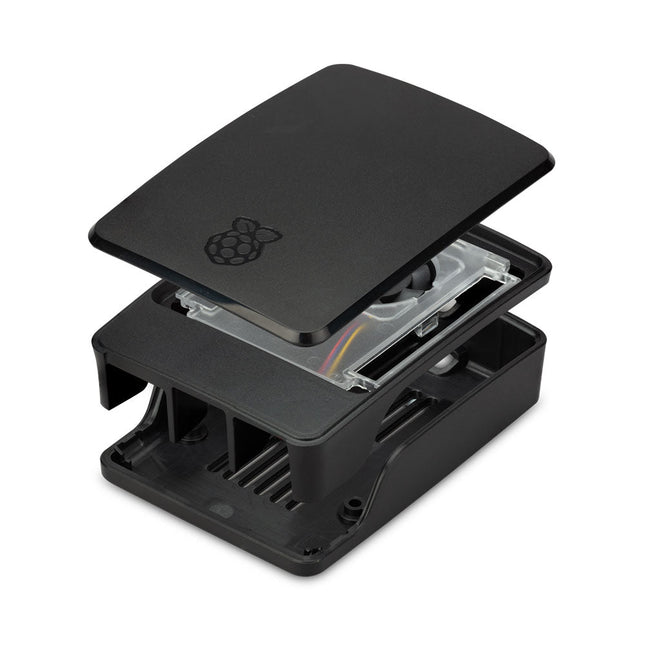
Raspberry Pi Foundation Boîtier officiel pour Raspberry Pi 5 (noir/gris)
Le boîtier Raspberry Pi 5 est une amélioration du boîtier Raspberry Pi 4 avec des caractéristiques thermiques améliorées pour prendre en charge la consommation d'énergie maximale plus élevée du Raspberry Pi 5. Il intègre un ventilateur à vitesse variable qui est alimenté et contrôlé via un connecteur dédié sur le Raspberry Pi 5.
€ 11,95€ 6,95Meilleur prix
-
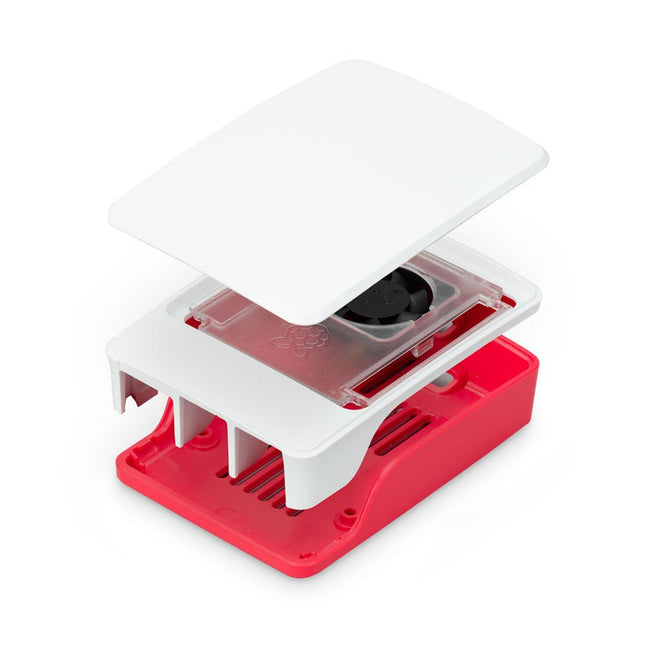
Raspberry Pi Foundation Boîtier officiel pour Raspberry Pi 5 (blanc/rouge)
Le boîtier Raspberry Pi 5 est une amélioration du boîtier Raspberry Pi 4 avec des caractéristiques thermiques améliorées pour prendre en charge la consommation d'énergie maximale plus élevée du Raspberry Pi 5. Il intègre un ventilateur à vitesse variable qui est alimenté et contrôlé via un connecteur dédié sur le Raspberry Pi 5.
-
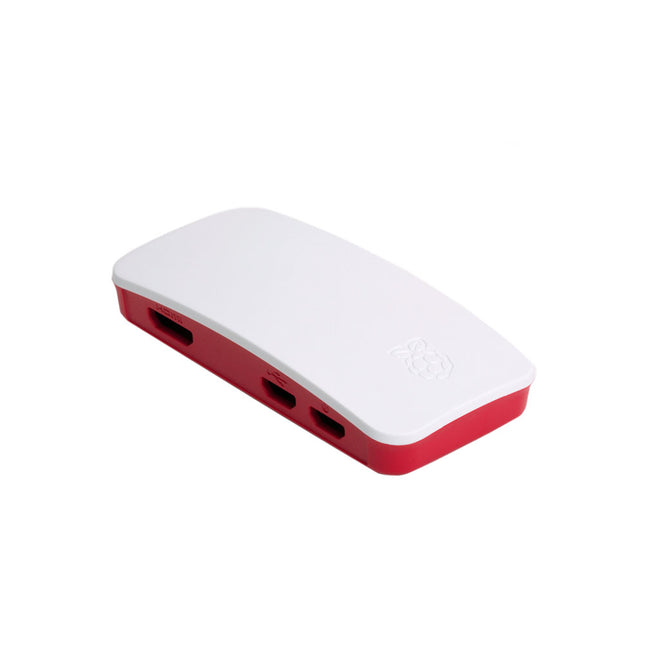
Raspberry Pi Foundation Boitier officiel pour Raspberry Pi Zero
Le dossier se compose de deux parties. Il dispose d'une base standard comportant une découpe pour permettre l'accès au GPIO, et d'un choix de trois couvercles : un couvercle simple, un couvercle GPIO (permettant l'accès au GPIO par le haut) et un couvercle de caméra (qui, lorsqu'il est utilisé avec le câble de caméra court fourni, permet d'installer parfaitement la caméra Raspberry Pi ou la caméra Noir). Inclus 1x socle 3x couvercles (unis, GPIO, appareil photo) 1x câble de caméra court 4x pieds en caoutchouc
-
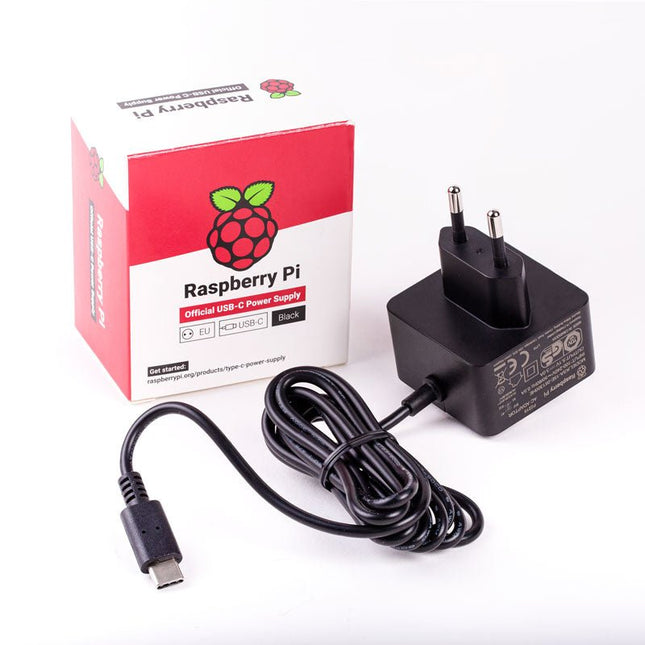
Raspberry Pi Foundation Alimentation officielle de l'UE pour Raspberry Pi 4 (noir)
L'alimentation USB-C Raspberry Pi est spécialement conçue pour alimenter le Raspberry Pi 4. L'alimentation est équipée d'un câble USB-C et est disponible en quatre modèles différents pour s'adapter à différentes prises de courant internationales, et en deux couleurs. Caractéristiques Sortir Tension de sortie +5,1 VCC Courant de charge minimum 0 Un Courant de charge nominal 3,0 A Puissance maximum 15,3 W Régulation de charge ±5% Régulation de ligne ±2% Ondulation et bruit 120 mVcrête à crête Temps de montée 100 ms maximum aux limites de régulation pour les sorties DC Allumer le délai 3000 ms maximum à la tension alternative d'entrée nominale et à pleine charge protection Protection de court circuit Protection contre les surintensités À propos de la protection contre la température Efficacité 81% minimum (courant de sortie à partir de 100%, 75%, 50%, 25%) 72% minimum à 10% de charge Câble de sortie 1,5 m 18AWG Connecteur de sortie USB Type-C Saisir Plage de tension 100-240 VCA (nominal) 96-264 Vca (fonctionnement) Fréquence 50/60 Hz ±3 Hz Actuel 0,5 A maximum Consommation d'énergie (sans charge) 0,075 W maximum Courant d'appel Aucun dommage ne doit se produire et le fusible d'entrée ne doit pas sauter Température ambiante de fonctionnement 0-40°C
-
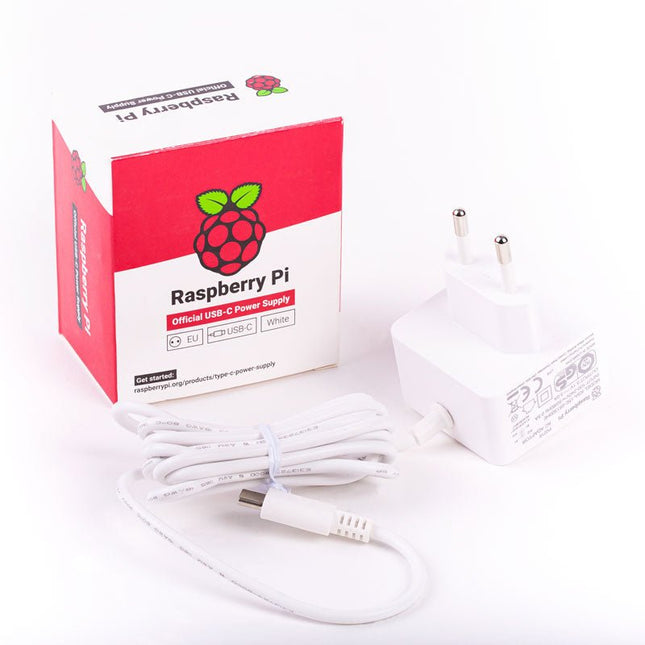
Raspberry Pi Foundation Alimentation officielle de l'UE pour Raspberry Pi 4 (blanc)
L'alimentation USB-C Raspberry Pi est conçue spécifiquement pour alimenter le dernier Raspberry Pi 4. Le bloc d'alimentation est doté d'un câble USB-C et est disponible en quatre modèles différents pour s'adapter à différentes prises de courant internationales, et en deux couleurs. Caractéristiques Sortir Tension de sortie +5,1 V CC Courant de charge minimum 0 Un Courant de charge nominal 3,0 A Puissance maximum 15,3 W Régulation de charge ±5% Régulation de ligne ±2% Ondulation et bruit 120 mVp-p Temps de montée 100 ms maximum aux limites de régulation pour les sorties DC Allumer le délai 3000 ms maximum à la tension alternative d'entrée nominale et à pleine charge Protection Protection de court circuit Protection contre les surintensités À propos de la protection contre la température Efficacité 81% minimum (courant de sortie à partir de 100%, 75%, 50%, 25%) 72% minimum à 10% de charge Câble de sortie 1,5 m 18AWG Connecteur de sortie USB Type-C Saisir Plage de tension 100-240 V CA (nominal) 96-264 V CA (fonctionnement) Fréquence 50/60 Hz ±3 Hz Actuel 0,5 A maximum Consommation d'énergie (sans charge) 0,075 W maximum Courant d'appel Aucun dommage ne doit se produire et le fusible d'entrée ne doit pas sauter Température ambiante de fonctionnement 0-40 °C
-
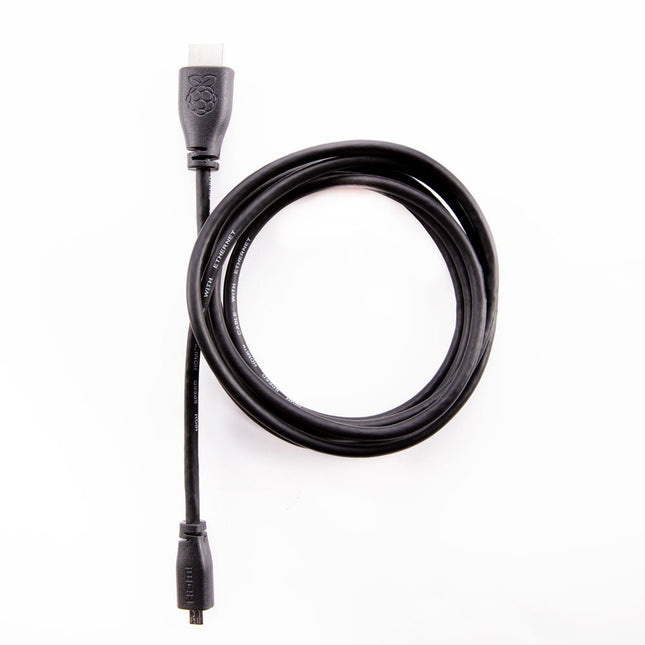
Raspberry Pi Foundation Câble HDMI officiel pour Raspberry Pi (noir, 1 m)
Le câble officiel Raspberry Pi micro HDMI vers HDMI (A/M) (noir, 1 m) conçu pour le Raspberry Pi 4 et 5. HDMI 19 broches types D(M) vers HDMI 19 broches types A(M) Câble de 1 m (noir) Fiches nickelées Conforme à la norme 4Kp60 Conforme à la directive RoHS Isolation de 3 Mohm à 300 VDC, résiste à 300 VDC pendant 0,1 s
-
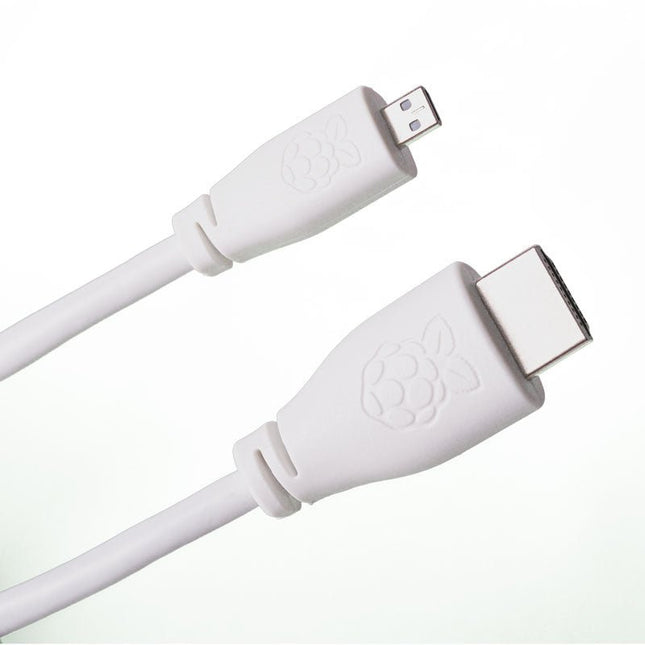
Raspberry Pi Foundation Câble HDMI officiel pour Raspberry Pi (blanc, 1 m)
Le câble officiel Raspberry Pi micro HDMI vers HDMI (A/M) (blanc, 1 m) conçu pour le Raspberry Pi 4 et 5. HDMI 19 broches types D(M) vers HDMI 19 broches types A(M) Câble de 1 m (blanc) Fiches nickelées Conforme à la norme 4Kp60 Conforme à la directive RoHS Isolation de 3 Mohm à 300 VDC, résiste à 300 VDC pendant 0,1 s
-
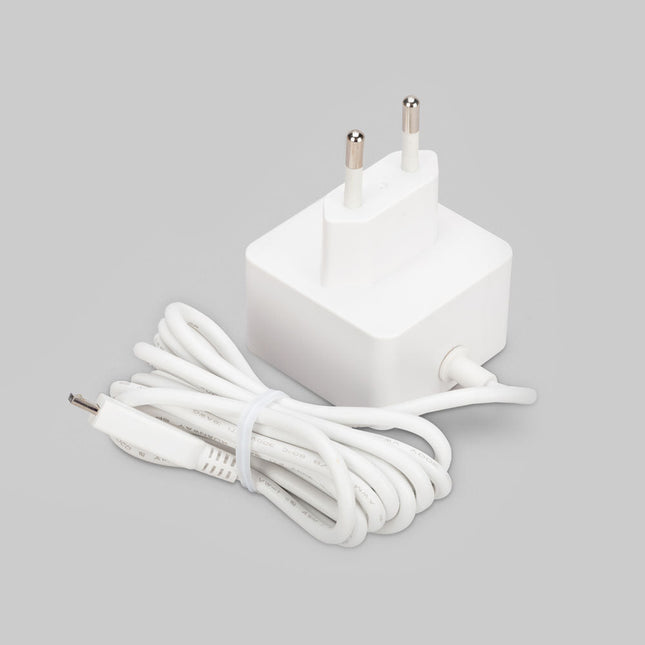
Raspberry Pi Foundation Alimentation Micro USB officielle pour Raspberry Pi
Alimentation Micro-USB officielle pour Raspberry Pi (12,5 W) Entrée : 100-240 V CA Sortie : alimentation 5,1 V / 2,5 A Connecteur : micro-USB Longueur : 1,5 m
-

Raspberry Pi Foundation Câble mini-HDMI officiel pour Raspberry Pi Zero
Le câble officiel Raspberry Pi mini-HDMI vers HDMI (A/M) conçu pour tous les modèles Raspberry Pi Zero. HDMI Type D(M) 19 broches vers HDMI Type A(M) 19 broches Câble de 1 m (blanc) Bouchons nickelés Conforme 4Kp60 Conforme RoHS Isolation 3 Mohm 300 V DC , résiste à 300 V DC pendant 0,1 s


