
Produits
-

OWON Oscilloscope USB 2-ch OWON VDS1022I (25 MHz)
L'oscilloscope USB 2 voies OWON VDS1022I (25 MHz) est un oscilloscope à utiliser avec un ordinateur. Il est alimenté par USB et a une petite taille, ce qui permet de l'emporter facilement avec soi. L'oscilloscope est très économique. Il dispose d'une connexion USB blindée, ce qui réduit les interférences et protège l'ordinateur contre les surtensions. Le port multiple de l'oscilloscope peut être utilisé pour le déclenchement externe, la sortie de déclenchement ou la sortie Pass / Fail. Caractéristiques Largeur de bande de 25 MHz, et taux d'échantillonnage en temps réel de 1 Géch/s maximum Longueur d'enregistrement de 10 Méch Interface utilisateur conviviale : FFT, ou X-Y, et forme d'onde 2 vues affichées sur le même écran Option de déclenchement multiple : front, vidéo, pente, impulsion et alternatif. Isolation USB - moins d'interférence de signal, plus de protection du PC Alimentation par bus USB et télécommande LAN (en option) Conception ultra-mince, facile à transporter Spécifications Bande passante 25 MHz 25 MHz Canal 2+1 (multi) Fréquence d'échantillonnage 100 Méch/s Échelle horizontale (s/div) 5 ns/div~100s/div, step by 1~2~5 Longueur des enregistrements 5K Tension d'entrée maximale 400 V (PK - PK) (DC+AC, PK - PK) 40 V (PK - PK) (DC+AC, PK - PK) Résolution verticale (A/D) 8 bits (2 canaux simultanément) Modèle VDS1022I Sensibilité verticale 5 mV/div~5 V/div Type de déclenchement Bord, impulsion, vidéo, pente et alternance Mode de déclenchement Auto, Normal, et Simple Mode d’acquisition Échantillon, détection des pics et moyenne Mathématiques +, -, ×, ÷, invert, FFT Interface de communication USB 2.0 (isolation) Multi-fonctions Interface Type de signal Niveau Standard TTL Alimentation éléctique 5,0 V/1 A Consommation éléctique ≤2,5 W Dimensions (W × H × D) 170 x 120 x 18 mm Poids 0,26 kg Inclus 1x Oscilloscope OWON VDS1022I 1x CD-ROM 1x Guide de démarrage rapide 2x Sonde d'oscilloscope 1x Outil de sonde 1x Adaptateur secteur 1x Câble USB 1x Étui de protection en silicone 1x Câble d'alimentation Téléchargements Fiche technique Manuel de l’utilisateur Protocole SCPI Pilote USB
€ 118,02
-
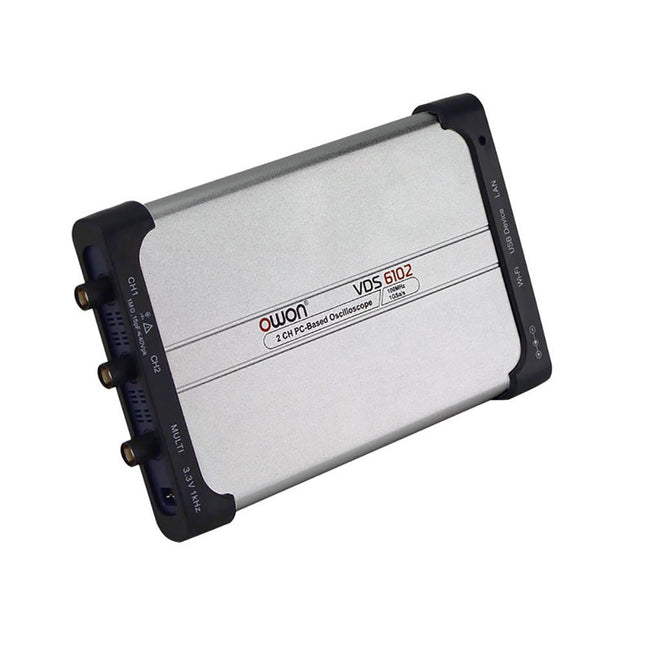
OWON OWON VDS6102A Oscilloscope USB à 2 canaux (100 MHz)
The OWON VDS6000 Series PC Oscilloscope combines powerful performance with a sleek, ultra-thin design. With 100 MHz bandwidth, 1 GSa/s real-time sampling, and up to 14-bit resolution, it delivers highly accurate measurements. The built-in 5 MHz function generator, USB-C power supply, and optional WiFi connectivity make it incredibly versatile. Compatible with Windows, Linux, Android, and iOS, the VDS6000 is perfect for labs, fieldwork, and remote diagnostics – compact, flexible, and ready for any challenge. Features Bandwidth: 100 MHz Vertical resolution: 14 bits Rise time: ≤3.5 ns Memory: 10 Mpts Number of channels: 2 channels + 1 channel function generator Horizontal scale: 5ns - 100s/div Sample rate: Max. 1 GSa/s Maximum voltage: 40 V (peak - peak) Automatic measurements: Vpp, Vavg, Vamp, Vrms, Freq, Period, Vmax, Vmin, Vtop, Vbase, Overshoot, Preshoot, Rise Time, Connectivity: USB-C, LAN, Wifi (optional) Fall Time, Delay A→B↑, Delay A→B↓, +Width, -Width, +Duty, -Duty Bandwidth: 5 MHz Sample rate: 25 MSa/s Standard waveforms: Sine (0.1 Hz - 5 MHz), Square (0.1 Hz - 200 kHz), Ramp (1 Hz - 10 kHz), Pulse (1 Hz - 10 kHz) Resolution: 10 bits DC offset range (AC + DC): ±2.5 V Amplitude range: 10 mVpp - 5 Vpp Dimensions: 190 x 120 x 18 mm Weight: 380 g Downloads Manual Quick Guide PC Software MacOS Software
€ 327,27
-

OWON Générateur d'ondes arbitraires OWON XDG2035 à 2 canaux (35 MHz)
L'OWON XDG2035 à 2 canaux est un générateur de fonctions/formes d'onde capable de générer des signaux avec une fréquence maximale de 35 Hz. Le générateur a une résolution de 1 µHz et un taux d'échantillonnage de 500 MSa/s. L'OWON XDG2035 est capable de générer 6 formes d'onde standard et 150 formes d'onde arbitraires. Avec le logiciel inclus, vous pouvez écrire des fonctions avancées jusqu'à 10 millions de points. Les formes d'onde peuvent être enregistrées dans la mémoire interne du générateur de fonctions à l'aide d'un PC via USB ou LAN. L'OWON XDG2035 prend également en charge les commandes SCPI et LabView. Le générateur de fonctions est doté d'un compteur de fréquence de haute qualité intégré, qui peut fonctionner de 100 à 200 MHz. Caractéristiques Sortie de fréquence maximale de 35 MHz Taux d'échantillonnage de 500 MSa/s, résolution verticale de 1 μHz Résolution verticale de 14 bits, longueur de forme d'onde de 10 Mpts Sortie de formes d'onde complètes : 6 formes d'onde de base et 150 formes d'onde arbitraires intégrées Fonctions de modulation complètes : AM, FM, PM, FSK, 3FSK, 4FSK, PSK, OSK, ASK, BPSK, PWM, balayage et rafale Compteur de fréquence de haute précision intégré, plage prise en charge de 100 à 200 MHz Prise en charge des commandes SCPI et LabVIEW Écran tactile multipoint de 7 pouces (800 x 480 pixels) Spécifications Canal 2 Fréquence de sortie 35 MHz Taux d'échantillonnage 500 MSa/s Résolution verticale 14 bits Forme d'onde Forme d'onde standard sinus, carré, impulsion, rampe, bruit et harmonique Forme d'onde arbitraire montée exponentielle, chute exponentielle, sin(x)/x, onde carrée, et autres, un total de 150 formes d'onde intégrées et une forme d'onde arbitraire définie par l'utilisateur Fréquence (résolution 1 μHz) Sinus 1 µHz à 100 MHz Carré 1 µHz à 30 MHz Impulsion 1 µHz à 25 MHz Rampe 1 µHz à 3 MHz Bruit (-3 dB, typique) 100 MHz Forme d'onde arbitraire 1 µHz à 15 MHz Harmonique 1 µHz à 50 MHz Précision ±2 ppm, 25°C ±5°C Longueur de forme d'onde 2 points - 10M points Amplitude Pour une charge de 50Ω 1 mVpp à 10Vpp (≤25 MHz) ; 1 mVpp à 5Vpp (≤60 MHz) ; 1 mVpp à 2.5Vpp (≤100 MHz) Modulation Type AM, DSB-AM, FM, PM, ASK, FSK, PSK, BPSK, QPSK, 3FSK, 4FSK, OSK, PWM, SUM Compteur de fréquence Fonction Fréquence, période, largeur positive, largeur négative, cycle de marche positif et cycle de marche négatif Plage de fréquence 100 ~ 200 MHz Résolution de fréquence 7 chiffres Entrée/Sortie Mode d'entrée compteur de fréquence, entrée de modulation externe, entrée de déclenchement externe, sortie d'horloge interne, entrée/sortie d'horloge de référence externe Interface de communication Hôte USB, Périphérique USB, LAN, RS232 (en option) Spécifications mécaniques Dimensions 340 x 177 x 90 mm Poids 2,3 kg Inclus 1x OWON XDG2035 1x Cordon d'alimentation 1x CD-ROM 1x Guide de démarrage rapide 1x Câble USB 1x Câble BNC-BNC Téléchargements Guide Rapide
€ 336,20
-
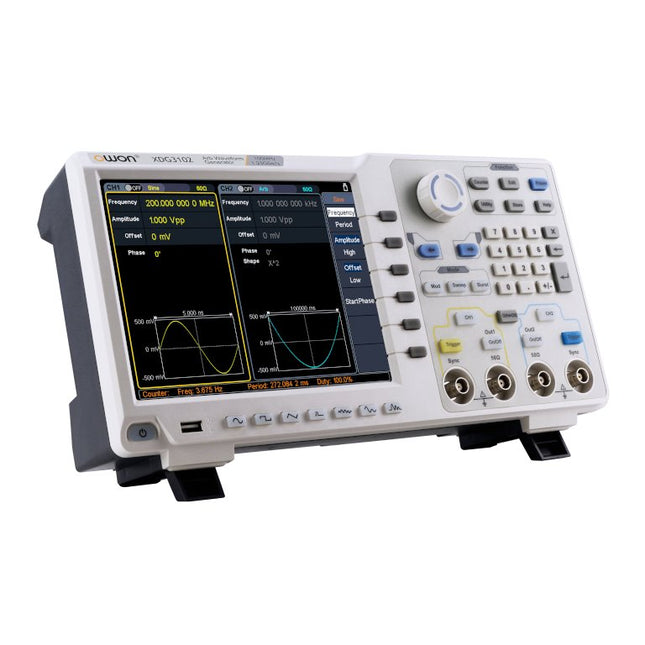
OWON OWON XDG3102 Générateur de formes d'onde arbitraires à 2 canaux (100 MHz)
Caractéristiques Technologie DDS avancée, sortie de fréquence jusqu'à 250 MHz Taux d'échantillonnage de 1,25 GS/s et résolution de fréquence de 1 μHz Jusqu'à 1 M de longueur de forme d'onde arbitraire Résolution verticale : 14 bits Sortie de forme d'onde complète : 6 groupes de formes d'onde et 152 groupes de formes d'onde arbitraires intégrées Options de modulation complètes : AM, FM, PM, FSK, 3FSK, 4FSK, PSK, OSK, ASK, BPSK, PWM, balayage et rafale Fréquencemètre intégré de haute précision, allant de 100 MHz à 200 MHz SCPI et LabVIEW pris en charge Écran LCD tactile 8'' 800 x 600 pixels Spécifications XDG3102 Canal 2 Sortie de fréquence 100MHz Taux d'échantillonnage 1,25 Géch/s Résolution verticale 14 bits Forme d'onde Forme d'onde standard sinus, carré, impulsion, rampe, bruit et harmonique Forme d'onde arbitraire montée exponentielle, chute exponentielle, sin(x)/x, onde progressive et autres,total de 150 formes d'onde intégrées et forme d'onde arbitraire définie par l'utilisateur Fréquence (résolution 1μHz) Sinus 1µHz - 100MHz Carré 1µHz - 40MHz Impulsion 1µHz - 25MHz Catastrophe 1μHz - 5MHz Harmonique 1µHz - 50MHz Bruit 120 MHz (-3 dB, typique) Forme d'onde arbitraire forme d'onde intégrée : 1uHz - 15MHzForme d'onde définie par l'utilisateur : 1 uHz - 50 MHz Précision ±1 ppm, 0°C - 40°C Amplitude Amplitude (50Ω) 1 mVpp - 10 Vpp (≤40 MHz) ; 1 mVpp - 5 Vpp (≤80 MHz)1 mVpp - 2,5 Vpp (≤120 MHz) ; 1 mVpp - 1Vpp (≤250 MHz) Amplitude (haute impédance) 2 mVpp - 20 Vpp (≤40 MHz) ; 2 mVpp - 10 Vpp (≤80 MHz) ;2 mVpp - 5Vpp (≤120 MHz) ; 2 mVpp - 2Vpp (≤250 MHz) Résolution 1mV ou 4 chiffres Décalage CC Plage (50Ω) ±(5 Vpk - Amplitude Vpp/2) Plage (Z élevé, circuit ouvert) ±(10 Vpk - Amplitude Vpp/2) Précision ±(1 % de |réglage| + 1 mV + Amplitude Vpp x 0,5 %) Résolution 1mV ou 4 chiffres Impédance de charge 50Ω (typique) Précision ±(1 % du réglage + 1 mVpp) (typique, sinusoïdal de 1 kHz, décalage de 0 V) Pureté du spectre d'onde sinusoïdale Distorsion harmoniqueTypique (0dB) C.C - 1 MHz : <-65 dBc1 MHz - 10 MHz : <-60 dBc10 MHz - 120 MHz : <-50 dBc120 MHz - 200 MHz : <-45 dBc Distorsion harmonique totale <0,05 %, 10 Hz à 20 kHz, 1 Vc.c. Parasitaire (non harmonique),Typique (0dB) ≤10MHz : <-70dBc>10MHz : <-70dBc + 6dB/octave Bruit de phaseTypique (0 dBm, déviation de 10 kHz) 10 MHz : ≤-110 dBc/Hz Carré Temps de montée/descente <5ns Dépasser <3% Cycle de service 50,0% (fixe) Gigue (rms) 300ps + 100ppm Impulsion Largeur d'impulsion 12ns - 996875s Temps de front montant/fin ≧7ns Dépasser <3% Gigue (rms) 300ps + 100ppm Catastrophe Linéarité ≤1 % de la sortie maximale (typique, 1 kHz, 1 Vpp, 50 % de symétrie) Symétrie 0% à 100% Harmonique Ordre Harmonique ≤16 Type harmonique pair, impair, tout, utilisateur Amplitude harmonique pourrait être réglé pour toutes les harmoniques Phase harmonique Arbitraire Longueur de la forme d'onde 2 points - 1 million de points Résolution verticale 14 bits Temps minimum de montée/descente <7ns Gigue (rms) 3ns Modulation Taper AM, FM, PM, PWM, FSK, 3FSK, 4FSK, PSK, OSK, ASK, BPSK, balayage et rafale SUIS Forme d'onde porteuse sinusoïdal, carré, rampe et arbitraire (sauf DC) Source interne externe Forme d'onde modulante sinusoïdal, carré, rampe, bruit et arbitraire Profondeur 0,0% - 100,0% Fréquence de modulation 2 MHz - 100 kHz FM Forme d'onde porteuse sinusoïdal, carré, rampe et arbitraire (sauf DC) Source interne externe Forme d'onde modulante sinusoïdal, carré, rampe, bruit et arbitraire Fréquence de modulation 2 MHz - 100 kHz P.M. Forme d'onde porteuse sinusoïdal, carré, rampe et arbitraire (sauf DC) Source interne externe Forme d'onde modulante sinusoïdal, carré, rampe, bruit et arbitraire Déviation de phase 0° - 180° Fréquence de modulation 2 MHz - 100 kHz MLI Forme d'onde porteuse impulsion Source interne externe Forme d'onde modulante sinusoïdal, carré, rampe, bruit et arbitraire Écart de largeur 0 ~ minimum (rapport d'impulsions, 100 % - rapport d'impulsions) Fréquence de modulation 2 MHz - 100 kHz FSK/3FSK/4FSK Forme d'onde porteuse sinusoïdal, carré, rampe et arbitraire (sauf DC) Source interne externe Forme d'onde modulante carré avec un rapport cyclique de 50 % Fréquence clé 2 MHz - 1 MHz PSK Forme d'onde porteuse sinusoïdal, carré, rampe et arbitraire (sauf DC) Source interne externe Forme d'onde modulante carré avec un rapport cyclique de 50 % Fréquence clé 2 MHz - 1 MHz OSK Forme d'onde porteuse sinusoïdal, carré, rampe et arbitraire (sauf DC) Source interne Temps d'oscillation carré avec un rapport cyclique de 50 % Fréquence clé 2 MHz - 1 MHz DEMANDER Forme d'onde porteuse sinusoïdal, carré, rampe et arbitraire (sauf DC) Source interne externe Forme d'onde modulante carré avec un rapport cyclique de 50 % Fréquence clé 2 MHz - 1 MHz BPSK Forme d'onde porteuse sinusoïdal, carré, rampe et arbitraire (sauf DC) Source interne Forme d'onde modulante carré avec un rapport cyclique de 50 % Fréquence clé 2 MHz - 1 MHz Balayer Forme d'onde porteuse sinusoïdal, carré, rampe et arbitraire (sauf DC) Taper linéaire et log Direction haut et bas Temps de balayage 1 ms à 500 s, ± 0,1 % Source de déclenchement interne, externe et manuel Éclatement Forme d'onde porteuse sinusoïdal, carré, rampe, impulsion et arbitraire (sauf DC) Nombre de rafales 1 à 50 000 périodes, infini, gate Période interne 10 ns - 500 s Source fermée déclencheur externe Compteur de fréquence Fonction période de fréquence, +largeur, -largeur, +devoir et -devoir Gamme de fréquences 100 MHz - 200 MHz Résolution de fréquence 7 chiffres Entrée sortie Afficher Écran LCD tactile 8" 800 x 600 pixels Taper fréquencemètre, entrée de modulation externe,entrée de déclenchement externe,entrée/sortie d'horloge de référence externe Interface de Communication Hôte USB, périphérique USB et réseau local Dimension 340 x 177 x 90 mm Poids (sans colis) 2,50 kg
€ 644,63
-

OWON OWON XDM1041 Multimètre True RMS
Le OWON XDM1141 est un multimètre de table numérique True RMS rapide et de haute précision, doté d'un écran LCD haute résolution de 3,5 pouces et de 50000 points. Sa précision en tension continue est de 0,05% et il peut mesurer jusqu'à 65 valeurs par seconde. Caractéristiques Ecran LCD haute résolution de 3,5 pouces (480x320 pixels) 55000 points, précision de la tension continue jusqu'à 0,05%. Jusqu'à 65 lectures par seconde Affichage double ligne pris en charge Analyse des tendances accessible en mode graphique Mesures AC True RMS (bande passante : 20 Hz – 1 kHz) Support SCPI : Commande à distance du multimètre à l'aide d'un logiciel PC via le port USB Spécifications Plage de mesure Résolution Précision Tension continue 50,000 mV 0,001 mV 0,1% +10 500,00 mV 0,01 mV 0,05% +5 5,0000 V 0,0001 V 0,05% +5 50,000 V 0,001 V 0,05% +5 500,00 V 0,01 V 0,1% +5 1000,0 V 0,1 V 0,1% +10 Tension alternative 500 mV~750 V 20 Hz~45 Hz 1% +30 45 Hz~65 Hz 0,5% +30 65 Hz~1 KHz 0,7% +30 Courant continu 500 uA 0,01 uA 0,15% +20 5000 uA 0,1 uA 0,15% +10 50 mA 0,001 mA 0,15% +20 500 mA 0,01 mA 0,15% +10 5 A 0,0001 A 0,5% +10 10 A 0,001 A 0,5% +10 Courant alternatif 500 uA~500 mA 20 Hz~1 KHz 0,5% +20 5 A-10 A 1,5% +20 Résistance 500 Ω 0,01 Ω 0,15% +10 5 KΩ 0,0001 KΩ 0,15% +5 50 KΩ 0,001 KΩ 0,15% +5 500 KΩ 0,01 KΩ 0,15% +5 5 MΩ 0,0001 MΩ 0,3% +5 50 MΩ 0.001 MΩ 1% +10 Fréquence 10,000 Hz~60 MHz / ±(0,2% +10) Capacité 50 nF~500 uF / 2,5% +10 5 mF~50 mF 5% +10 Diode 3,0000 V 0,0001 V / Continuité 1000 Ω 0,1 Ω Seuil réglable Température Type K, PT100 Affichage maximum 55 000 comptes Fonction d'enregistrement des données Durée d'enregistrement 15ms~9999,999s Longueur d'enregistrement 1,000 points Affichage Ecran LCD TFT 3,5" (480x320 pixels) Alimentation 230 V AC Dimensions 200 x 88 x 150 mm Poids environ 0,5 kg Inclus 1x OWON XDM1141 Multimètre 1x Cordon d'alimentation 2x Cordons de mesure 1x Fusible 1x Câble USB 1x Manuel Téléchargements Manuel de programmation Logiciel PC
€ 93,60
-

OWON OWON XDM1241 Multimètre True RMS
Le OWON XDM1241 est un multimètre de table numérique True RMS rapide et de haute précision, doté d'un écran LCD haute résolution de 3,5 pouces et de 50000 points. Sa précision en tension continue est de 0,05% et il peut mesurer jusqu'à 65 valeurs par seconde. Caractéristiques Ecran LCD haute résolution de 3,5 pouces (480x320 pixels) 55000 points, précision de la tension continue jusqu'à 0,05%. Jusqu'à 65 lectures par seconde Affichage double ligne pris en charge Analyse des tendances accessible en mode graphique Mesures AC True RMS (bande passante : 20 Hz – 1 kHz) Support SCPI : Commande à distance du multimètre à l'aide d'un logiciel PC via le port USB Spécifications Plage de mesure Résolution Précision Tension continue 50,000 mV 0,001 mV 0,1% +10 500,00 mV 0,01 mV 0,05% +5 5,0000 V 0,0001 V 0,05% +5 50,000 V 0,001 V 0,05% +5 500,00 V 0,01 V 0,1% +5 1000,0 V 0,1 V 0,1% +10 Tension alternative 500 mV~750 V 20 Hz~45 Hz 1% +30 45 Hz~65 Hz 0,5% +30 65 Hz~1 KHz 0,7% +30 Courant continu 500 uA 0,01 uA 0,15% +20 5000 uA 0,1 uA 0,15% +10 50 mA 0,001 mA 0,15% +20 500 mA 0,01 mA 0,15% +10 5 A 0,0001 A 0,5% +10 10 A 0,001 A 0,5% +10 Courant alternatif 500 uA~500 mA 20 Hz~1 KHz 0,5% +20 5 A-10 A 1,5% +20 Résistance 500 Ω 0,01 Ω 0,15% +10 5 KΩ 0,0001 KΩ 0,15% +5 50 KΩ 0,001 KΩ 0,15% +5 500 KΩ 0,01 KΩ 0,15% +5 5 MΩ 0,0001 MΩ 0,3% +5 50 MΩ 0.001 MΩ 1% +10 Fréquence 10,000 Hz~60 MHz / ±(0,2% +10) Capacité 50 nF~500 uF / 2,5% +10 5 mF~50 mF 5% +10 Diode 3,0000 V 0,0001 V / Continuité 1000 Ω 0,1 Ω Seuil réglable Température Type K, PT100 Affichage maximum 55 000 comptes Fonction d'enregistrement des données Durée d'enregistrement 15ms~9999,999s Longueur d'enregistrement 1,000 points Affichage Ecran LCD TFT 3,5" (480x320 pixels) Alimentation Batterie au lithium via USB-C ou entrée 5 V CC Dimensions 200 x 88 x 150 mm Poids environ 0,5 kg Inclus 1x OWON XDM1241 Multimètre 2x Cordons de mesure 1x Câble USB 1x Cordon USB à CC 1x Manuel Téléchargements Manuel de programmation Logiciel PC
€ 108,00
-

OWON OWON XDM2041 Multimètre True RMS
The OWON XDM2041 is a low-cost, high-precision benchtop multimeter. The meter has a True RMS function to measure the AC voltage and current and it has a reading speed of up to 65 values per second. Also, the XDM2041 is equipped with functions such as measuring 2-wire and 4-wire resistance. The XDM2041 is able to store data internally in the memory of the meter and display it on the 3.7" high-resolution LCD display. Up to 1000 points can be stored and the time interval can be varied from 15ms to 9999s. By means of the RS232 port on the back of the device, the meter can be programmed and controlled via SCPI. Spécifications Measurement Range Resolution Accuracy ±(% of reading + LSB) DC Voltage 50.000mV 0.001mV 0.1%+10 500.00mV 0.01mV 0.025%+5 5.0000V 0.0001V 0.025%+5 50.000V 0.001V 0.03%+5 500.00V 0.01V 0.1%+5 1000.0V 0.1V 0.1%+5 AC Voltage 500mv-750v 20Hz~45Hz 1%+30 45Hz~65Hz 0.5%+30 65Hz~1KHz 0.7%+30 DC Current 500uA 0.01uA 0.15%+20 5000uA 0.1uA 0.15%+10 50mA 0.001mA 0.15%+20 500mA 0.01mA 0.15%+10 5A 0.0001A 0.5%+10 10A 0.001A 0.5%+10 AC Current 500uA-500mA 20 Hz-1 kHz 0.5%+20 5A-10A 1.5%+20 Resistance 500Ω 0.01Ω 0.1%+10 5KΩ 0.0001KΩ 0.1%+5 50KΩ 0.001KΩ 0.1%+5 500KΩ 0.01KΩ 0.1%+5 5MΩ 0.0001MΩ 0.25%+5 50MΩ 0.001MΩ 0.1%+10 Four-wire resistance 500Ω 0.01Ω 0.1%+10 5KΩ 0.0001KΩ 0.1%+5 50KΩ 0.001KΩ 0.1%+5 Measurement Range Resolution Accuracy ±(% of reading + % of range) Frequency 10.000Hz-60MHz / ±(0.2%+8) Capacitance 50nF-500uF / 2.5%+5 5mF-50mF 5%+8 Diode 3.0000 V 0.0001V / Continuity 1000 Ω 0.1Ω / Temperature K type,PT100 Display 55,000 Data-logging Function Logging Duration 15ms-9999s Logging Length 1,000 points Inclus 1x OWON XDM2041 Multimeter 2x Multimeter leads 2x Alligator clips 1x Fuse 1x Manual Téléchargements User manual Programming manual PC software
€ 153,60
-
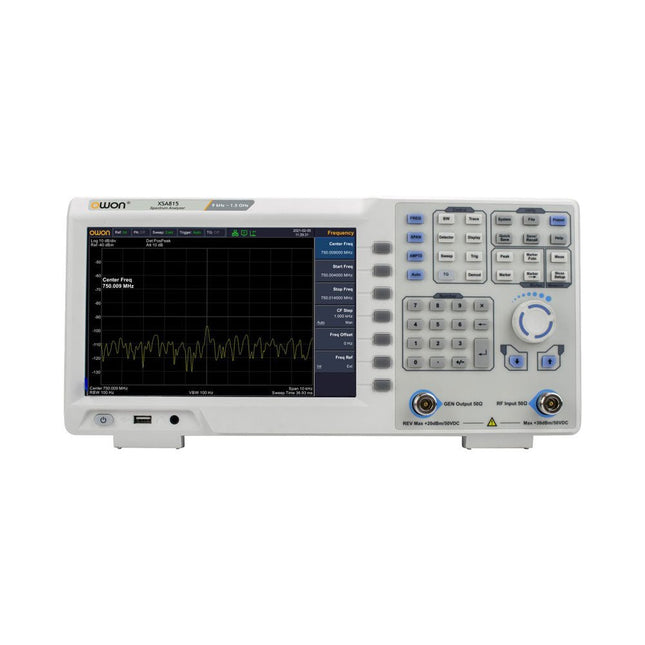
OWON OWON XSA815-TG Spectrum Analyzer (9 kHz – 1.5 GHz)
L'OWON XSA815-TG de 9 kHz à 1,5 GHz est un analyseur de spectre économique avec générateur de poursuite inclus et une résolution de fréquence de 1 Hz. Caractéristiques Plage de fréquence de 9 kHz à 1,500009 GHz Écran de 9 pouces Niveau moyen d'affichage du bruit (DANL) de -95 dBm de 9 kHz à 1 MHz, -140 dBm (typique), Phase bruit -10 kHz 100 kHz 1 MHz Bande passante de résolution (-3 dB) : de 1 Hz à 1 MHz, selon une séquence de 1-3-5-10 Kit de générateur de poursuite : de 100 kHz à 1,500009 GHz Spécifications Plage de fréquence 9 kHz à 500.009 MHz Résolution de fréquence 1 Hz Étendue de fréquence 9 kHz à 1,500009 GHz Plage d'étendue 0 Hz, de 100 Hz à la fréquence maximale de l'instrument Incertitude de l'étendue ± étendue / (points de balayage - 1) Phase bruit SSB (20°C à 30°C, fc=1 GHz) Décalage du porteuse 10 kHz Bande passante de résolution (-3 dB) de 1 Hz à 1 MHz, selon une séquence de 1-3-5-10 Précision de la bande passante de résolution Facteur de forme du filtre de résolution (60 dB : 3 dB) Bande passante vidéo (-3 dB) de 10 Hz à 1 MHz, selon une séquence de 1-3-5-10 Plage de mesure d'amplitude DANL à +10 dBm, de 100 kHz à 10 MHz, préamplificateur désactivé DANL à +20 dBm, de 10 MHz à 1,5 GHz, préamplificateur désactivé Niveau de référence -80 dBm à +30 dBm, 0,01 dB par étape Préamplificateur 20 dB, nominal, de 100 kHz à 1,5 GHz Atténuateur d'entrée de 0 à 40 dB, 1 dB par étape Niveau moyen d'affichage du bruit (DANL) Atténuation d'entrée = 0 dB, RBW = VBW = 100 Hz, détecteur d'échantillonnage, moyenne de trace ≥ 50, de 20°C à 30°C, impédance d'entrée = 50 Ω) Préamplificateur désactivé de 9 kHz à 1 MHz -95 dBm (typique), Préamplificateur désactivé de 1 MHz à 500 MHz -140 dBm (typique), Préamplificateur activé de 100 kHz à 1 MHz -135 dBm (typique), Préamplificateur activé de 1 MHz à 500 MHz -160 dBm (typique), Générateur de poursuite (en option) Plage de fréquence de 100 kHz à 1,500009 GHz Plage de niveau de puissance de sortie de -40 dBm à 0 dBm Résolution de niveau de sortie 1 dB Platitude de sortie Par rapport à 50 MHz | ±3 dB Spurious du générateur de poursuite Parasite harmonique -30 dBc (Puissance de sortie du générateur de poursuite -10 dBm) Parasite non-harmonique -40 dBc (Puissance de sortie du générateur de poursuite -10 dBm) Isolation entre le générateur de poursuite et la borne d'entrée -60 dB (Puissance de sortie du générateur de poursuite 0 dBm) Isolation entre le générateur de poursuite et la borne d'entrée -60 dB (Puissance de sortie du générateur de poursuite 0 dBm) Isolation entre le générateur de poursuite et la borne d'entrée -60 dB (Puissance de sortie du générateur de poursuite 0 dBm) Dimensions 375 x 185 x 120 mm Poids 3,7 kg Inclus 1x XSA815-TG 1x Câble d'alimentation 220 V AC 1x Câble USB 1x Guide de démarrage rapide Téléchargements Guide Rapide Spécifications
€ 900,00
-

Elektor Digital PC Programming (E-book)
A Small Basic Approach There are many different PC programming languages available on the market. Some have beautiful names; some have easy to use development tools. Others have incredible power. They all have one thing in common: they assume that you have, or want to have, a knack for technology and difficult to read commands. In this book we take a practical approach to programming. We assume that you simply want to write a PC program, and write it quickly. Not in a professional environment, not in order to start a new career, but for plain and simple fun... or just to get a task done. Therefore we use Small Basic. You will have an application up and running in a matter of minutes. You will understand exactly how it works and be able to write text programs, graphical user interfaces, and advanced drivers. It is so simple; you don't even need to be an adult!
€ 29,95
Membres : € 26,96
-

Peak Peak Atlas DCA55 Analyseur de semi-conducteurs
Le DCA55 est idéal pour identifier automatiquement le type de semi-conducteur sur les cordons de test ainsi que le brochage et de nombreux autres paramètres. Prend en charge les transistors MOSFET, JFET (seule la broche de grille peut être identifiée), les diodes, les LED et bien plus encore. Identifie automatiquement le type de composant, le brochage et d'autres paramètres importants. Comprend désormais la mesure des fuites des transistors et l'identification du germanium/silicium. Prise en charge des composants Transistors bipolaires (NPN/PNP avec silicium/germanium) Transistors Darlington (NPN/PNP) MOSFET en mode d'amélioration (N-Ch et P-Ch) MOSFET en mode appauvrissement (N-Ch et P-Ch) FET de jonction (N-Ch et P-Ch). Seul le fil du portail identifié. Diodes et réseaux de diodes (types 2 et 3 fils). LED et LED bicolores (2 types de fils et 3 types de fils). Triacs et thyristors sensibles à faible puissance (déclenchement et maintien <5 mA) Des mesures Identification du type de pièce Identification du brochage Gain de courant BJT (hFE) Tension de l'émetteur de base BJT (Vbe) Courant de fuite du collecteur BJT Tension de seuil de grille MOSFET Chute de tension directe de la diode (Vf) Spécifications Type d'analyseur Transistors, diodes, LED, MOSFET, JFET Détection de brochage Brochage complet (uniquement Gate sur JFET) Configuration du brochage Connectez-vous dans tous les sens Mesures de transistors Vbe, hFE, Iceo Mesures MOSFET Vgs (sur) Mesures de diodes VF Type de sonde Type de pince universelle Batterie Pile AAA unique (fournie). Durée de vie typique de 1300 opérations Conditions d'essai Généralement 5 mA, 5 V en crête Type d'affichage LCD alphanumérique (avec rétroéclairage) Inclus Instrument d'analyse de composants semi-conducteurs DCA55 Guide d'utilisation illustré et complet Sondes à crochet universelles installées Pile alcaline AAA Téléchargements Datasheet (EN) User Guide (FR)
€ 82,80
-

Peak Peak Atlas DCA75 Pro (Advanced Semiconductor Analyzer)
Le DCA75 Pro est un excellent instrument qui allie facilité d'utilisation et fonctionnalités étonnantes. Il peut identifier automatiquement une vaste gamme de semi-conducteurs, identifier automatiquement les brochages et mesurer des paramètres détaillés. Caractéristiques Écran graphique intégré (maintenant rétroéclairé) pour afficher un schéma détaillé du composant que vous testez ainsi que les données de brochage et de mesure. Connectivité USB pour permettre le traçage de courbes, le stockage/récupération de données et la correspondance de périphériques sur votre PC Windows (Windows 7 et supérieur). Pile alcaline AAA interne unique pour un fonctionnement autonome. Prise en charge des composants Transistors bipolaires (NPN/PNP avec silicium/germanium) Transistors Darlington (NPN/PNP) MOSFET en mode d'amélioration (N-Ch et P-Ch) MOSFET en mode appauvrissement (N-Ch et P-Ch) FET de jonction (N-Ch et P-Ch). Types symétriques et asymétriques IGBT d'amélioration (N-Ch et P-Ch) Diodes et réseaux de diodes (types 2 et 3 fils) Diodes Zener (jusqu'à environ 9 V) Régulateurs de tension (jusqu'à environ 8 V) LED et LED bicolores (2 types de fils et 3 types de fils) Triacs et thyristors sensibles à faible puissance (déclenchement et maintien <10 mA) Des mesures Gain de courant BJT (hFE) Tension de l'émetteur de base BJT (Vbe) Courant de fuite du collecteur BJT Tensions de seuil d'activation et de désactivation du MOSFET Transconductance MOSFET Tension de pincement JFET Transconductance JFET JFET IDSS (courant de drain pour Vgs=0) Tensions de seuil d'activation et de désactivation de l'IGBT Transconductance IGBT Tension de sortie du régulateur de tension Consommation de courant de repos du régulateur de tension Tension de chute du régulateur de tension Tension Zener Chute de tension directe de la diode Spécifications Type d'analyseur Composants semi-conducteurs Détection des composants Automatique Détection de brochage Automatique, connectez-vous dans tous les sens Type d'affichage LCD graphique (maintenant rétroéclairé) Type d'interface USB pour connexion PC en option Fonctions PC Traçage de courbe (Windows 7 et versions ultérieures) Logiciel Inclus sur clé USB pour Windows 7 et supérieur Batterie Pile AAA unique (fournie) Inclus Analyseur de composants semi-conducteurs DCA75 Logiciel PC sur clé USB pour Windows 11, 10, 8, 7, XP Câble micro-USB Sondes à crochet universelles haut de gamme installées Pile alcaline AAA Téléchargements Datasheet (EN) User Guide (FR) Software Installation Guide (EN) Software and Firmware Package
€ 190,80
-

Peak Peak Atlas ESR70 gold (ESR et Capacitance Meter)
Le Peak Atlas ESR70 gold est une version améliorée du précédent Peak Atlas ESR70 Plus. Il fait tout ce que l’ESR70 Plus a fait mais en mieux. Il mesure désormais la capacité jusqu'à 10 fois plus rapidement et sur une plage plus large, grâce à de nouveaux algorithmes de test. La mesure de capacité est également beaucoup moins influencée par les résistances parallèles ou les courants de fuite grâce à notre nouveau système de mesure Triple-Slope. À l'aide des sondes plaquées or fournies (amovibles), l'Atlas ESR70 gold peut mesurer l'ESR jusqu'à une résolution de 0,01 ohms, jusqu'à 40 ohms. Il peut même mesurer l'ESR pour les condensateurs en circuit. Les sondes sont amovibles, permettant d'installer des sondes compatibles de 2 mm. Des alertes sonores sont produites pour différents niveaux ESR, vous permettant d'effectuer de nombreux tests successivement sans avoir à regarder l'écran. L'ESR70 prend automatiquement en compte la réactance capacitive, de sorte que même les condensateurs de faible valeur (jusqu'à 0,3 uF) peuvent mesurer l'ESR avec précision. Caractéristiques Utilise une seule pile alcaline AAA (incluse). LCD alphanumérique avec rétroéclairage. Analyse automatique - démarrez lorsque vous appliquez les sondes. Décharge automatique du condensateur grâce à la fonction de décharge contrôlée. Mesure ESR (et faible résistance CC) (même en circuit). Réactance capacitive automatiquement prise en compte pour garantir une ESR précise. Mesure de capacité (si test hors circuit). Alertes sonores pour différents niveaux ESR. Plage de mesure ESR étendue jusqu'à 40 Ohms. Alternatives de sonde en option faciles à installer. Nouvelles fonctionnalités gold Écran LCD amélioré avec un meilleur rétroéclairage. Mesure de capacité 10 fois plus rapide pour les gros condensateurs. Système d'options utilisateur amélioré. Nouveau système de mesure à triple pente pour réduire considérablement l'influence de la résistance parallèle et/ou du courant de fuite sur les mesures de capacité. Plage de mesure de capacité beaucoup plus large, désormais de 0,3 uF à 90 000 uF (au lieu de 1 uF à 22 000 uF). Caractéristiques Type d'analyseur ESR et capacité Types de composants Condensateurs (>0,3 uF) Gamme ESR 0,00 Ohm à 40,0 Ohm Résolution ESR À partir de 0,01 Ohm Utilisation en circuit ESR uniquement Plage de capacité 0,3 uF à 90 000 uF Type de batterie Pile alcaline AAA 1,5 V (fournie). Durée de vie typique de 1 500 opérations Type d'affichage LCD alphanumérique (avec rétroéclairage) Inclus Peak Atlas ESR70 gold Câbles de test extra longs et extra flexibles (450 mm ou câble recouvert de silicone) Fiches et prises plaquées or 2 mm avec pinces crocodiles plaquées or amovibles Guide d'utilisation illustré et complet Pile alcaline AAA Téléchargements Fiche technique (EN) Guide de l'utilisateur (FR) Guide de l'utilisateur (FR) Guide de l'utilisateur (informatique)
€ 142,80
-

Peak Peak Atlas LCR45 LCR-mètre
Le LCR45 fait tout ce que le populaire LCR40 fait, mais il présente quelques améliorations significatives. Le LCR45 est doté d'un nouveau micro CAN haute capacité et haute résolution. Le LCR45 intègre des mathématiques avancées, basées sur une analyse d'impédance complexe. Cela permet une mesure améliorée de la valeur des composants ainsi qu'un affichage complet et détaillé de l'impédance. Caractéristiques Fourni avec des sondes à crochet amovibles plaquées or. Mesures de fluides avec fonction hold. Type de composant automatique ou manuel. Fréquence de test automatique ou manuel, DC, 1 kHz, 15 kHz ou 200 kHz. Résolution de mesure améliorée : 0,2 µH, 0,2 pF et 0,2 Ohms. Système de menu simple pour les paramètres utilisateur. Compensation améliorée pour les parasites et les pertes des composants (telles que les pertes de noyau, etc.). Mise hors tension automatique ou manuelle. Spécifications Type d'analyseur LCR et impédance des composants Types de composants Auto/Manuel pour L, C et R Types de mesures Inductance, capacité et résistance Autres mesures Impédance/admittance complexe Plus de mesures Amplitude et phase d'impédance Plage d'inductances 0uH à 2H Plage de capacité 0 pF à 10 000 uF Plage de résistance 0R à 2MR Fréquence des tests Auto et manuel : CC, 1 kHz, 15 kHz, 200 kHz Type d'affichage LCD alphanumérique (non rétroéclairé) Schéma de mesure Continu (avec maintien en option) Batterie GP23 (type 12 V/55 mAH), ~ 700 opérations Inclus Impédancemètre à composants passifs LCR45 Fiches et prises de 2 mm et sondes à crochet amovibles Guide d'utilisation illustré et complet 2 piles, une installée et une de rechange. Pile alcaline GP23. (12 V/55 mAh) Téléchargements Fiche technique (EN) Guide de l'utilisateur (FR) Guide de l'utilisateur (FR) Guide de l'utilisateur (informatique)
€ 130,80
-

Peak Pack Atlas Pro (LCR45 et DCA75)
Ce pack contient le LCR45 Impédancemètre pour composants passifs, idéal pour les amateurs avancés et les professionnels. Il contient également le très populaire DCA Pro (modèle DCA75), excellent pour l'identification des composants et leur brochage, et la mesure détaillée des caractéristiques et le traçage des courbes sur un PC. Complet avec câble USB et logiciel sur clé USB. DCA75 S'appuyant sur le succès continu des instruments d'identification et d'analyse des composants existants de Peak, le DCA Pro apporte une série de nouvelles caractéristiques intéressantes pour l'amateur et le professionnel. Le DCA Pro est une nouvelle conception avancée qui comprend un écran graphique, USB, un logiciel PC et une bibliothèque d'identification de composants améliorée. Identification automatique du type de composant Identification automatique du brochage (connectez dans n'importe quel sens) Le DCA Pro prend en charge tous les composants que le populaire Peak Atlas DCA55 prend en charge, mais il en ajoute beaucoup plus. Les composants pris en charge sont les suivants : Transistors (y compris les Darlington), types silicium et germanium. Mesure le gain, Vbe et les fuites. MOSFET, types à mode d'amélioration et à mode de déplétion. Mesure de la transconductance au seuil (à 5 mA) et de la transconductance approximative (pour une plage de 3 à 5 mA). JFET, y compris les types SiC normalement désactivés. Mesure de la tension de pincement (à 1 uA) et de la transconductance approximative (pour une plage de 3 à 5 mA). IGBT (transistors bipolaires à grille isolée). Mesure le seuil d'activation (à 5 mA) Diodes et réseaux de diodes LED et LED bicolores (types à 2 fils et à 3 fils) Diodes Zener avec mesure de la tension Zener jusqu'à 9 V à 5 mA Régulateurs de tension (mesure de la tension de régulation, de la tension de chute, du courant de repos) Triacs et thyristors nécessitant moins de 10 mA de courant de grille et de courant de maintien Autonome ou avec un PCL'instrument peut être utilisé de manière autonome ou connecté à un PC. Dans les deux cas, le DCA Pro identifiera automatiquement le type de composant et le brochage et mesurera également une série de paramètres tels que le gain du transistor, les fuites, les tensions de seuil des MOSFET et des IGBT, les caractéristiques PN et bien plus encore. Traçage de courbesLorsqu'il est connecté à un PC à l'aide du câble USB fourni, il est possible d'exécuter une série de fonctions de traçage de courbes de faible intensité. Différents types de graphiques sont disponibles, et d'autres sont à venir Caractéristiques de sortie des transistors bipolaires, IC vs VCE Caractéristiques de gain des transistors bipolaires, hFE par rapport à VCE Caractéristiques de gain des transistors bipolaires, hFE par rapport à IC Fonction de sortie du MOSFET et de l'IGBT, ID par rapport à VDS Fonction de transfert MOSFET et IGBT, ID vs VGS Fonction de sortie JFET, ID vs VDS Fonction de transfert JFET, ID vs VGS Régulateur de tension, VOUT vs VIN Régulateur de tension, IQ vs VIN Courbes I/V des jonctions PN, direct et inverse (pour les diodes Zener) Le traçage des courbes est effectué à l'aide de paramètres d'essai dans la plage de ±12 V ou ±12 mA. Toutes les données de traçage de courbes peuvent être instantanément collées dans Excel© pour une représentation graphique et une analyse plus approfondies. Le logiciel PC est fourni avec le DCA Pro sur une clé USB Peak. Le logiciel est conçu pour Windows 7 et plus récent (32 ou 64 bits). LCR45 Un excellent analyseur LCR portable qui peut mesurer la valeur de votre composant passif (inductance, condensateur ou résistance) et également mesurer l'impédance détaillée dans un certain nombre de modes. Le LCR45 offre une résolution de mesure améliorée (meilleure que 0,1 µH !) tout en vous donnant des mesures continues de fluides. En outre, les fréquences de test de CC, 1 kHz, 15 kHz et 200 kHz peuvent être réglées en mode automatique ou manuel. Fourni avec des sondes à crochet amovibles plaquées or, une batterie et un guide d'utilisation. Compatible avec les connecteurs de test standard de 2 mm. Non conçu pour une utilisation en circuit. Sélection automatique ou manuelle du type de composant : Inducteur, condensateur ou résistance Sélection automatique ou manuelle de la fréquence de test : CC, 1 kHz, 15 kHz et 200 kHz Inductance de 0,1 µH à 10 H Capacité de 0,1 pF à 10 000 µF Résistance de 0,1 Ω à 2 MΩ La mesure de l'inductance indique également la résistance de l'enroulement en courant continu. Affichage du type et des valeurs des composants, de l'impédance complexe, de la magnitude/phase et de l'admittance. Fréquence de test affichée pour toutes les mesures Précision typique de 1,5% pour les inductances et les condensateurs (voir le tableau des spécifications pour plus de détails) Précision typique de 1% pour les résistances Cordon de test complet avec fiches et douilles plaquées or de 2 mm Fourni avec des sondes à crochet amovibles plaquées or Inclus LCR45 DCA75 Pile GP23 supplémentaire Pile AAA supplémentaire Valise de transport double
€ 322,80
-

Peak Peak Atlas ZEN50 Analyseur de diode Zener
L'Atlas ZEN50 est idéal pour tester les diodes Zener (y compris les diodes à avalanche), les suppresseurs de transitoires, les LED et les chaînes de LED. Il génère des impulsions de courant constant (sélectionnables entre 2 mA, 5 mA, 10 mA et 15 mA) à des tensions de 0 V à 50 V. Ainsi, même les Zeners haute tension ou les chaînes de LED haute tension peuvent être testés. Les courants de test sont fournis sous forme d'impulsions étroites pour garantir que le composant testé reste à une température constante. La tension de la pièce est affichée sur l'écran avec le courant de test ainsi qu'une mesure de la résistance de pente du composant (également appelée impédance dynamique). Spécifications Type d'analyseur Zeners, LED, téléviseurs, etc. Courants de test 2 mA, 5 mA, 10 mA, 15 mA Plage de tension 0,00 à 50,00 V Plage de résistance à la pente 0 à 8000 Ohm Type de batterie AAA simple (fourni). Durée de vie typique de 1400 opérations Méthode d'essai Triple impulsion à 10 pps (type) Tester le cycle de service actuel 3% Type d'affichage LCD alphanumérique (avec rétroéclairage) Inclus Instrument ZEN50 Cordons de test flexibles équipés de crocs plaqués or Guide d'utilisation illustré et complet Pile alcaline AAA Téléchargements Fiche technique (EN) Guide de l'utilisateur (FR) Guide de l'utilisateur (FR) Guide de l'utilisateur (informatique)
€ 85,20
-
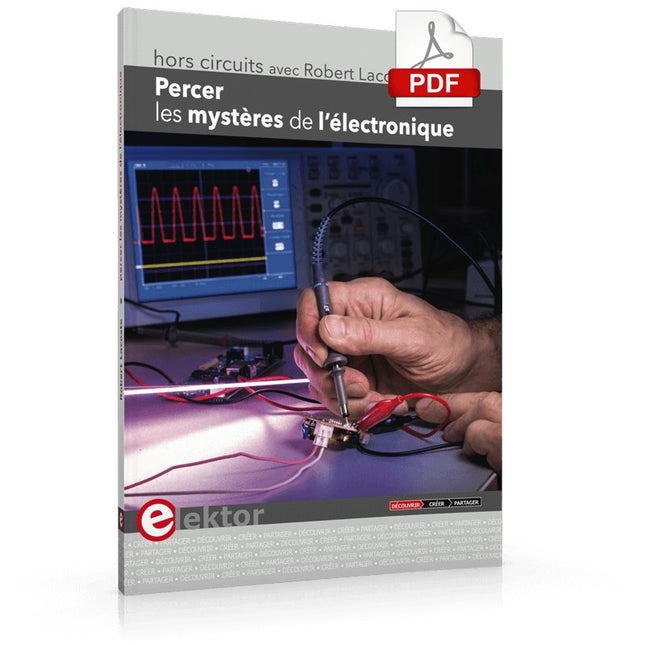
Elektor Digital Percer les mystères de l’électronique (E-book)
Le monde de l'électronique est à la fois vaste et… tout petit ! Voici un livre qui confirme ces deux constatations contradictoires. En effet, en électronique, tout touche à tout, d'une manière ou d'une autre. Le plus petit détail peut avoir les plus grandes conséquences, et pas toujours celles que l'on attendrait. L'objectif de l'auteur de cette série d'articles autonomes intitulée hors-circuits, réunis ici en un livre, n'est pas de vous tenir par la main. Robert Lacoste, électronicien professionnel de haut-niveau, vous donne des pistes pour comprendre ce qui paraît mystérieux. Il vous guide juste assez pour vous permettre ensuite de progresser tout seul. Avec lui, non seulement vous repousserez vos propres limites, mais saurez aussi détecter celles du matériel et du logiciel que vous utilisez. En vous invitant à repasser par les notions de physique de base, il vous permettra de séparer les véritables progrès techniques des laïus commerciaux. Les bases, ça peut mener loin D'où vient la sensibilité d'un récepteur d'ondes radio ? Pourquoi le téléchargement d'une vidéo sur votre portable est-il beaucoup plus lent à la campagne qu'en centre-ville ? Si pour vous la réponse technique à des questions comme celles-ci (et bien d'autres que vous n'osez peut-être même pas vous poser) n'est pas évidente, ce livre vous aidera à y voir plus clair. Oui, on peut être à l'aise avec les microcontrôleurs, mais dérouté par le comportement d'un simple transistor. Vous sentez-vous concerné par de telles interrogations ? Ce livre est donc pour vous. Sans aucune formule mathématique qui ne soit pas à la portée d'un lycéen, il balaye tout le champ de l'électronique, depuis l'analogique jusqu'au traitement numérique du signal en passant par le domaine si redouté des hautes-fréquences. La théorie ne s'y éloigne jamais beaucoup de la loi d'Ohm ! Avec des mots simples, l'auteur explique comment ça marche, pourquoi parfois ça ne marche pas comme on veut, et comment mieux utiliser différentes techniques dans vos propres projets pour que ça marche. Liste des sujets abordés : adaptation d'impédance : qu'est-ce-que c'est ? petite introduction aux microrubans jouons avec la réflectométrie temporelle circuits imprimés : éviter les bourdes en HF et avec les fréquences élevées le marquage CE pour les béotiens le quartz magie de la PLL VCO & PLL : pour obtenir des fréquences à la fois précises, stables et variables synthèse numérique directe : une introduction comprendre l'amplificateur à transistor : sexagénaire vaillant ampli de classe A, B, C, D, E, F, G, H : quesako ? le filtrage numérique sans stress : les filtres FIR le filtrage numérique sans stress : les filtres CIC le filtrage numérique sans stress : les filtres IIR l'ABC des CA/N DNL, INL, SNR, SINAD, ENOB, SFDR et consorts l'ABC des CA/N sigma-delta, quésaco ? bruit et sensibilité des récepteurs échange débit contre portée
€ 32,95
Membres : € 29,66
-

Elektor Bundles Physical AI with Raspberry Pi (offre groupée)
Cette offre comprend l’AI Fusion Lab Kit, composé de plus de 450 pièces, ainsi que le livre Physical AI with Raspberry Pi. Il offre une introduction complète et pratique à l’IA, à l’électronique et à la programmation en Python. Réalisez des projets concrets combinant vision par ordinateur, interaction vocale, capteurs, moteurs et grands modèles de langage. Le livre inclus vous guide étape par étape, de la configuration du Raspberry Pi et du contrôle du matériel jusqu'à la création d'applications avancées utilisant OpenCV, MediaPipe, YOLO, les services OpenAI et les modèles locaux Ollama. SunFounder AI Fusion Lab Kit pour Raspberry Pi (450+ pièces) Le kit AI Fusion Lab transforme un Raspberry Pi en une plateforme complète pour l'apprentissage de l'intelligence artificielle, de l'électronique et de la programmation en Python. Il est compatible avec les modèles Raspberry Pi 5, 4B, 3B+, 3B et Zero 2 W, ainsi qu'avec des modèles et services d'IA populaires tels que ChatGPT, Gemini, Grok, DeepSeek, Qwen, Doubao et Ollama. Grâce à sa caméra, son module Pan-Tilt HAT, son capteur 10 axes, son microphone, son haut-parleur et ses composants électroniques, ce kit permet aux utilisateurs de réaliser des projets d'IA interactifs combinant voix, vision, mouvement et données de capteurs. Il est idéal pour les débutants, les étudiants, les makers et toute personne souhaitant explorer des applications concrètes de l'IA. Créez des projets d'IA multimodaux Combinez de grands modèles de langage (LLM) avec la reconnaissance vocale, la synthèse vocale, la vision par caméra, des capteurs et des circuits sur platine d'essai. Réalisez des projets capables d'écouter, de parler, de voir, de réagir et d'interagir avec leur environnement, tout en découvrant le fonctionnement des systèmes d'IA modernes. Explorez la vision par IA et le suivi d'objets Utilisez YOLO, OpenCV et MediaPipe pour détecter et suivre des objets, des couleurs, des visages et des mouvements humains. Le module motorisé Pan-Tilt HAT permet à la caméra de suivre automatiquement des cibles, illustrant ainsi la synergie entre la vision par ordinateur et le contrôle de mouvement. IA vocale avec le Fusion HAT+ Le Fusion HAT+ simplifie le contrôle matériel grâce à une bibliothèque Python unifiée et prend en charge l'arrêt sécurisé du Raspberry Pi. Son microphone et son haut-parleur intégrés facilitent le développement d'assistants à commande vocale et d'autres applications d'IA conversationnelle. Compatible avec Raspberry Pi 5, 4B, 3B+, 3B et Zero 2 W Prend en charge plusieurs modèles d'IA, qu'ils soient basés sur le cloud ou locaux Inclut une caméra, une carte Pan-Tilt HAT, un module 10DOF, un microphone et un haut-parleur Projets couvrant l'IA vocale, la vision par ordinateur, les capteurs et l'électronique Tutoriels vidéo, documentation et exemples de code Livre : Physical AI with Raspberry Pi En s'appuyant sur le Raspberry Pi et le kit AI Fusion Lab, cet ouvrage vous guide étape par étape, depuis les bases de l'interfaçage matériel jusqu'au développement de systèmes intelligents capables de voir, d'écouter, de parler et de prendre des décisions. Que vous soyez étudiant, enseignant, maker ou ingénieur, vous acquerrez une expérience précieuse grâce à des projets conçus pour renforcer à la fois vos connaissances et votre confiance en vous. Après avoir abordé la configuration du système, la programmation GPIO, les capteurs, les écrans, les moteurs et les techniques d'automatisation, le livre introduit progressivement des sujets plus avancés tels que la reconnaissance vocale, la synthèse vocale (text-to-speech), l'IA conversationnelle, la reconnaissance d'objets et l'apprentissage automatique (machine learning). Vous apprendrez ainsi à créer des appareils à commande vocale, des assistants intelligents, des systèmes de suivi par caméra, des solutions de surveillance environnementale et des applications embarquées pilotées par l'IA. Explorez des technologies modernes comme les services OpenAI, les grands modèles de langage (LLM) locaux via Ollama, OpenCV, MediaPipe et la détection d'objets YOLO, tout en acquérant une expérience pratique sur des applications concrètes utilisées en robotique, en automatisation industrielle, dans les objets connectés et les systèmes autonomes. Vous découvrirez comment des logiciels intelligents peuvent interagir avec des capteurs, des caméras, des moteurs et des écrans pour créer des systèmes capables de réagir naturellement à leur environnement. Plutôt que de vous contenter de suivre des exemples de code, vous serez encouragé à expérimenter, personnaliser et enrichir chaque projet. Les techniques et compétences développées tout au long de cet ouvrage constituent une base solide pour l'innovation, le prototypage rapide, la recherche et le développement de produits. Si vous êtes prêt à aller au-delà de l'électronique traditionnelle pour explorer l'avenir des systèmes embarqués intelligents, ce livre vous accompagnera à chaque étape de votre parcours. Cette offre groupée contient : SunFounder AI Fusion Lab Kit for Raspberry Pi (d'une valeur de : 100 €) Livre : Physical AI with Raspberry Pi (d'une valeur de : 45 €) Non inclus Raspberry Pi
€ 144,95€ 129,95Meilleur prix
-
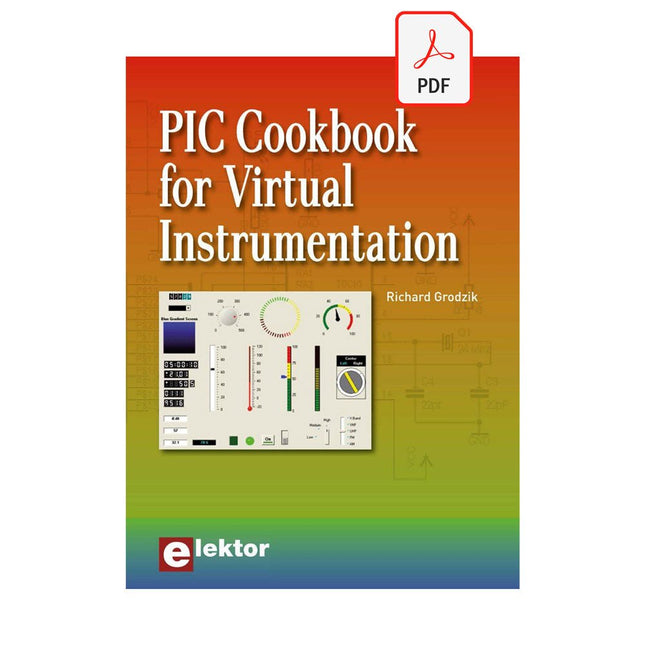
Elektor Digital PIC Cookbook for Virtual Instrumentation (E-book)
The software simulation of gauges, control-knobs, meters and indicators which behave just like real hardware components on a PC’s screen is known as virtual instrumentation. In this book, the Delphi program is used to create these mimics and PIC based external sensors are connected via a USB/RS232 converter communication link to a PC. Detailed case studies in this Book include a virtual compass displayed on the PC’s screen, a virtual digital storage oscilloscope, virtual -50 to +125 degree C thermometer, and FFT sound analyser, a joystick mouse and many examples detailing virtual instrumentation Delphi components. Arizona’s embedded microcontrollers – the PIC's are used in the projects and include PIC16F84A, PIC16C71, DSPIC30F6012A, PIC16F877, PIC12F629 and the PIC16F887. Much use is made of Microchip’s 44 pin development board (a virtual instrument ‘engine)’, equipped with a PIC16F887 with an onboard potentiometer in conjunction with the PIC’s ADC to simulate the generation of a variable voltage from a sensor/transducer, a UART to enable PC RS232 communications and a bank of 8 LED's to monitor received data is also equipped with an ISP connector to which the ‘PICKIT 2’ programmer may easily be connected. Full source code examples are provided both for several different PIC’s, both in assembler and C, together with the Pascal code for the Delphi programs which use different 3rd party Delphi virtual components.
€ 19,95
Membres : € 17,96
-
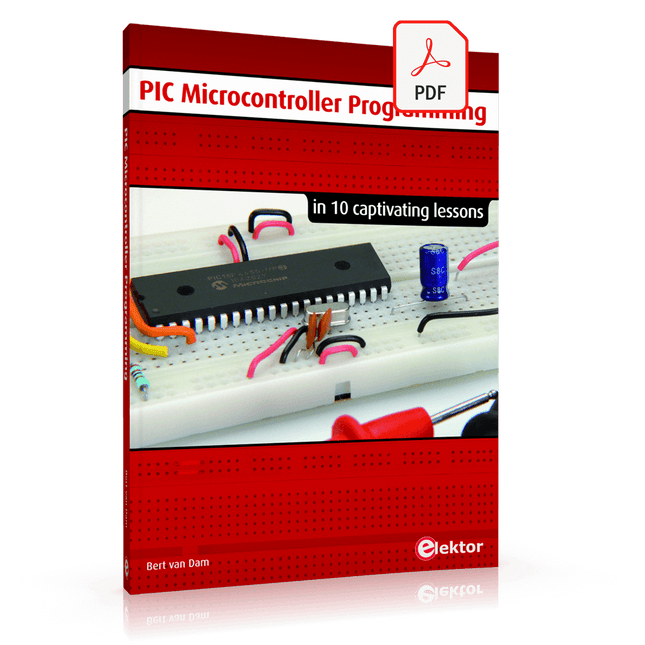
€ 29,95
Membres : € 26,96
-
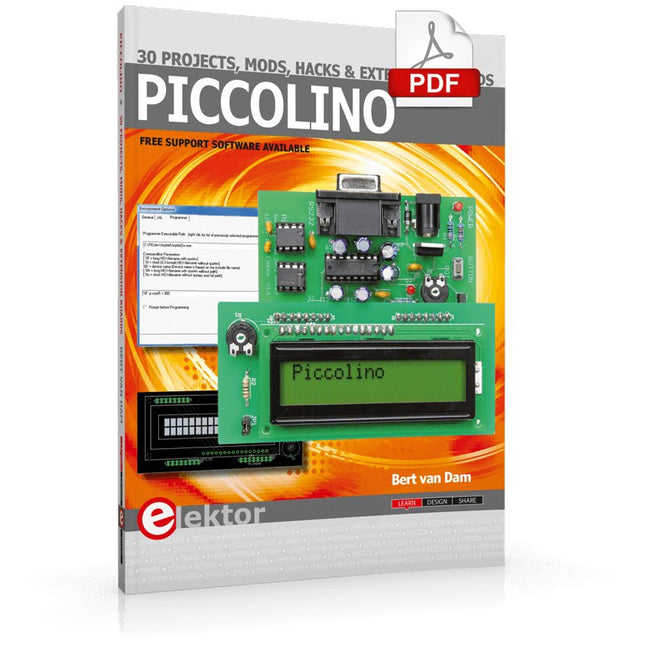
Elektor Digital Piccolino - 30 Projects, mods, hacks and extension (E-book)
The Piccolino rapid development board can be used to design microcontroller circuits quickly. The Piccolino has a fast 16f887 PIC microcontroller, voltage regulator, and communications module, and can be easily extended using its four headers. This e-book contains 30 projects based on the Piccolino. We'll use its unique communications facilities and get the Piccolino to communicate with programs on a PC. On the PC, we use the free programming language Small Basic. You can use this to create Windows programs with buttons and graphs quickly. You will learn how to analyze components such as inductors, capacitors, and OPAMPs, and how to display the measurement results in a graphical format. This will help you to design your circuits easily. We will then start to adapt to the Piccolino. We'll add components to it to make it more powerful, with extra features such as flow control and digital to analog conversion. The clear instructions will enable you to design and build your adaptations. This way you can make your custom designed Piccolino. We'll end up making an extension: a PCB that that can be mounted on the Piccolino headers. As an example, we'll design and build an extension for an LCD. You can use the included board layout to make your PCB or have it made for you. At the same time, you will learn how to make your extensions. The only limitation is your imagination! The clear descriptions along with circuit diagrams and photos, will make the building of these projects an enjoyable experience. Each project has a clear explanation of the reasons why it was designed in a particular way. This helps you learn a lot about the Piccolino, as well as Small Basic, and the components that are used in this e-book. You can adapt the projects to suit your requirements or combine several projects.
€ 34,95
Membres : € 31,46
-

Elektor Publishing PID-based Practical Digital Control with Raspberry Pi and Arduino Uno
The Arduino Uno is an open-source microcontroller development system encompassing hardware, an Integrated Development Environment (IDE), and a vast number of libraries. It is supported by an enormous community of programmers, electronic engineers, enthusiasts, and academics. The libraries in particular really smooth Arduino programming and reduce programming time. What’s more, the libraries greatly facilitate testing your programs since most come fully tested and working. The Raspberry Pi 4 can be used in many applications such as audio and video media devices. It also works in industrial controllers, robotics, games, and in many domestic and commercial applications. The Raspberry Pi 4 also offers Wi-Fi and Bluetooth capability which makes it great for remote and Internet-based control and monitoring applications. This book is about using both the Raspberry Pi 4 and the Arduino Uno in PID-based automatic control applications. The book starts with basic theory of the control systems and feedback control. Working and tested projects are given for controlling real-life systems using PID controllers. The open-loop step time response, tuning the PID parameters, and the closed-loop time response of the developed systems are discussed together with the block diagrams, circuit diagrams, PID controller algorithms, and the full program listings for both the Raspberry Pi and the Arduino Uno. The projects given in the book aim to teach the theory and applications of PID controllers and can be modified easily as desired for other applications. The projects given for the Raspberry Pi 4 should work with all other models of Raspberry Pi family. The book covers the following topics: Open-loop and closed-loop control systems Analog and digital sensors Transfer functions and continuous-time systems First-order and second-order system time responses Discrete-time digital systems Continuous-time PID controllers Discrete-time PID controllers ON-OFF temperature control with Raspberry Pi and Arduino Uno PID-based temperature control with Raspberry Pi and Arduino Uno PID-based DC motor control with Raspberry Pi and Arduino Uno PID-based water level control with Raspberry Pi and Arduino Uno PID-based LED-LDR brightness control with Raspberry Pi and Arduino Uno
€ 39,95
Membres : € 35,96
-
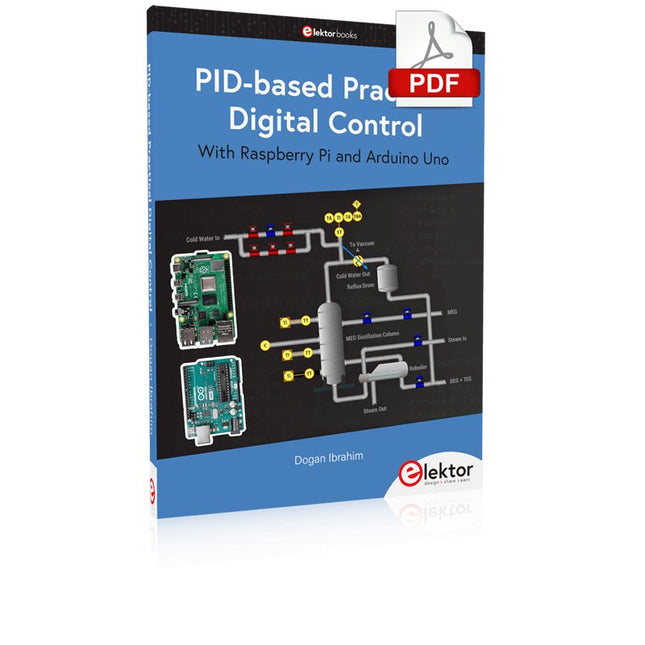
Elektor Digital PID-based Practical Digital Control with Raspberry Pi and Arduino Uno (E-book)
The Arduino Uno is an open-source microcontroller development system encompassing hardware, an Integrated Development Environment (IDE), and a vast number of libraries. It is supported by an enormous community of programmers, electronic engineers, enthusiasts, and academics. The libraries in particular really smooth Arduino programming and reduce programming time. What’s more, the libraries greatly facilitate testing your programs since most come fully tested and working. The Raspberry Pi 4 can be used in many applications such as audio and video media devices. It also works in industrial controllers, robotics, games, and in many domestic and commercial applications. The Raspberry Pi 4 also offers Wi-Fi and Bluetooth capability which makes it great for remote and Internet-based control and monitoring applications. This book is about using both the Raspberry Pi 4 and the Arduino Uno in PID-based automatic control applications. The book starts with basic theory of the control systems and feedback control. Working and tested projects are given for controlling real-life systems using PID controllers. The open-loop step time response, tuning the PID parameters, and the closed-loop time response of the developed systems are discussed together with the block diagrams, circuit diagrams, PID controller algorithms, and the full program listings for both the Raspberry Pi and the Arduino Uno. The projects given in the book aim to teach the theory and applications of PID controllers and can be modified easily as desired for other applications. The projects given for the Raspberry Pi 4 should work with all other models of Raspberry Pi family. The book covers the following topics: Open-loop and closed-loop control systems Analog and digital sensors Transfer functions and continuous-time systems First-order and second-order system time responses Discrete-time digital systems Continuous-time PID controllers Discrete-time PID controllers ON-OFF temperature control with Raspberry Pi and Arduino Uno PID-based temperature control with Raspberry Pi and Arduino Uno PID-based DC motor control with Raspberry Pi and Arduino Uno PID-based water level control with Raspberry Pi and Arduino Uno PID-based LED-LDR brightness control with Raspberry Pi and Arduino Uno
€ 32,95
Membres : € 29,66
-
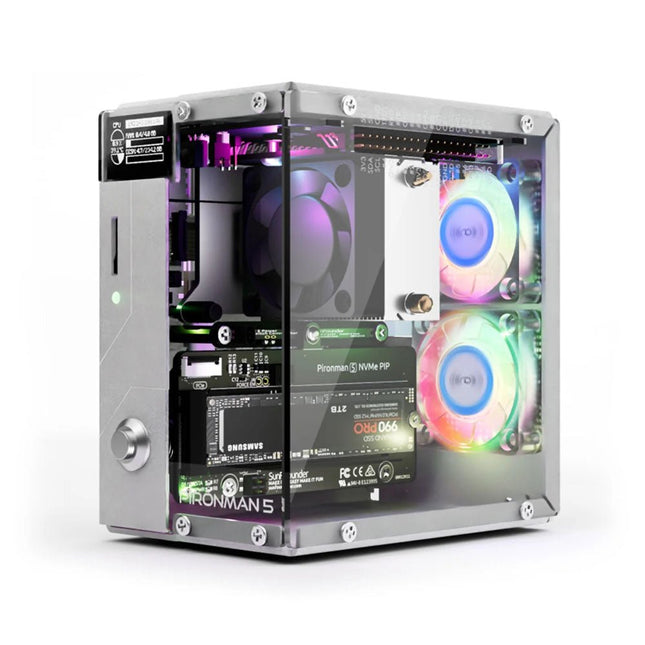
SunFounder Pironman 5 NVMe M.2 SSD PCIe Mini PC Boîtier pour Raspberry Pi 5
Améliorez votre Raspberry Pi 5 avec le Pironman 5, construit en aluminium robuste, avec un refroidissement supérieur, un support SSD NVMe M.2, un écran OLED, un éclairage RVB, des ports HDMI standard x2 et un interrupteur d'alimentation sécurisé. Il est parfait pour les NAS, Home Assistant, Media et Game Centers. Le Pironman 5 n'est pas seulement un boîtier ; il s'agit d'une mise à niveau qui transforme votre Raspberry Pi 5 en un appareil puissant, efficace et élégant. Le Pironman 5 comprend le Pi 5 NVMe PIP (PCIe Peripheral Board), une carte adaptateur PCIe spécialement conçue pour les disques SSD NVMe. Cette carte prend en charge quatre tailles de SSD NVMe : 2230, 2242, 2260 et 2280, qui peuvent tous être installés dans un emplacement pour clé M.2 M. La connexion est certifiée pour les vitesses Gen 2.0 (5 GT/sec), mais peut être forcée à Gen 3.0 (10 GT/sec) pour des performances plus rapides. Emplacement SSD NVMe M.2 extensible Améliorez les performances de votre Raspberry Pi 5 avec l'emplacement SSD NVMe M.2 du Pironman 5, prenant en charge plusieurs tailles (2230, 2242, 2260, 2280) pour un stockage accru et une réponse plus rapide du système. Système de refroidissement avancé Gardez votre Raspberry Pi 5 au frais et élégant avec le refroidisseur tour du Pironman 5 et ses deux ventilateurs RVB, dotés de filtres anti-poussière pour un fonctionnement durable et nécessitant peu d'entretien. Écran OLED pour des informations instantanées Le Pironman 5 comprend un écran OLED de 0,96 pouces, fournissant des mises à jour immédiates sur l'utilisation du processeur et de la RAM, la température, l'adresse IP, etc. Fonctionnalité et sécurité améliorées Le Pironman 5 sécurise votre Raspberry Pi 5 avec des fonctionnalités telles qu'un arrêt sécurisé, des LED RVB personnalisables, des ports HDMI, un récepteur IR et un prolongateur GPIO externe, améliorant ainsi la fonctionnalité et la connectivité. Caractéristiques Mini PC Raspberry Pi 5 Écran OLED de 0,96" affichant l'utilisation du processeur, la température, l'utilisation du disque, l'adresse IP, l'utilisation de la RAM, etc. du Raspberry Pi. Le refroidisseur tour peut refroidir une charge CPU à 100% Pi à 39°C à une température ambiante de 25°C 2 ventilateurs RVB, avec contrôle GPIO 1 ventilateur PWM sur le refroidisseur tour est contrôlé par le système Raspberry Pi. Prend en charge quatre tailles de SSD NVMe M.2 (PCIe Gen 2.0/PCIe Gen 3.0) : 2230, 2242, 2260 et 2280. 4 LED RVB adressables WS2812 illuminent l'ensemble du boîtier avec un effet de lumière cool Récepteur IR pour centre multimédia comme Kodi ou Volumio Bouton d'alimentation rétro en métal pour un arrêt en toute sécurité Rallonge GPIO externe avec étiquette de nom de code PIN, pour un accès facile Équipé d'un support à ressort pour un retrait facile de la carte Corps principal en aluminium avec panneau latéral en acrylique transparent Comprend deux ports HDMI standards Téléchargements Documentation
€ 79,95
Membres : € 71,96
-
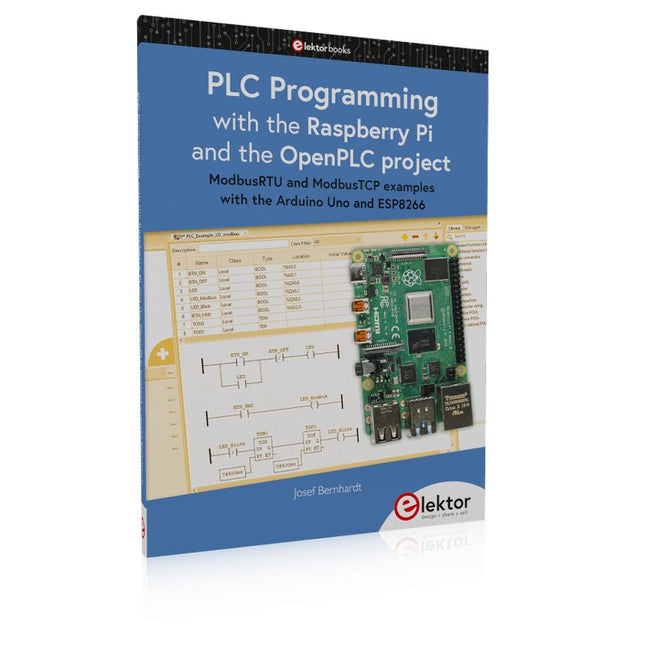
Elektor Publishing PLC Programming with the Raspberry Pi and the OpenPLC Project
ModbusRTU and ModbusTCP examples with the Arduino Uno and ESP8266 Introduction to PLC programming with OpenPLC, the first fully open source Programmable Logic Controller on the Raspberry Pi, and Modbus examples with Arduino Uno and ESP8266 PLC programming is very common in industry and home automation. This book describes how the Raspberry Pi 4 can be used as a Programmable Logic Controller. Before taking you into the programming, the author starts with the software installation on the Raspberry Pi and the PLC editor on the PC, followed by a description of the hardware. You'll then find interesting examples in the different programming languages complying with the IEC 61131-3 standard. This manual also explains in detail how to use the PLC editor and how to load and execute the programs on the Raspberry Pi. All IEC languages are explained with examples, starting with LD (Ladder Diagram) over ST (Structured Control Language) to SFC (Special Function Chart). All examples can be downloaded from the author's website. Networking gets thorough attention too. The Arduino Uno and the ESP8266 are programmed as ModbusRTU or ModbusTCP modules to get access to external peripherals, reading sensors and switching electrical loads. I/O circuits complying with the 24 V industry standard may also be of interest for the reader. The book ends with an overview of commands for ST and LD. After reading the book, the reader will be able to create his own controllers with the Raspberry Pi.
€ 39,95
Membres : € 35,96


