
Résultats de la recherche pour "beagley OR ai OR sbc OR with OR gpu OR dsp OR and OR ai OR accelerators"
-
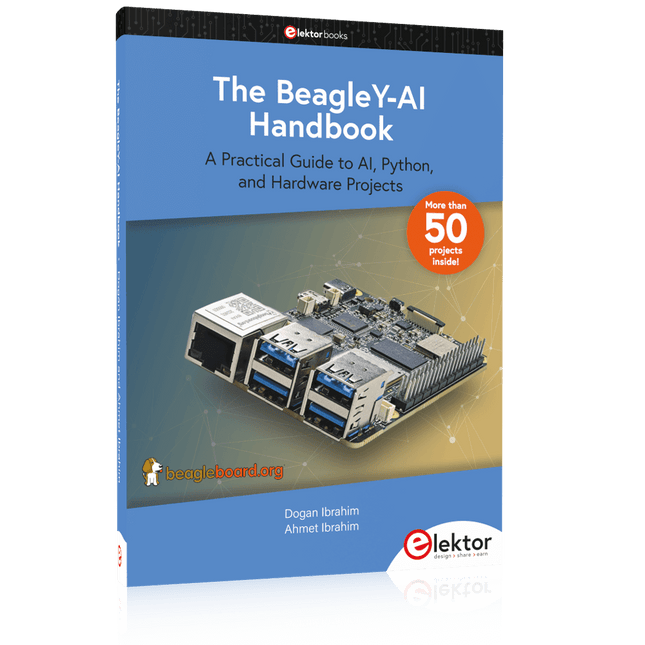
Elektor Publishing The BeagleY-AI Handbook
A Practical Guide to AI, Python, and Hardware Projects Welcome to your BeagleY-AI journey! This compact, powerful, and affordable single-board computer is perfect for developers and hobbyists. With its dedicated 4 TOPS AI co-processor and a 1.4 GHz Quad-core Cortex-A53 CPU, the BeagleY-AI is equipped to handle both AI applications and real-time I/O tasks. Powered by the Texas Instruments AM67A processor, it offers DSPs, a 3D graphics unit, and video accelerators. Inside this handbook, you‘ll find over 50 hands-on projects that cover a wide range of topics—from basic circuits with LEDs and sensors to an AI-driven project. Each project is written in Python 3 and includes detailed explanations and full program listings to guide you. Whether you‘re a beginner or more advanced, you can follow these projects as they are or modify them to fit your own creative ideas. Here’s a glimpse of some exciting projects included in this handbook: Morse Code Exerciser with LED or BuzzerType a message and watch it come to life as an LED or buzzer translates your text into Morse code. Ultrasonic Distance MeasurementUse an ultrasonic sensor to measure distances and display the result in real time. Environmental Data Display & VisualizationCollect temperature, pressure, and humidity readings from the BME280 sensor, and display or plot them on a graphical interface. SPI – Voltmeter with ADCLearn how to measure voltage using an external ADC and display the results on your BeagleY-AI. GPS Coordinates DisplayTrack your location with a GPS module and view geographic coordinates on your screen. BeagleY-AI and Raspberry Pi 4 CommunicationDiscover how to make your BeagleY-AI and Raspberry Pi communicate over a serial link and exchange data. AI-Driven Object Detection with TensorFlow LiteSet up and run an object detection model using TensorFlow Lite on the BeagleY-AI platform, with complete hardware and software details provided.
€ 44,95
Membres : € 40,46
-

Elektor Bundles Arduino UNO Q (offre groupée)
Cette offre groupée comprend l'Arduino UNO Q (2 Go) et le livre « Arduino UNO Q and AI ». L'Arduino UNO Q est la première carte UNO dotée d'une architecture hybride à double cœur, combinant un puissant processeur Linux et un microcontrôleur temps réel, ce qui permet d'allier puissance de calcul avancée et contrôle précis sur une seule et même carte. Équipée d’un MPU Qualcomm Dragonwing QRB2210 fonctionnant sous Debian Linux et d’un microcontrôleur STM32U585 pour les tâches en temps réel, l’UNO Q est conçue pour les applications de nouvelle génération. De l’Edge Computing et l’IA à la robotique et l’automatisation, elle offre des performances élevées sans sacrifier la facilité d’utilisation. Il suffit de connecter vos périphériques pour commencer – aucun matériel supplémentaire n'est nécessaire. Caractéristiques Architecture double cœur : MPU Linux + MCU temps réel Qualcomm Dragonwing QRB2210 avec prise en charge de Debian Linux Microcontrôleur STM32U585 pour le contrôle déterministe Exécute les sketches Arduino via le système d'exploitation Zephyr Idéal pour l'IA, l'IoT, la robotique et les projets industriels Spécifications Microprocesseur (MPU) Qualcomm Dragonwing QRB2210 :Quad-core Arm Cortex-A53 à 2,0 GHzAccélérateur graphique 3D Adreno GPU2× ISP (13 MP + 13 MP ou 25 MP) à 30 fps Microcontrôleur (MCU) STM32U585Arm Cortex-M33 jusqu'à 160 MHz2 Mo de mémoire flash786 Ko de SRAM RAM 2 Go LPDDR4 Alimentation Connecteur USB-C : 5 V max à 3 ATension d'entrée (VIN) : 7-24 V Mémoire 16 Go eMMC USB 1 port USB-C avec commutation hôte/périphérique, interrupteur d'alimentation et sortie vidéo Connectivité Wi-Fi 5 (2,4/5 GHz) avec antenne intégréeBluetooth 5.1 avec antenne intégrée Antenne Interfaces I²C/I³CSPIPWMCANUARTPSSIGPIOJTAGADC Vidéo Sortie vidéo via USB-CBroches MIPI DSI sur connecteur JMEDIA Supplémentaire 4× LED RVB contrôlables par l'utilisateur8× 13 Matrice de LED bleues1× connecteur Qwiic (3,3 V, I²C)1× bouton-poussoir utilisateurJCTL : Débogage à distance du microprocesseur Connecteur Audio Entrée microphone / Sortie casque / Sortie ligne sur JMISC Système d'exploitation MPU Linux Debian avec support amont Système d'exploitation temps réel Arduino Core sur Zephyr OS Conteneurisation Prise en charge de Docker et Docker Compose Systèmes d'exploitation compatibles avec Arduino App Lab Windows : Windows 10 ou version ultérieure (64 bits)macOS : macOS 11 ou version ultérieure (64 bits)Linux : Ubuntu 22.04 ou version ultérieure et Debian Trixie (64 bits) Dimensions 68,85 × 53,34 mm (format UNO) Téléchargements Datasheet User Manual Pinout Schematics Livre : Arduino UNO Q and AI – Learn to Build Intelligent Embedded Systems Développez des systèmes embarqués plus intelligents avec l’Arduino UNO Q. Ce livre vous fournit les outils, les connaissances et la confiance nécessaires pour transformer vos idées en solutions intelligentes et fonctionnelles grâce à la plateforme Arduino UNO Q. Découvrez comment créer des systèmes embarqués intelligents avec l’Arduino UNO Q et l’IA. Exploitez tout le potentiel de l’Arduino UNO Q, une plateforme de nouvelle génération qui associe la puissance temps réel du microcontrôleur STM32U585 à la flexibilité du microprocesseur Qualcomm Dragonwing QRB2210. Apprenez à prototyper rapidement des applications concrètes en utilisant l’Arduino IDE pour le contrôle embarqué bas niveau et Python dans Arduino App Lab pour le développement haut niveau. Gagnez en assurance grâce à des projets pratiques qui vous guident pas à pas, des fonctionnalités de base de la carte jusqu’à des systèmes entièrement opérationnels. Explorez des exemples prêts à l’emploi basés sur l’IA dans Arduino App Lab et découvrez comment ils peuvent accélérer votre développement et réduire le délai de mise sur le marché. Entrez dans le monde de l’Edge AI avec une introduction claire et pratique à Edge Impulse Studio – aucune expérience préalable en IA n’est requise. Suivez un workflow complet et concret pour créer une application d’IA de reconnaissance de mots-clés, couvrant la collecte de données, l’entraînement du modèle, l’optimisation et l’inférence embarquée avec Edge Impulse Studio. Faites le lien entre systèmes embarqués et apprentissage automatique et apprenez à intégrer l’intelligence directement dans votre matériel. Idéal pour les ingénieurs en systèmes embarqués, les enseignants, les étudiants et les makers souhaitant rester à la pointe du développement de produits basés sur l’IA. Cette offre groupée contient : Arduino UNO Q (2 Go) (d'une valeur de 50 €) Livre : Arduino UNO Q and AI (d'une valeur de 35 €)
€ 84,95€ 74,95Meilleur prix
-

Elektor Digital The BeagleY-AI Handbook (E-book)
A Practical Guide to AI, Python, and Hardware Projects Welcome to your BeagleY-AI journey! This compact, powerful, and affordable single-board computer is perfect for developers and hobbyists. With its dedicated 4 TOPS AI co-processor and a 1.4 GHz Quad-core Cortex-A53 CPU, the BeagleY-AI is equipped to handle both AI applications and real-time I/O tasks. Powered by the Texas Instruments AM67A processor, it offers DSPs, a 3D graphics unit, and video accelerators. Inside this handbook, you‘ll find over 50 hands-on projects that cover a wide range of topics—from basic circuits with LEDs and sensors to an AI-driven project. Each project is written in Python 3 and includes detailed explanations and full program listings to guide you. Whether you‘re a beginner or more advanced, you can follow these projects as they are or modify them to fit your own creative ideas. Here’s a glimpse of some exciting projects included in this handbook: Morse Code Exerciser with LED or BuzzerType a message and watch it come to life as an LED or buzzer translates your text into Morse code. Ultrasonic Distance MeasurementUse an ultrasonic sensor to measure distances and display the result in real time. Environmental Data Display & VisualizationCollect temperature, pressure, and humidity readings from the BME280 sensor, and display or plot them on a graphical interface. SPI – Voltmeter with ADCLearn how to measure voltage using an external ADC and display the results on your BeagleY-AI. GPS Coordinates DisplayTrack your location with a GPS module and view geographic coordinates on your screen. BeagleY-AI and Raspberry Pi 4 CommunicationDiscover how to make your BeagleY-AI and Raspberry Pi communicate over a serial link and exchange data. AI-Driven Object Detection with TensorFlow LiteSet up and run an object detection model using TensorFlow Lite on the BeagleY-AI platform, with complete hardware and software details provided.
€ 34,95
Membres : € 31,46
-

Elecrow Elecrow Kit de démarrage AI pour Jetson Orin Nano
Plateforme tout-en-un d'apprentissage et de développement en IA pour l'Edge Intelligence Ce kit de démarrage IA basé sur NVIDIA Jetson est une plateforme polyvalente pour l'apprentissage, le développement et l'expérimentation pratique de l'IA en périphérie (Edge AI). Conçu pour être utilisé avec le NVIDIA Jetson Orin Nano, le kit associe un écran IPS de 11,6 pouces, une caméra motorisée (pan-tilt) de 8 mégapixels et un système d'interaction vocale basé sur l'IA. Il comprend 30 modules fonctionnels et 38 cours Python soigneusement élaborés, allant du niveau débutant au niveau avancé. Le contenu pédagogique couvre les fondamentaux de Python, la technologie des capteurs, la vision par IA et la reconnaissance d'images. Grâce à des exercices pratiques étape par étape — allant de la programmation de base aux applications concrètes de vision par ordinateur — ce kit constitue une plateforme idéale pour les étudiants, les makers, les développeurs et toute personne souhaitant explorer l'intelligence artificielle et l'Edge Computing. Remarque : Le NVIDIA Jetson Orin Nano n'est pas inclus. Caractéristiques Conçu pour le NVIDIA Jetson Orin Nano Module d'interaction vocale par IA Caméra 8 MP avec contrôle panoramique et inclinaison Prend en charge le suivi d'objets et de visages Aucune soudure ni câblage complexe requis Écran IPS intégré de 11,6 pouces 30 modules fonctionnels 38 leçons Python étape par étape Interfaces d'extension I²C, UART et GPIO Mallette de transport incluse Spécifications Processeur principal Jetson Orin Nano Nombre de capteurs 30 Conception de la carte de capteurs Carte de capteurs intégrée ; aucune soudure ni câblage complexe requis Écran Écran IPS de 11,6 pouces Résolution de l'écran 1366 x 768 Caméra IMX219 8 MP Interfaces d'extension 2x I²C, 1x UART, 1x IO D13, 1x IO D12 Environnement de programmation Basé sur Python Nombre de tutoriels 38 tutoriels créatifs Public cible Étudiants, enseignants, passionnés de matériel informatique Scénarios d'application Idéal pour apprendre la programmation d'IA et les bases de la Jetson Orin Nano Dimensions 300 x 200 x 100 mm Liste des modules Module Quantité Capteur de température et d'humidité 1 pièce Bouton-poussoir 4 pièces Capteur de distance à ultrasons 1 pièce Capteur de luminosité 1 pièce Potentiomètre linéaire 1 pièce Buzzer 1 pièce Écran LCD 1 pièce Télécommande infrarouge 1 pièce Relais 1 pièce Module NFC 1 pièce Capteur de mouvement PIR 1 pièce Joystick 1 pièce Afficheur 4 chiffres 1 pièce LED 1 pièce Microphone 1 pièce Haut-parleur 1 paire Moteur vibrant 1 pièce Capteur tactile 1 pièce Matrice RVB 8x8 1 pièce Capteur de pression atmosphérique 1 pièce Capteur d'inclinaison 1 pièce Moteur pas à pas 1 pièce Accéléromètre et gyroscope 1 pièce Capteur de gaz (MQ2) 1 pièce Capteur à effet Hall 1 pièce Encodeur rotatif 1 pièce Commutateur photoélectrique en U 1 pièce Thermistance NTC 1 pièce Servomoteur 2 pièces Caméra monoculaire 1 pièce Inclus 1x Elecrow Kit de démarrage AI pour Jetson Orin Nano 1x Télécommande infrarouge 1x Carte NFC 1x Carte SD 128 Go 1x Câble GPIO 40 broches 2x Câble FPC 22 broches 2x Câble FPC 24 broches 1x Carte adaptateur Jetson DP et USB Non inclus NVIDIA Jetson Orin Nano Téléchargements Manual Wiki OpenClaw Install and Config Guide
€ 249,00
Membres : € 224,10
-

Raspberry Pi Foundation Raspberry Pi 5 (16 Go de RAM)
Le Raspberry Pi 5 offre plus de performances que jamais. Grâce à un CPU, un GPU et une RAM plus rapides, le Raspberry Pi 5 est jusqu'à 3 fois plus rapide que son prédécesseur déjà rapide. En plus de l'augmentation de la vitesse, le Raspberry Pi 5 (qui intègre la nouvelle puce Raspberry Pi RP1 pour des capacités d'E/S avancées) offre également pour la première fois les fonctionnalités suivantes : RTC, un bouton marche/arrêt et une interface PCIe. Caractéristiques Processeur ARM Cortex-A76 quadricœur 64 bits (2,4 GHz) GPU VideoCore VII (800 MHz) 16 Go de RAM LPDDR4X (4267 MHz) Contrôleur d'E/S Raspberry Pi RP1 Horloge temps réel (RTC) Bouton marche/arrêt PCIe 2.0 Connecteur UART Connecteur de ventilateur Spécifications SoC Broadcom BCM2712 CPU ARM Cortex-A76 (ARM v8) 64 bits Fréquence d'horloge 4x 2,4 GHz GPU VideoCore VII (800 MHz) RAM 16 Go de RAM LPDDR4X (4267 MHz) WiFi IEEE 802.11b/g/n/ac (2,4 GHz/5 GHz) Bluetooth Bluetooth 5.0, BLE Ethernet Gigabit Ethernet (avec support PoE+) USB 2x USB-A 3.0 (5 GBit/s)2x USB-A 2.0 PCI Express 1x PCIe 2.0 GPIO Embase GPIO standard à 40 broches Vidéo 2x ports micro-HDMI (4K60)2x MIPI à 4 voies (DSI/CSI) Multimédia H.265 (décodage 4K60)OpenGL ES 3.1, Vulkan 1.2 Carte SD microSD Alimentation 5 V/5 A (via USB-C)Power over Ethernet (PoE+) Raspberry Pi 5 2 Go de RAM 4 Go de RAM 8 Go de RAM Téléchargements Datasheet Unboxing the Raspberry Pi 5 First Insights
-

Raspberry Pi Foundation Raspberry Pi 3 B+
Par rapport à celles de son prédécesseur, la vitesse et la puissance de ce Raspberry Pi 3 B+ ont gagné globalement 15%. Cette amélioration significative du Raspberry Pi 3 B+ n'entrave nullement sa compatibilité (électrique et mécanique) avec les modèles Raspberry Pi 3 B, 2 et B+. Caractéristiques Accélération du processeur quadricœur : environ 15% de capacité de traitement supplémentaire Prise en charge du décodage H.264 MPEG-4 (1080p30), du codage H.264 (1080p30) et de la gestion graphique Open GL ES 1.1 et 2.0 1 Go de mémoire LPDDR2 SDRAM Gestion de l'alimentation améliorée Gestion thermique améliorée Connectivité sans fil double bande 802.11ac (2,4 GHz/5 GHz) Bande passante et vitesse de connexion augmentées Plus grande portée avec le canal de 5 GHz Rétrocompatibilité des applications Amélioration du flux vidéo HD par Wi-Fi Meilleure efficacité en tant que point d’accès sans fil Mode PoE (Pover over Ethernet) Libéré de la prise électrique, le Raspberry Pi 3 B+ peut être placé sans contrainte et facilement déporté, jusqu'à 100 m si nécessaire. L'alimentation par Ethernet simplifie et améliore la mise en réseau de différents Pi. Le mode PoE (alimentation par le câble Ethernet) nécessite la carte d'extension PoE HAT (disponible dans quelques semaines). Spécifications SoC Broadcom BCM2837B0 CPU ARM Cortex-A53 (64 bits) quadricoeur @ 1400 MHz GPU VideoCore IV coprocesseur multimédia double coeur RAM 1024 Mo USB 4x USB-A 2.0 GPIO 40 broches Ethernet Gigabit Ethernet sur USB 2.0 Wi-Fi 802.11b/g/n/ac (2,4 GHz/5 GHz) Bluetooth 4.2 + LE Alimentation Micro-USB (5 V | 2,5 A) Dimensions 85 x 56 x 17 mm
-

Raspberry Pi Foundation Raspberry Pi AI HAT+ (26 TOPS)
Le Raspberry Pi AI HAT+ est une carte d'extension conçue pour le Raspberry Pi 5, dotée d'un accélérateur Hailo AI intégré. Ce module complémentaire offre une approche rentable, efficace et accessible pour intégrer des capacités d'IA hautes performances, avec des applications couvrant le contrôle des processus, la sécurité, la domotique et la robotique. Disponible dans des modèles offrant 13 ou 26 téra-opérations par seconde (TOPS), l'AI HAT+ est basé sur les accélérateurs de réseaux neuronaux Hailo-8L et Hailo-8. Le 13 modèle TOPS prend en charge efficacement les réseaux de neurones pour des tâches telles que la détection d'objets, l'analyse sémantique et la segmentation des instances, l'estimation de la pose, et bien plus encore. Cette variante 26 TOPS s'adapte à des réseaux plus grands, permet un traitement plus rapide et est optimisée pour exécuter plusieurs réseaux simultanément. L'AI HAT+ se connecte via l'interface PCIe Gen3 du Raspberry Pi 5. Lorsque le Raspberry Pi 5 exécute une version actuelle du système d'exploitation Raspberry Pi, il détecte automatiquement l'accélérateur Hailo intégré, rendant l'unité de traitement neuronal (NPU) disponible pour les tâches d'IA. De plus, les applications de caméra rpicam-apps incluses dans Raspberry Pi OS prennent en charge de manière transparente le module AI, en utilisant automatiquement le NPU pour les fonctions de post-traitement compatibles. Inclus Raspberry Pi AI HAT+ (26 TOPS) Kit de matériel de montage (entretoises, vis) Embase d'empilage GPIO 16 mm Télechargements Datasheet
-
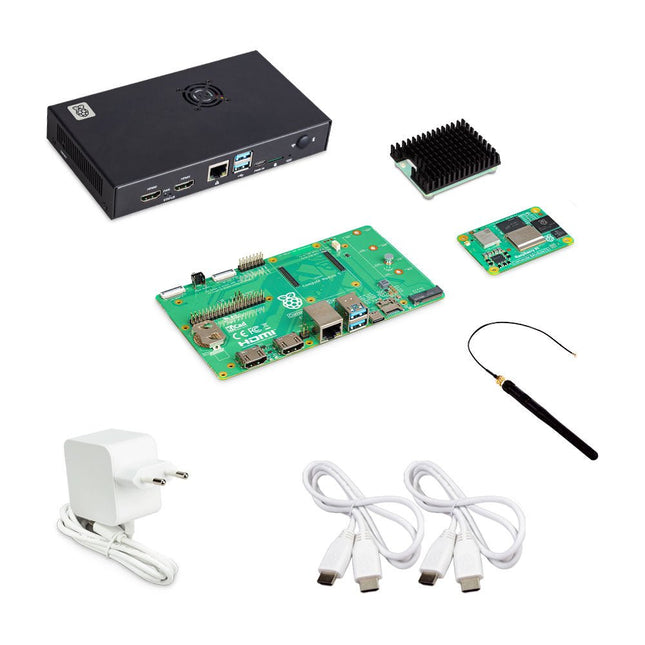
Raspberry Pi Foundation Kit de développement Raspberry Pi Compute Module 5
Le kit de développement Raspberry Pi Compute Module 5 fournit une plate-forme idéale pour le prototypage de solutions embarquées. Ce kit tout-en-un contient le Compute Module 5, la carte IO Compute Module 5 et tous les accessoires nécessaires pour démarrer la conception de votre produit. Compute Module 5 (CM5104032) Processeur Arm Cortex-A76 quadricœur 64 bits à 2,4 GHz GPU VideoCore VII, compatible avec OpenGL ES 3.1 et Vulkan 1.3 4 Go de SDRAM LPDDR4X-4267 32 Go de mémoire eMMC MLC 1x Double sortie d'affichage HDMI 4Kp60 1x Décodeur HEVC 4Kp60 1x Wi-Fi 802.11ac double bande et Bluetooth 5.0 2x Interfaces USB 3.0, prenant en charge un fonctionnement simultané à 5 Gbit/s 1x Gigabit Ethernet, avec prise en charge IEEE 1588 2x Émetteurs-récepteurs de caméra/écran MIPI à 4 voies 1x Interface PCIe 2.0 pour périphériques rapides 30 GPIO, prenant en charge un fonctionnement à 1,8 V ou 3,3 V Périphériques : UART, SPI, I²C, I²S, SDIO et PWM Carte IO Compute Module 5 1x GPIO standard à 40 broches 2x HDMI 2.0 pleine taille 2x FPC MIPI DSI/CSI-2 à 4 voies (câble à 22 broches, pas de 0,5 mm) 2x USB 3.0 1x Prise Ethernet Gigabit avec prise en charge PoE+ (nécessite un Raspberry Pi PoE+ HAT+) 1x Prise PCIe M.2 M-key (pour modules 2230, 2242, 2260 et 2280) 1x Emplacement pour carte microSD (à utiliser avec les modules Lite) 1x Prise de batterie RTC 1x Connecteur de ventilateur à 4 broches Boîtier IO Raspberry Pi Compute Module 5 Le boîtier métallique transforme la carte IO en un ordinateur entièrement fermé de qualité industrielle. Conçu spécifiquement pour le Raspberry Pi Compute Module 5, le boîtier IO est doté d'un ventilateur intégré qui se connecte au connecteur de ventilateur à 4 broches de la carte IO, garantissant des performances thermiques améliorées. Inclus 1x Raspberry Pi Compute Module 5 (sans fil, 4 Go de RAM, 32 Go d'eMMC) 1x Raspberry Pi Compute Module 5 carte IO (fournie pré-installée dans le boîtier IO) 1x Raspberry Pi Compute Module 5 boîtier IO 1x Raspberry Pi Compute Module 5 refroidisseur 1x Raspberry Pi kit d'antenne 1x Raspberry Pi 27 W USB-C PD alimentation (UE) 2x Raspberry Pi câbles HDMI vers HDMI 1x Raspberry Pi câble USB-A vers USB-C Téléchargements Datasheet (Compute Module 5) Datasheet (IO Board) Datasheet (IO Case) Datasheet (Cooler) Datasheet (Antenna Kit)
-

Raspberry Pi Foundation Raspberry Pi caméra AI
La caméra Raspberry Pi AI est un module de caméra compact basé sur le capteur de vision intelligent Sony IMX500. L'IMX500 combine un capteur d'image CMOS de 12 MP avec une accélération d'inférence intégrée pour divers modèles de réseaux neuronaux courants, ce qui permet aux utilisateurs de développer des applications d'IA sophistiquées basées sur la vision sans nécessiter d'accélérateur séparé. La caméra AI améliore les images fixes ou vidéo capturées avec des métadonnées tensorielles, tout en laissant le processeur du Raspberry Pi libre pour d'autres tâches. La prise en charge des métadonnées tensorielles dans les bibliothèques libcamera et Picamera2, ainsi que dans la suite d'applications rpicam-apps, garantit la facilité d'utilisation pour les débutants tout en offrant une puissance et une flexibilité inégalées pour les utilisateurs avancés. La caméra Raspberry Pi AI est compatible avec tous les modèles de Raspberry Pi. Caractéristiques Capteur de vision intelligent Sony IMX500 12 MP Modes du capteur : 4056 x 3040 (@ 10fps), 2028 x 1520 (@ 30fps) Taille des cellules de 1,55 x 1,55 µm Champ de vision de 78° avec mise au point réglable manuellement RP2040 intégré pour la gestion du réseau neuronal et du micrologiciel Spécifications Capteur Sony IMX500 Résolution 12,3 MP (4 056 x 3 040 pixels) Taille du capteur 7,857 mm (type 1/2,3) Taille des pixels 1,55 x 1,55 μm Filtre anti-IR Intégré Autofocus Mise au point réglable manuellement Plage de mise au point 20 cm – ∞ Longueur focale 4,74 mm Champ de vue horizontal 66 ±3° Champ de vue vertical 52,3 ±3° Rapport focal (F-stop) F1.79 Sortie Image (Bayer RAW10), sortie FAI (YUV/RGB), ROI, métadonnées Taille maximale du tenseur d'entrée 640 x 640 (H x V) Taux de rafraîchissement • 2 x 2 regroupés : 2028 x 1520 10 bits, 30 ips• Pleine résolution : 4056 x 3040, 10 bits, 10 ips Longueur du câble ruban 20 cm Connecteur de câble 15 x 1 mm FPC ou 22 x 0,5 mm FPC Dimensions 25 x 24 x 11,9 mm Téléchargements Datasheet Documentation


-
, par Lobna Belarbi Kickstart Your Electronics Journey with Elektor’s Learning Collection
Whether you're new to electronics or aiming to level up your embedded skills, Elektor’s Learning Collection delivers expert-curated kits, courses, and hands-on bundles. The first...
