
Résultats de la recherche pour "c OR programming OR on OR raspberry OR pi"
-
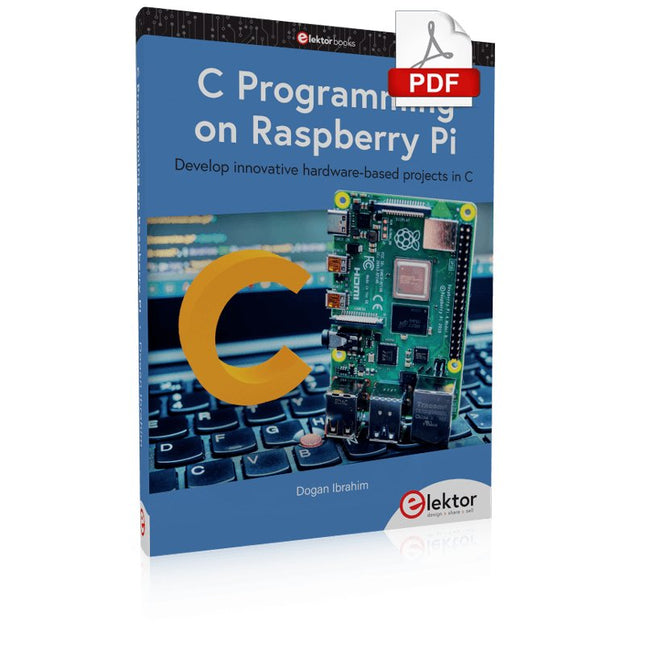
Elektor Digital C Programming on Raspberry Pi (E-book)
Develop innovative hardware-based projects in C The Raspberry Pi has traditionally been programmed using Python. Although this is a very powerful language, many programmers may not be familiar with it. C on the other hand is perhaps the most commonly used programming language and all embedded microcontrollers can be programmed using it. The C language is taught in most technical colleges and universities and almost all engineering students are familiar with using it with their projects. This book is about using the Raspberry Pi with C to develop a range of hardware-based projects. Two of the most popular C libraries, wiringPi and pigpio are used. The book starts with an introduction to C and most students and newcomers will find this chapter invaluable. Many projects are provided in the book, including using Wi-Fi and Bluetooth to establish communication with smartphones. Many sensor and hardware-based projects are included. Both wiringPi and pigpio libraries are used in all projects. Complete program listings are given with full explanations. All projects have been fully tested and work. The following hardware-based projects are provided in the book: Using sensors Using LCDs I²C and SPI buses Serial communication Multitasking External and timer interrupts Using Wi-Fi Webservers Communicating with smartphones Using Bluetooth Sending data to the cloud Program listings of all Raspberry Pi projects developed in this book are available on the Elektor website. Readers can download and use these programs in their projects. Alternatively, they can customize them to suit their applications.
€ 32,95
Membres € 26,36
-
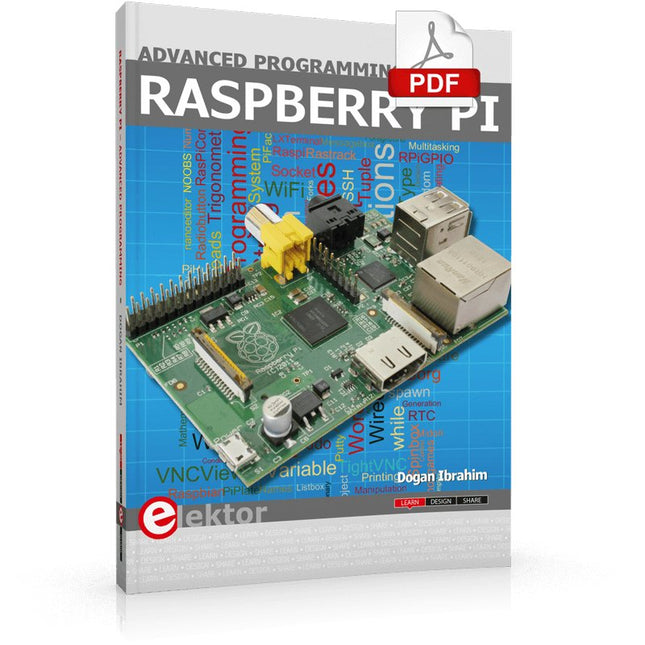
Elektor Digital Raspberry Pi Advanced Programming (E-book)
This book is about advanced programming of the Raspberry Pi computer using the Python programming language. The book explains in simple terms and with examples: How to configure the Raspberry Pi computer; How to install and use the Linux operating system and the desktop; How to write advanced programs using the Python programming language; How to use graphics in our programs; How to develop hardware based projects using the Raspberry Pi. The book starts with an introduction to the Raspberry Pi computer and covers the topics of purchasing all the necessary accessories and installing and operating the Linux operating system in command mode. The network interface of the RPi is explained in simple steps, demonstrating how the computer can be accessed remotely from a desktop or a laptop computer. The remaining parts of the book cover the Python programming language in detail, including advanced topics such as operating system calls, multitasking, interprocess synchronization and interprocess communication techniques. The important topic of network programming using UDP and TCP protocols is described with working examples. The Tkinter graphical user interface module (GUI) is described in detail with example widgets and programs. The last part of the book includes hardware projects based on using the advanced programming topics such as multitasking and interprocess communication techniques. All the projects given in the book have been fully tested and are working. Complete program listings of all projects are provided with detailed explanations.
€ 34,95
Membres € 27,96
-
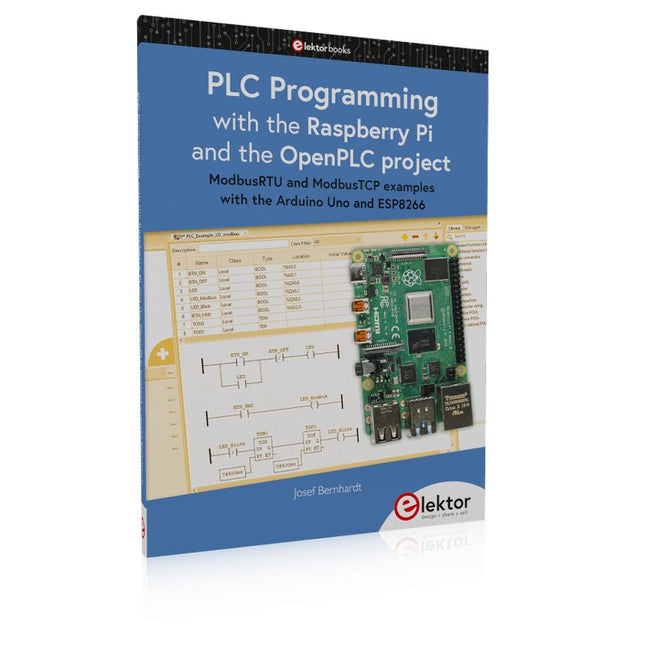
Elektor Publishing PLC Programming with the Raspberry Pi and the OpenPLC Project
ModbusRTU and ModbusTCP examples with the Arduino Uno and ESP8266 Introduction to PLC programming with OpenPLC, the first fully open source Programmable Logic Controller on the Raspberry Pi, and Modbus examples with Arduino Uno and ESP8266 PLC programming is very common in industry and home automation. This book describes how the Raspberry Pi 4 can be used as a Programmable Logic Controller. Before taking you into the programming, the author starts with the software installation on the Raspberry Pi and the PLC editor on the PC, followed by a description of the hardware. You'll then find interesting examples in the different programming languages complying with the IEC 61131-3 standard. This manual also explains in detail how to use the PLC editor and how to load and execute the programs on the Raspberry Pi. All IEC languages are explained with examples, starting with LD (Ladder Diagram) over ST (Structured Control Language) to SFC (Special Function Chart). All examples can be downloaded from the author's website. Networking gets thorough attention too. The Arduino Uno and the ESP8266 are programmed as ModbusRTU or ModbusTCP modules to get access to external peripherals, reading sensors and switching electrical loads. I/O circuits complying with the 24 V industry standard may also be of interest for the reader. The book ends with an overview of commands for ST and LD. After reading the book, the reader will be able to create his own controllers with the Raspberry Pi.
€ 39,95
Membres € 35,96
-
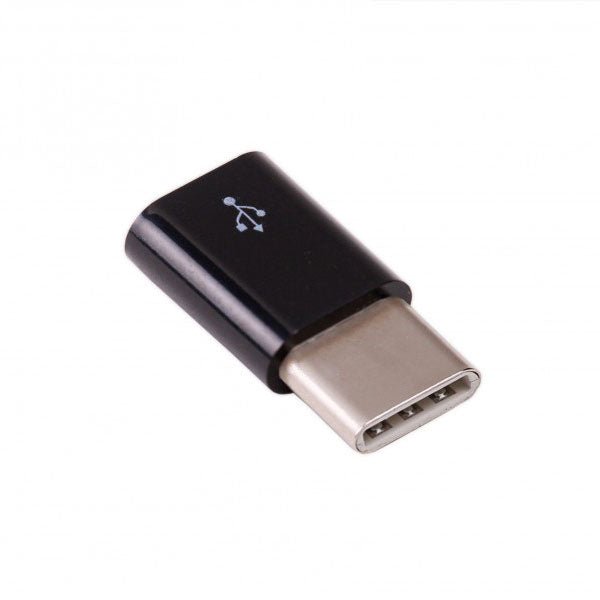
Raspberry Pi Foundation Official Raspberry Pi USB-C Adapter (black)
Ce petit adaptateur permet de convertir une alimentation micro USB existante en alimentation USB-C.
€ 0,95€ 0,38
Membres identique
-
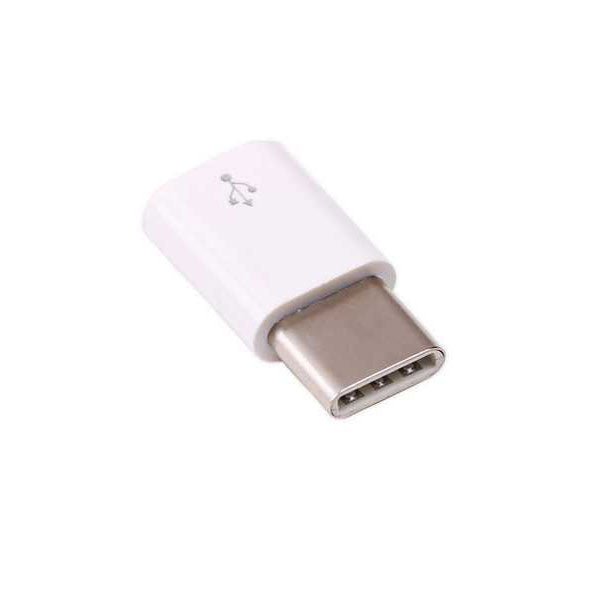
Raspberry Pi Foundation Official Raspberry Pi USB-C Adapter (white)
Ce petit adaptateur permet de convertir une alimentation micro USB existante en alimentation USB-C.
€ 0,95€ 0,38
Membres identique
-
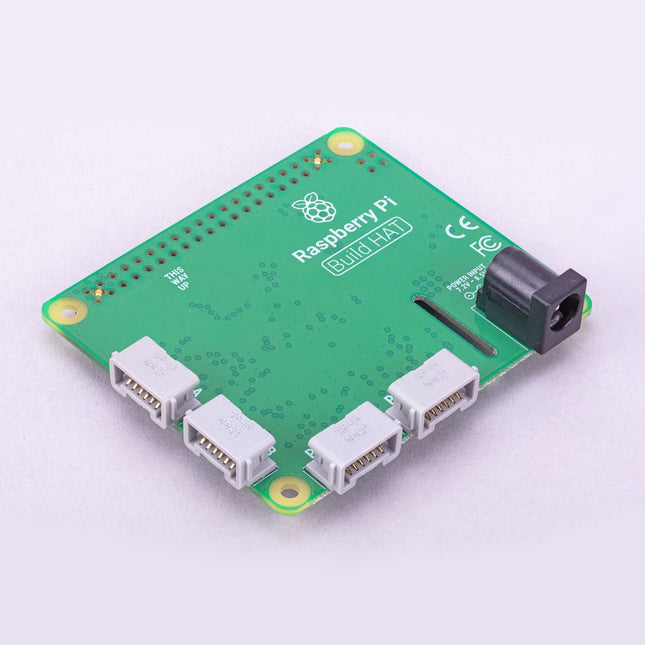
Raspberry Pi Foundation Raspberry Pi Build HAT
Construisez des machines robustes et intelligentes qui combinent la puissance de calcul du Raspberry Pi avec des composants LEGO. Le Raspberry Pi Build HAT fournit quatre connecteurs pour les moteurs et capteurs LEGO Technic du portefeuille SPIKE. Les capteurs disponibles comprennent un capteur de distance, un capteur de couleur et un capteur de force polyvalent. Les moteurs angulaires sont disponibles dans une gamme de tailles et comprennent des encodeurs intégrés qui peuvent être interrogés pour trouver leur position. Le Build HAT s'adapte à tous les ordinateurs Raspberry Pi dotés d'un connecteur GPIO à 40 broches, y compris – avec l'ajout d'un câble ruban ou d'un autre périphérique d'extension – le Raspberry Pi 400. Les appareils LEGO Technic connectés peuvent facilement être contrôlés en Python, aux côtés des accessoires Raspberry Pi standard. tel qu'un module de caméra. Caractéristiques Contrôle jusqu'à 4 moteurs et capteurs Alimente le Raspberry Pi (lorsqu'il est utilisé avec un bloc d'alimentation externe approprié) Facile à utiliser depuis Python sur le Raspberry Pi
€ 29,95€ 11,98
Membres identique
-
Elektor Publishing Programming Voice-controlled IoT Applications with Alexa and Raspberry Pi
Learn programming for Alexa devices, extend it to smart home devices and control the Raspberry Pi The book is split into two parts: the first part covers creating Alexa skills and the second part, designing Internet of Things and Smart Home devices using a Raspberry Pi. The first chapters describe the process of Alexa communication, opening an Amazon account and creating a skill for free. The operation of an Alexa skill and terminology such as utterances, intents, slots, and conversations are explained. Debugging your code, saving user data between sessions, S3 data storage and Dynamo DB database are discussed. In-skill purchasing, enabling users to buy items for your skill as well as certification and publication is outlined. Creating skills using AWS Lambda and ASK CLI is covered, along with the Visual Studio code editor and local debugging. Also covered is the process of designing skills for visual displays and interactive touch designs using Alexa Presentation Language. The second half of the book starts by creating a Raspberry Pi IoT 'thing' to control a robot from your Alexa device. This covers security issues and methods of sending and receiving MQTT messages between an Alexa device and the Raspberry Pi. Creating a smart home device is described including forming a security profile, linking with Amazon, and writing a Lambda function that gets triggered by an Alexa skill. Device discovery and on/off control is demonstrated. Next, readers discover how to control a smart home Raspberry Pi display from an Alexa skill using Simple Queue Service (SQS) messaging to switch the display on and off or change the color. A node-RED design is discussed from the basic user interface right up to configuring MQTT nodes. MQTT messages sent from a user are displayed on a Raspberry Pi. A chapter discusses sending a proactive notification such as a weather alert from a Raspberry Pi to an Alexa device. The book concludes by explaining how to create Raspberry Pi as a stand-alone Alexa device.
€ 39,95
Membres € 35,96
-
Elektor Digital PLC Programming with the Raspberry Pi and the OpenPLC Project (E-book)
ModbusRTU and ModbusTCP examples with the Arduino Uno and ESP8266 Introduction to PLC programming with OpenPLC, the first fully open source Programmable Logic Controller on the Raspberry Pi, and Modbus examples with Arduino Uno and ESP8266 PLC programming is very common in industry and home automation. This book describes how the Raspberry Pi 4 can be used as a Programmable Logic Controller. Before taking you into the programming, the author starts with the software installation on the Raspberry Pi and the PLC editor on the PC, followed by a description of the hardware. You'll then find interesting examples in the different programming languages complying with the IEC 61131-3 standard. This manual also explains in detail how to use the PLC editor and how to load and execute the programs on the Raspberry Pi. All IEC languages are explained with examples, starting with LD (Ladder Diagram) over ST (Structured Control Language) to SFC (Special Function Chart). All examples can be downloaded from the author's website. Networking gets thorough attention too. The Arduino Uno and the ESP8266 are programmed as ModbusRTU or ModbusTCP modules to get access to external peripherals, reading sensors and switching electrical loads. I/O circuits complying with the 24 V industry standard may also be of interest for the reader. The book ends with an overview of commands for ST and LD. After reading the book, the reader will be able to create his own controllers with the Raspberry Pi.
€ 32,95
Membres € 26,36
-
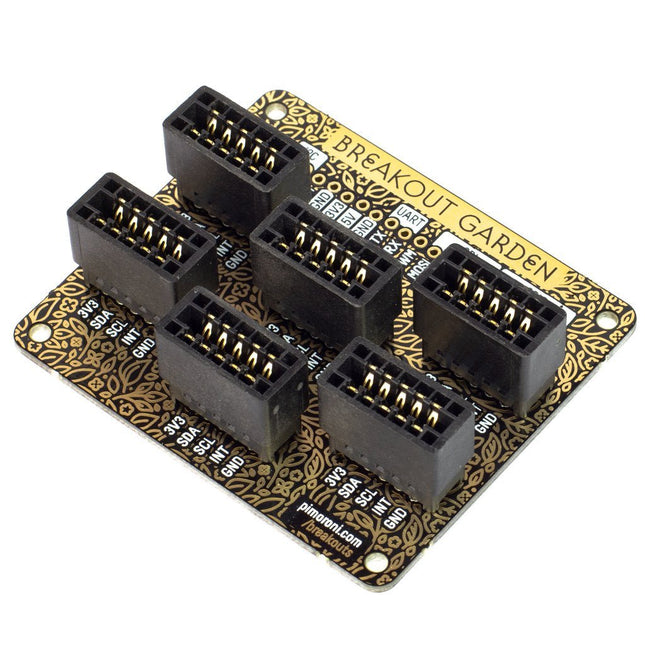
Pimoroni Pimoroni Breakout Garden pour Raspberry Pi (I²C)
Grâce à ses six emplacements robustes, Breakout Garden permet aux utilisateurs de simplement brancher et jouer avec diverses petites cartes de dérivation. Insérez simplement une ou plusieurs planches dans les emplacements du Breakout Garden HAT et vous êtes prêt à partir. Les mini-breakouts se sentent suffisamment en sécurité dans les fentes des connecteurs de bord et il est très peu probable qu'elles tombent. Il y a un certain nombre de broches utiles en haut de Breakout Garden, qui vous permettent de connecter d'autres appareils et de les intégrer dans votre projet. Vous ne devriez pas vous inquiéter si vous insérez une carte dans le mauvais sens grâce à la protection contre l'inversion de polarité fournie. Peu importe non plus l'emplacement que vous utilisez pour chaque dérivation, car l'adresse I²C de la dérivation sera reconnue par le logiciel et il les détectera correctement au cas où vous les déplaceriez. Caractéristiques Six emplacements de connecteur de bord robustes pour les sorties Pimoroni Pas de 0,1", connecteurs à 5 broches Broches cassées (bande 1 × 10 ou embase mâle incluse) Entretoises (M2,5, hauteur 10 mm) incluses pour maintenir votre Breakout Garden en toute sécurité Protection contre l'inversion de polarité (intégrée aux breakouts) Carte format HAT Compatible avec Raspberry Pi 3 B+, 3, 2, B+, A+, Zero et Zero W Il est suggéré d'utiliser les entretoises incluses pour fixer Breakout Garden à votre Raspberry Pi. Logiciel Breakout Garden ne nécessite aucun logiciel propre, mais chaque breakout que vous utiliserez aura besoin d'une bibliothèque Python. Sur la page GitHub de Breakout Garden, vous trouverez un programme d'installation automatique, qui installera le logiciel approprié pour une évasion donnée. Il existe également quelques exemples qui vous montrent ce que vous pouvez faire d'autre avec Breakout Garden.
€ 19,95€ 7,98
Membres identique
-
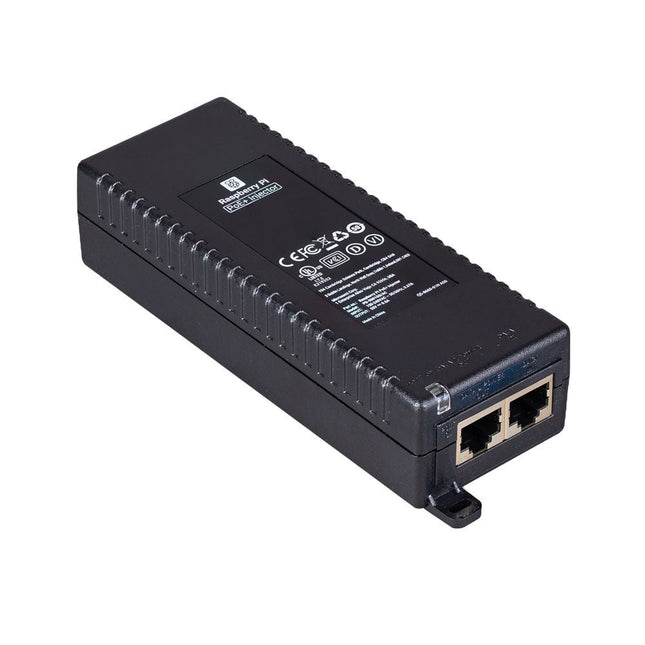
Raspberry Pi Foundation Raspberry Pi PoE+ Injector
L'injecteur PoE+ pour Raspberry Pi ajoute la fonctionnalité Power-over-Ethernet (PoE) à un seul port d'un commutateur Ethernet non PoE, fournissant à la fois l'alimentation et les données via un seul câble Ethernet. Il offre une solution plug-and-play et économique pour introduire progressivement la fonctionnalité PoE dans les réseaux Ethernet existants. L'injecteur PoE+ est un appareil monoport de 30 W, adapté à l'alimentation des équipements conformes aux normes IEEE 802.3af et 802.3at, y compris toutes les générations de HAT PoE pour Raspberry Pi. Il prend en charge des débits réseau de 10/100/1000 Mbit/s. Remarque : Un câble secteur IEC séparé est requis pour le fonctionnement (non fourni). Spécifications Débit de données 10/100/1000 Mbit/s Tension d'entrée 100 à 240 V CA Puissance de sortie 30 W Puissance de sortie sur les broches 4/5 (+), 7/8 (–) Tension de sortie nominale 55 V CC Connecteurs de données RJ-45 blindé, EIA 568A et 568B Connecteur d'alimentation Entrée secteur IEC c13 (non fournie) Humidité de stockage Maximum 95%, sans condensation Altitude de fonctionnement –300 m à 3000 m Température ambiante de fonctionnement 10°C à +50°C Dimensions 159 x 51,8 x 33,5 mm Téléchargements Datasheet
€ 29,95€ 11,98
Membres identique
-
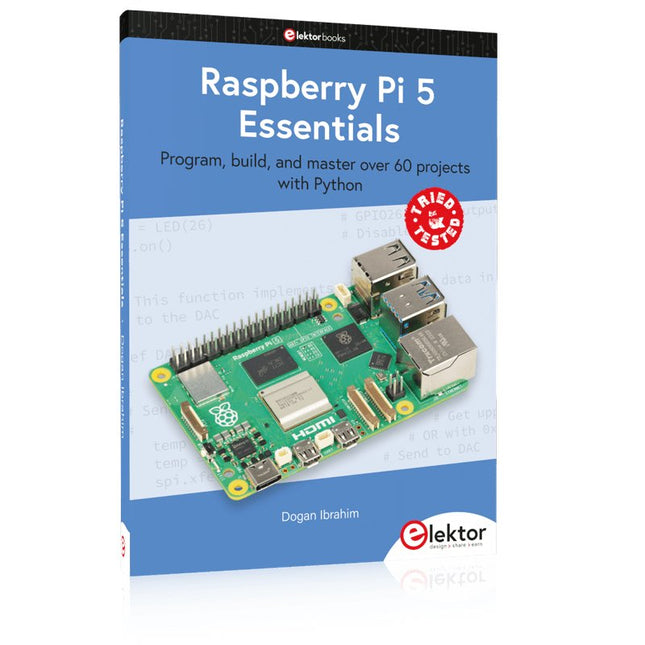
Elektor Publishing Raspberry Pi 5 Essentials
Program, build, and master over 60 projects with Python The Raspberry Pi 5 is the latest single-board computer from the Raspberry Pi Foundation. It can be used in many applications, such as in audio and video media centers, as a desktop computer, in industrial controllers, robotics, and in many domestic and commercial applications. In addition to the well-established features found in other Raspberry Pi computers, the Raspberry Pi 5 offers Wi-Fi and Bluetooth (classic and BLE), which makes it a perfect match for IoT as well as in remote and Internet-based control and monitoring applications. It is now possible to develop many real-time projects such as audio digital signal processing, real-time digital filtering, real-time digital control and monitoring, and many other real-time operations using this tiny powerhouse. The book starts with an introduction to the Raspberry Pi 5 computer and covers the important topics of accessing the computer locally and remotely. Use of the console language commands as well as accessing and using the desktop GUI are described with working examples. The remaining parts of the book cover many Raspberry Pi 5-based hardware projects using components and devices such as LEDs and buzzers LCDs Ultrasonic sensors Temperature and atmospheric pressure sensors The Sense HAT Camera modules Example projects are given using Wi-Fi and Bluetooth modules to send and receive data from smartphones and PCs, and sending real-time temperature and atmospheric pressure data to the cloud. All projects given in the book have been fully tested for correct operation. Only basic programming and electronics experience are required to follow the projects. Brief descriptions, block diagrams, detailed circuit diagrams, and full Python program listings are given for all projects described.
€ 39,95
Membres € 35,96
-
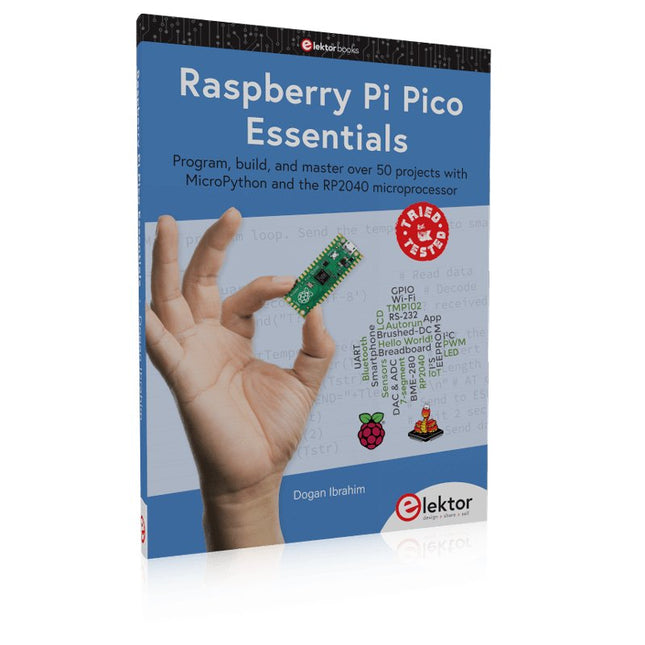
Elektor Publishing Raspberry Pi Pico Essentials
Le Raspberry Pi Pico est un microcontrôleur de haute performance conçu spécialement pour l'informatique physique. N'ayant pas de système d'exploitation, les microcontrôleurs diffèrent des ordinateurs monocartes, comme le Raspberry Pi 4. Le Raspberry Pi Pico peut être programmé pour exécuter efficacement une seule tâche dans des applications de contrôle et de surveillance en temps réel nécessitant de la rapidité. Le 'Pico', comme on l'appelle, est basé sur le microcontrôleur ARM Cortex-M0+ RP2040 à double cœur, rapide, efficace et peu coûteux, fonctionnant jusqu'à 133 MHz et disposant de 264 Ko de SRAM et de 2 Mo de mémoire Flash. Outre sa grande mémoire, le Pico présente des caractéristiques encore plus attrayantes, notamment un grand nombre de broches GPIO et des modules d'interface populaires comme ADC, SPI, I²C, UART et PWM. Pour couronner le tout, il offre des modules de synchronisation rapides et précis, une interface de débogage matériel et un capteur de température interne.Le Raspberry Pi Pico se programme facilement à l'aide des langages de haut niveau les plus courants, tels que MicroPython ou C/C++. Ce livre est une introduction à l'utilisation du microcontrôleur Raspberry Pi Pico avec le langage de programmation MicroPython. L'environnement de développement (IDE) Thonny est utilisé dans tous les projets décrits. Le livre contient plus de 50 projets testés et fonctionnels couvrant les sujets suivants:Installation de MicroPython sur Raspberry Pi Pico à l'aide d'un Raspberry Pi ou d'un PCLes interruptions du Timer et les interruptions externesDes projets sur convertisseur analogique-numérique Utilisation du capteur de température interne et du capteur de température externeDes projets d'enregistrement de donnéesDes projets de PWM, UART, I²C, et SPI Utilisation du Wi-Fi et des applications pour communiquer avec les smartphonesUtilisation de Bluetooth et d'applications pour communiquer avec les smartphonesDes projets sur convertisseur numérique-analogiqueTous les projets présentés dans ce livre sont fonctionnels et ont été entièrement testés. Des connaissances de base en programmation et en électronique sont nécessaires pour suivre les projets. De brèves descriptions, des schémas fonctionnels, des schémas de circuits détaillés et des listings complets des programmes MicroPython sont fournis pour tous les projets décrits. Les lecteurs peuvent trouver les listings des programmes sur la page Web Elektor créée à l'appui de ce livre.
€ 39,95
Membres € 35,96
