
Résultats de la recherche pour "pimoroni OR automation OR hat"
-
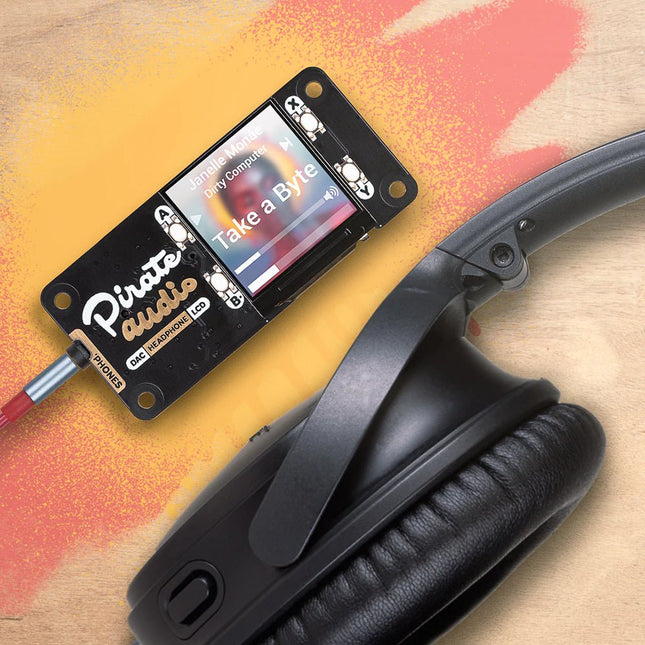
Pimoroni Pimoroni Pirate Audio : Amplificateur de casque pour Raspberry Pi
Vous pouvez utiliser l'amplificateur de casque Pirate Audio pour construire un lecteur de poche bien rangé pour les fichiers audio locaux (MP3, FLAC, etc.) ou pour la diffusion de musique en continu à partir de services en ligne comme Spotify. Pour vous aider à démarrer, Pimoroni a créé des plugins pour Mopidy qui vous permettront d'afficher de superbes pochettes d'album, de lire et pauser vos morceaux et de régler le volume. Le convertisseur numérique-analogique et l'amplificateur pour casque d'écoute vous permettront de bénéficier d'un son numérique amplifié d'une grande netteté dans votre casque. Pirate Audio est une gamme de cartes audio tout-en-un pour Raspberry Pi, avec un son numérique de haute qualité, des écrans IPS d'une grande netteté pour les pochettes d'album, des boutons tactiles pour la commande de lecture, et un logiciel et un installateur Pirate Audio personnalisés pour faciliter la configuration.CaractéristiquesAudio numérique amplifié (24 bits / 192 KHz) sur I2SPuce amplificateur PAM8908 pour casqueCommutateur à faible gain / gain élevé (le gain élevé augmente de 12dB)Puce CNA PCM5100ASortie stéréo 3.5 mmÉcran LCD couleur IPS de 1,3 pouce (240 x 240 px) (Pilote ST7789)Quatre boutons tactiles/li>Carte au format Mini HATEntièrement assembléCompatible avec tous les modèles de Raspberry Pi à 40 broches.Dimensions : 65x30.5x9.5 mmLogicielLe logiciel et le programme d'installation de Pirate Audio installent la bibliothèque Python pour l'écran LCD, configurent l'audio I2S et le SPI, puis installent Mopidy et nos plugins Pirate Audio personnalisés pour afficher la pochette de l'album et les informations sur les pistes, et pour utiliser les boutons pour contrôler la lecture.Voici comment démarrer :Configurer une carte SD avec la dernière version du système d'exploitation de Raspberry Pi.Connectez-vous à un réseau wifi ou à un réseau filaire.Ouvrez un terminal et tapez ce qui suit :git clone https://github.com/pimoroni/pirate-audiocd pirate-audio/mopidysudo ./install.shRedémarrez votre RPiTéléchargementsFiche technique du PAM8908Fiche technique du PCM5100ALogiciel Pirate Audio
€ 26,95€ 17,95
Membres identique
-
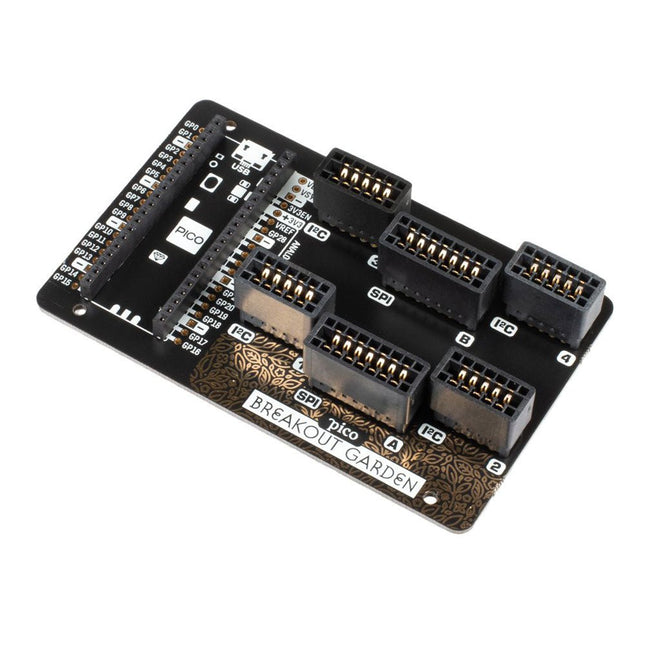
Pimoroni Pimoroni Raspberry Pi Pico Breakout Base de jardin
La base de jardin Pico Breakout se trouve sous votre Pico et vous permet d'y connecter jusqu'à six de notre vaste sélection de sorties Pimoroni. Qu'il s'agisse de capteurs environnementaux pour que vous puissiez suivre la température et l'humidité dans votre bureau, de toute une série de petits écrans pour les notifications et lectures importantes et, bien sûr, de LED. Faites défiler vers le bas pour une liste des sous-commissions actuellement compatibles avec nos bibliothèques C++/MicroPython ! En plus d'une zone d'atterrissage étiquetée pour votre Pico, il existe également un ensemble complet de connexions Pico découpées, au cas où vous auriez besoin de connecter encore plus de capteurs, de fils et de circuits. Nous avons ajouté des pieds en caoutchouc pour maintenir la base bien stable et pour l'empêcher de rayer votre bureau, ou il y a des trous de montage M2,5 dans les coins afin que vous puissiez la boulonner sur une surface solide si vous préférez. Les six emplacements noirs robustes sont des connecteurs de bord qui relient les sorties aux broches de votre Pico. Il y a deux emplacements pour les sorties SPI et quatre emplacements pour les sorties I²C. Parce qu'I²C est un bus, vous pouvez utiliser plusieurs appareils I²C en même temps, à condition qu'ils n'aient pas la même adresse I²C (nous nous sommes assurés que toutes nos sorties ont des adresses différentes, et nous les imprimons au dos de chaque bus). les éruptions cutanées pour qu'elles soient faciles à trouver). En plus d'être un moyen pratique d'ajouter des fonctionnalités à votre Pico, Breakout Garden est également très utile pour les projets de prototypage sans avoir besoin de câblage, de soudure ou de planches à pain compliqués, et vous pouvez agrandir ou modifier votre configuration à tout moment. Caractéristiques Six emplacements de connecteur de bord robustes pour les ruptures 4x emplacements I²C (5 broches) 2x emplacement SPI (7 broches) Zone d'atterrissage avec embases femelles pour Raspberry Pi Pico Pas de 0,1", connecteurs 5 ou 7 broches Des épingles cassées Protection contre l'inversion de polarité (intégrée aux breakouts) 99% assemblé – il suffit de coller les pieds ! Compatible avec Raspberry Pi Pico
€ 17,95€ 7,18
Membres identique
-
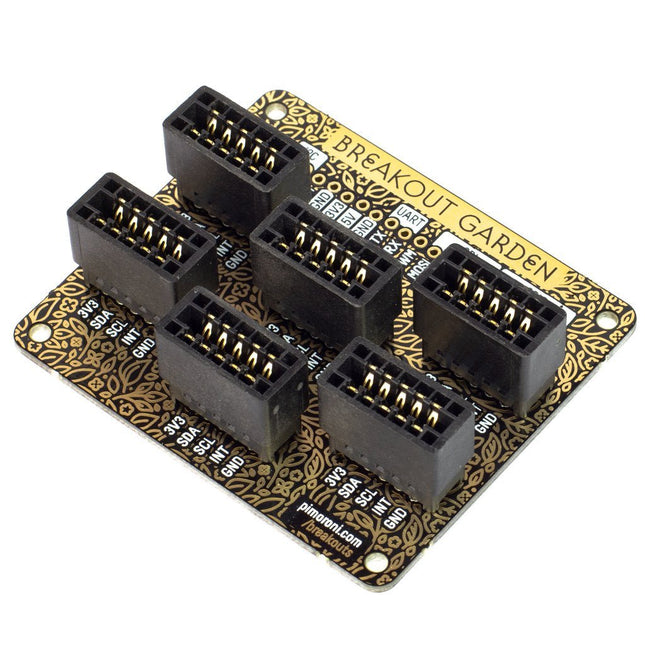
Pimoroni Pimoroni Breakout Garden pour Raspberry Pi (I²C)
Grâce à ses six emplacements robustes, Breakout Garden permet aux utilisateurs de simplement brancher et jouer avec diverses petites cartes de dérivation. Insérez simplement une ou plusieurs planches dans les emplacements du Breakout Garden HAT et vous êtes prêt à partir. Les mini-breakouts se sentent suffisamment en sécurité dans les fentes des connecteurs de bord et il est très peu probable qu'elles tombent. Il y a un certain nombre de broches utiles en haut de Breakout Garden, qui vous permettent de connecter d'autres appareils et de les intégrer dans votre projet. Vous ne devriez pas vous inquiéter si vous insérez une carte dans le mauvais sens grâce à la protection contre l'inversion de polarité fournie. Peu importe non plus l'emplacement que vous utilisez pour chaque dérivation, car l'adresse I²C de la dérivation sera reconnue par le logiciel et il les détectera correctement au cas où vous les déplaceriez. Caractéristiques Six emplacements de connecteur de bord robustes pour les sorties Pimoroni Pas de 0,1", connecteurs à 5 broches Broches cassées (bande 1 × 10 ou embase mâle incluse) Entretoises (M2,5, hauteur 10 mm) incluses pour maintenir votre Breakout Garden en toute sécurité Protection contre l'inversion de polarité (intégrée aux breakouts) Carte format HAT Compatible avec Raspberry Pi 3 B+, 3, 2, B+, A+, Zero et Zero W Il est suggéré d'utiliser les entretoises incluses pour fixer Breakout Garden à votre Raspberry Pi. Logiciel Breakout Garden ne nécessite aucun logiciel propre, mais chaque breakout que vous utiliserez aura besoin d'une bibliothèque Python. Sur la page GitHub de Breakout Garden, vous trouverez un programme d'installation automatique, qui installera le logiciel approprié pour une évasion donnée. Il existe également quelques exemples qui vous montrent ce que vous pouvez faire d'autre avec Breakout Garden.
€ 19,95€ 7,98
Membres identique
-

Elektor Digital Home Automation and Electronics for Starters (E-book)
Projets avec Arduino, ESPHome, Home Assistant, et Raspberry Pi & Co. Ce livre électronique contient plusieurs exemples de projets, en commençant par une introduction à l'électronique. Il explique également comment installer Home Assistant sur un Raspberry Pi, comment utiliser des capteurs de climat intérieur pour la température et l'humidité, comment mettre en œuvre le protocole MQTT et d'autres interfaces, et comment utiliser ESPHome pour intégrer des capteurs et des actionneurs dans Home Assistant. De nombreux tutoriels vidéo complètent le livre. Fundamentals of electrical engineering The book begins with an introduction to electrical engineering. You will learn the basics of voltage, current, resistors, diodes and transistors. Arduino and microcontrollers A complete section is dedicated to the Arduino Uno. You will get to know the structure, write your first programs and work on practical examples. Home Assistant and automation You will learn how to set up Home Assistant on a Raspberry Pi and how to use automations, scenes and devices. In addition, Zigbee, MQTT and ESP-NOW – important technologies for home automation – will be discussed. ESP8266, ESP32 and ESP32-CAM The popular ESP microcontrollers are covered in detail. A theoretical introduction is followed by practical projects that show you how to get the most out of these devices. Sensors and actuators The book explains the functionality and application of numerous sensors such as temperature and humidity sensors, motion detectors and RFID readers. For actuators, stepper motors, e-ink displays, servo motors and much more are covered. There are practical application examples for all devices. ESPHome This chapter shows you how to integrate sensors and actuators into Home Assistant without any programming effort. You will be guided step by step through the setup with ESPHome. LEDs and lighting technology In this chapter, you will learn about different types of LEDs and how they can be used. The basics of lighting technology are also explained. Node-RED A whole chapter is dedicated to Node-RED. You will learn the basics of this powerful tool and be guided step by step through its setup and use. Integrated Circuits (ICs) In electronics, there are numerous ICs that make our lives easier. You will get to know the most important ones and apply your knowledge in practical projects. Professional programming Advanced topics such as the correct use of buttons, the use of interrupts and the use of an NTP server for time synchronisation are covered in detail in this chapter. Downloads GitHub
€ 59,95
Membres identique
-

Elektor Digital Home Automation Projects with Arduino (E-book)
Using the RFID Starter Kit An Arduino board has now become ‘the’ basic component in the maker community. No longer is an introduction to the world of microcontrollers the preserve of the expert. When it comes to expanding the capabilities of the basic Arduino board however, the developer is still largely on his own. If you really want to build some innovative projects it’s often necessary to get down to component level. This can present many beginners with major problems. That is exactly where this book begins. This book explains how a wide variety of practical projects can be built using items supplied in a single kit together with the Arduino board. This kit, called the 'RFID Starter Kit for Arduino' (SKU 17240) is not just limited to RFID applications but contains more than 30 components, devices and modules covering all areas of modern electronics. In addition to more simple components such as LEDs and resistors there are also complex and sophisticated modules that employ the latest technology such as: A humidity sensor A multicolor LED A large LED matrix with 64 points of light A 4-character 7-segment LED display An infra red remote-controller unit A complete LC-display module A servo A stepper motor and controller module A complete RFID reader module and security tag On top of that you will get to build precise digital thermometers, hygrometers, exposure meters and various alarm systems. There are also practical devices and applications such as a fully automatic rain sensor, a sound-controlled remote control system, a multifunctional weather station and so much more. All of the projects described can be built using the components supplied in the Elektor kit.
€ 29,95
Membres € 23,96
-
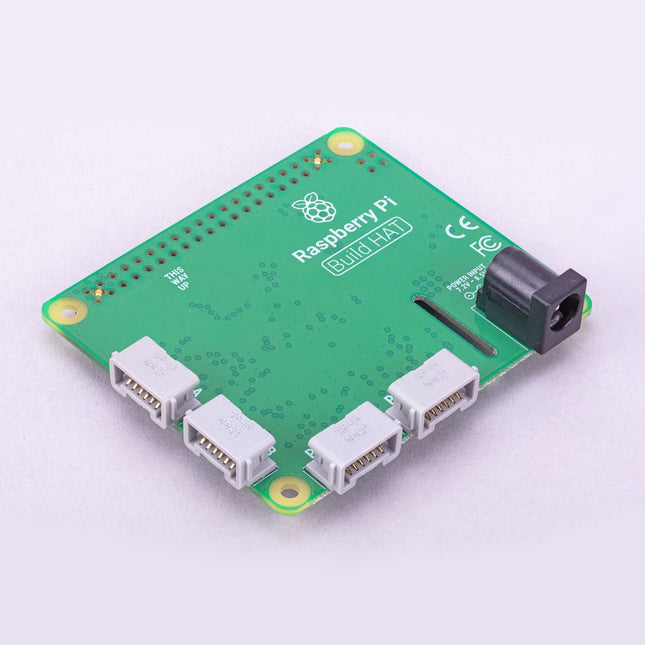
Raspberry Pi Foundation Raspberry Pi Build HAT
Construisez des machines robustes et intelligentes qui combinent la puissance de calcul du Raspberry Pi avec des composants LEGO. Le Raspberry Pi Build HAT fournit quatre connecteurs pour les moteurs et capteurs LEGO Technic du portefeuille SPIKE. Les capteurs disponibles comprennent un capteur de distance, un capteur de couleur et un capteur de force polyvalent. Les moteurs angulaires sont disponibles dans une gamme de tailles et comprennent des encodeurs intégrés qui peuvent être interrogés pour trouver leur position. Le Build HAT s'adapte à tous les ordinateurs Raspberry Pi dotés d'un connecteur GPIO à 40 broches, y compris – avec l'ajout d'un câble ruban ou d'un autre périphérique d'extension – le Raspberry Pi 400. Les appareils LEGO Technic connectés peuvent facilement être contrôlés en Python, aux côtés des accessoires Raspberry Pi standard. tel qu'un module de caméra. Caractéristiques Contrôle jusqu'à 4 moteurs et capteurs Alimente le Raspberry Pi (lorsqu'il est utilisé avec un bloc d'alimentation externe approprié) Facile à utiliser depuis Python sur le Raspberry Pi
€ 29,95€ 11,98
Membres identique
-
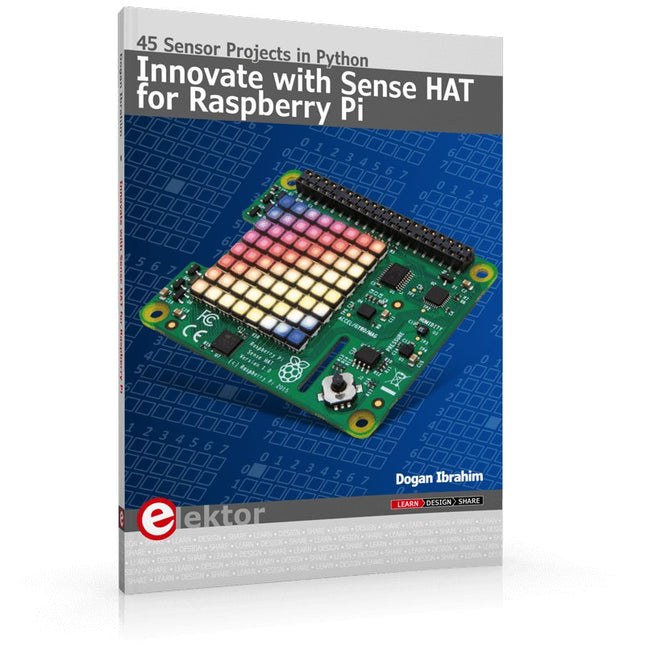
Elektor Publishing Innovate with Sense HAT for Raspberry Pi
Ready to explore the world around you? By attaching the Sense HAT to your Raspberry Pi, you can quickly and easily develop a variety of creative applications, useful experiments, and exciting games. The Sense HAT contains several helpful environmental sensors: temperature, humidity, pressure, accelerometer, magnetometer, and gyroscope. Additionally, an 8x8 LED matrix is provided with RGB LEDs, which can be used to display multi-color scrolling or fixed information, such as the sensor data. Use the small onboard joystick for games or applications that require user input. In Innovate with Sense HAT for Raspberry Pi, Dr. Dogan Ibrahim explains how to use the Sense HAT in Raspberry Pi Zero W-based projects. Using simple terms, he details how to incorporate the Sense HAT board in interesting visual and sensor-based projects. You can complete all the projects with other Raspberry Pi models without any modifications. Exploring with Sense HAT for Raspberry Pi includes projects featuring external hardware components in addition to the Sense HAT board. You will learn to connect the Sense HAT board to the Raspberry Pi using jumper wires so that some of the GPIO ports are free to be interfaced to external components, such as to buzzers, relays, LEDs, LCDs, motors, and other sensors. The book includes full program listings and detailed project descriptions. Complete circuit diagrams of the projects using external components are given where necessary. All the projects were developed using the latest version of the Python 3 programming language. You can easily download projects from the book’s web page. Let’s start exploring with Sense HAT.
€ 34,95
Membres € 31,46
-
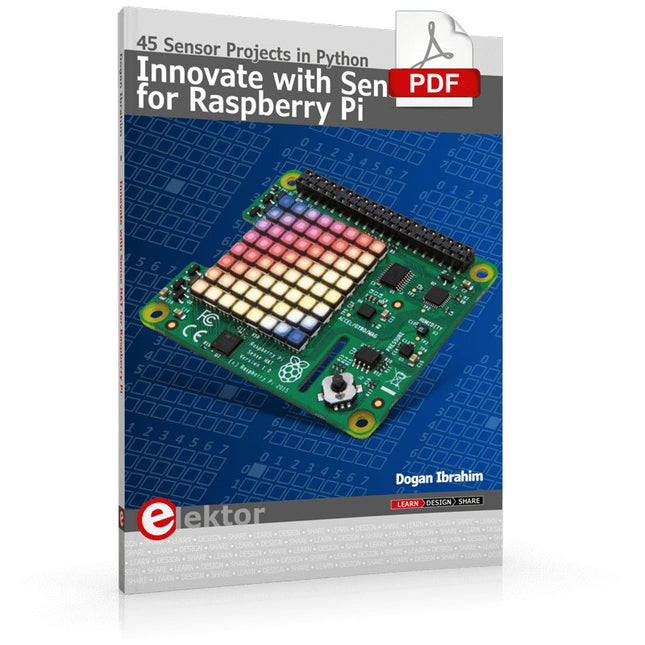
Elektor Digital Innovate with Sense HAT for Raspberry Pi (E-book)
Ready to explore the world around you? By attaching the Sense HAT to your Raspberry Pi, you can quickly and easily develop a variety of creative applications, useful experiments, and exciting games. The Sense HAT contains several helpful environmental sensors: temperature, humidity, pressure, accelerometer, magnetometer, and gyroscope. Additionally, an 8x8 LED matrix is provided with RGB LEDs, which can be used to display multi-color scrolling or fixed information, such as the sensor data. Use the small onboard joystick for games or applications that require user input. In Innovate with Sense HAT for Raspberry Pi, Dr. Dogan Ibrahim explains how to use the Sense HAT in Raspberry Pi Zero W-based projects. Using simple terms, he details how to incorporate the Sense HAT board in interesting visual and sensor-based projects. You can complete all the projects with other Raspberry Pi models without any modifications. Exploring with Sense HAT for Raspberry Pi includes projects featuring external hardware components in addition to the Sense HAT board. You will learn to connect the Sense HAT board to the Raspberry Pi using jumper wires so that some of the GPIO ports are free to be interfaced to external components, such as to buzzers, relays, LEDs, LCDs, motors, and other sensors. The book includes full program listings and detailed project descriptions. Complete circuit diagrams of the projects using external components are given where necessary. All the projects were developed using the latest version of the Python 3 programming language. You can easily download projects from the book’s web page. Let’s start exploring with Sense HAT.
€ 29,95
Membres € 23,96
-
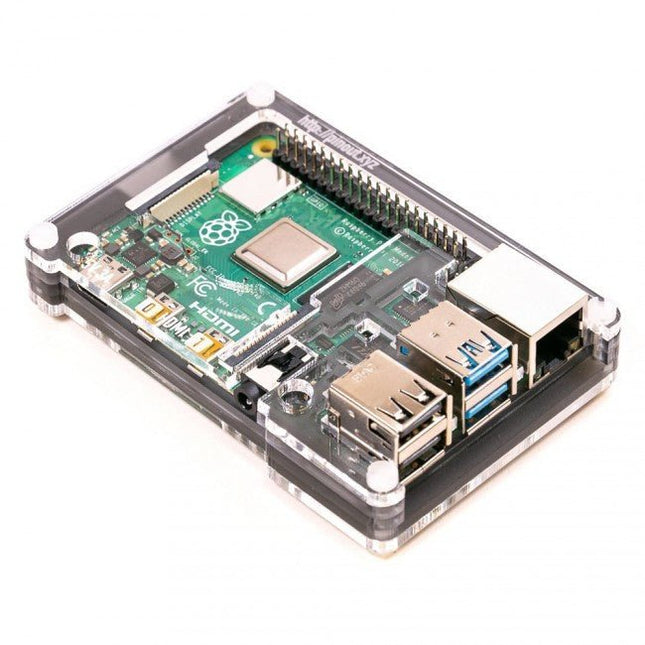
Pimoroni Pibow Coupé 4 (Ninja) – Slim Case for Raspberry Pi 4
Caractéristiques Compatible avec Raspberry Pi 4 uniquement Découpe dans le couvercle pour dissipateur thermique 40x30mm ou ventilateur SHIM Profil ultra fin Entièrement compatible HAT Protège votre Pi bien-aimé Le dessus et la base transparents laissent le Raspberry Pi 4 visible Découpe GPIO Étiquettes postales pratiques gravées au laser Laisse tous les ports accessibles Fabriqué à partir d'acrylique coulé léger et de haute qualité Idéal pour pirater et bricoler ! Fabriqué à Sheffield, Royaume-Uni Pesant un peu plus de 50 grammes, le boîtier est léger et idéal pour être monté sur n'importe quelle surface. Aucun outil n'est requis pour le montage ou le démontage. Les dimensions sont : 99 × 66 × 15 mm. Dans la vidéo ci-dessous, vous pouvez voir un guide de montage rapide.
€ 11,95€ 4,78
Membres identique
-
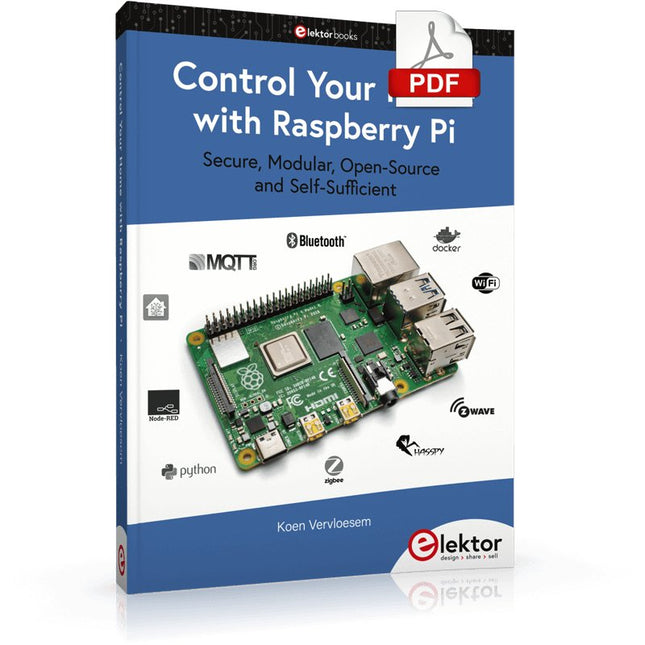
Elektor Digital Control Your Home with Raspberry Pi (E-book)
Secure, Modular, Open-Source and Self-Sufficient Ever since the Raspberry Pi was introduced, it has been used by enthusiasts to automate their homes. The Raspberry Pi is a powerful computer in a small package, with lots of interfacing options to control various devices. This book shows you how you can automate your home with a Raspberry Pi. You’ll learn how to use various wireless protocols for home automation, such as Bluetooth, 433.92 MHz radio waves, Z-Wave, and Zigbee. Soon you’ll automate your home with Python, Node-RED, and Home Assistant, and you’ll even be able to speak to your home automation system. All this is done securely, with a modular system, completely open-source, without relying on third-party services. You’re in control of your home, and no one else. At the end of this book, you can install and configure your Raspberry Pi as a highly flexible home automation gateway for protocols of your choice, and link various services with MQTT to make it your own system. This DIY (do it yourself) approach is a bit more laborious than just installing an off-the-shelf home automation system, but in the process, you can learn a lot, and in the end, you know exactly what’s running your house and how to tweak it. This is why you were interested in the Raspberry Pi in the first place, right? Turn your Raspberry Pi into a reliable gateway for various home automation protocols. Make your home automation setup reproducible with Docker Compose. Secure all your network communication with TLS. Create a video surveillance system for your home. Automate your home with Python, Node-RED, Home Assistant and AppDaemon. Securely access your home automation dashboard from remote locations. Use fully offline voice commands in your own language. Download the software and view the errata for the book on GitHub.
€ 34,95
Membres € 27,96
-
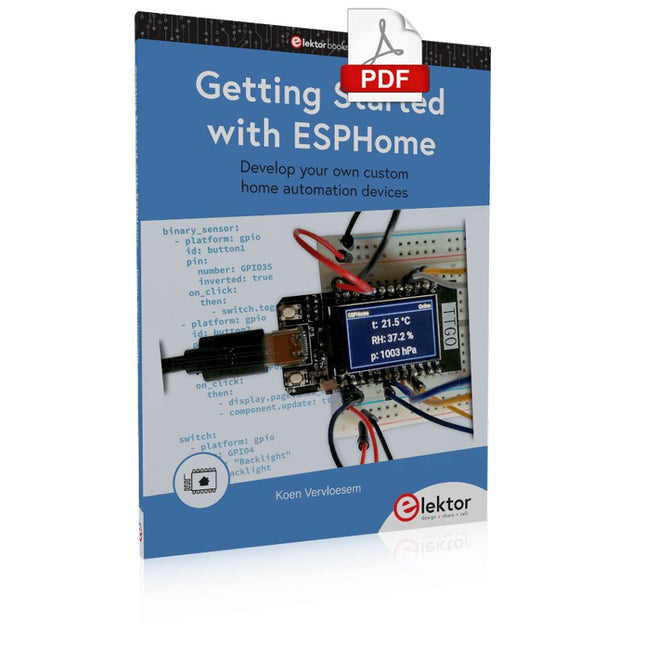
Elektor Digital Getting Started with ESPHome (E-book)
Develop your own custom home automation devices Espressif's ESP8266 and ESP32 microcontrollers have brought DIY home automation to the masses. However, not everyone is fluent in programming these microcontrollers with Espressif's C/C++ SDK, the Arduino core, or MicroPython. This is where ESPHome comes into its own: with this project, you don’t program your microcontroller but configure it. This book demonstrates how to create your own home automation devices with ESPHome on an ESP32 microcontroller board. You’ll learn how to combine all kinds of electronic components and automate complex behaviours. Your devices can work completely autonomously, and connect over Wi-Fi to your home automation gateways such as Home Assistant or MQTT broker. By the end of this book, you will be able to create your own custom home automation devices the way you want. Thanks to ESPHome and the ESP32, this is within everyone’s grasp. Set up an ESPHome development environment and create maintainable configurations Use buttons and LEDs Sound a buzzer and play melodies Read measurements from various types of sensors Communicate over a short distance with NFC, infrared light, and Bluetooth Low Energy Show information on various types of displays Downloads Software
€ 29,95
Membres € 23,96
-
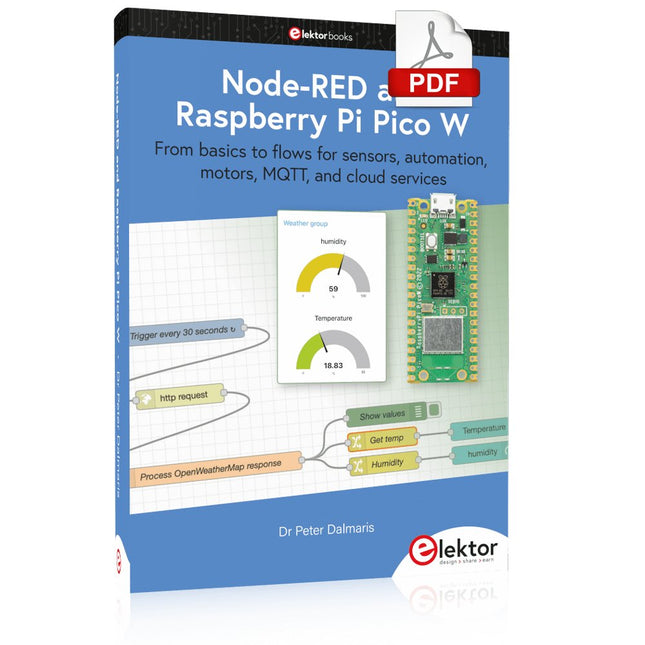
Elektor Digital Node-RED and Raspberry Pi Pico W (E-book)
From basics to flows for sensors, automation, motors, MQTT, and cloud services This book is a learning guide and a reference. Use it to learn Node-RED, Raspberry Pi Pico W, and MicroPython, and add these state-of-the-art tools to your technology toolkit. It will introduce you to virtual machines, Docker, and MySQL in support of IoT projects based on Node-RED and the Raspberry Pi Pico W. This book combines several elements into a platform that powers the development of modern Internet of Things applications. These elements are a flow-based server, a WiFi-enabled microcontroller, a high-level programming language, and a deployment technology. Combining these elements gives you the tools you need to create automation systems at any scale. From home automation to industrial automation, this book will help you get started. Node-RED is an open-source flow-based development tool that makes it easy to wire together devices, APIs, and online services. Drag and drop nodes to create a flowchart that turns on your lights at sunset or sends you an email when a sensor detects movement. Raspberry Pi Pico W is a version of the Raspberry Pi Pico with added 802.11n Wi-Fi capability. It is an ideal device for physical computing tasks and an excellent match to the Node-RED. Quick book facts Project-based learning approach. Assumes no prior knowledge of flow-based programming tools. Learn to use essential infrastructure tools in your projects, such as virtual machines, Docker, MySQL and useful web APIs such as Google Sheets and OpenWeatherMap. Dozens of mini-projects supported by photographs, wiring schematics, and source code. Get these from the book GitHub repository. Step-by-step instructions on everything. All experiments are based on the Raspberry Pi Pico W. A Wi-Fi network is required for all projects. Hardware (including the Raspberry Pi Pico W) is available as a kit. Downloads GitHub
€ 39,95
Membres € 31,96


