
Résultats de la recherche pour "the OR analog OR thing OR that OR analog OR computer"
-

SparkFun SparkFun Thing Plus Matter (MGM240P)
La SparkFun Thing Plus Matter est la première carte facilement accessible de ce type qui combine Matter et l'écosystème Qwiic de SparkFun pour le développement agile et le prototypage de dispositifs IoT basés sur Matter. Le module sans fil MGM240P de Silicon Labs offre une connectivité sécurisée pour les deux protocoles 802.15.4 avec communication Mesh (Thread) et Bluetooth Low Energy 5.3. Le module est prêt à être intégré au protocole Matter IoT de Silicon Labs pour la domotique. Qu'est-ce que Matter ? En termes simples, Matter permet un fonctionnement cohérent entre les appareils domestiques intelligents et les plateformes IoT sans connexion Internet, même s'ils proviennent de fournisseurs différents. Ce faisant, Matter est capable de communiquer entre les principaux écosystèmes IoT afin de créer un protocole sans fil unique, facile à utiliser, fiable et sécurisé. La Thing Plus Matter (MGM240P) comprend des connecteurs Qwiic et de batterie LiPo, ainsi que plusieurs connecteurs GPIO capables d'un multiplexage complet par le biais d'un logiciel. La carte comprend également le chargeur LiPo monocellulaire MCP73831 ainsi que la jauge de carburant MAX17048 pour charger et surveiller une batterie connectée. Enfin, un emplacement pour carte µSD est intégré pour tout besoin de mémoire externe. Le module sans fil MGM240P est construit autour du SoC sans fil EFR32MG24 avec un processeur ARM Cortex-M33 à 32 bits fonctionnant à 39 MHz avec 1536 kb de mémoire Flash et 256 kb de RAM. Le MGM240P fonctionne avec les protocoles sans fil 802.15.4 courants (Matter, ZigBee et OpenThread) ainsi qu'avec Bluetooth Low Energy 5.3. Le MGM240P supporte le Secure Vault de Silicon Labs pour les applications Thread. Spécifications Module sans fil MGM240P Construit autour du SoC sans fil EFR32MG24 Processeur Cœur ARM Cortex-M33 32 bits (@ 39 MHz) Mémoire flash de 1536 Ko 256 Ko de RAM Prise en charge de plusieurs protocoles sans fil 802.15.4 (ZigBee et OpenThread) Bluetooth Low Energy 5.3 Prêt pour Matter Prise en charge de Secure Vault Antenne intégrée Facteur de forme Thing Plus (compatible avec les fibres) : Dimensions : 5,8 x 2,3 cm (2,30 x 0,9')2 5,8 x 2,3 cm (2,30 x 0,9') 2 trous de fixation : compatible avec les vis 4-40 21 sorties GPIO Tous les connecteurs ont une capacité de multiplexage complète par logiciel Interfaces SPI, I²C et UART mappées par défaut sur les connecteurs étiquetés. 13 GPIO (6 étiquetés comme analogiques, 7 étiquetés comme GPIO) Toutes les fonctions sont soit GPIO, soit analogiques. Convertisseur numérique-analogique intégré (DAC) Connecteur USB-C Connecteur de batterie LiPo JST à 2 broches pour une batterie LiPo (non incluse) Connecteur JST Qwiic 4 broches Chargeur LiPo monocellulaire MC73831 Taux de charge configurable (500 mA par défaut, 100 mA en alternance) MAX17048 Jauge de carburant LiPo monocellulaire Emplacement pour carte µSD Faible consommation d'énergie (15 µA lorsque le MGM240P est en mode faible consommation) LED: PWR - LED rouge d'alimentation CHG - Voyant jaune d'état de charge de la batterie STAT - Voyant d'état bleu Bouton de réinitialisation : Bouton-poussoir physique Le signal de réinitialisation peut être lié à A0 pour permettre une utilisation en tant que périphérique. Téléchargements Schematic Eagle Files Board Dimensions Hookup Guide Datasheet (MGM240P) Fritzing Part Thing+ Comparison Guide Qwiic Info Page GitHub Hardware Repo
€ 34,95€ 13,98
Membres identique
-

Elektor Digital Computer Vision (EN) PDF
Computer vision is probably the most exciting branch of image processing, and the number of applications in robotics, automation technology and quality control is constantly increasing. Unfortunately entering this research area is, as yet, not simple. Those who are interested must first go through a lot of books, publications and software libraries. With this book, however, the first step is easy. The theoretically founded content is understandable and is supplemented by many practical examples. Source code is provided with the specially developed platform-independent open source library IVT in the programming language C/C++. The use of the IVT is not necessary, but it does make for a much easier entry and allows first developments to be quickly produced. The authorship is made up of research assistants of the chair of Professor Ruediger Dillmann at the Institut für Technische Informatik (ITEC), Universitaet Karlsruhe (TH). Having gained extensive experience in image processing in many research and industrial projects, they are now passing this knowledge on. Among other subjects, the following are dealt with in the fundamentals section of the book: Lighting, optics, camera technology, transfer standards, camera calibration, image enhancement, segmentation, filters, correlation and stereo vision. The practical section provides the efficient implementation of the algorithms, followed by many interesting applications such as interior surveillance, bar code scanning, object recognition, 3-D scanning, 3-D tracking, a stereo camera system and much more.
€ 19,95
Membres € 15,96
-
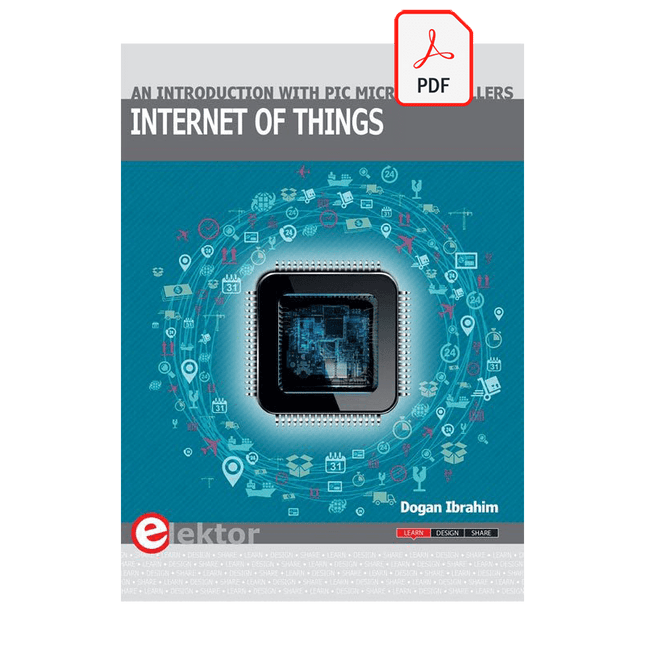
Elektor Digital Internet of Things (E-book)
The Internet of Things (IoT) is a new concept in intelligent automation and intelligent monitoring using the Internet as the communications medium. The “Things” in IoT usually refer to devices that have unique identifiers and are connected to the Internet to exchange information with each other. Such devices usually have sensors and/or actuators that can be used to collect data about their environments and to monitor and control their environments. The collected data can be processed locally or it can be sent to centralized servers or to the cloud for remote storage and processing. For example, a small device at the size of a matchbox can be used to collect data about the temperature, relative humidity and the atmospheric pressure. This data can be sent and stored in the cloud. Anyone with a mobile device can then access and monitor this data at any time and from anywhere on Earth provided there is Internet connectivity. In addition, users can for example, adjust the central heating remotely using their mobile devices and accessing the cloud. This book is written for students, for practising engineers and for hobbyists who want to learn more about the building blocks of an IoT system and also learn how to setup an IoT system using these blocks. Chapter 1 is an introduction to the IoT systems. In Chapter 2, the basic concepts and possible IoT architectures are discussed. The important parts of any IoT system are the sensors and actuators and they are described briefly in Chapter 3. The devices in an IoT system usually communicate with each other and the important aspect of IoT communication is covered in Chapter 4. Chapter 5 proceeds with the features of some of the commonly used development kits. One of these, the Clicker 2 for PIC18FJ manufactured by mikroElektronika, can be used as a processor in IoT systems and its features are described in detail in Chapter 6. A popular microcontroller C language, mikroC Pro for PIC gets introduced in Chapter 7. Chapter 8 covers the use of a click board with the Clicker 2 for PIC18FJ development kit. Similarly, the use of a sensor click board is described as a project in Chapter 9, and an actuator board in Chapter 10. Chapters 11 and 12 cover Bluetooth and Wi-Fi technologies in microcontroller based systems, and the remaining chapters of the book demo the creation of a simple Wi-Fi based IoT system with cloud-based data storage. This book has been written with the assumption that the reader has taken a course on digital logic design and has been exposed to writing programs using at least one high-level programming language. Knowledge of the C programming language will be very useful. Also, familiarity with at least one member of the PIC series of microcontrollers (e.g. PIC16 or PIC18) will be an advantage. The knowledge of assembly language programming is not required because all the projects in the book are based on using the C language. If you are a total beginner in programming you can still access the e-book, but first you are advised to study introductory books on microcontrollers.
€ 34,95
Membres € 27,96
-
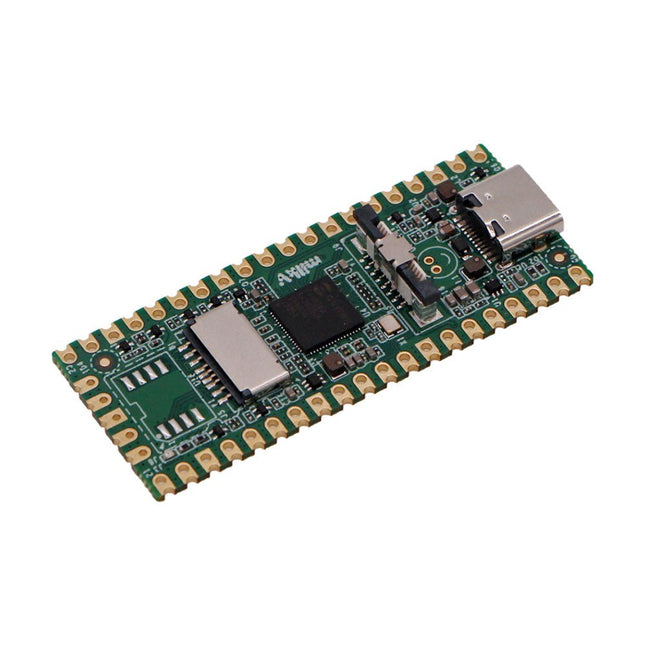
milkV Milk-V Duo 256M RISC-V Ordinateur monocarte
Le Milk-V Duo 256M est une plateforme de développement embarquée ultra-compacte basée sur la puce SG2002. Il peut exécuter Linux et RTOS, fournissant ainsi une plate-forme fiable, peu coûteuse et hautes performances pour les professionnels, les ODM industriels, les passionnés d'AIoT, les bricoleurs et les créateurs. Cette carte est une version améliorée de Duo avec une augmentation de mémoire à 256 Mo, destinée aux applications exigeant des capacités de mémoire plus importantes. Le SG2002 élève la puissance de calcul à 1,0 TOPS @ INT8. Il permet une commutation transparente entre les architectures RISC-V/ARM et prend en charge le fonctionnement simultané de deux systèmes. De plus, il comprend une gamme d'interfaces GPIO riches telles que SPI, UART, adaptées à un large éventail de développements matériels dans la surveillance intelligente de pointe, notamment des caméras TIP, des judas intelligents, des sonnettes visuelles, et bien plus encore. SG2002 est une puce hautes performances à faible consommation conçue pour divers domaines de produits tels que les caméras IP de surveillance intelligente de pointe, les serrures de porte intelligentes, les sonnettes visuelles et l'intelligence domestique. Il intègre la compression et le décodage vidéo H.264, l'encodage de compression vidéo H.265 et les capacités du FAI. Il prend en charge plusieurs algorithmes d'amélioration et de correction d'image tels que la large plage dynamique HDR, la réduction du bruit 3D, le désembuage et la correction de la distorsion de l'objectif, offrant aux clients une qualité d'image vidéo de qualité professionnelle. La puce intègre également un TPU auto-développé, offrant une puissance de calcul de 1,0 TOPS pour des opérations sur des nombres entiers de 8 bits. Le moteur de planification TPU spécialement conçu fournit efficacement un flux de données à large bande passante pour tous les cœurs de l'unité de traitement tensoriel. De plus, il offre aux utilisateurs un puissant compilateur de modèles d’apprentissage en profondeur et un kit de développement de SDK logiciels. Les principaux frameworks d'apprentissage profond tels que Caffe et Tensorflow peuvent être facilement portés sur sa plate-forme. En outre, il inclut le démarrage de sécurité, les mises à jour sécurisées et le cryptage, fournissant une série de solutions de sécurité allant du développement à la production de masse jusqu'aux applications de produits. La puce intègre un sous-système MCU 8 bits, remplaçant le MCU externe typique pour atteindre les objectifs d'économie de coûts et d'efficacité énergétique. Spécifications SoC SG2002 RISC-V CPU C906 @ 1 Ghz + C906 @ 700 MHz Arm CPU 1x Cortex-A53 @ 1 GHz MCU 8051 @ 6 Ko SRAM Mémoire 256 Mo de DRAM SIP TPU 1.0 TOPS @ INT8 Stockage 1x Connecteur microSD ou 1x SD NAND intégré USB 1x USB-C pour l'alimentation et les données, USB Pads disponibles CSI 1x Connecteur FPC 16P (MIPI CSI 2 voies) Prise en charge des capteurs 5 M @ 30 ips Ethernet Ethernet 100 Mbit/s avec PHY Audio Via des pads GPIO GPIO Jusqu'à 26x pads GPIO Puissance 5 V/1 A Support du système d'exploitation Linux, RTOS Dimensions 21 x 51 mm Téléchargements Documentation GitHub
€ 32,95€ 13,18
Membres identique
-
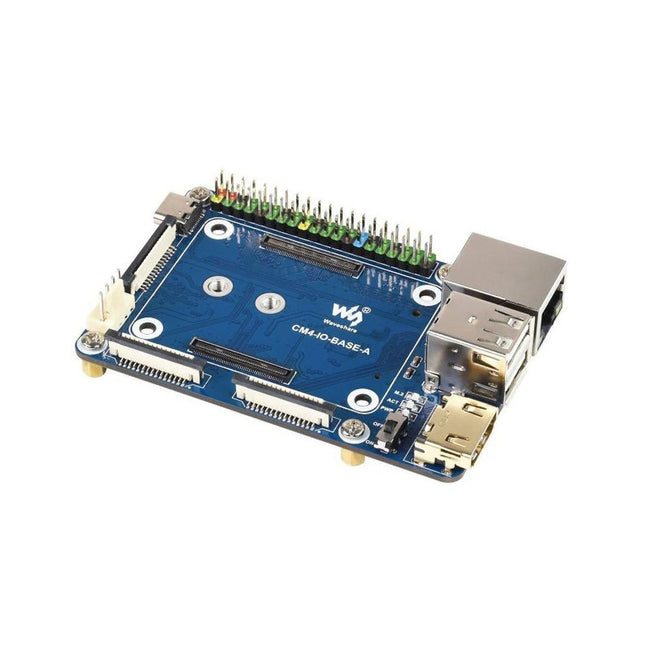
Waveshare Waveshare Mini carte de base (A) pour module de calcul Raspberry Pi 4
Caractéristiques Prise CM4 Convient à toutes les variantes du Compute Module 4 La mise en réseau Connecteur Gigabit Ethernet RJ45 M.2 M KEY, prend en charge les modules de communication ou SSD NVME Connecteur En-tête GPIO 40 broches Raspberry Pi USB 2x USB 2.0 Type-A 2x USB 2.0 via connecteur FFC Afficher Port d'affichage MIPI DSI (connecteur FPC 1,0 mm à 15 broches) Caméra 2x port caméra MIPI CSI-2 (connecteur FPC 1,0 mm 15 broches) Vidéo 2x ports HDMI (dont un port via connecteur FFC), prend en charge la sortie 4K 30 ips RTC APRÈS Stockage Prise de carte MicroSD pour les variantes Compute Module 4 Lite (sans eMMC) En-tête de ventilateur Pas de contrôle du ventilateur, 5 V Entrée de puissance 5 V Dimensions 85x56mm Inclus 1x CM4-IO-BASE-A 1x vis de montage SSD Téléchargements Wiki
€ 24,95€ 9,98
Membres identique
-
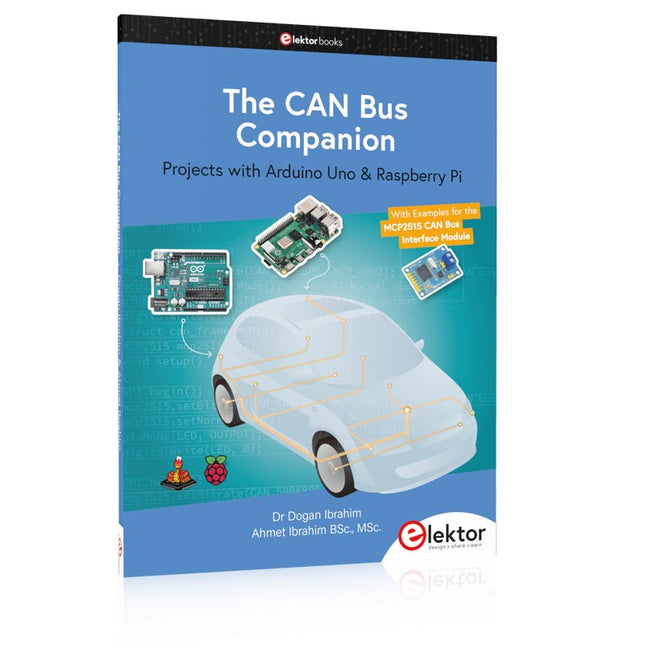
Elektor Publishing The CAN Bus Companion
This book details the use of the Arduino Uno and the Raspberry Pi 4 in practical CAN bus based projects. Using either the Arduino Uno or the Raspberry Pi with off-the-shelf CAN bus interface modules considerably ease developing, debugging, and testing CAN bus based projects. This book is written for students, practicing engineers, enthusiasts, and for everyone else wanting to learn more about the CAN bus and its applications. The book assumes that the reader has some knowledge of basic electronics. Knowledge of the C and Python programming languages and programming the Arduino Uno using its IDE and Raspberry Pi will be useful, especially if the reader intends to develop microcontroller-based projects using the CAN bus. The book should be a useful source of reference material for anyone interested in finding answers to questions such as: What bus systems are available for the automotive industry? What are the principles of the CAN bus? How can I create a physical CAN bus? What types of frames (or data packets) are available in a CAN bus system? How can errors be detected in a CAN bus system and how dependable is a CAN bus system? What types of CAN bus controllers exist? How do I use the MCP2515 CAN bus controller? How do I create 2-node Arduino Uno-based CAN bus projects? How do I create 3-node Arduino Uno-based CAN bus projects? How do I set the acceptance masks and acceptance filters? How do I analyze data on the CAN bus? How do I create 2-node Raspberry Pi-based CAN bus projects? How do I create 3-node Raspberry Pi-based CAN bus projects?
€ 34,95
Membres € 31,46
-
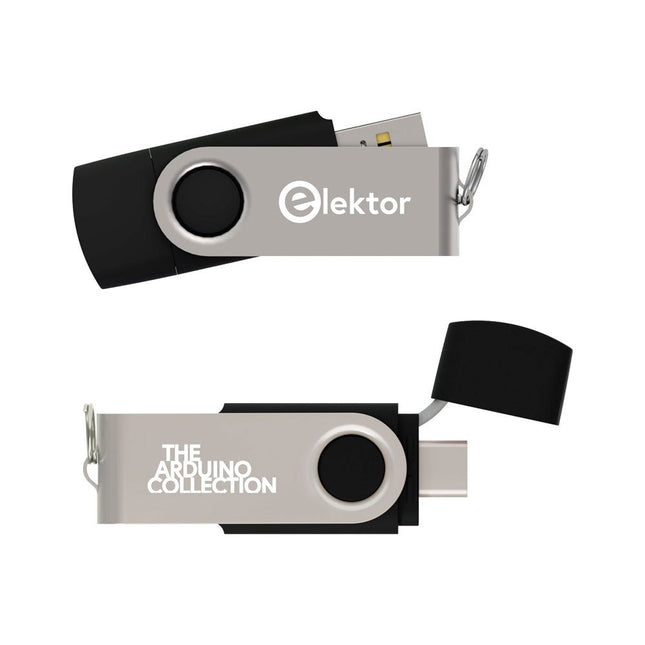
Elektor Classics The Arduino Collection (clé USB)
Cette clé USB contient une sélection de plus de 300 articles liés à Arduino publiés dans le magazine Elektor. Le contenu comprend à la fois des articles de fond et des projets sur les sujets suivants : Développement logiciel et matériel : tutoriels sur le développement logiciel avec l’IDE Arduino, Atmel Studio, les shield, et les concepts essentiels de programmation. Apprentissage : le Microcontroller Bootcamp propose une approche structurée pour programmer des systèmes embarqués. Acquisition et mesure de données : projets comme un enregistreur de données 16 bits, un tachymètre pour tour, et un analyseur de réseau électrique pour capturer et analyser des signaux en temps réel. Communication sans fil : apprenez à mettre en œuvre des réseaux sans fil, créer une interface Android, et communiquer efficacement avec des microcontrôleurs. Robotique et automatisation : le Arduino Nano Robot Controller, des cartes de support pour l'automatisation, et l'exploration de divers shield Arduino pour enrichir les fonctionnalités. Projets à construire soi-même : Des projets uniques tels qu’un projecteur laser, une horloge et un thermomètre Numitron, un récepteur TBF, Theremino, et des interfaces LED tactiles mettent en valeur des applications créatives. Que vous soyez débutant ou expérimenté, cette collection est une ressource précieuse pour apprendre, expérimenter et repousser les limites de la technologie Arduino.
€ 49,95€ 19,98
Membres identique
-
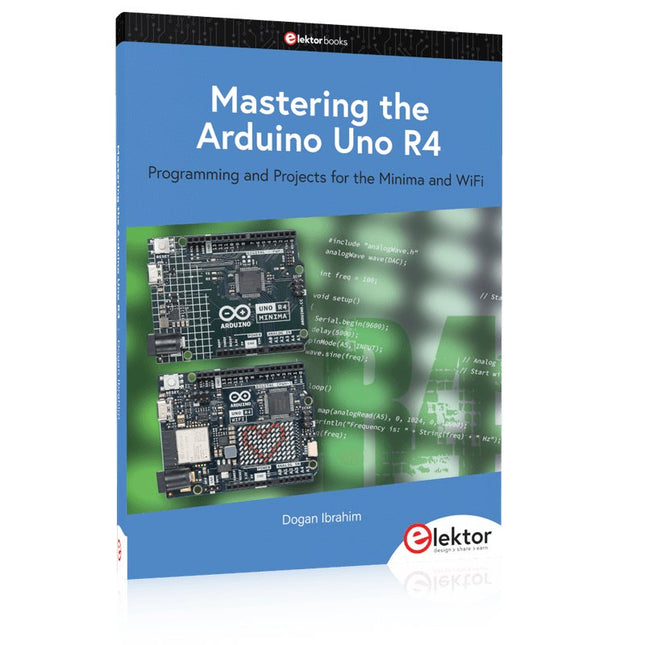
Elektor Publishing Mastering the Arduino Uno R4
Programming and Projects for the Minima and WiFi Based on the low-cost 8-bit ATmega328P processor, the Arduino Uno R3 board is likely to score as the most popular Arduino family member, and this workhorse has been with us for many years. Eleven years later, the long-overdue successor, the Arduino Uno R4, was released. It is built around a 48 MHz, 32-bit Arm Cortex-M4 microcontroller and provides significantly expanded SRAM and Flash memory. Additionally, a higher-precision ADC and a new DAC are added to the design. The Uno R4 board also supports the CAN Bus with an interface. Two versions of the board are available: Uno R4 Minima, and Uno R4 WiFi. This book is about using these new boards to develop many different and interesting projects with just a handful of parts and external modules. All projects described in the book have been fully tested on the Uno R4 Minima or the Uno R4 WiFi board, as appropriate. The project topics include the reading, control, and driving of many components and modules in the kit as well as on the relevant Uno R4 board, including LEDs 7-segment displays (using timer interrupts) LCDs Sensors RFID Reader 4x4 Keypad Real-time clock (RTC) Joystick 8×8 LED matrix Motors DAC (Digital-to-analog converter) LED matrix WiFi connectivity Serial UART CAN bus Infrared controller and receiver Simulators … all in creative and educational ways with the project operation and associated software explained in great detail.
€ 39,95
Membres € 35,96
-
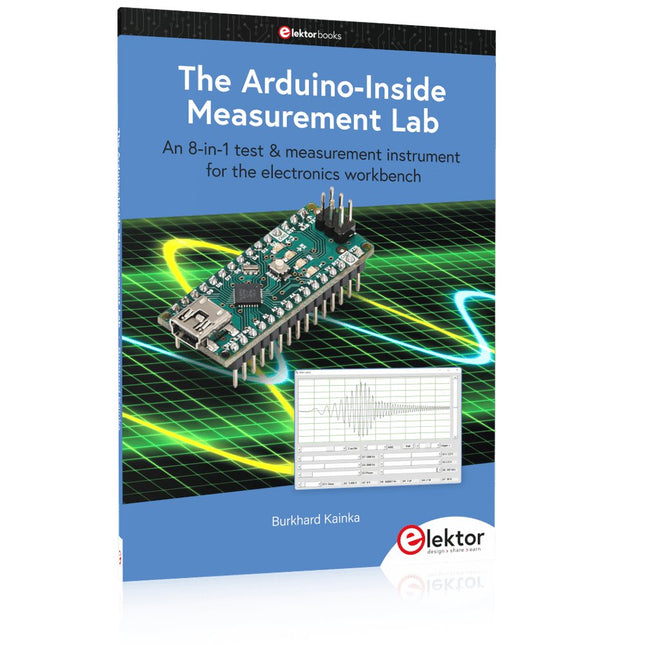
Elektor Publishing The Arduino-Inside Measurement Lab
An 8-in-1 test & measurement instrument for the electronics workbench A well-equipped electronics lab is crammed with power supplies, measuring devices, test equipment and signal generators. Wouldn‘t it be better to have one compact device for almost all tasks? Based on the Arduino, a PC interface is to be developed that’s as versatile as possible for measurement and control. It simply hangs on a USB cable and – depending on the software – forms the measuring head of a digital voltmeter or PC oscilloscope, a signal generator, an adjustable voltage source, a frequency counter, an ohmmeter, a capacitance meter, a characteristic curve recorder, and much more. The circuits and methods collected here are not only relevant for exactly these tasks in the "MSR" electronics lab, but many details can also be used within completely different contexts.
€ 34,95
Membres € 31,46
-

Elektor Publishing The BeagleY-AI Handbook
A Practical Guide to AI, Python, and Hardware Projects Welcome to your BeagleY-AI journey! This compact, powerful, and affordable single-board computer is perfect for developers and hobbyists. With its dedicated 4 TOPS AI co-processor and a 1.4 GHz Quad-core Cortex-A53 CPU, the BeagleY-AI is equipped to handle both AI applications and real-time I/O tasks. Powered by the Texas Instruments AM67A processor, it offers DSPs, a 3D graphics unit, and video accelerators. Inside this handbook, you‘ll find over 50 hands-on projects that cover a wide range of topics—from basic circuits with LEDs and sensors to an AI-driven project. Each project is written in Python 3 and includes detailed explanations and full program listings to guide you. Whether you‘re a beginner or more advanced, you can follow these projects as they are or modify them to fit your own creative ideas. Here’s a glimpse of some exciting projects included in this handbook: Morse Code Exerciser with LED or BuzzerType a message and watch it come to life as an LED or buzzer translates your text into Morse code. Ultrasonic Distance MeasurementUse an ultrasonic sensor to measure distances and display the result in real time. Environmental Data Display & VisualizationCollect temperature, pressure, and humidity readings from the BME280 sensor, and display or plot them on a graphical interface. SPI – Voltmeter with ADCLearn how to measure voltage using an external ADC and display the results on your BeagleY-AI. GPS Coordinates DisplayTrack your location with a GPS module and view geographic coordinates on your screen. BeagleY-AI and Raspberry Pi 4 CommunicationDiscover how to make your BeagleY-AI and Raspberry Pi communicate over a serial link and exchange data. AI-Driven Object Detection with TensorFlow LiteSet up and run an object detection model using TensorFlow Lite on the BeagleY-AI platform, with complete hardware and software details provided.
€ 44,95
Membres € 40,46
-

Elektor Publishing The Book of 555 Timer Projects
Over 45 Builds for the Legendary 555 Chip (and the 556, 558) The 555 timer IC, originally introduced by the Signetics Corporation around 1971, is sure to rank high among the most popular analog integrated circuits ever produced. Originally called the IC Time Machine, this chip has been used in many timer-related projects by countless people over decades. This book is all about designing projects based on the 555 timer IC. Over 45 fully tested and documented projects are presented. All projects have been fully tested by the author by constructing them individually on a breadboard. You are not expected to have any programming experiences for constructing or using the projects given in the book. However, it’s definitely useful to have some knowledge of basic electronics and the use of a breadboard for constructing and testing electronic circuits. Some of the projects in the book are: Alternately Flashing Two LEDs Changing LED Flashing Rate Touch Sensor On/Off Switch Switch On/Off Delay Light-Dependent Sound Dark/Light Switch Tone Burst Generator Long Duration Timer Chasing LEDs LED Roulette Game Traffic Lights Continuity Tester Electronic Lock Switch Contact Debouncing Toy Electronic Organ Multiple Sensor Alarm System Metronome Voltage Multipliers Electronic Dice 7-Segment Display Counter Motor Control 7-Segment Display Dice Electronic Siren Various Other Projects The projects given in the book can be modified or expanded by you for your very own applications. Electronic engineering students, people engaged in designing small electronic circuits, and electronic hobbyists should find the projects in the book instructive, fun, interesting, and useful.
€ 34,95
Membres € 31,46


-
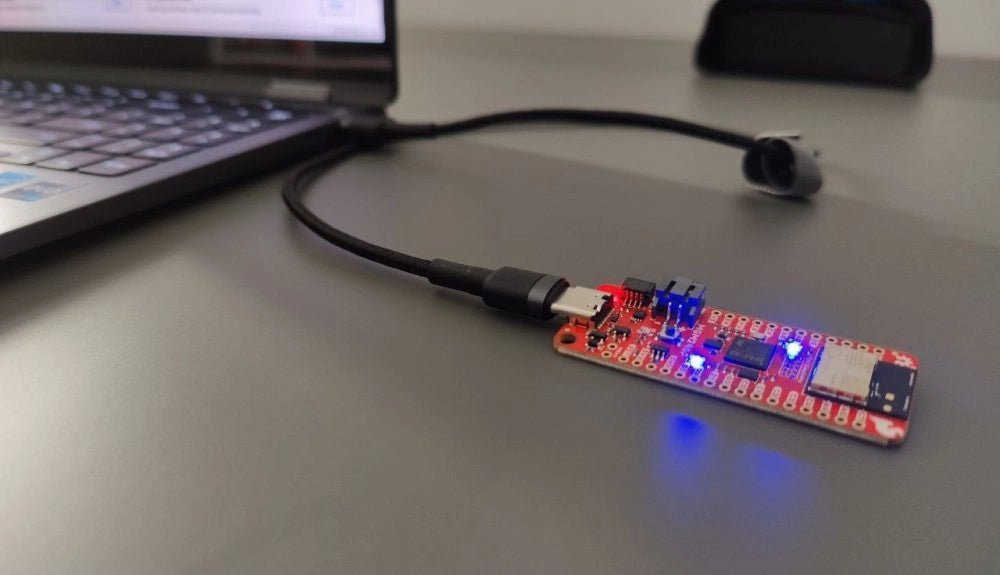
, par Saad Imtiaz SparkFun Thing Plus Matter (MGM240P) : Une carte de développement IoT polyvalente basée sur "Matter" (Essai)
La "SparkFun Thing Plus Matter - MGM240P" est une carte de développement polyvalente et riche en fonctionnalités, conçue pour réaliser des appareils IoT basés sur...
