
Résultats de la recherche pour "soft OR start OR unit OR for OR amplifier OR preprogrammed"
-

Elektor Digital Raspberry Pi Pico for Radio Amateurs (E-book)
Program and build RPi Pico-based ham station utilities, tools, and instruments Although much classical HF and mobile equipment is still in use by large numbers of amateurs, the use of computers and digital techniques has now become very popular among amateur radio operators. Nowadays, anyone can purchase a €5 Raspberry Pi Pico microcontroller board and develop many amateur radio projects using the “Pico” and some external components. This book is aimed at amateur radio enthusiasts, Electronic Engineering students, and anyone interested in learning to use the Raspberry Pi Pico to shape their electronic projects. The book is suitable for beginners in electronics as well as for those with wide experience. Step-by-step installation of the MicroPython programming environment is described. Some knowledge of the Python programming language is helpful to be able to comprehend and modify the projects given in the book. The book introduces the Raspberry Pi Pico and gives examples of many general-purpose, software-only projects that familiarize the reader with the Python programming language. In addition to the software-only projects tailored to the amateur radio operator, Chapter 6 in particular presents over 36 hardware-based projects for “hams”, including: Station mains power on/off control Radio station clock GPS based station geographical coordinates Radio station temperature and humidity Various waveform generation methods using software and hardware (DDS) Frequency counter Voltmeter / ammeter / ohmmeter / capacitance meter RF meter and RF attenuators Morse code exercisers RadioStation Click board Raspberry Pi Pico based FM radio Using Bluetooth and Wi-Fi with Raspberry Pi Pico Radio station security with RFID Audio amplifier module with rotary encoder volume control Morse decoder Using the FS1000A TX-RX modules to communicate with Arduino
€ 32,95
Membres : € 29,66
-
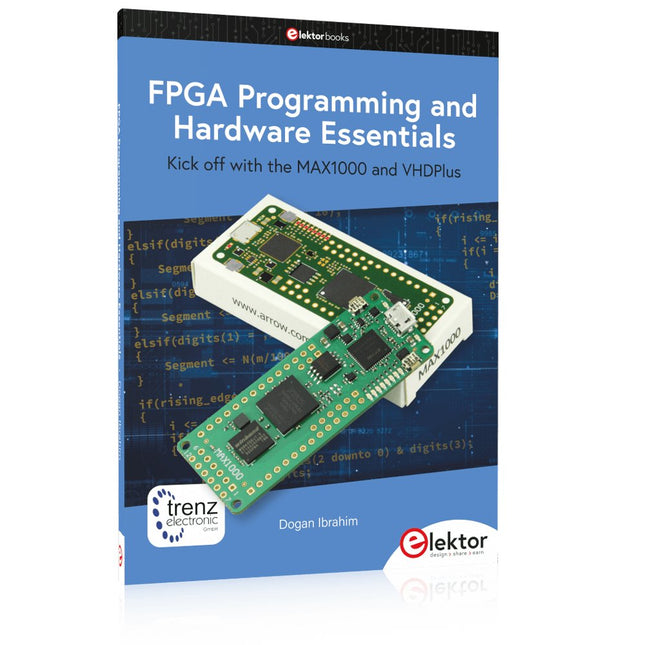
Elektor Publishing FPGA Programming and Hardware Essentials
Kick off with the MAX1000 and VHDPlus Ready to Master FPGA Programming? In this guide, we’re diving into the world of Field Programmable Gate Arrays (FPGAs) – a configurable integrated circuit that can be programmed after manufacturing. Imagine bringing your ideas to life, from simple projects to complete microcontroller systems! Meet the MAX1000: a compact and budget-friendly FPGA development board packed with features like memory, user LEDs, push-buttons, and flexible I/O ports. It’s the ideal starting point for anyone wanting to learn about FPGAs and Hardware Description Languages (HDLs). In this book, you’ll get hands-on with the VHDPlus programming language – a simpler version of VHDL. We’ll work on practical projects using the MAX1000, helping you gain the skills and confidence to unleash your creativity. Get ready for an exciting journey! You’ll explore a variety of projects that highlight the true power of FPGAs. Let’s turn your ideas into reality and embark on your FPGA adventure – your journey starts now! Exciting Projects You’ll Find in This Book Arduino-Driven BCD to 7-Segment Display Decoder Use an Arduino Uno R4 to supply BCD data to the decoder, counting from 0 to 9 with a one-second delay Multiplexed 4-Digit Event Counter Create an event counter that displays the total count on a 4-digit display, incrementing with each button press PWM Waveform with Fixed Duty Cycle Generate a PWM waveform at 1 kHz with a fixed duty cycle of 50% Ultrasonic Distance Measurement Measure distances using an ultrasonic sensor, displaying the results on a 4-digit 7-segment LED Electronic Lock Build a simple electronic lock using combinational logic gates with push buttons and an LED output Temperature Sensor Monitor ambient temperature with a TMP36 sensor and display the readings on a 7-segment LED Téléchargements Software
€ 39,95
Membres : € 35,96
-

Elektor Digital Elektor January/February 2021 (PDF) EN
DIY LiPo Supercharger BundleGreatScott and Elektor's LiPo Charger, Booster, and Protector MTheCamA Simple Mini Thermal Camera Weller WE 1010Soldering Station electronica Fast Forward 2020 Winners I2S Test Signal Generator with AVR Microcontroller32-Bit 1-kHz Digital Sine, fs 192 kHz, Level Adjustable from 0 to -110 dB Control Your Home with Raspberry PiRPi snoops on 433.92 MHz Simulate Circuits Online From Life's ExperienceThe Fine Line Between Order and Chaos Starting Out in ElectronicsEasier Than imagined! Homebrew CPUsThe Discrete Microcontroller Connect Your Thermostat with ESPHomeAn Attempt at Doing Home Automation the Right Way Developer’s ZoneTips & Tricks, Best Practices and Other Useful Information Small Circuits RevivalFrom the Elektor suggestions box Raspberry Pi Full StackRPi and RF24 at the heart of a sensor network Practical ESP32 Multitasking (6)Event Groups Multi-Channel Power Analyzer: Up to 3 Channels, with Graphic and Alphanumeric Display Analogue Filter Design (Part 3)Passive Filters JOY-iT VAX-1030Wireless Measurement Module New LCR Meter 50 Hz - 2 MHz Part 2Operation, Calibration, and Firmware Programming Error AnalysisTips on Voltage Regular Circuits, PCB Design, and More The Open Hardware ObservatoryCommunity-Based Open Source Hardware Assessment Java on the Raspberry PiAn Interview with Frank Delporte Data Analysis and Artificial Intelligence in PythonInterpreting Real Data with NumPy, pandas and scikit-learn Project 2.0Corrections, Updates and Readers’ letters Getting to Know the Parallax Propeller 2 (Part 1)An Introduction Hexadoku
€ 7,50
-

iFixit iFixit Essential Electronics Toolkit
La trousse à outils électronique essentielle iFixit est tout ce dont vous avez besoin pour effectuer les réparations électroniques les plus courantes, telles que le remplacement d'écrans et de batteries, ainsi que pour la plupart des réparations domestiques. Lancez-vous dans la réparation électronique avec tous les embouts et outils de précision nécessaires pour réparer vos écrans cassés et remplacer vos batteries dans les plus brefs délais. Ou complétez simplement votre trousse à outils domestique avec tout ce dont vous avez besoin pour réparer vos poignées de porte, vos appareils électroménagers, vos lunettes et bien plus encore. Le kit comprend Poignée de conducteur aimantée Pincettes de précision coudées Spudger Jimmy Outil d'ouverture iFixit Choix d'ouverture iFixit, lot de 6 Poignée d'aspiration Étui aimanté facile à ouvrir Membre avec plateau de tri intégré Seize embouts de tournevis de précision de 4 mm Phillips - 000, 00, 0, 1 Pentalobes-P2, P5 Tête plate - 1 mm, 2,5 mm, 4 mm Torx-T4, T5 Sécurité Torx - TR6, TR8, TR10 Tripoint - Y000 Bit d'éjection SIM Caractéristiques Embout métal : acier 6150 Matériau du pilote : polymère Matériau du boîtier: ABS Mousse : EVA
€ 34,66
-

Elektor Publishing MicroPython for STM32
Learning Embedded Systems with STM32 Nucleo Boards Programming compact electronic systems is now easier to get started with than ever before. Affordable development boards, powerful software tools, and readily available documentation make it possible to turn an idea into a working prototype in very little time. MicroPython plays an important role in this development by offering a readable, interactive way to control microcontrollers while still providing direct access to their hardware features. This book explores embedded programming with MicroPython using an STM32-based Nucleo board. It shows how a microcontroller continuously interacts with its environment by reading inputs, processing information, and controlling outputs. Step by step, you will learn to flash LEDs, measure analog signals, work with sensors, control actuators, and exchange data with other devices. The built-in REPL makes it easy to test instructions immediately, inspect results, and learn through experimentation. Although microcontroller boards differ in size, speed, memory, and peripherals, the fundamental concepts remain largely the same. Digital input and output, analog conversion, timers, PWM, interrupts, and serial communication are the essential building blocks of embedded applications. By concentrating on these transferable principles, the book provides a foundation that remains useful when moving to other boards, processors, or development environments. It is intended both for newcomers and for programmers who want to expand into embedded systems. MicroPython offers a practical route into this field, combining quick results with a clear understanding of how software and hardware work together.
€ 27,95
Membres : € 25,16
-

OWON Oscilloscope USB 2-ch OWON VDS1022I (25 MHz)
L'oscilloscope USB 2 voies OWON VDS1022I (25 MHz) est un oscilloscope à utiliser avec un ordinateur. Il est alimenté par USB et a une petite taille, ce qui permet de l'emporter facilement avec soi. L'oscilloscope est très économique. Il dispose d'une connexion USB blindée, ce qui réduit les interférences et protège l'ordinateur contre les surtensions. Le port multiple de l'oscilloscope peut être utilisé pour le déclenchement externe, la sortie de déclenchement ou la sortie Pass / Fail. Caractéristiques Largeur de bande de 25 MHz, et taux d'échantillonnage en temps réel de 1 Géch/s maximum Longueur d'enregistrement de 10 Méch Interface utilisateur conviviale : FFT, ou X-Y, et forme d'onde 2 vues affichées sur le même écran Option de déclenchement multiple : front, vidéo, pente, impulsion et alternatif. Isolation USB - moins d'interférence de signal, plus de protection du PC Alimentation par bus USB et télécommande LAN (en option) Conception ultra-mince, facile à transporter Spécifications Bande passante 25 MHz 25 MHz Canal 2+1 (multi) Fréquence d'échantillonnage 100 Méch/s Échelle horizontale (s/div) 5 ns/div~100s/div, step by 1~2~5 Longueur des enregistrements 5K Tension d'entrée maximale 400 V (PK - PK) (DC+AC, PK - PK) 40 V (PK - PK) (DC+AC, PK - PK) Résolution verticale (A/D) 8 bits (2 canaux simultanément) Modèle VDS1022I Sensibilité verticale 5 mV/div~5 V/div Type de déclenchement Bord, impulsion, vidéo, pente et alternance Mode de déclenchement Auto, Normal, et Simple Mode d’acquisition Échantillon, détection des pics et moyenne Mathématiques +, -, ×, ÷, invert, FFT Interface de communication USB 2.0 (isolation) Multi-fonctions Interface Type de signal Niveau Standard TTL Alimentation éléctique 5,0 V/1 A Consommation éléctique ≤2,5 W Dimensions (W × H × D) 170 x 120 x 18 mm Poids 0,26 kg Inclus 1x Oscilloscope OWON VDS1022I 1x CD-ROM 1x Guide de démarrage rapide 2x Sonde d'oscilloscope 1x Outil de sonde 1x Adaptateur secteur 1x Câble USB 1x Étui de protection en silicone 1x Câble d'alimentation Téléchargements Fiche technique Manuel de l’utilisateur Protocole SCPI Pilote USB
€ 118,02
-

OWON OWON HDS242 Oscilloscope 2 canaux (40 MHz) + Multimètre
Le HDS242 est un testeur multifonction portable 2-en-1, qui peut être utilisé comme oscilloscope à 2 canaux et multimètre. Il dispose d'un écran couleur haute résolution de 3,5 pouces à contraste élevé, adapté à la maintenance des installations extérieures, aux mesures rapides sur site, à la maintenance automobile, à la détection de puissance, etc. Caractéristiques Oscilloscope + Multimètre Écran LCD couleur haute résolution de 3,5 pouces à contraste élevé - adapté à une utilisation en extérieur Batterie au lithium 18650 - peut fonctionner en continu jusqu'à 6 heures Interface USB Type-C - prise en charge de la connexion à une banque d'alimentation et à un PC Fonction d'auto-étalonnage SCPI pris en charge - facilite le développement secondaire Spécifications Oscilloscope Bande passante 40 MHz Canaux Oscilloscope à 2 canaux Taux d'échantillonnage 250 MSa/s Modèle d'acquisition Normal, détection de crête Longueur d'enregistrement 8K Affichage Écran LCD de 3,5 pouces Taux de rafraîchissement des formes d'ondes 10 000 formes d'ondes/s Couplage d'entrée DC, AC et masse Impédance d'entrée 1 MΩ ± 2 %, en parallèle avec 16 pF ± 10 pF Facteurs d'atténuation de la sonde 1X, 10X, 100X, 1000X, 10000X Tension d'entrée max. 400 V (DC+AC, PK-PK, impédance d'entrée de 1 MΩ) (atténuation de sonde 10:1) Limite de bande passante (typique) 20 MHz Échelle horizontale 5ns/div - 1000s/div, pas de 1 - 2 - 52ns/div - 1000s/div, pas de 1 - 2 - 55ns/div - 1000s/div, pas de 1 - 2 - 52ns/div - 1000s/div, pas de 1 - 2 - 5 Sensibilité Verticale 10mV/div - 10V/div Résolution Verticale 8 bits Type de Déclenchement Bord Mode de Déclenchement Automatique, Normal, Unique Mesure Automatique Fréquence, Période, Amplitude, Max, Min, Moyenne, PK-PK Mesure de Curseur ΔV, ΔT, ΔT et ΔV entre les curseurs Multimètre Résolution Max. 20 000 points Mode de Test Tension, Courant, Résistance, Capacité, Diode et Continuité Impédance d'Entrée 10 MΩ Tension d'Entrée Max. CA : 750 V | CC : 1000 V Courant d'Entrée Max. CC : 10 A | CA : 10 A Diode 0-2 V Autre Connectivité USB Type-C Dimensions 198 x 96 x 38 mm (7,68 x 3,74 x 1,5') Poids 600 g (sans piles) Inclus 1x Oscilloscope OWON HDS242 1x Sac Souple 1x Sonde 1x Cordon d'Alimentation 1x Réglage de Sonde 1x Câble USB 1x Adaptateur Secteur 1x Paire de Fils de Sonde de Multimètre (rouge et noir) 1x Paire de Fils de Sonde d'Oscilloscope (BNC vers Pince Alligator) 1x Manuel d'Utilisation (Anglais) Téléchargements User Manual for HDS200 Series SCPI Protocol for HDS200 Series Quick Guide for HDS200 Series PC Software for OWON HDS200 Series
€ 111,94
-

Elektor Digital Elektor March/April 2022 (PDF)
Build Your Own RISC-V ControllerFirst Steps with the NEORV32 RISC-V Softcore for Low-Cost FPGAs How to Use Arduino’s Serial PlotterPlotting Graphs With Arduino Is Easy CLUE from AdafruitA Smart Solution for IoT Projects Buffer Board for the Raspberry Pi 400Protect the I/Os Raspberry Pi RP2040 Boards Aplenty A Handbook on DIY Electronic Security and EspionageSRAM Heated or Deep-Frozen Component IdentificationTips & Tricks, Best Practices and Other Useful Information DIY Touchless Light Switch Starting out in ElectronicsMatching and Transforming What’s New in Embedded Development?Rust and Keeping IoT Deployments Updated Infographics How the Industrial and Automotive Sectors Will Benefit from 5G Moving Coil RelaysPeculiar Parts, the series HomeLab ToursEverything Revolves Around the Tools... Understanding the Neurons in Neural Networks (Part 4)Embedded Neurons Magnetic Levitation the Very Easy WayThe Third and Most Compact Version PLC Programming with the Raspberry Pi and the OpenPLC ProjectVisualization of PLC Programs with AdvancedHMI From Life's ExperiencePack Up and Leave Under Your RadarMicrocontrollers You Should Know About Monitor and Debug Over the AirA Solution for Arduino, ESP32 and Co. Portable Temperature- and Humidity-Measuring DeviceUsing Ready-Made Modules Lithium Battery Pack RepairSave Money + More Power! GUIs with PythonMeme-Generator Three Questions to Build OnWhy, What, and Who? HexadokuThe Original Elektorized Sudoku
€ 7,50
-

Elektor Digital Practical Electronics Crash Course (E-book)
Learning circuit design the fun way Welcome to the world of electronics! Getting started in electronics is not as difficult as you may think. Using this book, you will explore and learn the most important electrical and electronics engineering concepts in a fun way by doing various experiments and by simulating circuits. It will teach you electronics practically without getting into complex technical jargon and long calculations. As a result, you will be creating your own projects soon. No prior knowledge of electronics is required, only some basic algebra is used in a few simple calculations. Many tested and working projects and simulations are presented to familiarise yourself with the construction of electronic circuits. Circuit simulation is introduced at an early stage to enable you to experiment with circuits easily without breaking anything. You will learn: The concepts of voltage, current, and power AC and DC Basic lamp circuits with switches Passive components: resistors, capacitors & inductors RC & RCL circuits Electromagnetism Loudspeakers, relays, buzzers, and transformers Active components: diodes & LEDs, bipolar transistors & MOSFETs Transistor-based switching circuits Optocoupler circuits Astable & monostable multivibrators Using the 555 timer IC The operational amplifier Digital logic Advanced examples: amplifiers, oscillators, filters, and sensors Test and measurement tools Microcontrollers: Arduino UNO, ESP32, Raspberry Pi Pico, and Raspberry Pi Reading datasheets and best practices for selecting components EMC & EMI and norms & regulations
€ 32,95
Membres : € 29,66
-

Elektor January/February 2026 (EN)
Elektor GREEN and GOLD members can download their digital edition here. Not a member yet? Click here. Low-Noise Lab Power Supply (1)A Quiet Source for Sensitive Circuits STM32 Edge AI Contest 2025: The Winners Batteries TodayTechnology and Differences in Lithium Batteries Adjustable Electronic LoadStatic + Dynamic DC Load Step-Down Converter from 48 V to 5 VThe Story of Circuit Development Autonomous Sensor Node v2.0Part 2: Hardware Validation and Power Optimizations VaristorsPeculiar Parts, the Series Graphical Grid Frequency MeterMonitor Grid Quality Starting Out in Electronics……Brings Its Own End Peak Current Load SMD FerritesMore Resilient Against Current Peaks Elektor Live! Expert Day 2025 Energy Harvesting Set to Accelerate IoT and IIoT Use CasesHow Energy Harvesting Frees IoT from the Grid Fnirsi DPS-150Compact and Portable Power Supply and Converter Adjustable USB-C Power SourceTurn Your USB-C Charger Into an Adjustable Power Supply Simple Charger and Capacity TesterWith Two Cheap “Off-the-Shelf” Modules Smart Color Detector with AI Voice and Playback PbMonitor v2.0Introduction to the Updated Battery Monitoring System A Fan for the Mini Reflow PlateSmart Modifications That Improve Results From Life’s ExperienceThe Tsunami of Indulgence Err-lectronicsCorrections, Updates, and Readers’ Letters 2026: An AI OdysseyWhen Models Start Dictating the Hardware Precision Picoammeter (2)Assembling, Calibration, and Test Wireless Device Poweringwith Inductive Technology AI-Based Autonomous DrivingThe RDW’s Self Driving Challenge 2024 Sound Card as Signal GeneratorPC as DCF77 Test Transmitter
€ 14,90
-

UFactory UFactory xArm 6
Ce robot multi-axes équilibre parfaitement puissance et taille. Caractéristiques Charge utile : 5 kg Portée : 700 mm Répétabilité : 0,1 mm Vitesse maximale 1000 mm/s Applications Entretien des machines Cueillette des bacs Plateforme mobile Automatisation du laboratoire Recherche robotique Des robots collaboratifs durables pour votre automatisation L'entraînement harmonique et les servomoteurs de qualité industrielle garantissent un fonctionnement 24h/24 et 7j/7 sans arrêt. Fabriqué en fibre de carbone, son poids de 15 kg permet un déploiement plus facile. Déploiement flexible avec fonctionnalité sécurisée Enseignement manuel, léger, peu encombrant et facile à redéployer vers plusieurs applications sans modifier votre organisation de production. Parfaitement pour les tâches récurrentes. La détection des collisions est disponible pour tous nos cobots. Votre sécurité est toujours la priorité absolue. Interface graphique pour une programmation conviviale pour les débutants Compatible avec divers systèmes d'exploitation, notamment macOS et Windows. Technologie Web compatible avec tous les principaux navigateurs. Glissez et déposez pour créer votre code en quelques minutes. Un SDK puissant et open source à portée de main Le SDK Python/C++ open source entièrement fonctionnel offre une programmation plus flexible. Les packages ROS/ROS2 sont prêts à l'emploi. Des exemples de codes vous aident à déployer le bras robotique en douceur. Caractéristiques UFactory 850 xArm 5 xArm 6 xArm 7 Charge utile 5kg 3kg 5kg 3,5 kg Atteindre 850 mm 700mm 700mm 700mm Degrés de liberté 6 5 6 7 Répétabilité ±0,02 mm ±0,1mm ±0,1mm ±0,1mm Vitesse maximum 1 m/s 1 m/s 1 m/s 1 m/s Poids (bras du robot uniquement) 20 kg 11,2 kg 12,2kg 13,7kg Vitesse maximum 180°/s 180°/s 180°/s 180°/s Articulation 1 ±360° ±360° ±360° ±360° Articulation 2 -132°~132° -118°~120° -118°~120° -118°~120° Articulation 3 -242°~3,5° -225°~11° -225°~11° ±360° Articulation 4 ±360° -97°~180° ±360° -11°~225° Articulation 5 -124°~124° ±360° -97°~180° ±360° Articulation 6 ±360° ±360° -97°~180° Articulation 7 ±360° Matériel xPauvre Spécifications du robot Plage de température ambiante 0-50°C Consommation d'énergie Min 8,4 W, typique 200 W, max 400 W Alimentation d'entrée 24 V CC, 16,5 A Empreinte Ø 126 mm Matériaux Aluminium, fibre de carbone Type de connecteur de base M5x5 Salle blanche de classe ISO 5 Montage de robots N'importe lequel Protocole de communication de l'effecteur final Modbus RTU(rs485) E/S de l'effecteur final 2x DI/2x DO/2x AI/1x RS485 Mode de communication Ethernet Inclus 1x bras robotique xArm 5 1x boîtier de commande AC 1x câble d'alimentation du bras robotique 1x câble adaptateur d'effecteur d'extrémité de bras robotique 1x câble de signal pour bras robotique 1x câble d'alimentation du boîtier de commande 1x câble réseau 1x outil de montage 1x Guide de démarrage rapide
€ 11.259,00
Meilleur prix
-

Elektor Digital Home Automation Projects with Arduino (E-book)
Using the RFID Starter Kit An Arduino board has now become ‘the’ basic component in the maker community. No longer is an introduction to the world of microcontrollers the preserve of the expert. When it comes to expanding the capabilities of the basic Arduino board however, the developer is still largely on his own. If you really want to build some innovative projects it’s often necessary to get down to component level. This can present many beginners with major problems. That is exactly where this book begins. This book explains how a wide variety of practical projects can be built using items supplied in a single kit together with the Arduino board. This kit, called the 'RFID Starter Kit for Arduino' (SKU 17240) is not just limited to RFID applications but contains more than 30 components, devices and modules covering all areas of modern electronics. In addition to more simple components such as LEDs and resistors there are also complex and sophisticated modules that employ the latest technology such as: A humidity sensor A multicolor LED A large LED matrix with 64 points of light A 4-character 7-segment LED display An infra red remote-controller unit A complete LC-display module A servo A stepper motor and controller module A complete RFID reader module and security tag On top of that you will get to build precise digital thermometers, hygrometers, exposure meters and various alarm systems. There are also practical devices and applications such as a fully automatic rain sensor, a sound-controlled remote control system, a multifunctional weather station and so much more. All of the projects described can be built using the components supplied in the Elektor kit.
€ 29,95
Membres : € 26,96


