
Résultats de la recherche pour "062 OR lcd OR oscilloscope OR diy OR kit"
-
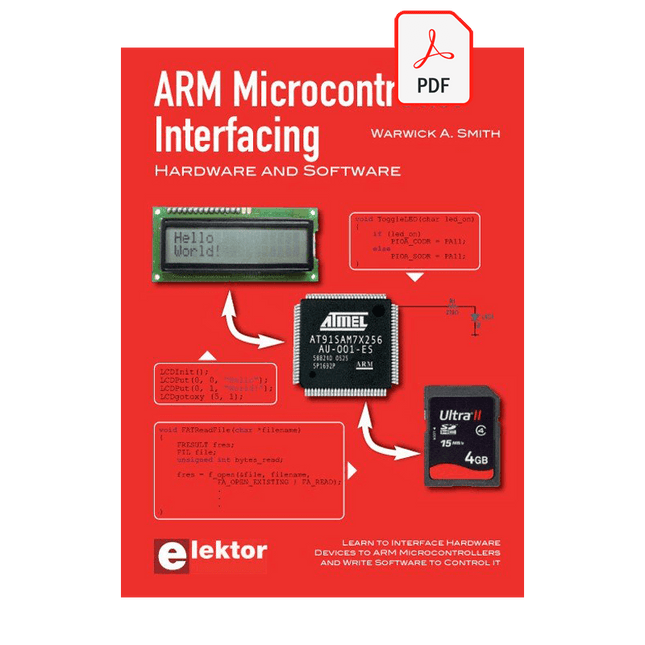
Elektor Digital ARM Microcontroller Interfacing (E-book)
Learn to interface and program hardware devices in a wide range of useful applications, using ARM7 microcontrollers and the C programming language. Examples covered in full detail include a simple LED to a multi-megabyte SD card running the FAT file system. Features of this book Build prototype circuits on breadboard or Veroboard and interface to ARM microcontrollers. A 32-bit ARM7 microcontroller is used in interfacing and software examples. Interfacing principles apply to other ARM microcontrollers and other non-ARM microcontrollers as well. Example programs are written in the C programming language. Use only free or open source software. Download and install all programming tools from the Internet. Template project files are provided for easy project creation. Hardware Interface to LEDs, transistors, optocouplers, relays, solenoids, switches, keypads, LCD displays, seven segment displays, DC motors, stepper motors, external analogue signals using the ADC, RS232, RS-485, TWI, USB, SPI and SD memory cards. Software Once hardware has been interfaced to a microcontroller, software must be written to control the hardware. You will learn how to write programs to operate externally interfaced hardware devices, use timers and interrupts. Also learn how to port FAT file system code for use with an SD memory card, program the PWM to produce an audio sine wave, program the PWM to speed control a DC motor and more. A chapter on more advanced ARM microcontrollers is included with an overview of some of the newest ARM microcontrollers and their features.
€ 29,95
Membres : € 26,96
-
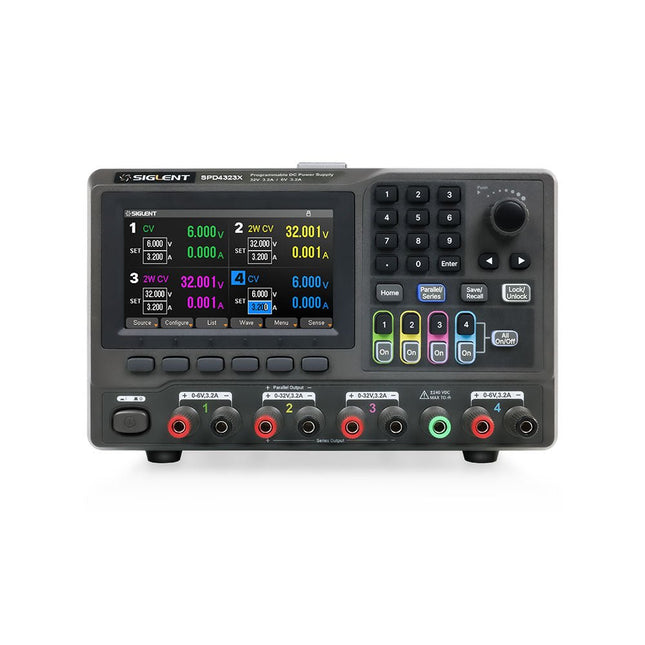
Siglent Siglent SPD4323X Alimentation 4 canaux (240 W)
The Siglent SPD4323X is a 4-channel DC Linear Programmable Power Supply equipped with a 4.3-inch TFT-LCD display, friendly human-machine interface, and excellent performance indicators. Real-time waveform display provides engineers with an informative user interface. SPD4323X offers a total output power of 240 W with a resolution of 1 mV/1 mA. The maximum voltage and current for each channel are as follows: CH1: 6 V/3.2 A CH2: 32 V/3.2 A CH3: 32 V/3.2 A CH4: 6 V/3.2 A Caractéristiques Rated output power: 240 W Rated voltage: 32 V, 12 V, 30 V Up to four high-precision power supplies with independent controllable outputs, supporting CH2 and CH3 series and parallel connections Clear graphical interface with waveform and timer display modes 5-digit voltage and current display with minimum resolution of 1 mV, 1 mA Fast output response time: <50us The high current channel support remote voltage compensation sense function. The maximum compensation voltage is 0.6 V Overvoltage protection and overcurrent protection or safe and accurate operation Equipped with a 4.3-inch TFT-LCD display (480 x 272 resolution) USB and LAN standard communication USB-GPIB module is optional Excellent channel density with up to 4 channels in a 3U half rack package Internal data storage for setups and parameters Embedded Web Server with instrument communication that doesn’t require software installation Fully SCPI programming command set support as well as a LabView driver for remote control and system automation Spécifications SPD4323X SPD4121X SPD4306X Channel Output CH1: Voltage 0 to 6 V Current 0 to 3.2 ACH2: Voltage 0 to 32 V Current 0 to 3.2 ACH3: Voltage 0 to 32 V Current 0 to 3.2 ACH4: Voltage 0 to 6 V Current 0 to 3.2 A CH1: Voltage 0 to 15 V Current 0 to 1.5 ACH2: Voltage 0 to 12 V Current 0 to 10 ACH3: Voltage 0 to 12 V Current 0 to 10 ACH4: Voltage 0 to 15 V Current 0 to 1.5 A CH1: Voltage 0 to 15 V Current 0 to 1.5 ACH2: Voltage 0 to 30 V Current 0 to 6 ACH3: Voltage 0 to 30 V Current 0 to 6 ACH4: Voltage 0 to 15 V Current 0 to 1 A Resolution 1 mV, 1 mA 1 mV, 1 mA 1 mV, 1 mA Setting Accuracy Voltage: ±(0.03% of reading+10) mV, Current: ±(0.3% of reading+10) mA Voltage: ±(0.03% of reading+10) mV, Current: ±(0.3% of reading+10) mA Voltage: ±(0.03% of reading+10) mV, Current: ±(0.3% of reading+10) mA Readback Accuracy Voltage: ±(0.03% of reading+10) mV, Current: ±(0.3% of reading+10) mA Voltage: ±(0.03% of reading+10) mV, Current: ±(0.3% of reading+10) mA Voltage: ±(0.03% of reading+10) mV, Current: ±(0.3% of reading+10) mA Display 4.3" TFT-LCD 5-digit voltage and current display 4.3" TFT-LCD 5-digit voltage and current display 4.3" TFT-LCD 5-digit voltage and current display Output power 240 W 285 W 400 W Inclus 1x Siglent SPD4323X Power Supply 1x Power cord (EU) 1x Output test cord (3 A) 1x USB cable 1x Quick start guide Téléchargements Datasheet Manual Quick start
€ 756,00
-
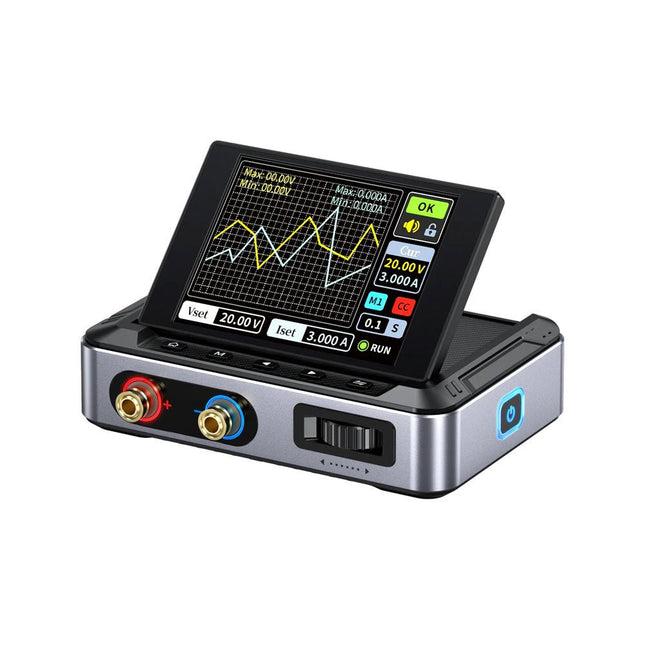
FNIRSI FNIRSI DPS150PD Alimentation (150 W)
Le FNIRSI DPS150 est une alimentation CC réglable hautes performances dotée d'une interface d'entrée USB-C et de plusieurs modes d'alimentation, permettant un réglage précis de la tension de sortie (0-30 V) et du courant (0-5 A). Il fournit une sortie efficace, à faible consommation et stable, équipée de plusieurs fonctions de protection de sécurité, notamment les surtensions, les surintensités, les surcharges, la surchauffe et la connexion inversée. Il peut être appliqué de manière flexible à la connexion série de plusieurs appareils, avec un affichage et un fonctionnement riches et conviviaux, une conception compacte et portable, répondant à divers besoins d'application. Caractéristiques Alimentation CC variable de 30 V, 5 A, 150 W avec une précision de 0,01 V, 0,001 A, des modes CC/CV et une ondulation <20 mV pour protéger les composants électroniques sensibles. Prend en charge les entrées PC, QC et DC avec des sorties programmables et 6 paramètres de tension/courant prédéfinis. Compatible avec les fiches bananes de 4 mm, les bornes en forme de U et les fils de cuivre pour divers équipements. 8 mécanismes de sécurité, dont une protection contre les surtensions, les courants, les courts-circuits et la surchauffe. Écran HD IPS de 2,8 pouces avec affichage inversé à 90°, numérique et courbe pour une surveillance facile. Conception compacte et peu encombrante pour utilisation dans les laboratoires, les réparations et les projets de bricolage. Spécifications Tension d'entrée 5~32 V DC Courant d'entrée 100 mA-5 A Tension de sortie 0-30 V Courant de sortie 0~5 A Puissance de sortie 0-150 W Mode d'entrée Chargeur rapide PD Chargeur rapide QC Banque d'alimentation Adaptateurs d'alimentation CC Environnement d'exploitation 0-40°C Régulation de charge 0,49% Efficacité à pleine charge 96,30% Écran 2,8 pouces (320 x 240) Dimensions 106 x 76 x 28 mm Poids 178 g Inclus 1x DPS150 alimentation 2x Fils à pince crocodile (noir et rouge) 1x Câble de chargement C2C PD 1x Adaptateur GaN PD 100 W (UE) 1x Câble micro-USB 1x Manuel Téléchargements Manual Firmware V0.0.1
€ 94,21
-

Elektor Digital Elektor May/June 2023 (PDF)
Elektor GREEN and GOLD members can download their digital edition here. Not a member yet? Click here. Knowledge for All! Super Servo TesterTest Up to Four Servos Stand-Alone or In-System Analog Signals and MicrocontrollersADCs, DACs, Current Measurement, and More embedded world 2023 Sub-Nyquist Sampling in PracticeReliably Capturing Higher Frequencies Using Subsampling Android Smartphone Here, ESP32 There?Practical Pproject Using the Android Wi-Fi API Active 1-kHz Filter for Distortion MeasurementBetter Measurements Through Optimization of the Measurement Signal Starting Out in Electronics......Multivibrating Cheerfully Further! Err-lectronicsCorrections, Updates and Readers’ Letters The New I3C ProtocolA Worthy Successor to I²C, or Just More Hot Air? BlueRC: IR Remote Control with Smartphone and ESP32Adaptive and Universal Microcontroller Documentation Explained (Part 2)Registers and Block Diagrams Automating Test and MeasurementProgramming Test Equipment to Do What You Want Infographics: Test and Measurement Overvoltage Protection for Safe OperationTransient Protection for Non-Isolated DC/DC Power Modules Wiha Measuring EquipmentReliable Electrical Testers and Meters Automating Testing and Collaborating on Test Results From Life’s ExperienceHigh-Level Electronics Energy LoggerMeasuring and Recording Power Consumption Assembling the 4tronix M.A.R.S. Rover Kit Parking Disk with E-Paper DisplayAn Innovative Digital Replacement eCO₂ Telegram botAir-Quality Measurement with Telegram Notification Behind the Scenes of DIY High-End AudioElektor’s Ton Giesberts Interviewed on the Fine Art of Analog Design HomeLab ToursWork in Progress... RFID Tag Reading and RFID Door LockSample Projects from the Elektor Arduino Experimenting Bundle Oscilloscope Current Probe for RFRF Current Measurements Made Easy Not for the Faint-Hearted: Robot Arm KitWith Raspberry Pi Pico and MicroPython Generative AIWho Made This Anyway? Hexadoku
€ 7,50
-

Elektor Digital Elektor Special: Arduino Shields (PDF) EN
Make your project dreams come true: an odometer for the hamster wheel, a fully automatic control of your ant farm with web interface, or the Sandwich-O-Mat – a machine that toasts and grills sandwiches of your choice. With the Arduino and the DIY or Maker movement, not only did entry into microcontroller programming become child's play, but a second development also took place: Resourceful developers brought small boards – so-called shields or modules – to the market, which greatly simplified the use of additional hardware. The small modules contain all the important electronic parts to be connected to the microcontroller with a few plug-in cables, eliminating the need for a fiddly and time-consuming assembly on the plug-in board. In addition, it is also possible to handle tiny components that do not have any connecting legs (so-called SMDs). Projects Discussed Arduino seeks connection BMP and introduction to libraries, I²C Learn I/O basics with the multi-purpose shield I²C LCD adapter and DOT matrix displays LCD keypad shield Level converter W5100: Internet connection I/O expansion shield Relays and solid-state relays The multi-function shield: A universal control unit Connecting an SD card reader via SPI Keys and 7-segment displays 16-bit ADC MCP4725 DAC 16-way PWM servo driver MP3 player GPS data logger using an SD card Touch sensor Joystick SHT31: Temperature and humidity VEML6070 UV-A sensor VL53L0X time-of-flight Ultrasonic distance meter MAX7219-based LED DOT matrix display DS3231 RTC Port expander MCP23017 433 MHz radio MPU-650 gyroscope ADXL345 accelerometer WS2812 RGB LEDs Power supply MQ-xx gas sensors CO2 gas sensor ACS712 current sensor INA219 current sensor L298 motor driver MFRC522 RFID 28BYJ-48 stepper motor TMC2209 silent step stick X9C10x digital potentiometer ST7735 in a color TFT display e-Paper display Bluetooth Geiger counter SIM800L GSM module I²C multiplexer Controller Area Network
€ 11,95
Membres : € 10,76
-

Elektor Digital Mastering Microcontrollers Helped by Arduino (3rd Edition) | E-book
Third, extended and revised edition with AVR Playground and Elektor Uno R4 Arduino boards have become hugely successful. They are simple to use and inexpensive. This book will not only familiarize you with the world of Arduino but it will also teach you how to program microcontrollers in general. In this book theory is put into practice on an Arduino board using the Arduino programming environment. Some hardware is developed too: a multi-purpose shield to build some of the experiments from the first 10 chapters on; the AVR Playground, a real Arduino-based microcontroller development board for comfortable application development, and the Elektor Uno R4, an Arduino Uno R3 on steroids. The author, an Elektor Expert, provides the reader with the basic theoretical knowledge necessary to program any microcontroller: inputs and outputs (analog and digital), interrupts, communication busses (RS-232, SPI, I²C, 1-wire, SMBus, etc.), timers, and much more. The programs and sketches presented in the book show how to use various common electronic components: matrix keyboards, displays (LED, alphanumeric and graphic color LCD), motors, sensors (temperature, pressure, humidity, sound, light, and infrared), rotary encoders, piezo buzzers, pushbuttons, relays, etc. This book will be your first book about microcontrollers with a happy ending! This book is for you if you are a beginner in microcontrollers, an Arduino user (hobbyist, tinkerer, artist, etc.) wishing to deepen your knowledge,an Electronics Graduate under Undergraduate student or a teacher looking for ideas. Thanks to Arduino the implementation of the presented concepts is simple and fun. Some of the proposed projects are very original: Money Game Misophone (a musical fork) Car GPS Scrambler Weather Station DCF77 Decoder Illegal Time Transmitter Infrared Remote Manipulator Annoying Sound Generator Italian Horn Alarm Overheating Detector PID Controller Data Logger SVG File Oscilloscope 6-Channel Voltmeter All projects and code examples in this book have been tried and tested on an Arduino Uno board. They should also work with the Arduino Mega and every other compatible board that exposes the Arduino shield extension connectors. Please note For this book, the author has designed a versatile printed circuit board that can be stacked on an Arduino board. The assembly can be used not only to try out many of the projects presented in this book but also allows for new exercises that in turn provide the opportunity to discover new techniques. Also available is a kit of parts including the PCB and all components. With this kit you can build most of the circuits described in the book and more. Datasheets Active Components Used (.PDF file): ATmega328 (Arduino Uno) ATmega2560 (Arduino Mega 2560) BC547 (bipolar transistor, chapters 7, 8, 9) BD139 (bipolar power transistor, chapter 10) BS170 (N-MOS transistor, chapter 8) DCF77 (receiver module, chapter 9) DS18B20 (temperature sensor, chapter 10) DS18S20 (temperature sensor, chapter 10) HP03S (pressure sensor, chapter 8) IRF630 (N-MOS power transistor, chapter 7) IRF9630 (P-MOS power transistor, chapter 7) LMC6464 (quad op-amp, chapter 7) MLX90614 (infrared sensor, chapter 10) SHT11 (humidity sensor, chapter 8) TS922 (dual op-amp, chapter 9) TSOP34836 (infrared receiver, chapter 9) TSOP1736 (infrared receiver, chapter 9) MPX4115 (analogue pressure sensor, chapter 11) MCCOG21605B6W-SPTLYI (I²C LCD, chapter 12) SST25VF016B (SPI EEPROM, chapter 13) About the author Clemens Valens, born in the Netherlands, lives in France since 1997. Manager at Elektor Labs and Webmaster of ElektorLabs, in love with electronics, he develops microcontroller systems for fun, and sometimes for his employer too. Polyglot—he is fluent in C, C++, PASCAL, BASIC and several assembler dialects—Clemens spends most of his time on his computer while his wife, their two children and two cats try to attract his attention (only the cats succeed). Visit the author’s website: www.polyvalens.com.Authentic testimony of Hervé M., one of the first readers of the book:'I almost cried with joy when this book made me understand things in only three sentences that seemed previously completely impenetrable.'
€ 34,95
Membres : € 31,46
-

Weller Weller WT 1010 Station de soudage numérique (90 W)
High-quality soldering with the most important tools and consumables, ideal for universal soldering applications. Features Power unit, 1 channel 1-channel Soldering Station digital 90 W (95 W) WTP 90: The soldering iron for universal use with power response tips. Tip family XNT & THM (high mass tips) Lock function Specifications Dimensions W x D x H (mm): 149 x 138 x 101 Dimensions W x D x H (inch): 5.87 x 5.43 x 3.98 Weight (ca) in kg: 1.9 Channels: 1 Voltage: 230 V, 50/60 Hz Heating output: 90 W (95 W) Temperature accuracy °C: ±9 Display: Backlit LCD Temperature range: Adjustable from 50°C - 450°C (150°F - 850°C)Adjustable temperature range varies among tools Temperature stability °C: ±2 Temperature accuracy °F: ±17 Temperature stability °F: ±4 Temperature range (depends on tool) °C: 100-450 Temperature range (depends on tool) °F: 150-850 Equipotential balance: yes Fuse: 0,5 A WT compatible: yes ESD-safe: yes Power cord: EMEA
€ 534,00
-

OWON OWON SPS6051 Alimentation CC sans ventilateur (150 W)
L'alimentation CC programmable sans ventilateur OWON SPS6051 (150 W) offre des performances ultra silencieuses et de haute précision avec une précision de 10 mV/1 mA et une dissipation thermique avancée pour une fiabilité à long terme. Doté d'une protection complète, d'une interface USB avec prise en charge SCPI pour le contrôle à distance et d'un écran LCD TFT de 2,8 pouces, c'est le choix idéal pour les laboratoires, les tests électroniques et la recherche. Caractéristiques Conception sans ventilateur : fonctionnement ultra-silencieux, réduisant le bruit de vibration et minimisant les risques de défaillance potentiels associés aux ventilateurs de refroidissement traditionnels. Excellente conception de dissipation thermique : assure une augmentation contrôlée de la température, permettant un fonctionnement à long terme dans des conditions de pleine charge et prolongeant la longévité des composants internes. Conception légère et ultra-mince. Précision de sortie jusqu'à 10 mV/1 mA. Prend en charge l'édition et la sortie de formes d'onde de liste, avec quatre paramètres de raccourci mémoire pour un accès rapide et pratique. Les fonctions de protection intégrées incluent la protection contre les surtensions, les surintensités, les surchauffes et les sous-tensions d'entrée pour une sécurité renforcée. Le circuit de décharge intégré évite les risques de haute tension résiduelle lorsque l'alimentation est coupée. Interface de communication USB avec prise en charge du protocole SCPI, permettant la programmation PC et le contrôle à distance pour une utilisation simplifiée gestion. Écran LCD TFT de 2,8 pouces Spécifications Modèle SPS6051 SPS3081 Sortie nominale (0°C-40°C) Tension 0-61 V 0-31 V Courant 0-5,1 A 0-8,1 A Puissance 150 W 120 W Régulation de charge Tension ≤30 mV Courant ≤20 mA Régulation de puissance Tension ≤30 mV Courant ≤20 mA Définition de la résolution Tension 10 mV Courant 1 mA Résolution de relecture Tension 10 mV Courant 1 mA Précision de réglage (25°C ±5°C) Tension ≤0,05% ±20 mV ≤0,1% ±20 mV Courant ≤0,05% ±20 mA ≤0,2% ±20 mA Précision de relecture (25°C ±5°C) Courant ≤0,05% ±20 mV ≤0,1% ±20 mV Tension ≤0,05% ±20 mV ≤0,2% ±20 mA Ondulation/Bruit Tension ≤30 mVp-p ≤30 mVp-p Tension ≤4 mVrms ≤5 mVrms Courant ≤10 mAp-p ≤30 mAp-p Coefficient de température de sortie (0°C-40°C) Tension 100 ppm/°C Courant 200 ppm/°C Relecture du coefficient de température Tension 100 ppm/°C Courant 200 ppm/°C Temps de réponse (charge nominale de 50 à 100%) ≤1,0 ms Stockage 4 groupes de données Température de fonctionnement 0-40°C Écran Écran LCD couleur de 2,8 pouces Interface USB Dimensions (L x H x P) 82 x 142 x 226 mm Poids 1,8 kg Inclus 1x OWON SPS6051 Alimentation 2x Fils de test 1x Cordon d'alimentation 1x Manuel Téléchargements Datasheet User Manual Programming Manual PC Software
€ 133,20
-

Uni-Trend UNI-T UDP3305S-E Alimentation CC (328 W)
L'UDP3305S-E est une alimentation CC linéaire programmable hautes performances. Il dispose d'une interface utilisateur LCD claire, d'excellents indicateurs de performance, d'une variété de fonctions d'analyse et d'interfaces de communication. Il peut répondre aux besoins de test diversifiés des utilisateurs. Son objectif est de fournir un équipement d'alimentation électrique programmable en courant continu rentable pour l'enseignement, la recherche scientifique, l'industrie et d'autres domaines. Interface interactive LCD Utilisant un écran d'affichage haute définition de 4,3 pouces, il fournit aux utilisateurs une interface homme-machine avec des fonctions riches et un fonctionnement simple, qui peut afficher la tension/courant de sortie réglé actuellement, la tension/courant de sortie réelle et la valeur de tension/courant de sortie de protection. de l'alimentation en temps réel. L'interface fonctionnelle est simple et complète, facile à utiliser. Réglage à une touche pour série et parallèle La connexion série-parallèle entre CH1 et CH2 du canal principal peut être réalisée sans connexion externe, ce qui simplifie la connexion et facilite le test. Fonction Liste/Delayer Avec les fonctions de liste et de réglage du délai, il peut configurer jusqu'à 2048 ensembles de données selon les exigences du test, et le nombre de cycles peut atteindre 99999. Il est utilisé avec des modèles de forme d'onde, ce qui est très pratique pour les tests de cycle et les tests de vieillissement. Interface de télécommande riche L'interface de communication RS232 standard, l'interface Ethernet, les E/S numériques et les interfaces USB maître et esclave, peuvent être contrôlées par connexion à distance à Ethernet, ou via RS232 et USB, avec le logiciel de l'ordinateur hôte pour obtenir un contrôle logiciel. Spécifications Taper Alimentation CC linéaire Canaux 4 Pouvoir total 328 W Tension de sortie CH1/CH2 : 0~30 V CH3 : 0 ~ 6 V CH4 : 5 V Courant de sortie CH1/CH2 : 0~5 A CH3 : 0 ~ 3 A CH4 : 2 A Résolution 10 mV, 1 mA Précision du réglage 0,3% +20 mV<0,2% +5mA Connectivité Périphérique USB, RS-232, LAN, hôte USB, E/S numérique Inclus 1x Alimentation CC UDP3305S-E 1x Cordon d'alimentation 1x Câble USB Téléchargements Fiche de données Manuel de l'Utilisateur Manuel de programmation Logiciel V1.0 Firmware V1.10
€ 393,26
-

Elektor Digital Elektor July/August 2020 (PDF) EN
Home Information SystemUsing Windows on a Raspberry Pi Starting with Node-REDAn open-source visual block-based programming tool Elektor Summer GiveAway Simple Function Generator: With Reverse-Order Signal Creation GreatScott! Builds a LoRa Alarm System Review: Joy-iT RD6006 Benchtop Power Supply Kit Review: The GreatFET One Interface Board Small Circuits Revival – XXLEscaped from the Suggestions Box Poorest Man's External 2.4 GHz Wi-Fi Antenna Simple On-Off Temperature Controller with Raspberry Pi HAT How to Take (Successful) Photos of ElectronicsShowing your projects in their best light Review: The I2CDriver Tool Review: JOY-iT Joy-View Portable Touchscreen LED Booster for MicrocontrollersWith just one component Experimental Ultrasonic Clothes Washer Review: The Joy-iT JDS2915 Signal GeneratorA 2-Channel Signal Generator and Frequency Counter Traffic Lights Programmed in PIC Assembly Code E-E-E-ternal Blinker Experimental Hall Sensor Tracing Shorts with the Milli-Ohm or ESR Meter Review: Elektor SDR Hands-on Kit Elektor Labs Pipeline Elektor KickstarterWell, you get the idea. Do You Really Need All That Stuff???This is where I spend many hours working on electronics projects Homelab Tours: The Kinetic Clock MakerStargate jigsawed! Hello, World! We’re Elektor, and We’re Social M4 + 2x A7 + GPU: An Unbalanced Dream TeamLatest STM32MP1-SoCs can tackle demanding applications Test Rig for 16F18877 & Similar Big PICs Inter-Microcontroller Traffic with the SPI Bus and ATmega328p Six Shades of LF/AF OSC (and the Miller’s Tale) BBC micro:bit Absolute Minimalist Oscilloscope with LED Display ‘Knight Rider’ LED Chaser with the ESP32 LW/MW AM Signal Generator with ATtiny13 Absolute Minimalist Dip Meter Photovoltaic Regulator UpdateNew function for measuring battery temperature Wireless SignallingTransmitting switching signals over LPR Ultrasonic Reverse Parking Aid with Arduino Uno Distortion Pedal with Op Amp and Space Charge Tubes Electronics Workspace Essentials Hexadoku Artificial Intelligence for Beginners (2)Neural networks with Linux and Python
€ 7,50
-

Elektor Digital Elektor Special: Stromversorgung & Batterien (PDF)
Der simpel „Stromversorgung“ genannte Schaltungsteil wird sowohl bei der Entwicklung als auch bei der Reparatur von Elektronik enorm unterschätzt. Dabei ist die Vielfalt bei Netzteilen oder neudeutsch „PSU“ enorm. Es gibt sie in den unterschiedlichsten Ausführungen: mit Gleich- oder Wechselspannung, als Generator, Akku oder Batterie, als Solar-Panel, extern oder eingebaut, linear oder „geschaltet“ – um nur einige zu nennen. Auch die Leistungsbereiche sind enorm: von Nano-Ampere bis Kilo-Ampere – dasselbe gilt für Spannungen. Bei der konkreten Umsetzung kann man zwischen ICs oder diskreten Bauteilen, zwischen fertigem Gerät bzw. Modul oder der Realisation aus selbstverlöteten Bauteilen wählen. Dieses Special deckt die wichtigsten Merkmale und Gestaltungsaspekte von Stromversorgungen ab. Inhalt Grundlagen BatteriemanagementWas man beim Einsatz von (Lithium-)Akkus beachten muss. Festspannungsnetzgerät mit LinearreglerDas beste Ergebnis gleich nach den Batterien. Lichtenergie sammelnWie man ein Solarmodul für ein Energy-Harvesting-Projekt verwenden kann. Netzbetriebene VersorgungsgeräteBasis-schaltungen und Tipps für Transformatoren, Gleichrichtung, Siebung und Stabilisierung. SanftanlaufDer hohe Einschaltstrompuls sollte vermieden werden. Steuerbare GleichrichterEinige Vorschläge um die Verlustleistung im Längsregler möglichst gering zu halten. Komponenten Arbeitsblatt: Spannungsreglerserie LM117 / LM217 / LM317 Supercaps Reviews Labornetzteil-Kit Joy-iT RD6006 Elektronische Last Siglent SDL1020X-E Projekte Balkon-KraftwerkSelbst installiert = schnell amortisiert! DIY-LiPo-Supercharger-KitVom Prototyp zum Massenmarkt. Doppelanoden-MOSFET-ThyristorSchneller und effizienter als herkömmliche SCRs. Batterie-EntsafterNicht wegwerfen, ausquetschen! Hochspannungsnetzteil mit KennlinienschreiberSpannungen bis 400 V einstellen und Kennlinien für Röhren und Transistoren erstellen. HochspannungsnetzteilFür RIAA-Röhrenvorverstärker und andere Anwendungen. MicroSupplyEine Laborstromversorgung für universelle Anwendungen. Phantom-Speisung mit geschalteten KondensatorenSpannungsverdreifachung mit zwei ICs. Das SMPS800RE Schaltnetzteil für den Elektor Fortissimo-100Zuverlässig, leicht und erschwinglich. SoftstartSchont das Netzgerät und die Last. UniLab 2Geschaltetes Labornetzteil 0…30 V/3 A Tipps Softstart für Step-Down-Schaltregler Stromabschaltung mit minimalen Verlusten Powerbank-Geheimnisse Künstliche Masse Akku-Erfrischer Akkupack-Entlader Parallelschaltung von Spannungsreglern
€ 11,90
Membres : € 10,71
-

iFixit iFixit Manta Driver Kit
Ce kit comprend le plus large assortiment d'embouts iFixit, ainsi que toutes les têtes de tournevis dont vous aurez besoin pour entreprendre tout projet de réparation ou de bricolage. Il comprend des embouts standard comme Phillips et Flathead dans une gamme complète de tailles pour tout gérer, de la réparation électronique de précision aux projets de bricolage à domicile. Et ce ne serait pas un ensemble de bits iFixit s'il n'incluait pas tous les éléments exotiques, des Pentalobes pour la réparation d'iPhone et de MacBook d'Apple aux Gamebits pour vos consoles Nintendo vintage. Tous les jeux d'embouts de nouvelle génération ont été repensés afin de maximiser la commodité et la convivialité. Le couvercle du jeu d'embouts est maintenu en place avec des aimants pour augmenter la durée de vie du produit (plus de charnières ou de fermoirs cassés) et se monte également à l'arrière du boîtier du jeu d'embouts pour le garder à l'écart pendant que vous faites votre travail. Si vous avez besoin d'aide pour organiser vos vis et pièces, vous pouvez utiliser le plateau de tri intégré au couvercle. Les embouts de 4 mm ont été ajustés et ont désormais un col plus long pour une portée plus profonde et plus précise. La boîte à outils comprend Étui aimanté facile à ouvrir Membre avec plateau de tri intégré Tournevis en aluminium de 4 mm Tourne-embout en aluminium 1/4' Embouts de tournevis de 4 mm Phillips - 000, 00, 0 Tête plate - 1, 1,5, 2, 2,5, 3, 3,5 mm Torx-T2, T3, T4, T5 Sécurité Torx - TR6, TR7, TR8 Pentalobes-P2, P5, P6 JIS-000, 00, 0, 1 Hex - 0,7, 0,9, 1,3, 1,5 mm Sécurité hexagonale - 2, 2,5, 3, 3,5 mm Tripoint - Y000, Y00, Y0, Y1 Tourne-écrou - 2,5, 3, 3,5, 4, 4,5, 5, 5,5 mm Mors de jeu - 3,8, 4,5 mm Tendeur - 4, 6 Triangles - 2, 2,2, 2,6, 3 mm Mors ovale Embout d'espacement pour iPhone Bit d'éjection Sim Embout de ramassage magnétique Embouts de tournevis 1/4' Phillips - 1, 2, 3 Tête plate - 4, 5, 6, 7, 8 mm Sécurité hexagonale - 4, 5, 6, 7, 8 mm Sécurité hexagonale SAE - 1/8, 9/64, 5/32, 3/16, 7/32, 1/4 Pozidriv-PZ0, PZ1, PZ2, PZ3 Jeu de couples - 6, 8, 10 Tendeur - 8, 10, 12 Carré - 0, 1, 2, 3 Cannelure-M5, M6, M8 Sécurité Torx - TR9, TR10, TR15, TR20, TR25, TR27, TR30, TR35, TR40 Tri-aile 1, 2, 3, 4 Embrayage 1, 2, 3 Vanne Schrader Entraînement à crochet Adaptateur 1/4' à 4 mm Pilote 1/4' à douille 1/4' Pilote 1/4' à douille 3/8' Douille 1/4' vers pilote 1/4' Caractéristiques Embout métal : acier 6150 Matériau du pilote : aluminium anodisé Matériau du boîtier: ABS Mousse : EVA
€ 64,41


