
Résultats de la recherche pour "sdr"
-

Elektor Digital Tube Amplifier Circuits (E-book)
From SRPP and Mu-Follower to OTL Designs Tube amplifiers suffer from distortion. Fortunately, circuits such as the SRPP amplifier, mu-follower, and beta-follower produce minimal distortion even at output voltages of 50 to 100 Vpeak. These designs are often published with errors. Without a sound understanding of the theory, it is easy to arrive at a flawed design. In the first section of this book, we investigate the origin of distortion, while in the second we investigate the design of and SRPP and a mu-follower. On the internet we can find the most exotic designs. Evaluating them teaches us that these designs often make matters worse rather than better. In the chapter on incorrect SRPPs and mu-followers, we sometimes see bizarre and misguided designs where using a simple single-triode amplifier would perform much better. Push-pull output stages also exist. A great number of them are examined, and their similarity to the SRPP is discussed. This is done especially with the help of the theory behind the OTL based on the ‘mother’ of all OTLs, the Philips HF303. Finally, attention is given to frequency characteristics and technical matters such as the supply voltage and the filament power supply. To illustrate these points, there are a few designs covering the subjects discussed. This book presents much new theory that has not been published before. It is often an eye-opener, showing that many things have a beautiful and unexpected simplicity.
€ 34,95
Membres : € 31,46
-

Elektor Academy Pro Raspberry Pi Pico with Arduino C/C++ (cours de programmation)
Ce cours complet de programmation de microcontrôleurs basé sur le Raspberry Pi Pico comprend un manuel, un kit de composants, des projets pratiques ainsi qu’un cours en ligne complet avec simulations. Il est idéal pour apprendre pas à pas la programmation des systèmes embarqués avec Arduino grâce à une approche pratique. Une introduction pratique aux systèmes embarqués avec le Raspberry Pi Pico Ce cours s’adresse aux débutants en systèmes embarqués recherchant une approche structurée et basée sur des exemples. Un kit de composants comprenant des LED et des résistances, des interrupteurs, des capteurs et actionneurs, des afficheurs, une breadboard et des fils est inclus. Ceux-ci sont utilisés dans le cours pour illustrer des applications concrètes. Aucune expérience préalable avec Arduino ou le développement embarqué n’est requise. Chaque section propose des exemples pratiques et des mini-projets conçus pour renforcer les concepts clés et encourager l’exploration. À la fin du cours, vous serez capable non seulement de reproduire les exemples, mais aussi de développer vos propres idées et applications. Que allez-vous apprendre ? Programmation de microcontrôleurs en C/C++ avec le Raspberry Pi Pico via l’IDE Arduino Utilisation des entrées/sorties numériques, lecture de boutons et encodeurs, commande de LED et relais Lecture des entrées analogiques, tensions et capteurs analogiques Génération de signaux analogiques et PWM Utilisation des communications série comme UART, I²C et SPI pour piloter des afficheurs et lire des capteurs numériques et cartes SD Gestion du temps Utilisation des interruptions Entrées capteurs en temps réel et contrôle via boutons, LED et afficheurs Commande d’actionneurs comme relais et servomoteurs À qui s’adresse ce cours ? Étudiants et autodidactes explorant les systèmes embarqués Makers et passionnés d’IoT souhaitant améliorer leurs compétences en hardware Formateurs et enseignants à la recherche de matériel pédagogique prêt à l’emploi Contenu de la boîte Accès au cours complet sur la plateforme Elektor Academy Pro Carte microcontrôleur Raspberry Pi Pico + câble USB Livre : Programming Microcontrollers in C/C++ Using Arduino Fichiers de projet téléchargeables pour chaque module Boîte de composants : 2× LED, rouge, 5 mm LED, verte, 5 mm 3× résistance, 470 Ω, 0,25 W LDR Potentiomètre, 10 kΩ, linéaire Bouton-poussoir Module encodeur rotatif Module relais Capteur DHT22 (température & humidité) Afficheur 7 segments 4 digits compatible TM1637 MPU-6050 IMU avec connecteurs Afficheur OLED I²C compatible SSD1306 Adaptateur carte micro SD avec connecteur Buzzer Micro servo SG90 Écran TFT SPI 240×320 compatible ILI9341 20× fils jumper Breadboard Tous les cours de programmation (et différences de contenu) Cours Arduino Raspberry Pi Pico with Arduino C/C++ ESP32 with Arduino C/C++ Raspberry Pi Pico with MicroPython ESP32 with MicroPython Cours en ligne Access to Arduino Course Access to Pico with Arduino C/C++ Course Access to ESP32 with Arduino C/C++ Course Access to Pico with MicroPython Course Access to ESP32 with MicroPython Course Carte Uno R3 Raspberry Pi Pico ESP32 Raspberry Pi Pico ESP32 Livre Programming Microcontrollers in C/C++ Using Arduino Programming Microcontrollers in C/C++ Using Arduino Programming Microcontrollers in C/C++ Using Arduino Programming Microcontrollers in MicroPython Programming Microcontrollers in MicroPython Kit Boîte de composants (40 pièces) Boîte de composants (40 pièces) Boîte de composants (40 pièces) Boîte de composants (40 pièces) Boîte de composants (40 pièces)
€ 69,95
Membres : € 62,96
-
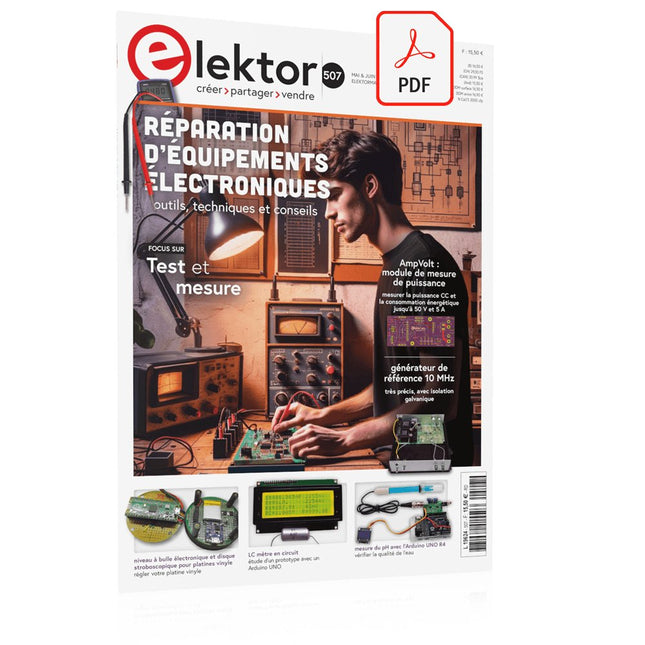
Elektor Digital Elektor Mai/Juin 2024 (PDF)
Le téléchargement intégral de ce numéro est disponible pour nos membres GOLD et GREEN sur le site Elektor Magazine ! Pas encore membre ? Cliquez ici. STM32 Wireless Innovation Design Contest Winners : les gagnants LC mètre en circuitétude de prototype AmpVolt : module de mesure de puissance (1)mesure de la puissance CC et de la consommation énergétique jusqu'à 50 V et 5 A Embedded world 2024 réparation d'équipements électroniquesoutils, techniques et conseils démarrer en électronique...plus de théorie sur les ampli-op un générateur de signaux simplePure synthèse numérique directe Sparkplug en un coup d'œilune spécification pour les données MQTT contrôleur de tube cathodique éclairage à commande radarcomment éclairer automatiquement un escalier en détectant une présence humaine niveau à bulle électronique et disque stroboscopique actif pour platines vinylerégler votre platine vinyle avec cet outil tout-en-un explorer les défis et la valeur commerciale de l’électronique open source le connecteur circulaire codé Aune solution de choix pour les applications industrielles The Arduino-Inside Measurement Labun instrument de test et de mesure 8 en 1 pour le labo d’électronique analyseur de gain-phase avec une carte sonpour les fréquences de 100 Hz à 90 kHz mesure du pH avec l'Arduino UNO R4vérifier la qualité de l'eau sur le vifdouble détente oscilloscope numérique FNIRSI 1014Dde bonnes performances pour des budgets serrés 2024 : l'odyssée de l'IAdétection d'objets générateur de référence 10 MHztrès précis, avec distributeur et isolation galvanique mise à jour #2 : compteur d'énergie basé sur l'ESP32quelques améliorations projet 2.0corrections, Mises à jour, et Courrier des lecteurs entretien avec Eben Upton, PDG de Raspberry PiRaspberry Pi 5 et au delà
€ 10,95
-
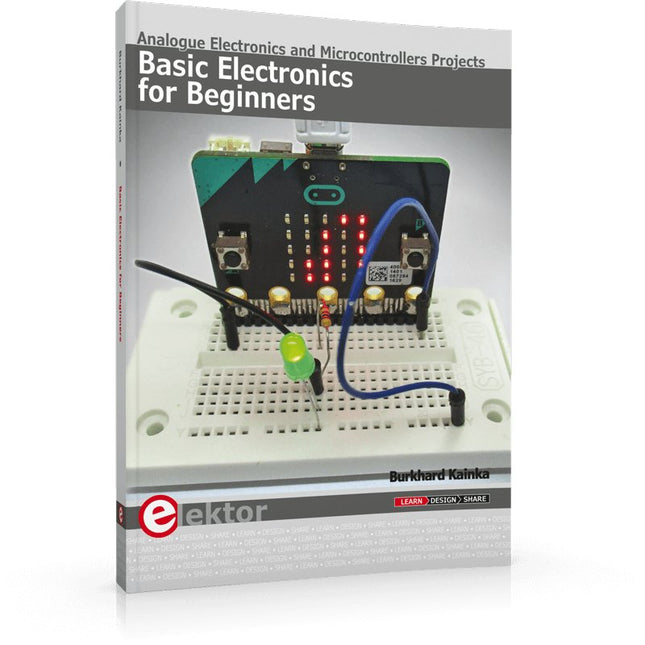
Elektor Publishing Basic Electronics for Beginners
Analogue Electronics and Microcontrollers Projects Hobbyist electronics can be a fun way to learn new skills that can be helpful to your career. Those who understand the basics of electronics can design their own circuits and projects. However, before you run, you need to learn to walk. It all starts with analogue electronics. You should be familiar with the simple components and circuits and understand their basic behaviors and the issues you may encounter. The best way to do this is through real experiments. Theory alone is not enough. This book offers a large number of practical entry-level circuits, with which everyone can gain the basic experience. Through the widespread introduction of microcontrollers, a new chapter in electronics has begun. Microcontrollers are now performing more and more tasks that were originally solved using discrete components and conventional ICs. Starting out has become easier and easier thanks to platforms including Bascom, Arduino, micro:bit. The book introduces numerous manageable microcontroller applications. It’s now a case of less soldering and more programming.
€ 39,95
Membres : € 35,96
-

Elektor Digital Mastering the Arduino Uno R4 (E-book)
Programming and Projects for the Minima and WiFi Based on the low-cost 8-bit ATmega328P processor, the Arduino Uno R3 board is likely to score as the most popular Arduino family member, and this workhorse has been with us for many years. Eleven years later, the long-overdue successor, the Arduino Uno R4, was released. It is built around a 48 MHz, 32-bit Arm Cortex-M4 microcontroller and provides significantly expanded SRAM and Flash memory. Additionally, a higher-precision ADC and a new DAC are added to the design. The Uno R4 board also supports the CAN Bus with an interface. Two versions of the board are available: Uno R4 Minima, and Uno R4 WiFi. This book is about using these new boards to develop many different and interesting projects with just a handful of parts and external modules. All projects described in the book have been fully tested on the Uno R4 Minima or the Uno R4 WiFi board, as appropriate. The project topics include the reading, control, and driving of many components and modules in the kit as well as on the relevant Uno R4 board, including LEDs 7-segment displays (using timer interrupts) LCDs Sensors RFID Reader 4x4 Keypad Real-time clock (RTC) Joystick 8×8 LED matrix Motors DAC (Digital-to-analog converter) LED matrix WiFi connectivity Serial UART CAN bus Infrared controller and receiver Simulators … all in creative and educational ways with the project operation and associated software explained in great detail.
€ 34,95
Membres : € 31,46
-
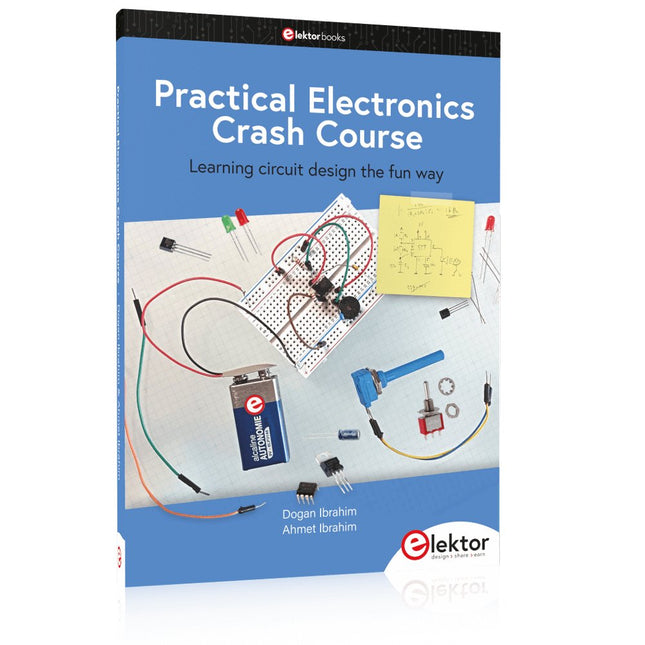
Elektor Publishing Practical Electronics Crash Course
Learning circuit design the fun way Welcome to the world of electronics! Getting started in electronics is not as difficult as you may think. Using this book, you will explore and learn the most important electrical and electronics engineering concepts in a fun way by doing various experiments and by simulating circuits. It will teach you electronics practically without getting into complex technical jargon and long calculations. As a result, you will be creating your own projects soon. No prior knowledge of electronics is required, only some basic algebra is used in a few simple calculations. Many tested and working projects and simulations are presented to familiarise yourself with the construction of electronic circuits. Circuit simulation is introduced at an early stage to enable you to experiment with circuits easily without breaking anything. You will learn: The concepts of voltage, current, and power AC and DC Basic lamp circuits with switches Passive components: resistors, capacitors & inductors RC & RCL circuits Electromagnetism Loudspeakers, relays, buzzers, and transformers Active components: diodes & LEDs, bipolar transistors & MOSFETs Transistor-based switching circuits Optocoupler circuits Astable & monostable multivibrators Using the 555 timer IC The operational amplifier Digital logic Advanced examples: amplifiers, oscillators, filters, and sensors Test and measurement tools Microcontrollers: Arduino UNO, ESP32, Raspberry Pi Pico, and Raspberry Pi Reading datasheets and best practices for selecting components EMC & EMI and norms & regulations
€ 39,95
Membres : € 35,96
-

Elektor Publishing Arduino UNO Q and AI
Learn to Build Intelligent Embedded Systems Build smarter embedded systems with Arduino UNO Q. This book gives you the tools, knowledge, and confidence to turn ideas into intelligent, working solutions using the Arduino UNO Q platform. Discover how to build intelligent embedded systems with the Arduino UNO Q and AI. Unlock the full potential of the Arduino UNO Q, a next-generation platform that combines the real-time power of the STM32U585 microcontroller with the flexibility of a Qualcomm Dragonwing QRB2210 microprocessor. Learn how to rapidly prototype real-world applications using the Arduino IDE for low-level embedded control and Python in Arduino App Lab for high-level development. Build confidence through hands-on projects that guide you step by step from basic board features to complete working systems. Explore ready-to-use, AI based Arduino App Lab examples and see how they can jump-start your development and reduce time to deployment. Step into the world of Edge AI with a clear, practical introduction to Edge Impulse Studio—no prior AI experience required. Follow a complete, real-world workflow to create a Keyword Spotting AI application, covering data collection, model training, optimization, and on-device inference using the Edge Impulse Studio. Bridge the gap between embedded systems and machine learning and learn how to bring intelligence directly onto your hardware. Perfect for embedded engineers, educators, students, and makers looking to stay ahead in AI-enabled product development.
€ 34,95
Membres : € 31,46
-

Elektor Publishing Grundschaltungen der Elektronik
Grundschaltungen der Elektronik
€ 49,00
Meilleur prix
-
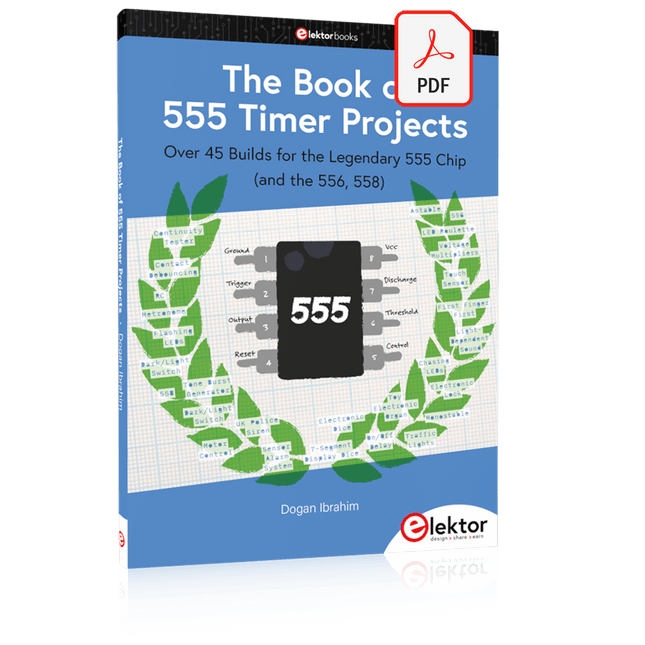
Elektor Digital The Book of 555 Timer Projects (E-book)
Over 45 Builds for the Legendary 555 Chip (and the 556, 558) The 555 timer IC, originally introduced by the Signetics Corporation around 1971, is sure to rank high among the most popular analog integrated circuits ever produced. Originally called the IC Time Machine, this chip has been used in many timer-related projects by countless people over decades. This book is all about designing projects based on the 555 timer IC. Over 45 fully tested and documented projects are presented. All projects have been fully tested by the author by constructing them individually on a breadboard. You are not expected to have any programming experiences for constructing or using the projects given in the book. However, it’s definitely useful to have some knowledge of basic electronics and the use of a breadboard for constructing and testing electronic circuits. Some of the projects in the book are: Alternately Flashing Two LEDs Changing LED Flashing Rate Touch Sensor On/Off Switch Switch On/Off Delay Light-Dependent Sound Dark/Light Switch Tone Burst Generator Long Duration Timer Chasing LEDs LED Roulette Game Traffic Lights Continuity Tester Electronic Lock Switch Contact Debouncing Toy Electronic Organ Multiple Sensor Alarm System Metronome Voltage Multipliers Electronic Dice 7-Segment Display Counter Motor Control 7-Segment Display Dice Electronic Siren Various Other Projects The projects given in the book can be modified or expanded by you for your very own applications. Electronic engineering students, people engaged in designing small electronic circuits, and electronic hobbyists should find the projects in the book instructive, fun, interesting, and useful.
€ 29,95
Membres : € 26,96
-

Elektor Publishing Arduino & Co – Measure, Control, and Hack
Clever Tricks with ATmega328 Pro Mini Boards With a simple Pro Mini board and a few other components, projects that 20 or 30 years ago were unthinkable (or would have cost a small fortune) are realized easily and affordably in this book: From simple LED effects to a full battery charging and testing station that will put a rechargeable through its paces, there’s something for everyone. All the projects are based on the ATmega328 microcontroller, which offers endless measuring, switching, and control options with its 20 input and output lines. For example, with a 7-segment display and a few resistors, you can build a voltmeter or an NTC-based thermometer. The Arduino platform offers the perfect development environment for programming this range of boards. Besides these very practical projects, the book also provides the necessary knowledge for you to create projects based on your own ideas. How to measure, and what? Which transistor is suitable for switching a certain load? When is it better to use an IC? How do you switch mains voltage? Even LilyPad-based battery-operated projects are discussed in detail, as well as many different motors, from simple DC motors to stepper motors. Sensors are another exciting topic: For example, a simple infrared receiver that can give disused remote controls a new lease on life controlling your home, and a tiny component that can actually measure the difference in air pressure between floor and table height!
€ 39,95
Membres : € 35,96
-
Elektor Publishing Les oscilloscopes anciens & modernes pour les débutants
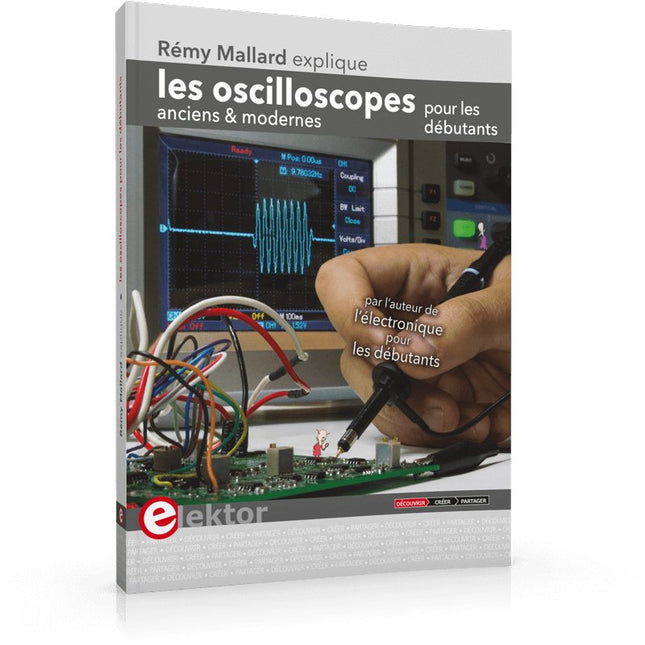
Ce qui se passe en électronique est par définition invisible à l'oeil nu. L'instrument qui permet précisément de rendre visibles les signaux électriques, celui par le truchement duquel les effets de l'électronique se manifestent à nous, c'est l'oscilloscope. Hélas, quand on commence à faire de l'électronique, c'est souvent sans oscilloscope. Et l'on en est réduit à tâtonner, aussi bien physiquement que mentalement. Le jour où l'on goûte à la visualisation des signaux sur un écran, c'est une révélation. Plus personne ne souhaite se priver de cet enchantement. Pas de retour en arrière. En électronique, si l'on veut progresser dans le plaisir et dans la compréhension, il faut un oscillo. Commence alors une période d'interrogation : comment choisir ? Et à peine cette question-là aura-t-elle trouvé sa réponse, il en viendra une ribambelle d'autres que l'on peut résumer en une seule : comment se servir de l'oscilloscope de telle sorte que ce qu'il affiche corresponde bien à la réalité des signaux ? Dans ce livre, Rémy Mallard, répond clairement à ces questions. Il donne aussi de nombreuses informations pour aider son lecteur à élucider lui-même de nouveaux mystères qui ne manqueront pas de surgir. Ceux qui le connaissent déjà comme l'auteur d'un livre sur l'électronique dont le titre est un programme à lui tout seul : L'électronique pour les débutants qui sèchent les cours mais soudent sans se brûler les doigts, ainsi que d'un livre d'initiation à la programmation des microcontrôleurs PIC, savent qu'ils trouveront ici un ouvrage utile, qu'ils rouvriront souvent.
€ 44,95
Membres : € 40,46
-
OWON OWON XDG3102 Générateur de formes d'onde arbitraires à 2 canaux (100 MHz)
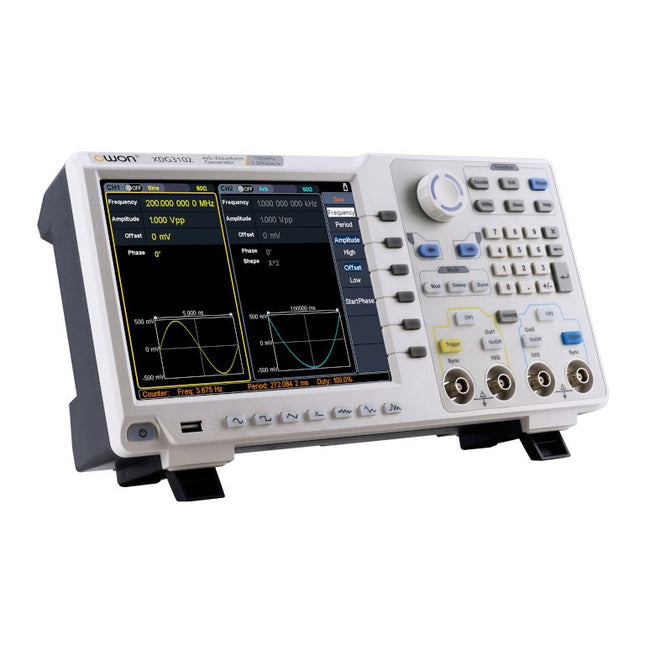
Caractéristiques Technologie DDS avancée, sortie de fréquence jusqu'à 250 MHz Taux d'échantillonnage de 1,25 GS/s et résolution de fréquence de 1 μHz Jusqu'à 1 M de longueur de forme d'onde arbitraire Résolution verticale : 14 bits Sortie de forme d'onde complète : 6 groupes de formes d'onde et 152 groupes de formes d'onde arbitraires intégrées Options de modulation complètes : AM, FM, PM, FSK, 3FSK, 4FSK, PSK, OSK, ASK, BPSK, PWM, balayage et rafale Fréquencemètre intégré de haute précision, allant de 100 MHz à 200 MHz SCPI et LabVIEW pris en charge Écran LCD tactile 8'' 800 x 600 pixels Spécifications XDG3102 Canal 2 Sortie de fréquence 100MHz Taux d'échantillonnage 1,25 Géch/s Résolution verticale 14 bits Forme d'onde Forme d'onde standard sinus, carré, impulsion, rampe, bruit et harmonique Forme d'onde arbitraire montée exponentielle, chute exponentielle, sin(x)/x, onde progressive et autres,total de 150 formes d'onde intégrées et forme d'onde arbitraire définie par l'utilisateur Fréquence (résolution 1μHz) Sinus 1µHz - 100MHz Carré 1µHz - 40MHz Impulsion 1µHz - 25MHz Catastrophe 1μHz - 5MHz Harmonique 1µHz - 50MHz Bruit 120 MHz (-3 dB, typique) Forme d'onde arbitraire forme d'onde intégrée : 1uHz - 15MHzForme d'onde définie par l'utilisateur : 1 uHz - 50 MHz Précision ±1 ppm, 0°C - 40°C Amplitude Amplitude (50Ω) 1 mVpp - 10 Vpp (≤40 MHz) ; 1 mVpp - 5 Vpp (≤80 MHz)1 mVpp - 2,5 Vpp (≤120 MHz) ; 1 mVpp - 1Vpp (≤250 MHz) Amplitude (haute impédance) 2 mVpp - 20 Vpp (≤40 MHz) ; 2 mVpp - 10 Vpp (≤80 MHz) ;2 mVpp - 5Vpp (≤120 MHz) ; 2 mVpp - 2Vpp (≤250 MHz) Résolution 1mV ou 4 chiffres Décalage CC Plage (50Ω) ±(5 Vpk - Amplitude Vpp/2) Plage (Z élevé, circuit ouvert) ±(10 Vpk - Amplitude Vpp/2) Précision ±(1 % de |réglage| + 1 mV + Amplitude Vpp x 0,5 %) Résolution 1mV ou 4 chiffres Impédance de charge 50Ω (typique) Précision ±(1 % du réglage + 1 mVpp) (typique, sinusoïdal de 1 kHz, décalage de 0 V) Pureté du spectre d'onde sinusoïdale Distorsion harmoniqueTypique (0dB) C.C - 1 MHz : <-65 dBc1 MHz - 10 MHz : <-60 dBc10 MHz - 120 MHz : <-50 dBc120 MHz - 200 MHz : <-45 dBc Distorsion harmonique totale <0,05 %, 10 Hz à 20 kHz, 1 Vc.c. Parasitaire (non harmonique),Typique (0dB) ≤10MHz : <-70dBc>10MHz : <-70dBc + 6dB/octave Bruit de phaseTypique (0 dBm, déviation de 10 kHz) 10 MHz : ≤-110 dBc/Hz Carré Temps de montée/descente <5ns Dépasser <3% Cycle de service 50,0% (fixe) Gigue (rms) 300ps + 100ppm Impulsion Largeur d'impulsion 12ns - 996875s Temps de front montant/fin ≧7ns Dépasser <3% Gigue (rms) 300ps + 100ppm Catastrophe Linéarité ≤1 % de la sortie maximale (typique, 1 kHz, 1 Vpp, 50 % de symétrie) Symétrie 0% à 100% Harmonique Ordre Harmonique ≤16 Type harmonique pair, impair, tout, utilisateur Amplitude harmonique pourrait être réglé pour toutes les harmoniques Phase harmonique Arbitraire Longueur de la forme d'onde 2 points - 1 million de points Résolution verticale 14 bits Temps minimum de montée/descente <7ns Gigue (rms) 3ns Modulation Taper AM, FM, PM, PWM, FSK, 3FSK, 4FSK, PSK, OSK, ASK, BPSK, balayage et rafale SUIS Forme d'onde porteuse sinusoïdal, carré, rampe et arbitraire (sauf DC) Source interne externe Forme d'onde modulante sinusoïdal, carré, rampe, bruit et arbitraire Profondeur 0,0% - 100,0% Fréquence de modulation 2 MHz - 100 kHz FM Forme d'onde porteuse sinusoïdal, carré, rampe et arbitraire (sauf DC) Source interne externe Forme d'onde modulante sinusoïdal, carré, rampe, bruit et arbitraire Fréquence de modulation 2 MHz - 100 kHz P.M. Forme d'onde porteuse sinusoïdal, carré, rampe et arbitraire (sauf DC) Source interne externe Forme d'onde modulante sinusoïdal, carré, rampe, bruit et arbitraire Déviation de phase 0° - 180° Fréquence de modulation 2 MHz - 100 kHz MLI Forme d'onde porteuse impulsion Source interne externe Forme d'onde modulante sinusoïdal, carré, rampe, bruit et arbitraire Écart de largeur 0 ~ minimum (rapport d'impulsions, 100 % - rapport d'impulsions) Fréquence de modulation 2 MHz - 100 kHz FSK/3FSK/4FSK Forme d'onde porteuse sinusoïdal, carré, rampe et arbitraire (sauf DC) Source interne externe Forme d'onde modulante carré avec un rapport cyclique de 50 % Fréquence clé 2 MHz - 1 MHz PSK Forme d'onde porteuse sinusoïdal, carré, rampe et arbitraire (sauf DC) Source interne externe Forme d'onde modulante carré avec un rapport cyclique de 50 % Fréquence clé 2 MHz - 1 MHz OSK Forme d'onde porteuse sinusoïdal, carré, rampe et arbitraire (sauf DC) Source interne Temps d'oscillation carré avec un rapport cyclique de 50 % Fréquence clé 2 MHz - 1 MHz DEMANDER Forme d'onde porteuse sinusoïdal, carré, rampe et arbitraire (sauf DC) Source interne externe Forme d'onde modulante carré avec un rapport cyclique de 50 % Fréquence clé 2 MHz - 1 MHz BPSK Forme d'onde porteuse sinusoïdal, carré, rampe et arbitraire (sauf DC) Source interne Forme d'onde modulante carré avec un rapport cyclique de 50 % Fréquence clé 2 MHz - 1 MHz Balayer Forme d'onde porteuse sinusoïdal, carré, rampe et arbitraire (sauf DC) Taper linéaire et log Direction haut et bas Temps de balayage 1 ms à 500 s, ± 0,1 % Source de déclenchement interne, externe et manuel Éclatement Forme d'onde porteuse sinusoïdal, carré, rampe, impulsion et arbitraire (sauf DC) Nombre de rafales 1 à 50 000 périodes, infini, gate Période interne 10 ns - 500 s Source fermée déclencheur externe Compteur de fréquence Fonction période de fréquence, +largeur, -largeur, +devoir et -devoir Gamme de fréquences 100 MHz - 200 MHz Résolution de fréquence 7 chiffres Entrée sortie Afficher Écran LCD tactile 8" 800 x 600 pixels Taper fréquencemètre, entrée de modulation externe,entrée de déclenchement externe,entrée/sortie d'horloge de référence externe Interface de Communication Hôte USB, périphérique USB et réseau local Dimension 340 x 177 x 90 mm Poids (sans colis) 2,50 kg
€ 644,63


