
Résultats de la recherche pour "arduino OR based OR all OR in OR one OR multitester OR kit"
-

Elektor Digital Elektor 03-04/2024 PDF (DE)
Diese Ausgabe steht allen GOLD- und GREEN-Mitgliedern auf der ElektorMagazine-Website zum Download bereit! Sie sind noch kein Mitglied? Hier klicken! CaptureCountEin Objektdetektor und -zähler auf dem Raspberry Pi 5 Spannungsreferenz mit Arduino Pro MiniLinearisieren und kalibrieren Sie analoge Eingänge FPGAs für EinsteigerDer Weg vom Mikrocontroller zur FPGA-Programmierung Update: STM32 Wireless Innovation Design Contest 2024 Bluetooth LE mit MAUISteuer-Apps für Android und Co. Breakout-Board für Port-ErweiterungMehr I/Os für Ihr Entwicklungssystem AI-SpezialistMachine Learning mit dem Jetson Nano 2024: Eine Odyssee in die KIErste Gehversuche mit TensorFlow 262.144 Wege, das Spiel des Lebens zu spielenEin Leserprojekt in Kürze Aus dem Leben gegriffenDer Chinesische Drache Bringen Sie Ihren DC-Bürstenmotor zum Laufen!Beispielprojekte aus dem Motor Control Development Bundle von Elektor ESP32-RS232-AdapterWireless-Anbindung klassischer Messgeräte Aller Anfang......muss nicht schwer sein: Mehr über Operationsverstärker Empfehlungen für ESP-Bibliotheken Piezoelektrische BauelementeBemerkenswerte Bauteile Ein intelligenter ObjektzählerBilderkennung leicht gemacht mit Edge Impulse Meistern Sie die kniffligsten Probleme Ihrer Embedded-Entwicklungen! ESP32-TerminalEin Handheld-Gerät mit Touch-Display Erste Schritte mit dem Zephyr RTOSSehr leistungsfähig, aber schwer zu beherrschen Preisgekrönte EthikEin Gespräch mit CTO Alexander Gerfer von Würth Elektronik eiSos über die Ermöglichung von Innovation und achtsames Verhalten Projekt 2.0Korrekturen, Updates und Leserbriefe
€ 11,90
-

iFixit iFixit Tapis magnétique pour projets
Le tapis magnétique iFixit 8 x 10 pouces attrape et retient solidement les vis lorsque vous les retirez d'un appareil. Vous pouvez désormais cesser de vous soucier du suivi de toutes les vis desserrées et vous concentrer sur votre réparation. Les vis et les petites pièces resteront là où vous les avez laissées. Pour les ordinateurs portables comportant des centaines de vis, utilisez l'ensemble du tapis comme guide de vis et notez soigneusement l'emplacement. Inclus est un stylo – fabriqué par Staedtler, producteur de stylos et crayons haut de gamme pour artistes et architectes – spécialement conçu pour le Project Mat. Le stylo Lumocolor Correctable résiste aux taches et ne s'efface pas avec un simple pinceau de la main. Une fois votre réparation terminée, utilisez la pointe de la gomme ou un chiffon sec pour essuyer l'encre. Caractéristiques Organisez toutes vos petites pièces pendant que vous travaillez sur un appareil. La surface effaçable à sec vous permet de conserver des notes et des croquis de localisation. Réduit le temps de remontage jusqu'à 40% tout en évitant les erreurs.
€ 19,79
-

Elektor Digital Edition spéciale Elektor : Invité édité par Espressif 2023 (PDF)
Les membres d'Elektor GREEN et GOLD peuvent télécharger ce numéro ici . Pas encore membre? Cliquez ici pour souscrire une adhésion. L’innovation IoT au galop Un cadre photo couleur E-Ink WiFi Tutoriel ESP Launchpad de zéro à flasher en quelques minutes ESP32 et ChatGPT en route vers un système d’auto-programmation… Talkie-walkie avec ESP-NOW pas tout à fait WiFi, pas tout à fait Bluetooth, mais... De l'idée au circuit avec l'ESP32-S3 voici comment construire un prototype avec les puces Espressif Innovation en matière de puce AIoT une interview avec Teo Swee-Ann, PDG d'Espressif Simulez ESP32 avec Wokwi le jumeau numérique de votre projet Test de l'ESP32-S3-BOX-3 une plateforme complète de développement AIoT pour votre poste de travail électronique Considérations et conseils des techniciens Espressif L'histoire d'ESP RainMaker comment nous avons construit « votre » cloud IoT Construction de l'Elektor Cloc 2.0 un produit Elektor déballé par Espressif L'ESP32-P4 se déchaîne la prochaine ère des microcontrôleurs Reste + intégré un puissant duo de développement Qui sont les intrépides développeurs Rust embarqués ? c'est ainsi qu'Espressif cultive Rust embarqué pour l'ESP32 la série SoC d'Espressif Un automate avec les solutions Espressif avec les possibilités et fonctionnalités du protocole ISOBUS La carte VGA ESP32-S3 suivez Bitluni pendant le processus de conception Prise d'empreintes acoustiques avec l'ESP32 reconnaissance de chansons avec le projet open-source Olaf Sapin de Noël rond 2023 une façon high-tech de célébrer les vacances Une vie plus simple et plus pratique un projet amateur basé sur le module ESP8266 d'Espressif Créer des applications IoT sans expertise logicielle avec la plateforme Blynk IoT et le matériel Espressif Créez une interface utilisateur intelligente sur ESP32 Développement IoT rapide et facile avec M5Stack Prototype d'un compteur d'énergie basé sur ESP32 Un distributeur à valeur ajoutée pour l'IoT et plus encore Dans les coulisses : entretien avec Arduino à propos du Nano ESP32 Alessandro Ranellucci et Martino Facchin sur la collaboration avec Espressif les coulisses d'Espressif Rationalisez le développement de MCU avec la séparation des privilèges ESP-IDF Un serveur de reconnaissance vocale open source... ...et la BOÎTE ESP L'œil pensant, la reconnaissance faciale et bien plus encore avec l'ESP32-S3-EYE Interrupteur à pile bouton avec ESP32-C2 conception axée sur la performance La matière fait avancer la maison intelligente libère le potentiel de l'IoT pour la maison intelligente Tech the Future : où aller avec Smarthome IoT ?
€ 9,95
-

iFixit iFixit iOpener Toolkit
Les appareils électroniques sont de plus en plus souvent équipés d'écrans et de batteries collés. Et si le joint adhésif sert de protection contre la saleté et l'eau, il complique la procédure d'ouverture de l'appareil et donc sa réparation. L'iOpener : Réchauffez-le, décollez la colle ! Grâce à notre iOpener, vous pouvez facilement et rapidement décoller l'adhésif sans risquer d'endommager votre appareil à cause d'une surchauffe avec un pistolet thermique. Conçu à l'origine pour ouvrir les iPad d'Apple, l'iOpener convient tout aussi bien aux tablettes Samsung, aux smartphones Sony et aux appareils de tout autre fabricant qui préfère l'adhésif aux vis. Comment ça marche ? Chauffez l'iOpener et placez-le sur votre appareil : il suffit de chauffer l'iOpener au micro-ondes ou dans une casserole d'eau bouillante et de le placer sur le bord de votre appareil. La chaleur va ramollir l'adhésif sans endommager votre gadget afin que vous puissiez insérer un pic d'ouverture entre l'écran et le boîtier. Répétez cette procédure pour toutes les zones collées, l'iOpener est réutilisable un nombre illimité de fois. Utilisez les outils d'ouverture pour enlever les résidus d'adhésif : avec les bons outils, vous êtes maintenant prêt à ouvrir votre appareil sans problème. Les outils d'ouverture sont suffisamment tranchants pour couper les bandes adhésives. Complétez la procédure d'ouverture en faisant levier sur le boîtier avec un outil d'ouverture ou soulevez votre écran avec une ventouse ou un iSclack. Un outil indispensable pour les réparations électroniques La partie la plus ennuyante de votre réparation est faite, le reste sera presque un jeu d'enfant. Que vous soyez débutant ou professionnel, l'iOpener devrait faire partie intégrante de toute boîte à outils digne de ce nom. Vos avantages Détachement des fixations adhésives Simple à réchauffer au micro-ondes ou à l'eau bouillante Réutilisable Disponible en option avec des outils d'ouverture Contient de la glycérine de qualité alimentaire Économise de l'argent et protège la planète Inclus iOpener Spatule antistatique Outil d'ouverture iFixit 6x Pics d'ouverture iFixit Aiguille d'isolation de batterie iFixit Cartes en plastique Ventouse Pince à épiler coudée Tournevis en plastique avec embout magnétique (4 mm), poignée caoutchoutée et capuchon pivotant Embouts de précision (4 mm) Phillips #00 Tête plate 2,5 mm
€ 24,74
-
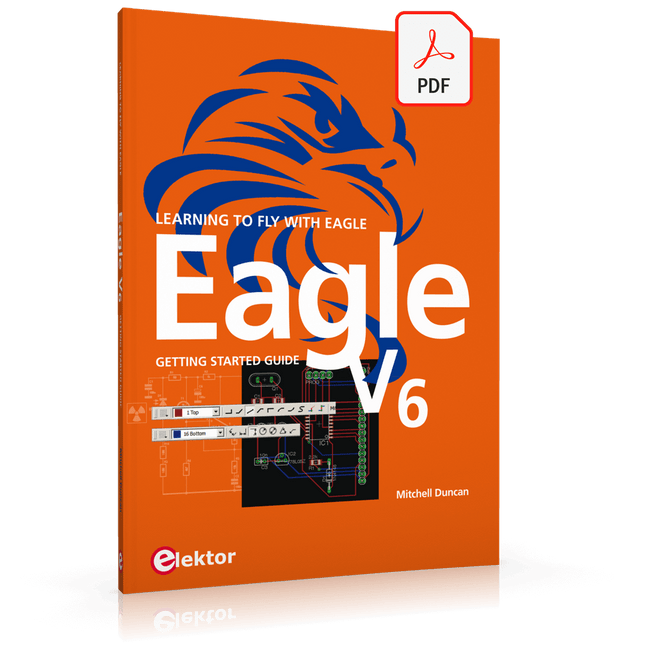
Elektor Digital EAGLE V6 Getting Started Guide (E-book)
Whether you are an electronics enthusiast or engineering professional, this book provides the reader with an introduction to the use of the CadSoft’s EAGLE PCB design software package. EAGLE is a user-friendly, powerful and affordable software package for the efficient design of printed circuit boards. It offers the same power and functionality to all users, at a smaller cost than its competitors. A free version of EAGLE is available to enthusiasts for their own use. EAGLE can be used on the main computing platforms including: Microsoft Windows (XP, Vista or Windows 7); Linux (based on kernel 2.6 or above) and Apple Mac OS X (Version 10.6 or higher). Any hardware that supports these software platforms will run the EAGLE application. The book is intended for anyone who wants an introduction to the capabilities of EAGLE. The reader may be a novice at PCB design or a professional wanting to learn about EAGLE, with the intention of migrating from another CAD package. This book will quickly allow you to: obtain an overview of the main modules of EAGLE: the schematic editor; layout editor and autorouter in one single interface; learn to use some of the basic commands in the schematic and layout editor modules of EAGLE; apply your knowledge of EAGLE commands to a small project; learn more about some of the advanced concepts of EAGLE and its capabilities; understand how EAGLE relates to the stages of PCB manufacture; create a complete project, from design through to PCB fabrication. The project discussed in the book is a popular, proven design from the engineering team at Elektor. After reading this book while practicing some of the examples, and completing the projects, the reader should feel confident about taking on more challenging endeavors.
€ 29,95
Membres : € 26,96
-

Elektor Digital Oscilloscopes (E-book)
Understanding and Using Them Effectively What happens in electronics is invisible to the naked eye. The instrument that allows to accurately visualize electrical signals, the one through which the effects of electronics become apparent to us, is the oscilloscope. Alas, when one first ventures into electronics, it is often without an oscilloscope. And one is left fumbling, both physically and mentally. Observing an electrical signal on a screen for the first time is a revelation. Nobody wishes to forgo that marvel again. There is no turning back. In electronics, if one wishes to progress with both enjoyment and understanding, an oscilloscope is essential. This marks the beginning of a period of questioning: how to choose one? And no sooner is that question answered than a whole string of others arises, which can be summed up in just one: how does one use the oscilloscope in such a way that what it displays truly reflects the reality of the signals? Rémy Mallard is a passionate communicator with a gift for making complex technical subjects understandable and engaging. In this book, he provides clear answers to essential questions about using an oscilloscope and offers a wealth of guidance to help readers explore and understand the electrical signals behind electronic systems. With his accessible style and practical insights, this book is a valuable tool for anyone eager to deepen their understanding of electronics.
€ 34,95
Membres : € 31,46
-

Elektor Digital Raspberry Pi 5 for Radio Amateurs (E-book)
Program and Build Raspberry Pi 5 Based Ham Station Utilities with the RTL-SDR The RTL-SDR devices (V3 and V4) have gained popularity among radio amateurs because of their very low cost and rich features. A basic system may consist of a USB based RTL-SDR device (dongle) with a suitable antenna, a Raspberry Pi 5 computer, a USB based external audio input-output adapter, and software installed on the Raspberry Pi 5 computer. With such a modest setup, it is possible to receive signals from around 24 MHz to over 1.7 GHz. This book is aimed at amateur radio enthusiasts and electronic engineering students, as well as at anyone interested in learning to use the Raspberry Pi 5 to build electronic projects. The book is suitable for both beginners through experienced readers. Some knowledge of the Python programming language is required to understand and eventually modify the projects given in the book. A block diagram, a circuit diagram, and a complete Python program listing is given for each project, alongside a comprehensive description. The following popular RTL-SDR programs are discussed in detail, aided by step-by-step installation guides for practical use on a Raspberry Pi 5: SimpleFM GQRX SDR++ CubicSDR RTL-SDR Server Dump1090 FLDIGI Quick RTL_433 aldo xcwcp GPredict TWCLOCK CQRLOG klog Morse2Ascii PyQSO Welle.io Ham Clock CHIRP xastir qsstv flrig XyGrib FreeDV Qtel (EchoLink) XDX (DX-Cluster) WSJT-X The application of the Python programming language on the latest Raspberry Pi 5 platform precludes the use of the programs in the book from working on older versions of Raspberry Pi computers.
€ 32,95
Membres : € 29,66
-

Elektor Digital Praxiskurs AVR-XMEGA-Mikrocontroller (E-book)
Die Mikrocontrollertechnologie ist eines der wichtigsten Gebiete der modernen Elektronik. Mikrocontroller haben sich in den letzten Jahren in allen Bereichen der modernen Technik etabliert. Der vorliegende Kurs gibt eine umfassende Einführung in die faszinierende Welt der Controllertechnik. Nach grundlegenden Betrachtungen zur Controllertechnologie wird bereits im ersten Teil des Kurses auf die praktische Umsetzung des Stoffes eingegangen. Als Basis dafür dient ein modernes Entwicklungsboard (XMEGA-A3BU Xplained), das mit einem der aktuellsten Controller des Herstellers Atmel ausgestattet ist. Der zweite Teil beschäftigt sich detailliert mit der Programmierung des Controllers. Hier kommt die Sprache „C“ zum Einsatz, da diese in der Firmware-Entwicklung eine dominierende Stellung einnimmt. Die bei weitem überwiegende Mehrheit der professionellen Entwicklungsarbeit wird in C ausgeführt. Diese Programmiersprache bietet eine umfassende Grundlage für alle Controlleranwendungen. Im dritten Teil des Kurses wird schließlich auf die hardwarenahe Programmierung eingegangen. Nach der Durchsprache von Pin-Ansteuerung, Takterzeugung und Oszillatoroptionen werden die anspruchsvolleren Themen wie Interrupts, Timer und Counter, Pulsweitenmodulation und Analog-Digitalwandlung behandelt. Der Kurs setzt auf die Philosophie des „Learning by Doing“. Er eignet sich dadurch hervorragend als praktische Ergänzung für Unterricht und Vorlesungen in Weiterführenden Schulen Technischen Berufsschulen und Fachakademien Fachhochschulen und Universitäten Aber auch der ambitionierte, nichtprofessionelle Anwender kann sich mit dem Lernmaterial einen Überblick über den neuesten Stand der Controllertechnik verschaffen.Umfangreiche Praxisbeispiele und Übungsprogramme runden den Kurs ab und lassen keine Fragen offen.
€ 34,80
Membres : € 31,32
-

Elektor Digital Elektor January/February 2026 (PDF) EN
Elektor GREEN and GOLD members can download their digital edition here. Not a member yet? Click here. Low-Noise Lab Power Supply (1)A Quiet Source for Sensitive Circuits STM32 Edge AI Contest 2025: The Winners Batteries TodayTechnology and Differences in Lithium Batteries Adjustable Electronic LoadStatic + Dynamic DC Load Step-Down Converter from 48 V to 5 VThe Story of Circuit Development Autonomous Sensor Node v2.0Part 2: Hardware Validation and Power Optimizations VaristorsPeculiar Parts, the Series Graphical Grid Frequency MeterMonitor Grid Quality Starting Out in Electronics……Brings Its Own End Peak Current Load SMD FerritesMore Resilient Against Current Peaks Elektor Live! Expert Day 2025 Energy Harvesting Set to Accelerate IoT and IIoT Use CasesHow Energy Harvesting Frees IoT from the Grid Fnirsi DPS-150Compact and Portable Power Supply and Converter Adjustable USB-C Power SourceTurn Your USB-C Charger Into an Adjustable Power Supply Simple Charger and Capacity TesterWith Two Cheap “Off-the-Shelf” Modules Smart Color Detector with AI Voice and Playback PbMonitor v2.0Introduction to the Updated Battery Monitoring System A Fan for the Mini Reflow PlateSmart Modifications That Improve Results From Life’s ExperienceThe Tsunami of Indulgence Err-lectronicsCorrections, Updates, and Readers’ Letters 2026: An AI OdysseyWhen Models Start Dictating the Hardware Precision Picoammeter (2)Assembling, Calibration, and Test Wireless Device Poweringwith Inductive Technology AI-Based Autonomous DrivingThe RDW’s Self Driving Challenge 2024 Sound Card as Signal GeneratorPC as DCF77 Test Transmitter
€ 9,50
-

Elektor Digital Elektor 11-12/2021 (PDF)
NVIDIA JETSON NANO - BILDVERARBEITUNG FÜR EINSTEIGER (TEIL 2)Erkennen von Objekten mit Edge Impulse ELEKTOR JUMPSTARTER-NEWSKommende Kampagnen OPEN-SOURCE-GPS-TRACKING-PLATTFORMFahrzeug-Tracking ohne fremde Cloud mit Traccar MULTIFUNKTIONS-KOMPONENTENTESTER LCR-T7 VON JOY-ITTesten von passiven Bauteilen, diskreten Halbleitern und IR-Fernbedienungen RAUSCH-SYNTHESIZERVom Rauschen zur Musik mit dem PRBSynth1 ALLER ANFANG …ist gar nicht schwer! Weiter geht's mit der Spule... DIE NEURONEN IN NEURONALEN NETZEN VERSTEHENTeil 2: Logische Neuronen BLITZLICHT-GESCHÜTZTER ANALOGSPEICHER-ZUSATZ FÜR DAS MANIPULATIONSSICHERE DATENPAKETProbleme mit der Sicherheit? Bekämpfen Sie Feuer mit Feuer! LCR METER POSTER BLUETOOTH-BEACONS IN DER PRAXISOrtsbestimmung in Innenräumen C-PROGRAMMIERUNG AUF RASPBERRY PIEin Beispielkapitel: Kommunizieren über WLAN EMV-VORKONFORMITÄTSTEST FÜR IHR DC-VERSORGTES PROJEKTTeil 2: Die Hardware und wie man sie benutzt PARALLAX PROPELLER 2Teil 5: Das Innenleben des Smart Pins MODBUS ÜBER WLANTeil 1: Hardware und Programmierung ZUTRITT FÜR UNBEFUGTE VERBOTENWie der Junior-Computer wieder zum Leben erweckt wurde BAUEN SIE IHREN EIGENEN HOCHPRÄZISIONSKALIBRATOR-10 V bis +10 V, 0 bis 40 mA, 0,001% ARDUINO NANO RP2040 CONNECTRaspberry Pi RP2040 + WLAN + Bluetooth DER PHYSISCHE KÖRPER DER KÜNSTLICHEN INTELLIGENZ PROJEKT 2.0Korrekturen, Updates und Leserbriefe GRAFISCHE BENUTZEROBERFLÄCHEN MIT PYTHON UND GUIZERO CO2-MESSGERÄT-SET FÜRS KLASSENZIMMEREin ESP8266-basiertes Gerät, entwickelt von der FH Aachen NOSTALGISCHES MW/LW-RADIO MIT MK484...macht immer Spaß zu bauen! 60 JAHRE ELEKTOREs werde Licht! HEXADOKUThe Original Elektorized Sudoku
€ 11,90
-
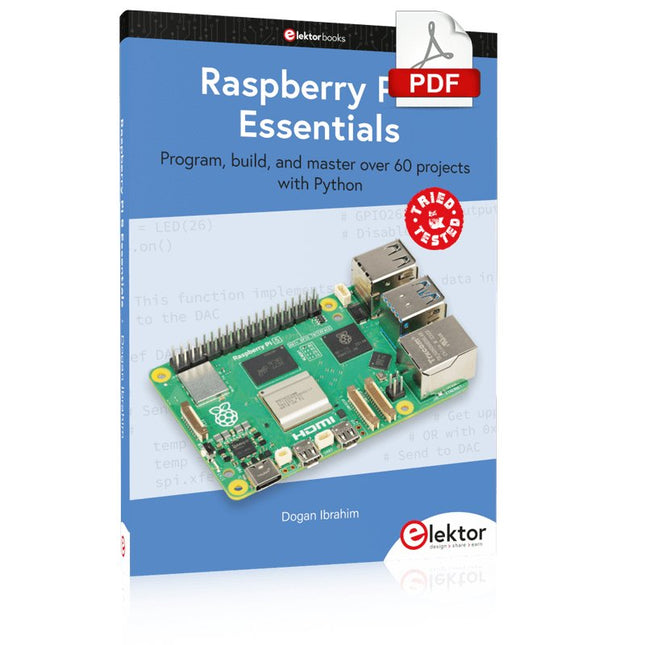
Elektor Digital Raspberry Pi 5 Essentials (E-book)
Program, build, and master over 60 projects with Python The Raspberry Pi 5 is the latest single-board computer from the Raspberry Pi Foundation. It can be used in many applications, such as in audio and video media centers, as a desktop computer, in industrial controllers, robotics, and in many domestic and commercial applications. In addition to the well-established features found in other Raspberry Pi computers, the Raspberry Pi 5 offers Wi-Fi and Bluetooth (classic and BLE), which makes it a perfect match for IoT as well as in remote and Internet-based control and monitoring applications. It is now possible to develop many real-time projects such as audio digital signal processing, real-time digital filtering, real-time digital control and monitoring, and many other real-time operations using this tiny powerhouse. The book starts with an introduction to the Raspberry Pi 5 computer and covers the important topics of accessing the computer locally and remotely. Use of the console language commands as well as accessing and using the desktop GUI are described with working examples. The remaining parts of the book cover many Raspberry Pi 5-based hardware projects using components and devices such as LEDs and buzzers LCDs Ultrasonic sensors Temperature and atmospheric pressure sensors The Sense HAT Camera modules Example projects are given using Wi-Fi and Bluetooth modules to send and receive data from smartphones and PCs, and sending real-time temperature and atmospheric pressure data to the cloud. All projects given in the book have been fully tested for correct operation. Only basic programming and electronics experience are required to follow the projects. Brief descriptions, block diagrams, detailed circuit diagrams, and full Python program listings are given for all projects described.
€ 32,95
Membres : € 29,66
-
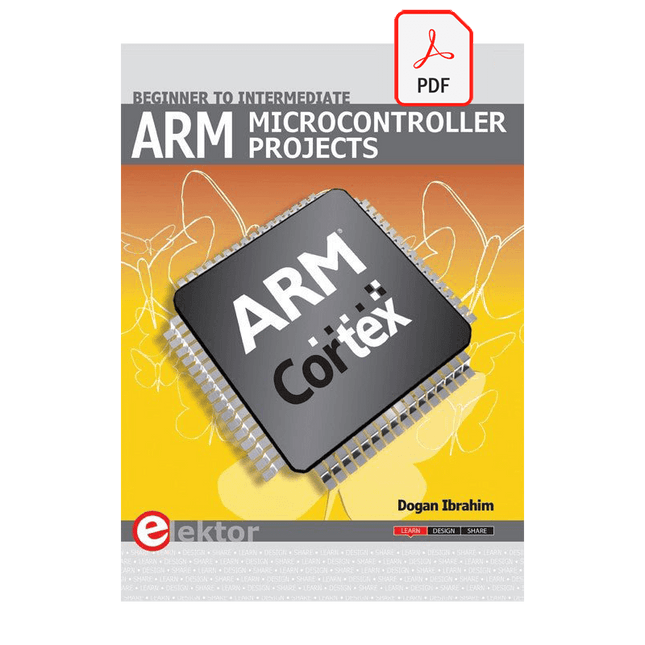
Elektor Digital ARM Microcontroller Projects (E-book)
It is becoming important for microcontroller users to quickly learn and adapt to new technologies and architecture used in high performance 32-bit microcontrollers. Many manufacturers now offer 32-bit microcontrollers as general purpose processors in embedded applications. ARM provide 32 and 64-bit processors mainly for embedded applications. These days, the majority of mobile devices including mobile phones, tablets, and GPS receivers are based on ARM technology. The low cost, low power consumption, and high performance of ARM processors makes them ideal for use in complex communication and mixed signal applications. This book makes use of the ARM Cortex-M family of processors in easy-to-follow, practical projects. It gives a detailed introduction to the architecture of the Cortex-M family. Examples of popular hardware and software development kits are described. The architecture of the highly popular ARM Cortex-M processor STM32F107VCT6 is described at a high level, taking into consideration its clock mechanisms, general input/output ports, interrupt sources, ADC and DAC converters, timer facilities, and more. The information provided here should act as a basis for most readers to start using and programming the STM32F107VCT6 microcontroller together with a development kit. Furthermore, the use of the mikroC Pro for ARM integrated development environment (IDE) has been described in detail. This IDE includes everything required to create a project; namely an editor, compiler, simulator, debugger, and device programmer. Although the book is based on the STM32F107VCT6 microcontroller, readers should not find it difficult to follow the projects using other ARM processor family members.
€ 34,95
Membres : € 31,46


