
Résultats de la recherche pour "analogue OR video OR e OR book"
-

Elektor Digital Elektor July/August 2020 (PDF) EN
Home Information SystemUsing Windows on a Raspberry Pi Starting with Node-REDAn open-source visual block-based programming tool Elektor Summer GiveAway Simple Function Generator: With Reverse-Order Signal Creation GreatScott! Builds a LoRa Alarm System Review: Joy-iT RD6006 Benchtop Power Supply Kit Review: The GreatFET One Interface Board Small Circuits Revival – XXLEscaped from the Suggestions Box Poorest Man's External 2.4 GHz Wi-Fi Antenna Simple On-Off Temperature Controller with Raspberry Pi HAT How to Take (Successful) Photos of ElectronicsShowing your projects in their best light Review: The I2CDriver Tool Review: JOY-iT Joy-View Portable Touchscreen LED Booster for MicrocontrollersWith just one component Experimental Ultrasonic Clothes Washer Review: The Joy-iT JDS2915 Signal GeneratorA 2-Channel Signal Generator and Frequency Counter Traffic Lights Programmed in PIC Assembly Code E-E-E-ternal Blinker Experimental Hall Sensor Tracing Shorts with the Milli-Ohm or ESR Meter Review: Elektor SDR Hands-on Kit Elektor Labs Pipeline Elektor KickstarterWell, you get the idea. Do You Really Need All That Stuff???This is where I spend many hours working on electronics projects Homelab Tours: The Kinetic Clock MakerStargate jigsawed! Hello, World! We’re Elektor, and We’re Social M4 + 2x A7 + GPU: An Unbalanced Dream TeamLatest STM32MP1-SoCs can tackle demanding applications Test Rig for 16F18877 & Similar Big PICs Inter-Microcontroller Traffic with the SPI Bus and ATmega328p Six Shades of LF/AF OSC (and the Miller’s Tale) BBC micro:bit Absolute Minimalist Oscilloscope with LED Display ‘Knight Rider’ LED Chaser with the ESP32 LW/MW AM Signal Generator with ATtiny13 Absolute Minimalist Dip Meter Photovoltaic Regulator UpdateNew function for measuring battery temperature Wireless SignallingTransmitting switching signals over LPR Ultrasonic Reverse Parking Aid with Arduino Uno Distortion Pedal with Op Amp and Space Charge Tubes Electronics Workspace Essentials Hexadoku Artificial Intelligence for Beginners (2)Neural networks with Linux and Python
€ 7,50
-

Elektor May/June 2025 (EN)
Elektor GREEN and GOLD members can download their digital edition here. Not a member yet? Click here. PbMonitor v1.0A Battery-Monitoring System for UPS and Energy Storage Applications Solar Charge Controller with MPPT (1)Basic Principles of a Solar Controller for Stand-Alone Systems B-Field Integration Magnetometer With Home-Made Sensors Precise or Accurate?Your Instruments Need to Be Both! AD7124 A Precision ADC in PracticeFeatures for Sensor Signal Conditioning PID Control ToolOptimize Your Parameters Easily embedded world 2025 Starting Out in Electronics……Continues with Tone Control Academy Pro BoxBook + Online Course + Hardware Milliohmmeter AdapterUses the Precision of Your Multimeter The Next Leap in SemiconductorsOnward Toward 1.4 nm Through-Hole Technology ConnectorsThe Best of Two Worlds: THR Frequency CounterPortable and Auto-Calibrating Via GPS Analog MetersPeculiar Parts, the Series Stand-Alone Crystal TesterHow Accurate Is Your Clock Source? Low-Cost I²C TesterConnect I²C Devices Directly to Your PC From Life’s ExperienceWho Doesn’t Honor the Small Things? 2025: An AI OdysseyThe Transformative Impact on Software Development Err-lectronicsCorrections, Updates, and Readers’ Letters Raspberry Pi Standalone MIDI Synthesizer (2)Enhancing Our Setup with Intelligence Nortonized Wien Bridge OscillatorSmall Changes Yield Significant Improvements Putting a $0.10 Controller to the TestThe CH32V003 RISC-V Microcontroller and MounRiver Studio in Practice An FPGA-Based Audio Player with Equalizer (2)Adding Volume Control, Advanced Mixing, and a Web Interface
€ 10,95
-
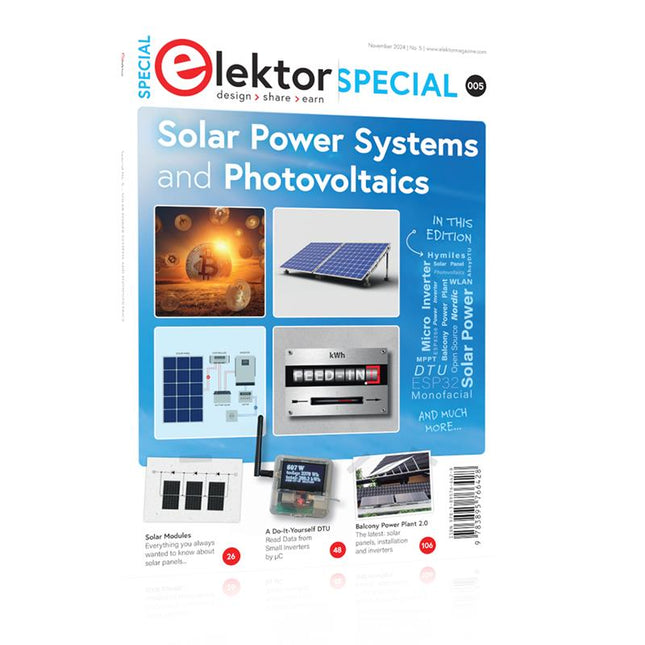
Elektor Special: Solar Power Systems and Photovoltaics
As demand for solar panel installation has risen sharply, especially for installations larger than balcony power plants, the order books of solar companies are full. If you ask for a quote today, you may have to wait a while, if your request isn't simply postponed indefinitely. Another consequence of the solar boom is that some companies are charging very high prices for installations. Yet there is an obvious and radical solution to the problem of excessive prices: Do it yourself, as the English say. The price of materials is currently affordable, and it's the ideal time for those who do the work themselves. They couldn't save more. Add to this the satisfaction of doing something useful, both economically and ecologically, and the pleasure of building yourself. In this special issue, you'll find a wide selection of Elektor assemblies, from solar panel controllers to solar water heaters and solar panel orientation systems. The issue also contains practical information on solar panel installation and the technology behind them. Finally, there are a number of articles on the subject of balcony power plants, from how to install them to how to connect them to the Internet... Contents BASICS Dimensioning Photovoltaic Panel ArraysAn introduction to photovoltaic energy and the commonest techniques,followed by simplified calculation models and setup guidelines. Light Sensor TechnologyMeasuring daylight using LEDs. Solar Power Made SimpleSolar charging with and without a controller. Cable Cross-sections and Energy Losses in Solar SystemsKey considerations on the minimum values to respect for electricalcurrent in solar panel cabling. Solar ModulesEverything you always wanted to know about solar panels... Ideal Diode ControllerDiode Circuits with Low Power Dissipation. TIPS Tracking for Solar Modules zBot Solar/Battery Power Supply Solar Cell Array Charger with Regulator Solar Cell Voltage Regulator Solar-Powered Night Light Alternative Solar Battery Charger PROJECTS Energy LoggerMeasuring and Recording Power Consumption. Tiny Solar SupplySunlight In, 3.3 V Out. A Do-It-Yourself DTURead Data from Small Inverters by μC. Solar ChargerPortable energy for people on the move. Solar Thermal Energy RegulatorMaximum power point tracking explored. 2-amp Maximum Power Tracking ChargerSolar Power To The Max. Computer-driven HeliostatFollow the sun or the stars. Garden LightingUsing solar cells. Solar Panel Voltage Converter for IoT DevicesYes we CAN exploit indoor lighting. Travel ChargerFree power in the mountains. Solar Cell Battery Charger/MonitorWith protection against deep discharge. Solar-powered Battery ChargerPIC12C671 avoids overcharging and deep charging. Converters for Photovoltaic PanelsContributed by TME (Transfer MultisortElektronik). Solar Charging RegulatorFor panels up to 53 watts. Solar-Powered ChargerFor lead-acid batteries. CAN Bus + Arduino for Solar PV Cell MonitoringDetect and locate serviceable panels in large arrays. Balcony Power Plant 2.0The latest: solar panels, installation and inverters
€ 19,95
Membres : € 17,96
-

Siglent Oscilloscope Siglent SDS1204X-E 4 canaux (200 MHz)
Le Siglent SDS1204X-E est un puissant oscilloscope à quatre canaux de 200 MHz construit sur la même plate-forme que le très populaire SDS1202X-E mais avec plusieurs améliorations significatives, notamment deux CAN de 1 GSa/s et deux modules de mémoire de 14 Mpt. Les taux de capture de forme d'onde peuvent atteindre 100 000 wfms/s en mode normal et 400 000 wfms/s en mode séquence. Les oscilloscopes SDS1000X-E sont dotés d'un grand écran couleur de 7 pouces à 256 niveaux avec des fonctions d'gradation d'intensité et de température de couleur. Spécifications Bande passante 200MHz Taux d'échantillonnage (Max.) 1 Géch/s Canaux 2CH+EXT 4CH Profondeur de mémoire (max.) 7 Mpts/CH (pas de mode entrelacé) ; 14 Mpts/CH (mode entrelacé) Taux de capture de forme d'onde (max.) 100 000 wfms/s (mode normal), 400 000 wfms/s (mode séquence) Types de déclencheurs Bord, pente, largeur d'impulsion, fenêtre, avorton, intervalle, décrochage, motif, vidéo Déclencheur série (standard) Je 2 C, SPI, UART/RS232, PEUT, LIN Type de décodage (standard) Je 2 C, SPI, UART/RS232, PEUT, LIN 16 chaînes numériques (série à quatre canaux uniquement, option) Taux de capture de forme d'onde maximum jusqu'à 1 GSa/s, longueur d'enregistrement jusqu'à 14 Mpts/CH Module USB-AWG (série à quatre canaux uniquement, option) Un canal, 25 MHz, fréquence d'échantillonnage de 125 MHz, longueur d'onde de 16 kpts Diagramme de Bode (séries à quatre canaux uniquement) Fréquence de démarrage minimale de 10 Hz, bande passante de balayage minimale de 500 Hz, bande passante de balayage maximale de 120 MHz (en fonction de la bande passante de l'oscilloscope et de l'AWG), 500 points de fréquence de balayage maximum Adaptateur Wi-Fi USB (série à quatre canaux uniquement, option) 802.11b/g/b, WPA-PSK, l'adaptateur doit être fourni par Siglent pour garantir son bon fonctionnement Téléchargements Datasheet Manual Programming Guide
€ 774,98
-
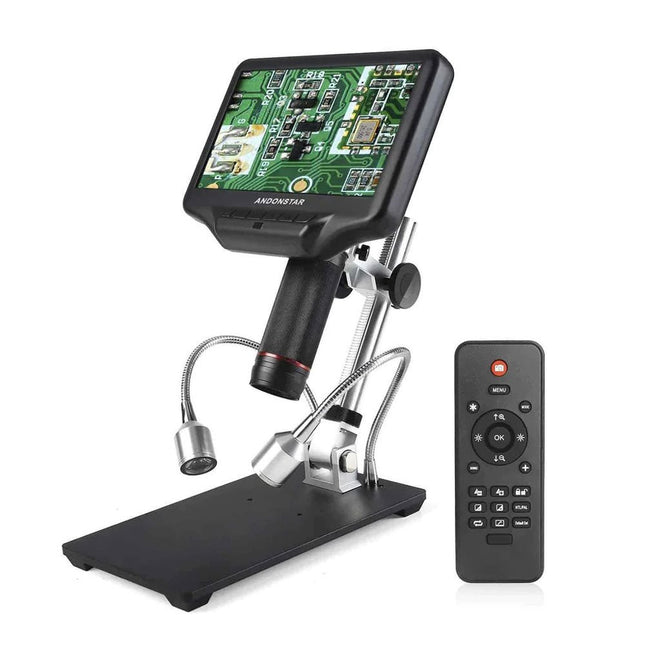
Andonstar Andonstar AD407 7" Microscope numérique HDMI
Examinez vos circuits avec une grande précision et soudez les plus petits CMS et éléments sans difficulté. Caractéristiques Le microscope numérique HDMI multifonctionnel présente les caractéristiques suivantes : Full HD, hauteur confortable, ergonomie améliorée, signaux de sortie multiples avec différentes résolutions. L'angle d'inclinaison du grand écran LCD est réglable. Livré avec une télécommande. Peut être utilisé de manière autonome. Spécifications Taille de l'écran 7 pouces (17,8 cm) Capteur d'image Capteur HD de 4 mégapixels Sortie vidéo UHD 2880x2160 (24fps)FHD 1920x1080 (60fps/30fps)HD 1280x720 (120fps) Format vidéo MP4 Magnification Jusqu'à 270 fois (moniteur HDMI 27 pouces) Résolution des photos Max. 12 MP (4032x3024) Format des photos JPG Plage de focalisation Minimum 5 cm Fréquence de trame Max. 120fps (sous 600 Lux de luminosité & HDP120) Interface vidéo HDMI Stockage Carte microSD, jusqu'à 32 Go Alimentation 5 V CC Source d'éclairage 2 LEDs avec le support Taille du support 20 x 12 x 19 cm Inclus 1x Microscope numérique Andonstar AD407 1x Support métallique 1x Support optique 1x Filtre UV 1x Télécommande IR 1x Câble de commutation 1x Adaptateur secteur 1x Câble HDMI 2x Vis 1x Tournevis 1x Manuel de l'utilisateur Téléchargements Manual Comparaison des modèles AD407 AD407 Pro AD409 AD409 Pro-ES Taille de l’écran 7 pouces (17,8 cm) 7 pouces (17,8 cm) 10,1 pouces (25,7 cm) 10,1 pouces (25,7 cm) Capteur d’image 4 MP 4 MP 4 MP 4 MP Sortie vidéo 2160p 2160p 2160p 2160p Interfaces HDMI HDMI USB, HDMI, WiFi USB, HDMI, WiFi Format vidéo MP4 MP4 MP4 MP4 Agrandissement Jusqu'à 270x Jusqu'à 270x Jusqu'à 300x Jusqu'à 300x Résolution photo Max. 4032x3024 Max. 4032x3024 Max. 4032x3024 Max. 4032x3024 Format photo< JPG JPG JPG JPG istance focale Min. 5 cm Min. 5 cm Min. 5 cm Min. 5 cm Fréquence d'images Max. 120f/s Max. 120f/s Max. 120f/s Max. 120f/s Storage carte microSD carte microSD carte microSD carte microSD Support PC Non Non Windows Windows Raccordement mobile Non Non WiFi + Mesure WiFi + Mesure Source d'alimentation 5 V DC 5 V DC 5 V DC 5 V DC Source lumineuse 2 LED avec le support 2 LED avec le support 2 LED avec le support 2 LED avec le support Endoscope Non Non Non Oui Taille du support 20 x 12 x 19 cm 20 x 18 x 32 cm 18 x 20 x 30 cm 18 x 20 x 32 cm Poids 1,6 kg 2,1 kg 2,2 kg 2,5 kg
€ 183,60
-

Rigol Rigol DS1202Z-E Oscilloscope à 2 canaux (200 MHz)
Caractéristiques Bande passante : 200 MHz Canaux analogiques : 2 Taux d'échantillonnage en temps réel jusqu'à 1 GS/s Profondeur de mémoire jusqu'à 24 Mpts Taux de capture de forme d'onde jusqu'à 30 000 wfms/s Fonctions matérielles d'enregistrement et de lecture de forme d'onde en temps réel jusqu'à 60 000 images Technologie innovante « UltraVision » Diverses fonctions de déclenchement et de décodage de bus Faible bruit de fond, plage d'échelle verticale : 1 mV/div à 10 V/div Diverses interfaces : hôte et périphérique USB, LAN (LXI), AUX Taille compacte, poids léger, facile à utiliser Écran LCD TFT WVGA (800 x 480) de 7 pouces, écran couleur à intensité variable Inclus 1x Oscilloscope Rigol DS1202Z-E 1x cordon d'alimentation 1x câble USB 2x sonde d'oscilloscope passif PVP2350 (350 MHz)
€ 260,10
-

OWON OWON ADS924A Oscilloscope à 4 canaux (250 MHz)
La série OWON ADS900A est un oscilloscope numérique compact 12 bits offrant jusqu'à 2 GSa/s, une mémoire de 100 Mpts et une bande passante de 125/250 MHz. Avec son écran tactile multipoint de 7 pouces, sa FFT, son décodage de protocole et son analyseur logique intégré, il permet une analyse précise des signaux pour les applications en laboratoire, en atelier et sur le terrain. Spécifications ADS914A ADS924A Bandwidth (-3 dB) 125 MHz 250 MHz Channels 4 Max. sample rate 2 GSa/s (single-channel) 1 GSa/s (dual-channel) 500 MSa/s (full-channel) DC Gain Accuracy 3% (≤1 mV) 2% (≥2 mV) Max memory depth 100M Vertical resolution 12 bits Relay time accuracy ±25 ppm (typical) Input Impedance 1 MΩ±2%, parallel with20 pF±5 pF Probe Attenuation Coefficient 1.00μX-1M.00X,step by 1-2-5, support custom Trigger type Edge, Video, Pulse, Slope, Runt, Windows, Timeout, Nth, Logic, RS232/UART, I²C, SPI CAN, LIN Bus decoding RS232/UART, I²C, SPI, CAN, LIN Auto measurement Period, Frequency, +Width, -Width, Rise Time, Fall Time, Scr Duty, +Duty,-Duty, Vavg, Vpp, VRMS, Overshoot, Vmax, Vmin, Vtop, CycRms, Vbase, Vamp, Preshoot, Std Dev, +Pulse Cnt, -Pulse Cnt, Rise Cnt, Fall Cnt, Area, Cyc Area, Delay(A↑-B↑), Delay(A↑-B↓), Delay(A↓-B↑), Delay(A↓-B↓), Phase(A↑-B↑) Phase(A↑-B↓), Phase(A↓-B↑), Phase(A↓-B↓), FRR(A↑-B↑), FRF(A↑-B↓) FFR(A↓-B↑), FFF(A↓-B↓), LRR(A↑-B↑), LRF(A↑-B↓), LFR(A↓-B↑), LFF(A↓-B↓) Waveform Math +, -, *, /, &&, ||, ^, !, Intg, Diff, Sqrt, Function operation (Lg / Ln / Exp / Abs / Sine / Cosine / Tan), FFT, FFT rms, User Defined, digital filter (low pass, high pass, band pass, band reject) Frequency counter 6-digit frequency counter Maximum frequency: maximum analog bandwidth of oscilloscope Voltmeter Support DC, AC+DCrms, ACrms, Resolution: 4 digits (ACV/DCV) Logical Analyzer Specifications Number of channels 16 input channels (D0-D15) (D0 to D7, D8 to D15) Max. input voltage ±40V peak CAT I, transient overvoltage 800Vpk Input Impedance 100kΩ, 8 pF Vertical resolution 1 bit Other Communication Interface HDMI, USB device, USB Host, Trig Out (P/F), LAN Display 7 inch (1024x600), capacitive multi-touch screen Power supply interface USB-C Dimensions 260 x 160 x 78 mm Weight 1.5 kg Inclus 1x OWON ADS924A Oscilloscope 1x Adaptateur secteur 1x Cordon d'alimentation 1x Câble USB 1x Sonde 1x Quick Guide Téléchargements Manual Quick Guide PC Software
€ 682,80
-

OWON OWON ADS914A Oscilloscope à 4 canaux (125 MHz)
La série OWON ADS900A est un oscilloscope numérique compact 12 bits offrant jusqu'à 2 GSa/s, une mémoire de 100 Mpts et une bande passante de 125/250 MHz. Avec son écran tactile multipoint de 7 pouces, sa FFT, son décodage de protocole et son analyseur logique intégré, il permet une analyse précise des signaux pour les applications en laboratoire, en atelier et sur le terrain. Spécifications ADS914A ADS924A Bandwidth (-3 dB) 125 MHz 250 MHz Channels 4 Max. sample rate 2 GSa/s (single-channel) 1 GSa/s (dual-channel) 500 MSa/s (full-channel) DC Gain Accuracy 3% (≤1 mV) 2% (≥2 mV) Max memory depth 100M Vertical resolution 12 bits Relay time accuracy ±25 ppm (typical) Input Impedance 1 MΩ±2%, parallel with20 pF±5 pF Probe Attenuation Coefficient 1.00μX-1M.00X,step by 1-2-5, support custom Trigger type Edge, Video, Pulse, Slope, Runt, Windows, Timeout, Nth, Logic, RS232/UART, I²C, SPI CAN, LIN Bus decoding RS232/UART, I²C, SPI, CAN, LIN Auto measurement Period, Frequency, +Width, -Width, Rise Time, Fall Time, Scr Duty, +Duty,-Duty, Vavg, Vpp, VRMS, Overshoot, Vmax, Vmin, Vtop, CycRms, Vbase, Vamp, Preshoot, Std Dev, +Pulse Cnt, -Pulse Cnt, Rise Cnt, Fall Cnt, Area, Cyc Area, Delay(A↑-B↑), Delay(A↑-B↓), Delay(A↓-B↑), Delay(A↓-B↓), Phase(A↑-B↑) Phase(A↑-B↓), Phase(A↓-B↑), Phase(A↓-B↓), FRR(A↑-B↑), FRF(A↑-B↓) FFR(A↓-B↑), FFF(A↓-B↓), LRR(A↑-B↑), LRF(A↑-B↓), LFR(A↓-B↑), LFF(A↓-B↓) Waveform Math +, -, *, /, &&, ||, ^, !, Intg, Diff, Sqrt, Function operation (Lg / Ln / Exp / Abs / Sine / Cosine / Tan), FFT, FFT rms, User Defined, digital filter (low pass, high pass, band pass, band reject) Frequency counter 6-digit frequency counter Maximum frequency: maximum analog bandwidth of oscilloscope Voltmeter Support DC, AC+DCrms, ACrms, Resolution: 4 digits (ACV/DCV) Logical Analyzer Specifications Number of channels 16 input channels (D0-D15) (D0 to D7, D8 to D15) Max. input voltage ±40V peak CAT I, transient overvoltage 800Vpk Input Impedance 100kΩ, 8 pF Vertical resolution 1 bit Other Communication Interface HDMI, USB device, USB Host, Trig Out (P/F), LAN Display 7 inch (1024x600), capacitive multi-touch screen Power supply interface USB-C Dimensions 260 x 160 x 78 mm Weight 1.5 kg Inclus 1x OWON ADS914A Oscilloscope 1x Adaptateur secteur 1x Cordon d'alimentation 1x Câble USB 1x Sonde 1x Quick Guide Téléchargements Manual Quick Guide PC Software
€ 574,80
-

OWON OWON SDS1104 Oscilloscope à 4 canaux (100 MHz)
L’oscilloscope OWON SDS1104 est un choix pratique pour les ingénieurs, techniciens, étudiants et passionnés qui ont besoin d’une analyse précise des signaux sans le coût d’instruments haut de gamme. Avec sa bande passante de 100 MHz et sa fréquence d’échantillonnage de 1 Géch/s, il capture de manière fiable les signaux de basse à moyenne fréquence, ce qui le rend parfaitement adapté au développement électronique, au dépannage et à l’enseignement. Équipé d’un écran TFT couleur de 7 pouces, le SDS1104 offre une visualisation claire des formes d’onde, tandis que les fonctions de mesure automatique et l’analyse FFT aident les utilisateurs à évaluer rapidement les paramètres de fréquence, de tension et de synchronisation. Les opérations mathématiques avancées, les mesures par curseurs et les multiples modes de déclenchement apportent une flexibilité supplémentaire, faisant de cet oscilloscope un outil polyvalent pour un large éventail de scénarios de test. Spécifications Bandwidth 100 MHz Sample Rate 1 GS/s Horizontal Scale (s/div) 5ns/div - 1000s/div, step by 1 - 2 - 5 Channel 4 Display 7" color LCD, 800 x 480 pixels Input Coupling DC, AC and GND Vertical Resolution (A/D) Vertical Resolution (A/D) Vertical Sensitivity 5mV/div - 5V/div (at input) Trigger Type Edge, Video Trigger Mode Auto, Normal and Single Waveform Math +, -, x, ÷, invert, FFT Fuse 2A, T class, 250 V Dimension (W x H x D) 301 x 152 x 70 mm Weight 1.1 kg Inclus 1x OWON SDS1104 Oscilloscope 1x Mains power cord 1x CD Rom 1x Quickstart Guide 1x USB Cable 4x Oscilloscope probe 1x Probe Adjust Téléchargements Datasheet Manual
€ 246,94
-

OWON Oscilloscope USB 2-ch OWON VDS1022I (25 MHz)
L'oscilloscope USB 2 voies OWON VDS1022I (25 MHz) est un oscilloscope à utiliser avec un ordinateur. Il est alimenté par USB et a une petite taille, ce qui permet de l'emporter facilement avec soi. L'oscilloscope est très économique. Il dispose d'une connexion USB blindée, ce qui réduit les interférences et protège l'ordinateur contre les surtensions. Le port multiple de l'oscilloscope peut être utilisé pour le déclenchement externe, la sortie de déclenchement ou la sortie Pass / Fail. Caractéristiques Largeur de bande de 25 MHz, et taux d'échantillonnage en temps réel de 1 Géch/s maximum Longueur d'enregistrement de 10 Méch Interface utilisateur conviviale : FFT, ou X-Y, et forme d'onde 2 vues affichées sur le même écran Option de déclenchement multiple : front, vidéo, pente, impulsion et alternatif. Isolation USB - moins d'interférence de signal, plus de protection du PC Alimentation par bus USB et télécommande LAN (en option) Conception ultra-mince, facile à transporter Spécifications Bande passante 25 MHz 25 MHz Canal 2+1 (multi) Fréquence d'échantillonnage 100 Méch/s Échelle horizontale (s/div) 5 ns/div~100s/div, step by 1~2~5 Longueur des enregistrements 5K Tension d'entrée maximale 400 V (PK - PK) (DC+AC, PK - PK) 40 V (PK - PK) (DC+AC, PK - PK) Résolution verticale (A/D) 8 bits (2 canaux simultanément) Modèle VDS1022I Sensibilité verticale 5 mV/div~5 V/div Type de déclenchement Bord, impulsion, vidéo, pente et alternance Mode de déclenchement Auto, Normal, et Simple Mode d’acquisition Échantillon, détection des pics et moyenne Mathématiques +, -, ×, ÷, invert, FFT Interface de communication USB 2.0 (isolation) Multi-fonctions Interface Type de signal Niveau Standard TTL Alimentation éléctique 5,0 V/1 A Consommation éléctique ≤2,5 W Dimensions (W × H × D) 170 x 120 x 18 mm Poids 0,26 kg Inclus 1x Oscilloscope OWON VDS1022I 1x CD-ROM 1x Guide de démarrage rapide 2x Sonde d'oscilloscope 1x Outil de sonde 1x Adaptateur secteur 1x Câble USB 1x Étui de protection en silicone 1x Câble d'alimentation Téléchargements Fiche technique Manuel de l’utilisateur Protocole SCPI Pilote USB
€ 118,02
-

Siglent Siglent SDS1104X-E Oscilloscope à 4 canaux (100 MHz)
Le Siglent SDS1104X-E utilise une nouvelle génération de technologie SPO (Super Phosphor Oscilloscope) qui offre une excellente fidélité des signaux et des performances. Le bruit du système est également inférieur à celui des produits similaires de l'industrie. Il est doté d'une plage d'entrée verticale minimale de 500 µV/div, d'un système de déclenchement numérique innovant à haute sensibilité et faible gigue, et d'un taux de capture de forme d'onde de 400 000 images/seconde (mode séquence). Le SDS1104X-E est doté d’un affichage à 256 niveaux d'intensité et d'un mode d'affichage à température de couleur que l'on ne trouve pas dans les autres modèles de cette catégorie. Le dernier né des oscilloscopes SIGLENT supporte de nombreux modes de déclenchement puissants, y compris le déclenchement par bus série. Le décodage est une configuration standard incluant I²C, SPI, UART, CAN, LIN. L'enregistrement de l'historique des formes d'ondes et le déclenchement séquentiel permettent un enregistrement et une analyse étendus des formes d'ondes. La nouvelle fonction mathématique FFT 1 Mpt est un autre ajout puissant qui confère au SDS1104X-E une très haute résolution de fréquence lors de l'observation des spectres de signaux. Caractéristiques Déclenchement intelligent : Bord, pente, largeur d'impulsion, fenêtre, course, intervalle, délai d'attente (Dropout) et motif. Déclenchement et décodage libre du bus série : I²C, SPI, UART, RS232, CAN et LIN Déclenchements vidéo et prise en charge de la HDTV Faible bruit de fond et échelles de tension de 500 μV / div à 10 V / div 10 types de raccourcis à un bouton, prise en charge de la configuration automatique, du défaut, des curseurs, de la mesure, du roulement, de l'historique, de l'affichage/de la persistance, de l'effacement du balayage, du zoom et de l'impression. Mode d'acquisition segmentée (séquence), divisant la longueur maximale de l'enregistrement en plusieurs segments (jusqu'à 80 000), en fonction des conditions de déclenchement définies par l'utilisateur, avec un très petit segment de temps mort pour capturer l'événement qualifiant. Fonction d'enregistrement de la forme d'onde historique (historique), la longueur maximale de la forme d'onde enregistrée est de 80 000 images. Fonction de mesure automatique de 38 paramètres, prenant en charge les statistiques, les mesures de déclenchement, les mesures mathématiques, les mesures d'historique et les mesures de réf. 1 Mpts FFT Les mesures réelles et mathématiques peuvent utiliser les 14 Mpts de la mémoire. Les touches de préréglage peuvent être personnalisées pour les réglages de l'utilisateur ou les valeurs par défaut de l'usine. Mode d'effacement de sécurité Fonction de passage/échec à grande vitesse basée sur le matériel Grand écran TFT-LCD de 7 pouces avec une résolution de 800 x 480 Plusieurs types d'interface : USB Host, USB Device (USB-TMC), LAN (VXI-11), Pass / Fail, Trigger Out Prise en charge des commandes de contrôle à distance SCPI Affichage multilingue et aide intégrée Contrôle par navigateur/page web embarquée pour une surveillance sans logiciel (modèles à 4 canaux uniquement) Inclus 1x Oscilloscope Siglent SDS1104X-E 4x Sondes 100 MHz 1x Carte de garantie 1x Cordon d'alimentation 1x Câble USB 1x Guide de démarrage rapide Téléchargements Datasheet Manual Programming Guide
€ 504,51
-
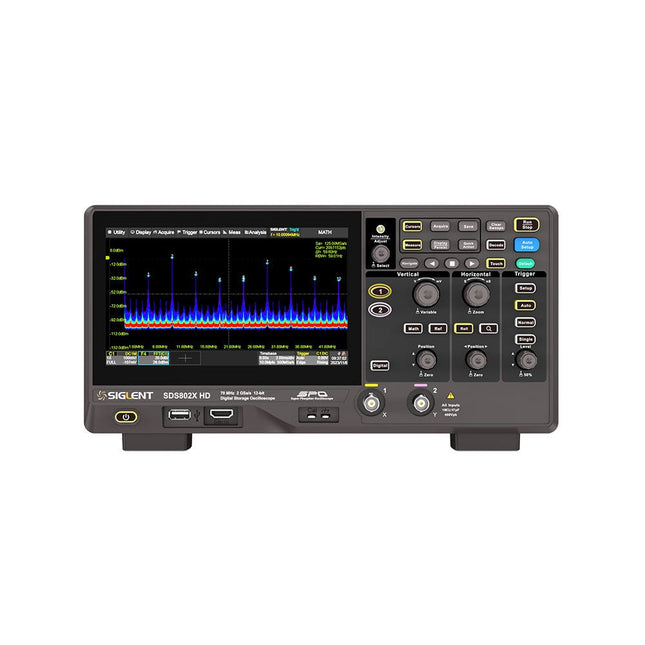
Siglent Siglent SDS822X HD Oscilloscope à 2 canaux (200 MHz)
The Siglent SDS822X HD digital storage oscilloscope is based on 2 GSa/s, 12-bit Analog-Digital Converters and front ends with excellent noise floor performance. With a 200 MHz bandwidth, and a maximum record length of 100 Mpts, and the capability to analyze 2 analog channels alongside 16 digital channels, the SDS822X HD is perfectly suited for mixed signal analysis. Caractéristiques 12-bit High Resolution 12-bit Analog-Digital Convertors with sample rate up to 2 GSa/s Front ends with 70 μVrms noise floor @ 200 MHz bandwidth 2/4 analog channels, up to 700 MHz bandwidth SPO technology Waveform capture rate up to 120,000 wfm/s (normal mode), and 500,000 wfm/s (sequence mode) Supports 256-level intensity grading and color temperature display modes. Up to 50 Mpts record length Digital trigger system Intelligent trigger: Edge, Slope, Pulse width, Window, Runt, Interval, Dropout, Pattern, Video (HDTV supported), Qualified, Nth edge, Delay, Setup/Hold time. Serial bus triggering and decoder, supports protocols I²C, SPI, UART, CAN, LIN. Segmented acquisition (Sequence) mode, dividing the maximum record length into multiple segments (up to 80,000), according to trigger conditions set by the user, with a very small dead time between segments to capture the qualifying event. History waveform record (History) function, the maximum recorded waveform length is 80,000 frames. Automatic measurements on 50+ parameters, supports statistics with histogram, track, trend, Gating measurement, and measurements on Math, History and Ref. 4 Math traces (2 Mpts FFT, addition, subtraction, multiplication, division, integration, differential, square root, etc.), supports formula editor. Abundant data analysis functions such as Search, Navigate, Counter, Bode plot and Power Analysis High Speed hardware-based Mask Test function, with Mask Editor tool for creating user-defined masks 16 digital channels (optional) 25 MHz waveform generator (optional) 7" TFT-LCD display with 1024 x 600 resolution; Capacitive touch screen supports multi-touch gestures. Interfaces include: USB Hosts, USB Device (USBTMC), LAN (VXI-11/Telnet/Socket), Pass/Fail, Trigger Out Built-in web server supports remote control over the LAN port using a web browser. Supports SCPI remote control commands. Supports external mouse and keyboard. Supports NTP. Spécifications Analog Channels 2 Bandwidth 200 MHz Vertical resolution 12-bit Sample rate (Max.) One channel mode: 100 Mpts/chTwo channel mode: Mpts/chFour channel mode: 25 Mpts/ch Memory depth (Max.) One channel mode: 50 Mpts/chTwo channel mode: 25 Mpts/ch Waveform capture rate (Max.) Normal mode: 120,000 wfm/sSequence mode: 500,000 wfm/s Trigger type Edge, Slope, Pulse width, Window, Runt, Interval, Dropout, Pattern, Video, Qualified, Nth edge, Delay, Setup/Hold time, Serial Serial trigger and decode (Standard) I²C, SPI, UART, CAN, LIN Measurement 50+ parameters, statistics, histogram, trend, and track supported Math 4 traces 2 Mpts FFT, Filter, +, -, x, ÷, ∫dt, d/dt, √, Identity, Negation, Absolute, Sign, ex, 10x, ln, lg, Interpolation, MaxHold, MinHold, ERES, Average. Supports formula editor Data analysis Search, Navigate, History, Mask Test, Counter, Bode plot, and Power Analysis Digital channel (optional) 16-channel; maximum sample rate up to 1 GSa/s; record length up to 10 Mpts USB AWG module (option) One channel, 25 MHz, sample rate of 125 MHz, wave length of 16 kpts, isolated output I/O 2x USB 2.0 Host, USB 2.0 Device, 10/100 M LAN, Auxiliary output (TRIG OUT, PASS/FAIL), SBUS (Siglent MSO) Probe (Standard) Passive probe PB470 for each channel Display 7 TFT-LCD with capacitive touch screen (1024x600) Inclus 1x Siglent SDS822X Oscilloscope 2x Passive probe (200 MHz) PP520 1x Power cord (EU) 1x USB cable 1x Certificate of calibration 1x Quick start Téléchargements Datasheet Manual Programming guide
€ 630,00


