
Résultats de la recherche pour "elektor OR magazine OR fr OR mars OR avril OR 2021"
-

Elektor Digital Mikrocontroller-Module (PDF)
Grundlagen und Selbstbau Weshalb nicht damit beginnen, Mikrocontroller-Module selbst zu entwickeln, zumindest aber sich in Gedanken mit solchen Aufgaben zu beschäftigen? Wie Mikrocontroller-Module aufgebaut sind und wozu sie verwendet werden, soll in 'Mikrocontroller-Module – Grundlagen und Selbstbau' dargestellt werden. Das vorliegende Buch beleuchtet Mikrocontroller-Module, die vor allem zum Experimentieren, zum Lernen und zum Einarbeiten in die Entwicklung und Programmierung von Embedded Systems gedacht sind. Die Entwurfsgrundsätze, Lösungsvorschläge und Projekte, die in diesem Buch beschrieben werden, sind aus zwei Ideen hervorgegangen: Erstens können neue Entwicklungen zwischen den weit verbreiteten kostengünstigen Mikrocontroller-Modulen und der industriellen Computer- und Steuerungstechnik ihren Platz finden und zweitens ist es eine Herausforderung an sich, solche Module zu entwickeln und einzusetzen. In den ersten sieben Kapiteln dieses Buches werden die technischen Grundlagen diskutiert und anhand eigener Entwicklungen veranschaulicht. Das achte Kapitel gibt einen Überblick über diesen Modulbaukasten. Alle Fotos aus dem Buch können hier vierfarbig heruntergeladen werden.
€ 32,80
Membres : € 29,52
-

Elektor Digital Elektronik-Praxis für Einsteiger (E-book)
Elektronik-Praxis für Einsteiger (E-book)
€ 32,80
Membres : € 29,52
-

Elektor Digital Elektronik & Modellbahn 1 (E-BOOK)
Électronique et Modellbahn 1 (E-book)
€ 24,90
Membres : € 22,41
-

Elektor Publishing Arduino & Co – Measure, Control, and Hack
Clever Tricks with ATmega328 Pro Mini Boards With a simple Pro Mini board and a few other components, projects that 20 or 30 years ago were unthinkable (or would have cost a small fortune) are realized easily and affordably in this book: From simple LED effects to a full battery charging and testing station that will put a rechargeable through its paces, there’s something for everyone. All the projects are based on the ATmega328 microcontroller, which offers endless measuring, switching, and control options with its 20 input and output lines. For example, with a 7-segment display and a few resistors, you can build a voltmeter or an NTC-based thermometer. The Arduino platform offers the perfect development environment for programming this range of boards. Besides these very practical projects, the book also provides the necessary knowledge for you to create projects based on your own ideas. How to measure, and what? Which transistor is suitable for switching a certain load? When is it better to use an IC? How do you switch mains voltage? Even LilyPad-based battery-operated projects are discussed in detail, as well as many different motors, from simple DC motors to stepper motors. Sensors are another exciting topic: For example, a simple infrared receiver that can give disused remote controls a new lease on life controlling your home, and a tiny component that can actually measure the difference in air pressure between floor and table height!
€ 39,95
Membres : € 35,96
-

Elektor Digital Advanced Control Robotics (E-book)
If you enjoy DIY electronics, projects, software and robots, you’ll find this book intellectually stimulating and immediately useful. With the right parts and a little guidance, you can build robot systems that suit your needs more than overpriced commercial systems can. 20 years ago, robots based on simple 8-bit processors and touch sensors were the norm. Now, it’s possible to build multi-core robots that can react to their surroundings with intelligence. Today’s robots combine sensor readings from accelerometers, gyroscopes and computer vision sensors to learn about their environments. They can respond using sophisticated control algorithms and they can process data both locally and in the cloud. This book, which covers the theory and best practices associated with advanced robot technologies, was written to help roboticists, whether amateur hobbyist or professional, take their designs to the next level. As will be seen, building advanced applications does not require extremely costly robot technology. All that is needed is simply the knowledge of which technologies are out there and how best to use each of them. Each chapter in this book will introduce one of these different technologies and discuss how best to use it in a robotics application. On the hardware side, we’ll cover microcontrollers, servos, and sensors, hopefully inspiring you to design your own awe-inspiring, next-generation systems. On the software side, we’ll cover programming languages, debugging, algorithms, and state machines. We’ll focus on the Arduino, the Parallax Propeller, Revolution Education PICAXE and projects I’ve with which I’ve been involved, including the TBot educational robot, the PropScope oscilloscope, the 12Blocks visual programming language, and the ViewPort development environment. In addition, we’ll serve up a comprehensive introduction to a variety of essential topics, including output (e.g. LEDs, servo motors), and communication technologies (e.g. infrared, audio), that you can use to develop systems that interact to stimuli and communicate with humans and other robots. To make these topics as accessible as possible, handy schematics, sample code and practical tips regarding building and debugging have been included. Hanno Sander Christchurch, New Zealand
€ 24,95
Membres : € 22,46
-

Peak Peak Atlas ZEN50 Analyseur de diode Zener
L'Atlas ZEN50 est idéal pour tester les diodes Zener (y compris les diodes à avalanche), les suppresseurs de transitoires, les LED et les chaînes de LED. Il génère des impulsions de courant constant (sélectionnables entre 2 mA, 5 mA, 10 mA et 15 mA) à des tensions de 0 V à 50 V. Ainsi, même les Zeners haute tension ou les chaînes de LED haute tension peuvent être testés. Les courants de test sont fournis sous forme d'impulsions étroites pour garantir que le composant testé reste à une température constante. La tension de la pièce est affichée sur l'écran avec le courant de test ainsi qu'une mesure de la résistance de pente du composant (également appelée impédance dynamique). Spécifications Type d'analyseur Zeners, LED, téléviseurs, etc. Courants de test 2 mA, 5 mA, 10 mA, 15 mA Plage de tension 0,00 à 50,00 V Plage de résistance à la pente 0 à 8000 Ohm Type de batterie AAA simple (fourni). Durée de vie typique de 1400 opérations Méthode d'essai Triple impulsion à 10 pps (type) Tester le cycle de service actuel 3% Type d'affichage LCD alphanumérique (avec rétroéclairage) Inclus Instrument ZEN50 Cordons de test flexibles équipés de crocs plaqués or Guide d'utilisation illustré et complet Pile alcaline AAA Téléchargements Fiche technique (EN) Guide de l'utilisateur (FR) Guide de l'utilisateur (FR) Guide de l'utilisateur (informatique)
€ 85,20
-

Elektor Digital RFID (E-book)
RFID technology has conquered many areas in which barcodes, magnetic strips and contact smartcards were used previously. Everyday applications, such as electronic ticketing, access cards, debit cards and electronic identity documents would not be possible without this technology. MIFARE is the most widely used RFID technology, and this book provides a practical and comprehensive introduction to it. Among other things, the initial chapters cover physical fundamentals, relevant standards, RFID antenna design, security considerations and cryptography. The complete design of a reader’s hardware and software is described in detail. The reader’s firmware and the associated PC software support programming using any .NET language. The specially developed PC program, “Smart Card Magic.NET”, is a simple development environment that supports sending commands to a card at the click of a mouse, as well as the ability to create C# scripts. Alternatively, one may follow all of the examples using Visual Studio 2010 Express Edition. Finally, the major smart card reader API standards are introduced. The focus is on programming contactless smartcards using standard PC/SC readers using C/C++, Java and C#.
€ 34,95
Membres : € 31,46
-

Elektor Digital Basiscursus Bascom-AVR (E-book)
AVR-microcontrollers zijn populair, eenvoudig in het gebruik en bijzonder veelzijdig. In het elektronicatijdschrift 'Elektor' is dan ook al een groot aantal speciale toepassingen en printen met een ATmega- of een ATtiny-controller gepubliceerd. Meestal ging het daarbij om afgeronde projecten. In dit boek staat echter de programmering van deze controllers centraal. BASCOM is hiervoor een ideaal gereedschap. Na een minimale voorbereiding kunt u al beginnen uw eigen ideeën te realiseren. BASCOM en AVR-controllers, een onverslaanbaar team! Wat u ook wilt ontwikkelen, in de meeste gevallen heeft een ATmega alles aan boord wat u nodig hebt. Poorten, timers, A/D-omzetters, PWM-uitgangen en seriële interfaces, RAM, flash-ROM en EEPROM: alles is ruimschoots voorhanden. En met BASCOM is het gebruik daarvan kinderspel. Ook ingewikkelder periferie als LCD, RC5 en I²C kan met slechts een handjevol instructies worden gebruikt. Er is een brede hardware-basis beschikbaar. Of u nu de STK500 van Atmel gebruikt, de ATM18 of een eigen print, u kunt de voorbeelden uit dit boek meteen in praktijk brengen. Voor heel kleine taken worden controllers uit de ATtiny-reeks gebruikt. Op die manier kunt u uw eigen projecten snel en met weinig kosten realiseren. Downloads Software
€ 34,95
Membres : € 31,46
-

€ 34,80
Membres : € 31,32
-
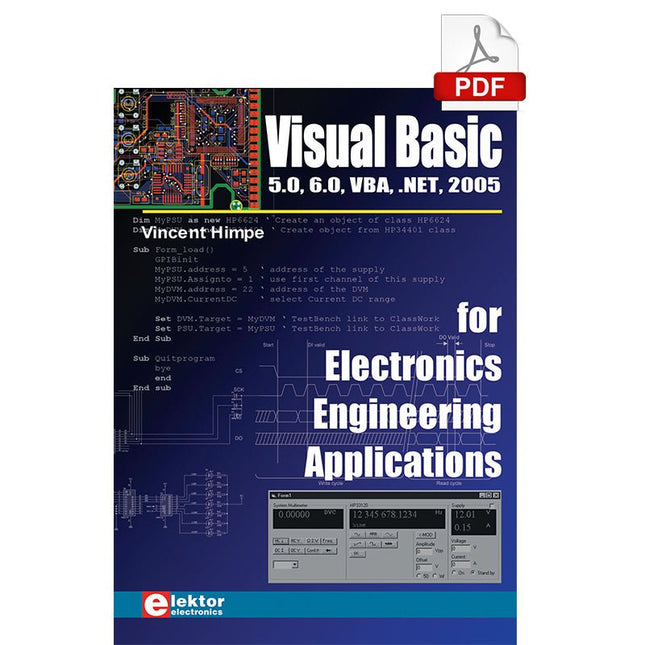
Elektor Digital Visual Basic for Electronics Engineering Applications (E-book)
The PC has long-time outgrown its function as a pure computer and has become an all-purpose machine. This book is targeted towards those people that want to control existing or self-built hardware from their computer. Using Visual Basic as Rapid Application Development tool we will take you on a journey to unlock the world beyond the connectors of the PC. After familiarising yourself with Visual Basic, its development environment and the toolset it offers, items such as serial communications, printer ports, bit-banging, protocol emulation, ISA, USB and Ethernet interfacing and the remote control of test-equipment over the GPIB bus, are covered in extent. Each topic is accompanied by clear, ready to run code, and where necessary, schematics are provided that will get your projects up to speed in no time. This book will show you advanced things like: using tools like Debug to find hardware addresses, setting up remote communication using TCP/IP and UDP sockets and even writing your own internet servers. Or how about connecting your own block of hardware over USB or Ethernet and controlling it from Visual Basic. Other things like internet-program communication, DDE and the new graphics interface of Windows XP are covered as well. All examples are ready to compile using Visual Basic 5.0, 6.0, NET or 2005. Extensive coverage is given on the differences between what could be called Visual Basic Classic and Visual basic .NET / 2005.
€ 39,95
Membres : € 35,96
-

Elektor Digital CAN und EOBD in der Fahrzeugtechnik (PDF)
Elektronische Systeme in Fahrzeugen werden immer wichtiger. Dies ist nicht nur auf die gestiegenen Ansprüche der Kunden hinsichtlich Komfort und Sicherheit zurückzuführen: Auch der Umweltschutz spielt bei dieser Entwicklung eine entscheidende Rolle. Aufgrund dieser Tatsache befinden sich heutzutage bis zu 80 elektronische Regeleinheiten in unseren Fahrzeugen, die – auch wenn sie von verschiedenen Herstellern stammen – natürlich auch miteinander kommunizieren müssen. Seit 2008 verlangt die europäische Gesetzgebung bei neu zugelassenen Fahrzeugen, dass sich Störungen, die zu einem erhöhten Schadstoffausstoß führen, über den CAN-Bus mit einem externen Diagnosetester aufspüren lassen. In diesem Buch werden Funktion und Aufbau des CAN-Protokolls sowohl im Hard- als auch im Software-Bereich ausführlich beschrieben. Dabei kommen die damit verbundenen Themen wie „Aufbau eines CAN-Berichtes“, „Prioritätsregelung“ und „physikalische Verbindung“ nicht zu kurz. Neben dem CAN-Bus ist EOBD-via-CAN ein vorherrschendes Thema. Wie funktioniert EOBD und welche diagnostischen Gegebenheiten sind mithilfe eines Diagnosetesters zugänglich? Die Gesetzgebung der Europäischen Union und die internationalen ISO- und SAE-Normen führen den Leser wie ein roter Faden durch die einzelnen Kapitel. Alle mit dem Thema in Zusammenhang stehenden Gesetze tragen zu einer Verringerung der Umweltbelastung bei und sorgen dafür, dass eine emissionsbezogene Störung am Fahrzeug schnell angezeigt (und damit auch repariert) wird. Ganz gleich, ob es um das Verständnis eines CAN-Berichtes, um das Aufspüren eines lästigen Fehlers oder gar um den Aufbau eines eigenen CAN-Bus-Systems geht: Dieses Buch erklärt nicht nur den CAN-Bus, sondern auch die Diagnose mittels CAN-Bus in verständlicher Weise und ist für private „Schrauber“ und professionelle Diagnosetechniker gleichermaßen geeignet. Studenten und Entwickler von CAN- und EOBD-Applikationen können sich mit diesem Buch durch „Probieren und Studieren“ eine Basis für ihre eigenen Entwicklungen schaffen.
€ 34,80
Membres : € 31,32
-
Elektor Digital Analogue Video (E-book)
This book is intended for electronics enthusiasts and professionals alike, who want a much deeper understanding of the incredible technology conquests over the pre-digital decades that created video. It details evolution of analogue video electronics and technology from the first electro-mechanical television, through advancements in Cathode Ray Tubes, transistor circuits and signal processing, up to the latest analogue, colour-rich TV, entertainment devices and calibration equipment. Key technological advances that enabled monochrome video and, eventually, colour are explained. The importance, compromises and techniques of maintaining crucial backward legacy compatibilities are described. The generation, signal processing and playback of analogue video signals in numerous capture, display, recording and playback devices together with operating principles and practices are examined. Technical and, often, political merits and deficiencies of key national and international video standards are highlighted. Several formats are shown to win and ultimately to co-exist. This book begins at fairly basic levels; concepts are introduced with human physiological perceptions of light and colour explained. This leads to the subject matter of luminance and chrominance; their equations and the circuits to process. There is full, detailed analysis of waveform shapes and timings inside video equipment and relevant popular connections e.g. S-video. Several analogue video projects which you can build yourself are also included in this book; with schematics, circuit board layouts and calibration steps to help you obtain the best results. The book makes use of many colour pages where the subject matter demands it (e.g. test cards). If you really want a deeper understanding of analogue video then this book is for you!
€ 24,95
Membres : € 22,46


