
Résultats de la recherche pour "doorbell OR memory OR 140092 OR 1"
-

Elektor Digital Raspberry Pi Pico W (E-book)
Program, build, and master 60+ projects with the Wireless RP2040 The Raspberry Pi Pico and Pico W are based on the fast, efficient, and low-cost dual-core ARM Cortex M0+ RP2040 microcontroller chip running at up to 133 MHz and sporting 264 KB of SRAM and 2 MB of Flash memory. Besides spacious memory, the Pico and Pico W offer many GPIO pins, and popular peripheral interface modules like ADC, SPI, I²C, UART, PWM, timing modules, a hardware debug interface, and an internal temperature sensor. The Raspberry Pi Pico W additionally includes an on-board Infineon CYW43439 Bluetooth and Wi-Fi chipset. At the time of writing this book, the Bluetooth firmware was not yet available. Wi-Fi is however fully supported at 2.4 GHz using the 802.11b/g/n protocols. This book is an introduction to using the Raspberry Pi Pico W in conjunction with the MicroPython programming language. The Thonny development environment (IDE) is used in all of the 60+ working and tested projects covering the following topics: Installing the MicroPython on Raspberry Pi Pico using a Raspberry Pi or a PC Timer interrupts and external interrupts Analogue-to-digital converter (ADC) projects Using the internal temperature sensor and external sensor chips Using the internal temperature sensor and external temperature sensor chips Datalogging projects PWM, UART, I²C, and SPI projects Using Bluetooth, WiFi, and apps to communicate with smartphones Digital-to-analogue converter (DAC) projects All projects are tried & tested. They can be implemented on both the Raspberry Pi Pico and Raspberry Pi Pico W, although the Wi-Fi-based subjects will run on the Pico W only. Basic programming and electronics experience are required to follow the projects. Brief descriptions, block diagrams, detailed circuit diagrams, and full MicroPython program listings are given for all projects.
€ 34,95
Membres : € 31,46
-

Elektor Digital Elektor November/December 2020 (PDF) EN
New LCR Meter 50 Hz - 2 MHz Part 1automatic impedance measuring bridge measures the resistance, capacitance and inductance of components with an impedance of 10 mΩ to 100 MΩ From Ding-Dong Door Chime to IoT DoorbellIntegrate your doorbell in Home Assistant with ESPHome Battery ManagementWhat to Be Aware of When Using (Lithium) Batteries Starting Out in ElectronicsEasier Than Imagined! Small Circuits RevivalFrom the Elektor Suggestions Box Breadboard Graphics with Fritzing Analogue Filter Design (Part 2)Active Filters Homelab Tours: The Lap CounterA Project for Mini Petrol-Heads Developer’s ZoneTips & Tricks, Best Practices and Other Useful Information Review: Rigol DS1054Z Four-Channel Oscilloscope Christmas CandleBlow It Out! Tunable Valve Sinewave Generator Retro is back! Review: The Rigol DG2072 Generator KiCad Plugins and Add-ons Differential Oscilloscope Current Probe 2.0Measure Currents Using Your Oscilloscope The Hewlett-Packard Interface LoopConnect the world! The Future of Machine LearningAn Interview with Daniel Situnayake Smartphone Apps for Android and iOSProgramming Apps Within a Single Development Environment From Life's ExperienceThe Value of a Technical Education 5G: How Infrastructure Shapes Our Society Practical ESP32 Multitasking (5)Task event notification HP 10811 OscillatorPeculiar Parts, the series LoRa GPS TrackerWith Open Hardware and Software Programming the Finite State Machinewith 8-bit PICs in Assembly and C
€ 7,50
-

€ 15,90
Membres : € 14,31
-

Siglent Oscilloscope Siglent SDS2104X Plus 4 canaux (100 MHz)
Siglent's SDS2000X Plus series Digital Storage Oscilloscopes are available in bandwidths of 100 MHz, 200 MHz, and 350 MHz, have a maximum sample rate of 2 GSa/s, a maximum record length of 200 Mpts/ch, and up to 4 analog channels + 16 digital channels mixed-signal analysis ability. The SDS2000X Plus series employs Siglent?s SPO technology with a maximum waveform capture rate of up to 120,000 wfm/s (normal mode, up to 500,000 wfm/s in Sequence mode), 256-level intensity grading display function plus a color temperature display mode. It also employs an innovative digital trigger system with high sensitivity and low jitter. The trigger system supports multiple powerful triggering modes including serial bus triggering. History waveform recording, Sequence acquisition, Search and Navigate functions allow for extended waveform records to be captured, stored, and analyzed. An impressive array of measurement and math capabilities, options for a 50 MHz waveform generator, as well as serial decoding, mask test, bode plot, and power analysis are also features of the SDS2000X Plus. A 10-bit acquisition mode helps to satisfy applications that require more than 8-bit resolution. The large 10.1?? capacitive touch screen supports multi-touch gestures, while the remote web control, mouse and external keyboard support greatly improve the operating efficiency of the SDS2000X Plus. Features 100 MHz, 200 MHz, 350 MHz (upgradable to 500 MHz) models Real-time sampling rate up to 2 GSa/s Record length up to 200 Mpts Serial bus triggering and decoder, supports I²C, SPI, UART, CAN, LIN, CAN FD, FlexRay, I²S and MIL-STD-1553B Provide 10 bit mode, Vertical and Horizontal Zoom Capacitive touch screen supports multi-touch gestures Siglent SDS2000X Plus Oscilloscopes SDS2102X Plus SDS2104X Plus SDS2204X Plus SDS2354X Plus Bandwidth 100 MHz 100 MHz 200 MHz 350 MHz Channels 2 4 4 4 Real-time sampling rate 2 GSa/s 2 GSa/s 2 GSa/s 2 GSa/s Capture rate 120,000 wfm/s 120,000 wfm/s 120,000 wfm/s 120,000 wfm/s Memory depth 200 Mpts/ch 200 Mpts/ch 200 Mpts/ch 200 Mpts/ch Included Siglent SDS2104X Plus Oscilloscope Passive probes Power cord USB cable Manual Downloads Datasheet Manual Quick guide User manual Firmware
€ 1.151,04
-

Elektor Digital Serielle Schnittstellen (E-book)
Die serielle Schnittstelle dient dem Datenaustausch zwischen Mikrocontrollern und Peripheriegeräten. Bei einer seriellen Datenübertragung werden die Bits nacheinander – also seriell – über eine Leitung übertragen. Das Wissen um diese seriellen Schnittstellen erweitert die Einsatzmöglichkeiten von Mikrocontrollern und Peripheriegeräten ungemein. In diesem Buch werden die Grundlagen der Kommunikation für die drei seriellen Schnittstellen I²C, SPI und 1-Wire vorgestellt. Anhand praxisnaher Beispiele werden die Schnittstellen anschaulich dargestellt und deren Einsatz verdeutlicht. Software- und Hardwarebeispiele, die man in diesem Buch finden kann, wurden in Assembler für PIC-Mikrocontroller von Microchip realisiert. Die verwendeten Algorithmen und Vorgehensweisen kann man aber auf beliebige Plattform übertragen. Um den Inhalt des Buches ansprechend zu gestalten, demonstriert der Autor den Buchinhalt an zwei Platinen. Mit diesen Platinen ist es möglich, die in diesem Buch beschriebenen Beispiele auszuprobieren und mit den Schnittstellen zu experimentieren. Beide Platinen basieren auf 8-bit-PIC-Mikrocontrollern von Microchip.
€ 34,80
Membres : € 31,32
-

Elektor Digital Elektor 07-08/2023 (PDF)
Diese Ausgabe steht allen GOLD- und GREEN-Mitgliedern auf der ElektorMagazine-Website zum Download bereit! Sie sind noch kein Mitglied? Hier klicken! Drehscheibentelefon als FernbedienungLicht einschalten, wählen Sie die 1, Kaffeemaschine einschalten, wähle Sie die 2 GPS-gestützte GeschwindigkeitsüberwachungNie mehr rasen, nie mehr Knöllchen! RGB-Stroboskop mit ArduinoFarbenfrohe Anwendung eines nützlichen Werkzeugs Drahtloser Notruf-TasterErhöhte Sicherheit mit LoRa Aller Anfang......muss nicht schwer sein: Folgen Sie dem Emitter! Beliebige und unabhängige Hysteresestufen für Komparatorenmit Simulationen, Tabellenkalkulationen und etwas Algebra ESP32-basierter Impedanz-AnalysatorEinfach, wenige Bauteile und preiswert! Das besondere ProjektErmutigung zum Heimwerken Mikrocontroller-Praxiskurs für Arduino-Einsteiger mit TrainingsboardAll-in-One-Trainingshardware für den Mikrocontroller-Kurs Aus dem Leben gegriffenModerner Luddismus Sensor 1x1: Temperatur-Sensor DS18B20Anschluss am 1-Draht-Bus Rettet Matter das Smart Home?Neue Standards zur Vereinfachung der Hausautomatisierung Eine Frage der ZusammenarbeitEntwickeln mit dem Board Thing Plus Matter und dem Simplicity Studio Infografik: IoT und Sensoren Matter, ExpressLink, Rainmaker - Worum geht es eigentlich?Interview mit Amey Inamdar von Espressif Development-Kits für IoT- und IIoT-ApplikationenÜber die Auswahl von Mikrocontroller-Entwicklungsboards Kondensatoren verhalten sich nicht immer kapazitiv Eine NTP-Uhr mit CircuitPythonWarum Sie diese Programmiersprache verwenden sollten Bauen Sie ein cooles IoT-DisplayMit dem Phambili Newt Der Doppler-Bewegungssensor HB100Theorie und Praxis eines ungewöhnlichen Sensors Eine Anleitung zur Bare-Metal-ProgrammierungTeil 1: STM32 und andere Controller Siglent-Multimeter SDM3045X Mikroprozessoren für eingebettete SystemeBemerkenswerte Bauteile Mikrocontroller-Dokumentation verstehenTeil 3: Blockdiagramme und mehr LoRa-Wetterstation mit niedriger StromaufnahmeBauen Sie Ihre entfernte Wetterstation selbst! Transverter für das 70-cm-Band Climate Calling EngineersMove Fast and Fix Things Hexadoku
€ 11,90
-

OWON Alimentation électrique CC OWON SPE6103 (300 W)
OWON SPE6103 est une alimentation électrique CC à 1 canal (300 W) dans un petit boîtier doté de fonctionnalités telles que la protection contre les surtensions et les surintensités. Elle possède une haute résolution de 10 mV/1 mA. L'écran LCD de 2,8 pouces affiche les informations suivantes (sortie de tension constante, sortie de courant constant, temps de fonctionnement cumulatif, puissance de sortie réelle, statut de sortie du canal, sortie de tension réelle, sortie de courant réelle). Caractéristiques Petit boîtier pour un transport facile Haute résolution : 10 mV/1 mA Liste d'édition de forme d'onde de sortie, fonction de sortie de minutage éditable pour 10 groupes Faible ondulation/bruit Protection contre les surtensions / surintensités Fonction de surveillance des courbes de tension et de courant de sortie Refroidissement intelligent par ventilateur à contrôle de température Écran LCD TFT de 2,8 pouces Interface de communication USB, prise en charge SCPI Spécifications Modèle SPE6102 SPE6103 Sortie nominale (0-40°C) Tension 0-60 V 0-60 V Courant 10 A 10 A Puissance de sortie 200 W 300 W Sortie USB 5 V/1 A (Série SPE) ou prise en charge des protocoles de charge rapide QC2.0, QC3.0, BC1.2, Apple, Huawei, Samsung (en option) Régulation de charge Tension ≤30 mV Courant ≤20 mA Régulation de puissance Tension ≤30 mV Courant ≤20 mA Résolution de réglage Tension 10 mV Courant 1 mA Résolution de lecture Tension 10 mV Courant 1 mA Résolution de la valeur (dans les 12 mois) (25 ±5°C) Tension ≤0,1% ±30 mV ≤0,1% ±30 mV Courant ≤0,05% ±10 mA Résolution de la valeur de lecture (25 ±5°C) Tension ≤0,1% ±30 mV ≤0,1% ±30 mV Courant Ondulation/bruit Tension (Vp-p) ≤50mVp-p ≤50mVp-p Tension (rms) ≤5mVrms ≤5mVrms Courant (rms) ≤30mAp-p Coefficient de température de sortie (0-40°C) Tension 100ppm/°C Courant 200ppm/°C Coefficient de température de lecture Tension 100ppm/°C Courant 200ppm/°C Temps de réponse (charge nominale 50-100%) ≤1,0ms Stockage 4 groupes de données Température de fonctionnement 0-40°C Inclus 1x OWON SPE6102 1x Cordon d'alimentation 1x Guide rapide 1x Câble USB 1x Fusible Téléchargements Manuel d'utilisation Manuel de programmation Logiciel
€ 123,97
-

Weller Weller WT1013 Station de soudage numérique (95 W)
Le kit de station de soudage Weller WT 1013 comprend l'unité d'alimentation WT 1, le fer à souder WP 80 et le support de sécurité WSR 201. Il est empilable et crée ainsi plus d'espace sur le lieu de travail. Grâce à un capteur d'utilisation intégré, l'outil de soudage s'éteint automatiquement. Caractéristiques Canaux 1 Tension 230 V Pouvoir 95 W Afficher Écran LCD rétroéclairé Écart de température 50°C - 450°C Stabilité de la température ±2 °C Précision de la température ±9 °C Fusible 0,5 A Liaison équipotentielle sur Compatible WT sur Sécurité ESD sur Câble d'alimentation EMEA Dimensions 149x138x101mm Poids (environ) 1,9 kg
€ 438,00
-
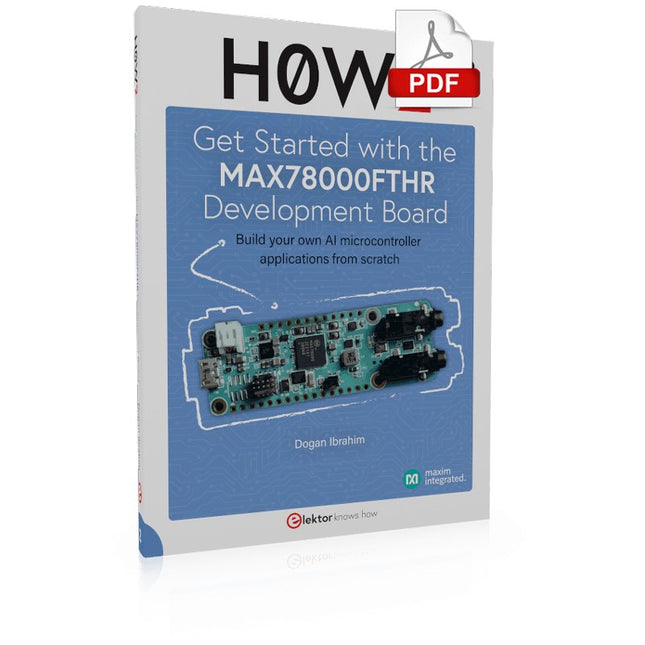
Elektor Digital H0W2: Get Started with the MAX78000FTHR Development Board (E-book)
Build your own AI microcontroller applications from scratch The MAX78000FTHR from Maxim Integrated is a small development board based on the MAX78000 MCU. The main usage of this board is in artificial intelligence applications (AI) which generally require large amounts of processing power and memory. It marries an Arm Cortex-M4 processor with a floating-point unit (FPU), convolutional neural network (CNN) accelerator, and RISC-V core into a single device. It is designed for ultra-low power consumption, making it ideal for many portable AI-based applications. This book is project-based and aims to teach the basic features of the MAX78000FTHR. It demonstrates how it can be used in various classical and AI-based projects. Each project is described in detail and complete program listings are provided. Readers should be able to use the projects as they are, or modify them to suit their applications. This book covers the following features of the MAX78000FTHR microcontroller development board: Onboard LEDs and buttons External LEDs and buttons Using analog-to-digital converters I²C projects SPI projects UART projects External interrupts and timer interrupts Using the onboard microphone Using the onboard camera Convolutional Neural Network
€ 32,95
Membres : € 29,66
-

Siglent Siglent SPD3303X-E Alimentation CC à 3 canaux (220 W)
L'alimentation CC linéaire programmable de la série SPD3000X est dotée d'un écran LCD TFT de 4,3 pouces. Elle permet la programmation et l'affichage d'ondes en temps réel, ce qui apporte une nouvelle expérience aux utilisateurs. Elle possède trois sorties isolées : deux canaux réglables et un canal sélectionnable de 2,5 V, 3,3 V et 5 V. Elle dispose également d'une fonction de protection contre les courts-circuits et les surcharges, et peut être utilisé en production et en développement. Caractéristiques 3 sorties réglables indépendantes et isolées, 32V/3,2A×2, 2,5V/3,3V/5V/3,2A×1, total 220W. Affichage de la tension à 5 chiffres, du courant à 4 chiffres, résolution minimale de 10mV/10mA. Sorties de synchronisation/temporisateurs. Écran TFT LCD couleur de 4,3 pouces 480x272 pixels. 3 types de modes de sortie : indépendant, série, parallèle. Compatible 100V/120V/220V/230V pour répondre aux besoins des différents réseaux électriques. Ventilateur intelligent à température contrôlée, réduisant efficacement le bruit. Interface graphique claire, avec fonction d'affichage de la forme d'onde. Sauvegarde/rappel interne de 5 groupes de paramètres système, permettant l'extension de l'espace de stockage des données. Logiciel PC : Easypower, prend en charge les pilotes SCPI et LabVIEW. Sortie haute résolution et haute précision La résolution la plus élevée de 10mV/10mA offre une excellente précision de réglage et de lecture. Cela garantit une sortie précise même en cas de très faibles variations de tension ou de courant. Ceci est impossible avec une alimentation à faible résolution. Fonction mode série/parallèle/indépendant Les fonctions série et parallèle permettent de combiner deux canaux en une seule sortie avec une plus grande capacité de sortie de puissance, ce qui élargit le champ d'application. La puissance de chacun des trois canaux peut être activée ou désactivée indépendamment et peut également être activée ou désactivée en totalité. Le panneau affiche la sortie de synchronisation Le panneau de commande permet d'afficher 5 groupes de réglages de temporisation et de contrôle de sortie, ce qui offre aux utilisateurs une fonction simple de programmation de l'alimentation. Il est également possible d'établir une connexion avec le logiciel PC EasyPower de Siglent, ce qui permet de répondre à toutes les exigences en matière de communication et de contrôle. Sauvegarde/rappel des paramètres de réglage L'alimentation programmable de la série SPD3000X peut enregistrer ou rappeler 5 groupes de paramètres de réglage dans la mémoire interne, et permet également l'extension de la mémoire externe. Vous pouvez facilement obtenir les paramètres dont vous avez besoin.
€ 432,90
-

iFixit iFixit Manta Driver Kit
Ce kit comprend le plus large assortiment d'embouts iFixit, ainsi que toutes les têtes de tournevis dont vous aurez besoin pour entreprendre tout projet de réparation ou de bricolage. Il comprend des embouts standard comme Phillips et Flathead dans une gamme complète de tailles pour tout gérer, de la réparation électronique de précision aux projets de bricolage à domicile. Et ce ne serait pas un ensemble de bits iFixit s'il n'incluait pas tous les éléments exotiques, des Pentalobes pour la réparation d'iPhone et de MacBook d'Apple aux Gamebits pour vos consoles Nintendo vintage. Tous les jeux d'embouts de nouvelle génération ont été repensés afin de maximiser la commodité et la convivialité. Le couvercle du jeu d'embouts est maintenu en place avec des aimants pour augmenter la durée de vie du produit (plus de charnières ou de fermoirs cassés) et se monte également à l'arrière du boîtier du jeu d'embouts pour le garder à l'écart pendant que vous faites votre travail. Si vous avez besoin d'aide pour organiser vos vis et pièces, vous pouvez utiliser le plateau de tri intégré au couvercle. Les embouts de 4 mm ont été ajustés et ont désormais un col plus long pour une portée plus profonde et plus précise. La boîte à outils comprend Étui aimanté facile à ouvrir Membre avec plateau de tri intégré Tournevis en aluminium de 4 mm Tourne-embout en aluminium 1/4' Embouts de tournevis de 4 mm Phillips - 000, 00, 0 Tête plate - 1, 1,5, 2, 2,5, 3, 3,5 mm Torx-T2, T3, T4, T5 Sécurité Torx - TR6, TR7, TR8 Pentalobes-P2, P5, P6 JIS-000, 00, 0, 1 Hex - 0,7, 0,9, 1,3, 1,5 mm Sécurité hexagonale - 2, 2,5, 3, 3,5 mm Tripoint - Y000, Y00, Y0, Y1 Tourne-écrou - 2,5, 3, 3,5, 4, 4,5, 5, 5,5 mm Mors de jeu - 3,8, 4,5 mm Tendeur - 4, 6 Triangles - 2, 2,2, 2,6, 3 mm Mors ovale Embout d'espacement pour iPhone Bit d'éjection Sim Embout de ramassage magnétique Embouts de tournevis 1/4' Phillips - 1, 2, 3 Tête plate - 4, 5, 6, 7, 8 mm Sécurité hexagonale - 4, 5, 6, 7, 8 mm Sécurité hexagonale SAE - 1/8, 9/64, 5/32, 3/16, 7/32, 1/4 Pozidriv-PZ0, PZ1, PZ2, PZ3 Jeu de couples - 6, 8, 10 Tendeur - 8, 10, 12 Carré - 0, 1, 2, 3 Cannelure-M5, M6, M8 Sécurité Torx - TR9, TR10, TR15, TR20, TR25, TR27, TR30, TR35, TR40 Tri-aile 1, 2, 3, 4 Embrayage 1, 2, 3 Vanne Schrader Entraînement à crochet Adaptateur 1/4' à 4 mm Pilote 1/4' à douille 1/4' Pilote 1/4' à douille 3/8' Douille 1/4' vers pilote 1/4' Caractéristiques Embout métal : acier 6150 Matériau du pilote : aluminium anodisé Matériau du boîtier: ABS Mousse : EVA
€ 64,41
-
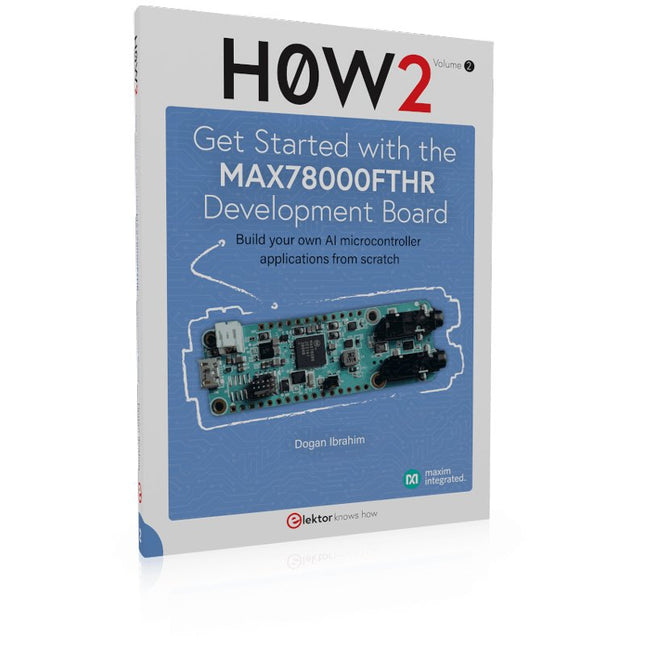
Elektor Publishing H0W2: Get Started with the MAX78000FTHR Development Board
Build your own AI microcontroller applications from scratch The MAX78000FTHR from Maxim Integrated is a small development board based on the MAX78000 MCU. The main usage of this board is in artificial intelligence applications (AI) which generally require large amounts of processing power and memory. It marries an Arm Cortex-M4 processor with a floating-point unit (FPU), convolutional neural network (CNN) accelerator, and RISC-V core into a single device. It is designed for ultra-low power consumption, making it ideal for many portable AI-based applications. This book is project-based and aims to teach the basic features of the MAX78000FTHR. It demonstrates how it can be used in various classical and AI-based projects. Each project is described in detail and complete program listings are provided. Readers should be able to use the projects as they are, or modify them to suit their applications. This book covers the following features of the MAX78000FTHR microcontroller development board: Onboard LEDs and buttons External LEDs and buttons Using analog-to-digital converters I²C projects SPI projects UART projects External interrupts and timer interrupts Using the onboard microphone Using the onboard camera Convolutional Neural Network
€ 39,95
Membres : € 35,96


