
Résultats de la recherche pour "raspberry OR pi OR 3 OR a OR plus"
-

Elektor Digital Elektor July/August 2021 (PDF) EN
LoRa with the Raspberry Pi PicoFun with MicroPython What Is RISC-V?And Why the Industry Is So Excited About a New Processing Core! Elektor @ 60Circuits of Summer Past Versatile Power Supply for BreadboardsPositive and Negative Voltages Out of 5 V from USB Raspberry Pi Pico EssentialsSample Chapter: Wi-Fi with the Raspberry Pi Pico Magnetic Levitation the Easy Way Hands On the Parallax Propeller 2Part 3: Smart Pins and Serial Data (UART) Nucleo Boards Programming with the STM32CubeIDESample Chapter: FreeRTOS for the STM32 MCU Developer's ZoneTips & Tricks, Best Practices and Other Useful Information Miniware DT71 Digital Tweezers Wearable Wi-Fi Gadget: ESPHome Does the Job Again Starting out in ElectronicsEasier Than Imagined! This Concludes the Subject of “Capacitors” Simple Sketches Using the Qwiic Ecosystem Java on the Raspberry Pi (Part 2)Controlling GPIOs with a Spring REST Service Raspberry Pi Compute Module 4A Raspberry Pi for Industry Portable, Stand-Alone Air Quality Display for 2.5 µm ParticlesKeep(s) an Eye on Your Health From Life’s ExperienceThe Future Was Better in the Past MicroPython for the ESP32 and FriendsPart 1: Installation and Our First Programs Charge-Coupled Devices in OscilloscopesPeculiar Parts, the series ESD – The Invisible DestroyerComponents Trashed by a Bolt from the Blue Solar Power for Mowing RobotsEcological, Inexpensive, Simple! Europe’s Efforts to Tame Big Tech HexadokuThe Original Elektorized Sudoku
€ 7,50
-

Elektor Digital Elektor March/April 2024 (PDF)
Elektor GREEN and GOLD members can download their digital edition here. Not a member yet? Click here. CaptureCountAn Object Detector and Counter on the Raspberry Pi 5 Voltage Reference With Arduino Pro MiniLinearize and Calibrate Your Analog Inputs FPGAs for BeginnersThe Path From MCU to FPGA Programming Update: STM32 Wireless Innovation Design Contest 2024 Bluetooth LE With MAUIControl Apps for Android & Co. Port-Expanding Breakout BoardIncrease the Number of I/Os on Your Dev Board AI SpecialistMachine Learning with the Jetson Nano 2024: An AI OdysseyFirst Forays Into TensorFlow 262,144 Ways to Play The Game of LifeA Reader’s Project in Brief From Life’s ExperienceThe Chinese Dragon Get Your (Brushed DC) Motor Running!Sample Projects from the Elektor Motor Control Development Bundle ESP32-RS-232 AdapterA Wireless Link for Classic Test Equipment Starting Out in Electronics……More About Opamps ESP Library Recommendations Piezoelectric DevicesPeculiar Parts, the Series A Smart Object CounterImage Recognition Made Easy with Edge Impulse Resolve Your Trickiest Embedded Development Challenges ESP32 TerminalA Handheld Device with a Touch-Capable Display Getting Started With the Zephyr RTOSAs Powerful as It Is Hard to Master Award-Winning EthicsA Dialog with CTO Alexander Gerfer of Würth Elektronik eiSos on Enabling Innovation and Mindful Behavior Err-lectronicsCorrections, Updates, and Readers’ Letters Infographics: Embedded and AI Square Wave Generation BenchmarksExploring ESP32, Pico, and Other Microcontrollers
€ 7,50
-
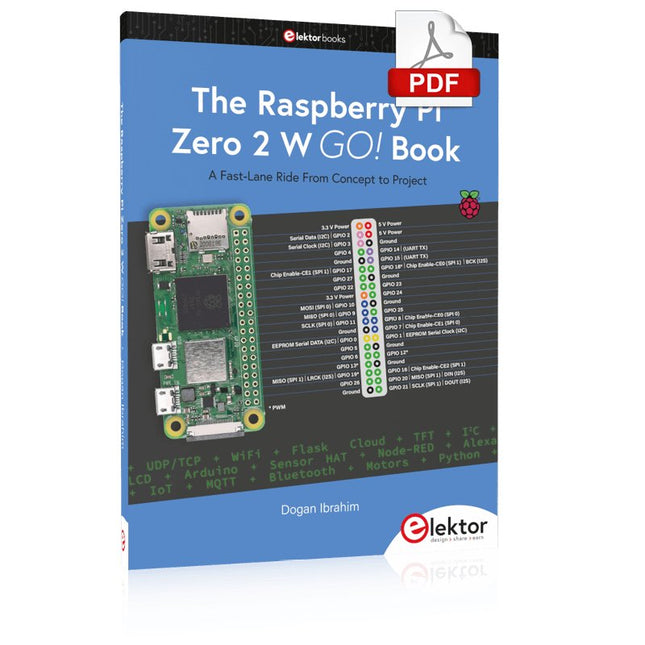
Elektor Digital The Raspberry Pi Zero 2 W GO! Book (PDF)
A Fast-Lane Ride From Concept to Project The core of the book explains the use of the Raspberry Pi Zero 2 W running the Python programming language, always in simple terms and backed by many tested and working example projects. On part of the reader, familiarity with the Python programming language and some experience with one of the Raspberry Pi computers will prove helpful. Although previous electronics experience is not required, some knowledge of basic electronics is beneficial, especially when venturing out to modify the projects for your own applications. Over 30 tested and working hardware-based projects are given in the book, covering the use of Wi-Fi, communication with smartphones and with a Raspberry Pi Pico W computer. Additionally, there are Bluetooth projects including elementary communication with smartphones and with the popular Arduino Uno. Both Wi-Fi and Bluetooth are key features of the Raspberry Pi Zero 2 W. Some of the topics covered in the book are: Raspberry Pi OS installation on an SD card Python program creation and execution on the Raspberry Pi Zero 2 W Software-only examples of Python running on the Raspberry Pi Zero 2 W Hardware-based projects including LCD and Sense HAT interfacing UDP and TCP Wi-Fi based projects for smartphone communication UDP-based project for Raspberry Pi Pico W communication Flask-based webserver project Cloud storage of captured temperature, humidity, and pressure data TFT projects Node-RED projects Interfacing to Alexa MQTT projects Bluetooth-based projects for smartphone and Arduino Uno communications
€ 32,95
Membres : € 29,66
-

Elektor Publishing Das offizielle Raspberry Pi Handbuch
Von den Machern von MagPi, dem offiziellen Raspberry Pi Magazin Starten Sie jetzt mit dem Raspberry Pi 5, dem neuesten und besten Minicomputer von Raspberry Pi – und lernen Sie, mit diesem unglaublichen Computer zu programmieren und Projekte zu erstellen. In diesem Buch finden Sie außerdem jede Menge kreative Ideen und Tipps, die Sie mit dem Raspberry Pi 4, dem Raspberry Pi Zero 2 W und dem Raspberry Pi Pico W umsetzen können. Mit den neuesten Reviews, Tutorials, Projekten, Anleitungen und mehr ist dies Ihre ultimative Ressource für den Raspberry Pi! 228 Seiten über Raspberry Pi Alles, was Sie über den Raspberry Pi 5 wissen müssen Erste Schritte für jeden Raspberry Pi Viel Spaß mit Elektronik und dem Pico W Inspirierende Projekte für Ihre nächste Bauidee Lernen Sie MicroPython, indem Sie ein Handheld bauen Erste Schritte mit dem Raspberry Pi Camera Modul Künstliche Intelligenz: Bauen Sie Ihren eigenen GPT Chatbot
€ 34,80
Meilleur prix
-

Elektor Digital Internet of Things (DE) E-BOOK
Internet des objets (DE) | Livre électronique
€ 34,80
Membres : € 31,32
-
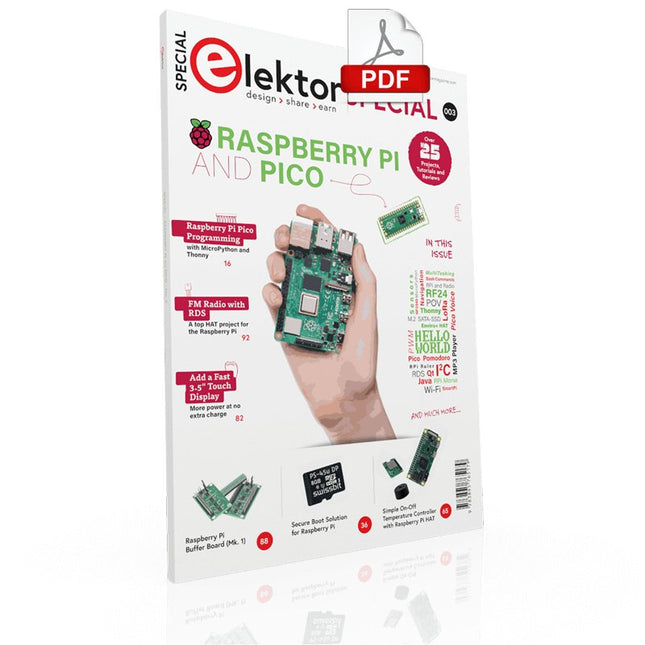
Elektor Digital Elektor Special: Raspberry Pi and Pico (PDF)
Contents Projects PicoVoiceVoice alienation and sound effects with the Raspberry Pi Pico Navigation with Vibration Feedback POV Display Pulse Width Modulation (PWM) with the Raspberry Pi Pico Wi-Fi with the Raspberry Pi Pico 'Hello World' from the Raspberry Pi Pico and RP2040A look at the Raspberry Pi Foundation’s first microcontroller Simple On-Off Temperature Controller with Raspberry Pi HAT Multitasking with the Raspberry PiShowcase: a traffic lights controller The Raspberry Pi Ruler GadgetFun with a time-of-flight sensor Raspberry Pi Buffer Board (Mk. 1)Never blow up the I/O again FM radio with RDSA top HAT project for the Raspberry Pi LoRa with the Raspberry Pi PicoFun with MicroPython! Tutorials Qt for the Raspberry Pi Raspberry Pi Pico Programmingwith MicroPython and Thonny Raspberry Pi Full StackRPi and RF24 at the heart of a sensor network Raspberry Pi Bash Command Cheat Sheet Community Java on the Raspberry PiAn interview with Frank Delporte Reviews Introducing the New Raspberry Pi Pico W, H, and WH Secure Boot Solution for Raspberry PiRetrofit security at a reasonable price Review: SmartPi – Smart Meter Extension for Raspberry Pi Review: The Enviro+ Raspberry Pi HATMeasuring environmental data with Raspberry Pi and the HAT Enviro+ Review: Meet the Raspberry Pi 4All new but still good? Raspberry Pi Gets a Fast 3.5' Touch DisplayMore power at no extra charge Book Launch: Raspberry Pi for Radio Amateurs
€ 11,95
Membres : € 10,76
-

FNIRSI FNIRSI GC-03 Détecteur de rayonnement multifonction
Le FNIRSI GC-03 est un détecteur de rayonnement multifonction conçu pour la mesure professionnelle des rayonnements nucléaires dans des environnements quotidiens tels que le domicile, le bureau, la voiture ou l'extérieur. Doté d'un écran couleur haute définition de 2,4 pouces, il permet une surveillance en temps réel des rayonnements nucléaires ainsi que de l'intensité des champs électriques et magnétiques. Pour une sécurité accrue, l'appareil dispose de trois modes d'alarme : alerte sonore, vibration et signal lumineux. Caractéristiques Détection 3-en-1 : Surveille les rayonnements électriques, magnétiques et nucléaires avec un seul appareil. Tube GM de haute précision : Détecte avec précision les rayons gamma, les rayons X et le rayonnement bêta dur, tout en consommant peu d'énergie. Courbe en temps réel et 50 historiques d'alarmes : Suit l'évolution des niveaux de rayonnement et mémorise l'historique des alarmes pour une consultation facile. Triple alarme personnalisable : Prend en charge des alertes visuelles, sonores et par vibration, avec des seuils réglables. Autonomie prolongée : Batterie de 1500 mAh pour une utilisation fiable et de longue durée sur le terrain. Spécifications Rayonnement nucléaire Plage : 0,01 μSv/h - 999,99 μSv/h Précision : 0,01 μSv/h Champ électrique Plage : 1 V/m - 1999 V/m Précision : 1 V/m Champ magnétique Plage : 0,01 μT - 99,99 μT Précision : 0,01 μT Puissance du rayonnement 0,2 - 1000 mW/m² Type de rayonnement détecté Rayonnement ionisant (rayons gamma, etc.) Détecteur Tube GM à compensation d'énergie (tube compteur Geiger) Débit de dose 0,00 - 10000 μSv/h (10 mSv/h) Équivalent de dose cumulée 0,00 μSv - 500,0 mSv Plage d'énergie 48 keV - 1,5 MeV ≤ ±30% (pour le 137Cs) Sensibilité 80 CPM/μSv Unité de dose μSv/h, μGy/h, mR/h, CPS, CPM Mode d'alarme Visuelle, vibration, sonore Écran Écran couleur de 2,4 pouces Rétroéclairage Luminosité réglable Alimentation USB-C (5 V/1 A) Batterie 1500 mAh Langues Anglais, Chinois Dimensions 138 x 63 x 32 mm Poids 141 g Inclus 1x FNIRSI GC-03 Détecteur de rayonnement 1x Câble USB 1x Manuel Téléchargement Manual Firmware v1.0.4
€ 99,95€ 84,95Meilleur prix
-

Elektor Digital IoT GET-U-GOING (E-book)
In 35 Projects with the Raspberry Pi and Arduino The Internet of Things (IoT) is a trend with a strong technological impulse. At home, we want to do everything on our tablets, from browsing Facebook to watching TV, from operating lights to keeping an eye on the temperature. In 35 fun projects, this book will show you how to build your own Internet of Things system. We'll cover the hardware (primarily the Raspberry Pi and Arduino) and the software that makes control via Internet possible. We employ Wi-Fi and radio links so no requirement any longer to install cabling crisscross through your home. Assuming the projects in the book are finished, you have a complete Internet of Things system that allows you to control and view of everything in your home. For example, if there's something in the mail box or the car is securely in the garage. Also, you can switch on the lights and the alarm from your couch. The crisp explanations allow the projects to be customized with ease, for example, to turn on your coffee machine or TV remotely. The index gives easy access to creative projects that can serve as an example, enabling you to do all the connecting to the IoT independently. All project software can be downloaded free of charge from the Elektor website. In this unique book, Raspberry Pi, Arduino and HTML webpages with stylesheets and JavaScript come together in clearly-described, easy-to-build projects. This special book is an essential part of your collection!
€ 34,95
Membres : € 31,46
-
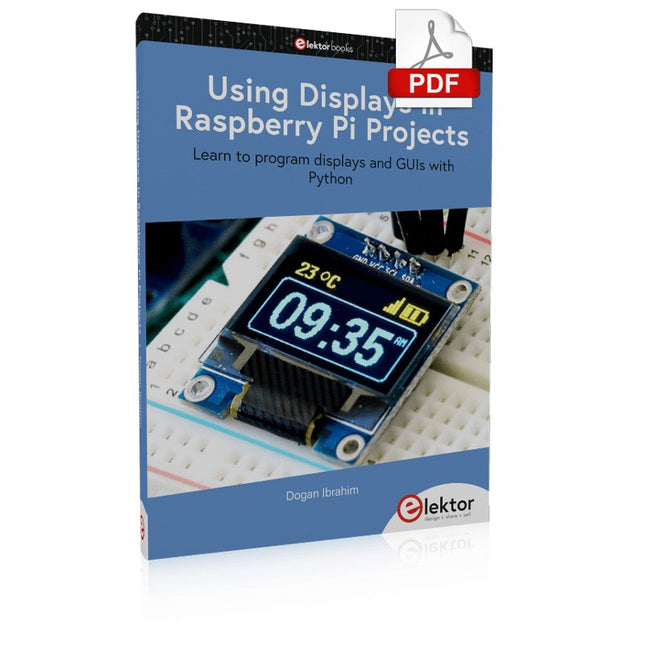
Elektor Digital Using Displays in Raspberry Pi Projects (E-book)
Learn to program displays and GUIs with Python This book is about Raspberry Pi 4 display projects. The book starts by explaining how to install the latest Raspbian operating system on an SD card, and how to configure and use the GPIO ports. The core of the book explains the following topics in simple terms with fully tested and working example projects: Simple LED projects Bar graph LED projects Matrix LED projects Bitmap LED projects LED strips LCDs OLED displays E-paper displays TFT displays 7-inch touch screen GUI Programming with Tkinder One unique feature of this book is that it covers almost all types of display that readers will need to use in their Raspberry Pi based projects. The operation of each project is fully given, including block diagrams, circuit diagrams, and commented full program listings. It is therefore an easy task to convert the given projects to run on other popular platforms, such as Arduino or PIC microcontrollers. Python program listings of all Raspberry Pi projects developed in this book are available for download at Elektor.com. Readers can use these programs in their projects. Alternatively, they can modify the programs to suit their applications.
€ 32,95
Membres : € 29,66
-
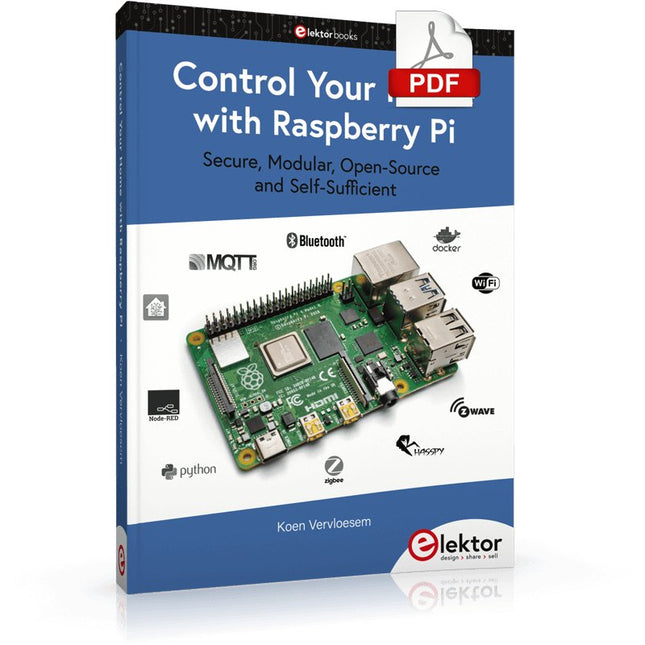
Elektor Digital Control Your Home with Raspberry Pi (E-book)
Secure, Modular, Open-Source and Self-Sufficient Ever since the Raspberry Pi was introduced, it has been used by enthusiasts to automate their homes. The Raspberry Pi is a powerful computer in a small package, with lots of interfacing options to control various devices. This book shows you how you can automate your home with a Raspberry Pi. You’ll learn how to use various wireless protocols for home automation, such as Bluetooth, 433.92 MHz radio waves, Z-Wave, and Zigbee. Soon you’ll automate your home with Python, Node-RED, and Home Assistant, and you’ll even be able to speak to your home automation system. All this is done securely, with a modular system, completely open-source, without relying on third-party services. You’re in control of your home, and no one else. At the end of this book, you can install and configure your Raspberry Pi as a highly flexible home automation gateway for protocols of your choice, and link various services with MQTT to make it your own system. This DIY (do it yourself) approach is a bit more laborious than just installing an off-the-shelf home automation system, but in the process, you can learn a lot, and in the end, you know exactly what’s running your house and how to tweak it. This is why you were interested in the Raspberry Pi in the first place, right? Turn your Raspberry Pi into a reliable gateway for various home automation protocols. Make your home automation setup reproducible with Docker Compose. Secure all your network communication with TLS. Create a video surveillance system for your home. Automate your home with Python, Node-RED, Home Assistant and AppDaemon. Securely access your home automation dashboard from remote locations. Use fully offline voice commands in your own language. Download the software and view the errata for the book on GitHub.
€ 34,95
Membres : € 31,46
-
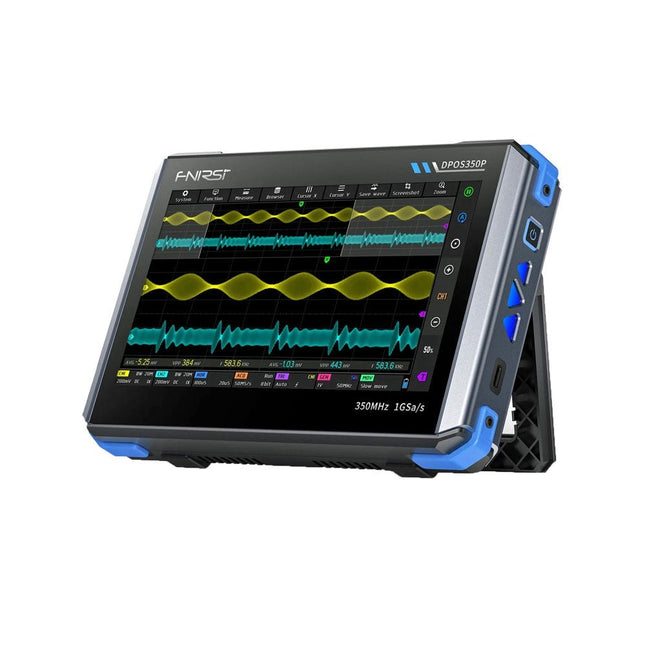
FNIRSI FNIRSI DPOS350P (4-en-1) Oscilloscope tablette à 2 canaux (350 MHz) + Générateur de signaux + Analyseur de réponse en fréquence + Analyseur de spectre
2 canaux • 350 MHz • 1 Géch/s • 50000 wfm/s • Écran tactile de 7 pouces Le FNIRSI DPOS350P est un appareil 4-en-1 élégant et puissant sous forme de tablette ! Cet appareil compact et portable offre des fonctionnalités avancées : il combine un oscilloscope à 2 canaux (350 MHz), un générateur de signaux (50 MHz), un analyseur de réponse en fréquence (50 MHz) et un analyseur de spectre (200 kHz–350 MHz), le tout dans un seul appareil. Que vous soyez en R&D, en dépannage ou en tests sur le terrain, le DPOS350P vous offre les outils nécessaires pour mesurer, générer, analyser et visualiser des signaux électroniques avec précision et clarté. Son écran tactile haute résolution réactif et ses commandes intuitives rendent l'analyse des signaux rapide, flexible et efficace. Caractéristiques Intégration multifonction puissante Oscilloscope 2 canaux 350 MHz avec échantillonnage en temps réel de 1 Géch/s Générateur de signaux 50 MHz avec 14 formes d'onde standard et personnalisées Analyseur de spectre (200 kHz–350 MHz) : Parfait pour les interférences électromagnétiques, RF et Tests HF Analyseur de réponse en fréquence (ARF) jusqu'à 50 MHz Capture de forme d'onde haute performance Fréquence de rafraîchissement de 50000 wfm/s pour une clarté du signal en temps réel Bande passante de 350 MHz (mode monocanal) Détecte les anomalies rares et à faible probabilité Affichage net et Fonctionnement fluide Écran tactile IPS 7" (résolution 1024 x 600) Basculement entre l'affichage des niveaux de gris et de la température de couleur Facilité d'utilisation dans divers environnements de test Fiable, protégé et charge rapide Protection haute tension jusqu'à 400 V Charge rapide avec QC 18 W (charge complète en 2 heures) Conçu pour un fonctionnement stable à long terme Stockage et exportation des données Enregistrement jusqu'à 500 enregistrements de formes d'onde + 90 captures d'écran Exportation USB pour faciliter la création de rapports et l'analyse hors ligne Spécifications Général Écran 7 pouces (IPS plein angle de vision) Résolution 1024 x 600 pixels Mode interaction Écran tactile capacitif Consommation totale 10 W Configuration à la mise sous tension 5 préréglages Chargement QC 18 W, 12 V/1,5 A (USB-C) Batterie Batterie au lithium 3,7 V, 8000 mAh Autonomie de la batterie Environ 3 heures en fonctionnement, 5 heures en veille Dissipation thermique Refroidissement par air Interface d'extension Port de données USB Arrêt automatique 15 à 60 minutes / arrêt Mise à jour du micrologiciel Prise en charge de la mise à niveau des images ISO Langues Anglais / Portugais / Russe / Chinois Dimensions 190 x 128 x 37 mm Oscilloscope Voies analogiques 2 Bande passante analogique 350 MHz Temps de montée 1 ns Fréquence d'échantillonnage en temps réel 1 Géch/s Profondeur mémoire 60 Kpts Impédance d'entrée 1 MΩ / 14PF Plage de base de temps 5 ns ~ 50 s Base de temps de défilement 50 ms ~ 50 s Sensibilité verticale 2 mV ~ 20 V (1X) Plage verticale 16 mV ~ 160 V (1X) Précision CC ±2% Temps Précision ±0,01% Couplage d'entrée CC / CA Atténuation de la sonde 1X / 10X / 100X Limite de bande passante matérielle 150 Mbit/s / 20 Mbit/s Mode haute résolution 8 bits ~ 16 bits Mesures de paramètres 12 types Mesure du curseur Temps, période, fréquence, niveau, tension Détection du déclencheur Déclenchement numérique Canal de déclenchement CH1 / CH2 Mode de déclenchement Auto / Simple / Normal Front de déclenchement Rising edge / Falling edge Suppression du déclencheur L1 ~ L3 Niveau de déclenchement Manuel / automatique 10% ~ 90% Stockage de captures d'écran 90 images Stockage de formes d'onde 500 groupes Grille d'arrière-plan Afficher / Masquer Mouvement de la forme d'onde Réglage grossier / réglage fin Protection contre les surtensions Tension de tenue 400 V Luminosité de la forme d'onde Réglable Affichage FFT simple Oui Fluorescence numérique Oui Affichage de la température de couleur Oui Mode X-Y Oui Base de temps ZOOM Oui Réglage automatique par simple pression sur une touche Oui Remise à zéro par simple pression sur une touche Oui Navigateur de données Oui Générateur de signaux Types de formes d'onde 14 fonctions standard + forme d'onde capturée Fréquence 0 à 50 MHz (onde sinusoïdale uniquement, autres formes d'onde jusqu'à 10M/5M/3M) Amplitude 0 à 5 VPP Décalage -2,5 V à +2,5 V Utilité Cycle 0,1~99,9% Résolution en fréquence 1 Hz Résolution en amplitude 1 mV Résolution du décalage 1 mV Résolution du rapport cyclique 0,1% Forme d'onde capturée personnalisable 500 groupes Analyseur de réponse en fréquence (ARF) Fréquence du signal d'excitation 100 Hz ~ 50 MHz Amplitude du signal d'excitation 0~5 VPP Décalage du signal d'excitation -2,5 V ~ +2,5 V Nombre de fréquences d'excitation 20~500 Mesure du curseur Fréquence / gain / Phase Mode de fonctionnement Simple / cyclique Calibrage du système Oui Analyseur de spectre Méthode de conversion FFT Longueur FFT 4K ~ 32K Gamme de fréquences 200 KHz ~ 350 MHz Plage de niveaux -60 dBmV ~ +260 dBmV Mesure du curseur Fréquence / amplitude Paramètre de marquage Harmoniques d'énergie maximale Graphique en cascade Oui Graphique en cascade 3D Oui Ajustement automatique Oui Calibrage du système Oui Inclus 1x FNIRSI DPOS350P (4-en-1) 2x Sondes de 350 MHz 1x Chargeur rapide QC 18 W (UE) 1x Câble de données USB 1x Pince crocodile 1x Sac de rangement 1x Manuel Téléchargements Manual Firmware
€ 309,00€ 259,00Meilleur prix
-
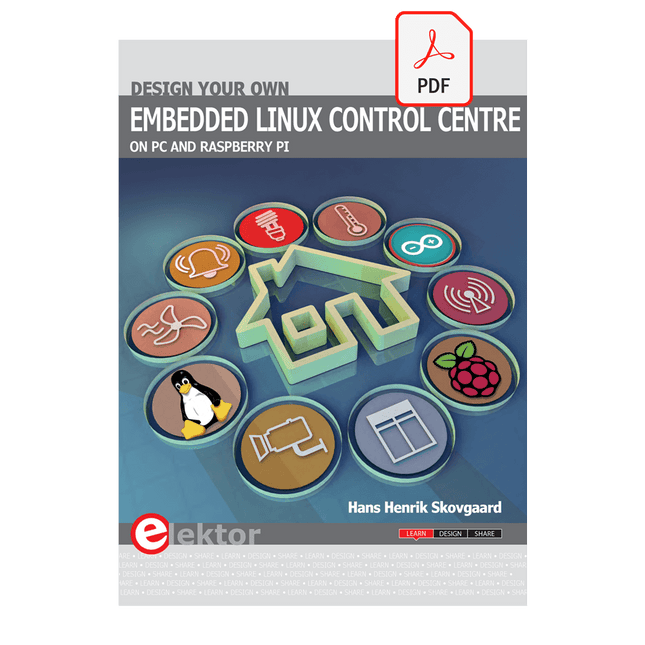
Elektor Digital Design your own Embedded Linux Control Centre (E-book)
This book is all about building your own DIY home control system. It presents two innovative ways to assemble such a system: By recycling old PC hardware – possibly extending the life of an old PC, or by using Raspberry Pi. In both cases, the main system outlined in this book will consist of a computer platform, a wireless mains outlet, a controller and a USB webcam – All linked together by Linux. By using the Raspberry Pi in conjunction with Arduino (used as an advanced I/O system board), it is possible to construct a small, compact, embedded control system offering enhanced capacity for USB integration, webcams, thermal monitoring and communication with the outside world. The experience required to undertake the projects within this book are minimal exposure to PC hardware and software, the ability to surf the internet, burn a CD-ROM and assemble a small PCB.
€ 34,95
Membres : € 31,46


