
Résultats de la recherche pour "all or new or pro or tech or toolkit"
-

Elektor Digital Software Defined Radio zum Selbstbau (PDF)
Praktischer Einstieg mit Arduino, GnuRadio und FPGA Das Thema „Software Defined Radio“ ist facettenreich: Neben der Schaltungstechnik ist auch eine Einarbeitung in die Programmierung von Hardware und PC wichtig. Ein schrittweises Vorgehen erleichtert Ihnen den Einstieg. Mit dem im Buch vorgestellten modularen „RF Bricks“-Konzept werden Sie zum Architekten Ihrer Signalkette. Auf einem Chassis angeordnet gewährleisten die Module einen soliden und gut abgeschirmten Aufbau, den Sie einfach verändern und mit eigenen Ideen anreichern können. Der skalierbare Aufbau bildet Ihr Blockschaltbild auch mechanisch ab – die so gewonnene Übersicht kann in der Aus- und Weiterbildung nützlich sein. Ein Arduino in Ihrem Chassis kommuniziert nach einigen Anpassungen mit üblichen SDR-Programmen, z. B. SDRCPP, GQRX und CubicSDR auf einer Linux-Plattform. Damit können Sie Ihren Empfänger direkt per Mausklick abstimmen. Wenn Sie Blockschaltbilder mögen, ist GnuRadio ein natürlicher Partner der „RF Bricks“. Mit einem selbst programmierten Python-Block gelingt Ihnen in GnuRadio die Fernsteuerung Ihres Empfängers. Im GnuRadio-Universum können Sie Ihre GUI stufenweise ausbauen, behalten dabei aber immer volle Kontrolle über die inneren Abläufe des Programms. Mit einem FPGA können zeitaufwändige Operationen auch direkt in die Hardware verlagert werden. Sie bauen stufenweise einen Doppelsuperhet auf und entwickeln die Filterkoeffizienten für FIR-Filter mit Scilab. Das in VHDL realisierte Weaver-Schema rundet diesen Empfänger ab, der mit hoher Empfindlichkeit und Dynamik aufwarten kann. Mit dem gewonnen Überblick und Ihrer neuen Hardware können Sie die einzelnen Aspekte des Themenkomplexes SDR beliebig weiter vertiefen. Downloads Software
€ 34,80
Membres : € 31,32
-

€ 34,80
Membres : € 31,32
-

Elektor Digital Zonne-energie (E-book)
Dit praktijkboek richt zich tot iedereen die geïnteresseerd is in de techniek, de planning, de opbouw en het mogelijke rendement van zonnestroominstallaties. Het boek bevat veel nuttige informatie, van de principes van het genereren van stroom uit zonlicht via de dimensionering van leidingen, de werking van omvormers, laadregelaars en accuʻs tot en met de beschrijving van complete autonome of netgekoppelde fotovoltaïsche generatoren. Zowel de leek als de (meer of minder ervaren) elektrotechnicus kan dit boek ook als leidraad gebruiken bij de aansluiting van een generator op het elektriciteitsnet conform de voorschriften van de netbeheerder. Het boek bevat bovendien wetenswaardigheden over veiligheids bepalingen en over de belasting door en deugdelijke constructie van fotovoltaïsche generatoren. Ontwerp, planning en montage worden aan de hand van een groot aantal illustraties gedetailleerd en op een ook voor leken begrijpelijke wijze behandeld; bovendien geeft het boek waardevolle informatie over de kosten en eventuele opbrengst van zonnestroomgeneratoren. Het boek bevat ook een overzicht van belangrijke internet-sites waar gratis software kan worden gedownload voor het ontwerp en de dimensionering van netgekoppelde en autonome fotovol taïsche installaties, zodat geen kostbare PC-programmatuur hoeft te worden aangeschaft.
€ 19,95
Membres : € 17,96
-
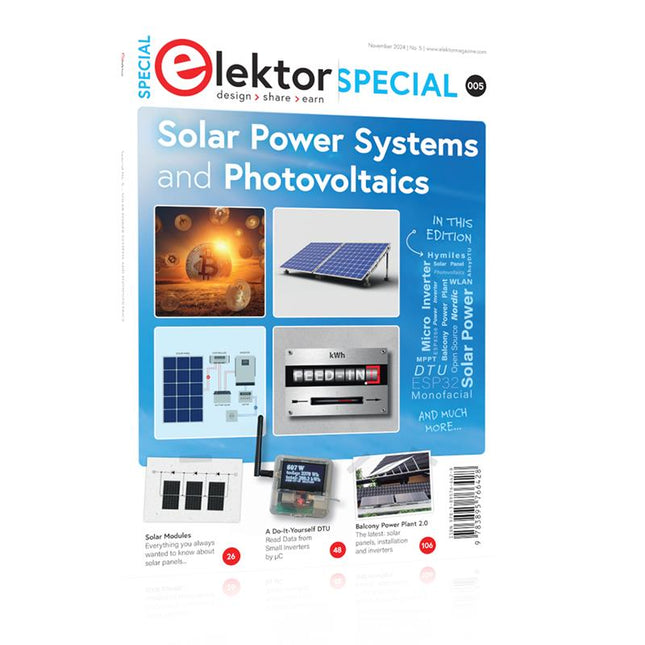
Elektor Special: Solar Power Systems and Photovoltaics
As demand for solar panel installation has risen sharply, especially for installations larger than balcony power plants, the order books of solar companies are full. If you ask for a quote today, you may have to wait a while, if your request isn't simply postponed indefinitely. Another consequence of the solar boom is that some companies are charging very high prices for installations. Yet there is an obvious and radical solution to the problem of excessive prices: Do it yourself, as the English say. The price of materials is currently affordable, and it's the ideal time for those who do the work themselves. They couldn't save more. Add to this the satisfaction of doing something useful, both economically and ecologically, and the pleasure of building yourself. In this special issue, you'll find a wide selection of Elektor assemblies, from solar panel controllers to solar water heaters and solar panel orientation systems. The issue also contains practical information on solar panel installation and the technology behind them. Finally, there are a number of articles on the subject of balcony power plants, from how to install them to how to connect them to the Internet... Contents BASICS Dimensioning Photovoltaic Panel ArraysAn introduction to photovoltaic energy and the commonest techniques,followed by simplified calculation models and setup guidelines. Light Sensor TechnologyMeasuring daylight using LEDs. Solar Power Made SimpleSolar charging with and without a controller. Cable Cross-sections and Energy Losses in Solar SystemsKey considerations on the minimum values to respect for electricalcurrent in solar panel cabling. Solar ModulesEverything you always wanted to know about solar panels... Ideal Diode ControllerDiode Circuits with Low Power Dissipation. TIPS Tracking for Solar Modules zBot Solar/Battery Power Supply Solar Cell Array Charger with Regulator Solar Cell Voltage Regulator Solar-Powered Night Light Alternative Solar Battery Charger PROJECTS Energy LoggerMeasuring and Recording Power Consumption. Tiny Solar SupplySunlight In, 3.3 V Out. A Do-It-Yourself DTURead Data from Small Inverters by μC. Solar ChargerPortable energy for people on the move. Solar Thermal Energy RegulatorMaximum power point tracking explored. 2-amp Maximum Power Tracking ChargerSolar Power To The Max. Computer-driven HeliostatFollow the sun or the stars. Garden LightingUsing solar cells. Solar Panel Voltage Converter for IoT DevicesYes we CAN exploit indoor lighting. Travel ChargerFree power in the mountains. Solar Cell Battery Charger/MonitorWith protection against deep discharge. Solar-powered Battery ChargerPIC12C671 avoids overcharging and deep charging. Converters for Photovoltaic PanelsContributed by TME (Transfer MultisortElektronik). Solar Charging RegulatorFor panels up to 53 watts. Solar-Powered ChargerFor lead-acid batteries. CAN Bus + Arduino for Solar PV Cell MonitoringDetect and locate serviceable panels in large arrays. Balcony Power Plant 2.0The latest: solar panels, installation and inverters
€ 19,95
Membres : € 17,96
-

Elektor Digital Praxiskurs AVR-XMEGA-Mikrocontroller (E-book)
Die Mikrocontrollertechnologie ist eines der wichtigsten Gebiete der modernen Elektronik. Mikrocontroller haben sich in den letzten Jahren in allen Bereichen der modernen Technik etabliert. Der vorliegende Kurs gibt eine umfassende Einführung in die faszinierende Welt der Controllertechnik. Nach grundlegenden Betrachtungen zur Controllertechnologie wird bereits im ersten Teil des Kurses auf die praktische Umsetzung des Stoffes eingegangen. Als Basis dafür dient ein modernes Entwicklungsboard (XMEGA-A3BU Xplained), das mit einem der aktuellsten Controller des Herstellers Atmel ausgestattet ist. Der zweite Teil beschäftigt sich detailliert mit der Programmierung des Controllers. Hier kommt die Sprache „C“ zum Einsatz, da diese in der Firmware-Entwicklung eine dominierende Stellung einnimmt. Die bei weitem überwiegende Mehrheit der professionellen Entwicklungsarbeit wird in C ausgeführt. Diese Programmiersprache bietet eine umfassende Grundlage für alle Controlleranwendungen. Im dritten Teil des Kurses wird schließlich auf die hardwarenahe Programmierung eingegangen. Nach der Durchsprache von Pin-Ansteuerung, Takterzeugung und Oszillatoroptionen werden die anspruchsvolleren Themen wie Interrupts, Timer und Counter, Pulsweitenmodulation und Analog-Digitalwandlung behandelt. Der Kurs setzt auf die Philosophie des „Learning by Doing“. Er eignet sich dadurch hervorragend als praktische Ergänzung für Unterricht und Vorlesungen in Weiterführenden Schulen Technischen Berufsschulen und Fachakademien Fachhochschulen und Universitäten Aber auch der ambitionierte, nichtprofessionelle Anwender kann sich mit dem Lernmaterial einen Überblick über den neuesten Stand der Controllertechnik verschaffen.Umfangreiche Praxisbeispiele und Übungsprogramme runden den Kurs ab und lassen keine Fragen offen.
€ 34,80
Membres : € 31,32
-

Elektor January/February 2026 (EN)
Elektor GREEN and GOLD members can download their digital edition here. Not a member yet? Click here. Low-Noise Lab Power Supply (1)A Quiet Source for Sensitive Circuits STM32 Edge AI Contest 2025: The Winners Batteries TodayTechnology and Differences in Lithium Batteries Adjustable Electronic LoadStatic + Dynamic DC Load Step-Down Converter from 48 V to 5 VThe Story of Circuit Development Autonomous Sensor Node v2.0Part 2: Hardware Validation and Power Optimizations VaristorsPeculiar Parts, the Series Graphical Grid Frequency MeterMonitor Grid Quality Starting Out in Electronics……Brings Its Own End Peak Current Load SMD FerritesMore Resilient Against Current Peaks Elektor Live! Expert Day 2025 Energy Harvesting Set to Accelerate IoT and IIoT Use CasesHow Energy Harvesting Frees IoT from the Grid Fnirsi DPS-150Compact and Portable Power Supply and Converter Adjustable USB-C Power SourceTurn Your USB-C Charger Into an Adjustable Power Supply Simple Charger and Capacity TesterWith Two Cheap “Off-the-Shelf” Modules Smart Color Detector with AI Voice and Playback PbMonitor v2.0Introduction to the Updated Battery Monitoring System A Fan for the Mini Reflow PlateSmart Modifications That Improve Results From Life’s ExperienceThe Tsunami of Indulgence Err-lectronicsCorrections, Updates, and Readers’ Letters 2026: An AI OdysseyWhen Models Start Dictating the Hardware Precision Picoammeter (2)Assembling, Calibration, and Test Wireless Device Poweringwith Inductive Technology AI-Based Autonomous DrivingThe RDW’s Self Driving Challenge 2024 Sound Card as Signal GeneratorPC as DCF77 Test Transmitter
€ 14,90
-

€ 29,80
Membres : € 26,82
-

Elektor Publishing 8-Bit-Mikrocontroller
PIC und AVR verstehen In diesem Buch werden wir uns ausschließlich mit 8-Bit-Mikrocontrollern beschäftigen, und zwar mit Mikrocontrollern der 8-Bit-PIC- und der 8-Bit-AVR-Mikrocontroller-Linien. Bei der PIC-Familie handelt es sich dabei um PIC10, PIC12, PIC16 und PIC18; bei der AVR-Familie um ATtiny, ATmega und ATxmega. Die vorgestellten 8-Bit-Chips sind für sehr viele Anwendungen vollkommen ausreichend und preislich auch attraktiv. Durch die Lektüre des Buches erhalten Sie ein fundiertes Wissen über die genannten 8-Bit-Mikrocontroller, über ihre Architektur, ihre Pinbelegungen und über ihre Programmierung. Weil wir uns in diesem Buch mit den Grundlagen der Architektur der PICs und AVRs vertraut machen möchten, werden wir auch für alle PIC- und AVR-Anwendungen Assembler einsetzen, denn die Assembler-Sprache erlaubt es, die Technik im Detail kennenzulernen. Wenn man wirklich wissen möchte, was sich im Mikrocontroller abspielt, greift man zu Assembler. Damit hat man die beste Gelegenheit, sehr nah an den Kern zu kommen. Und wenn man schon einen Mikrocontroller-Typ kennengelernt und verstanden hat, ist es bei dem nächsten deutlich einfacher, auch wenn er von einem anderen Hersteller kommt. Bei anderen Programmiersprachen bleibt die Technik immer ziemlich tief versteckt. Die Assembler-Beispiele sind so einfach gestaltet, dass sie jeder mit den im Buch aufgezeigten Programmiertechniken erstellen kann. Weil es sich um einfache Beispiele handelt, werden wir sie alle auf einer universellen Lochrasterplatine realisieren. Manche sind auch auf einem Experimentier-Breadboard umsetzbar.
€ 39,80
Meilleur prix
-
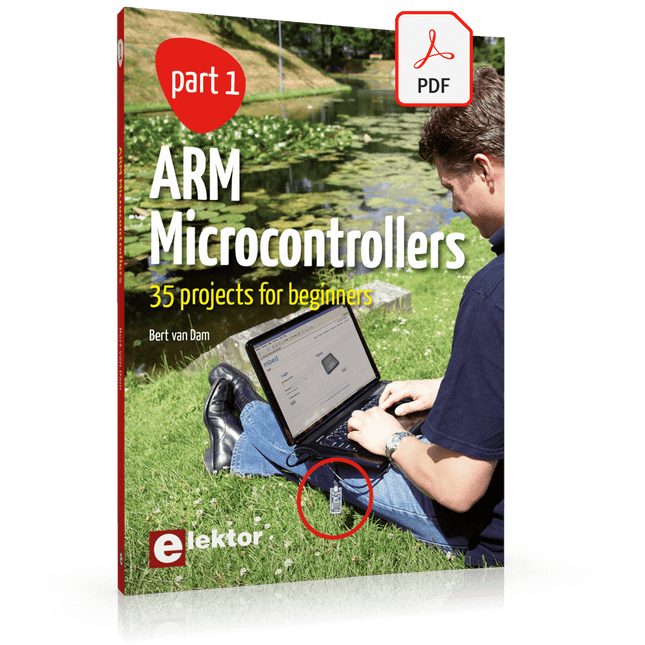
Elektor Digital ARM Microcontrollers (EN) | E-book
35 Projects for Beginners This book is for hobbyists, students and engineers who want to learn C and how to use an mbed ARM microcontroller in an easy and fun way, without the need for cumbersome software installations. ARM mbed microcontroller NXP LPC1768 The projects in this book are meant for beginners in C and ARM microcontrollers. That doesn't mean the projects are simple, but it does mean that they are easy to understand. We use for example USB communications, a subject that is made so easy by the mbed that it is suitable for a beginners book. Cloud technology The mbed NXP LPC1768 uses cloud technology, a revolutionary concept in software development. This means you do not need to install software on your PC in order to program the mbed! The only thing you need is a browser such as Microsoft Internet Explorer, and a USB port on your PC. You can get access to your project from any PC anywhere in the world and continue working on it. When you are done a few simple mouse clicks transfer the program to your mbed hardware. Of course you can optionally download the projects and store them on your own PC. Features of this Book Learn how to program an mbed ARM microcontroller using cloud technology. No complicated software installation on your PC needed. Learn programming in C by doing fun and interesting projects. No previous experience or knowledge required. Examples of projects in this book: flashing light, timer, light activated switch, digital thermometer, people detector, USB communication, talking microcontroller, debugging, sound switch, and much more - 35 projects in total. Examples of C subjects in this book: variables, commands, functions, program execution, pointers (introduction).
€ 29,95
Membres : € 26,96
-
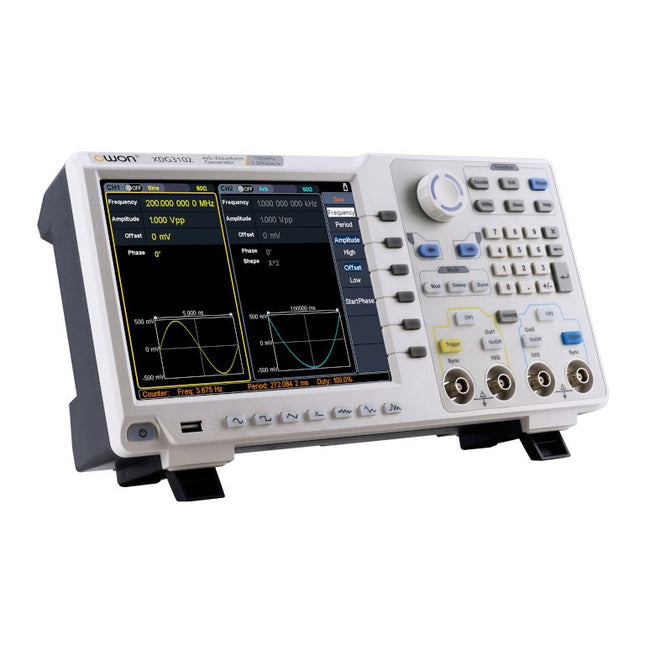
OWON OWON XDG3102 Générateur de formes d'onde arbitraires à 2 canaux (100 MHz)
Caractéristiques Technologie DDS avancée, sortie de fréquence jusqu'à 250 MHz Taux d'échantillonnage de 1,25 GS/s et résolution de fréquence de 1 μHz Jusqu'à 1 M de longueur de forme d'onde arbitraire Résolution verticale : 14 bits Sortie de forme d'onde complète : 6 groupes de formes d'onde et 152 groupes de formes d'onde arbitraires intégrées Options de modulation complètes : AM, FM, PM, FSK, 3FSK, 4FSK, PSK, OSK, ASK, BPSK, PWM, balayage et rafale Fréquencemètre intégré de haute précision, allant de 100 MHz à 200 MHz SCPI et LabVIEW pris en charge Écran LCD tactile 8'' 800 x 600 pixels Spécifications XDG3102 Canal 2 Sortie de fréquence 100MHz Taux d'échantillonnage 1,25 Géch/s Résolution verticale 14 bits Forme d'onde Forme d'onde standard sinus, carré, impulsion, rampe, bruit et harmonique Forme d'onde arbitraire montée exponentielle, chute exponentielle, sin(x)/x, onde progressive et autres,total de 150 formes d'onde intégrées et forme d'onde arbitraire définie par l'utilisateur Fréquence (résolution 1μHz) Sinus 1µHz - 100MHz Carré 1µHz - 40MHz Impulsion 1µHz - 25MHz Catastrophe 1μHz - 5MHz Harmonique 1µHz - 50MHz Bruit 120 MHz (-3 dB, typique) Forme d'onde arbitraire forme d'onde intégrée : 1uHz - 15MHzForme d'onde définie par l'utilisateur : 1 uHz - 50 MHz Précision ±1 ppm, 0°C - 40°C Amplitude Amplitude (50Ω) 1 mVpp - 10 Vpp (≤40 MHz) ; 1 mVpp - 5 Vpp (≤80 MHz)1 mVpp - 2,5 Vpp (≤120 MHz) ; 1 mVpp - 1Vpp (≤250 MHz) Amplitude (haute impédance) 2 mVpp - 20 Vpp (≤40 MHz) ; 2 mVpp - 10 Vpp (≤80 MHz) ;2 mVpp - 5Vpp (≤120 MHz) ; 2 mVpp - 2Vpp (≤250 MHz) Résolution 1mV ou 4 chiffres Décalage CC Plage (50Ω) ±(5 Vpk - Amplitude Vpp/2) Plage (Z élevé, circuit ouvert) ±(10 Vpk - Amplitude Vpp/2) Précision ±(1 % de |réglage| + 1 mV + Amplitude Vpp x 0,5 %) Résolution 1mV ou 4 chiffres Impédance de charge 50Ω (typique) Précision ±(1 % du réglage + 1 mVpp) (typique, sinusoïdal de 1 kHz, décalage de 0 V) Pureté du spectre d'onde sinusoïdale Distorsion harmoniqueTypique (0dB) C.C - 1 MHz : <-65 dBc1 MHz - 10 MHz : <-60 dBc10 MHz - 120 MHz : <-50 dBc120 MHz - 200 MHz : <-45 dBc Distorsion harmonique totale <0,05 %, 10 Hz à 20 kHz, 1 Vc.c. Parasitaire (non harmonique),Typique (0dB) ≤10MHz : <-70dBc>10MHz : <-70dBc + 6dB/octave Bruit de phaseTypique (0 dBm, déviation de 10 kHz) 10 MHz : ≤-110 dBc/Hz Carré Temps de montée/descente <5ns Dépasser <3% Cycle de service 50,0% (fixe) Gigue (rms) 300ps + 100ppm Impulsion Largeur d'impulsion 12ns - 996875s Temps de front montant/fin ≧7ns Dépasser <3% Gigue (rms) 300ps + 100ppm Catastrophe Linéarité ≤1 % de la sortie maximale (typique, 1 kHz, 1 Vpp, 50 % de symétrie) Symétrie 0% à 100% Harmonique Ordre Harmonique ≤16 Type harmonique pair, impair, tout, utilisateur Amplitude harmonique pourrait être réglé pour toutes les harmoniques Phase harmonique Arbitraire Longueur de la forme d'onde 2 points - 1 million de points Résolution verticale 14 bits Temps minimum de montée/descente <7ns Gigue (rms) 3ns Modulation Taper AM, FM, PM, PWM, FSK, 3FSK, 4FSK, PSK, OSK, ASK, BPSK, balayage et rafale SUIS Forme d'onde porteuse sinusoïdal, carré, rampe et arbitraire (sauf DC) Source interne externe Forme d'onde modulante sinusoïdal, carré, rampe, bruit et arbitraire Profondeur 0,0% - 100,0% Fréquence de modulation 2 MHz - 100 kHz FM Forme d'onde porteuse sinusoïdal, carré, rampe et arbitraire (sauf DC) Source interne externe Forme d'onde modulante sinusoïdal, carré, rampe, bruit et arbitraire Fréquence de modulation 2 MHz - 100 kHz P.M. Forme d'onde porteuse sinusoïdal, carré, rampe et arbitraire (sauf DC) Source interne externe Forme d'onde modulante sinusoïdal, carré, rampe, bruit et arbitraire Déviation de phase 0° - 180° Fréquence de modulation 2 MHz - 100 kHz MLI Forme d'onde porteuse impulsion Source interne externe Forme d'onde modulante sinusoïdal, carré, rampe, bruit et arbitraire Écart de largeur 0 ~ minimum (rapport d'impulsions, 100 % - rapport d'impulsions) Fréquence de modulation 2 MHz - 100 kHz FSK/3FSK/4FSK Forme d'onde porteuse sinusoïdal, carré, rampe et arbitraire (sauf DC) Source interne externe Forme d'onde modulante carré avec un rapport cyclique de 50 % Fréquence clé 2 MHz - 1 MHz PSK Forme d'onde porteuse sinusoïdal, carré, rampe et arbitraire (sauf DC) Source interne externe Forme d'onde modulante carré avec un rapport cyclique de 50 % Fréquence clé 2 MHz - 1 MHz OSK Forme d'onde porteuse sinusoïdal, carré, rampe et arbitraire (sauf DC) Source interne Temps d'oscillation carré avec un rapport cyclique de 50 % Fréquence clé 2 MHz - 1 MHz DEMANDER Forme d'onde porteuse sinusoïdal, carré, rampe et arbitraire (sauf DC) Source interne externe Forme d'onde modulante carré avec un rapport cyclique de 50 % Fréquence clé 2 MHz - 1 MHz BPSK Forme d'onde porteuse sinusoïdal, carré, rampe et arbitraire (sauf DC) Source interne Forme d'onde modulante carré avec un rapport cyclique de 50 % Fréquence clé 2 MHz - 1 MHz Balayer Forme d'onde porteuse sinusoïdal, carré, rampe et arbitraire (sauf DC) Taper linéaire et log Direction haut et bas Temps de balayage 1 ms à 500 s, ± 0,1 % Source de déclenchement interne, externe et manuel Éclatement Forme d'onde porteuse sinusoïdal, carré, rampe, impulsion et arbitraire (sauf DC) Nombre de rafales 1 à 50 000 périodes, infini, gate Période interne 10 ns - 500 s Source fermée déclencheur externe Compteur de fréquence Fonction période de fréquence, +largeur, -largeur, +devoir et -devoir Gamme de fréquences 100 MHz - 200 MHz Résolution de fréquence 7 chiffres Entrée sortie Afficher Écran LCD tactile 8" 800 x 600 pixels Taper fréquencemètre, entrée de modulation externe,entrée de déclenchement externe,entrée/sortie d'horloge de référence externe Interface de Communication Hôte USB, périphérique USB et réseau local Dimension 340 x 177 x 90 mm Poids (sans colis) 2,50 kg
€ 644,63
-

Siglent Oscilloscope Siglent SDS2354X Plus 4 canaux (350 MHz)
Siglent's SDS2000X Plus series Digital Storage Oscilloscopes are available in bandwidths of 100 MHz, 200 MHz, and 350 MHz, have a maximum sample rate of 2 GSa/s, a maximum record length of 200 Mpts/ch, and up to 4 analog channels + 16 digital channels mixed-signal analysis ability. The SDS2000X Plus series employs Siglent?s SPO technology with a maximum waveform capture rate of up to 120,000 wfm/s (normal mode, up to 500,000 wfm/s in Sequence mode), 256-level intensity grading display function plus a color temperature display mode. It also employs an innovative digital trigger system with high sensitivity and low jitter. The trigger system supports multiple powerful triggering modes including serial bus triggering. History waveform recording, Sequence acquisition, Search and Navigate functions allow for extended waveform records to be captured, stored, and analyzed. An impressive array of measurement and math capabilities, options for a 50 MHz waveform generator, as well as serial decoding, mask test, bode plot, and power analysis are also features of the SDS2000X Plus. A 10-bit acquisition mode helps to satisfy applications that require more than 8-bit resolution. The large 10.1?? capacitive touch screen supports multi-touch gestures, while the remote web control, mouse and external keyboard support greatly improve the operating efficiency of the SDS2000X Plus. Features 100 MHz, 200 MHz, 350 MHz (upgradable to 500 MHz) models Real-time sampling rate up to 2 GSa/s Record length up to 200 Mpts Serial bus triggering and decoder, supports I²C, SPI, UART, CAN, LIN, CAN FD, FlexRay, I²S and MIL-STD-1553B Provide 10 bit mode, Vertical and Horizontal Zoom Capacitive touch screen supports multi-touch gestures Siglent SDS2000X Plus Oscilloscopes SDS2102X Plus SDS2104X Plus SDS2204X Plus SDS2354X Plus Bandwidth 100 MHz 100 MHz 200 MHz 350 MHz Channels 2 4 4 4 Real-time sampling rate 2 GSa/s 2 GSa/s 2 GSa/s 2 GSa/s Capture rate 120,000 wfm/s 120,000 wfm/s 120,000 wfm/s 120,000 wfm/s Memory depth 200 Mpts/ch 200 Mpts/ch 200 Mpts/ch 200 Mpts/ch Included Siglent SDS2354X Plus Oscilloscope Passive probes Power cord USB cable Manual Downloads Datasheet Manual Quick guide User manual Firmware
€ 2.495,04
-

€ 32,80
Membres : € 29,52


