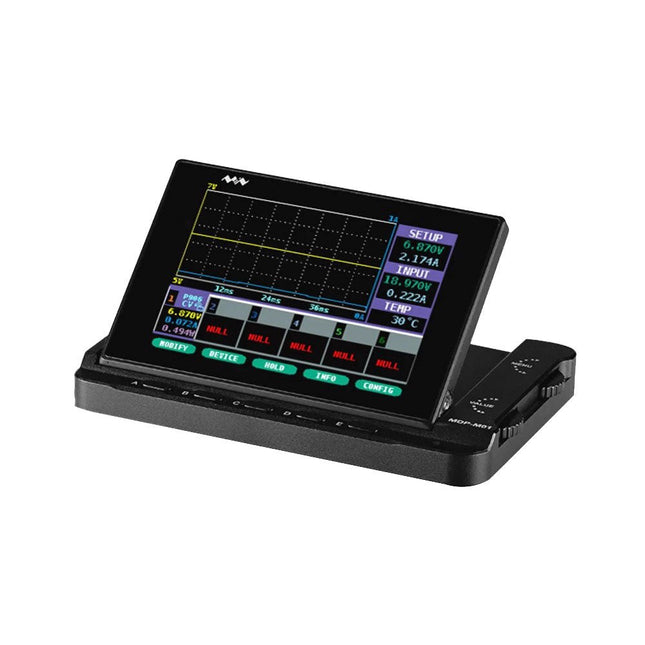
Le MDP-M01 est un module de contrôle d'affichage équipé d'un écran TFT de 2,8 pouces. L'écran peut être tourné à 90 degrés, ce qui permet aux utilisateurs de visualiser les données et les formes d'onde. Le MDP-M01 peut réaliser un affichage et un contrôle en ligne avec les mini-modules d'alimentation numérique MDP-P906 et d'autres modules du système MDP par le biais d'une communication sans fil de 2,4 GHz, et peut contrôler jusqu'à 6 sous-modules en même temps. Specifications Taille de l’écran 2,8' TFT Résolution de l’écran 240 x 320 Alimentation Entrée d'alimentation micro USB, ou prise d'alimentation du sous-module via un câble d'alimentation dédié Entrée DC 5 V/0,3 A Autres fonctions Peut contrôler jusqu'à 6 sous-modulesMise à jour du logiciel par micro USB Dimensions 107 x 66 x 13,6 mm Poids 133 g Inclus 1x MDP-M01 Moniteur numérique intelligent 1x Cable (2.5 mm jack to Micro USB) Téléchargements User Manual v3.4 Firmware v1.32
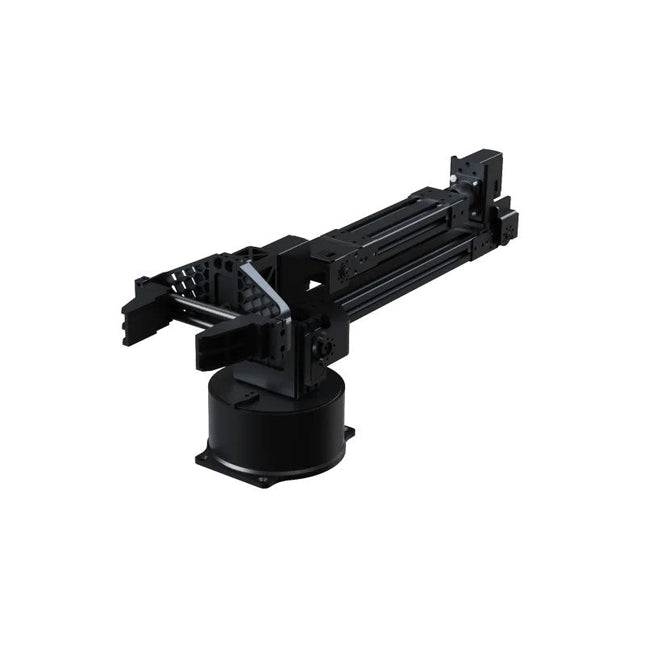
Ce robot multi-axes équilibre parfaitement puissance et taille.
Caractéristiques
5 axes
Charge utile : 3 kg
Portée : 700 mm
Répétabilité : 0,1 mm
Vitesse maximale 1000 mm/s
Applications
Entretien des machines
Cueillette des bacs
Plateforme mobile
Automatisation du laboratoire
Recherche robotique
Des robots collaboratifs durables pour votre automatisation
L'entraînement harmonique et les servomoteurs de qualité industrielle garantissent un fonctionnement 24h/24 et 7j/7 sans arrêt.
Fabriqué en fibre de carbone, son poids de 15 kg permet un déploiement plus facile.
Déploiement flexible avec fonctionnalité sécurisée
Enseignement manuel, léger, peu encombrant et facile à redéployer vers plusieurs applications sans modifier votre organisation de production. Parfaitement pour les tâches récurrentes.
La détection des collisions est disponible pour tous nos cobots. Votre sécurité est toujours la priorité absolue.
Interface graphique pour une programmation conviviale pour les débutants
Compatible avec divers systèmes d'exploitation, notamment macOS et Windows.
Technologie Web compatible avec tous les principaux navigateurs.
Glissez et déposez pour créer votre code en quelques minutes.
Un SDK puissant et open source à portée de main
Le SDK Python/C++ open source entièrement fonctionnel offre une programmation plus flexible.
Les packages ROS/ROS2 sont prêts à l'emploi.
Des exemples de codes vous aident à déployer le bras robotique en douceur.
Caractéristiques
UFactory 850
xArm 5
xArm 6
xArm 7
Charge utile
5 kg
3 kg
5 kg
3,5 kg
Atteindre
850mm
700mm
700mm
700mm
Degrés de liberté
6
5
6
7
Répétabilité
±0,02 mm
±0,1mm
±0,1mm
±0,1mm
Vitesse maximum
1 m/s
1 m/s
1 m/s
1 m/s
Poids (bras du robot uniquement)
20 kg
11,2 kg
12,2kg
13,7 kg
Vitesse maximum
180°/s
180°/s
180°/s
180°/s
Articulation 1
±360°
±360°
±360°
±360°
Articulation 2
-132°~132°
-118°~120°
-118°~120°
-118°~120°
Articulation 3
-242°~3,5°
-225°~11°
-225°~11°
±360°
Articulation 4
±360°
-97°~180°
±360°
-11°~225°
Articulation 5
-124°~124°
±360°
-97°~180°
±360°
Articulation 6
±360°
±360°
-97°~180°
Articulation 7
±360°
Matériel
Plage de température ambiante
0-50°C
Consommation d'énergie
Min 8,4 W, typique 200 W, max 400 W
Alimentation d'entrée
24 V CC, 16,5 A
Empreinte
Ø 126 mm
Matériaux
Aluminium, fibre de carbone
Type de connecteur de base
M5x5
Salle blanche de classe ISO
5
Montage de robots
N'importe lequel
Protocole de communication de l'effecteur final
Modbus RTU(rs485)
E/S de l'effecteur final
2x DI/2x DO/2x AI/1x RS485
Mode de communication
Ethernet
Inclus
1x bras robotique xArm 5
1x boîtier de commande AC
1x câble d'alimentation du bras robotique
1x câble adaptateur d'effecteur d'extrémité de bras robotique
1x câble de signal pour bras robotique
1x câble d'alimentation du boîtier de commande
1x câble réseau
1x outil de montage
1x Guide de démarrage rapide
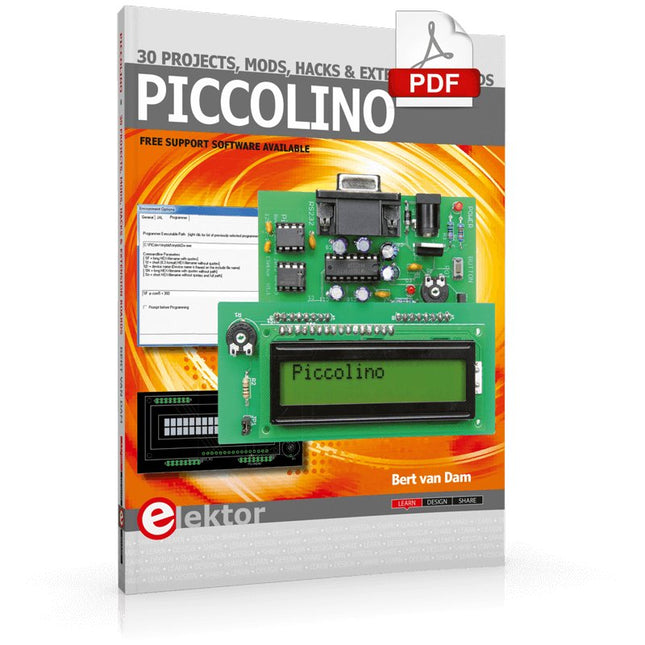
The Piccolino rapid development board can be used to design microcontroller circuits quickly. The Piccolino has a fast 16f887 PIC microcontroller, voltage regulator, and communications module, and can be easily extended using its four headers.
This e-book contains 30 projects based on the Piccolino. We'll use its unique communications facilities and get the Piccolino to communicate with programs on a PC. On the PC, we use the free programming language Small Basic. You can use this to create Windows programs with buttons and graphs quickly. You will learn how to analyze components such as inductors, capacitors, and OPAMPs, and how to display the measurement results in a graphical format. This will help you to design your circuits easily.
We will then start to adapt to the Piccolino. We'll add components to it to make it more powerful, with extra features such as flow control and digital to analog conversion. The clear instructions will enable you to design and build your adaptations. This way you can make your custom designed Piccolino.
We'll end up making an extension: a PCB that that can be mounted on the Piccolino headers. As an example, we'll design and build an extension for an LCD. You can use the included board layout to make your PCB or have it made for you. At the same time, you will learn how to make your extensions. The only limitation is your imagination!
The clear descriptions along with circuit diagrams and photos, will make the building of these projects an enjoyable experience. Each project has a clear explanation of the reasons why it was designed in a particular way. This helps you learn a lot about the Piccolino, as well as Small Basic, and the components that are used in this e-book. You can adapt the projects to suit your requirements or combine several projects.
Caractéristiques
Bandwidth: DC-800 KHz
Maximum measurable current: 100 Apk (70.7 Arms)
Max. conductor diameter: 13 mm
Auto & Manual "Zero" function
Directly powered by USB port
Standard BNC interface, compatible with any oscilloscope
Spécifications
Bandwidth
DC-800 KHz
Rise time
<= 583 ns
Ranges
10 A / 100 A
Output sensitivity
0.1 V/A (10 A) 0.01 V/A (100 A)
DC accuracy
3% ±50 mA (10 A) 4% ±50 mA (100 A, 500 mA - 40 Apk) 15% (100 A, 40 Apk -100 Apk)
Signal delay
< 150 ns (10 A) < 200ns (100 A)
Current measurement range
50 mA - 10 Apk (10 A) 1 A - 100 Apk (100 A)
Max. Voltage
CAT III 300 V CAT II 600 V
Power supply
DC 5 V
Téléchargements
Quick Guide
Datasheet
Manual
Spécifications
Canaux : 3
Puissance totale : 195 watts
Max. Tension : 30 Volts
Max. Courant : 3 ampères
Faible ondulation et bruit : <350 μVrms/2 mVpp
Excellent taux de régulation linéaire et taux de régulation de charge
Temps de réponse transitoire rapide : <50 μs
Certaines chaînes sont isolées
Fonctions de protection standard OVP/OCP/OTP
Sortie de synchronisation standard
Mesures V, A, W et affichage de forme d'onde intégrés
Contrôle indépendant pour chaque canal
Écran TFT de 3,5 pouces
Inclus
1x Rigol DP832 Alimentation CC
1x Cordon d'alimentation
1x Câble USB
Le bras robotisé servo Unitree Go2 D1 est un bras robotisé hautes performances à 6 degrés de liberté, spécialement conçu pour une intégration parfaite avec le robot quadrupède Unitree Go2. Conçu pour allier flexibilité et précision, c'est l'outil idéal pour l'éducation, la recherche, l'automatisation et le développement robotique avancé.
Doté de six articulations entièrement articulées et d'une pince intégrée, le D1 offre un véritable mouvement sur six axes et une liberté de mouvement exceptionnelle. Grâce à la prise en charge du contrôle de la position, de la vitesse et de la force, il permet un fonctionnement précis pour un large éventail de tâches, du déploiement en conditions réelles aux environnements d'apprentissage expérimentaux.
Fabriqué en alliage d'aluminium léger, le bras ne pèse que 2,37 kg pour une portée de 670 mm. Cet équilibre entre robustesse et agilité le rend parfaitement adapté aux applications mobiles, sans compromettre la stabilité ni la portée.
Grâce à son architecture d'interface à deux niveaux, le D1 prend en charge les commandes motrices de bas niveau et la programmation comportementale de haut niveau, offrant aux développeurs, enseignants et chercheurs un contrôle total, qu'il s'agisse d'affiner des séquences de mouvements ou de créer des workflows robotiques complexes.
Compatible avec des composants externes tels que des caméras ou des châssis de robots mobiles, l'Unitree D1 ouvre la voie à une variété de cas d'utilisation étendus. Qu'il s'agisse de manipulation autonome d'objets, de formation à l'IA ou d'enseignement pratique de la robotique, le D1 transforme n'importe quel environnement en une plateforme d'innovation dynamique et interactive.
Spécifications
DoF
6 axes + 1 pince
Charge utile
500 g
Portée du bras
550 mm (pince non incluse)670 mm (pince incluse)
Interfaces
DC5.5-2.1 (alimentation)RJ45 (communication)USB-C (débogage du port série)
Type de moteur
Servo bus
Puissance
60 W
Poids
2,37 kg
Amplitude de rotation articulaire
J1: ±135°J2: ±90°J3: ±90°J4: ±135°J5: ±90°J6: ±135°
Ce robot multi-axes équilibre parfaitement puissance et taille.
Caractéristiques
Charge utile : 5 kg
Portée : 700 mm
Répétabilité : 0,1 mm
Vitesse maximale 1000 mm/s
Applications
Entretien des machines
Cueillette des bacs
Plateforme mobile
Automatisation du laboratoire
Recherche robotique
Des robots collaboratifs durables pour votre automatisation
L'entraînement harmonique et les servomoteurs de qualité industrielle garantissent un fonctionnement 24h/24 et 7j/7 sans arrêt.
Fabriqué en fibre de carbone, son poids de 15 kg permet un déploiement plus facile.
Déploiement flexible avec fonctionnalité sécurisée
Enseignement manuel, léger, peu encombrant et facile à redéployer vers plusieurs applications sans modifier votre organisation de production. Parfaitement pour les tâches récurrentes.
La détection des collisions est disponible pour tous nos cobots. Votre sécurité est toujours la priorité absolue.
Interface graphique pour une programmation conviviale pour les débutants
Compatible avec divers systèmes d'exploitation, notamment macOS et Windows.
Technologie Web compatible avec tous les principaux navigateurs.
Glissez et déposez pour créer votre code en quelques minutes.
Un SDK puissant et open source à portée de main
Le SDK Python/C++ open source entièrement fonctionnel offre une programmation plus flexible.
Les packages ROS/ROS2 sont prêts à l'emploi.
Des exemples de codes vous aident à déployer le bras robotique en douceur.
Caractéristiques
UFactory 850
xArm 5
xArm 6
xArm 7
Charge utile
5kg
3kg
5kg
3,5 kg
Atteindre
850 mm
700mm
700mm
700mm
Degrés de liberté
6
5
6
7
Répétabilité
±0,02 mm
±0,1mm
±0,1mm
±0,1mm
Vitesse maximum
1 m/s
1 m/s
1 m/s
1 m/s
Poids (bras du robot uniquement)
20 kg
11,2 kg
12,2kg
13,7kg
Vitesse maximum
180°/s
180°/s
180°/s
180°/s
Articulation 1
±360°
±360°
±360°
±360°
Articulation 2
-132°~132°
-118°~120°
-118°~120°
-118°~120°
Articulation 3
-242°~3,5°
-225°~11°
-225°~11°
±360°
Articulation 4
±360°
-97°~180°
±360°
-11°~225°
Articulation 5
-124°~124°
±360°
-97°~180°
±360°
Articulation 6
±360°
±360°
-97°~180°
Articulation 7
±360°
Matériel
xPauvre
Spécifications du robot
Plage de température ambiante
0-50°C
Consommation d'énergie
Min 8,4 W, typique 200 W, max 400 W
Alimentation d'entrée
24 V CC, 16,5 A
Empreinte
Ø 126 mm
Matériaux
Aluminium, fibre de carbone
Type de connecteur de base
M5x5
Salle blanche de classe ISO
5
Montage de robots
N'importe lequel
Protocole de communication de l'effecteur final
Modbus RTU(rs485)
E/S de l'effecteur final
2x DI/2x DO/2x AI/1x RS485
Mode de communication
Ethernet
Inclus
1x bras robotique xArm 5
1x boîtier de commande AC
1x câble d'alimentation du bras robotique
1x câble adaptateur d'effecteur d'extrémité de bras robotique
1x câble de signal pour bras robotique
1x câble d'alimentation du boîtier de commande
1x câble réseau
1x outil de montage
1x Guide de démarrage rapide
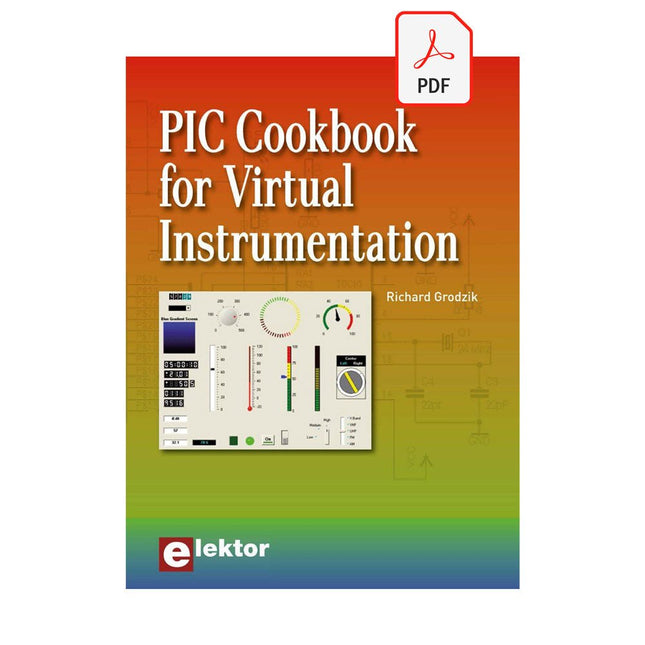
The software simulation of gauges, control-knobs, meters and indicators which behave just like real hardware components on a PC’s screen is known as virtual instrumentation.
In this book, the Delphi program is used to create these mimics and PIC based external sensors are connected via a USB/RS232 converter communication link to a PC.
Detailed case studies in this Book include a virtual compass displayed on the PC’s screen, a virtual digital storage oscilloscope, virtual -50 to +125 degree C thermometer, and FFT sound analyser, a joystick mouse and many examples detailing virtual instrumentation Delphi components. Arizona’s embedded microcontrollers – the PIC's are used in the projects and include PIC16F84A, PIC16C71, DSPIC30F6012A, PIC16F877, PIC12F629 and the PIC16F887. Much use is made of Microchip’s 44 pin development board (a virtual instrument ‘engine)’, equipped with a PIC16F887 with an onboard potentiometer in conjunction with the PIC’s ADC to simulate the generation of a variable voltage from a sensor/transducer, a UART to enable PC RS232 communications and a bank of 8 LED's to monitor received data is also equipped with an ISP connector to which the ‘PICKIT 2’ programmer may easily be connected.
Full source code examples are provided both for several different PIC’s, both in assembler and C, together with the Pascal code for the Delphi programs which use different 3rd party Delphi virtual components.
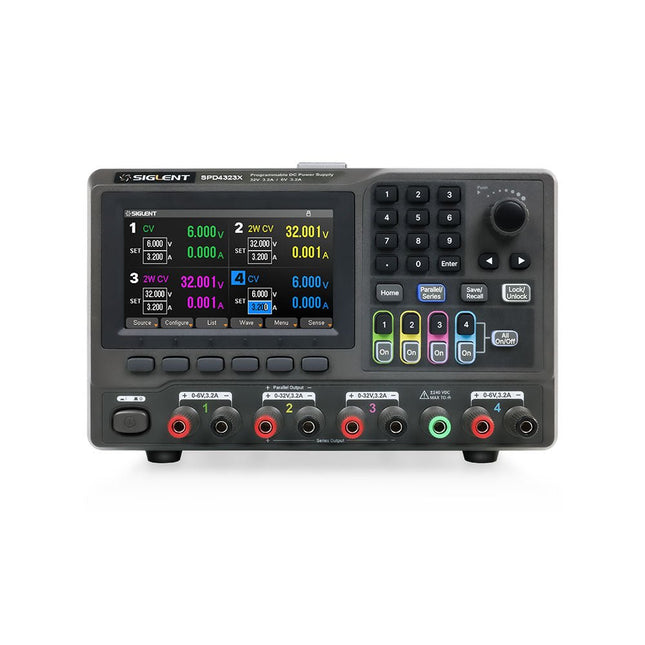
The Siglent SPD4323X is a 4-channel DC Linear Programmable Power Supply equipped with a 4.3-inch TFT-LCD display, friendly human-machine interface, and excellent performance indicators. Real-time waveform display provides engineers with an informative user interface.
SPD4323X offers a total output power of 240 W with a resolution of 1 mV/1 mA. The maximum voltage and current for each channel are as follows:
CH1: 6 V/3.2 A
CH2: 32 V/3.2 A
CH3: 32 V/3.2 A
CH4: 6 V/3.2 A
Caractéristiques
Rated output power: 240 W
Rated voltage: 32 V, 12 V, 30 V
Up to four high-precision power supplies with independent controllable outputs, supporting CH2 and CH3 series and parallel connections
Clear graphical interface with waveform and timer display modes
5-digit voltage and current display with minimum resolution of 1 mV, 1 mA
Fast output response time: <50us
The high current channel support remote voltage compensation sense function. The maximum compensation voltage is 0.6 V
Overvoltage protection and overcurrent protection or safe and accurate operation
Equipped with a 4.3-inch TFT-LCD display (480 x 272 resolution)
USB and LAN standard communication
USB-GPIB module is optional
Excellent channel density with up to 4 channels in a 3U half rack package
Internal data storage for setups and parameters
Embedded Web Server with instrument communication that doesn’t require software installation
Fully SCPI programming command set support as well as a LabView driver for remote control and system automation
Spécifications
SPD4323X
SPD4121X
SPD4306X
Channel Output
CH1: Voltage 0 to 6 V Current 0 to 3.2 ACH2: Voltage 0 to 32 V Current 0 to 3.2 ACH3: Voltage 0 to 32 V Current 0 to 3.2 ACH4: Voltage 0 to 6 V Current 0 to 3.2 A
CH1: Voltage 0 to 15 V Current 0 to 1.5 ACH2: Voltage 0 to 12 V Current 0 to 10 ACH3: Voltage 0 to 12 V Current 0 to 10 ACH4: Voltage 0 to 15 V Current 0 to 1.5 A
CH1: Voltage 0 to 15 V Current 0 to 1.5 ACH2: Voltage 0 to 30 V Current 0 to 6 ACH3: Voltage 0 to 30 V Current 0 to 6 ACH4: Voltage 0 to 15 V Current 0 to 1 A
Resolution
1 mV, 1 mA
1 mV, 1 mA
1 mV, 1 mA
Setting Accuracy
Voltage: ±(0.03% of reading+10) mV, Current: ±(0.3% of reading+10) mA
Voltage: ±(0.03% of reading+10) mV, Current: ±(0.3% of reading+10) mA
Voltage: ±(0.03% of reading+10) mV, Current: ±(0.3% of reading+10) mA
Readback Accuracy
Voltage: ±(0.03% of reading+10) mV, Current: ±(0.3% of reading+10) mA
Voltage: ±(0.03% of reading+10) mV, Current: ±(0.3% of reading+10) mA
Voltage: ±(0.03% of reading+10) mV, Current: ±(0.3% of reading+10) mA
Display
4.3" TFT-LCD 5-digit voltage and current display
4.3" TFT-LCD 5-digit voltage and current display
4.3" TFT-LCD 5-digit voltage and current display
Output power
240 W
285 W
400 W
Inclus
1x Siglent SPD4323X Power Supply
1x Power cord (EU)
1x Output test cord (3 A)
1x USB cable
1x Quick start guide
Téléchargements
Datasheet
Manual
Quick start
Avec une capacité de 15000 mAh, la batterie Unitree Go2 fournit une source d'alimentation robuste qui permet à votre robot d'effectuer des tâches en toute simplicité. Que ce soit pour des explorations complexes, des projets de recherche ou des excursions amusantes, cette puissante batterie fournit l'énergie dont votre robot a besoin.
L'autonomie de la batterie Unitree Go2 varie en fonction de l'application et de l'utilisation. En fonction des fonctions et des activités utilisées, la batterie peut offrir entre 2 et 4e heures de fonctionnement. Cette flexibilité vous permet de personnaliser le robot selon vos besoins, permettant ainsi des missions d'exploration plus longues ou des projets plus étendus.
La batterie Unitree Go2 est un compagnon fiable pour vos aventures robotiques. Avec sa capacité impressionnante et son autonomie adaptable, il garantit à votre robot des performances puissantes et endurantes, sans recharge fréquente.
Que vous ayez besoin de la batterie Unitree Go2 en remplacement ou en mise à niveau de votre robot, cette puissante solution de stockage d'énergie offre l'équilibre parfait entre performances et fiabilité.
Spécifications
Tension nominale : 28,8 V CC
Tension de charge limitée : 33,6 V CC
Courant de charge : 9 A
Capacité nominale : 15000 mAh, 432 Wh
Norme : IS 16046 (partie 2) / CEI 62133-2
Système de gestion de batterie (BMS) auto-développé
Dimensions : 120 x 80 x 182 mm
Caractéristiques :
Indicateur d'alimentation
Protection contre l'autodécharge du stockage de la batterie
Protection de charge d'équilibre
Protection contre les surcharges
Protection contre les décharges
Protection contre les courts-circuits
Protection contre la détection de charge de la batterie
Inhalt
Theorie & Anwendung
Es werde Licht – Physikalische Grundlagen zu Licht und Beleuchtung
Illuminati – Beleuchtungstechnik: Grundlagen und Anwendungen
Steuerzentrale – LED-Leistungseinheit und -Steuerung auf einem Chip
LED-Beamer-Technologie – Funktionsweise und Anwendungen
Hitzeschild – Kaltleiter als Strombegrenzer für LEDs
Strahler 09 – Ansteuerelektronik und Wärmemanagement für Leuchtmittel auf LED-Basis
LEDs für eine neue Ära in der Lichttechnik – Die Leuchtdiode und ihre Möglichkeiten aus Sicht eines Herstellers
Ökobilanz von LED-Lampen – Ergebnisse einer Gesamtlebenszyklusanalyse für LED-Lampen
Lichtpumpe – Spannungswandler mit Konstantstromausgang für 0,5-W- und 1-W-Power-LEDs
LED the sun shine – LED-Licht fürs Automobil
Licht im Tunnel – Die XLamp LED-Serie von Cree
Selbstbauprojekte
Ambilight mit Bluetooth – Ein modulares RGB-Power-LED-System mit PC-Schnittstelle
Universelle LED-Lampe – Mit programmierbarem Farbwechsel
LED-Tester – Lichtstärke prüfen und vergleichen
Künstlerischer LED-Dimmer – Farbmischung stufenlos einstellen
Computerisierter LED-Weihnachtsbaum
LED-Würfel – Mogeln unmöglich!
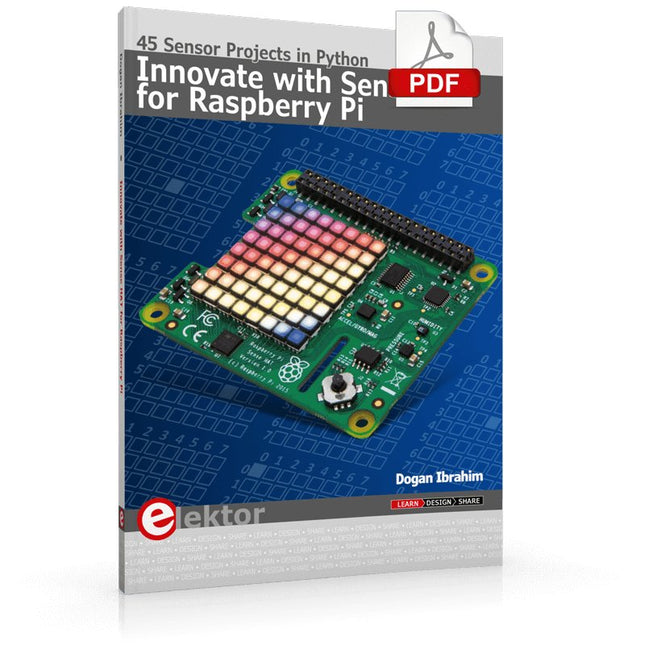
Ready to explore the world around you? By attaching the Sense HAT to your Raspberry Pi, you can quickly and easily develop a variety of creative applications, useful experiments, and exciting games.
The Sense HAT contains several helpful environmental sensors: temperature, humidity, pressure, accelerometer, magnetometer, and gyroscope. Additionally, an 8x8 LED matrix is provided with RGB LEDs, which can be used to display multi-color scrolling or fixed information, such as the sensor data. Use the small onboard joystick for games or applications that require user input. In Innovate with Sense HAT for Raspberry Pi, Dr. Dogan Ibrahim explains how to use the Sense HAT in Raspberry Pi Zero W-based projects. Using simple terms, he details how to incorporate the Sense HAT board in interesting visual and sensor-based projects. You can complete all the projects with other Raspberry Pi models without any modifications.
Exploring with Sense HAT for Raspberry Pi includes projects featuring external hardware components in addition to the Sense HAT board. You will learn to connect the Sense HAT board to the Raspberry Pi using jumper wires so that some of the GPIO ports are free to be interfaced to external components, such as to buzzers, relays, LEDs, LCDs, motors, and other sensors.
The book includes full program listings and detailed project descriptions. Complete circuit diagrams of the projects using external components are given where necessary. All the projects were developed using the latest version of the Python 3 programming language. You can easily download projects from the book’s web page. Let’s start exploring with Sense HAT.