
Résultats de la recherche pour "raspberry or pi or experimenting or bundle"
-

Elektor Publishing Experimenting with Red Pitaya STEMlab Gen 2
Practical Projects and Programs With Experimenting with Red Pitaya STEMlab Gen 2, Red Pitaya goes beyond a versatile board. It becomes a powerful laboratory instrument for precision measurement, analysis, and control. From the fundamentals of electronic project development, monitoring, control, and design to testing, this book walks you step-by-step through everything you need to know to harness the full potential of Red Pitaya hardware and software. The book presents real-time, FPGA-based projects that are developed on a PC using the Vivado environment, then transferred to the Red Pitaya for execution and testing. You will learn about enhanced performance, expanded I/O capabilities, improved FPGA features, and advanced connectivity options that open up new frontiers for precision measurement, monitoring, and control in your embedded applications. Inside the book you will discover: A deep dive into Red Pitaya architecture and hardware design Electronic experiments using Red Pitaya for measurement and monitoring Hands-on projects using the Python programming language Practical guidance for FPGA programming using Red Pitaya Red Pitaya FPGA projects using the Verilog HDL under Vivado IDE Practical design of electronic projects including measurement and testing Step-by-step examples that bridge theory and real-world implementation Whether you are designing your own electronic circuits, developing signal analysis tools, or creating real-time control or monitoring systems, this book provides you the knowledge and confidence you need to fully learn and customize the Red Pitaya platform.
€ 39,95€ 32,95Meilleur prix
-

Elektor Publishing Arduino & Co – Measure, Control, and Hack
Clever Tricks with ATmega328 Pro Mini Boards With a simple Pro Mini board and a few other components, projects that 20 or 30 years ago were unthinkable (or would have cost a small fortune) are realized easily and affordably in this book: From simple LED effects to a full battery charging and testing station that will put a rechargeable through its paces, there’s something for everyone. All the projects are based on the ATmega328 microcontroller, which offers endless measuring, switching, and control options with its 20 input and output lines. For example, with a 7-segment display and a few resistors, you can build a voltmeter or an NTC-based thermometer. The Arduino platform offers the perfect development environment for programming this range of boards. Besides these very practical projects, the book also provides the necessary knowledge for you to create projects based on your own ideas. How to measure, and what? Which transistor is suitable for switching a certain load? When is it better to use an IC? How do you switch mains voltage? Even LilyPad-based battery-operated projects are discussed in detail, as well as many different motors, from simple DC motors to stepper motors. Sensors are another exciting topic: For example, a simple infrared receiver that can give disused remote controls a new lease on life controlling your home, and a tiny component that can actually measure the difference in air pressure between floor and table height!
€ 39,95
Membres : € 35,96
-

Elektor Digital Experimenten met de Elektor Sensor Kit voor Arduino en ATtiny85 (E-book)
De mens is van nature uitgerust met sensoren voor geluid, licht, geur, smaak en gevoel. Zintuigen die met elektronica slechts ten dele gekopieerd kunnen worden. Met de Elektor sensorkit kunnen we wel aardig in de buurt komen. Sensoren kunnen elektronica aansturen, maar ze kunnen ons ook van informatie voorzien. Daarom vormt niet alleen het meten van grootheden, maar ook het zichtbaar maken ervan via de Arduino seriële monitor een niet onbelangrijk deel van dit boek. De microprocessor ATtiny85 die de Arduino-taal begrijpt, maakt het experimenteren met sensoren gemakkelijk en goedkoop. We zullen niet snel een Arduino-kaartje vast solderen in een permanente opstelling. Bij een achtpotige ATtiny zal dat geen schuldgevoel opleveren. Dat neemt niet weg dat alle sketches gewoon op elk Arduino-board draaien met mogelijk hier en daar een aanpassing van pennummers omdat die kunnen verschillen met reguliere Arduino-boards. We zullen uitgebreid aandacht besteden aan het programmeren van de ATtiny. Veel schakelingen zijn bruikbaar in het natuurkundepracticum op school of voor bedrijfsmatige toepassingen. Maar de nadruk ligt toch wel op de (beginnende) elektronicahobbyist die zijn vrije tijd op een leuke maar vooral ook nuttige manier wil besteden. Want meer dan ooit tevoren heeft techniek de toekomst.
€ 19,95
Membres : € 17,96
-

UFactory UFactory uArm Swift Pro
Le uArm Swift Pro est un bras robotique de haute qualité qui peut être utilisé dans un large éventail d'applications. Le uArm Swift Pro a été développé et optimisé pour une utilisation dans l'enseignement, ce qui signifie que de nombreux packages sont déjà disponibles pour les plateformes open source telles que ROS. Le uArm Swift Pro a une répétabilité de position de 0,2 mm et est également équipé d'un moteur pas à pas et d'un encodeur 12 bits. Ce ne sont là que quelques-unes des raisons qui font du uArm Swift Pro un excellent choix pour une utilisation pédagogique. Le kit d'impression 3D, qui permet de convertir le uArm Swift Pro en imprimante 3D en moins d'une minute, est une autre caractéristique intéressante. L'uArm peut être utilisé avec les plateformes/systèmes de développement suivants : SDK UFACTORY Arduino Python ROS GRABCAD OpenMV Application pour smartphone L'application pour smartphone iOS est déjà disponible dans l’App Store et permet de contrôler et de surveiller facilement le bras robotique. L'application pour Android est en cours de développement et sera bientôt disponible. Un exemple de vision industrielle Le GIF suivant montre l'uArm en combinaison avec l'OpenMV Machine Vision Cam M7 et les applications de reconnaissance faciale qui peuvent être mises en œuvre en MicroPython. Spécifications Degrés de liberté : 4 Répétabilité : Jusqu'à 0,2 mm Charge utile : 500 g Plage de travail : 50-320 mm Vitesse de positionnement : 100 m/s Retour de position : codeur 12 bits Dimensions : 150 x 140 x 281 mm 150 x 140 x 281 mm Poids : 2,2 kg Inclus UFactory uArm Swift Pro Body Bluetooth & Pince à vide Téléchargements Fiche technique
€ 939,00
Meilleur prix
-
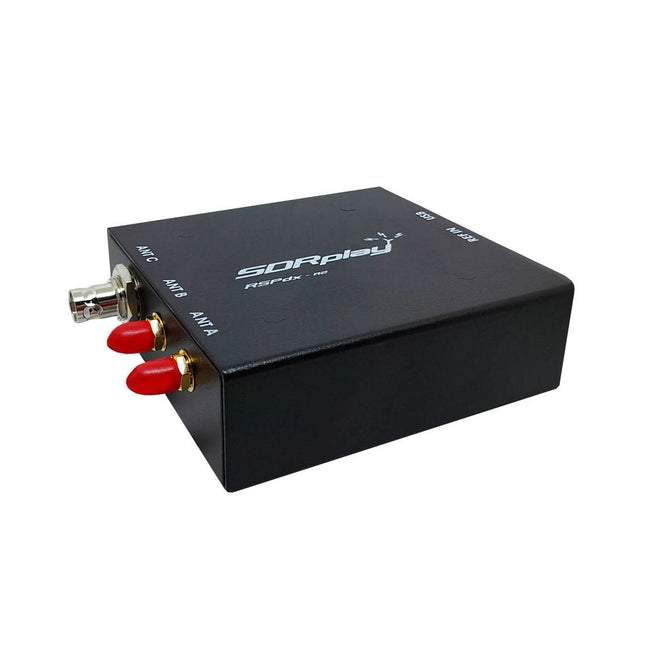
SDRplay SDRplay RSPdx-R2 Récepteur SDR 14 bits à syntoniseur simple (1 kHz à 2 GHz)
Le SDRplay RSPdx-R2 est un récepteur SDR 14 bits à large bande et à syntoniseur simple qui couvre l'ensemble du spectre RF de 1 kHz à 2 GHz, avec une visibilité du spectre allant jusqu'à 10 MHz. Il contient trois ports d'antenne, dont deux utilisent des connecteurs SMA et fonctionnent sur l'ensemble de la gamme de 1 kHz à 2 GHz et le troisième utilise un connecteur BNC qui fonctionne jusqu'à 200 MHz. Le RSPdx-R2 est une version améliorée du RSPdx, dotée de nouvelles améliorations de conception pour une utilisation à des fréquences inférieures à 2 MHz. Logé dans un boîtier en acier robuste, le RSPdx-R2 offre, en plus des fonctionnalités du RSP1B, trois entrées d'antenne sélectionnables par logiciel et une entrée d'horloge externe. Il offre d'excellentes performances sur les fréquences HF et VHF jusqu'à 2 GHz. Le RSPdx-R2 prend également en charge un mode HDR optimisé pour les conditions de réception radio exigeantes en dessous de 2 MHz. Utilisé avec le logiciel SDRplay, le RSPdx-R2 propose un mode HDR (High Dynamic Range) spécial pour la réception dans certaines bandes inférieures à 2 MHz. Ce mode HDR offre de meilleures performances d'intermodulation et réduit les réponses parasites sur ces bandes difficiles. Caractéristiques Couvre toutes les fréquences de 1 kHz à 2 GHz, en passant par les bandes VLF, LF, MW, HF, VHF, UHF et L, sans aucune lacune Réception, contrôle et enregistrement jusqu'à 10 MHz de spectre à la fois Performances nettement améliorées en dessous de 2 MHz – plage dynamique et sélectivité accrues Choix de 3 ports d'antenne sélectionnables par logiciel Capacité accrue à gérer des signaux extrêmement forts Entrée d'horloge externe à des fins de synchronisation, ou connexion à l'horloge de référence GPS pour une plus grande précision de la fréquence Excellente gamme dynamique pour les conditions de réception difficiles Utilisation gratuite du logiciel SDRuno basé sur Windows, qui offre un ensemble de fonctions de plus en plus complet. Réseau d'assistance logicielle solide et en pleine expansion Mesure étalonnée du S-mètre/de la puissance RF et du SNR avec SDRuno (y compris l'enregistrement des données dans un fichier .CSV) API documentée permettant le développement de démodulateurs ou d'applications sur de multiples plates-formes. Applications (amateur) Écoute des ondes courtes Radio diffusion DX (AM/FM/TV) Panadaptor Avions (ADS-B et ATC) TV à balayage lent Surveillance des bandes multi amateurs WSPR et modes numériques Fax météo (HF et satellite) Surveillance des satellites Satellites environnementaux géostationnaires Radio à ressources partagées Surveillance des services publics et des services d'urgence Comparaison rapide et efficace des antennes Applications (Industrie) Analyseur de spectre Surveillance Surveillance des microphones sans fil Surveillance RF Chaîne de réception IoT Enregistrement des signaux Détection RFI/EMC Surveillance de l'intégrité de la diffusion Surveillance du spectre Mesure de la puissance Applications (éducatives/scientifiques) Enseignement Conception de récepteurs Radioastronomie Radar passif Ionosonde Analyseur de spectre Récepteur pour les projets de capteurs IoT Recherche sur les antennes Specifications Gamme de fréquences 1 kHz – 2 GHz Connecteur d'antenne SMA Impédance de l'antenne 50 Ω Consommation de courant (typique) 190 mA @ >60 MHz (excl. Bias-T)120 mA @ <60 MHz (excl. Bias-T) Connecteur USB USB-B Puissance d'entrée maximale +0 dBm en continu+10 dBm Courte durée Taux d'échantillonnage de l'ADC 2-10,66 MSPS Nombre de bits du CAN 14 bits 2 - 6.048 MSPS12 bits 6,048 - 8,064 MSPS10 bits 8.064 - 9.216 MSPS8 bits >9,216 MSPS Bias-T 4.7 V100 mA garanti Référence 0,5ppm TCXO 24 MHz.Erreur de fréquence réglable à 0,01 ppm. Plage de température de fonctionnement −10°C à +60°C Dimensions 113 x 94 x 35 mm Poids 315 g Téléchargements Datasheet Software RSPdx-R2 vs RSPduo RSPdx-R2 RSPduo Couverture continue de 1 kHz à 2 GHz ✓ ✓ Largeur de bande visible jusqu'à 10 MHz ✓ ✓ Technologie silicium ADC 14 bits et multiples filtres d'entrée haute performance ✓ ✓ Filtres coupe-bande AM/FM et DAB sélectionnables par logiciel ✓ ✓ Bias-T de 4,7 V pour l'alimentation de l'amplificateur d'antenne distant externe ✓ ✓ Alimentation par le câble USB avec une simple prise de type B ✓ ✓ Entrée(s) d'antenne SMA 50Ω pour un fonctionnement de 1 kHz à 2 GHz (sélectionnable par logiciel) 2 2 Entrée Hi-Z supplémentaire sélectionnable par logiciel pour un fonctionnement jusqu'à 30 Mhz ✓ Entrée BNC 50Ω supplémentaire sélectionnable par logiciel pour un fonctionnement jusqu'à 200 MHz ✓ Filtre LF/VLF supplémentaire pour les fréquences inférieures à 500 kHz ✓ Entrée horloge de référence 24 MHz (+ sortie sur RSPduo) ✓ ✓ Deux syntoniseurs permettant la réception sur 2 plages de 2 MHz totalement indépendantes ✓ Deux syntoniseurs permettant la réception en diversité à l'aide de SDRuno ✓ Boîtier robuste en acier peint en noir ✓ ✓ Performances globales en dessous de 2 MHz pour les ondes hectométriques et kilométriques ++ + Applications multiples simultanées + ++ Performance dans des conditions d'évanouissement difficiles (*en utilisant la syntonisation en diversité) + *++
€ 260,83
-

Elektor Digital Elektor January/February 2021 (PDF) EN
DIY LiPo Supercharger BundleGreatScott and Elektor's LiPo Charger, Booster, and Protector MTheCamA Simple Mini Thermal Camera Weller WE 1010Soldering Station electronica Fast Forward 2020 Winners I2S Test Signal Generator with AVR Microcontroller32-Bit 1-kHz Digital Sine, fs 192 kHz, Level Adjustable from 0 to -110 dB Control Your Home with Raspberry PiRPi snoops on 433.92 MHz Simulate Circuits Online From Life's ExperienceThe Fine Line Between Order and Chaos Starting Out in ElectronicsEasier Than imagined! Homebrew CPUsThe Discrete Microcontroller Connect Your Thermostat with ESPHomeAn Attempt at Doing Home Automation the Right Way Developer’s ZoneTips & Tricks, Best Practices and Other Useful Information Small Circuits RevivalFrom the Elektor suggestions box Raspberry Pi Full StackRPi and RF24 at the heart of a sensor network Practical ESP32 Multitasking (6)Event Groups Multi-Channel Power Analyzer: Up to 3 Channels, with Graphic and Alphanumeric Display Analogue Filter Design (Part 3)Passive Filters JOY-iT VAX-1030Wireless Measurement Module New LCR Meter 50 Hz - 2 MHz Part 2Operation, Calibration, and Firmware Programming Error AnalysisTips on Voltage Regular Circuits, PCB Design, and More The Open Hardware ObservatoryCommunity-Based Open Source Hardware Assessment Java on the Raspberry PiAn Interview with Frank Delporte Data Analysis and Artificial Intelligence in PythonInterpreting Real Data with NumPy, pandas and scikit-learn Project 2.0Corrections, Updates and Readers’ letters Getting to Know the Parallax Propeller 2 (Part 1)An Introduction Hexadoku
€ 7,50
-

Elektor Digital Elektor AI Guest Edition 2024 (PDF) EN
Elektor GREEN and GOLD members can download their digital edition here. Not a member yet? Click here. The AlertAlfred AI Security SystemPowered by a Raspberry Pi 5 and the Hailo 8L Module AI in Electronics DevelopmentAn Update After Only One Year Intro to AI AlgorithmsPrompt: Which Algorithms Implement Each AI Tool? Single-Board Computers for Artificial Intelligence ProjectsBackground and Overview From Sensor Data to Machine Learning ModelsGesture Detection with an Accelerometer and Edge Impulse Build a Leaky Integrate-and-Fire Spiking NeuronArtificial Intelligence Without Software ChatGPT for Electronic DesignDoes GPT-4o Do It Any Better? Bringing AI to the Edge with ESP32-P4 Exploring Speech Functions on Raspberry Pi ZeroWhen Overclocking Gives Freedom of Speech The Growing Role of Edge AIA Trend Shaping the Future Unlocking the Power of Edge AIA Conversation with François de Rochebouët of STMicroelectronics A VHDL Clock Made with ChatGPT AI’s Real ImpactSayash Kapoor on “AI Snake Oil” and More The Latest Stuff From BeagleBoardBeagleY-AI, BeagleV-Fire, BeagleMod, BeaglePlay and BeagleConnect Freedom Mosquito Detection Using Open Datasets and Arduino Nicla Vision AI Today and Tomorrow: Insights from Espressif, Arduino, and SparkFun Artificial Intelligence Timeline BeagleY-AIThe Latest SBC for AI Applications AI in FocusPerspectives from the Elektor Community Machine Vision with OpenMVCreate a Soda Can Detector A Conversation with the Digital MindChatGPT vs Gemini Skilling Me Softly with This Bot?Is the AI Revolution in the Electronic Field Failing Due to a Lack of Social Precision?
€ 7,50
-

Elektor Digital The ESP32 Cheap Yellow Display Book (PDF)
Projects Using Arduino IDE and the LVGL Graphics Library The ESP32 is probably one of the most popular microcontrollers used by many people, including students, hobbyists, and professional engineers. Its low cost, coupled with rich features makes it a popular device to use in many projects. Recently, a board called the ESP32 Cheap Yellow Display (CYD for short) is available from its manufacturers. The board includes a standard ESP32 microcontroller together with a 320x240 pixel TFT display. Additionally, the board provides several connectors for interfaces such as GPIO, serial port (TX/RX), power and Ground. The inclusion of a TFT display is a real advantage as it enables users to design complex graphics-based projects without resorting to an external LCD or graphics displays. The book describes the basic hardware of the ESP32 CYD board and provides details of its on-board connectors. Many basic, simple, and intermediate-level projects are given in the book based on the ESP32 CYD, using the highly popular Arduino IDE 2.0 integrated development environment. The use of both the basic graphics functions and the use of the popular LVGL graphics library are discussed in the book and projects are given that use both types of approaches. All the projects given in the book have been tested and are working. The block diagram, circuit diagram, and the complete program listings and program descriptions of all the projects are given with explanations. Readers can use the LVGL graphics library to design highly popular eye-catching full-color graphics projects using widgets such as buttons, labels, calendars, keypads, keyboards, message boxes, spinboxes, sliders, charts, tables, menus, bars, switches, drop-down lists, animations, and many more widgets.
€ 29,95
Membres : € 26,96
-

Elektor Publishing ESP32 by Example
A Project-Based Introduction to Microcontrollers and Drone Control A Practical Introduction to Embedded Systems with the ESP32 This book is intended for readers who are new to embedded systems and looking for a structured, example-driven way to begin. If you’ve explored general-purpose electronics or Arduino-based resources but found them too broad or lacking in practical application, this guide offers a more focused alternative. With a small, affordable set of components – such as LEDs, sensors, an OLED screen and a motion sensor – you’ll build and work with the same hardware setup throughout the book. This allows you to focus on learning and experimenting without constant reconfiguration. Topics include: Understanding and programming the ESP32 microcontroller Using the Arduino IDE to write and deploy code Exploring cyber-physical systems, culminating in basic drone control No prior experience with Arduino or embedded development is required. Each section includes hands-on examples and mini-projects designed to reinforce core concepts and encourage deeper exploration. By the end, you’ll be equipped not only to reproduce the book’s examples, but also to extend them toward your own ideas and applications. Whether your interest is in learning embedded programming, building interactive systems, or exploring educational drone control, this book provides a clear and practical path to getting started.
€ 44,95
Membres : € 40,46
-

SDRplay SDRplay RSP1B Récepteur SDR 14 bits (1 kHz à 2 GHz)
Le SDRplay RSP1B est une version améliorée du populaire RSP1A : un SDR 14 bits puissant, large bande et complet, couvrant le spectre RF de 1 kHz à 2 GHz. Le RSP1B est livré dans un boîtier robuste en acier peint en noir et offre des performances de bruit nettement améliorées. Il suffit d'un ordinateur et d'une antenne pour offrir d'excellentes fonctionnalités de réception. Il inclut SDRuno pour Windows et le logiciel multiplateforme SDRconnect pour Windows, macOS et Linux (fourni gratuitement par SDRplay). Vous pouvez surveiller jusqu'à 10 MHz de spectre simultanément. Une API documentée permet aux développeurs de créer de nouveaux démodulateurs ou applications pour la plateforme. Caractéristiques Couvre toutes les fréquences de 1 kHz à 2 GHz, en passant par VLF, LF, MW, HF, VHF, UHF et la bande L, sans aucune lacune Réception, contrôle et enregistrement d'un spectre allant jusqu'à 10 MHz à la fois Utilisation gratuite du logiciel SDRuno basé sur Windows, qui offre un ensemble de fonctions de plus en plus complet. Réseau d'assistance logicielle solide et en pleine expansion S-mètre étalonné / mesure de la puissance RF et du SNR avec SDRuno (y compris l'enregistrement de données dans un fichier .CSV) API documentée fournie pour permettre le développement de démodulateurs ou d'applications sur de multiples plates-formes Excellente plage dynamique pour les conditions de réception difficiles Fonctionne avec les logiciels SDR tiers les plus répandus (y compris HDSDR, SDR Console et Cubic SDR) Plugin ExtIO disponible Mise à jour du logiciel pour les normes futures Réseau d'assistance logicielle solide et en pleine expansion API fournie pour permettre le développement de démodulateurs ou d'applications Prise en charge de pilotes et d'API multiplateformes, y compris Windows, Linux, Mac, Android et Raspberry Pi Jusqu'à 16 récepteurs individuels dans une tranche de spectre de 10 MHz à l'aide de SDRuno S-mètre calibré et mesures de puissance avec SDRuno Logiciel d'analyse de spectre autonome basé sur Windows disponible (avec fonctions de balayage, d'échantillonnage et de maintien) Idéal pour la surveillance des bandes ISM/IoT/Télémétrie <2 GHz Idéal pour un fonctionnement portable Spécifications Gamme de fréquences 1 kHz – 2 GHz Connecteur d’antenne SMA Impédance de l’antenne 50 Ω Consommation de courant (typique) 185 mA (excl. Bias-T) Connecteur USB USB Type B Puissance d’entrée maximale +0 dBm en continu+10 dBm courte durée Taux d'échantillonnage de l'ADC 2 - 10.66 MSPS Nombre de bits du CAN 14 bit 2 - 6.048 MSPS12 bit 6.048 - 8.064 MSPS10 bit 8.064 - 9.216 MSPS8 bit >9.216 MSPS Bias-T 4.7 V100 mA garanti Référence 0.5 ppm 24 MHz TCXO.Erreur de fréquence réglable à 0.01 ppm. Plage de température de fonctionnement -10°C à +60°C Dimensions 98 x 88 x 34 mm Poids 110 g Téléchargements Datasheet Software RSP1B vs RSPdx vs RSPduo RSP1B RSPdx RSPduo Couverture continue de 1 kHz à 2 GHz ✓ ✓ ✓ Largeur de bande visible jusqu'à 10 Mhz ✓ ✓ ✓ Technologie silicium CAN 14 bits et multiples filtres d'entrée haute performance ✓ ✓ ✓ Filtres coupe-bande AM/FM et DAB sélectionnables par logiciel ✓ ✓ ✓ Bias-T de 4,7 V pour l'alimentation de l'amplificateur d'antenne distant externe ✓ ✓ ✓ Alimentation par le câble USB avec une simple prise de type B ✓ ✓ ✓ Entrée(s) d'antenne SMA 50Ω pour un fonctionnement de 1 kHz à 2 GHz (sélectionnable par logiciel) 1 2 2 Entrée Hi-Z supplémentaire sélectionnable par logiciel pour un fonctionnement jusqu'à 30 Mhz ✓ Entrée BNC 50Ω supplémentaire sélectionnable par logiciel pour un fonctionnement jusqu'à 200 MHz ✓ Filtre LF/VLF supplémentaire pour les fréquences inférieures à 500 kHz ✓ Entrée horloge de référence 24 MHz (+ sortie sur RSPduo) ✓ ✓ Deux syntoniseurs permettant la réception sur 2 plages de 2 MHz totalement indépendantes ✓ Deux syntoniseurs permettant la réception en diversité à l'aide de SDRuno ✓ Boîtier en plastique robuste et résistant (avec couche interne de blindage RF) ✓ Boîtier robuste en acier peint en noir ✓ ✓ Performances globales en dessous de 2 MHz pour les ondes hectométriques et kilométriques + ++ + Applications multiples simultanées + + ++ Performance dans des conditions d'évanouissement difficiles (*en utilisant la syntonisation en diversité) + + *++
€ 147,76
-

Elektor Classics Elektor Archive 1961-2025 (USB Stick) NL
65 jaargangen op USB – Nu incl. jaargang 2025! NIEUW: Voor artikelen vanaf het jaar 2000 is er nu een aparte downloadoptie voor extra materiaal zoals PCB-layouts, Gerber-bestanden en software! Deze USB-stick (64 GB) bevat de complete jaargangen 1961-2025 (alle nummers) van het elektronica-vakblad Elektor. Elektor wil mensen inspireren om zich elektronica en computertechniek eigen te maken door het presenteren van nabouwvriendelijke, professioneel ontworpen schakelingen op alle terreinen van de elektronica: Audio & Video Basiskennis Computer & apparatuur Hobby & modelbouw Hoogfrequent Huis & tuin Meten & testen Microcontrollers Stroomvoorziening Al dat andere dat niet zo gemakkelijk in een van deze categorieën kan worden ondergebracht. De meer dan 15.000 afzonderlijke artikelen zijn chronologisch op publicatiedatum (maand/jaar) geordend. Elektor GPT Elektor GPT is een AI-aangedreven tool waarmee gebruikers door het decennialange Elektor-archief kunnen navigeren. Met behulp van geavanceerde zoekalgoritmen en natuurlijke taalverwerking vindt Elektor GPT snel artikelen, projecten en andere bronnen uit het archief. Specificaties Geheugen 64 GB Connectoren 1x USB-A1x USB-C Systeemeisen Computer geschikt voor Adobe Reader vanaf versie 7 Webbrowser
€ 199,95€ 99,95Meilleur prix
-

Elektor Digital Elektor Summer Circuits 2022 PDF (DE)
Über 50 Schaltungen und Projekte Sirene im US-Stil Zwei Drehgeber an einem Analogeingang Wie man mit dem Arduino einen 230-V-AC-Dimmer baut Zehnfache LED-Stromquelle Vier Schalter an einem Pin erkennen Ein/Aus-Schalter mit Akku-Füllstandskontrolle Handdesinfektionsmittel-Spender selbstgebaut Eine einfache elektronische Orgel Ultra-einfacher Stereo-Verstärker Sound Activated Switch für Verstärker Balanced/Unbalanced-Wandler Externes Netzfilter Tastenfreie Torsteuerung DI-Box für ein Smartphone Spaß mit Lauflichtern Ein-Knopf-Thyristor-Steuerung Quasi-analoger Belichtungstimer für die Dunkelkammer Schaltungen von der Hackster.io-Community Analoger Bräunungstimer Noch eine Ein-Draht-LCD-Schnittstelle Einfacher PWM-Generator mit ATtiny13 Zweites Leben für Batterien Touch-Schalter für LED-Leuchten Tester für LEDs und DIP-Schalter Funktionstester für IR-Fernbedienungen Leistungshalbleiter-Tester SPI für WS2812(B)-LEDs Messen von Leistungsinduktivitäten Ein DIY-Doppelnetzteil DIY-Testvorrichtung für das LCR-Meter Arduino-Amperemeter Zwei-Finger-Orgel Rauscharmer ADC-Kalibrator DC/DC-Aufwärtswandler Zwei Potentiometer an einem digitalen Eingang Akustischer Näherungssensor Batterieloser Heizkörper-Sensor Wanzen und drahtlose Kameras aufgespürt Timer für die Innenbeleuchtung im Auto Kerzensimulator Digitaler Küchentimer Milliohm-Meter Verzögerungstimer für Heißwasserbereiter Einfaches Ladegerät für zwei Zellen des Typs 18650 Winzige Frequenzreferenz Sparsamer IR-Schalter Recyceln Sie den Auto-Handylader! Mikrofon-Vorverstärker für Arduino EMI-Filter im Selbstbau Elektronischer Würfel – ganz ohne MCU Finger-Kondensator Der selbstladende LED-Blitzer Außerdem in dieser Ausgabe KiCad 6 – Fünf interessante neue Funktionen Flashback – Der Elektor-Computer SC/MP Interview – Mit Elektrizität Kunst machen Meine erste Platine – Crash-Einstieg in KiCad Mit intelligenter Software Hardware minimieren Infografik – Fakten und Zahlen Neue ICs von Analog Devices Flashback – DER Elektor-Metalldetektor Hexadoku – Sudoku für Elektroniker
€ 11,90


