
Résultats de la recherche pour "revue or elektor or mars or 2014 or fr"
-

Elektor Digital Practical Microcontroller Cryptography (E-book)
From Simple Ciphers to Secure Systems Understanding how to apply cryptography on modern microcontrollers is essential for building secure, reliable, and trustworthy systems. This book explains cryptography in the context of embedded hardware, from classical ciphers that illustrate core principles to modern techniques such as AES for practical high-security applications. By combining mathematical theory with real-world microcontroller implementations, readers learn not only how cryptography works, but also how to implement it effectively on systems with limited processing power and memory. The book is intended for students starting out in cryptography, hobbyists securing personal projects, and engineers looking for a structured guide to embedded security. The book covers these key topics in applied cryptography: Classical ciphers on Arduino Uno and Raspberry Pi Pico, with full programs: Spartan Scytale, Hebrew Atbash, Caesar, ROT13, Alberti Disk, Vigenère, Affine, Polybius, Playfair, Beaufort, Ottoman Codebook, and One-Time Pad. Hacking classical ciphers using microcontrollers, with examples. Pseudo-random (PRNG) and true random number generation (TRNG) on microcontrollers. Symmetric-key cryptography with full programs: DES and AES-128/256. Memory and speed constraints of cryptography on microcontrollers. Asymmetric cryptography: public/private keys, digital signatures, key distribution and derivation (KDF), RSA, and SHA-256 implementations. A complete secure communication program using RSA and AES-256. A glossary of commonly used cryptography terms.
€ 29,95
Membres : € 26,96
-

€ 16,90
Membres : € 15,21
-

FNIRSI FNIRSI SWM-20 Poste de soudage par points à double impulsion
La soudeuse par points portative FNIRSI SWM-20 est un outil de soudage performant, convivial et facile à transporter. Elle intègre la technologie de soudage par points à double impulsion, garantissant des soudures plus stables et fiables, et dispose également d'une fonction de batterie externe pratique. Dotée d'un écran haute définition de 2,4 pouces, la SWM-20 offre une utilisation claire et intuitive. Sa molette de réglage rotative permet un ajustement rapide et précis des paramètres, facilitant ainsi la configuration des réglages de soudage et améliorant l'expérience utilisateur. Caractéristiques 2-en-1 : poste de soudage par points et batterie externe de 5000 mAh Puissance de sortie élevée de 1200 A pour des soudures robustes et fiables Technologie à double impulsion pour une soudure plus propre et plus stable Deux batteries de qualité A avec 8 protections de sécurité Capacité de soudage multi-matériaux de 0,1 à 0,5 mm Plus de 10000 niveaux de réglage de précision pour un contrôle professionnel Écran TFT de 2,4 pouces avec surveillance des données en temps réel Spécifications Courant de soudage max. 1200 A Capacité de la batterie 5000 mAh Charge 5 V/2,1 A Décharge 5 V/2,1 A Matériaux de soudage Nickel, fer, acier inoxydable Épaisseur de soudure 0,1 à 0,5 mm Niveau 4 combinaisons prédéfinies Niveaux Inclus 1x FNIRSI SWM-20 Poste de soudage par points 2x Stylos à souder 2x Conseils de remplacement 1x Bande de nickel 1x Câble USB-C 1x Manuel Téléchargements Manual
€ 79,95€ 67,95Meilleur prix
-

Elektor Digital Formula Flowcode Robot Theorie en Praktijk (E-book)
De Formula Flowcode Robot is een combinatie van analoge en digitale elektronica. De robot zit boordevol sensoren en actuatoren, en is grafisch programmeerbaar met Flowcode-software. Hierdoor vormt het een leuk en motiverend platform om kennis te maken met moderne elektronica en technologie. Via de robot en deze handleiding kun je op uitdagende manier kennis maken met basiselektronica. Onderwerpen die aan bod komen zijn analoog en digitaal, logische poorten, diode, LCD, microcontrollers, frequentie, sensoren, actuatoren, infrarood, meet- en regeltechniek, servomotoren, gelijkrichting, programmeren en nog veel meer.
€ 12,95
Membres : € 11,66
-

Elektor Digital Messtechnik für Niederfrequenzverstärker (PDF)
Messtechnik für Niederfrequenzverstärker (E-book)
€ 24,90
Membres : € 22,41
-

Elektor Digital Röhren 10 (PDF)
Inhalt Grundlagen Kathodengegenkopplung – bei Endröhren durch eine Übertragerwicklung Der Zwischenübertrager Bauanleitungen Eintakt-A-Endstufe mit 4x 6V6 – 6V6 quatroSE – ernsthafter Eintakter mit 16 W, nicht nur für hocheffiziente Lautsprecher CD-Vorverstärker mit CD-Filter Moderne Hybridendstufe Die Kathedrale in der Streichholzschachtel – Elektronische Hallspirale UKW-Mischteil – mit der Doppeltriode ECC2000 und der Triode/Pentode ECF80 Technik In die Röhre geschaut – Computer-tomografische Bilder vom Röhreninneren 6L6GC – with best Regards from the United States of America Röhrensockel Info Die Röhren-Sonderheft-Reihe hat die runde Zahl 10 erreicht Nachruf Jan Jurco – Gründer von JJ Electronic Buchbesprechung Röhrendaten
€ 18,50
Membres : € 16,65
-
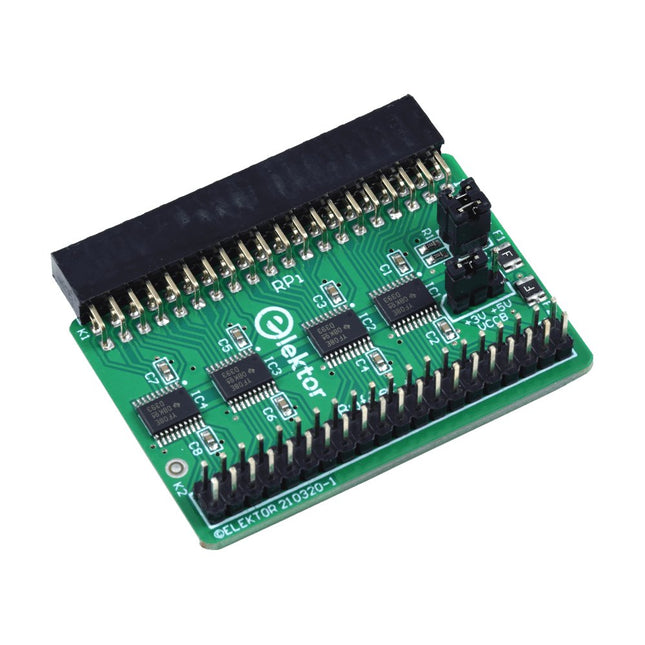
Elektor Labs Carte tampon pour Raspberry Pi d'Elektor
Lorsque vous expérimentez régulièrement avec le Raspberry Pi et que vous connectez une variété de matériel externe au port GPIO via le connecteur, il se peut que vous ayez causé des dommages par le passé. La carte tampon Raspberry Pi d'Elektor est là pour éviter cela ! La carte est compatible avec les Raspberry Pi Zero, Zero 2 (W), 3, 4, 5, 400 et 500. Les 26 GPIO sont protégées par des convertisseurs de tension bidirectionnels afin de protéger le Raspberry Pi lors de l'expérimentation de nouveaux circuits. Le circuit imprimé est destiné à être inséré à l'arrière du Raspberry Pi 400/500. Le connecteur à connecter au Raspberry Pi est un réceptacle 40 voies à angle droit (2x20). La platine est seulement un peu plus large. Un câble plat à 40 voies avec des connecteurs 2x20 appropriés peut être connecté au connecteur de sortie du tampon pour expérimenter avec par exemple un circuit sur une plaque d’expérimentation ou sur une platine. Le circuit utilise 4x circuits intégrés TXS0108E de Texas Instruments. Le circuit imprimé peut également être monté sur un Raspberry Pi. Téléchargements Schematics Layout
€ 34,95
Membres : € 31,46
-

Elektor Publishing Raspberry Pi Pico Essentials
Program, build, and master over 50 projects with MicroPython and the RP2040 microprocessor The Raspberry Pi Pico is a high-performance microcontroller module designed especially for physical computing. Microcontrollers differ from single-board computers, like the Raspberry Pi 4, in not having an operating system. The Raspberry Pi Pico can be programmed to run a single task very efficiently within real-time control and monitoring applications requiring speed. The ‘Pico’ as we call it, is based on the fast, efficient, and low-cost dual-core ARM Cortex-M0+ RP2040 microcontroller chip running at up to 133 MHz and sporting 264 KB of SRAM, and 2 MB of Flash memory. Besides its large memory, the Pico has even more attractive features including a vast number of GPIO pins, and popular interface modules like ADC, SPI, I²C, UART, and PWM. To cap it all, the chip offers fast and accurate timing modules, a hardware debug interface, and an internal temperature sensor. The Raspberry Pi Pico is easily programmed using popular high-level languages such as MicroPython and or C/C++. This book is an introduction to using the Raspberry Pi Pico microcontroller in conjunction with the MicroPython programming language. The Thonny development environment (IDE) is used in all the projects described. There are over 50 working and tested projects in the book, covering the following topics: Installing the MicroPython on Raspberry Pi Pico using a Raspberry Pi or a PC Timer interrupts and external interrupts Analogue-to-digital converter (ADC) projects Using the internal temperature sensor and external temperature sensor chips Datalogging projects PWM, UART, I²C, and SPI projects Using Wi-Fi and apps to communicate with smartphones Using Bluetooth and apps to communicate with smartphones Digital-to-analogue converter (DAC) projects All projects given in the book have been fully tested and are working. Only basic programming and electronics experience is required to follow the projects. Brief descriptions, block diagrams, detailed circuit diagrams, and full MicroPython program listings are given for all projects described. Readers can find the program listings on the Elektor web page created to support the book.
€ 39,95
Membres : € 35,96
-

Elektor Publishing Raspberry Pi Pico W (Book)
Program, build, and master 60+ projects with the Wireless RP2040 The Raspberry Pi Pico and Pico W are based on the fast, efficient, and low-cost dual-core ARM Cortex M0+ RP2040 microcontroller chip running at up to 133 MHz and sporting 264 KB of SRAM and 2 MB of Flash memory. Besides spacious memory, the Pico and Pico W offer many GPIO pins, and popular peripheral interface modules like ADC, SPI, I²C, UART, PWM, timing modules, a hardware debug interface, and an internal temperature sensor. The Raspberry Pi Pico W additionally includes an on-board Infineon CYW43439 Bluetooth and Wi-Fi chipset. At the time of writing this book, the Bluetooth firmware was not yet available. Wi-Fi is however fully supported at 2.4 GHz using the 802.11b/g/n protocols. This book is an introduction to using the Raspberry Pi Pico W in conjunction with the MicroPython programming language. The Thonny development environment (IDE) is used in all of the 60+ working and tested projects covering the following topics: Installing the MicroPython on Raspberry Pi Pico using a Raspberry Pi or a PC Timer interrupts and external interrupts Analogue-to-digital converter (ADC) projects Using the internal temperature sensor and external sensor chips Using the internal temperature sensor and external temperature sensor chips Datalogging projects PWM, UART, I²C, and SPI projects Using Bluetooth, WiFi, and apps to communicate with smartphones Digital-to-analogue converter (DAC) projects All projects are tried & tested. They can be implemented on both the Raspberry Pi Pico and Raspberry Pi Pico W, although the Wi-Fi-based subjects will run on the Pico W only. Basic programming and electronics experience are required to follow the projects. Brief descriptions, block diagrams, detailed circuit diagrams, and full MicroPython program listings are given for all projects.
€ 44,95
Meilleur prix
-
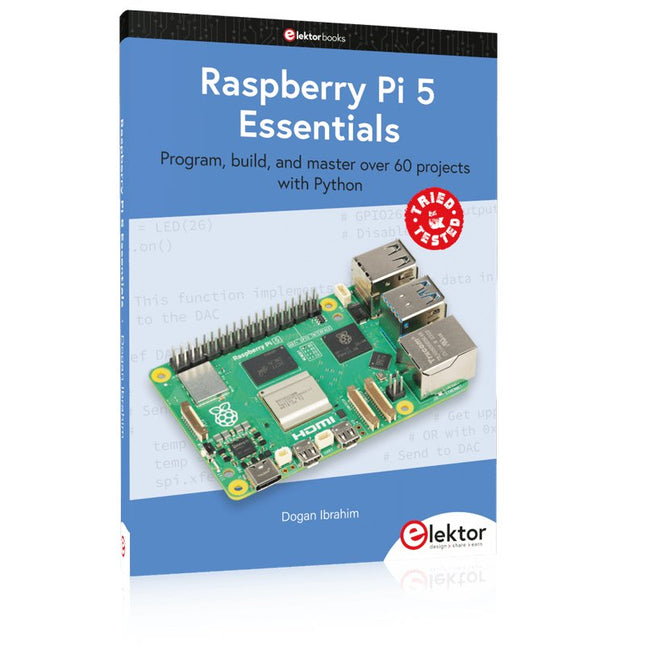
Elektor Publishing Raspberry Pi 5 Essentials
Program, build, and master over 60 projects with Python The Raspberry Pi 5 is the latest single-board computer from the Raspberry Pi Foundation. It can be used in many applications, such as in audio and video media centers, as a desktop computer, in industrial controllers, robotics, and in many domestic and commercial applications. In addition to the well-established features found in other Raspberry Pi computers, the Raspberry Pi 5 offers Wi-Fi and Bluetooth (classic and BLE), which makes it a perfect match for IoT as well as in remote and Internet-based control and monitoring applications. It is now possible to develop many real-time projects such as audio digital signal processing, real-time digital filtering, real-time digital control and monitoring, and many other real-time operations using this tiny powerhouse. The book starts with an introduction to the Raspberry Pi 5 computer and covers the important topics of accessing the computer locally and remotely. Use of the console language commands as well as accessing and using the desktop GUI are described with working examples. The remaining parts of the book cover many Raspberry Pi 5-based hardware projects using components and devices such as LEDs and buzzers LCDs Ultrasonic sensors Temperature and atmospheric pressure sensors The Sense HAT Camera modules Example projects are given using Wi-Fi and Bluetooth modules to send and receive data from smartphones and PCs, and sending real-time temperature and atmospheric pressure data to the cloud. All projects given in the book have been fully tested for correct operation. Only basic programming and electronics experience are required to follow the projects. Brief descriptions, block diagrams, detailed circuit diagrams, and full Python program listings are given for all projects described.
€ 39,95
Membres : € 35,96
-

Elektor Digital Mikrocontroller-Technik (PDF)
Mikrocontroller haben sich in den letzten Jahren in praktisch allen Bereichen der modernen Technik etabliert. In zunehmendem Maße dringen sie auch in die Gebiete der Künstlichen Intelligenz und der Robotertechnik vor. Das vorliegende Buch gibt eine umfassende Einführung in die Welt der Controller-Technik mit all ihren Facetten, von der einfachen Steuerung über die Sensor-Technik bis hin zur Datenübertragung in das Internet. Als Basis dafür dient das von Elektor entwickelte AVR-Playground-Board. Das Board kann mit Controllern der ATmega-Familie bestückt werden und ist mit dem bekannten Arduino-System kompatibel, so dass auch die verschiedenen Arduino-Hardware-Erweiterungen verwendet werden können. Für die Programmierung kommt die Sprache „C“ zum Einsatz. Auch hier wird im Buch auf das Arduino-System zurückgegriffen. Die frei verfügbare Arduino-Entwicklungsumgebung erlaubt den leichten Einstieg, ohne dass später Einschränkungen in Kauf genommen werden müssen. Die Hardware-nahe Programmierung steht dabei besonders im Fokus. Nach der Erläuterung von grundlegenden Anwendungen wird auf die anspruchsvolleren Themen wie Interrupts, Timer und Counter, Pulsweitenmodulation und Analog-Digital-Wandlung eingegangen. Praktische Anwendungen können sowohl mit einem Arduino als auch mit dem AVR-Playground-Board durchgeführt werden. Da das AVR-Playground-Board bereits über eine Vielzahl von Peripherie-Einheiten verfügt, sind nur noch wenige externe Bauteile erforderlich. Das Board kann im Elektor-Shop hier bezogen werden.
€ 32,80
Membres : € 29,52
-

FNIRSI FNIRSI DSO-TC4 (3-en-1) Oscilloscope (10 MHz) + Testeur de transistors + Générateur de signaux
Le FNIRDSI DSO-TC4 est un oscilloscope à transistors multifonctionnel, à la fois complet et pratique. Conçu pour les applications de maintenance et de R&D, il intègre un oscilloscope, un testeur de transistors et un générateur de signaux dans un seul appareil. Caractéristiques Équipé d'un écran couleur TFT de 2,8 pouces pour un affichage clair et intuitif Batterie lithium rechargeable haute capacité intégrée (1500 mAh) avec une autonomie en veille allant jusqu'à 4 heures Compact et léger, idéal pour une utilisation mobile Spécifications Oscilloscope Bande passante analogique 10 MHz Fréquence d'échantillonnage en temps réel 48 Méch./s Impédance d'entrée 1 MΩ Mode de couplage CA/CC Plage de tension de test Sonde 1:1 : 80 Vpp (+40 V) Sonde 10:1 : 800 Vpp (+400 V) Sensibilité verticale 10 mV/div~10 V/div (plage X1) Déplacement vertical Réglable avec indication Plage de base de temps 50 ns~20 s Mode de déclenchement Auto/Normal/Single Type de déclenchement Rising edge, Falling edge Niveau de déclenchement Réglable avec Indication Gel de la forme d'onde Oui (fonction HOLD) Mesure automatique Max, Min, Avg, RMS, Vpp, Frequency, Cycle, Duty Cycle Testeur de transistors Transistor Facteur d'amplification « hfe » ; Tension base-émetteur « Ube », Ic/Ie, courant de fuite inverse collecteur-émetteur « Iceo », Ices, chute de tension directe de la diode de protection « Uf » Diode Chute de tension directe <5 V (chute de tension directe, capacité de jonction, courant de fuite inverse) Diode Zener 0,01 à 32 V Tension de claquage inverse (zone de test K-A-A) Transistor à effet de champ (FET) JFET : capacité de grille « Cg », courant de drain Id inférieur à « Vgs », chute de tension directe de la diode de protection Uf IGBT : Courant de drain Id sous Vgs, Chute de tension directe de la diode de protection Uf MIOSTET : Tension de seuil Vt, Capacité de grille Cg, Résistance drain-source Rds, Chute de tension directe de la diode de protection Uf SCR unidirectionnel Tension de déclenchement <5 V, Niveau de grille (tension de grille) SCR bidirectionnel Courant de déclenchement <6 mA (tension de grille) Condensateur 25 pF à 100 mF, Valeur de capacité, Facteur de perte "Vloss" Résistance 0,01 Ω à 50 MΩ Inductance 10 μH à 1000 μH, résistance CC DS18B20 Capteur de température, broches : GND, DQ, VDD DHT11 Capteur de température et d'humidité, broches : VDD, DATA, GND Générateur de signaux Forme d'onde de sortie Prend en charge 13 sorties de forme d'onde Fréquence de la forme d'onde 0-50 kHz Rapport cyclique de l'onde carrée 0-100% Amplitude de la forme d'onde 0,1-3,0 V Général Écran Écran couleur TFT 2,8 pouces Rétroéclairage Luminosité réglable Alimentation USB-C (5 V/1 A) Batterie 3,7 V/1500 mAh Langues Anglais, allemand, espagnol, portugais, russe, chinois, japonais, coréen Dimensions 90 x 142 x 27,5 mm Poids 186 g Inclus 1x FNIRSI DSO-TC4 (3-en-1) Oscilloscope (10 MHz) 1x Sonde d'oscilloscope P6100 (10X) 1x Sonde à pince crocodile 3x Crochets de test 1x Adaptateur 1x Câble de chargement USB-C 1x Manuel Téléchargements Manual Firmware V0.0.7 (+V1.0.9)
€ 89,95€ 74,95Meilleur prix


