Elektor GREEN en GOLD leden kunnen deze uitgave hier downloaden.
Nog geen lid? Klik hier om een lidmaatschap af te sluiten.
OBD2-sensordashboardOude meters vormden het startpunt van een zoektocht naar echte gegevens
OBD2: voeg een toerenteller en schakelindicator toe aan je autoRetro, maar uiterst nuttig
LiDAR- en Visiesensoren voor Robotica
Sensor+Test 2025 en PCIM 2025
Contactloze E-Veldmetingen (1)Een Trillende Membraan voor het Detecteren van Gelijkspanningen of Statische Elektrische Velden
Draadloze brievenbusmeldervan optische sensoren tot radar: enkele mogelijkheden
Elektor Mini-Wheelieeen zelfbalancerende robot
ZonnecellenVreemde onderdelen, de serie
Aan de slag met een moderne radarsensorStaat een nauwkeurige meting op uw radar?
Uit het leven gegrepenpapierfabriek
CybersecurityZware tijden voor hackers
Infographics: IoT en sensoren 2025
Bluetooth 6.0 brengt verbeterde toepassingen voor afstandsbepalingNieuwe versie biedt betere apparaatpositionerings- en -locatieservices
Draadloze communicatie verkennen met BeagleY-AI
Err-lectronicsCorrecties, updates en lezerspost
Alle begin......sluit het thema opamps af
Een krachtige AI-codeerassistentsneller ontwikkelen met Continue en Visual Studio Code
Zonne-laadregelaar met MPPT (2)Het schema
Ultrasone obstakeldetectoreen eenvoudig project om slechtzienden te helpen
2025: Een AI-odysseeHalfjaaroverzicht
Raspberry Pi Standalone MIDI-synthesizer (3)Het slimmer maken en een gebruikersinterface toevoegen
Meshtastic: een demonstratieprojectEen slim netwerk van LoRa-radio's
Analoge audio-frequentiegeneratorHoogwaardige sinusgenerator met instelbare frequentie
GUI with Touch — for ESP32, RPi & Co.Graphical user interfaces with the LittlevGL library
"Not Just Any Guy's Project”Interview with Gábor Kiss-Vámosi, the developer of LittlevGL
Capaci-Meterwith two-digit Dekatron-style LED display
How To: Debounce a Mechanical Contact or SwitchA switch is either open or closed, isn't It?
Developer's ZoneTips & Tricks, Best Practices and Other Useful Information
Extendable Environmental Monitoring Systempublishes data on IoT platforms
Practical ESP32 MultitaskingTask programming with FreeRTOS and the Arduino IDE
InteractiveCorrections & Updates || Questions & Answers
Automotive Headlight TuningLegal, illegal — it matters!
Review: Toolcraft Digital Soldering Station
Arduino Pro IDE - First Impressions
Two Thermal Imaging Cameras ComparedSeek ShotPro and Seek Compact
Steeped in ElectronicsOutfitting the e-lab and e-workshop
Monsanto MAN1 LED DisplayPeculiar Parts, the series
Thermoelectric Tea TimerFirst dealings with energy harvesting
Single-Phase 1-Kilowatt AC Motor DriveThree-mode design: integral-cycle switching, phase-cut trailing, or phase-cut leading edge.
RPi Gets a Fast 3.5" Touch DisplayMore power at no extra charge
Lab, Sweet LabA glimpse of The Holy Place — no unauthorized entry.
First Steps with RISC-VTrying out the LoFive Board
Elektor Labs Challenged: a DIY LoRa Tracker
Glitches and results in electronics development
Sigfox and the IoT (2)Registration in the Sigfox network
Starting Out in ElectronicsEasier than imagined!
Analogue Electronics Design
Case Study #1 — Section 1: MEMS Microphone… Testing 1-2-3
Small Circuits RevivalCapita Selecta from the Elektor Project Suggestions Box
In a Nutshell: Text for MicrocontrollersUsing compression to save memory
Focus On: Autonomous DrivingState of the art at a glance
Start-Up Leaders and Innovators Talk “Innovation 4.0” in Munich
Lego Electronic Train Set from 196850 years on, electronic toys still fascinate
Beyond ElectronicsThe MX3D Bridge Senses the City
Elektor GREEN and GOLD members can download their digital edition here.
Not a member yet? Click here.
DIY Solar Energy StorageBuild Your Own Energy Store for a PV Solar Array
Solar Module SimulatorA Solution for Testing and Optimizing MPP Trackers and Inverters
The STM32 Edge AI ContestExplore the new STM32N6 and Compete for a Share of €5,000 in Prizes!
Widening the BandgapWhy There Is So Much Interest in SiC and GaN
Notebook Power BankExtend the Life of Your Aged Laptop
Medical RobotsOvercoming Technical and Regulatory Hurdles
Frost Guard for Fruit Plants With Temperature Data Logger
The Analog ThingThe Arduino of Analog Computing?
Energy Saving Relay DriverSaves 90% of Relay Drive Power
Improving the ET5410A+ DC loadKeep Cool and Be Quiet, Please
electronica 2024 in Review
Electromagnetic CompatibilityEMC in a Nutshell!
Starting Out in Electronics……Filters Actively
Reducing Power Dissipation With Dropping CapacitorsA Clever Use of Capacitive Reactance
The Affordable MCP4725 12-Bit Digital-to-Analog ConverterAn EEPROM Feature Enables Safe Switch-On Behavior
Fnirsi LCR-ST1 Smart LCR SMD Tweezers
Raspberry Pi-Based Private Test & Measurement LabFirst Things First: The ADC
Electronic Load ResistorAn Out-of-the-Box Project
2025: An AI OdysseySome Projects to See in the New Year
AmpVolt v2.0 Project Update100 Amps and Beyond!
Err-lectronicsCorrections, Updates, and Readers’ Letters
Unveiling Ethical TransparencyInsights from Ethics in Electronics’s 2024 Survey
Elektor Audio DSP FX Processor Board (2)Creating Applications
Elektor GREEN en GOLD leden kunnen deze uitgave hier downloaden.
Nog geen lid? Klik hier om een lidmaatschap af te sluiten.
PbMonitor v1.0Een accu-bewakingssysteem voor UPS en energieopslag toepassingen
Zonne-laadregelaar met MPPT (1)basisprincipes van een zonne-laadregelaar voor autonome systemen
Integrerende B-veld magnetometermet zelfgemaakte sensoren
Precies of nauwkeurig?Je instrumenten moeten het allebei zijn!
AD7124 Een precisie-ADC in de praktijkEssentieel voor Sensorsignaalconditionering
PID-regeltoolGemakkelijk PID-parameters optimaliseren
embedded world 2025
Alle begin......gaat verder met de toonregeling
Academy Pro BoxBoek + onlinecursus + hardware
Milliohmmeter adapterGebruik de nauwkeurigheid van uw multimeter
De volgende sprong in halfgeleidersVoorwaarts naar 1,4nm
Through-hole connectorenHet beste van twee werelden: THR
FrequentietellerDraagbaar en Automatische Kalibratie met GPS
Analoge metersVreemde onderdelen, de serie
Stand-alone kristaltesterhoe nauwkeurig is uw kloksignaal?
Goedkope I²C-testersluit I²C-apparaten rechtstreeks op uw PC aan
Uit het leven gegrepenwie het kleine niet eert...
2025: een AI-odysseede transformerende invloed op softwareontwikkeling
Err-lectronicsCorrecties, updates en ingezonden brieven
Raspberry Pi standalone MIDI-synthesizer (2)We verbeteren onze setup met intelligentie
Norton-getransformeerde wienbrug-oscillatorkleine verandering, grote verbetering
Test van een 10-cent-controllerde CH32V003 RISC-V microcontroller en MounRiver Studio in de praktijk
Een FPGA-gebaseerde audiospeler met equalizer (2)volumeregeling, geavanceerd mixen en een webinterface
Ce cours complet de programmation de microcontrôleurs STM32 comprend un manuel, un kit de composants, des projets pratiques et une formation en ligne approfondie. Il est idéal pour apprendre étape par étape la programmation de systèmes embarqués avec Arduino grâce à une approche pratique.
Une introduction pratique aux systèmes embarqués avec le STM32
Ce cours s'adresse aux débutants dans le domaine des systèmes embarqués qui recherchent une méthode structurée et basée sur des exemples pour se lancer. Un kit de composants est inclus ; il contient notamment des LED, des résistances, des interrupteurs, des capteurs, des actionneurs, des afficheurs, une plaque d'essai (breadboard) et des fils de connexion. Ces éléments sont utilisés tout au long du cours pour illustrer des exemples d'applications.
Aucune expérience préalable d'Arduino ou du développement de systèmes embarqués n'est requise. Chaque section propose des exemples pratiques et des mini-projets conçus pour consolider les concepts clés et encourager une exploration plus approfondie. À l'issue de la formation, vous serez capable non seulement de reproduire les exemples présentés, mais aussi de les enrichir grâce à vos propres idées et applications.
Que allez-vous apprendre ?
Programmation de microcontrôleurs STM32 en C/C++ avec l'IDE Arduino
Utilisation des entrées/sorties numériques, lecture de boutons et encodeurs, commande de LED et relais
Lecture des entrées analogiques, tensions et capteurs analogiques
Génération de signaux analogiques et PWM
Utilisation des communications série comme UART, I²C et SPI pour piloter des afficheurs et lire des capteurs numériques et cartes SD
Gestion du temps
Utilisation des interruptions
Entrées capteurs en temps réel et contrôle via boutons, LED et afficheurs
Commande d’actionneurs comme relais et servomoteurs
Déboguer des programmes à l'aide de points d'arrêt et de l'exécution pas à pas
À qui s’adresse ce cours ?
Étudiants et autodidactes explorant les systèmes embarqués
Makers et passionnés d’IoT souhaitant améliorer leurs compétences en hardware
Formateurs et enseignants à la recherche de matériel pédagogique prêt à l’emploi
Contenu de la boîte
Accès au cours complet sur la plateforme Elektor Academy Pro
Carte microcontrôleur STM32 NUCLEO-F411RE
Livre : Arduino for STM32
Fichiers de projet téléchargeables pour chaque module
Boîte de composants :
2× LED, rouge, 5 mm
LED, verte, 5 mm
3× résistance, 470 Ω, 0,25 W
LDR
Potentiomètre, 10 kΩ, linéaire
Bouton-poussoir
Module encodeur rotatif
Module relais
Capteur DHT22 (température & humidité)
Afficheur 7 segments 4 digits compatible TM1637
MPU-6050 IMU avec connecteurs
Afficheur OLED I²C compatible SSD1306
Adaptateur carte micro SD avec connecteur
Buzzer
Micro servo SG90
Écran TFT SPI 240×320 compatible ILI9341
20× fils jumper
Breadboard
MOTOREN AANSTUREN MET H-BRUGGENeen inleiding tot gelijkstroom-, stappen- en borstelloze motoren
HET ELEKTOR LAB-TEAMonze aanpak, onze tools – en meer...
RASPBERRY PI ALS KVM-AFSTANDSBEDIENINGsoftwaretest Pi-KVM
IQAUDIO CODEC ZEROgeluidskaart voor de Raspberry Pi-familie
WAT WE KUNNEN LEREN VAN HET PIKVM-PROJECTeen vraaggesprek met Maxim Devaev
AUTONOOM RIJDEN MET 2D-LIDARESP32 Pico interpreteert gegevens van de lidar-module DE RASPBERRY PI ZERO 2 W GAAT QUAD-CORE NOTITIES BIJ VAN HET WORLD ETHICAL ELECTRONICS FORUM 2021
MOTORBESTURINGhoe de complexiteit van motorbesturing wordt gereduceerd
GROTE ELEKTROMOTORENbasisprincipes en nuttige informatie AAN DE SLAG MET DE ESP32-C3 RISC-V MCU
BESCHERM UZELF EN ANDEREN!DHZ-hoofdschakelaar voor uw werkbank
GUI'S MAKEN MET PYTHON (DEEL 2)Spionnennaamkiezer
PRODUCTRONICA FAST FORWARD 2021: DE WINNAARSspannende technologieën en creatieve engineeringoplossingen
VEELZIJDIGE SERVOTESTERcontroleer het gedrag, ook zonder datasheet
MODBUS VIA WLANdeel 2: software voor de Modbus TCP WLAN-module
KENNISMAKING MET NEURONEN IN NEURALE NETWERKENdeel 3: neuronen in de praktijk
IN EEN OPEN SOURCE-PROCESSORvoorbeeldhoofdstuk: vergelijking van Lattice- en Xilinx-FPGA’s
ALLE BEGIN......is nog niet klaar met de spoel
PROJECT 2.0correcties, updates en brieven van lezers
KLEUR NAAR GELUIDeen kleursensor via I2C uitlezen
BATTLAB-ONEmeet en optimaliseer de gebruiksduur van IoT-accu’s
EENVOUDIGE AARDLEKTESTERisolatietest voor lichtnetinstallaties
ARMOEDE EN ELEKTRONICAhet streven naar duurzame ontwikkeling
HEXADOKUpuzzelen voor elektronici
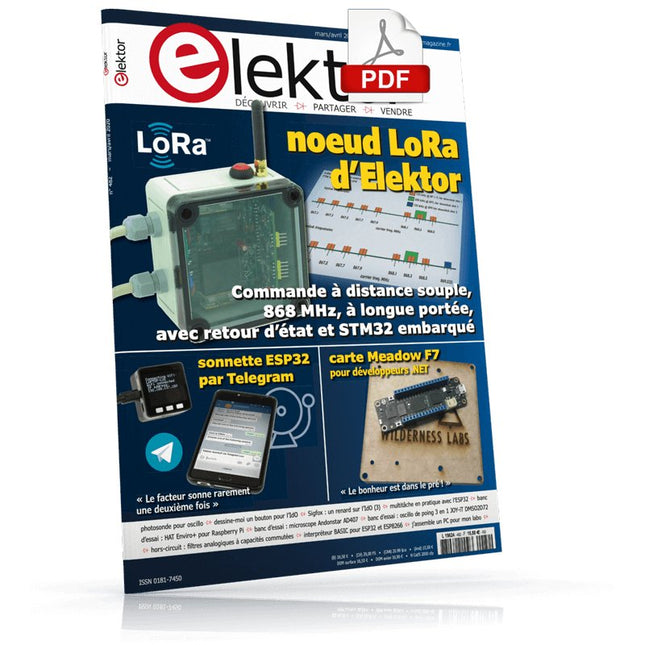
nœud LORA d'ElektorCommande à distance souple, 868 MHz, à longue portée, avec retour d'état et STM32 embarquémises au point & mises à jourCorrections & Updates || Questions & Answersélectronique analogiqueÉtude de cas n° 1 - Section 2 : Préamplificateur optimisé pour les microphones MEMSdessine-moi un bouton pour l'IdOboutonnière nº 1 : Architecture de l'IdOinterpréteur BASIC pour ESP32 et ESP8266Programmation avec Annex WiFi RDSsonnette ESP32 par Telegram'Le facteur sonne rarement une deuxième fois'retour des petits circuits... et des bonnes petites idées de projets d'ElektorLoRaWAN : décollage facileAvec Blue Pill, passerelle LoRa et The Things Network' Un pilier de l'internet ouvert 'Entretien avec Wienke Giezeman, initiateur du réseau The Thingscarte Meadow F7Une carte pour développeurs .NETmultitâche en pratique avec l'ESP32 (2)Priorités des tâchesSigfox : un renard sur l'internet des objets (3)Vos premiers pas sur l'internet des objetsRaspberry Pi Aide-mémoire des commandes Bashl'accélérateur de démarrage le plus performant d'Europe ?HighTechXL, Eindhoven, Pays-Basbanc d'essai : HAT Enviro+ pour Raspberry PiMesure et collecte de la qualité de l'air avec RPi et le HAT Enviro+expérience vécueCommandes de composants en Ukraine et en Russiebanc d'essai : microscope Andonstar AD407Est-il le meilleur de sa catégorie ?Une soue ? Non, un labo d'électronique !Visite guidée dans le saint des saintsphotosonde pour oscilloscopesMesure de fluctuation de luminosité des systèmes d'éclairageprojet TABULA – des nouveautés tangiblesDe l'importance du retour d'informationcomment calculer le courant de court-circuit présumé ou PSCCet choisir le bon disjoncteurafficheur à LED Monsanto MAN1drôle(s) de composant(s)filtres analogiques à capacités commutéesCeci n'est pas la rubrique Rétronique même si elle s'appuie sur un principe décrit en 1873 !bureau d'études – Zone DD comme développement, débrouille et dur-à-cuire ! Trucs et astuces, meilleures pratiques et autres informations utilesdémarrer en électronique (2)... est plus facile qu'on ne l'imagine !banc d'essai : oscillo de poing 3 en 1 JOY-iT DMSO2D72j'assemble un PC pour mon laboConseils pour le choix des composantsl'ordinateur de jeu d'échecs intelekt d'Elektor (1981)Tiny Chess 86 porté sur l'Intel 8088hexadoku - casse-tête pour elektorniciens
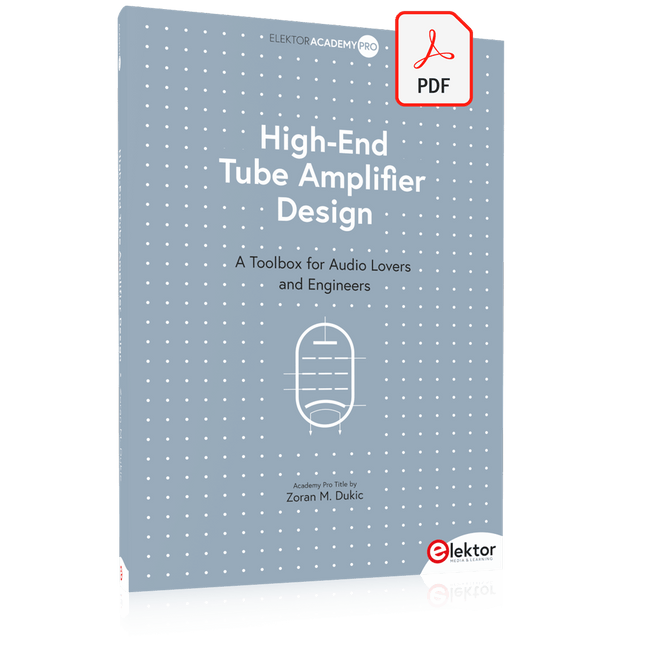
A Toolbox for Audio Lovers and Engineers
Without any ambition to reach scientific levels, this book aims to be a toolbox for both audio lovers and high-end equipment designers. The elementary theory presented is the bare minimum for readers to grasp the operation and practical use of electrical, electromagnetic, physics, and electronic operations available in the designers’ toolbox. Each tool is explained in a minimum of words and theory without needless coverage of underlying equations or figures.
The book chapters guide you through the process of designing quality amplifiers with vacuum tubes, from the very beginning, considering both technical and subjective requirements – in theory and practice.
The book is a compilation of the author’s notes used in his professional and educational career but was nevertheless primarily written as a result of true love for the audiophile hobby.
From SRPP and Mu-Follower to OTL Designs
Tube amplifiers suffer from distortion. Fortunately, circuits such as the SRPP amplifier, mu-follower, and beta-follower produce minimal distortion even at output voltages of 50 to 100 Vpeak.
These designs are often published with errors. Without a sound understanding of the theory, it is easy to arrive at a flawed design.
In the first section of this book, we investigate the origin of distortion, while in the second we investigate the design of and SRPP and a mu-follower.
On the internet we can find the most exotic designs. Evaluating them teaches us that these designs often make matters worse rather than better. In the chapter on incorrect SRPPs and mu-followers, we sometimes see bizarre and misguided designs where using a simple single-triode amplifier would perform much better.
Push-pull output stages also exist. A great number of them are examined, and their similarity to the SRPP is discussed. This is done especially with the help of the theory behind the OTL based on the ‘mother’ of all OTLs, the Philips HF303.
Finally, attention is given to frequency characteristics and technical matters such as the supply voltage and the filament power supply.
To illustrate these points, there are a few designs covering the subjects discussed.
This book presents much new theory that has not been published before. It is often an eye-opener, showing that many things have a beautiful and unexpected simplicity.
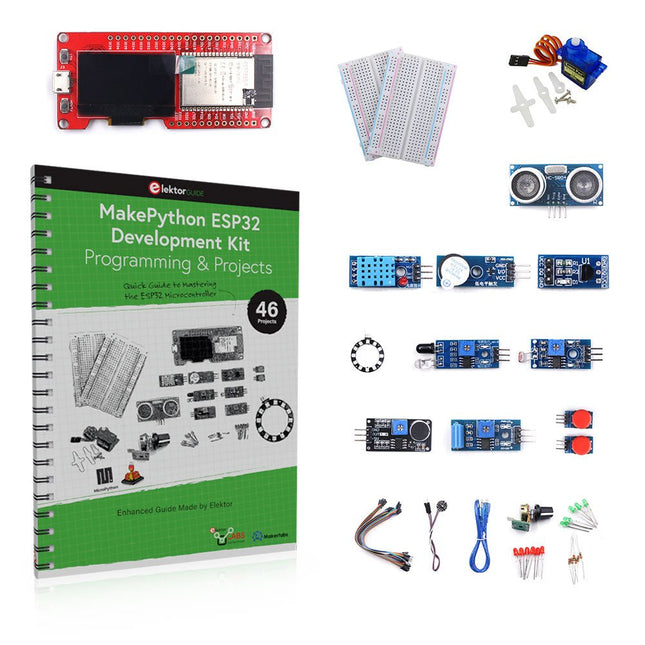
Apprenez à utiliser et programmer le microcontrôleur ESP32 en MicroPython dans vos futurs projets !
Ce livre (en anglais) de projets par Dogan Ibrahim, auteur populaire de livres Elektor contient de nombreux projets logiciels et matériels spécialement développés pour le kit de développement ESP32 de MakePython. Le kit est livré avec plusieurs LED, capteurs et actionneurs. Le kit vous aidera à acquérir les connaissances de base pour créer des projets IdO.
Les projets testés dans le livre sont basés sur les composants fournis. Chaque projet est décrit par un schéma fonctionnel, un schéma de circuit, un listage complet ainsi qu’une description détaillée du programme.
Contenu du kit
1x Carte de développement MakePython ESP32 avec LCD
1x Module de mesure à ultrasons
1x Capteur de température et d'humidité
1x Module buzzer
1x Module DS18B20
1x Module infrarouge
1x Potentiomètre
1x Module WS2812
1x Capteur de son
1x Capteur de vibrations
1x Module de résistance photosensible
1x Capteur de pouls
1x Servomoteur
1x Câble USB
2x Bouton
2x Plaque d'essai
45x Fils de connexion
10x résistances 330R
10x LED (Rouges)
10x LED (Verts)
1x Livre de projets (en anglais, 206 pages)
46 projets dans le livres
Projets à LED
LED clignotante
SOS clignotant
LED clignotante – utilisation d'un timer
LED clignotantes en alternance
Contrôle des boutons
Modification de la fréquence de clignotement des LED à l'aide d'interruptions de boutons-poussoirs
LED de poursuite
Compteur binaire à LED
Lumières de Noël (8 LEDs clignotant de façon aléatoire)
Dés électronique
Jour de chance de la semaine
Projets de modulation de la largeur d'impulsion (PWM)
Génération d'une forme d'onde PWM de 1000 Hz avec un rapport cyclique de 50%
Contrôle de la luminosité des LED
Mesures de la fréquence et du rapport cyclique d'une forme d'onde PWM
Compositeur de mélodies
Orgue électronique simple
Servo motor control
Thermomètre DS18B20 à servomoteur
Projets de convertisseur analogique-numérique (CAN)
Voltmètre
Traçage de la tension d'entrée analogique
Capteur de température interne de l'ESP32
Ohmmètre
Module de résistance photosensible
Projets de convertisseur numérique-analogique (CNA)
Génération de tensions fixes
Génération d'un signal en dents de scie
Génération d'un signal à onde triangulaire
Forme d'onde périodique arbitraire
Génération d'un signal sinusoïdal
Génération d'un signal sinusoïdal précis au moyen d'interruptions du timer
Utilisation de l'afficheur OLED
Compteur de secondes
Compteur d'événements
Thermomètre numérique à base d'OLED DS18B20
Contrôleur de température ON-OFF
Mesure de la température et de l'humidité
Mesure de la distance par ultrasons
Taille d'une personne (stadiomètre)
Mesure de la fréquence cardiaque (pouls)
Autres capteurs fournis dans le kit
Alarme antivol
Lumière activée par le son
Détection d'obstacles par infrarouge avec buzzer
Anneau de LED RVB WS2812
Horodatage des données de température et d'humidité
Programmation réseau
Scanner Wi-Fi
Contrôle à distance depuis le navigateur Internet (à l'aide d'un smartphone ou d'un PC) – Serveur Web
Stockage des données de température et d'humidité dans le cloud
Fonctionnement à faible puissance
Utilisation d'un timer pour activer le processeur
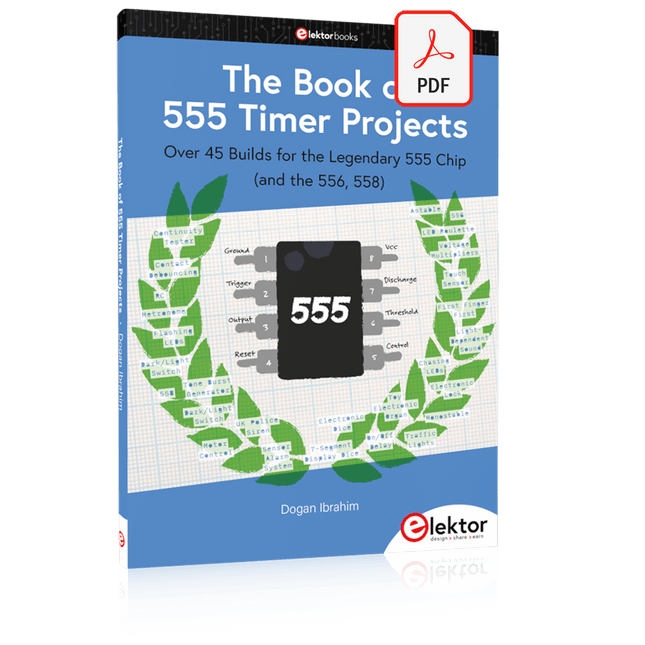
Over 45 Builds for the Legendary 555 Chip (and the 556, 558)
The 555 timer IC, originally introduced by the Signetics Corporation around 1971, is sure to rank high among the most popular analog integrated circuits ever produced. Originally called the IC Time Machine, this chip has been used in many timer-related projects by countless people over decades.
This book is all about designing projects based on the 555 timer IC. Over 45 fully tested and documented projects are presented. All projects have been fully tested by the author by constructing them individually on a breadboard. You are not expected to have any programming experiences for constructing or using the projects given in the book. However, it’s definitely useful to have some knowledge of basic electronics and the use of a breadboard for constructing and testing electronic circuits.
Some of the projects in the book are:
Alternately Flashing Two LEDs
Changing LED Flashing Rate
Touch Sensor On/Off Switch
Switch On/Off Delay
Light-Dependent Sound
Dark/Light Switch
Tone Burst Generator
Long Duration Timer
Chasing LEDs
LED Roulette Game
Traffic Lights
Continuity Tester
Electronic Lock
Switch Contact Debouncing
Toy Electronic Organ
Multiple Sensor Alarm System
Metronome
Voltage Multipliers
Electronic Dice
7-Segment Display Counter
Motor Control
7-Segment Display Dice
Electronic Siren
Various Other Projects
The projects given in the book can be modified or expanded by you for your very own applications. Electronic engineering students, people engaged in designing small electronic circuits, and electronic hobbyists should find the projects in the book instructive, fun, interesting, and useful.