Elektor GREEN en GOLD leden kunnen deze uitgave hier downloaden.
Nog geen lid? Klik hier om een lidmaatschap af te sluiten.
Relio v1.0 – Aanwezigheidsdetectie en afstandsbedieningEen smart controller met Matter-functionaliteit voor AC-apparaten
Betere printplaten ontwerpenEen praktische gids voor professionals en makers
KiCad 9De belangrijkste nieuwe en verbeterde functies
Precisie pico-ampèremeter (1)Met curvetracer-functionaliteit tot in het pA-bereik!
Kerstster 2025soldeer de sterren van de hemel!
100mV-doorgangstester
Wie verlegt de grenzen van de Europese elektronica?Bedrijven om in het oog te houden
Productronica 2025: Wat is er nieuw in de ontwikkeling en productie van elektronica
Automatisering om reshoring van productie, invoerheffingen en tekorten aan arbeidskrachten aan te pakken
Meer dan toekomstbestendigCirculariteit in elektronica
Passieve componentenVerliesarme inductoren voor hoogrendements DC/DC-converters
Hoe desktopmachines de printplaatproductie toegankelijker maken
Alle begin......heeft voeding nodig
Uit het leven gegrepenKnopjeskoorts
Soldeertechniek in 2025Praktische soldeertips rechtstreeks van de werkbank
SimulIDEEen alles-in-één tool voor circuit-prototyping
2025: Een AI OdysseyVan autocomplete tot collega
Wordy Christmas TreeEen feestelijk elektronica-project met een taalkundig tintje
Err-lectronicsCorrecties, updates en lezersbrieven
Analoge pipeline-vervormingEen fraai audio-effect voor gitaren en andere instrumenten
ESP32 audiotransceiver-board (deel 3)Stereotransmissie en dual-radio
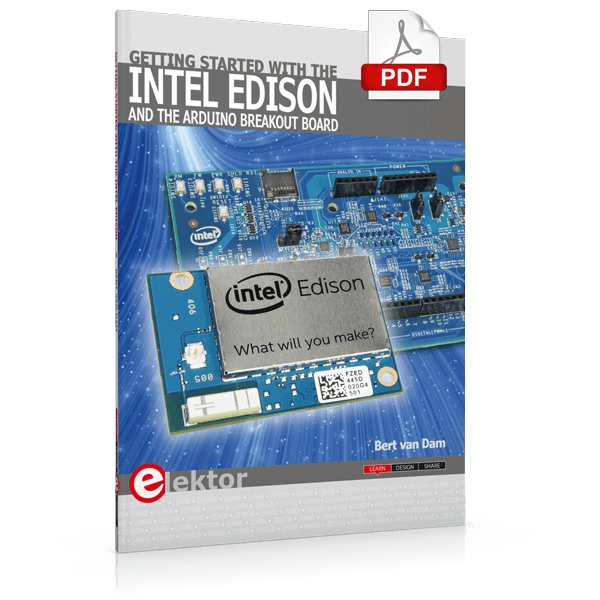
The Internet of Things is rapidly gaining interest, and that has fueled the development of the Edison. A tiny computer, the size of a postage stamp, with a lot of power and built-in wireless communication capabilities.
In this eBook we will help you get up-to-speed with the Edison, by installing the software both on the Edison as well as on your Windows PC. We will use the Edison Arduino break-out board because it is easy to work with. We will discuss Linux, Arduino C++ and Python, and show examples of how the Edison can interface with other hardware. We will use Wi-Fi and Bluetooth to set up wireless connections, and show you a trick to program sketches over Wi-Fi.
Once you have completed this book your Edison will be up and running with the latest software version, and you will have sufficient knowledge of both hardware and software to start making your own applications. You will even be able to program the Edison over USB and wireless both in Arduino C++ and Python.
This is not a projects eBook, but a toolbox that will allow you to explore the wonderful world of the Intel Edison!
Elektor GREEN and GOLD members can download their digital edition here.
Not a member yet? Click here.
What to expect
This Elektor edition guest-edited by Edge Impulse explores the edge AI workflow, from data collection and model training to deployment and optimization:
End-to-End Edge AIA hands-on object detection series that walks through the complete machine learning pipeline on embedded hardware.
High-Resolution, High-Speed Object Counting (Nvidia Jetson Nano, TensorRT)Pushing inference speed and precision for visual counting applications.
PCB Defect Detection with Computer Vision (Raspberry Pi)Smarter manufacturing through embedded vision.
Smart Building Ventilation with Sensor FusionAI-powered environmental optimization for energy efficiency.
Analog Meter Reading (Arduino Nicla Vision)A TinyML approach to automating analog infrastructure.
Smart Appliance Control Using Voice Commands (Nordic Thingy:53)Speech recognition at the edge.
Liquid Classification with TinyML (Seeed Wio Terminal + TDS Sensor)Combining IoT sensing and embedded ML for fluid analysis.
Surgery Inventory Object DetectionApplying real-time vision to healthcare logistics.
Plus, the magazine includes exclusive interviews with: Edge Impulse co-founders Zach Shelby and Jan Jongboom; Qualcomm Technologies VP of product management Manny Singh; and EDGE AI FOUNDATION CEO Pete Bernard. Also included are a Tech the Future essay titled "AI at the Edge: Powering the Next Generation of Devices," an Industry Case Study on GlobalSense, and more.
Contents
What the Heck Is Edge AI Anyway?Bringing Intelligence to the Device
Meet Edge Impulse StudioEasily Build and Deploy Edge AI Models
Keyword Spotting with Edge ImpulseCollect, Train, and Deploy
Smart Appliance Control Using Voice Commands with the Nordic Thingy:53
Key Terms for Understanding Edge AI and Machine Learning
Crash Course: Getting Started with Edge ImpulseLearn to Collect, Train, and Deploy an ML Model with the Arduino Nano 33 BLE Sense
A New Chapter for ArduinoFrom Hobby Board to Edge Computing Powerhouse
Getting Started with Object Detection on Edge Devices
PCB Defect DetectionComputer Vision with Raspberry Pi
Scaling AI to the Smallest Devices
Optimizing Power Efficiency in Battery-Driven Edge AI Devices
AI ToasterWhen Edge AI Meets Breakfast
Thundercomm Rubik Pi 3Raspberry Pi Familiarity Meets Edge AI
Leadership, Embedded ML, and the Edge Revolution
Vision Language Models for the EdgeCascading Models for Better Reliability
Get to Know Edge ImpulseQuestions from the Elektor Community
Project Update #5: ESP32-Based Energy MeterUsing Edge AI to Recognize Household Loads
Motion Recognition with Anomaly DetectionAn End-to-End Tutorial
Smart Ventilation System: Fusing Sound and Environmental DataA Dual-MCU Machine Learning Approach for Automated Window and Louver Control
Bringing Voice Control to Earbuds and Headsets
AI at the Edge: Powering the Next Generation of Devices
Elektor GREEN en GOLD leden kunnen deze uitgave hier downloaden.
Nog geen lid? Klik hier om een lidmaatschap af te sluiten.
OBD2-sensordashboardOude meters vormden het startpunt van een zoektocht naar echte gegevens
OBD2: voeg een toerenteller en schakelindicator toe aan je autoRetro, maar uiterst nuttig
LiDAR- en Visiesensoren voor Robotica
Sensor+Test 2025 en PCIM 2025
Contactloze E-Veldmetingen (1)Een Trillende Membraan voor het Detecteren van Gelijkspanningen of Statische Elektrische Velden
Draadloze brievenbusmeldervan optische sensoren tot radar: enkele mogelijkheden
Elektor Mini-Wheelieeen zelfbalancerende robot
ZonnecellenVreemde onderdelen, de serie
Aan de slag met een moderne radarsensorStaat een nauwkeurige meting op uw radar?
Uit het leven gegrepenpapierfabriek
CybersecurityZware tijden voor hackers
Infographics: IoT en sensoren 2025
Bluetooth 6.0 brengt verbeterde toepassingen voor afstandsbepalingNieuwe versie biedt betere apparaatpositionerings- en -locatieservices
Draadloze communicatie verkennen met BeagleY-AI
Err-lectronicsCorrecties, updates en lezerspost
Alle begin......sluit het thema opamps af
Een krachtige AI-codeerassistentsneller ontwikkelen met Continue en Visual Studio Code
Zonne-laadregelaar met MPPT (2)Het schema
Ultrasone obstakeldetectoreen eenvoudig project om slechtzienden te helpen
2025: Een AI-odysseeHalfjaaroverzicht
Raspberry Pi Standalone MIDI-synthesizer (3)Het slimmer maken en een gebruikersinterface toevoegen
Meshtastic: een demonstratieprojectEen slim netwerk van LoRa-radio's
Analoge audio-frequentiegeneratorHoogwaardige sinusgenerator met instelbare frequentie
Elektor GREEN and GOLD members can download their digital edition here.
Not a member yet? Click here.
The Raspberry Pi 5A Huge Improvement From Its Predecessor
AI in the Electronics LabGoogle Bard and Flux Copilot Put to the Test
Arduino Nano Waveform GeneratorNano + Code = Function Generator
Solar-Powered Christmas GarlandAn Eco-Friendly Solution for Garnishing Your Balcony
USB Killer DetectorBetter Safe Than Sorry
A Simple CNCed EnclosureWith Autodesk Fusion 360 for Personal Use
Low-Volume Board ProductionWith and without Assembly
IoT Simulation Simplified with WokwiDeveloper Uri Shaked on Design, Software, and More
A Bare-Metal Programming Guide (Part 3)CMSIS Headers, Automatic Testing, and a Web Server
LoRa, a Swiss Army Knife (2)The Hardware and Software
MEMS Microphone Design and Construction
Tools to Try Before You SolderSimulation and 3D Modeling Tools That Can Be Used for Free
New Tools From Microchip!PICkit 5 and MPLAB ICD 5 Available Now!
Rapid Prototyping of Flexible, Stretchable ElectronicsHow the Voltera NOVA Speeds Up Innovation in Wearable Electronic Systems
Galvanic IsolationUsing Phototransistor Optocouplers Successfully
The Complex Solution or the Anybus Solution?Embedded Industrial Ethernet in 2 Days Rather Than Many Months
Your Essential DFM ChecklistHow to Start Designing for Manufacture
3D Printing FilamentsTypes, Features and Use in Prototyping
Specialists for Effective Signal Analysis from ELF to EHF BandAaronia’s latest real-time SPECTRAN® V6 series spectrum analyzers
Challenges of DFM Analysis for Flex and Rigid-Flex Design
Setting Up an SMT Line
The Right Combination for a Reliable Assembly
Revolutionizing IndustriesThe Rise of Autonomous Mobile Robots (AMRs)
Evolved for More ChallengesRohde & Schwarz Adds Eight-Channel R&S MXO 5 to Next-Generation Oscilloscopes
Starting Out in Electronics……Amplifying Differences
Mini Reflow PlateFor Assembling or Repairing Small SMD Circuits
Don’t Start with a Prototype – Start with a Pretotype!Check That a Market Exists for Your Product Before Warming Your Soldering Iron
2023: An AI OdysseyGetting Help Designing a Physical Project
Brussels Is InnovatingSupport for Deep Tech
Computer vision is probably the most exciting branch of image processing, and the number of applications in robotics, automation technology and quality control is constantly increasing. Unfortunately entering this research area is, as yet, not simple.
Those who are interested must first go through a lot of books, publications and software libraries. With this book, however, the first step is easy. The theoretically founded content is understandable and is supplemented by many practical examples. Source code is provided with the specially developed platform-independent open source library IVT in the programming language C/C++. The use of the IVT is not necessary, but it does make for a much easier entry and allows first developments to be quickly produced.
The authorship is made up of research assistants of the chair of Professor Ruediger Dillmann at the Institut für Technische Informatik (ITEC), Universitaet Karlsruhe (TH). Having gained extensive experience in image processing in many research and industrial projects, they are now passing this knowledge on.
Among other subjects, the following are dealt with in the fundamentals section of the book: Lighting, optics, camera technology, transfer standards, camera calibration, image enhancement, segmentation, filters, correlation and stereo vision.
The practical section provides the efficient implementation of the algorithms, followed by many interesting applications such as interior surveillance, bar code scanning, object recognition, 3-D scanning, 3-D tracking, a stereo camera system and much more.
FLUX Beamo est une découpeuse laser de bureau CO2 puissante et compacte de 30 W qui peut couper et graver une gamme de matériaux, y compris les métaux. Avec sa conception facile à utiliser, ses commandes et fonctionnalités intuitives, vous pouvez créer sans effort des choses étonnantes.
Caméra HD intégrée
La découpe et la gravure se font sans problème grâce à notre mode aperçu. Placez votre matériau, prévisualisez la zone de travail dans le logiciel Beam Studio et gravez. Votre design apparaît exactement comme indiqué dans l'aperçu.
Fonctions de sécurité intégrées
S'il est laissé ouvert, la pause automatique garantit l'arrêt du laser. Le système de refroidissement par eau interne offre un processus de coupe stable. De plus, vous pouvez arrêter la production à tout moment avec un seul interrupteur.
Laser haute résolution puissant
Le laser ultra fin Beamo peut graver des détails exceptionnels jusqu'à 0,05 mm de large avec une résolution claire de 1 000 dpi. Convient à tout projet d'artisanat ou de petite entreprise.
Le graveur laser CO2 compact le plus précis
Le design élégant, moderne et compact de Beamo s'intègre parfaitement dans n'importe quel espace de maison, d'école ou d'atelier. Il est livré pré-assemblé avec un corps en métal et un couvercle en acrylique mesurant 615 x 445 x 177 mm. Donnez vie à vos créations grâce à son laser CO2 de 30 W fonctionnant sur une zone de travail de 30 x 21 cm.
Sans danger pour la maison et l'école
Beamo donne la priorité à la sécurité grâce à ses caractéristiques de conception réfléchies. La machine est entièrement fermée et se met automatiquement en pause si le couvercle est ouvert pendant une tâche. De plus, il existe un seul interrupteur pour l'arrêt immédiat de la machine en cas d'urgence. Beamo est équipé d'un laser de classe 1, totalement sûr dans des conditions normales d'utilisation.
Caractéristiques
Dimensions
615x445x177mm
Poids
22 kg
Espace de travail
300 x 210 x 45 mm (11,81 x 8,27 x 1,77")
Zone d'aperçu de la caméra
300x195mm
Tension
C.A. 110 V/220 V
Ecran tactile
Écran LCD 1024x600
Caméra
CMOS HD
IO
Wi-Fi/Ethernet
Spécifications laser
Laser CO₂ 30 W
Vitesse de déplacement du laser
0~300 mm/s
Épaisseur de découpe laser
0-5 mm (varie selon le matériau)
Mode logiciel
Vectoriel/Graphique (monochrome, échelle de gris)
Système opérateur
Windows/MacOS/Linux
Type de fichier logiciel
JPG/PNG/SVG/DXF
Inclus
FLUX Beamo (eau distillée incluse)
Collier de serrage pour tuyau de ventilation
Ruban adhésif double face pour aligner les miroirs
câble Ethernet
Tuyau de type
Clé à double tête
Morceau de bois
Tournevis Torx et clé hexagonale de 2,5 mm
Entonnoir
1x lubrifiant pour découpe laser
Cordon d'alimentation
Clé WiFi USB
Manuel Beamo
Plateforme en nid d'abeille (30W)
Téléchargements
Micrologiciel
Elektor GREEN and GOLD members can download their digital edition here.
Not a member yet? Click here.
Relio v1.0 - Presence Detection and Remote ControlA Matter-Enabled Smart Controller for AC Appliances
Designing Better PCBsA Practical Guide for Professionals and Makers
KiCad 9Top New and Updated Features
Precision Picoammeter (1)With Curve Tracer Functionality Down to the pA range!
Christmas Star 2025A Star Is Soldered
100 mV Continuity Tester
Who’s Pushing the Boundaries of European Electronics?Companies to Watch
productronica 2025: What’s New in Electronics Development and Production
Automation to Tackle Reshoring Manufacturing, Tariffs and Labour Shortages
Beyond Future ProofCircularity in Electronics
Passive ComponentsLow-Loss Inductors Enabling High-Efficiency DC/DC Converters
How Desktop Manufacturing Machines Are Democratizing PCB Production
Starting Out in Electronics...Needs Power
UHD Displays Driven with EaseYour Guide to Easily Put Various TFT-LCDs Into Operation Quickly
Soldering in 2025Practical Soldering Tips Straight from the Workbench
SimulIDEAn All-in-One Tool for Circuit Prototyping
2025: An AI OdysseyFrom Autocomplete to Colleague
Wordy Christmas TreeA Festive Electronics Project with a Linguistic Twist
Err-lectronicsCorrections, Updates, and Readers’ Letters
Analog Pipeline DistortionA Cool Audio Effect For Guitars and Other Instruments
ESP32 Audio Transceiver Board (Part 3)Stereo Transmission and Dual Radio
La plateforme ROS la plus populaire au monde
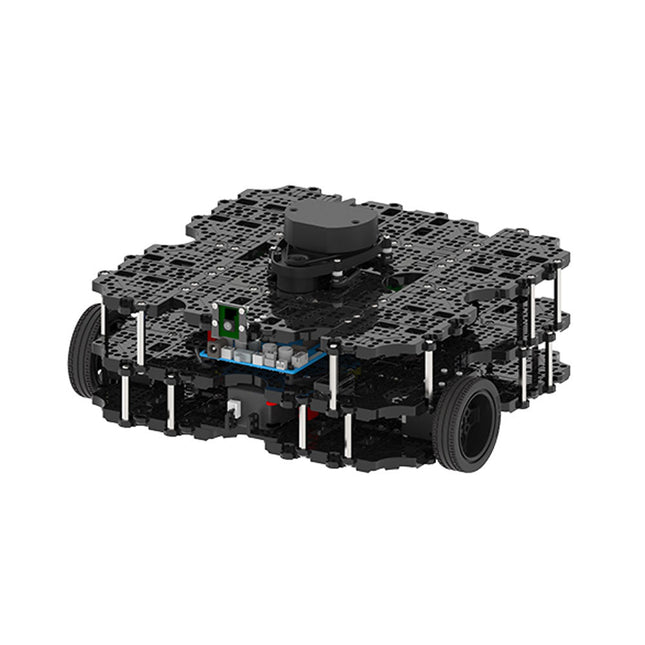
TurtleBot est le robot open source le plus populaire pour l'éducation et la recherche. La nouvelle génération de TurtleBot3 est un petit robot mobile, peu coûteux, entièrement programmable et basé sur ROS. Il est destiné à être utilisé pour l'éducation, la recherche, les loisirs et le prototypage de produits.
Coût abordable
TurtleBot a été développé pour répondre aux besoins économiques des écoles, des laboratoires et des entreprises. TurtleBot3 est le robot le plus abordable parmi les robots mobiles SLAM équipés d'un capteur de distance laser 360° LDS-01.
Norme ROS
La marque TurtleBot est gérée par Open Robotics, qui développe et maintient ROS. Aujourd'hui, ROS est devenu la plateforme de référence pour tous les roboticiens du monde. TurtleBot peut être intégré à des composants robotiques existants basés sur ROS, mais TurtleBot3 peut être une plateforme abordable pour ceux qui veulent commencer à apprendre ROS.
Extensibilité
TurtleBot3 encourage les utilisateurs à personnaliser sa structure mécanique à l'aide d'options alternatives : carte embarquée open source (en tant que carte de contrôle), ordinateur et capteurs. TurtleBot3 Waffle Pi est une plate-forme à deux roues à entraînement différentiel, mais sa structure et sa mécanique peuvent être personnalisées de nombreuses façons : voitures, vélos, remorques, etc. Développez vos idées au-delà de l'imagination avec différents SBC, capteurs et moteurs sur une structure évolutive.
Actionneur modulaire pour robot mobile
TurtleBot3 est capable d'obtenir des données spatiales précises en utilisant 2 DYNAMIXEL dans les articulations des roues. Les DYNAMIXEL de la série XM peuvent être utilisés selon l'un des 6 modes de fonctionnement (série XL : 4 modes de fonctionnement) : Mode de contrôle de la vitesse pour les roues, mode de contrôle du couple ou mode de contrôle de la position pour les articulations, etc. DYNAMIXEL peut même être utilisé pour fabriquer un manipulateur mobile qui est léger mais qui peut être contrôlé avec précision grâce au contrôle de la vitesse, du couple et de la position. DYNAMIXEL est un composant c?ur qui rend TurtleBot3 parfait. Il est facile à assembler, à entretenir, à remplacer et à reconfigurer.
Carte de contrôle ouverte pour ROS
La carte de contrôle est open-source au niveau du matériel et du logiciel pour la communication ROS. La carte de contrôle OpenCR1.0 est suffisamment puissante pour contrôler non seulement les capteurs DYNAMIXEL mais aussi les capteurs ROBOTIS qui sont fréquemment utilisés pour des tâches de reconnaissance de base de manière rentable. Différents capteurs tels que les capteurs tactiles, les capteurs infrarouges, les capteurs de couleur et bien d'autres sont disponibles. L'OpenCR1.0 possède un capteur IMU à l'intérieur de la carte afin d'améliorer la précision du contrôle pour d'innombrables applications. La carte dispose d'alimentations de 3,3 V, 5 V et 12 V pour renforcer les gammes d'appareils informatiques disponibles.
Source ouverte
Le matériel, le micrologiciel et le logiciel de TurtleBot3 sont des logiciels libres, ce qui signifie que les utilisateurs sont invités à télécharger, modifier et partager les codes sources. Tous les composants de TurtleBot3 sont fabriqués en plastique moulé par injection afin de réduire les coûts, mais les données de CAO 3D sont également disponibles pour l'impression 3D.
Spécifications
Vitesse de translation maximale
0.26 m/s
Vitesse de rotation maximale
1.82 rad/s (104.27 deg/s)
Charge utile maximale
30 kg
Taille (L x L x H)
281 x 306 x 141 mm
Poids (+ SBC + batterie + capteurs)
1.8 kg
Seuil de montée
Max 10 mm
Durée d'utilisation prévue
2 h
Temps de charge prévu
2 h 30 m
SBC (ordinateur à carte unique)
Raspberry Pi 4 (2 Go RAM)
MCU
32-bit ARM Cortex-M7 with FPU (216 MHz, 462 DMIPS)
Contrôleur à distance
RC-100B + BT-410 Set (Bluetooth 4, BLE)
Actionneur
XL430-W210
LDS (capteur de distance laser)
360 Laser Distance Sensor LDS-01 or LDS-02
Caméra
Raspberry Pi Camera Module v2.1
IMU
Gyroscope 3 axesAccelerometer 3 axes
Connecteurs d'alimentation
3.3 V/800 mA5 V/4 A12 V/1 A
Connecteurs d'extension
GPIO 18 brochesArduino 32 broches
Périphériques
3x UART, 1x bus CAN, 1x SPI, 1x I²C, 5x CAN, 4x 5-pin OLLO
Ports DYNAMIXEL
3x RS485, 3x TTL
Audio
Plusieurs séquences programmables
LED programmables
4x User LED
LED d'état
1x Board status LED1x Arduino LED1x Power LED
Boutons et interrupteurs
2x boutton poussoir, 1x bouton Reset, 2x DIPswitch
Batterie
Lithium polymer 11.1 V 1800 mAh / 19.98 Wh 5C
Connexion PC
USB
Mise à jour du micrologiciel
par USB / par JTAG
Adaptateur d'alimentation (SMPS)
Entrée: 100-240 VCA 50/60 Hz, 1.5 A @maxSortie: 12 VCC, 5 A
Téléchargements
Programmation de robots ROS
GitHub
Manuel électronique
Communauté
UNDERSTANDING THE NEURONS IN NEURAL NETWORKS (PART 1)Artificial Neurons
EMC PRE-COMPLIANCE TEST FOR YOUR DC-POWERED PROJECT (PART 1)Dual DC LISN
ELECTRONIC LOAD FOR DC AND ACUp to 400 V and 10 A (Peak)
STARTING OUT IN ELECTRONICSEasier Than Imagined! ...Taking on the Choke!
IMAGE PROCESSING WITH THE NVIDIA JETSON NANO (PART 1)The Hardware and Software
AN IN-DEPTH LOOK AT MAINS TRANSFORMERSHow Do They Behave When They Are Switched On and Off?
YES WE CAN WITH PICAN 3A CAN Bus HAT for the Raspberry Pi 4
BALCONY POWER PLANTDIY Solar Balcony = Speedy Payback!
IMAGING AND VIDEO-STREAMING WITH A RASPBERRY PI 4The Raspberry Pi High-Quality Camera in Practice
USING DISPLAYS IN RASPBERRY PI PROJECTSSample Chapter: Organic Light Emitting Diode Displays (OLED)
HANDS ON THE PARALLAX PROPELLER 2 (PART 4)Sending Strings
ELEKTOR @ 60A Look Back at Previous Septembers
HOMELAB TOURSIn the Friesian Countryside, Where the Tubes Bloom ...
HYBRIDSPeculiar Parts, the series
A COMPASS ROSE USING THE GY-271Or Why We Move in Figures of Eight to Calibrate a Sensor
FINDING YOUR FOOTPRINTCalculate the Carbon Footprint of Your Electronics
ESP32-CONNECTED THERMOSTATKeep Your Wine at the Right Temperature!
MAGNETIC LEVITATION THE DIGITAL WAYESP32 Pico Replaces the Analog Comparator
ULTIMATE ARDUINO UNO HARDWARE MANUALSample Chapter: Main Microcontroller Bootloader
MICROPYTHON FOR THE ESP32 AND FRIENDS (PART 2)Control Matrix Displays Easily
MADMACHINE SWIFTIO BOARDModern Language Meets Modern Hardware
FROM LIFE’S EXPERIENCEOn-Again, Off-Again Relationship
HEXADOKUThe Original Elektorized Sudoku
Elektor GREEN and GOLD members can download their digital edition here.
Not a member yet? Click here.
ESP32 Audio Transceiver Board (Part 2)Wireless Audio Transmission
Inductive AM TransmitterUses Pico’s PIO in an Arduino Sketch
Navigating Wireless ProtocolsA Technical Guide
Satellite Tracking Using LoRaThe TinyGS Network Bringing Space Data to Earth
4G-Compatible SMS Remote ControlRemotely Control Your Equipment
High-Speed ProbeHigh-Impedance Inputs for Signals up to 200 MHz
From Life’s ExperienceKafka
KrakenSDR
Performance Tests with the RP2350Is an Upgrade from Raspberry Pi Pico 1 to Pico 2 Worthwhile?
Contact-Free E-Field Measurements (2)A Laser Vibrometer for Assessing the Membrane's Vibrations
Crystals and OscillatorsImproving Crystal Accuracy Through Capacitor Selection
Starting Out in ElectronicsSpecial Audio ICs
Getting Started with Coding a DIY Project
SPECTRAN® V6 MobileModular, Configurable Real-Time Spectrum Analyzer for Reliable Measurements Across All Frequency Ranges
The Future of AI Is Forged in SiliconAn Interview with Anastasiia Nosova
Autonomous Sensor Node v2.0 (System Architecture)Solar-Powered Sensing Platform with Integrated GPS, LoRaWAN, and More
Precise PositioningBluetooth Channel Sounding Tested
Powering the Future of Wireless CommunicationBTRY’s Ultra-Thin Solid-State Batteries
Test-Driven Development in Firmware Writing
Phone-Controlled Model CarWi-Fi + ESP32 + Smartphone = Remote Control
2025: An AI OdysseyAI Reasoning Models: The Chain-of-Thought Revolution
Solar Charge Controller with MPP Tracking (3)Software and Commissioning
Raspberry Pi Zero Web Streaming CameraUsing the ZeroTier VPN
De Elektor LoRa Nodeveelzijdige 868MHz-afstandsbediening met status-feedback, een groot bereik en een STM32
Interactiefcorrecties & updates || vragen & antwoorden
Analoge elektronica ontwerpencase-study #1 – deel 2: de voorversterker voor de MEMS-microfoon
My IoT-button: de knop voor het netdeel 1: IoT-architectuur
BASIC voor ESP32/ESP8266programmeren met Annex WiFi RDS
ESP32-deurbel via Telegram“de postbode belt maar één keer”
Wie het kleine niet eert
Beginnen met LoRaWANmet Blue Pill, LoRa-breakout-board en The Things Network
“Een voorvechter van Open Internet”vraaggesprek met Wienke Giezeman, initiatiefnemer van The Things Network
Meadow F7een board voor .NET-ontwikkelaars
Multitasking met de ESP32 (2)taakprioriteiten
Met de vos in het IoT (3)eerste stappen op het net
Raspberry Pi Bash-commando cheat sheet
De meest succesvolle start-up aanjager?HighTechXL, Eindhoven, Nederland
Review: RPi-HAT Enviro+meet milieudata met Raspberry Pi en de Enviro+ HAT
Uit het leven gegrepenonderdelen bestellen in Oekraïne en Rusland
Review: Andonstar AD407beter dan zijn voorganger?
Oost West Lab Besteen blik in het allerheiligste, waar onbevoegden geen toegang hebben...
Optische probe voor de oscilloscoopmeet helderheidsvariaties van verlichtingssystemen
Het TABULA-project: een updatetangibles met gebruikersfeedback
Hoe... de maximale kortsluitstroom berekenenen de juiste zekeringautomaat te kiezen
TMS1000-serie microcontrollersvreemde onderdelen
Alle begin......hoeft niet zo moeilijk te zijn
Developer’s Zonetips & trucs, vakkunstigheden en andere nuttige informatie
Leidingen opsporenover het zoeken en vinden van onzichtbare en onderbroken leidingen
Review: Joy-IT DMSO2D72 portable 3-in-1 oscilloscoop
Doe-het-zelf PC voor het elektronicalabtips voor componentenkeuze en bouw
De Elektuur 'Intelekt' schaakcomputer (1981)Tiny Chess-86 geport naar de Intel 8088
PCB-kunstverlegt de grenzen van industriële productie
Hexadoku