GUI with Touch — for ESP32, RPi & Co.Graphical user interfaces with the LittlevGL library
"Not Just Any Guy's Project”Interview with Gábor Kiss-Vámosi, the developer of LittlevGL
Capaci-Meterwith two-digit Dekatron-style LED display
How To: Debounce a Mechanical Contact or SwitchA switch is either open or closed, isn't It?
Developer's ZoneTips & Tricks, Best Practices and Other Useful Information
Extendable Environmental Monitoring Systempublishes data on IoT platforms
Practical ESP32 MultitaskingTask programming with FreeRTOS and the Arduino IDE
InteractiveCorrections & Updates || Questions & Answers
Automotive Headlight TuningLegal, illegal — it matters!
Review: Toolcraft Digital Soldering Station
Arduino Pro IDE - First Impressions
Two Thermal Imaging Cameras ComparedSeek ShotPro and Seek Compact
Steeped in ElectronicsOutfitting the e-lab and e-workshop
Monsanto MAN1 LED DisplayPeculiar Parts, the series
Thermoelectric Tea TimerFirst dealings with energy harvesting
Single-Phase 1-Kilowatt AC Motor DriveThree-mode design: integral-cycle switching, phase-cut trailing, or phase-cut leading edge.
RPi Gets a Fast 3.5" Touch DisplayMore power at no extra charge
Lab, Sweet LabA glimpse of The Holy Place — no unauthorized entry.
First Steps with RISC-VTrying out the LoFive Board
Elektor Labs Challenged: a DIY LoRa Tracker
Glitches and results in electronics development
Sigfox and the IoT (2)Registration in the Sigfox network
Starting Out in ElectronicsEasier than imagined!
Analogue Electronics Design
Case Study #1 — Section 1: MEMS Microphone… Testing 1-2-3
Small Circuits RevivalCapita Selecta from the Elektor Project Suggestions Box
In a Nutshell: Text for MicrocontrollersUsing compression to save memory
Focus On: Autonomous DrivingState of the art at a glance
Start-Up Leaders and Innovators Talk “Innovation 4.0” in Munich
Lego Electronic Train Set from 196850 years on, electronic toys still fascinate
Beyond ElectronicsThe MX3D Bridge Senses the City
Kick off with the MAX1000 and VHDPlus
Ready to Master FPGA Programming? In this guide, we’re diving into the world of Field Programmable Gate Arrays (FPGAs) – a configurable integrated circuit that can be programmed after manufacturing. Imagine bringing your ideas to life, from simple projects to complete microcontroller systems!
Meet the MAX1000: a compact and budget-friendly FPGA development board packed with features like memory, user LEDs, push-buttons, and flexible I/O ports. It’s the ideal starting point for anyone wanting to learn about FPGAs and Hardware Description Languages (HDLs).
In this book, you’ll get hands-on with the VHDPlus programming language – a simpler version of VHDL. We’ll work on practical projects using the MAX1000, helping you gain the skills and confidence to unleash your creativity.
Get ready for an exciting journey! You’ll explore a variety of projects that highlight the true power of FPGAs. Let’s turn your ideas into reality and embark on your FPGA adventure – your journey starts now!
Exciting Projects You’ll Find in This Book
Arduino-Driven BCD to 7-Segment Display Decoder
Use an Arduino Uno R4 to supply BCD data to the decoder, counting from 0 to 9 with a one-second delay
Multiplexed 4-Digit Event Counter
Create an event counter that displays the total count on a 4-digit display, incrementing with each button press
PWM Waveform with Fixed Duty Cycle
Generate a PWM waveform at 1 kHz with a fixed duty cycle of 50%
Ultrasonic Distance Measurement
Measure distances using an ultrasonic sensor, displaying the results on a 4-digit 7-segment LED
Electronic Lock
Build a simple electronic lock using combinational logic gates with push buttons and an LED output
Temperature Sensor
Monitor ambient temperature with a TMP36 sensor and display the readings on a 7-segment LED
Téléchargements
Software
A Practical Guide to AI, Python, and Hardware Projects
Welcome to your BeagleY-AI journey! This compact, powerful, and affordable single-board computer is perfect for developers and hobbyists. With its dedicated 4 TOPS AI co-processor and a 1.4 GHz Quad-core Cortex-A53 CPU, the BeagleY-AI is equipped to handle both AI applications and real-time I/O tasks. Powered by the Texas Instruments AM67A processor, it offers DSPs, a 3D graphics unit, and video accelerators.
Inside this handbook, you‘ll find over 50 hands-on projects that cover a wide range of topics—from basic circuits with LEDs and sensors to an AI-driven project. Each project is written in Python 3 and includes detailed explanations and full program listings to guide you. Whether you‘re a beginner or more advanced, you can follow these projects as they are or modify them to fit your own creative ideas.
Here’s a glimpse of some exciting projects included in this handbook:
Morse Code Exerciser with LED or BuzzerType a message and watch it come to life as an LED or buzzer translates your text into Morse code.
Ultrasonic Distance MeasurementUse an ultrasonic sensor to measure distances and display the result in real time.
Environmental Data Display & VisualizationCollect temperature, pressure, and humidity readings from the BME280 sensor, and display or plot them on a graphical interface.
SPI – Voltmeter with ADCLearn how to measure voltage using an external ADC and display the results on your BeagleY-AI.
GPS Coordinates DisplayTrack your location with a GPS module and view geographic coordinates on your screen.
BeagleY-AI and Raspberry Pi 4 CommunicationDiscover how to make your BeagleY-AI and Raspberry Pi communicate over a serial link and exchange data.
AI-Driven Object Detection with TensorFlow LiteSet up and run an object detection model using TensorFlow Lite on the BeagleY-AI platform, with complete hardware and software details provided.
Build Smart Applications with Raspberry Pi, Arduino, and ESP32
Discover how easy and exciting mobile app development can be with MIT App Inventor. This hands-on guide takes you from basic concepts to building real-world mobile applications using a simple visual programming approach—no prior coding experience required. You will create IoT and AI-powered apps for Android devices and explore how App Inventor can also be used with iPhones and iPads.
Connect your applications to platforms such as Arduino UNO R4 WiFi, ESP32, Raspberry Pi Pico (2)W and Raspberry Pi 5, enabling you to build smart, connected systems.
Inside the book, you will learn how to:
Build interactive apps using buttons, images, sound, and multimedia
Create text-to-speech and speech-recognition applications
Develop camera-based and location-aware (GPS) apps
Design useful tools such as calculators and educational apps
Work with smartphone sensors like accelerometers and light sensors
Build AI-powered applications, including voice assistants and image-generation features
Send and receive messages, and create communication-based apps
Connect mobile apps to hardware using Wi-Fi and Bluetooth
Control real devices such as LEDs, motors, and sensors
Designed for beginners, students, and hobbyists, this book focuses on learning by doing. By the end, you will have the skills and confidence to create your own innovative applications that interact with both the digital and physical worlds.
Start building and turning your ideas into reality.
Le téléchargement intégral de ce numéro est disponible pour nos membres GOLD et GREEN sur le site Elektor Magazine !
Pas encore membre ? Cliquez ici.
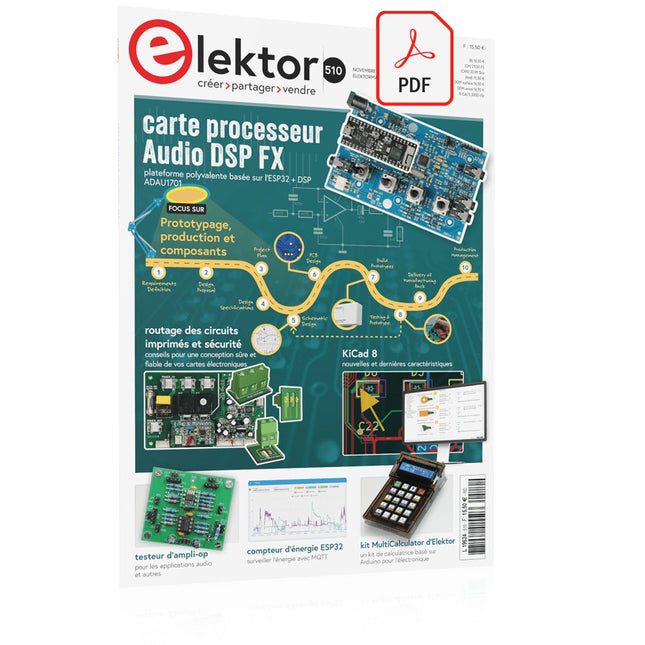
Prototypage, production et composants !
carte processeur Audio DSP FXpartie 1 : caractéristiques et conception
50 ans d'Elektor en anglais
KiCad 8nouvelles et dernières caractéristiques
Elektor @ electronica 2024electronica Fast Forward 2024, des experts sur scène, des forums d'influenceurs, des talk-shows Elektor Lab en direct, et plus encore
kit MultiCalculator d'ElektorUn kit de calculatrice basé sur Arduino pour l'électronique
systèmes GNSS RTK à faible coûtavec un degré de précision de l'ordre du centimètre
routage des Circuits Imprimés et sécuritéConseils pour une conception sure et fiable de vos cartes électroniques
testeur d'ampli-oppour les applications audio et autres
mise à jour du projet #4 : compteur d'énergie ESP32surveiller l'énergie avec MQTT
analyseur de spectre temps-réel à technologie guide d’onde et PC à interfaces multiplesAaronia introduit une nouvelle ligne de produit et présente ses premiers prototypes au salon Electronica de Munich
inductances SMTbobines et ferrites – un choix simplifié
utilisation d’un blindage EMI pour assurer la conformité à la compatibilité électromagnétique
l'outil ultime pour tous les passionnés d’électroniqueDébloquez des possibilités infinies avec Red Pitaya et plus de 1000 Click Boards™
HDI au milieuUn nouveau service PCB-pooling rentable pour des petits BGA
défis de l'analyse DFM pour les circuits flexibles et flexibles-rigides
outils open-sourcesimulateur d'antennes, gestion des composants, calculatrice, et bien plus
Infographie : prototypage et production
sur le vifmicrotechnophobie : c’est grave, docteur ?
arbre de Noël 3Dcircuit imprimé 3D avec un microcontrôleur 32 bits peu coûteux
démarrer en électronique......on continue avec l'ampli-op !
nœud de capteurs autonome (mise à jour du projet #1)Reducing Idle Power Consumption with External RTC and Power Switch
2024 : l'odyssée de l'IAUn regard sur l'avenir
afficheurs LED avec le MAX7219Une méthode pratique pour une excellente puce
projet 2.0Corrections, mises à jour et courrier des lecteurs
gants vibro-tactilesune avancée pour les patients de Parkinson
Projects with Thonny-IDE, uPyCraft-IDE, and ESP32
The 'Python' programming language has enjoyed an enormous upswing in recent years. Not least, various single-board systems such as the Raspberry Pi have contributed to its popularity. But Python has also found widespread use in other fields, such as artificial intelligence (AI) or machine learning (ML). It is obvious, therefore, to use Python or the 'MicroPython' variant for use in SoCs (Systems on Chip) as well.
Powerful controllers such as the ESP32 from Espressif Systems offer excellent performance as well as Wi-Fi and Bluetooth functionality at an affordable price. With these features, the Maker scene has been taken by storm. Compared to other controllers, the ESP32 has a significantly larger flash and SRAM memory, as well as a much higher CPU speed. Due to these characteristics, the chip is not only suitable for classic C applications, but also for programming with MicroPython.
This book introduces the application of modern one-chip systems. In addition to the technical background, the focus is on MicroPython itself. After the introduction to the language, the programming skills learned are immediately put into practice. The individual projects are suitable for use in the laboratory as well as for everyday applications. So, in addition to the actual learning effect, the focus is also on the joy of building complete and useful devices. By using laboratory breadboards, circuits of all kinds can be realized with little effort, turning the testing and debugging of the 100% homebrew projects into an instructive pleasure.
The various applications, such as weather stations, digital voltmeters, ultrasound range finders, RFID card readers or function generators, make the projects presented ideally suited for practical courses or subject and study work in the natural sciences, or in science and technology classes.
Elektor GREEN en GOLD leden kunnen deze uitgave hier downloaden.
Nog geen lid? Klik hier om een lidmaatschap af te sluiten.
OBD2-sensordashboardOude meters vormden het startpunt van een zoektocht naar echte gegevens
OBD2: voeg een toerenteller en schakelindicator toe aan je autoRetro, maar uiterst nuttig
LiDAR- en Visiesensoren voor Robotica
Sensor+Test 2025 en PCIM 2025
Contactloze E-Veldmetingen (1)Een Trillende Membraan voor het Detecteren van Gelijkspanningen of Statische Elektrische Velden
Draadloze brievenbusmeldervan optische sensoren tot radar: enkele mogelijkheden
Elektor Mini-Wheelieeen zelfbalancerende robot
ZonnecellenVreemde onderdelen, de serie
Aan de slag met een moderne radarsensorStaat een nauwkeurige meting op uw radar?
Uit het leven gegrepenpapierfabriek
CybersecurityZware tijden voor hackers
Infographics: IoT en sensoren 2025
Bluetooth 6.0 brengt verbeterde toepassingen voor afstandsbepalingNieuwe versie biedt betere apparaatpositionerings- en -locatieservices
Draadloze communicatie verkennen met BeagleY-AI
Err-lectronicsCorrecties, updates en lezerspost
Alle begin......sluit het thema opamps af
Een krachtige AI-codeerassistentsneller ontwikkelen met Continue en Visual Studio Code
Zonne-laadregelaar met MPPT (2)Het schema
Ultrasone obstakeldetectoreen eenvoudig project om slechtzienden te helpen
2025: Een AI-odysseeHalfjaaroverzicht
Raspberry Pi Standalone MIDI-synthesizer (3)Het slimmer maken en een gebruikersinterface toevoegen
Meshtastic: een demonstratieprojectEen slim netwerk van LoRa-radio's
Analoge audio-frequentiegeneratorHoogwaardige sinusgenerator met instelbare frequentie
Aus dem Inhalt
Lieferbarkeit von Röhren
Passive Übeltäter – Einfluss der Kondensatoren auf den Klang
Übertragerwissen
Theorie der Trioden
Der richtige Einsatz von Gleichrichterröhren
Line-Vorverstärker mit Klangsteller
Vollverstärker mit 2 x 50 W oder 2 x 40 W
HiFi-CD-Player mit Playstation 1
CD-Filter
Nachlese
In dem Artikel "Moderne Triodenendstufe mit der legendären 2A3" ab Seite 66 wurden bei den Platinenabbildungen die Maßangaben nicht abgedruckt. Hier die Maße der Originalgrößen:
Netzteilplatine (S. 68) 123 x 80 mm
Stabilisierung (S. 69) 70 x 85 mm
Hauptplatine (S. 71) 295 x 135 mm
Le spectre-analyseur Siglent SSA3015X Plus est un outil puissant et flexible pour l'analyse des signaux RF et des réseaux. Avec une plage de fréquence de 1,5 GHz, l'analyseur offre des mesures automatiques fiables et plusieurs modes de fonctionnement : analyseur de spectre de base, les fonctions optionnelles comprennent la mesure de puissance RF, l'analyse de modulation de signal vectoriel, la mesure de réflexion et les tests de IEM.
Les applications incluent la surveillance/évaluation de la diffusion, la cartographie de site, la mesure des paramètres S, l'analyse de modulation analogique/numérique, le test de préconformité IEM, la recherche et développement, l'éducation, la production et la maintenance.
Caractéristiques
Plage de fréquence de l'analyseur de spectre de 9 kHz à 1,5 GHz
Niveau de bruit moyen affiché de -156 dBm/Hz (typique)
Bruit de phase décalée de -99 dBc/Hz à 10 kHz de décalage (1 GHz, typique)
Incertitude de mesure de niveau
Largeur de bande de résolution minimale de 1 Hz (RBW)
Préamplificateur (standard)
Générateur de poursuite (fourni gratuitement)
Mode d'analyse de modulation de signal analogique et numérique (en option)
Kit de mesure de réflexion (en option)
Kit de filtre IEM et détecteur quasi-crête (en option)
Kit de mesure avancée (en option)
Écran multi-touch de 10,1 pouces, prise en charge de la souris et du clavier
Contrôle distant via navigateur web sur PC et terminaux mobiles et opérations de fichiers
Spécifications
SSA3015X Plus
SSA3021X Plus
SSA3032X Plus
SSA3075X Plus
Plage de fréquence
9 kHz ~ 1,5 GHz
9 kHz ~ 2,1 GHz
9 kHz ~ 3,2 GHz
9 kHz ~ 7,5 GHz
Largeur de bande de résolution
1 Hz ~ 1 MHz
1 Hz ~ 1 MHz
1 Hz ~ 1 MHz
1 Hz ~ 3 MHz
Bruit de phase
Précision totale de l'amplitude
Niveau moyen de bruit affiché
-156 dBm/Hz
-161 dBm/Hz
-161 dBm/Hz
-165 dBm/Hz
Inclus
Spectre-analyseur Siglent SSA3015X Plus
Câble USB
Cordon d'alimentation
Guide de démarrage rapide
Téléchargements
Datasheet
Manual
Documentation
Firmware
Diese Ausgabe steht allen GOLD- und GREEN-Mitgliedern auf der ElektorMagazine-Website zum Download bereit!
Sie sind noch kein Mitglied? Hier klicken!
Digitale Last für HochstromtestsVon der Notwendigkeit zur Innovation
GesangsentfernerInstant-Karaoke-Schaltung
Audio-Eingangswahlschalter mit VerstärkungseinstellungSchaltet von Mikrofon- auf Line-Eingänge um
Ladeschaltung für LIR2032Optimierte Ladung = längere Haltbarkeit
Touch-Sensing leicht gemachtEin DIY-Leitfaden für jeden Mikrocontroller
Universeller Infrarot-FernschalterEin neues Leben für alte Fernbedienungen
Mikrocontroller-gesteuerte MuhdoseBovine Klänge mit einem Mikrocontroller erzeugen
USB-Batterieschnittstelle
Stromversorgung von Low-Power-Geräten mit PowerbanksEine Stay-Alive-Lösung
Kleiner Klasse-A-Audioverstärker mit StromausgangLautsprecher mit Strom statt mit Spannung ansteuern
Pseudosymmetrisches ModulHohes Gleichtaktunterdrückungsverhältnis trotz asymmetrischen Audioverbindungen
Automatisches Ladegerät für Ni-MH-ZellenFüllen Sie alle Ihre Akkupacks in einem Rutsch auf!
Sicherheit durch thyristor-basierte Strombegrenzung
Fingerabdruck-Sensor-SchalterEin nützliches Gerät zum Identitätsnachweis
3-A-GleichspannungswandlerBessere Nutzung Ihrer Festspannungsquellen
Innovationen aus dem Arduino-Project-HubNeue Projekte aus der Community
Fernkontrolle eines BoilersSpannungs- und Stromdetektion für Netzspannungsleitungen
Abschwächer für AudiosignaleTeil 1. Einstellbar über Jumper
Autobatterie-Ladegerät aufgemotztTeil 1. Wiederverwenden statt wegwerfen!
Eine Platine für „The Blue One“Platine für Alps-Motorpotentiometer mit Rückmeldung
50-Hz-Referenz aus 60-Hz-NetzspannungWie man 50-Hz-Elektronik in 60-Hz-Umgebungen verwendet
Digitale IsolatorenGalvanische Trennung einfach realisieren
Kompakter 12-W-Hi-Fi-MonoverstärkerKlein, aber leistungsstark
LM386-Rampengenerator
DrehstromgeneratorMit Raspberry Pi Pico
Türöffner für musikalisch Begabte
Elektor-Klassiker: Surf-SynthesizerMeereswassersporthintergrundgeräuschgenerator (Mwsh3g)
Autobatterie-Ladegerät aufgemotztTeil 2. Ladesteuerung analog und digital
LampenstromüberwachungMit Raspberry Pi Pico
Infrarot-Telegraphie
Fnirsi SWM-10Reparatur von Batteriepacks mit tragbarem intelligentem Punktschweißgerät
Stereo-Audio-Codec für ESP32 und Co.Keine Angst vor Audio-Messtechnik
Die Kunst des LötensLötzinn-Techniken für einwandfreie Verbindungen
Abschwächer für AudiosignaleTeil 2. Umschalten per Relais
USB-C-PowerStrom aus USB-C-Netzteilen beziehen
Drei Schaltungen mit zwei und drei Zähler-ICs4017-ICs im Zusammenspiel
Aktive Bauelemente – Die Diode
Timer für extrem lange VerzögerungenEinstellen und vergessen!
Klinke rein, Klinke rausEine nützlicher Anschluss für Audioschaltungen
ESP32 mit nur einer Lithium-Zelle versorgen
Hexadoku
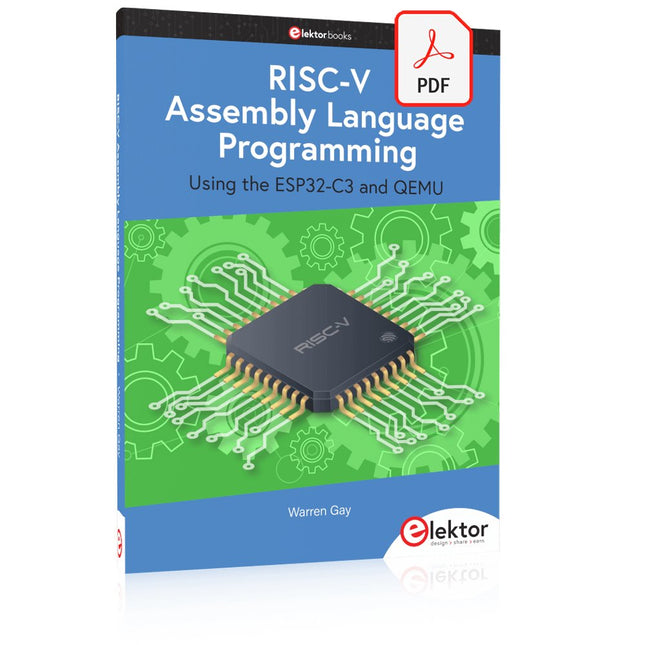
With the availability of free and open source C/C++ compilers today, you might wonder why someone would be interested in assembler language. What is so compelling about the RISC-V Instruction Set Architecture (ISA)? How does RISC-V differ from existing architectures? And most importantly, how do we gain experience with the RISC-V without a major investment? Is there affordable hardware available?
The availability of the Espressif ESP32-C3 chip provides a way to get hands-on experience with RISC-V. The open sourced QEMU emulator adds a 64-bit experience in RISC-V under Linux. These are just two ways for the student and enthusiast alike to explore RISC-V in this book.
The projects in this book are boiled down to the barest essentials to keep the assembly language concepts clear and simple. In this manner you will have “aha!” moments rather than puzzling about something difficult. The focus in this book is about learning how to write RISC-V assembly language code without getting bogged down. As you work your way through this tutorial, you’ll build up small demonstration programs to be run and tested. Often the result is some simple printed messages to prove a concept. Once you’ve mastered these basic concepts, you will be well equipped to apply assembly language in larger projects.
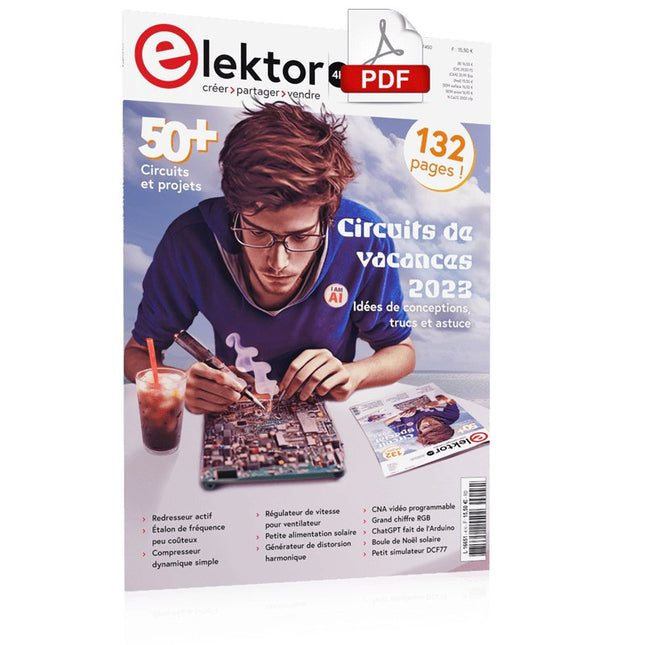
Le téléchargement intégral de ce numéro est disponible pour nos membres GOLD et GREEN sur le site Elektor Magazine !Pas encore membre ? Cliquez ici.petite alimentation solairelumière du soleil en entrée, 3,3 V en sortiecommutateur audio stéréo statiquesans clics ni pièces mobilesgrand chiffre RGBavec LED traversants de type WS2812préamplificateur de microphone avec alimentation fantôme 48 Vidéal pour le podcasting et la sonorisation progénérateurs d'ondes carrées avec commande de rapport cyclique et de fréquencemontages simples avec des CI CMOS et TTLcompresseur Dynamique Simpleavec contrôle doux et un son chaleureuxserrure électronique simpleredresseur actifde 2 à 40 V jusqu'à 3 A avec suppression du courant inversecommutation marche/arrêt pour enceintes activesconvertisseur symétrique/asymétriqueavec filtre RFI et protection CC2023 : l'odyssée de l'IAorigine et évolutionrégulateur de vitesse pour ventilateur ou aérateuravec modes manuel et thermostatPlateforme Projets Arduino : dernières nouvellesnouveaux projets de la communautémoniteur de surchargesurveillez les lignes électriques pour détecter les courants excessifsclignotement nocturne sans transistorsun oscillateur ne comportant que des composants à deux filsgénérateur de code morseutilisez-le comme balise ou dispositif d'apprentissage !CNA vidéo programmabletraite tous les formats jusqu'à RGB888un tout petit pianosans pièces mobilesdouble-dé électronique sans microcontrôleurdeux dés sur un seul circuit imprimé – plus quelques astuces de conceptioneffaroucheur électroniquecircuits qui amusent, inspirent et étonnentthermomètre LC-LP-HAmesures précises et affichage binairegénérateur de distorsion harmoniquegénérer volontairement de la distorsionindicateur de surchauffe à thyristorutilisation non conventionnelle des composants électroniquesune bascule CTPun drôle d'oiseauun classique d'Elektor qui émet des gazouillislampe au néon avec microcontrôleursource de courant stable en températureéliminer la dérive de température des CI sources de courantcorrecteur d'aigus d'ordre 2 réglablecorrection auditive pour personnes âgéesEdwin revientaprès 53 ans d'absencemachine à sous à levierun classique d'Elektor simple, amusant, nostalgique et éducatifrésistance variable simple à contrôle numériqueprotection contre les fuites d'eauprotection et alarme contre les fuites d'eauminuterie économique avec arrêt automatiquenécessite 0,0 mW en mode éteint !ChatGPT fait de l'ArduinoZD-mètremesure de la tension de coude des diodes Z ≤ 100 Vtesteur de servosContrôleur Windows ESP32 avec logiciel gratuitcircuits analogiques et mixtes de Microchipgestion de l'alimentation économe en énergie et traitement de signalstandards d'interfacesfiltrage et protection contre leurtensions pour le bus I²Cmoniteur de batterie Li-Ionl'indicateur de charge résiduelle fournit un retour d'information visuelsouris PS/2 comme codeur rotatif (et plus…)interrupteur crépusculaire simplepour moderniser vos luminaires ou vos installationscommande de pompe à eauprotégez-vous contre la montée des eauxboule de Noël solaire avec radio FMtout ce que vous voulez pour Noël, c'est celacapteur de vibrations avec relaistapotez ou secouez pour allumertesteur de continuitésensible et discretbouton-poussoir marche/arrêtContrôleur pour mini-perceuse 2023révision d'un projet de 1980détecteur de vibration numériquetransformez les vibrations en impulsions précisesprotection contre l'inversion de polarité avec faible chute de tensionétalon de fréquence peu coûteuxpetit simulateur DCF77une référence précise pour le Fake-Timele Lilygo T-PicoC3combine un RP2040 et un ESP32-C3 avec un écran TFT couleurHexadoku