
Résultats de la recherche pour "seminar OR c OR programmierung OR mikrocontroller OR programm"
-
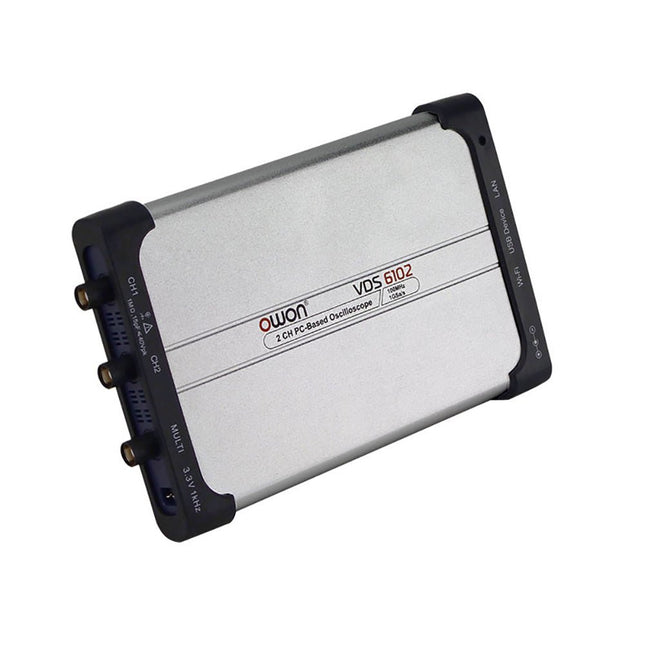
OWON OWON VDS6102A Oscilloscope USB à 2 canaux (100 MHz)
The OWON VDS6000 Series PC Oscilloscope combines powerful performance with a sleek, ultra-thin design. With 100 MHz bandwidth, 1 GSa/s real-time sampling, and up to 14-bit resolution, it delivers highly accurate measurements. The built-in 5 MHz function generator, USB-C power supply, and optional WiFi connectivity make it incredibly versatile. Compatible with Windows, Linux, Android, and iOS, the VDS6000 is perfect for labs, fieldwork, and remote diagnostics – compact, flexible, and ready for any challenge. Features Bandwidth: 100 MHz Vertical resolution: 14 bits Rise time: ≤3.5 ns Memory: 10 Mpts Number of channels: 2 channels + 1 channel function generator Horizontal scale: 5ns - 100s/div Sample rate: Max. 1 GSa/s Maximum voltage: 40 V (peak - peak) Automatic measurements: Vpp, Vavg, Vamp, Vrms, Freq, Period, Vmax, Vmin, Vtop, Vbase, Overshoot, Preshoot, Rise Time, Connectivity: USB-C, LAN, Wifi (optional) Fall Time, Delay A→B↑, Delay A→B↓, +Width, -Width, +Duty, -Duty Bandwidth: 5 MHz Sample rate: 25 MSa/s Standard waveforms: Sine (0.1 Hz - 5 MHz), Square (0.1 Hz - 200 kHz), Ramp (1 Hz - 10 kHz), Pulse (1 Hz - 10 kHz) Resolution: 10 bits DC offset range (AC + DC): ±2.5 V Amplitude range: 10 mVpp - 5 Vpp Dimensions: 190 x 120 x 18 mm Weight: 380 g Downloads Manual Quick Guide PC Software MacOS Software
€ 327,27
-
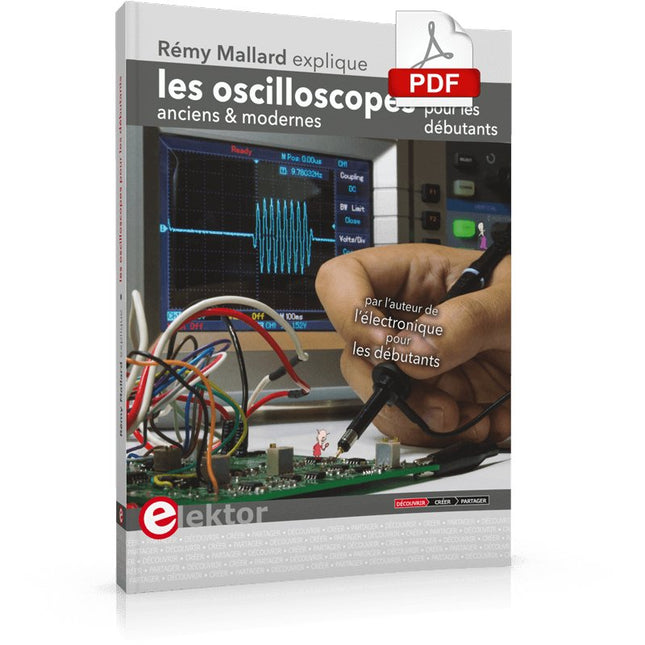
Elektor Digital Les oscilloscopes anciens & modernes pour les débutants (E-book)
Ce qui se passe en électronique est par définition invisible à l'oeil nu. L'instrument qui permet précisément de rendre visibles les signaux électriques, celui par le truchement duquel les effets de l'électronique se manifestent à nous, c'est l'oscilloscope. Hélas, quand on commence à faire de l'électronique, c'est souvent sans oscilloscope. Et l'on en est réduit à tâtonner, aussi bien physiquement que mentalement. Le jour où l'on goûte à la visualisation des signaux sur un écran, c'est une révélation. Plus personne ne souhaite se priver de cet enchantement. Pas de retour en arrière. En électronique, si l'on veut progresser dans le plaisir et dans la compréhension, il faut un oscillo. Commence alors une période d'interrogation : comment choisir ? Et à peine cette question-là aura-t-elle trouvé sa réponse, il en viendra une ribambelle d'autres que l'on peut résumer en une seule : comment se servir de l'oscilloscope de telle sorte que ce qu'il affiche corresponde bien à la réalité des signaux ? Dans ce livre, Rémy Mallard, répond clairement à ces questions. Il donne aussi de nombreuses informations pour aider son lecteur à élucider lui-même de nouveaux mystères qui ne manqueront pas de surgir. Ceux qui le connaissent déjà comme l'auteur d'un livre sur l'électronique dont le titre est un programme à lui tout seul : L'électronique pour les débutants qui sèchent les cours mais soudent sans se brûler les doigts, ainsi que d'un livre d'initiation à la programmation des microcontrôleurs PIC, savent qu'ils trouveront ici un ouvrage utile, qu'ils rouvriront souvent.
€ 34,95
Membres : € 31,46
-

Arduino Câble USB-C officiel d'Arduino (2-en-1)
Maintenant, vous pouvez connecter vos cartes Arduino avec le câble USB officiel d'Arduino. Grâce à une connexion USB-C vers USB-C avec un adaptateur USB-A, ce câble USB de données peut facilement relier vos cartes Arduino à l'appareil de programmation de votre choix. Le câble USB d'Arduino possède une gaine tressée en nylon aux couleurs typiques d'Arduino, blanc et teal (bleu-vert). Les connecteurs ont une coque en aluminium qui protège votre câble tout en ayant un aspect élégant. Longueur : 100 cm Coque en aluminium avec logo Gaine tressée en nylon blanc et teal
€ 12,95
Membres : € 11,66
-

Elektor Januari/Februari 2026 (NL)
Elektor GREEN en GOLD leden kunnen deze uitgave hier downloaden. Nog geen lid? Klik hier om een lidmaatschap af te sluiten. Low-noise laboratorium voeding (1)Een stabiele voedingsbron voor gevoelige circuits STM32 Edge-AI Contest 2025: De winnaars Batterijen van vandaagTechnologie en verschillen in lithiumbatterijen Instelbare elektronische belastingStatische en dynamische DC-belasting Step-down converter van 48 V naar 5 VHet verhaal achter de ontwikkeling van een schakeling Autonome sensornode v2.0Deel 2: Hardware-validatie en vermogensoptimalisatie VaristorenVreemde onderdelen Grafische netfrequentiemeterControleer de kwaliteit van het stroomnet Alle begin......maakt er een eind aan Piekstroombelasting SMD-ferrietenBeter bestand tegen stroompieken Elektor Live! Expert Day 2025 Energy harvesting belooft de implementatie van IoT- en IIoT-toepassingen te zullen versnellenHoe energy harvesting IoT loskoppelt van het stroomnet Fnirsi DPS-150Compacte draagbare voeding en converter Instelbare USB-C voedingsbronMaak van uw USB-C-lader een regelbare voeding Eenvoudige lader en capaciteitstesterMet twee goedkope kant-en-klaar modules Slimme kleurendetector met AI-stem en afspeelfunctie PbMonitor v2.0Overzicht van het vernieuwde accu-bewakingssysteem Een ventilator voor de mini-reflow plateSlimme aanpassingen die de resultaten verbeteren Uit het leven gegrepende tsunami der verwendheid Err-lectronicsCorrecties, updates en lezersbrieven 2026: Een AI-odysseeWanneer modellen de hardware bepalen Precisie pico-ampèremeter (2)Montage, kalibratie en test Draadloze energievoorziening van apparatenMet inductieve technologie Autonoom rijden op basis van AIDe Self Driving Challenge 2024 van de RDW Geluidskaart als signaalgeneratorPC als DCF77-testzender
€ 15,95
-
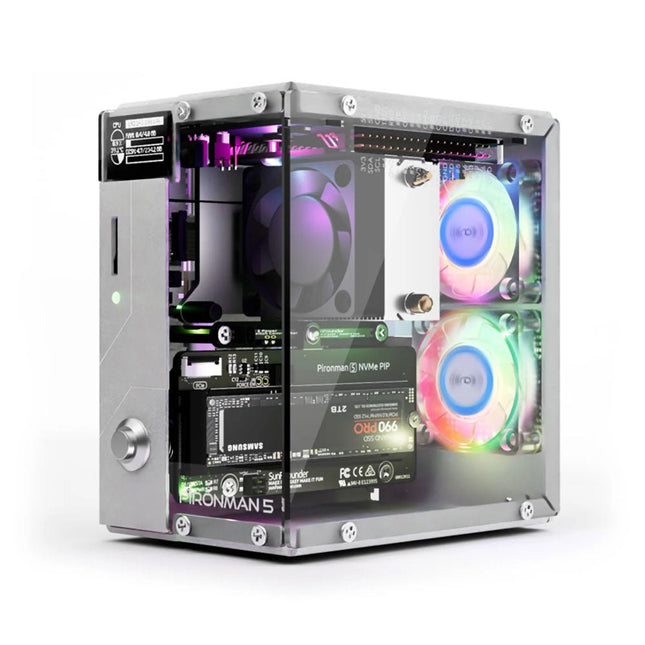
SunFounder Pironman 5 NVMe M.2 SSD PCIe Mini PC Boîtier pour Raspberry Pi 5
Améliorez votre Raspberry Pi 5 avec le Pironman 5, construit en aluminium robuste, avec un refroidissement supérieur, un support SSD NVMe M.2, un écran OLED, un éclairage RVB, des ports HDMI standard x2 et un interrupteur d'alimentation sécurisé. Il est parfait pour les NAS, Home Assistant, Media et Game Centers. Le Pironman 5 n'est pas seulement un boîtier ; il s'agit d'une mise à niveau qui transforme votre Raspberry Pi 5 en un appareil puissant, efficace et élégant. Le Pironman 5 comprend le Pi 5 NVMe PIP (PCIe Peripheral Board), une carte adaptateur PCIe spécialement conçue pour les disques SSD NVMe. Cette carte prend en charge quatre tailles de SSD NVMe : 2230, 2242, 2260 et 2280, qui peuvent tous être installés dans un emplacement pour clé M.2 M. La connexion est certifiée pour les vitesses Gen 2.0 (5 GT/sec), mais peut être forcée à Gen 3.0 (10 GT/sec) pour des performances plus rapides. Emplacement SSD NVMe M.2 extensible Améliorez les performances de votre Raspberry Pi 5 avec l'emplacement SSD NVMe M.2 du Pironman 5, prenant en charge plusieurs tailles (2230, 2242, 2260, 2280) pour un stockage accru et une réponse plus rapide du système. Système de refroidissement avancé Gardez votre Raspberry Pi 5 au frais et élégant avec le refroidisseur tour du Pironman 5 et ses deux ventilateurs RVB, dotés de filtres anti-poussière pour un fonctionnement durable et nécessitant peu d'entretien. Écran OLED pour des informations instantanées Le Pironman 5 comprend un écran OLED de 0,96 pouces, fournissant des mises à jour immédiates sur l'utilisation du processeur et de la RAM, la température, l'adresse IP, etc. Fonctionnalité et sécurité améliorées Le Pironman 5 sécurise votre Raspberry Pi 5 avec des fonctionnalités telles qu'un arrêt sécurisé, des LED RVB personnalisables, des ports HDMI, un récepteur IR et un prolongateur GPIO externe, améliorant ainsi la fonctionnalité et la connectivité. Caractéristiques Mini PC Raspberry Pi 5 Écran OLED de 0,96" affichant l'utilisation du processeur, la température, l'utilisation du disque, l'adresse IP, l'utilisation de la RAM, etc. du Raspberry Pi. Le refroidisseur tour peut refroidir une charge CPU à 100% Pi à 39°C à une température ambiante de 25°C 2 ventilateurs RVB, avec contrôle GPIO 1 ventilateur PWM sur le refroidisseur tour est contrôlé par le système Raspberry Pi. Prend en charge quatre tailles de SSD NVMe M.2 (PCIe Gen 2.0/PCIe Gen 3.0) : 2230, 2242, 2260 et 2280. 4 LED RVB adressables WS2812 illuminent l'ensemble du boîtier avec un effet de lumière cool Récepteur IR pour centre multimédia comme Kodi ou Volumio Bouton d'alimentation rétro en métal pour un arrêt en toute sécurité Rallonge GPIO externe avec étiquette de nom de code PIN, pour un accès facile Équipé d'un support à ressort pour un retrait facile de la carte Corps principal en aluminium avec panneau latéral en acrylique transparent Comprend deux ports HDMI standards Téléchargements Documentation
€ 79,95
Membres : € 71,96
-

Zhongdi ZD-8962B Station de soudage ESD (70 W)
La station de soudage ZD-8962B offre une plage de température réglable de 160°C à 480°C et une puissance de 70 W. Grâce à son élément chauffant intégré à la panne, elle atteint la température de fonctionnement souhaitée en seulement 8 secondes. Un grand écran numérique permet un contrôle précis de la température en temps réel, affichant à la fois la température cible préréglée et la température actuelle du fer. De plus, la station est protégée contre les décharges électrostatiques (ESD), garantissant ainsi la protection des composants électroniques sensibles contre les décharges électrostatiques pendant son utilisation. Spécifications Puissance 70 W Tension d'entrée 220-240 V CA/50 Hz Tension de sortie 20 V Plage de température 160°C – 480°C Temps de chauffe ~8 s Écran Grand écran LED à deux lignes affichant la température cible et la température réelle Fonctions spéciales Protection contre les décharges électrostatiques, Mode veille/économie d'énergie, Basculer entre °C et °F Inclus ZD-8962B Station de soudage Fer à souder Pointe à souder N12-1 Support pour fer à souder avec brosse en cuivre et éponge Support pour fil à souder avec fil à souder sans plomb (10 g) Câble d'alimentation (UE) Manuel
€ 59,95
Meilleur prix
-

Elektor Digital Elektor May/June 2021 (PDF) EN
DIY LiPo Supercharger KitFrom Handcrafted to Mass Market Elektor @ 60Reflections on Six Decades of Electronics Siglent Bench Multimeter SDM3045X DC Current-Sense ClampHall Sensor + Ferrite Core + Arduino Soldering Station 2021Easy to build! Hands On the Parallax Propeller 2Part 2: The Development Environment and Code Wi-Fi for LoRa SwitchIntegrated in Home Assistant with ESPHome Do Not Fear the Cellular Module! Tracking Time with ESP32 and TogglWorking with the M5Stack Get to Know the Raspberry Pi Pico Board and RP2040 MicroPython for MicrocontrollersSmall-Format Screens 12-to-200-V DC/DC Converter for Valve Amplifiers Heat SeekerThe Seek Shot Pro Thermal Imaging Camera Object-Oriented Programming: A Short Primer Using C++ HomeLab ToursHome Lab and an Analogue Synthesiser by Kurt Diedrich Java on the Raspberry PiPart 1: GPIOs DIP SwitchesPeculiar Parts, the series Project 2.0Corrections, Updates and Readers’ Letters Whose Product Is It Anyway?Right to Repair Gains Momentum From Life's ExperienceThe Great Book of Blunders Micro-ProfessorLearning Assembly Language on a Z80 Starting out in ElectronicsEasier Than Imagined! Even When It Is About Capacitors HexadokuThe Original Elektorized Sudoku
€ 7,50
-

Siglent Oscilloscope Siglent SDS2204X Plus 4 canaux (200 MHz)
Siglent's SDS2000X Plus series Digital Storage Oscilloscopes are available in bandwidths of 100 MHz, 200 MHz, and 350 MHz, have a maximum sample rate of 2 GSa/s, a maximum record length of 200 Mpts/ch, and up to 4 analog channels + 16 digital channels mixed-signal analysis ability. The SDS2000X Plus series employs Siglent?s SPO technology with a maximum waveform capture rate of up to 120,000 wfm/s (normal mode, up to 500,000 wfm/s in Sequence mode), 256-level intensity grading display function plus a color temperature display mode. It also employs an innovative digital trigger system with high sensitivity and low jitter. The trigger system supports multiple powerful triggering modes including serial bus triggering. History waveform recording, Sequence acquisition, Search and Navigate functions allow for extended waveform records to be captured, stored, and analyzed. An impressive array of measurement and math capabilities, options for a 50 MHz waveform generator, as well as serial decoding, mask test, bode plot, and power analysis are also features of the SDS2000X Plus. A 10-bit acquisition mode helps to satisfy applications that require more than 8-bit resolution. The large 10.1?? capacitive touch screen supports multi-touch gestures, while the remote web control, mouse and external keyboard support greatly improve the operating efficiency of the SDS2000X Plus. Features 100 MHz, 200 MHz, 350 MHz (upgradable to 500 MHz) models Real-time sampling rate up to 2 GSa/s Record length up to 200 Mpts Serial bus triggering and decoder, supports I²C, SPI, UART, CAN, LIN, CAN FD, FlexRay, I²S and MIL-STD-1553B Provide 10 bit mode, Vertical and Horizontal Zoom Capacitive touch screen supports multi-touch gestures Siglent SDS2000X Plus Oscilloscopes SDS2102X Plus SDS2104X Plus SDS2204X Plus SDS2354X Plus Bandwidth 100 MHz 100 MHz 200 MHz 350 MHz Channels 2 4 4 4 Real-time sampling rate 2 GSa/s 2 GSa/s 2 GSa/s 2 GSa/s Capture rate 120,000 wfm/s 120,000 wfm/s 120,000 wfm/s 120,000 wfm/s Memory depth 200 Mpts/ch 200 Mpts/ch 200 Mpts/ch 200 Mpts/ch Included Siglent SDS2204X Plus Oscilloscope Passive probes Power cord USB cable Manual Downloads Datasheet Manual Quick guide User manual Firmware
€ 1.823,04
-

Elektor Digital Elektor 11-12/2023 (PDF)
Diese Ausgabe steht allen GOLD- und GREEN-Mitgliedern auf der ElektorMagazine-Website zum Download bereit! Sie sind noch kein Mitglied? Hier klicken! Der Raspberry Pi 5Gegenüber seinem Vorgänger enorm verbessert KI im ElektroniklaborSchaltungsdesign, Bauteil-Suche, Software Funktionsgenerator mit dem Arduino NanoNano + Code = Funktionsgenerator Solarbetriebene WeihnachtsgirlandeEine umweltfreundliche Lösung für die Dekoration Ihres Balkons USB-Killer-DetektorBesser sicher als traurig Ein einfaches CNC-GehäuseSchritt für Schritt mit Autodesk Fusion 360 Platinenproduktion in kleinen StückzahlenMit und ohne Bestückung IoT-Simulation vereinfacht mit WokwiEntwickler Uri Shaked über Entwicklung, Software und mehr Eine Anleitung zur Bare-Metal-ProgrammierungTeil 3: CMSIS-Header, automatische Tests und ein Webserver LoRa, ein Schweizer TaschenmesserTeil 2: Hard- und Software MEMS-MikrofoneEntwurf und Konstruktion eines Messmikrofons Werkzeuge zum Ausprobieren, bevor Sie lötenSimulations- und 3D-Modellierungstools, die kostenlos genutzt werden können Neue Tools von Microchip!Version 5 von PICkit und ICD jetzt erhältlich Rapid Prototyping von flexibler, dehnbarer ElektronikWie Voltera NOVA Innovationen bei tragbaren elektronischen Systemen beschleunigt Galvanische TrennungPhototransistor-Optokoppler erfolgreich einsetzen Die komplexe Lösung oder die Lösung von Anybus?Embedded Industrial Ethernet als Kurzstrecke statt als Marathon Ihre essentielle DFM-ChecklisteWie Sie mit dem Entwurf für die Fertigung beginnen Filamente für den 3D-DruckArten, Eigenschaften und Verwendung im Prototyping Spezialisten für eine effektive Signalauswertung von ELF bis EHF-BandAaronias neueste Echtzeit-Spektrumanalyzer der SPECTRAN® V6-Serie Herausforderungen der DFM-Analyse für Flex- und Rigid-Flex-Design Einrichten einer SMT-Fertigungsstrecke Die richtige Kombination für die zuverlässige Baugruppe Revolution in der IndustrieDer Aufstieg der Autonomen Mobilen Roboter (AMR) Für höchste Anforderungen weiterentwickeltR&S MXO 5 mit acht Kanälen ergänzt Oszilloskope der nächsten Generation Aller Anfang...... muss nicht schwer sein: Verstärkung von Unterschieden Mini-Reflow-PlatteFür die Bestückung und die Reparatur kleiner SMD-Schaltungen Starte nicht mit einem Prototyp – starte mit einem Pretotyp!Prüfe erst, ob es einen Markt für dein Produkt gibt, bevor du deinen Lötkolben vorwärmst 2023: Odyssee in die KIHilfe beim Entwerfen eines physikalischen Projekts erhalten Innovationen aus BrüsselUnterstützung für die Spitzentechnologie
€ 11,90
-

Elektor Digital Elektor 09-10/2021 (PDF)
DIE NEURONEN IN NEURONALEN NETZWERKEN VERSTEHENTeil 1. Künstliche Neuronen EMV-VOR-KONFORMITÄTSTESTER FÜR IHR PROJEKT MIT DC-VERSORGUNGTeil 1: Was ist eine Netznachbildung? ELEKTRONISCHE LAST FÜR DC UND ACBis zu 400 V und 10 A ALLER ANFANG …ist gar nicht schwer! NVIDIA JETSON NANO - BILDVERARBEITUNG FÜR EINSTEIGERTeil 1: Hard- und Software im Überblick NETZTRANSFORMATOREN AUS DER NÄHE BETRACHTETWie verhalten sie sich beim Ein- und Ausschalten? PICAN 3 - YES WE CAN!CAN-Zusatzboard für Raspberry Pi 4 BALKONKRAFTWERKSelbst installiert = schnell amortisiert! FOTOGRAFIEREN UND VIDEO-STREAMING MIT DEM RASPBERRY PI 4Die High-Quality-Kamera des Raspberry Pi in der Praxis VERWENDUNG VON DISPLAYS IN RASPBERRY-PI-PROJEKTENBeispiel-Kapitel: Organische Leuchtdioden-Displays (OLED) PARALLAX PROPELLER 2Teil 4: Senden von Strings 60 JAHRE ELEKTOR: SEPTEMBER-RENAISSANCEDer Plan, der Plan, ein leerer Wahn ... ZUTRITT FÜR UNBEFUGE VERBOTEN ERWÜNSCHTIn Friesland, wo die Röhren blühen ... HYBRIDE SCHALTUNGENBemerkenswerte Bauteile KOMPASSROSE MIT DEM GY-271Oder, warum man mit dem Handy Achten gehen muss… KENNEN SIE IHREN FUSSABDRUCKBerechnen Sie die CO2-Bilanz Ihrer Elektronik ESP32-VERBUNDENES THERMOSTATLagern Sie Ihren Wein bei der richtigen Temperatur! MAGNETISCHE LEVITATION DIE DIGITALE ARTEin ESP32 Pico ersetzt den analogen Komparator ULTIMATE ARDUINO UNO HARDWARE MANUALEin beispielhaftes Kapitel: Bootloader für den Haupt-Mikrocontroller MICROPYTHON FÜR DEN ESP32 UND CO.Teil 2. Matrix-Displays einfach ansteuern MADMACHINE SWIFTIO-KARTEModerne Sprache trifft moderne Hardware AUS DEM LEBEN GEGRIFFENEine elektronische On/Off-Beziehung HEXADOKUSudoku für Elektroniker
€ 11,90
-

Uni-Trend UNI-T UDP3305S-E Alimentation CC (328 W)
L'UDP3305S-E est une alimentation CC linéaire programmable hautes performances. Il dispose d'une interface utilisateur LCD claire, d'excellents indicateurs de performance, d'une variété de fonctions d'analyse et d'interfaces de communication. Il peut répondre aux besoins de test diversifiés des utilisateurs. Son objectif est de fournir un équipement d'alimentation électrique programmable en courant continu rentable pour l'enseignement, la recherche scientifique, l'industrie et d'autres domaines. Interface interactive LCD Utilisant un écran d'affichage haute définition de 4,3 pouces, il fournit aux utilisateurs une interface homme-machine avec des fonctions riches et un fonctionnement simple, qui peut afficher la tension/courant de sortie réglé actuellement, la tension/courant de sortie réelle et la valeur de tension/courant de sortie de protection. de l'alimentation en temps réel. L'interface fonctionnelle est simple et complète, facile à utiliser. Réglage à une touche pour série et parallèle La connexion série-parallèle entre CH1 et CH2 du canal principal peut être réalisée sans connexion externe, ce qui simplifie la connexion et facilite le test. Fonction Liste/Delayer Avec les fonctions de liste et de réglage du délai, il peut configurer jusqu'à 2048 ensembles de données selon les exigences du test, et le nombre de cycles peut atteindre 99999. Il est utilisé avec des modèles de forme d'onde, ce qui est très pratique pour les tests de cycle et les tests de vieillissement. Interface de télécommande riche L'interface de communication RS232 standard, l'interface Ethernet, les E/S numériques et les interfaces USB maître et esclave, peuvent être contrôlées par connexion à distance à Ethernet, ou via RS232 et USB, avec le logiciel de l'ordinateur hôte pour obtenir un contrôle logiciel. Spécifications Taper Alimentation CC linéaire Canaux 4 Pouvoir total 328 W Tension de sortie CH1/CH2 : 0~30 V CH3 : 0 ~ 6 V CH4 : 5 V Courant de sortie CH1/CH2 : 0~5 A CH3 : 0 ~ 3 A CH4 : 2 A Résolution 10 mV, 1 mA Précision du réglage 0,3% +20 mV<0,2% +5mA Connectivité Périphérique USB, RS-232, LAN, hôte USB, E/S numérique Inclus 1x Alimentation CC UDP3305S-E 1x Cordon d'alimentation 1x Câble USB Téléchargements Fiche de données Manuel de l'Utilisateur Manuel de programmation Logiciel V1.0 Firmware V1.10
€ 393,26
-

Elektor March/April 2025 (EN)
Elektor GREEN and GOLD members can download their digital edition here. Not a member yet? Click here. The RISC-V Open-Source Processor Architecture16 Boards and MCUs You Should Know An FPGA-Based Audio Player with Equalizer (1)Mixing Digital Audio with an Arduino MKR Vidor 4000 Laser Head for Pico-Based Sand ClockDrawing with Light Enter the STM32 Edge AI Contest A Multi-Sensor Environmental Monitoring System for PlantsWireless Measurement of Water Supply and Light Conditions Maixduino AI-Powered Automatic DoormanFace Detection with a Camera Embedded Electronics 2024AI Is Set to Redefine the Industry Charge-Based In-Memory Compute at EnCharge AI AI Inferencing at 10 Times Lower Power and 20 Fold Lower Cost Click Board Helps Develop and Train ML Models for Vibration Analysis The Elektor Mini-WheelieA Self-Balancing Robot Kit MCU, I See YouMCUViewer Open-Source Multiplatform Debugging Tool USB 2.0 IsolatorElectrically Isolated Connections for USB Devices Intervention Before DamagePredictive Maintenance in Practice SPoE – Electromagnetic CompatibilitySingle-Pair with Power-Over-Ethernet Through the Eyes of EMC Color TV: A Wonder of Its TimeCreating a New World ECG Graph MonitoringAn Implementation with Hexabitz Modules and an STM32CubeMonitor The Battle for AI at the Edge HaLow Hits Record 16-km Wi-Fi Distance at 900 MHz First CHERI RISC-V Embedded Chip and Early Access Programme Third-Generation Wildfire Detection Uses Satellite Links From Life’s ExperienceChoice Overload Starting Out in Electronics……Continues Filtering and Controls Tone Quasi-Analog ClockworkA Remake of an Elektor Classic A Modular Approach to Sensor TestingThe ESP32-S3-Based Sensor Evaluation Board 2025: An AI OdysseyThe Rise of Foundation Models and Their Role in Democratizing AI Raspberry Pi Standalone MIDI Synthesizer (1)Preparing a Platform for Some Edge AI Experiments Err-lectronicsCorrections, Updates, and Readers’ Letters Universal AI RISC-V Processor Does It All — CPU, GPU, DSP, FPGA CEO Interview: Ventiva’s Thin and Cool Tech Dual-Core Programming with a Raspberry Pi PicoVenture Into the World of Parallel Programming
€ 10,95


