
Résultats de la recherche pour "explore OR attiny OR microcontrollers OR using OR c OR and OR assembly OR language"
-
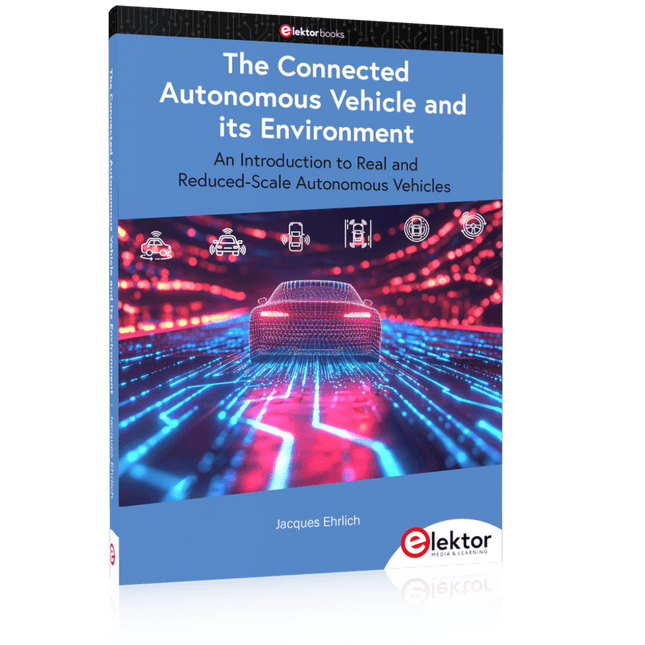
Elektor Publishing The Connected Autonomous Vehicle and its Environment
An Introduction to Real and Reduced-Scale Autonomous Vehicles Want to cut through the hype and get to the core of autonomous and connected vehicles? Then this book is your clear, accessible guide to a complex and fast-moving field. Starting with Intelligent Transport Systems (ITS), it walks you through the essential foundations, including Advanced Driver Assistance Systems (ADAS) – the stepping stones to full autonomy. Explore how self-driving cars mimic human behavior through a loop of perception, analysis, decision, and action. Discover the key functions that make it possible: localization, obstacle detection, driver monitoring, cooperative awareness – and the most challenging of all, trajectory planning, across strategic, tactical, and operational levels. Will vehicles be connected? The debate is on – but the standards are already here. Learn how connectivity, infrastructure, and vehicles can work in synergy through the innovative concept of floating car data (FCD). Dive into real-world implementation: with embedded electronics account-ing for over 30% of a modern vehicle‘s cost, we unpack the architecture, coordination, and tools required to manage the complexity – brought to life with a hands-on case study. To finish, we open the door to the future: building your own 1:10 scale autonomous vehicle. No plug-and-play solutions – just the foundations for a collaborative, creative, and geek-friendly challenge. Let’s drive the future together.
€ 34,95
Membres : € 31,46
-

Elektor Digital Raspberry Pi 5 for Radio Amateurs (E-book)
Program and Build Raspberry Pi 5 Based Ham Station Utilities with the RTL-SDR The RTL-SDR devices (V3 and V4) have gained popularity among radio amateurs because of their very low cost and rich features. A basic system may consist of a USB based RTL-SDR device (dongle) with a suitable antenna, a Raspberry Pi 5 computer, a USB based external audio input-output adapter, and software installed on the Raspberry Pi 5 computer. With such a modest setup, it is possible to receive signals from around 24 MHz to over 1.7 GHz. This book is aimed at amateur radio enthusiasts and electronic engineering students, as well as at anyone interested in learning to use the Raspberry Pi 5 to build electronic projects. The book is suitable for both beginners through experienced readers. Some knowledge of the Python programming language is required to understand and eventually modify the projects given in the book. A block diagram, a circuit diagram, and a complete Python program listing is given for each project, alongside a comprehensive description. The following popular RTL-SDR programs are discussed in detail, aided by step-by-step installation guides for practical use on a Raspberry Pi 5: SimpleFM GQRX SDR++ CubicSDR RTL-SDR Server Dump1090 FLDIGI Quick RTL_433 aldo xcwcp GPredict TWCLOCK CQRLOG klog Morse2Ascii PyQSO Welle.io Ham Clock CHIRP xastir qsstv flrig XyGrib FreeDV Qtel (EchoLink) XDX (DX-Cluster) WSJT-X The application of the Python programming language on the latest Raspberry Pi 5 platform precludes the use of the programs in the book from working on older versions of Raspberry Pi computers.
€ 32,95
Membres : € 29,66
-

Elektor May/June 2025 (EN)
Elektor GREEN and GOLD members can download their digital edition here. Not a member yet? Click here. PbMonitor v1.0A Battery-Monitoring System for UPS and Energy Storage Applications Solar Charge Controller with MPPT (1)Basic Principles of a Solar Controller for Stand-Alone Systems B-Field Integration Magnetometer With Home-Made Sensors Precise or Accurate?Your Instruments Need to Be Both! AD7124 A Precision ADC in PracticeFeatures for Sensor Signal Conditioning PID Control ToolOptimize Your Parameters Easily embedded world 2025 Starting Out in Electronics……Continues with Tone Control Academy Pro BoxBook + Online Course + Hardware Milliohmmeter AdapterUses the Precision of Your Multimeter The Next Leap in SemiconductorsOnward Toward 1.4 nm Through-Hole Technology ConnectorsThe Best of Two Worlds: THR Frequency CounterPortable and Auto-Calibrating Via GPS Analog MetersPeculiar Parts, the Series Stand-Alone Crystal TesterHow Accurate Is Your Clock Source? Low-Cost I²C TesterConnect I²C Devices Directly to Your PC From Life’s ExperienceWho Doesn’t Honor the Small Things? 2025: An AI OdysseyThe Transformative Impact on Software Development Err-lectronicsCorrections, Updates, and Readers’ Letters Raspberry Pi Standalone MIDI Synthesizer (2)Enhancing Our Setup with Intelligence Nortonized Wien Bridge OscillatorSmall Changes Yield Significant Improvements Putting a $0.10 Controller to the TestThe CH32V003 RISC-V Microcontroller and MounRiver Studio in Practice An FPGA-Based Audio Player with Equalizer (2)Adding Volume Control, Advanced Mixing, and a Web Interface
€ 10,95
-

Elektor Digital Van 0 en 1 tot processor (E-book)
Het boek beschrijft de werking van digitale circuits vanaf schakelingen met poorten tot aan de werking van een processor. Van elke schakeling of systeem kan de werking worden gesimuleerd. Hierbij wordt het gedrag van componenten en het verloop van signalen in de tijd op ingangen, uitgangen en relevante verbindingslijnen zichtbaar gemaakt. Zo wordt in detail gevisualiseerd wat het gedrag is van de hardware als er een instructie wordt uitgevoerd. Het boek is opgebouwd uit drie modules die de volgende onderwerpen behandelen: Basismodule Poorten en combinatorische schakelingen. Hoe rekent een computer? Hoe werkt een rekenmachine? Module Digitale Techniek Hoe ontwerp je combinatorische schakelingen m.b.v. Boole-algebra? Sequentiële schakelingen en het ontwerpen van ‘Finite State Systems’. Complexe schakelingen als decoders, multiplexers, asynchrone en synchrone tellers. Module Computerarchitectuur Hoe werkt een ‘loopje’ precies? If-then-else, while en for loops. De Harvard-architectuur. Hoe verloopt de communicatie tussen de aanroeper en de aangeroepene bij aanroep van een procedure? Bij de module Computerarchitectuur worden programma’s in de taal assembler geschreven. Hierbij wordt gebruik gemaakt van een instructieset van slechts 15 instructies. Website Het boek wordt ondersteund door de website: www.science.uva.nl/amstel/SIM-PL. De SIM-PL software en de componenten die nodig zijn voor de simulaties kunnen hiervandaan worden gedownload. Ook staan hier antwoorden op vragen en vraagstukken. Verder zijn op deze site collegesheets voor docenten en voorbeelden van tentamens beschikbaar. Doelgroepen VAN 0 EN 1 TOT PROCESSOR is geschreven voor iedereen die geïnteresseerd is in de basisprincipes waarop de werking van computers berust. Het boek is zeer geschikt voor studenten Informatica, Technische Informatica en E-technology in het hoger onderwijs en het MBO. Het boek kan worden ingezet bij vakken als Digitale Techniek, Embedded Systems en Architectuur & Computerorganisatie. Delen van de eerste drie hoofdstukken zijn opgenomen in modules voor de vakken Informatica, NLT en Wiskunde D in het voortgezet onderwijs. Ben Bruidegom is werkzaam bij het AMSTEL-Instituut van de Universiteit van Amsterdam als ontwikkelaar van educatieve hard- en software en docent aan het College of Science van deze universiteit. Hij heeft tientallen jaren ervaring op het gebied van de technische automatisering en het ontwikkelen van onderwijs hiervoor.
€ 19,95
Membres : € 17,96
-
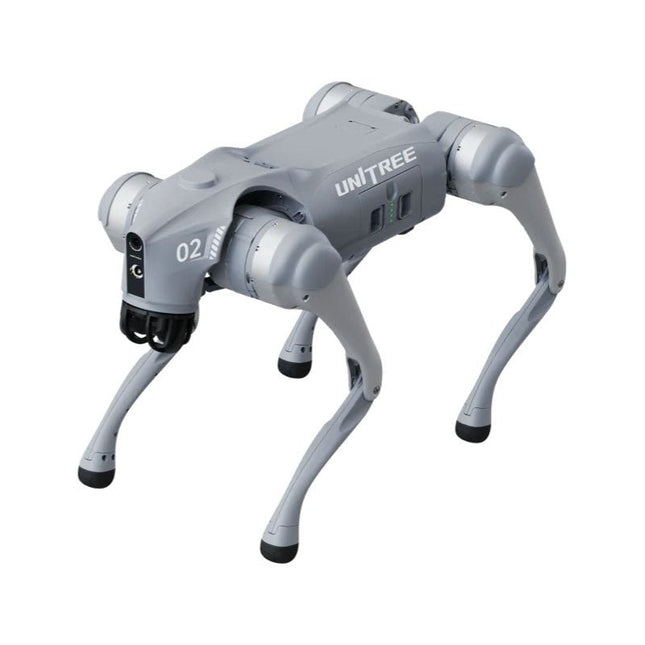
Unitree Unitree Go2 Edu Robot quadrupède
Retard temporaire dans la livraison des robots Unitree Comme de nombreux autres fournisseurs, nous rencontrons actuellement des retards dans la livraison des robots Unitree. Un envoi de notre fournisseur est actuellement bloqué en douane, ce qui entraîne un retard dans la livraison des commandes déjà passées. Nous travaillons activement avec notre fournisseur pour résoudre ce problème et espérons obtenir plus de clarté bientôt, mais nous ne pouvons malheureusement pas garantir de délais précis pour le moment. Un nouvel envoi est également en cours d'acheminement, mais il faudra un certain temps avant qu'il n'arrive. Comme d'autres fournisseurs rencontrent les mêmes difficultés, changer de prestataire ne permettrait pas d’obtenir une solution plus rapide. Notre priorité est d’honorer les commandes existantes. Si vous avez des questions ou souhaitez modifier votre commande, n’hésitez pas à contacter notre service client. Nous vous tiendrons informés des prochains développements. La série Unitree Go2 se compose de robots quadrupèdes destinés à la recherche et au développement de systèmes autonomes dans les domaines de l'interaction homme-robot (HRI), du SLAM et du transport. Grâce à ses quatre pattes et à ses 12 degrés de liberté, ce robot peut évoluer sur des terrains variés. Le Go2 est équipé d'un système perfectionné de gestion de l'entraînement et de la puissance, qui permet une vitesse (selon la version) allant jusqu'à 3,7 m/s ou 11,88 km/h, avec une autonomie pouvant atteindre 4 heures. De plus, les moteurs ont un couple de 45 N.m au niveau du corps/des cuisses et des genoux, ce qui permet également des sauts ou des saltos arrière. Caractéristiques Système de reconnaissance ultra-performant : LIDAR 4D L1 Vitesse de course maximale : environ 5 m/s Couple d'articulation maximal : environ 45 N.m Module sans fil : Wi-Fi 6/Bluetooth/4G Autonomie ultra-longue : environ 2 à 4 h (longue durée de vie mesurée en conditions réelles) Système de suivi latéral intelligent : ISS 2.0 Spécifications Module de suivi : Suivi automatique ou télécommandé Caméra frontale : Résolution de transmission d'image : 1280 x 720, champ de vision : 120°, objectif ultra grand angle pour une clarté exceptionnelle. Feu avant : Éclaire intensément la route. LiDAR 4D L1 : Balayage omnidirectionnel ultra grand angle 360° x 90° permettant un évitement automatique avec un angle mort réduit et un fonctionnement stable. 12 moteurs d'articulation : Robuste et puissant, élégant et simple, une expérience visuelle inédite. Microphone interphone : Communication efficace sans restriction de scénario. Sangle auto-rétractable : Facile à transporter et à charger. Plus stable, plus puissant grâce à des appareils avancés. LiDAR 3D, carte ESIM 4G, Wi-Fi 6 bi-bande, Bluetooth 5.2 pour une connexion stable et un contrôle à distance. Puissant cœur de calcul : contrôleur de mouvement, processeur ARM hautes performances, processeur à algorithme d'intelligence artificielle amélioré, ORIN NX/NANO externe. Batterie intelligente : batterie standard de 8000 mAh, batterie longue durée de 15000 mAh, protection contre les surchauffes, les surcharges et les courts-circuits. Haut-parleur pour écouter de la musique : écoutez votre musique comme bon vous semble. Variantes de l'Unitree Go2 Le Go2 impressionne non seulement par ses capacités techniques, mais aussi par son design moderne et fin qui lui confère un look futuriste et attire tous les regards. Le Go2 Air est spécialement conçu pour les démonstrations et les présentations. Grâce à ses fonctionnalités de base, il offre une base solide pour démontrer les capacités de mouvement et les fonctionnalités d'un robot à quatre pattes. Important : Le Go2 Air est livré sans contrôleur. Celui-ci est disponible en option. Équipés d'un puissant processeur 8 cœurs hautes performances, les modèles Pro et Edu offrent une puissance de calcul impressionnante, indispensable aux tâches complexes et aux calculs exigeants. Cela permet un traitement des données plus rapide et plus efficace, faisant des modèles Pro et Edu des partenaires fiables pour vos projets. À partir de la version Edu, le Go2 est programmable et offre des possibilités infinies pour le développement et la recherche de vos propres applications robotiques. Le Go2 est également capable de gérer une hauteur de marche allant jusqu'à 14 cm. Cela en fait un outil idéal pour la recherche, l'éducation et l'initiation au monde de la robotique. Le Go2 Edu est livré avec une télécommande pour un contrôle simple et intuitif. Il dispose également d'une station d'accueil d'une puissance de calcul impressionnante de 100 TOPS, équipée de puissants algorithmes d'IA et d'une assistance technique. Le Go2 Edu est équipé d'une puissante batterie de 15000 mAh qui lui confère une autonomie impressionnante allant jusqu'à 4 heures. Cette longue durée de fonctionnement permet au robot d'effectuer des missions d'exploration plus longues et d'accomplir des tâches exigeantes. Comparaison des modèles Air Pro Edu/Edu Plus Dimensions (debout) 70 x 31 x 40 cm 70 x 31 x 40 cm 70 x 31 x 40 cm Dimensions (accroupi) 76 x 31 x 20 cm 76 x 31 x 20 cm 76 x 31 x 20 cm Matériau Alliage d'aluminium + Plastique technique haute résistance Alliage d'aluminium + Plastique technique haute résistance Alliage d'aluminium + Plastique technique haute résistance plastique Poids (avec batterie) environ 15 kg environ 15 kg environ 15 kg Tension 28~33,6 V 28~33,6 V 28~33,6 V Puissance de pointe environ 3000 W environ 3000 W Charge utile ≈7 kg (MAX ~ 10 kg) ≈8 kg (MAX ~ 10 kg) ≈8 kg (MAX ~ 12 kg) Vitesse 0~2,5 m/s 0~3,5 m/s 0~3,7 m/s (MAX ~ 5 m/s) Hauteur de montée/chute max. environ 15 cm environ 16 cm environ 16 cm Angle de montée max. 30° 40° 40° Puissance de calcul de base N/A 8 cœurs hautes performances Processeur Processeur 8 cœurs hautes performances Moteur d'articulation du genou en aluminium Ensemble de 12 Ensemble de 12 Ensemble de 12 Circuit intra-articulaire (genou) ✓ ✓ ✓ Refroidisseur de caloduc articulaire ✓ ✓ ✓ Amplitude de mouvement Corps : −48~48° Corps : −48~48° Corps : −48~48° Cuisse : −200°~90° Cuisse : −200°~90° Cuisse : −200°~90° Jarret : −156°~−48° Jarret : −156°~−48° Couple max. N/A Environ 45 N.m Environ 45 N.m LiDAR 3D super grand-angle ✓ ✓ ✓ Module de suivi de positionnement vectoriel sans fil N/A ✓ ✓ Grand angle HD Caméra ✓ ✓ ✓ Capteur de force côté pied N/A N/A ✓ Action de base ✓ ✓ ✓ Sangle de mise à l'échelle automatique N/A ✓ N/A OTA intelligent amélioré ✓ ✓ ✓ Transmission d'images RTT 2.0 ✓ ✓ ✓ Télécommande de base via l'application ✓ ✓ ✓ Visualisation des données via l'application ✓ ✓ ✓ Programme graphique via l'application ✓ ✓ ✓ Lampe frontale (3) W) ✓ ✓ ✓ Wi-Fi 6 double bande ✓ ✓ ✓ Bluetooth 5.2/4.2/2.1 ✓ ✓ ✓ Module 4G N/A CN/GB CN/GB Voix Fonction N/A ✓ ✓ Lecture musicale N/A ✓ ✓ Système intelligent de suivi latéral ISS 2.0 N/A ✓ ✓ Détection et évitement intelligents ✓ ✓ ✓ Secondaire Développement N/A N/A ✓ Contrôleur manuel En option En option ✓ Module haute puissance de calcul N/A N/A Edu : 40 TOPS de puissance de calcul Edu Plus : 100 TOPS de puissance de calcul NVIDIA Jetson Orin (en option) Smart Batterie Standard (8000 mAh) Standard (8000 mAh) Longue autonomie (15000 mAh) Autonomie 1 à 2 h 1 à 2 h 2 à 4 h Chargeur Standard (33,6 V, 3,5 A) Standard (33,6 V, 3,5 A) Charge rapide (33,6 V, 9 A) Inclus 1x Unitree Go2 Edu 1x Unitree Go2 télécommande 1x Unitree Go2 batterie (15000 mAh) 1x Unitree station d'accueil avec une puissance de calcul de 40 TOPS Téléchargements Documentation iOS/Android apps GitHub
€ 12.499,00
Meilleur prix
-

Elektor Digital C# 2010 Programmierung und PC-Anbindung (E-book)
Programmation C# 2010 et connexion PC (E-book)
€ 39,80
Membres : € 35,82
-

Elektor 05-06/2025 (DE)
Diese Ausgabe steht allen GOLD- und GREEN-Mitgliedern auf der ElektorMagazine-Website zum Download bereit! Sie sind noch kein Mitglied? Hier klicken! PbMonitor v1.0Ein Batterieüberwachungssystem für USV und Energiespeicher Solarladeregler mit MPP-TrackingTeil 1: Grundlagen eines Solarreglers für Insel-Anlagen B-Feld-Integrationsmagnetometer mit selbstgebauten Sensoren Präzise, richtig oder genau?Ihre Messgeräte müssen alles sein! AD7124 – Ein Präzisions-ADC in der PraxisHinweise für die Sensor-Signalaufbereitung PID-RegelungswerkzeugOptimieren Sie ganz einfach Ihre Parameter embedded world 2025 Aller Anfang ......muss nicht schwer sein: Klangeinstellung! Academy Pro BoxBook + Online Course + Hardware Milliohmmeter-AdapterNutzen Sie die Präzision Ihres Multimeters! Der nächste Meilenstein bei HalbleiternWeiter in Richtung 1,4 nm Steckverbinder in DurchstecktechnikDas Beste aus zwei Welten: THR FrequenzzählerPortabel und mit automatischer GPS-Kalibrierung Analoge MessgeräteBemerkenswerte Bauteile Stand-alone-QuarztesterWie genau ist Ihre Taktquelle? Preiswerter I²C-TesterSchließen Sie I²C-Chips direkt an Ihren PC an Aus dem Leben gegriffenWer das Kleine nicht ehrt... 2025: Eine Odyssee in die KIDie transformativen Auswirkungen auf die Softwareentwicklung Projekt 2.0Korrekturen, Updates und Leserbriefe Standalone-MIDI-Synthesizer mit Raspberry PiTeil 2: Setup mit Intelligenz aufwerten Nortonisierter Wien-Brücken-OszillatorKleine Änderungen führen zu bedeutenden Verbesserungen 10-Cent-Controller in der PraxisRISC-V-Mikrocontroller CH32V003 und MounRiver Studio ausprobiert Audio-Player mit FPGA und EqualizerTeil 2: Lautstärkeregelung, erweitertes Mischen und ein Web-Interface
€ 14,90
-
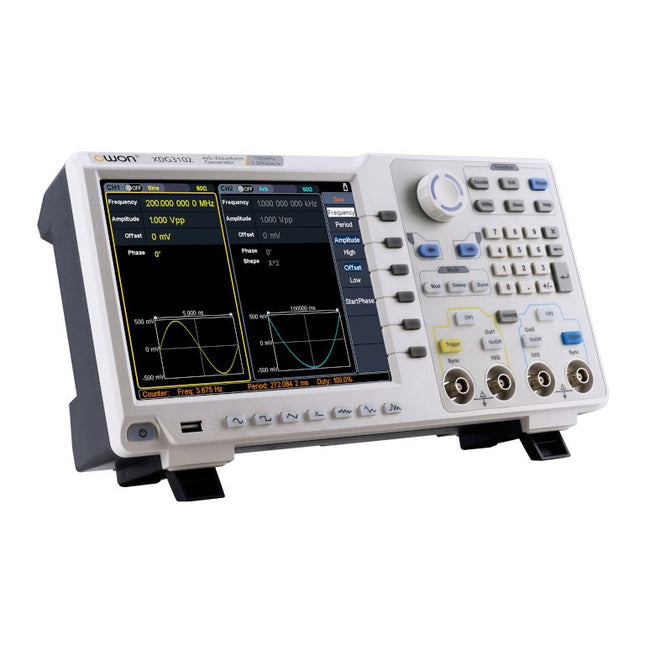
OWON OWON XDG3102 Générateur de formes d'onde arbitraires à 2 canaux (100 MHz)
Caractéristiques Technologie DDS avancée, sortie de fréquence jusqu'à 250 MHz Taux d'échantillonnage de 1,25 GS/s et résolution de fréquence de 1 μHz Jusqu'à 1 M de longueur de forme d'onde arbitraire Résolution verticale : 14 bits Sortie de forme d'onde complète : 6 groupes de formes d'onde et 152 groupes de formes d'onde arbitraires intégrées Options de modulation complètes : AM, FM, PM, FSK, 3FSK, 4FSK, PSK, OSK, ASK, BPSK, PWM, balayage et rafale Fréquencemètre intégré de haute précision, allant de 100 MHz à 200 MHz SCPI et LabVIEW pris en charge Écran LCD tactile 8'' 800 x 600 pixels Spécifications XDG3102 Canal 2 Sortie de fréquence 100MHz Taux d'échantillonnage 1,25 Géch/s Résolution verticale 14 bits Forme d'onde Forme d'onde standard sinus, carré, impulsion, rampe, bruit et harmonique Forme d'onde arbitraire montée exponentielle, chute exponentielle, sin(x)/x, onde progressive et autres,total de 150 formes d'onde intégrées et forme d'onde arbitraire définie par l'utilisateur Fréquence (résolution 1μHz) Sinus 1µHz - 100MHz Carré 1µHz - 40MHz Impulsion 1µHz - 25MHz Catastrophe 1μHz - 5MHz Harmonique 1µHz - 50MHz Bruit 120 MHz (-3 dB, typique) Forme d'onde arbitraire forme d'onde intégrée : 1uHz - 15MHzForme d'onde définie par l'utilisateur : 1 uHz - 50 MHz Précision ±1 ppm, 0°C - 40°C Amplitude Amplitude (50Ω) 1 mVpp - 10 Vpp (≤40 MHz) ; 1 mVpp - 5 Vpp (≤80 MHz)1 mVpp - 2,5 Vpp (≤120 MHz) ; 1 mVpp - 1Vpp (≤250 MHz) Amplitude (haute impédance) 2 mVpp - 20 Vpp (≤40 MHz) ; 2 mVpp - 10 Vpp (≤80 MHz) ;2 mVpp - 5Vpp (≤120 MHz) ; 2 mVpp - 2Vpp (≤250 MHz) Résolution 1mV ou 4 chiffres Décalage CC Plage (50Ω) ±(5 Vpk - Amplitude Vpp/2) Plage (Z élevé, circuit ouvert) ±(10 Vpk - Amplitude Vpp/2) Précision ±(1 % de |réglage| + 1 mV + Amplitude Vpp x 0,5 %) Résolution 1mV ou 4 chiffres Impédance de charge 50Ω (typique) Précision ±(1 % du réglage + 1 mVpp) (typique, sinusoïdal de 1 kHz, décalage de 0 V) Pureté du spectre d'onde sinusoïdale Distorsion harmoniqueTypique (0dB) C.C - 1 MHz : <-65 dBc1 MHz - 10 MHz : <-60 dBc10 MHz - 120 MHz : <-50 dBc120 MHz - 200 MHz : <-45 dBc Distorsion harmonique totale <0,05 %, 10 Hz à 20 kHz, 1 Vc.c. Parasitaire (non harmonique),Typique (0dB) ≤10MHz : <-70dBc>10MHz : <-70dBc + 6dB/octave Bruit de phaseTypique (0 dBm, déviation de 10 kHz) 10 MHz : ≤-110 dBc/Hz Carré Temps de montée/descente <5ns Dépasser <3% Cycle de service 50,0% (fixe) Gigue (rms) 300ps + 100ppm Impulsion Largeur d'impulsion 12ns - 996875s Temps de front montant/fin ≧7ns Dépasser <3% Gigue (rms) 300ps + 100ppm Catastrophe Linéarité ≤1 % de la sortie maximale (typique, 1 kHz, 1 Vpp, 50 % de symétrie) Symétrie 0% à 100% Harmonique Ordre Harmonique ≤16 Type harmonique pair, impair, tout, utilisateur Amplitude harmonique pourrait être réglé pour toutes les harmoniques Phase harmonique Arbitraire Longueur de la forme d'onde 2 points - 1 million de points Résolution verticale 14 bits Temps minimum de montée/descente <7ns Gigue (rms) 3ns Modulation Taper AM, FM, PM, PWM, FSK, 3FSK, 4FSK, PSK, OSK, ASK, BPSK, balayage et rafale SUIS Forme d'onde porteuse sinusoïdal, carré, rampe et arbitraire (sauf DC) Source interne externe Forme d'onde modulante sinusoïdal, carré, rampe, bruit et arbitraire Profondeur 0,0% - 100,0% Fréquence de modulation 2 MHz - 100 kHz FM Forme d'onde porteuse sinusoïdal, carré, rampe et arbitraire (sauf DC) Source interne externe Forme d'onde modulante sinusoïdal, carré, rampe, bruit et arbitraire Fréquence de modulation 2 MHz - 100 kHz P.M. Forme d'onde porteuse sinusoïdal, carré, rampe et arbitraire (sauf DC) Source interne externe Forme d'onde modulante sinusoïdal, carré, rampe, bruit et arbitraire Déviation de phase 0° - 180° Fréquence de modulation 2 MHz - 100 kHz MLI Forme d'onde porteuse impulsion Source interne externe Forme d'onde modulante sinusoïdal, carré, rampe, bruit et arbitraire Écart de largeur 0 ~ minimum (rapport d'impulsions, 100 % - rapport d'impulsions) Fréquence de modulation 2 MHz - 100 kHz FSK/3FSK/4FSK Forme d'onde porteuse sinusoïdal, carré, rampe et arbitraire (sauf DC) Source interne externe Forme d'onde modulante carré avec un rapport cyclique de 50 % Fréquence clé 2 MHz - 1 MHz PSK Forme d'onde porteuse sinusoïdal, carré, rampe et arbitraire (sauf DC) Source interne externe Forme d'onde modulante carré avec un rapport cyclique de 50 % Fréquence clé 2 MHz - 1 MHz OSK Forme d'onde porteuse sinusoïdal, carré, rampe et arbitraire (sauf DC) Source interne Temps d'oscillation carré avec un rapport cyclique de 50 % Fréquence clé 2 MHz - 1 MHz DEMANDER Forme d'onde porteuse sinusoïdal, carré, rampe et arbitraire (sauf DC) Source interne externe Forme d'onde modulante carré avec un rapport cyclique de 50 % Fréquence clé 2 MHz - 1 MHz BPSK Forme d'onde porteuse sinusoïdal, carré, rampe et arbitraire (sauf DC) Source interne Forme d'onde modulante carré avec un rapport cyclique de 50 % Fréquence clé 2 MHz - 1 MHz Balayer Forme d'onde porteuse sinusoïdal, carré, rampe et arbitraire (sauf DC) Taper linéaire et log Direction haut et bas Temps de balayage 1 ms à 500 s, ± 0,1 % Source de déclenchement interne, externe et manuel Éclatement Forme d'onde porteuse sinusoïdal, carré, rampe, impulsion et arbitraire (sauf DC) Nombre de rafales 1 à 50 000 périodes, infini, gate Période interne 10 ns - 500 s Source fermée déclencheur externe Compteur de fréquence Fonction période de fréquence, +largeur, -largeur, +devoir et -devoir Gamme de fréquences 100 MHz - 200 MHz Résolution de fréquence 7 chiffres Entrée sortie Afficher Écran LCD tactile 8" 800 x 600 pixels Taper fréquencemètre, entrée de modulation externe,entrée de déclenchement externe,entrée/sortie d'horloge de référence externe Interface de Communication Hôte USB, périphérique USB et réseau local Dimension 340 x 177 x 90 mm Poids (sans colis) 2,50 kg
€ 644,63
-
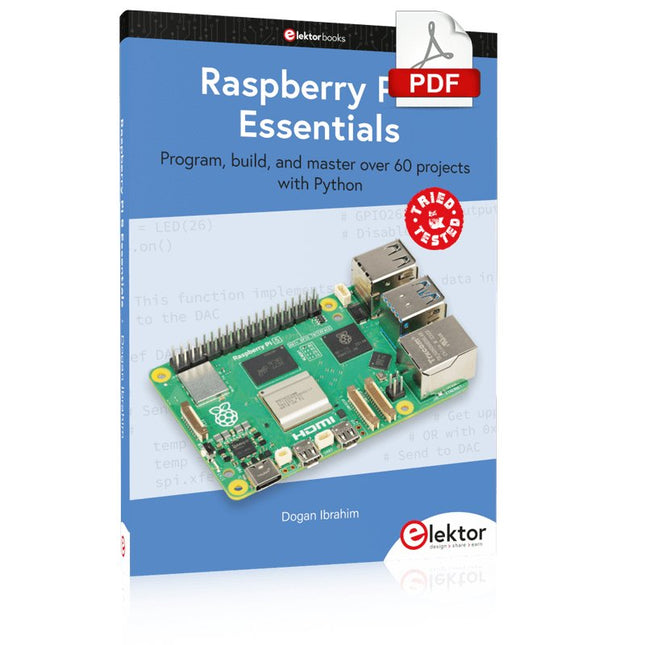
Elektor Digital Raspberry Pi 5 Essentials (E-book)
Program, build, and master over 60 projects with Python The Raspberry Pi 5 is the latest single-board computer from the Raspberry Pi Foundation. It can be used in many applications, such as in audio and video media centers, as a desktop computer, in industrial controllers, robotics, and in many domestic and commercial applications. In addition to the well-established features found in other Raspberry Pi computers, the Raspberry Pi 5 offers Wi-Fi and Bluetooth (classic and BLE), which makes it a perfect match for IoT as well as in remote and Internet-based control and monitoring applications. It is now possible to develop many real-time projects such as audio digital signal processing, real-time digital filtering, real-time digital control and monitoring, and many other real-time operations using this tiny powerhouse. The book starts with an introduction to the Raspberry Pi 5 computer and covers the important topics of accessing the computer locally and remotely. Use of the console language commands as well as accessing and using the desktop GUI are described with working examples. The remaining parts of the book cover many Raspberry Pi 5-based hardware projects using components and devices such as LEDs and buzzers LCDs Ultrasonic sensors Temperature and atmospheric pressure sensors The Sense HAT Camera modules Example projects are given using Wi-Fi and Bluetooth modules to send and receive data from smartphones and PCs, and sending real-time temperature and atmospheric pressure data to the cloud. All projects given in the book have been fully tested for correct operation. Only basic programming and electronics experience are required to follow the projects. Brief descriptions, block diagrams, detailed circuit diagrams, and full Python program listings are given for all projects described.
€ 32,95
Membres : € 29,66
-
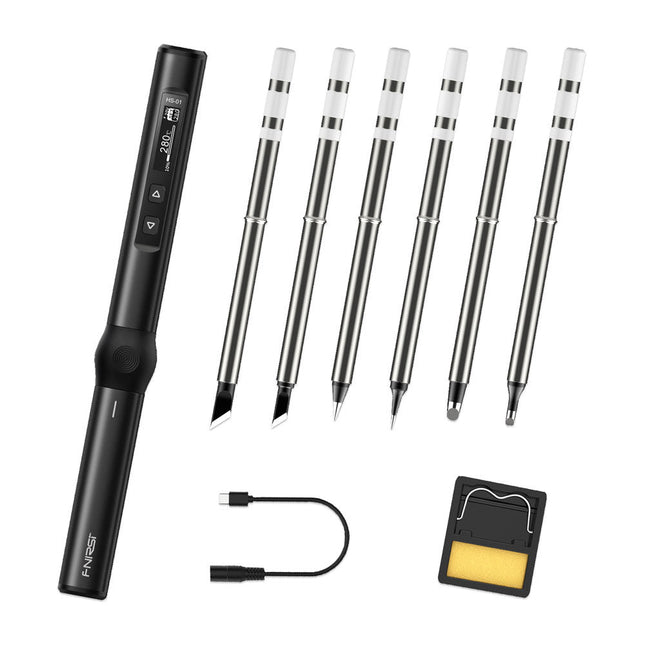
FNIRSI FNIRSI HS-01 Fer à souder intelligent (avec 6 pointes de soudure)
L'outil parfait pour des réparations rapides Le HS-01 est un puissant fer à souder intelligent réglable équipé d'un écran OLED intégré de 0,87 pouces qui atteint rapidement des températures comprises entre 80 et 420°C. L'écran affiche toutes les informations essentielles, notamment l'état du niveau de température, la température réglée, la tension d'alimentation et le pourcentage de puissance. Vous pouvez régler la tension d'entrée de 9 à 20 V directement dans le menu selon vos besoins. Le mode veille intégré éteint automatiquement le fer après 30 minutes. Caractéristiques Entrée de 96 W (CC) Puissance PD de 65 W Écran OLED Température constante et chauffage rapide Moulage intégral en métal CNC Sécurité intelligente anti-brûlure Format de poche mini Design ergonomique Matériau en aluminium Interrupteur pour main gauche/droite Évacuation de chaleur efficace Veille inductive Couleur : Noir Spécifications Puissance 65 W Écran OLED de 0,87 pouce Tension de fonctionnement 9-20 VCC Alimentation électrique USB-C Plage de température 80-420°C Protocole de charge rapide Déclenchement PD Dimensions 184 x 20 x 20 mm (7,24 x 0,79 x 0,79 pouces) Poids 56 g Sélection de la puissance Tension de fonctionnement 20 V 15 V 12 V 9 V Courant de fonctionnement ≥3,25 A ≥2,5 A ≥2 A ≥1,5 A Puissance 65 W 37,5 W 24 W 13,5 W Temps de fusion de l'étain 8 s 12 s 17 s 30 s Inclus 1x Fer à souder intelligent FNRISI HS-01 6x Embouts de fer à souder (HS01-BC2, HS01-KR, HS01-K65, HS01-B2, HS01-ILS, HS01-BC3) 1x Câble d'alimentation CC vers USB-C 1x Support de fer à souder mini 1x Manuel Requis Adaptateur secteur Câble USB-C Téléchargements Manual Firmware V0.3.s19
€ 81,32
-
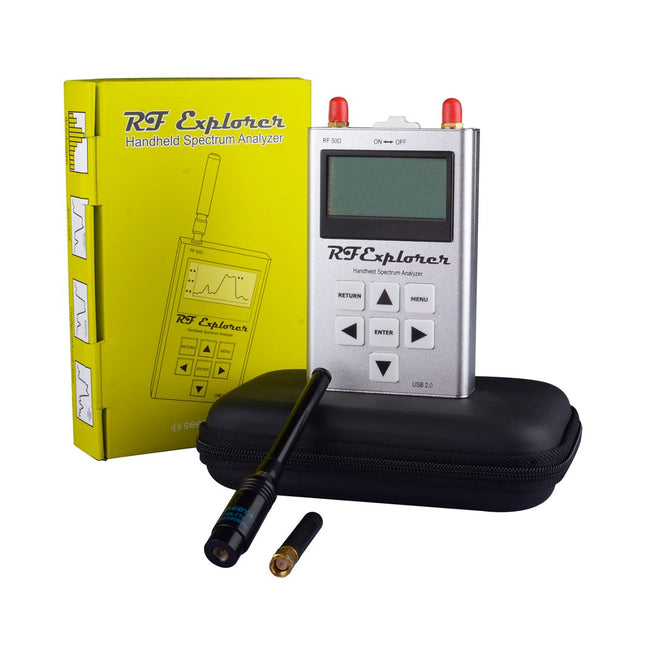
Seeed Studio Seeed Studio RF Explorer 3G Combo analyseur de spectre
The Seeed Studio RF Explorer 3G Combo is a handheld digital spectrum analyzer and an affordable tool for working across a wide range of popular frequency bands. It is based on a highly integrated frequency synthesizer and a double-balanced mixer, providing high performance, compact dimensions, low power consumption, and excellent value. Designed for both indoor and outdoor use, the RF Explorer 3G Combo can also be connected to a PC via a standard Mini-USB 2.0 connector for additional functionality. This model combines a WSUB1G base unit with an RFEMWSUB3G expansion module, supplied fully assembled and tested. It features two SMA connectors and includes two antennas: a dual-band 144/430 MHz telescopic antenna for sub-GHz frequencies and a helical whip antenna for the 2.4 GHz band. Additional frequency-specific antennas may be required for optimal performance in certain supported frequency ranges. This combination provides the wide frequency coverage of the WSUB3G module together with the high sensitivity and fast response of the WSUB1G unit in the commonly used sub-1 GHz frequency range. Caractéristiques Pocket size and light weight Solid aluminum metal case Includes a transport EVA carry case for RF Explorer Spectrum Analyzer mode with Peak Max and Hold, Normal, Overwrite and Averaging modes Lifetime free firmware upgrades available, open to community requested features High capacity Lipo for 16+ hours of continuous run, rechargeable by USB Windows PC client Open Source Can be extended with internal Expansion Modules for additional band and functionality Wide band coverage to all popular RF frequencies, starting at 15 MHz and going up to 2.7 GHz. This includes very interesting frequency areas such as 2 m HAM radio, all VHF and UHF, FM radio, GPS, WiFi and WiMax, Bluetooth, etc. Firmware: RF Explorer 3G Combo is delivered with upgraded firmware v1.09. Note some of the features and operation accuracy will be improved in upcoming free firmware revisions. Spécifications Battery Lithium Cells / Batteries contained in equipment UN3481 - PI967 Frequency band 15-2700 MHz Frequency span 112 KHz - 600 MHz Graphics LCD 128 x 64 pixels, great visibility outdoors PC Windows client Supports Windows (32 and 64 bits) Backlight For great indoor visibility 2 standard SMA 50 ohms connector, One for Sub-GHz wideband Nagoya NA-773 telescopic antenna included and another 2.4 GHz one for 15-2700 MHz band with helical antenna included. Amplitude resolution 0.5 dBm Dynamic range Left SMA port (WSUB1G) -115 dBm to 0 dBm Right SMA port (WSUB3G) -110 dBm to -10 dBm Absolute Max input power Left SMA port (WSUB1G) +5 dBm Right SMA port (WSUB3G) +30 dBm Average noise level (typical) -110 dBm Frequency stability and accuracy (typical) ±10 ppm Amplitude stability and accuracy (typical) ±6 dBm Frequency resolution 1 KHz Resolution bandwidth (RBW) Automatic 3 KHz to 600 KHz Weight 185 g Dimensions 113 x 70 x 25 mm Inclus Seeed Studio RF Explorer 3G Combo Spectrum Analyzer Nagoya NA-773 wideband telescopic antenna 2.4 GHz band antenna EVA Case Documentation For more info and to get started with your RF Explorer, visit the start page. For questions and support, please visit https://support.rf-explorer.com
€ 277,64
-

Elektor Publishing The Book of 555 Timer Projects
Over 45 Builds for the Legendary 555 Chip (and the 556, 558) The 555 timer IC, originally introduced by the Signetics Corporation around 1971, is sure to rank high among the most popular analog integrated circuits ever produced. Originally called the IC Time Machine, this chip has been used in many timer-related projects by countless people over decades. This book is all about designing projects based on the 555 timer IC. Over 45 fully tested and documented projects are presented. All projects have been fully tested by the author by constructing them individually on a breadboard. You are not expected to have any programming experiences for constructing or using the projects given in the book. However, it’s definitely useful to have some knowledge of basic electronics and the use of a breadboard for constructing and testing electronic circuits. Some of the projects in the book are: Alternately Flashing Two LEDs Changing LED Flashing Rate Touch Sensor On/Off Switch Switch On/Off Delay Light-Dependent Sound Dark/Light Switch Tone Burst Generator Long Duration Timer Chasing LEDs LED Roulette Game Traffic Lights Continuity Tester Electronic Lock Switch Contact Debouncing Toy Electronic Organ Multiple Sensor Alarm System Metronome Voltage Multipliers Electronic Dice 7-Segment Display Counter Motor Control 7-Segment Display Dice Electronic Siren Various Other Projects The projects given in the book can be modified or expanded by you for your very own applications. Electronic engineering students, people engaged in designing small electronic circuits, and electronic hobbyists should find the projects in the book instructive, fun, interesting, and useful.
€ 34,95
Membres : € 31,46


