Your First Steps with an ESP32-C3 and the IoTA Wi-Fi Button and Relay IoT Cloud a la Arduino
Dual Geiger-Müller Tube Arduino ShieldA High Sensitivity, Very Low-Power Radiation Sensor
CO2 GuardA DIY Approach to Monitoring Air Quality
MonkMakes Air Quality Kit for Raspberry PiMeasures Temperature and eCO2
Starting Out in ElectronicsWelcome to the Diode
Tips & Tricks for Testing ComponentsNo Expensive Equipment Required
Reducing the Power Consumption of Your Mole RepellerAn ATtiny13 Replaces a 555
Light Switch DeLuxA Solution for High-Precision Light-Controlled Switching
The Challenges in Bringing IoT Solutions to MarketWorries Around Security, Scalability, and Competition Infographics 5-6/2022
Preferably Wired After AllTips for Developing a 1 Gbit/s Interface in an Industrial Environment Bringing Real-Time Object Detection to MCUs with Edge Impulse FOMO
Traveling-Wave TubesPeculiar Parts, the Series
Narrowband Internet of ThingsStandards, Coverage, Agreements, and Modules
Dragino LPS8 Indoor GatewaySpeedy LoRaWAN Gateway Setup
Explore ATtiny Microcontrollers Using C and Assembly LanguageSample Chapter: ATtiny I/O Ports
Err-lectronicsCorrections, Updates and Readers’ Letters
LoRa GPS Tracker UpdateReceive and Show Location Using a Raspberry Pi
Circuit Simulation with TINA Design Suite & TINACloudSample Chapter: Sinusoidal Oscillators
From Life’s ExperienceAssembly Line Work
The WinUI Graphics Framework for Windows AppsA Small Demo Application
GUIs with PythonWorst GUI of the world
Off-Grid Solar SystemsElectrical Energy Independent of the Mains Grid
The 10-Year SmartphoneRenew Your Expectations
HexadokuThe Original Elektorized Sudoku
Le kit Whadda 3D Xmas Tree est destiné aux amateurs et aux débutants intéressés par la soudure et l'électronique. Avec ce kit DIY, vous pouvez construire un sapin de Noël LED festif.
Caractéristiques
16 LED rouges clignotantes
LED vertes et jaunes supplémentaires fournies pour personnaliser votre arbre
Peut être accroché et alimenté par des fils
Fonctionne sur 12 V CC (par exemple dans les voitures)
Spécifications
Faible consommation d'énergie
8 mA
Alimentation
Pile 9 V (non incluse)
Dimensions
102 x 88 x 80 mm
Poids
65 g
Téléchargements
Manuel
Dieses Buch ist eine Einführung in das hochaktuelle Gebiet der Robotik. Dabei stehen praktische Anwendungsbeispiele im Vordergrund. Neben den technischen und mechanischen Grundlagen werden die elektronischen Komponenten und Module erläutert. Eine zentrale Rolle spielt dabei der Mikrocontroller.
Für Robotik-Anwendungen haben sich zwei Controller-Boards etabliert: der Arduino und der Raspberry Pi. Dem trägt dieses Buch Rechnung und beschreibt praktische Nachbauprojekte mit diesen beiden populären Boards.
Getreu der Philosophie des „Learning by Doing“ können sich auch ambitionierte, nichtprofessionelle Anwender mit dem Lernmaterial des Buches einen Überblick über den neuesten Stand der Robotertechnik und KI verschaffen. Für praktische Anwendungen können sowohl komplette Bausätze als auch einzelne Komponenten verwendet werden. Dabei wurde stets darauf geachtet, dass die Hardware möglichst universell einsetzbar ist.
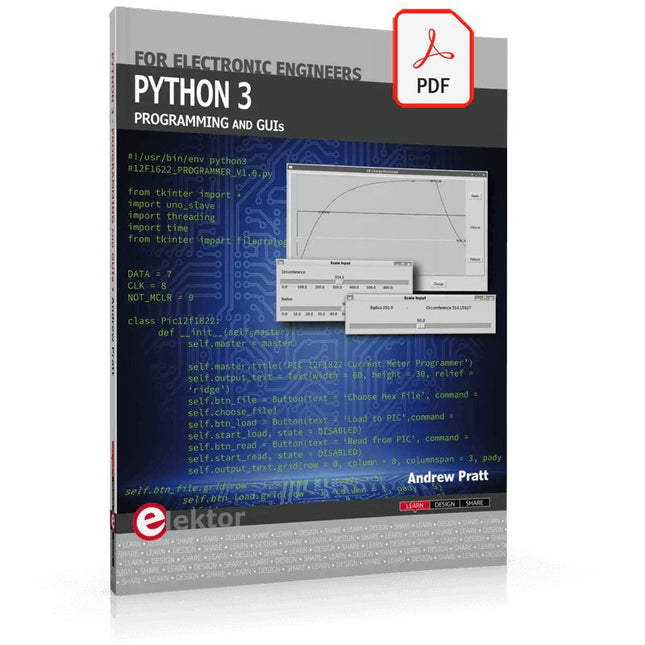
This is the second edition of a book aimed at engineers, scientists, and hobbyists who want to interface PCs with hardware projects using graphical user interfaces. Desktop and web-based applications are covered.
The programming language used is Python 3, which is one of the most popular languages around: speed of programming being a key feature. The book has been revised and updated with an emphasis on getting the user to produce practical designs with ease – a text editor is all that is required to produce Python programs.
Hardware interfacing is achieved using an Arduino Uno as a remote slave. A full description and source code of the communication interface is given in the book. The slave provides digital and analog input and outputs. Multiple Unos can be included in one project with all control code written in Python and running on a PC One project involves a PIC microcontroller with the code provided that can be loaded into the PIC using the Uno.
The web applications and server are all implemented in Python, allowing you to access your electronic hardware over the Internet. The Raspberry Pi computer can be used as your web server. An introductory chapter is provided to get you started with using Linux.
The book is written for use with Debian or variations including Mint or Ubuntu. All of the programs in the book are freely available, ready to use and experiment with by way of a download from Elektor.
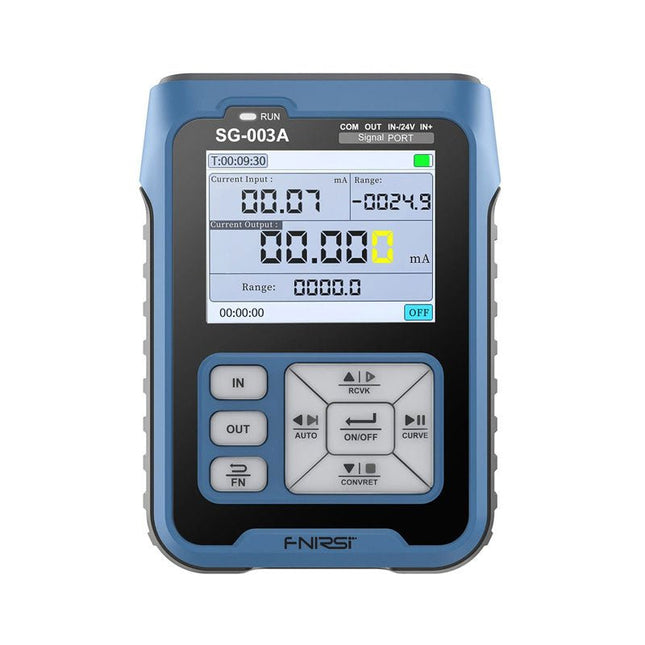
Le générateur de signaux multifonction FNIRSI SG-003A, également connu sous le nom de process meter/calibrator, est un générateur et un compteur de tension/courant de haute précision. Le SG-003A fournit des tensions ou des courants de référence très précis pour tester et étalonner d'autres instruments de mesure, tels que les multimètres et les oscilloscopes.
En plus des tensions et des courants, le SG-003A génère également des signaux d'impulsion rectangulaires avec des fréquences et des rapports cycliques programmables avec précision. Le mode convertisseur transforme la SG-003A en une source de courant précise commandée en tension, ou en une source de tension commandée en courant, et même en un générateur de fréquence commandé en tension ou en courant.
Le SG-003A est un outil très utile pour vérifier l'exactitude et la précision de votre multimètre, et pour tester les LED, par exemple.
Caractéristiques
Précision (tension/courant)
0,1% ±0,005
Résolution (actuelle)
0,01 mA
Fréquence
0-10 kHz
Résolution
5 chiffres
Puissance de sortie
24 V
Écran
LCD TFT 2,4" (320 x 240)
Dimensions
92 x 72 x 30 mm
Poids
165 g
Caractéristiques
Signal
Gamme
Précision
Résolution
Charge maximale
Alimentation externe
Sortie courant active
0~24 mA
±(0,1% + 0,005)
0,01 mA
750 Ω
Sortie courant passive (XMT)
0~24 mA
±(0,1% + 0,005)
0,01 mA
0~30 V
Sortie de tension
0~24 V
±(0,1% + 0,005)
0,01 V
Boucle 24 V
0~24 mA
±(0,1% + 0,005)
0,01 mA
Sortie fréquence
0~9999 Hz
±2%
5 chiffres
Entrée actuelle
0~24 mA
±(0,1% + 0,005)
0,01 mA
Entrée de tension
0~30 V
±(0,1% + 0,005)
0,01 V
Inclus
1x FNIRSI SG-003A Générateur de signaux
4x Pinces de test
1x Chargeur USB
1x Câble USB-C
1x Manuel
Téléchargements
Manual
Firmware V4.3
Open-Source-Code mit Arduino IDE und PlatformIO
Autonomes Fahren: GPS, Accelerometer, Gyroskop
PS3-Controller
Mikrocontroller wie der Arduino und Einplatinenrechner wie der Raspberry Pi haben sich zu beliebten Komponenten entwickelt. Dritter im Bunde ist der ESP32 der Firma Espressif. Mikrocontroller dieser Baureihe zeichnen sich durch eine Vielzahl implementierter Funktionen aus, die bei einem Arduino konventioneller Prägung mit einem Atmel-AVR-Mikrocontroller erst mit weiterer Hardware möglich sind. Prominentes Beispiel sind hier die WiFi- und Bluetooth-Funktionalitäten. Gegenüber einem Raspberry Pi zeichnen sie sich durch einen deutlich geringeren Preis aus.
Allgemeine Informationen für die Realisierung eines Roboterauto-Projekts mit dem ESP32 sind leicht zu finden. Dabei handelt es sich aber oft nur um Ausführungen zu einem Teilaspekt, ohne inhaltliche oder funktionale Abstimmung. So ist nicht nur die Beschaffung der benötigten Informationen mühselig und zeitaufwändig, sie kann auch außerordentlich fehlerträchtig sein.
Ansatzpunkt dieses Buches ist, diese Lücke zu schließen. Es geht auf verschiedene Möglichkeiten eines Chassis ein, vermittelt nötige Kenntnisse und führt schrittweise von einer einfachen Motorsteuerung zu einem komplexen sensor- und sprachgesteuerten Roboterauto. Hacks rund um GPS und eine PlayStation 3 runden die Sache ab.
Inhalt
Bei der Reihenfolge der Kapitel wurde versucht – beginnend bei der Darstellung von grundlegenden Informationen – über die Lösung einfacher Aufgaben zu etwas anspruchsvolleren Techniken zu führen.
Der Mikrocontroller ESP32
Die Software erstellen
Die Stromversorgung
Rund um die Hardware
Das Chassis
Der Gleichstrommotor
Kabellose Steuerung über WiFi
Mit Sensoren Hindernisse erkennen
Eine eigene Roboterauto-App
Servo und Lichtsensor
GPS
Accelerometer / Gyroskop
PS3-Controller
Roboterauto-App
Hinweis zur Software
Die Dateien haben das Suffix (.cpp). Grund ist die Entwicklung mit PlatformIO. Mit Copy & Paste sollten sie auch in der Arduino-IDE verwendet werden können.
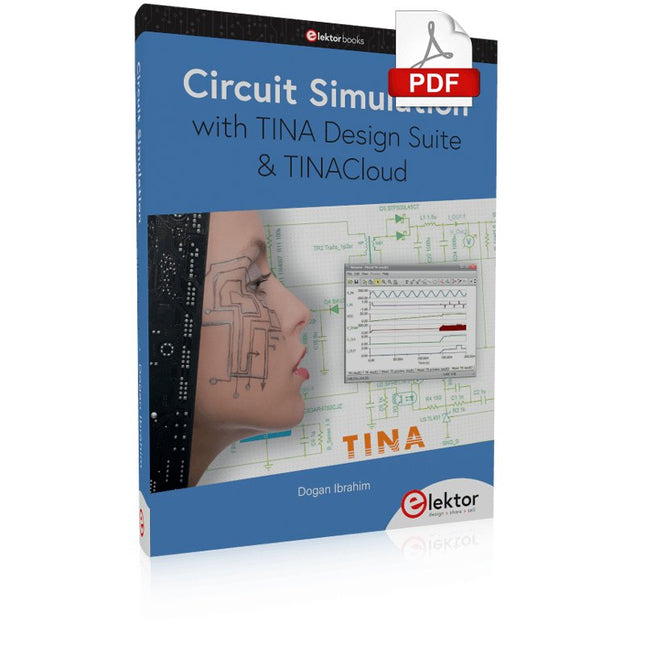
TINA Design Suite is a professional, powerful and affordable circuit simulator. It is a circuit designer and PCB design software package for analysing, designing, and real-time testing of analogue, digital, IBIS, VHDL, Verilog, Verilog AMS, SystemC, MCU, and mixed electronic circuits and their PCB layouts.
In this book, top-selling Elektor author, Prof. Dr. Dogan Ibrahim aims to teach the design and analysis of electrical and electronic circuits and develop PCB boards using both TINA and TINACloud. The book is aimed at electrical/electronic engineers, undergraduate electronic/electrical engineering students at technical colleges and universities, postgraduate and research students, teachers, and hobbyists. Many tested and working simulation examples are provided covering most fields of analogue and digital electrical/electronic engineering. These include AC and DC circuits, diodes, zener diodes, transistor circuits, operational amplifiers, ladder diagrams, 3-phase circuits, mutual inductance, rectifier circuits, oscillators, active and passive filter circuits, digital logic, VHDL, MCUs, switch-mode power supplies, PCB design, Fourier series, and spectrum. Readers do not need to have any programming experience unless they wish to simulate complex MCU circuits.
Elektor GREEN and GOLD members can download their digital edition here.
Not a member yet? Click here.
The Raspberry Pi 5A Huge Improvement From Its Predecessor
AI in the Electronics LabGoogle Bard and Flux Copilot Put to the Test
Arduino Nano Waveform GeneratorNano + Code = Function Generator
Solar-Powered Christmas GarlandAn Eco-Friendly Solution for Garnishing Your Balcony
USB Killer DetectorBetter Safe Than Sorry
A Simple CNCed EnclosureWith Autodesk Fusion 360 for Personal Use
Low-Volume Board ProductionWith and without Assembly
IoT Simulation Simplified with WokwiDeveloper Uri Shaked on Design, Software, and More
A Bare-Metal Programming Guide (Part 3)CMSIS Headers, Automatic Testing, and a Web Server
LoRa, a Swiss Army Knife (2)The Hardware and Software
MEMS Microphone Design and Construction
Tools to Try Before You SolderSimulation and 3D Modeling Tools That Can Be Used for Free
New Tools From Microchip!PICkit 5 and MPLAB ICD 5 Available Now!
Rapid Prototyping of Flexible, Stretchable ElectronicsHow the Voltera NOVA Speeds Up Innovation in Wearable Electronic Systems
Galvanic IsolationUsing Phototransistor Optocouplers Successfully
The Complex Solution or the Anybus Solution?Embedded Industrial Ethernet in 2 Days Rather Than Many Months
Your Essential DFM ChecklistHow to Start Designing for Manufacture
3D Printing FilamentsTypes, Features and Use in Prototyping
Specialists for Effective Signal Analysis from ELF to EHF BandAaronia’s latest real-time SPECTRAN® V6 series spectrum analyzers
Challenges of DFM Analysis for Flex and Rigid-Flex Design
Setting Up an SMT Line
The Right Combination for a Reliable Assembly
Revolutionizing IndustriesThe Rise of Autonomous Mobile Robots (AMRs)
Evolved for More ChallengesRohde & Schwarz Adds Eight-Channel R&S MXO 5 to Next-Generation Oscilloscopes
Starting Out in Electronics……Amplifying Differences
Mini Reflow PlateFor Assembling or Repairing Small SMD Circuits
Don’t Start with a Prototype – Start with a Pretotype!Check That a Market Exists for Your Product Before Warming Your Soldering Iron
2023: An AI OdysseyGetting Help Designing a Physical Project
Brussels Is InnovatingSupport for Deep Tech
Ce robot multi-axes équilibre parfaitement puissance et taille.
Caractéristiques
5 axes
Charge utile : 3 kg
Portée : 700 mm
Répétabilité : 0,1 mm
Vitesse maximale 1000 mm/s
Applications
Entretien des machines
Cueillette des bacs
Plateforme mobile
Automatisation du laboratoire
Recherche robotique
Des robots collaboratifs durables pour votre automatisation
L'entraînement harmonique et les servomoteurs de qualité industrielle garantissent un fonctionnement 24h/24 et 7j/7 sans arrêt.
Fabriqué en fibre de carbone, son poids de 15 kg permet un déploiement plus facile.
Déploiement flexible avec fonctionnalité sécurisée
Enseignement manuel, léger, peu encombrant et facile à redéployer vers plusieurs applications sans modifier votre organisation de production. Parfaitement pour les tâches récurrentes.
La détection des collisions est disponible pour tous nos cobots. Votre sécurité est toujours la priorité absolue.
Interface graphique pour une programmation conviviale pour les débutants
Compatible avec divers systèmes d'exploitation, notamment macOS et Windows.
Technologie Web compatible avec tous les principaux navigateurs.
Glissez et déposez pour créer votre code en quelques minutes.
Un SDK puissant et open source à portée de main
Le SDK Python/C++ open source entièrement fonctionnel offre une programmation plus flexible.
Les packages ROS/ROS2 sont prêts à l'emploi.
Des exemples de codes vous aident à déployer le bras robotique en douceur.
Caractéristiques
UFactory 850
xArm 5
xArm 6
xArm 7
Charge utile
5 kg
3 kg
5 kg
3,5 kg
Atteindre
850mm
700mm
700mm
700mm
Degrés de liberté
6
5
6
7
Répétabilité
±0,02 mm
±0,1mm
±0,1mm
±0,1mm
Vitesse maximum
1 m/s
1 m/s
1 m/s
1 m/s
Poids (bras du robot uniquement)
20 kg
11,2 kg
12,2kg
13,7 kg
Vitesse maximum
180°/s
180°/s
180°/s
180°/s
Articulation 1
±360°
±360°
±360°
±360°
Articulation 2
-132°~132°
-118°~120°
-118°~120°
-118°~120°
Articulation 3
-242°~3,5°
-225°~11°
-225°~11°
±360°
Articulation 4
±360°
-97°~180°
±360°
-11°~225°
Articulation 5
-124°~124°
±360°
-97°~180°
±360°
Articulation 6
±360°
±360°
-97°~180°
Articulation 7
±360°
Matériel
Plage de température ambiante
0-50°C
Consommation d'énergie
Min 8,4 W, typique 200 W, max 400 W
Alimentation d'entrée
24 V CC, 16,5 A
Empreinte
Ø 126 mm
Matériaux
Aluminium, fibre de carbone
Type de connecteur de base
M5x5
Salle blanche de classe ISO
5
Montage de robots
N'importe lequel
Protocole de communication de l'effecteur final
Modbus RTU(rs485)
E/S de l'effecteur final
2x DI/2x DO/2x AI/1x RS485
Mode de communication
Ethernet
Inclus
1x bras robotique xArm 5
1x boîtier de commande AC
1x câble d'alimentation du bras robotique
1x câble adaptateur d'effecteur d'extrémité de bras robotique
1x câble de signal pour bras robotique
1x câble d'alimentation du boîtier de commande
1x câble réseau
1x outil de montage
1x Guide de démarrage rapide
A Practical Guide to Tube Electronics
Vacuum tubes continue to exert a special fascination. Their long-lasting operation, robustness, and characteristic behavior fundamentally distinguish them from modern semiconductor technology. Despite their age, tubes are by no means merely historical components; they are still used today in audio technology, measurement technology, and especially in hobbyist applications.
This book is aimed at electronics enthusiasts and hobbyists who want to not only learn about and understand vacuum tubes in theory, but also use them in practice. It conveys the fundamentals of tube technology, explains the different designs and designations, shows typical circuits, and addresses power supplies, measurements, and safety-related aspects. The focus is on practical explanations and realistic examples from the workshop. Numerous tips help you avoid typical mistakes, build circuits, and understand tube devices and their construction. Basic knowledge of electronics is assumed.
Vacuum Tubes: A Practical Guide to Tube Electronics offers an accessible and thorough introduction to tube technology – factual, comprehensible, and with a clear focus on practical applications.
Ein Elektor-Klassiker ist zurück! Das Elektor-Halbleiterheft, das Nachschlagewerk für das Elektronik-Labor, Elektroniker und Ingenieure. Über Jahrzehnte waren Elektor-Abonnenten besonders scharf auf dieses eine Heft im Jahr, das auch am Kiosk immer wieder eine deutlich erhöhte Nachfrage erfuhr. In dieser Jubiläums-Sonderausgabe finden Sie mehr als 100 Schaltungen unterschiedlichen Schwierigkeitsgrads.
Inhalt
Akku-Doppel
Aktiver Differenz-Tastkop
40-W-Verstärker im Retro-Stil
60 dB VU-Meter
Heißer Draht
Analoges LED-Lauflicht
Schwarzeneggerisator
Ofen Temperaturstabilisierung
THD-Meter für Netzspannung
Dynamikbegrenzer
LED-Farbregler
Klingelgesteuerte Beleuchtung
WC Lüfterautomat
Sparsame 7-Segment-Anzeige
TV-Ton aus!
Bleiakkulader
Binärer Klatschschalter
Nulldurchgangsdetektor
Bio-Feedback
Einfache Kapazitätsmessung
PWM-Modulator
Software Defined Röhrenradio
Universaltester für dreibeinige Bauteile
Simpler Solar-Lader
Fahrrad-Standlicht
100-W-Endstufe mit einem IC
Dämmerungsschalter
Low-cost-Funktionsgenerator
Rausch-Injektor
Signal für Wasserwaage
NiCd-Akku-Regenerierer
Elko-Messgerät
LED-Powerlampe
Einfache Alarmanlage
Automatische Hundescheuche
Galvanische Trennung für I²C-Bus
Sicherungswächter
Solar-Nachtlicht
Variable Stromsenke/Last
Rettung für die Lötstation
Einfache Frequenzverdoppler
US-Sirene
Aussteuerungsindikator mit Dual-LED
Einbereichs-Funktionsgenerator
Spike-Detektor
12-V-Lichtorgel
Künstliche Spule mit 1 kH
Schrittmotor-Steuerung
FM-Sender mit Opamp
Octopush
Bidirektionale 12-V-Motorsteuerung
Metronom
Supersimpler 12-V-Batteriemonitor
Quarz-Tester
Milliohm-Vorsatz für DVM
Leistungs-Summer
Zahnputzuhr
Einfache Schrittmotor-Steuerung
Direkte 5-V-Stromversorgung
Phantom-Speisung
Röhrensound-Konverter
Elektronische Gießkanne
Sie haben Post!
Hochspannungswandler: 90 V aus 1,5 V
Sparsames Transistorradio
Universelle Pegelanpaßstufe
Fledermausohr
Tiefentladeschutz für Wohnmobile
Spannungs/Frequenz-Umsetzer
Zündwinkel-Stroboskop
Transistor-Dipmeter
Geradeausempfänger
LED-Mikroskop-Beleuchtung
Quarztester
Single-supply-Messverstärker
Zweidraht-Gegensprech-Intercom
Solar-Feuchtesensor
Automatische Bereichsumschaltung
Mini-Endstufe
Genaues Akku-Kapatitätsmessgerät
Pico-Amperemeter
Breitband-Wienbrückenoszillator mit 1-Gang-Poti
Betriebs- und Sicherungsausfallanzeige
Gleichstrom-Dimmer
Kurzwellen-konverter
Stress-o-Meter
Treiber für dicke DC-Motoren
Schalter für ferngesteuerte Modelle
Torricelli und die Elektronik
Nachführung für Solarmodul
Vielseitiger Thermostat
Klang-Extender für E-Gitarren
Gewitter-Warner
Klirrarmer Sinusgenerator
Entschwefeler für Bleiakkus
Kellerpumpensteuerung
USB-Audioverstärker
DC-Protektor
Diskretes Netzteil
Jogging-Timer
Netzwerk-Kabeltester
Richtungsabhängige Lichtschranke
Paraphase-Klangeinsteller
Reiherschreck
Low-Drop-Konstantstromquelle
Kapazitiver Berührschalter
Batterie-Sparschaltung
Polizei-Sirene mit nur einem IC!
Points forts
Fréquence : 1,5 GHz
DANL : -161 dBm
Bruit de phase : -102 dBc/Hz
Bande passante : 1 Hz
Caractéristiques
Technologie ultra réelle
Fréquence : jusqu'à 1,5 GHz
Niveau de bruit moyen affiché (DANL) : <-161 dBm (typique)
Bruit de phase : <-102 dBc/Hz (typique)
Incertitude de mesure de niveau : <1,0 dB
Générateur de suivi 1,5 GHz
Min. RBW 1 Hz
Bande passante d'analyse en temps réel jusqu'à 10 MHz
Plusieurs modes de mesure
Diverses fonctions de mesure avancées
Application de mesure EMI (option)
Plusieurs modes de déclenchement et masques de déclenchement
Densité, spectrogramme et autres modes d'affichage
Options du logiciel PC
Écran multi-touch capacitif de 10,1 pouces ; prise en charge des gestes tactiles
USB, LAN, HDMI et autres interfaces de communication et d'affichage
Inclus
1x Rigol RSA3015E-TG analyseur de spectre
1x Cordon d'alimentation
1x Câble USB