Elektor GREEN en GOLD leden kunnen deze uitgave hier downloaden.Nog geen lid? Klik hier om een lidmaatschap af te sluiten.
Voor ogen en oren
Video-output met microcontrollers (1)Composiet Video
electronica 2022nieuws van 's werelds grootste elektronicabeurs
ESP32-camerazo simpel – heeft niet eens WiFi
ATX-voeding voor Raspberry Pi
32 Ω KoptelefoonversterkerEenvoudige maar hoogwaardige 3-chip oplossing
SDR-radioklokkenvijf tijdsignalen, zes displays
Alle begin......zet een streep onder de diode
Uit het leven gegrepenover de kwaliteit der dingen
Reverse-engineering van een Bluetooth Low Energy LED-badgeeen BLE-apparaat besturen met een Python-script
MakePython ESP32 Development KitAlles in een doosje
THD-meting met een oscilloscoop en FFTgemakkelijke berekening van de vervormingsfactor
Allesziende machinesde technologie achter moderne industrële visionsystemen
Infographics
De evolutie van spraak- en audiogestuurde elektronische apparaten
WEEF 2022 terugblik
FFWD elektronica 2022 terugblikde vernieuwers hebben niet nagelaten indruk te maken
The Tubeeen ongebruikelijke buizenversterker
Biomateriaal in elektronica: klaar of niet
De Opera Cake antenne switch voor HackRF OneSluit tot acht antennes aan op uw SDR
Engineering met de Arduino, en meerEen interview met auteur Ashwin Pajankar
LiDAR-precisiemetermeet tot 12 meter
Audiosignalen en de ESP32De ESP-ADF-omgeving in de praktijk
Elektor Fortissimo-100 einversterker-kit
Lichtgestuurde geluidseffectenSpanningsgestuurd 24 dB/oct synthesizerfilter (VCF) met LDR's
De kilo-watter van Elektuurmeer volume gaat niet!
Oost West Lab Besteen volumetrisch display in Canada
Project 2.0Correcties, Updates en Brieven van lezers
Hexadoku
Elektor GREEN and GOLD members can download their digital edition here.
Not a member yet? Click here.
Digital Load for High-Current TestingFrom Necessity to Innovation
Vocal RemoverInstant Karaoke Circuit
Audio A/B Selector With Gain ControlSwitches from Microphone to Line Inputs
Better Charging for the LIR2032Be Kind to Your Coin Cells
Touch Sensing Made SimpleA DIY Guide for Any Microcontroller
Universal Infrared Remote SwitchA New Life for Old Remotes
Microcontroller-Powered Moo BoxMaking Playful Sounds With a Microcontroller
USB Battery Interface
Powering Low-Draw Devices With Power BanksA “Stay Alive” Solution
Small Class-A Audio Amplifier With Current OutputDrive Speakers with Current Instead of Voltage
Pseudo-Balanced ModuleHigh CMRR with Unbalanced Audio Links
Ni-MH Cells Automatic ChargerRefill All Your Battery Packs in One Go!
Thyristor-Based Power Supply Protection
Fingerprint Sensor SwitchA Useful Proof-of-Identity Device
DC-DC 3-A Power ConverterUpgrade Your Fixed-Voltage Sources
Remote Water Heater MonitorVoltage and Current Detection for AC Lines
Attenuators for Audio Signals (1)Adjustable Via Jumpers
Pimp My Car Battery Charger (Part 1)Don’t Throw It Away, Mod It!
A Board for the Blue OnePCB for Alps Motorized Potentiometer with Feedback
50-Hz Reference from 60-Hz Mains VoltageHow to Use 50-Hz Electronics in 60-Hz Environments
Digital IsolatorsRealizing Galvanic Isolation Easily
Compact 12-W Hi-Fi Mono AmplifierSmall But Powerful
LM386 Ramp Generator
Three-Phase GeneratorWith Raspberry Pi Pico
Door Opener for the Musically Talented
Elektor Classic: Surf SynthesizerOcean Watersports Background Sound Generator (OWBSG)
Pimp my Car Battery Charger (Part 2)Don’t Throw It Away, Mod It!
Lamp Current MonitorWith a Raspberry Pi Pico
Infrared Telegraphy
Fnirsi SWM-10Repair Battery Packs With This Portable Intelligent Spot Welding Machine
Stereo Audio Codec for the ESP32 and Co.No Need to Be Afraid of Audio Measurement Technology
Tin Soldering TechniquesMake Them Well Right Away!
Attenuators for Audio Signals (2)Switching Via Relays
USB-C PowerDrawing Power from USB-C Power Adapters
Three Circuits with Two and Three Counter ICs4017 ICs Working Together
Active Components – The Diode
A Timer For Ultra-Long DelaysSet It, and Forget It!
Jack In and Jack OutA Useful Insert Option for Audio Circuits
Power an ESP32 from a Single Li-ion Cell
Hexadoku
Elektor GREEN en GOLD leden kunnen deze uitgave hier downloaden.
Nog geen lid? Klik hier om een lidmaatschap af te sluiten.
OBD2-sensordashboardOude meters vormden het startpunt van een zoektocht naar echte gegevens
OBD2: voeg een toerenteller en schakelindicator toe aan je autoRetro, maar uiterst nuttig
LiDAR- en Visiesensoren voor Robotica
Sensor+Test 2025 en PCIM 2025
Contactloze E-Veldmetingen (1)Een Trillende Membraan voor het Detecteren van Gelijkspanningen of Statische Elektrische Velden
Draadloze brievenbusmeldervan optische sensoren tot radar: enkele mogelijkheden
Elektor Mini-Wheelieeen zelfbalancerende robot
ZonnecellenVreemde onderdelen, de serie
Aan de slag met een moderne radarsensorStaat een nauwkeurige meting op uw radar?
Uit het leven gegrepenpapierfabriek
CybersecurityZware tijden voor hackers
Infographics: IoT en sensoren 2025
Bluetooth 6.0 brengt verbeterde toepassingen voor afstandsbepalingNieuwe versie biedt betere apparaatpositionerings- en -locatieservices
Draadloze communicatie verkennen met BeagleY-AI
Err-lectronicsCorrecties, updates en lezerspost
Alle begin......sluit het thema opamps af
Een krachtige AI-codeerassistentsneller ontwikkelen met Continue en Visual Studio Code
Zonne-laadregelaar met MPPT (2)Het schema
Ultrasone obstakeldetectoreen eenvoudig project om slechtzienden te helpen
2025: Een AI-odysseeHalfjaaroverzicht
Raspberry Pi Standalone MIDI-synthesizer (3)Het slimmer maken en een gebruikersinterface toevoegen
Meshtastic: een demonstratieprojectEen slim netwerk van LoRa-radio's
Analoge audio-frequentiegeneratorHoogwaardige sinusgenerator met instelbare frequentie
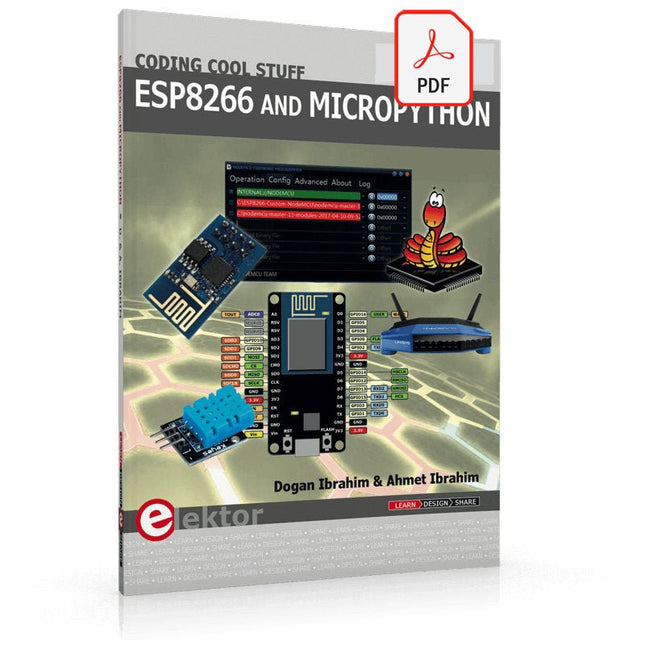
Recently, the development of a tiny chip called the ESP8266 has made it possible to interface any type of microcontroller to a Wi-Fi AP. The ESP8266 is a low-cost tiny Wi-Fi chip having fully built-in TCP/IP stack and a 32-bit microcontroller unit. This chip, produced by Shanghai based Chinese manufacturer Espressif System, is IEEE 802.11 b/g/n Wi-Fi compatible with on-chip program and data memory, and general purpose input-output ports. Several manufacturers have incorporated the ESP8266 chip in their hardware products (e.g. ESP-xx, NodeMCU etc) and offer these products as a means of connecting a microcontroller system such as the Android, PIC microcontroller or others to a Wi-Fi. The ESP8266 is a low-power chip and costs only a few Dollars.
ESP8266 and MicroPython – Coding Cool Stuff is an introduction to the ESP8266 chip and describes the features of this chip and shows how various firmware and programming languages such as the MicroPython can be uploaded to the chip. The main aim of the book is to teach the readers how to use the MicroPython programming language on ESP8266 based hardware, especially on the NodeMCU.
Several interesting and useful projects are given in the e-book (pdf) to show how to use the MicroPython in NodeMCU type ESP8266 hardware:
Project “What shall I wear today?”: You will be developing a weather information system using a NodeMCU development board together with a Text-to-Speech processor module.
Project “The Temperature and Humidity on the Cloud”: You will be developing a system that will get the ambient temperature and humidity using a sensor and then store this data on the cloud so that it can be accessed from anywhere.
Project “Remote Web Based Control”: You will be developing a system that will remotely control two LEDs connected to a NodeMCU development board using an HTTP Web Server application.
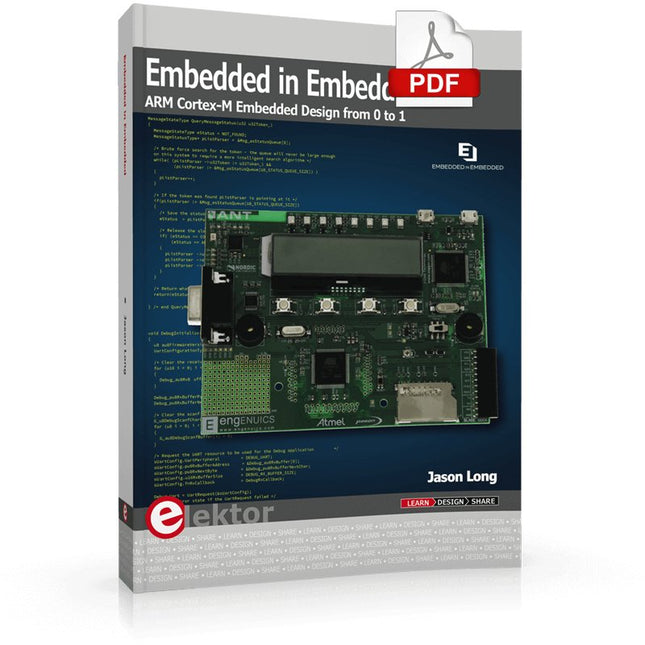
ARM Cortex-M Embedded Design from 0 to 1
Hobbyists can mash together amazing functional systems using platforms like Arduino or Raspberry Pi, but it is imperative that engineers and product designers understand the foundational knowledge of embedded design. There are very few resources available that describe the thinking, strategies, and processes to take an idea through hardware design and low-level driver development, and successfully build a complete embedded system. Many engineers end up learning the hard way, or never really learn at all.
ARM processors are essentially ubiquitous in embedded systems. Design engineers building novel devices must understand the fundamentals of these systems and be able to break down large, complicated ideas into manageable pieces. Successful product development means traversing a huge amount of documentation to understand how to accomplish what you need, then put everything together to create a robust system that will reliably operate and be maintainable for years to come.
This book is a case study in embedded design including discussion of the hardware, processor initialization, low‑level driver development, and application interface design for a product. Though we describe this through a specific application of a Cortex-M3 development board, our mission is to help the reader build foundational skills critical to being an excellent product developer. The completed development board is available to maximize the impact of this book, and the working platform that you create can then be used as a base for further development and learning.
The Embedded in Embedded program is about teaching fundamental skill sets to help engineers build a solid foundation of knowledge that can be applied in any design environment. With nearly 20 years of experience in the industry, the author communicates the critical skill development that is demanded by companies and essential to successful design. This book is as much about building a great design process, critical thinking, and even social considerations important to developers as it is about technical hardware and firmware design.
Downloads
EiE Software Archive (200 MB)
IAR ARM 8.10.1 (Recommended IDE version to use) (1.2 GB)
IAR ARM 7.20.1 (Optional IDE version to use) (600 MB)
La série OWON ADS900A est un oscilloscope numérique compact 12 bits offrant jusqu'à 2 GSa/s, une mémoire de 100 Mpts et une bande passante de 125/250 MHz. Avec son écran tactile multipoint de 7 pouces, sa FFT, son décodage de protocole et son analyseur logique intégré, il permet une analyse précise des signaux pour les applications en laboratoire, en atelier et sur le terrain.
Spécifications
ADS914A
ADS924A
Bandwidth (-3 dB)
125 MHz
250 MHz
Channels
4
Max. sample rate
2 GSa/s (single-channel) 1 GSa/s (dual-channel) 500 MSa/s (full-channel)
DC Gain Accuracy
3% (≤1 mV)
2% (≥2 mV)
Max memory depth
100M
Vertical resolution
12 bits
Relay time accuracy
±25 ppm (typical)
Input Impedance
1 MΩ±2%, parallel with20 pF±5 pF
Probe Attenuation Coefficient
1.00μX-1M.00X,step by 1-2-5, support custom
Trigger type
Edge, Video, Pulse, Slope, Runt, Windows, Timeout, Nth, Logic, RS232/UART, I²C, SPI CAN, LIN
Bus decoding
RS232/UART, I²C, SPI, CAN, LIN
Auto measurement
Period, Frequency, +Width, -Width, Rise Time, Fall Time, Scr Duty, +Duty,-Duty, Vavg, Vpp, VRMS, Overshoot, Vmax, Vmin, Vtop, CycRms, Vbase, Vamp, Preshoot, Std Dev, +Pulse Cnt, -Pulse Cnt, Rise Cnt, Fall Cnt, Area, Cyc Area, Delay(A↑-B↑), Delay(A↑-B↓), Delay(A↓-B↑), Delay(A↓-B↓), Phase(A↑-B↑)
Phase(A↑-B↓), Phase(A↓-B↑), Phase(A↓-B↓), FRR(A↑-B↑), FRF(A↑-B↓)
FFR(A↓-B↑), FFF(A↓-B↓), LRR(A↑-B↑), LRF(A↑-B↓), LFR(A↓-B↑), LFF(A↓-B↓)
Waveform Math
+, -, *, /, &&, ||, ^, !, Intg, Diff, Sqrt, Function operation (Lg / Ln / Exp / Abs / Sine / Cosine / Tan), FFT, FFT rms, User Defined, digital filter (low pass, high pass, band pass, band reject)
Frequency counter
6-digit frequency counter
Maximum frequency: maximum analog bandwidth of oscilloscope
Voltmeter
Support DC, AC+DCrms, ACrms, Resolution: 4 digits (ACV/DCV)
Logical Analyzer Specifications
Number of channels
16 input channels (D0-D15) (D0 to D7, D8 to D15)
Max. input voltage
±40V peak CAT I, transient overvoltage 800Vpk
Input Impedance
100kΩ, 8 pF
Vertical resolution
1 bit
Other
Communication Interface
HDMI, USB device, USB Host, Trig Out (P/F), LAN
Display
7 inch (1024x600), capacitive multi-touch screen
Power supply interface
USB-C
Dimensions
260 x 160 x 78 mm
Weight
1.5 kg
Inclus
1x OWON ADS924A Oscilloscope
1x Adaptateur secteur
1x Cordon d'alimentation
1x Câble USB
1x Sonde
1x Quick Guide
Téléchargements
Manual
Quick Guide
PC Software
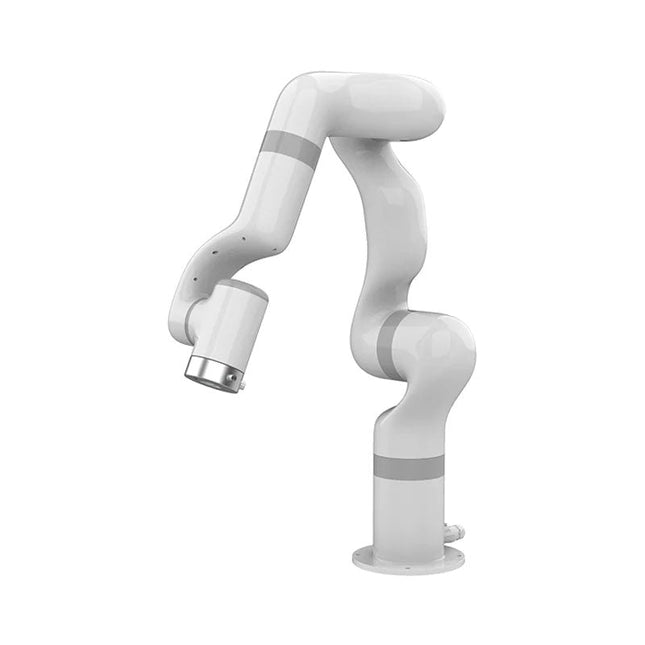
UFactory 850 est le robot le plus puissant offrant des performances de qualité industrielle.
Caractéristiques
6DoF
Charge utile : 5 kg
Portée : 850 mm
Répétabilité : 0,02 mm
Poids : 20 kg
Applications
Glambot
Soudage
Vissage
Vision robotique
Production industrielle
Conçu pour les plates-formes mobiles et votre établi
Le boîtier de commande AC contient un adaptateur AC-DC à l'intérieur, 100-240 V AC est prêt à fonctionner.
Le boîtier de commande DC prend en charge des entrées larges de 48 à 72 V, il s'adapte parfaitement au système de batterie de votre plate-forme mobile.
Déploiement flexible avec fonctionnalité sécurisée
Enseignement manuel, peu encombrant et facile à redéployer vers plusieurs applications sans modifier votre organisation de production. Parfaitement pour les tâches récurrentes.
La détection des collisions est disponible pour tous nos cobots. Votre sécurité est toujours la priorité absolue.
Interface graphique pour une programmation adaptée aux débutants
Compatible avec divers systèmes d'exploitation, notamment macOS et Windows.
Technologie Web compatible avec tous les principaux navigateurs.
Glissez et déposez pour créer votre code en quelques minutes.
SDK puissant et open source à portée de main
Le SDK Python/C++ open source entièrement fonctionnel offre une programmation plus flexible.
Les packages ROS/ROS2 sont prêts à l'emploi.
Des exemples de codes vous aident à déployer le bras robotique en douceur.
Caractéristiques
UFactory 850
xArm 5
xArm 6
xArm 7
Charge utile
5kg
3kg
5kg
3,5 kg
Atteindre
850 mm
700mm
700mm
700mm
Degrés de liberté
6
5
6
7
Répétabilité
±0,02 mm
±0,1mm
±0,1mm
±0,1mm
Vitesse maximum
1 m/s
1 m/s
1 m/s
1 m/s
Poids (bras du robot uniquement)
20 kg
11,2 kg
12,2 kg
13,7 kg
Vitesse maximum
180°/s
180°/s
180°/s
180°/s
Articulation 1
±360°
±360°
±360°
±360°
Articulation 2
-132°~132°
-118°~120°
-118°~120°
-118°~120°
Articulation 3
-242°~3,5°
-225°~11°
-225°~11°
±360°
Articulation 4
±360°
-97°~180°
±360°
-11°~225°
Articulation 5
-124°~124°
±360°
-97°~180°
±360°
Articulation 6
±360°
±360°
-97°~180°
Articulation 7
±360°
Matériel
Plage de température ambiante
0-50°C
Consommation d'énergie
Typique 240 W, maximum 1 000 W
Alimentation d'entrée
48 V CC, 20,8 A
Empreinte
Ø190mm
Matériaux
Aluminium, fibre de carbone
Type de connecteur de base
M8x4
Salle blanche de classe ISO
5
Montage de robots
N'importe lequel
Protocole de communication de l'effecteur final
Modbus RTU
E/S de l'effecteur final
2x DI / 2x DO / 2x AI / 1x RS485
Mode de communication
Ethernet
Inclus
1x bras robotique UFactory 850
1x boîtier de commande AC
1x câble d'alimentation du boîtier de commande
OWON SPE6103 est une alimentation électrique CC à 1 canal (300 W) dans un petit boîtier doté de fonctionnalités telles que la protection contre les surtensions et les surintensités. Elle possède une haute résolution de 10 mV/1 mA. L'écran LCD de 2,8 pouces affiche les informations suivantes (sortie de tension constante, sortie de courant constant, temps de fonctionnement cumulatif, puissance de sortie réelle, statut de sortie du canal, sortie de tension réelle, sortie de courant réelle). Caractéristiques Petit boîtier pour un transport facile Haute résolution : 10 mV/1 mA Liste d'édition de forme d'onde de sortie, fonction de sortie de minutage éditable pour 10 groupes Faible ondulation/bruit Protection contre les surtensions / surintensités Fonction de surveillance des courbes de tension et de courant de sortie Refroidissement intelligent par ventilateur à contrôle de température Écran LCD TFT de 2,8 pouces Interface de communication USB, prise en charge SCPI Spécifications Modèle SPE6102 SPE6103 Sortie nominale (0-40°C) Tension 0-60 V 0-60 V Courant 10 A 10 A Puissance de sortie 200 W 300 W Sortie USB 5 V/1 A (Série SPE) ou prise en charge des protocoles de charge rapide QC2.0, QC3.0, BC1.2, Apple, Huawei, Samsung (en option) Régulation de charge Tension ≤30 mV Courant ≤20 mA Régulation de puissance Tension ≤30 mV Courant ≤20 mA Résolution de réglage Tension 10 mV Courant 1 mA Résolution de lecture Tension 10 mV Courant 1 mA Résolution de la valeur (dans les 12 mois) (25 ±5°C) Tension ≤0,1% ±30 mV ≤0,1% ±30 mV Courant ≤0,05% ±10 mA Résolution de la valeur de lecture (25 ±5°C) Tension ≤0,1% ±30 mV ≤0,1% ±30 mV Courant Ondulation/bruit Tension (Vp-p) ≤50mVp-p ≤50mVp-p Tension (rms) ≤5mVrms ≤5mVrms Courant (rms) ≤30mAp-p Coefficient de température de sortie (0-40°C) Tension 100ppm/°C Courant 200ppm/°C Coefficient de température de lecture Tension 100ppm/°C Courant 200ppm/°C Temps de réponse (charge nominale 50-100%) ≤1,0ms Stockage 4 groupes de données Température de fonctionnement 0-40°C Inclus 1x OWON SPE6102 1x Cordon d'alimentation 1x Guide rapide 1x Câble USB 1x Fusible Téléchargements Manuel d'utilisation Manuel de programmation Logiciel
Physical Computing met het Arduino-platform
Dit leerboek over het Arduino-platform is uniek en brengt u stap voor stap van beginner tot gevorderde Arduino-gebruiker. Er wordt duidelijk in uitgelegd waarom en waardoor toepassingen werken, ondersteund door gedetailleerde afbeeldingen in kleur. Er is slechts een geringe elektronische basiskennis vereist, omdat de benodigde hardware uitgebreid wordt besproken. Het laatste gedeelte van dit boek bevat een degelijke theoretische verdieping, zodat u een krachtig naslagwerk achter de hand houdt.
Er bestond in het Nederlands nog geen lesboek over dit platform. De didactische opbouw is zodanig dat de vereiste abstracte kennis wordt uitgelegd aan de hand van toepasbare en actuele praktijkvoorbeelden. De meeste toepassingen zijn gericht op ‘physical computing’, dat is de interactie tussen sensoren, actoren, elektronica en software. Hierdoor is het boek ook geschikt voor technisch beroepsonderwijs, o.a. voor de richting mechatronica.
De opbouw van het boek is als volgt:
Algemene introductie microcontrollers.
Informatie over het Arduino-platform.
Oefeningen met uitleg aan de hand van 21 voorbeelden.
Praktijkvoorbeelden met uitleg aan de hand van 5 voorbeelden.
Theoretische verdieping van de software en hardware.
Praktische elektronicaschema´s.
Alle software-voorbeelden in het boek zijn als download beschikbaar.
Ce robot multi-axes équilibre parfaitement puissance et taille.
Caractéristiques
5 axes
Charge utile : 3 kg
Portée : 700 mm
Répétabilité : 0,1 mm
Vitesse maximale 1000 mm/s
Applications
Entretien des machines
Cueillette des bacs
Plateforme mobile
Automatisation du laboratoire
Recherche robotique
Des robots collaboratifs durables pour votre automatisation
L'entraînement harmonique et les servomoteurs de qualité industrielle garantissent un fonctionnement 24h/24 et 7j/7 sans arrêt.
Fabriqué en fibre de carbone, son poids de 15 kg permet un déploiement plus facile.
Déploiement flexible avec fonctionnalité sécurisée
Enseignement manuel, léger, peu encombrant et facile à redéployer vers plusieurs applications sans modifier votre organisation de production. Parfaitement pour les tâches récurrentes.
La détection des collisions est disponible pour tous nos cobots. Votre sécurité est toujours la priorité absolue.
Interface graphique pour une programmation conviviale pour les débutants
Compatible avec divers systèmes d'exploitation, notamment macOS et Windows.
Technologie Web compatible avec tous les principaux navigateurs.
Glissez et déposez pour créer votre code en quelques minutes.
Un SDK puissant et open source à portée de main
Le SDK Python/C++ open source entièrement fonctionnel offre une programmation plus flexible.
Les packages ROS/ROS2 sont prêts à l'emploi.
Des exemples de codes vous aident à déployer le bras robotique en douceur.
Caractéristiques
UFactory 850
xArm 5
xArm 6
xArm 7
Charge utile
5 kg
3 kg
5 kg
3,5 kg
Atteindre
850mm
700mm
700mm
700mm
Degrés de liberté
6
5
6
7
Répétabilité
±0,02 mm
±0,1mm
±0,1mm
±0,1mm
Vitesse maximum
1 m/s
1 m/s
1 m/s
1 m/s
Poids (bras du robot uniquement)
20 kg
11,2 kg
12,2kg
13,7 kg
Vitesse maximum
180°/s
180°/s
180°/s
180°/s
Articulation 1
±360°
±360°
±360°
±360°
Articulation 2
-132°~132°
-118°~120°
-118°~120°
-118°~120°
Articulation 3
-242°~3,5°
-225°~11°
-225°~11°
±360°
Articulation 4
±360°
-97°~180°
±360°
-11°~225°
Articulation 5
-124°~124°
±360°
-97°~180°
±360°
Articulation 6
±360°
±360°
-97°~180°
Articulation 7
±360°
Matériel
Plage de température ambiante
0-50°C
Consommation d'énergie
Min 8,4 W, typique 200 W, max 400 W
Alimentation d'entrée
24 V CC, 16,5 A
Empreinte
Ø 126 mm
Matériaux
Aluminium, fibre de carbone
Type de connecteur de base
M5x5
Salle blanche de classe ISO
5
Montage de robots
N'importe lequel
Protocole de communication de l'effecteur final
Modbus RTU(rs485)
E/S de l'effecteur final
2x DI/2x DO/2x AI/1x RS485
Mode de communication
Ethernet
Inclus
1x bras robotique xArm 5
1x boîtier de commande AC
1x câble d'alimentation du bras robotique
1x câble adaptateur d'effecteur d'extrémité de bras robotique
1x câble de signal pour bras robotique
1x câble d'alimentation du boîtier de commande
1x câble réseau
1x outil de montage
1x Guide de démarrage rapide
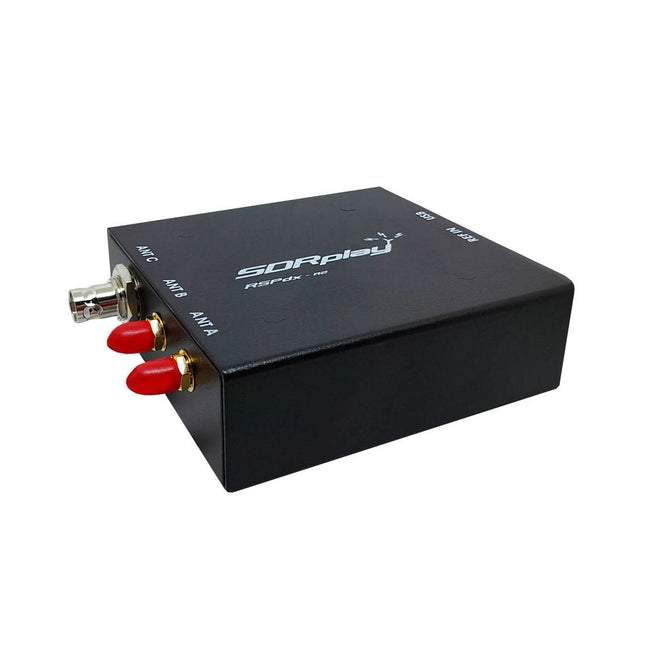
Le SDRplay RSPdx-R2 est un récepteur SDR 14 bits à large bande et à syntoniseur simple qui couvre l'ensemble du spectre RF de 1 kHz à 2 GHz, avec une visibilité du spectre allant jusqu'à 10 MHz. Il contient trois ports d'antenne, dont deux utilisent des connecteurs SMA et fonctionnent sur l'ensemble de la gamme de 1 kHz à 2 GHz et le troisième utilise un connecteur BNC qui fonctionne jusqu'à 200 MHz.
Le RSPdx-R2 est une version améliorée du RSPdx, dotée de nouvelles améliorations de conception pour une utilisation à des fréquences inférieures à 2 MHz. Logé dans un boîtier en acier robuste, le RSPdx-R2 offre, en plus des fonctionnalités du RSP1B, trois entrées d'antenne sélectionnables par logiciel et une entrée d'horloge externe. Il offre d'excellentes performances sur les fréquences HF et VHF jusqu'à 2 GHz. Le RSPdx-R2 prend également en charge un mode HDR optimisé pour les conditions de réception radio exigeantes en dessous de 2 MHz.
Utilisé avec le logiciel SDRplay, le RSPdx-R2 propose un mode HDR (High Dynamic Range) spécial pour la réception dans certaines bandes inférieures à 2 MHz. Ce mode HDR offre de meilleures performances d'intermodulation et réduit les réponses parasites sur ces bandes difficiles.
Caractéristiques
Couvre toutes les fréquences de 1 kHz à 2 GHz, en passant par les bandes VLF, LF, MW, HF, VHF, UHF et L, sans aucune lacune
Réception, contrôle et enregistrement jusqu'à 10 MHz de spectre à la fois
Performances nettement améliorées en dessous de 2 MHz – plage dynamique et sélectivité accrues
Choix de 3 ports d'antenne sélectionnables par logiciel
Capacité accrue à gérer des signaux extrêmement forts
Entrée d'horloge externe à des fins de synchronisation, ou connexion à l'horloge de référence GPS pour une plus grande précision de la fréquence
Excellente gamme dynamique pour les conditions de réception difficiles
Utilisation gratuite du logiciel SDRuno basé sur Windows, qui offre un ensemble de fonctions de plus en plus complet.
Réseau d'assistance logicielle solide et en pleine expansion
Mesure étalonnée du S-mètre/de la puissance RF et du SNR avec SDRuno (y compris l'enregistrement des données dans un fichier .CSV)
API documentée permettant le développement de démodulateurs ou d'applications sur de multiples plates-formes.
Applications (amateur)
Écoute des ondes courtes
Radio diffusion DX (AM/FM/TV)
Panadaptor
Avions (ADS-B et ATC)
TV à balayage lent
Surveillance des bandes multi amateurs
WSPR et modes numériques
Fax météo (HF et satellite)
Surveillance des satellites
Satellites environnementaux géostationnaires
Radio à ressources partagées
Surveillance des services publics et des services d'urgence
Comparaison rapide et efficace des antennes
Applications (Industrie)
Analyseur de spectre
Surveillance
Surveillance des microphones sans fil
Surveillance RF
Chaîne de réception IoT
Enregistrement des signaux
Détection RFI/EMC
Surveillance de l'intégrité de la diffusion
Surveillance du spectre
Mesure de la puissance
Applications (éducatives/scientifiques)
Enseignement
Conception de récepteurs
Radioastronomie
Radar passif
Ionosonde
Analyseur de spectre
Récepteur pour les projets de capteurs IoT
Recherche sur les antennes
Specifications
Gamme de fréquences
1 kHz – 2 GHz
Connecteur d'antenne
SMA
Impédance de l'antenne
50 Ω
Consommation de courant (typique)
190 mA @ >60 MHz (excl. Bias-T)120 mA @ <60 MHz (excl. Bias-T)
Connecteur USB
USB-B
Puissance d'entrée maximale
+0 dBm en continu+10 dBm Courte durée
Taux d'échantillonnage de l'ADC
2-10,66 MSPS
Nombre de bits du CAN
14 bits 2 - 6.048 MSPS12 bits 6,048 - 8,064 MSPS10 bits 8.064 - 9.216 MSPS8 bits >9,216 MSPS
Bias-T
4.7 V100 mA garanti
Référence
0,5ppm TCXO 24 MHz.Erreur de fréquence réglable à 0,01 ppm.
Plage de température de fonctionnement
−10°C à +60°C
Dimensions
113 x 94 x 35 mm
Poids
315 g
Téléchargements
Datasheet
Software
RSPdx-R2 vs RSPduo
RSPdx-R2
RSPduo
Couverture continue de 1 kHz à 2 GHz
✓
✓
Largeur de bande visible jusqu'à 10 MHz
✓
✓
Technologie silicium ADC 14 bits et multiples filtres d'entrée haute performance
✓
✓
Filtres coupe-bande AM/FM et DAB sélectionnables par logiciel
✓
✓
Bias-T de 4,7 V pour l'alimentation de l'amplificateur d'antenne distant externe
✓
✓
Alimentation par le câble USB avec une simple prise de type B
✓
✓
Entrée(s) d'antenne SMA 50Ω pour un fonctionnement de 1 kHz à 2 GHz (sélectionnable par logiciel)
2
2
Entrée Hi-Z supplémentaire sélectionnable par logiciel pour un fonctionnement jusqu'à 30 Mhz
✓
Entrée BNC 50Ω supplémentaire sélectionnable par logiciel pour un fonctionnement jusqu'à 200 MHz
✓
Filtre LF/VLF supplémentaire pour les fréquences inférieures à 500 kHz
✓
Entrée horloge de référence 24 MHz (+ sortie sur RSPduo)
✓
✓
Deux syntoniseurs permettant la réception sur 2 plages de 2 MHz totalement indépendantes
✓
Deux syntoniseurs permettant la réception en diversité à l'aide de SDRuno
✓
Boîtier robuste en acier peint en noir
✓
✓
Performances globales en dessous de 2 MHz pour les ondes hectométriques et kilométriques
++
+
Applications multiples simultanées
+
++
Performance dans des conditions d'évanouissement difficiles (*en utilisant la syntonisation en diversité)
+
*++
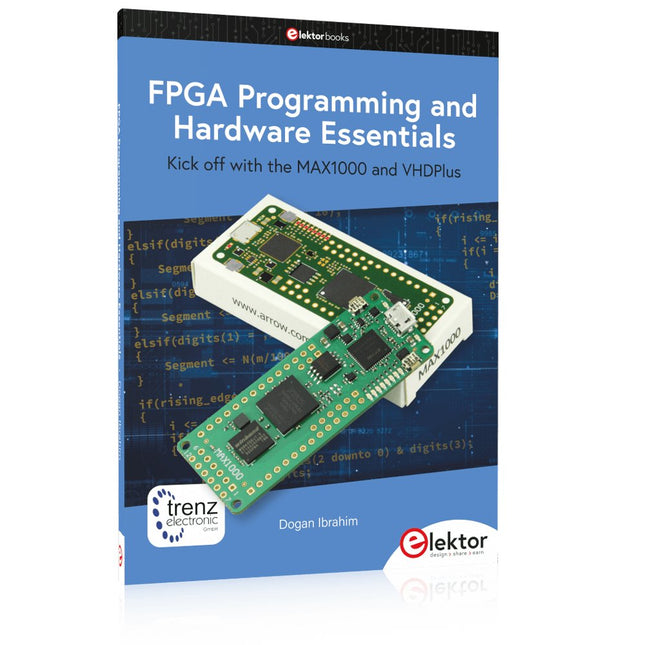
Kick off with the MAX1000 and VHDPlus
Ready to Master FPGA Programming? In this guide, we’re diving into the world of Field Programmable Gate Arrays (FPGAs) – a configurable integrated circuit that can be programmed after manufacturing. Imagine bringing your ideas to life, from simple projects to complete microcontroller systems!
Meet the MAX1000: a compact and budget-friendly FPGA development board packed with features like memory, user LEDs, push-buttons, and flexible I/O ports. It’s the ideal starting point for anyone wanting to learn about FPGAs and Hardware Description Languages (HDLs).
In this book, you’ll get hands-on with the VHDPlus programming language – a simpler version of VHDL. We’ll work on practical projects using the MAX1000, helping you gain the skills and confidence to unleash your creativity.
Get ready for an exciting journey! You’ll explore a variety of projects that highlight the true power of FPGAs. Let’s turn your ideas into reality and embark on your FPGA adventure – your journey starts now!
Exciting Projects You’ll Find in This Book
Arduino-Driven BCD to 7-Segment Display Decoder
Use an Arduino Uno R4 to supply BCD data to the decoder, counting from 0 to 9 with a one-second delay
Multiplexed 4-Digit Event Counter
Create an event counter that displays the total count on a 4-digit display, incrementing with each button press
PWM Waveform with Fixed Duty Cycle
Generate a PWM waveform at 1 kHz with a fixed duty cycle of 50%
Ultrasonic Distance Measurement
Measure distances using an ultrasonic sensor, displaying the results on a 4-digit 7-segment LED
Electronic Lock
Build a simple electronic lock using combinational logic gates with push buttons and an LED output
Temperature Sensor
Monitor ambient temperature with a TMP36 sensor and display the readings on a 7-segment LED
Téléchargements
Software