
Résultats de la recherche pour "elektor or sdr or praxis or bundle"
-

Elektor Digital Elektor May/June 2026 (PDF) EN
Elektor GREEN and GOLD members can download their digital edition here. Not a member yet? Click here. PbMonitor v2.0 UpdateBattery Monitoring with Improved Analog Design Audio Latency MeasurementA Standalone Tool for Evaluating Errors and Latency in Audio Transmission Square Wave vs. Bode PlotChecking the Performances of an Audio Device embedded world 2026 Clever Coding with AIAI in Software Development for Electronics Engineers QA403 Audio AnalyzerAffordable Precision for Audio Professionals and Hobbyists EasyGimbalAutonomous Camera Tracking with AI, Stepper and Servo Motors Sigfox Breakout Board (2)Sending Messages Circuit ProtectionControlling Overvoltages with TVS Diodes Emerging Battery Testing ApproachesA New Era of Diagnostics AudiotronicsA First Preamplifier CANopenTermAn Open-Source Tool That Brings CAN to Makers and Engineers Alike Stabilization of Operational AmplifiersAvoiding Feedback Instability Err-lectronicsCorrections, Updates, and Readers’ Letters Signal ConditioningTips and Tricks to Fit Voltage Ranges TDR Attachment for OscilloscopesLength, Short Circuit, Mismatch: Measure Cables Using Reflections! From Life's ExperienceLED It Be Speaker Oscillator and Resonance TesterA Fully Experimental Project for Your Speakers Elektor Community Perspectives on Test and Measurement ESP32 Audio Transceiver Board (Part 5)Audio Processing and Remote Control 2026: An AI OdysseyAI Has a Context Problem Battery Storage for Balcony Power PlantsSmall Batteries, Big Impact
€ 9,50
-

Elektor Digital Digital Electronics (E-book)
The Basics, New Ideas & Applications Build digital electronics from the ground up—and take it all the way to practical circuits you can use. This book guides you through the core principles of digital technology with a strongly hands-on approach. You’ll begin with the essentials: signals, devices for working with them, and what "logic 0" and "logic 1" mean in real hardware. Simple demonstration setups made from easy-to-find parts (LEDs, diodes, resistors, switches) help you see how logic behaves, making the theory click before you move on. From there, you’ll explore a wide range of logic elements and how they’re implemented, including classic logic families such as TTL and CMOS. The fundamentals section covers the building blocks of digital systems: flip-flops, Schmitt triggers, registers, counters and dividers, encoders/ decoders, multiplexers/demultiplexers, plus A/D and D/A conversion and timing circuits. Next, the book invites you into "new ideas" in digital electronics—universal logic elements, unconventional approaches (including thyristor-based and fractional logic), and creative logic functions that can inspire original designs. Finally, a large, well-organized collection of application circuits turns knowledge into projects: electronic switches and selectors, pulse generators, PWM regulators, frequency multipliers/dividers, phase shifters, and digital filters. Study it deeply, and you’ll gain not only understanding—but the ability to design and debug digital circuits independently.
€ 32,95
Membres : € 29,66
-
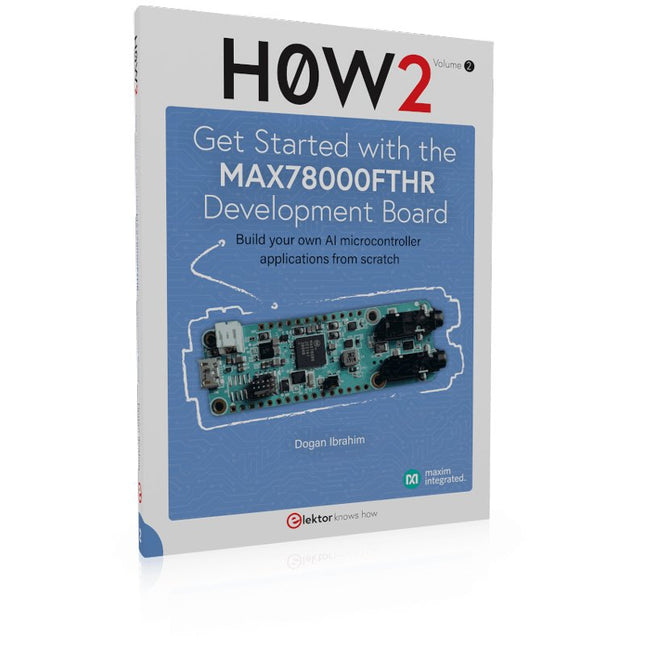
Elektor Publishing H0W2: Get Started with the MAX78000FTHR Development Board
Build your own AI microcontroller applications from scratch The MAX78000FTHR from Maxim Integrated is a small development board based on the MAX78000 MCU. The main usage of this board is in artificial intelligence applications (AI) which generally require large amounts of processing power and memory. It marries an Arm Cortex-M4 processor with a floating-point unit (FPU), convolutional neural network (CNN) accelerator, and RISC-V core into a single device. It is designed for ultra-low power consumption, making it ideal for many portable AI-based applications. This book is project-based and aims to teach the basic features of the MAX78000FTHR. It demonstrates how it can be used in various classical and AI-based projects. Each project is described in detail and complete program listings are provided. Readers should be able to use the projects as they are, or modify them to suit their applications. This book covers the following features of the MAX78000FTHR microcontroller development board: Onboard LEDs and buttons External LEDs and buttons Using analog-to-digital converters I²C projects SPI projects UART projects External interrupts and timer interrupts Using the onboard microphone Using the onboard camera Convolutional Neural Network
€ 39,95
Membres : € 35,96
-

SDRplay SDRplay RSPduo Récepteur SDR 14 bits à syntoniseur double (1 kHz à 2 GHz)
Le SDRplay RSPduo est un récepteur SDR 14 bits à syntoniseur double de haute performance. Logé dans un boîtier en acier de haute qualité, chaque syntoniseur peut fonctionner individuellement entre 1 kHz et 2 GHz avec une largeur de bande allant jusqu'à 10 MHz ou les deux tuners peuvent fonctionner simultanément entre 1 kHz et 2 GHz avec une largeur de bande allant jusqu'à 2 MHz par tuner. Une référence de haute stabilité ainsi que des fonctions d'horloge externe font de cet appareil un outil idéal pour les applications industrielles, scientifiques et éducatives. Caractéristiques Le syntoniseur double offre une couverture indépendante de 1 kHz à 2 GHz en utilisant simultanément 2 ports d'antenne Technologie silicium ADC 14 bits Largeur de bande visible jusqu'à 10 MHz (mode syntoniseur simple) ou 2 tranches de spectre de 2 MHz (mode syntoniseur double) 3 ports d'antenne sélectionnables par logiciel (2x 50Ω et 1x 1kΩ entrée symétrique/asymétrique à haute impédance) Port d'antenne haute impédance (1 kHz à 30 MHz) avec filtre coupe-bande MW sélectionnable et choix de 2 filtres de présélection Filtres coupe-bande AM/FM et DAB sélectionnables par logiciel pour les 2 ports d'antenne SMA (1 kHz à 2 GHz) L'entrée et la sortie d'horloge externe permettent une synchronisation facile avec plusieurs RSP ou une horloge de référence externe. Alimentation par le câble USB à l'aide d'une simple prise de type B 11 filtres de présélection frontaux intégrés à haute sélectivité sur les deux ports d'antenne SMA Préamplificateur à faible bruit multi-niveaux sélectionnable par logiciel Alimentation Bias-T pour alimenter le LNA monté sur l'antenne Le tout dans un boîtier robuste en acier peint en noir. SDRuno – Logiciel SDR de classe mondiale pour Windows API documentée pour le développement de nouvelles applications Spécifications Gamme de fréquences 1 kHz – 2 GHz Connecteur d'antenne SMA Impédance de l'antenne 50 Ω Consommation de courant (typique) Mode syntoniseur simple : 180 mA (hors Bias-T)Mode syntoniseur double : 280 mA (sans Bias-T) Connecteur USB USB-B Puissance d'entrée maximale +0 dBm en continu +10 dBm courte durée Taux d'échantillonnage ADC 2-10,66 MSPS ADC Nombre de bits 14 bits 2-6,048 MSPS12 bits 6.048-8,064 MSPS10 bits 8.064-9,216 MSPS8 bits >9,216 MSPS Bias-T 4.7 V100 mA garantis Référence TCXO 24 MHz à haute stabilité de température (0,5ppm). Erreur de fréquence réglable à 0,01 ppm. Plage de température de fonctionnement −10°C à +60°C Dimensions 98 x 94 x 33 mm Poids 315 g Téléchargements Fiche technique Informations techniques détaillées Logiciel RSPdx-R2 vs RSPduo RSPdx-R2 RSPduo Couverture continue de 1 kHz à 2 GHz ✓ ✓ Largeur de bande visible jusqu'à 10 MHz ✓ ✓ Technologie silicium ADC 14 bits et multiples filtres d'entrée haute performance ✓ ✓ Filtres coupe-bande AM/FM et DAB sélectionnables par logiciel ✓ ✓ Bias-T de 4,7 V pour l'alimentation de l'amplificateur d'antenne distant externe ✓ ✓ Alimentation par le câble USB avec une simple prise de type B ✓ ✓ Entrée(s) d'antenne SMA 50Ω pour un fonctionnement de 1 kHz à 2 GHz (sélectionnable par logiciel) 2 2 Entrée Hi-Z supplémentaire sélectionnable par logiciel pour un fonctionnement jusqu'à 30 Mhz ✓ Entrée BNC 50Ω supplémentaire sélectionnable par logiciel pour un fonctionnement jusqu'à 200 MHz ✓ Filtre LF/VLF supplémentaire pour les fréquences inférieures à 500 kHz ✓ Entrée horloge de référence 24 MHz (+ sortie sur RSPduo) ✓ ✓ Deux syntoniseurs permettant la réception sur 2 plages de 2 MHz totalement indépendantes ✓ Deux syntoniseurs permettant la réception en diversité à l'aide de SDRuno ✓ Boîtier robuste en acier peint en noir ✓ ✓ Performances globales en dessous de 2 MHz pour les ondes hectométriques et kilométriques ++ + Applications multiples simultanées + ++ Performance dans des conditions d'évanouissement difficiles (*en utilisant la syntonisation en diversité) + *++
€ 285,60
-

Elektor Digital PID-basierte digitale Regelungstechnik mit Raspberry Pi und Arduino Uno (PDF)
Der Arduino Uno ist ein Open-Source-Mikrocontroller-Entwicklungssystem, das Hardware, eine integrierte Entwicklungsumgebung (IDE) und eine Vielzahl von Bibliotheken umfasst. Es wird von einer riesigen Gemeinschaft von Programmierern, Elektronikern, Enthusiasten und Akademikern unterstützt. Insbesondere die Bibliotheken erleichtern die Programmierarbeit und reduzieren die Entwicklungszeiten, da sie das Erstellen von Programmen erheblich erleichtern. Der Raspberry Pi 4 kann in vielen Projekten wie Audio- und Videoanwendungen, aber auch in Industriesteuerungen, Robotik, Spielen usw. eingesetzt werden. Dazu bietet er auch WiFi- und Bluetooth-Fähigkeiten, wodurch er sich zudem hervorragend für internetbasierte Steuerungs- und Überwachungsanwendungen eignet. In diesem Buch werden sowohl der Raspberry Pi 4 als auch der Arduino Uno in PID-basierten automatischen Steuerungsanwendungen eingesetzt. Nach einer grundlegenden Theorie der Regelsysteme werden funktionierende und getestete Projekte zur Steuerung realer Systeme mit PID-Reglern vorgestellt. Die Open-Loop-Eigenschaften, die Abstimmung der PID-Parameter und das Closed-Loop-Zeitverhalten der Systeme werden zusammen mit Blockdiagrammen, Schaltplänen und PID-Regelalgorithmen ausführlich diskutiert. Vollständige Programme für den Raspberry Pi und den Arduino Uno runden die im Buch vorgestellten Projekte ab. Die Regelsysteme können problemlos auch auf andere Projekte angewendet werden und die für den Raspberry Pi 4 angegebenen Programme sollten auch mit anderen Modellen der Raspberry Pi-Familie reibungslos funktionieren. Das Buch behandelt folgende Themen: Steuer- und Regelsysteme Analoge und digitale Sensoren Übertragungsfunktionen und zeitkontinuierliche Systeme Systemantwortfunktionen erster und zweiter Ordnung Zeitdiskrete digitale Systeme Zeitkontinuierliche PID-Regler Zeitdiskrete PID-Regler Zweipunkt-Temperaturregelung mit Raspberry Pi und Arduino Uno PID-basierte Temperaturregelung mit Raspberry Pi und Arduino Uno Motorsteuerung mit Raspberry Pi und Arduino Uno Wasserstandsregelung mit Raspberry Pi und Arduino Uno PID-basierte LED-Helligkeitsregelung mit Raspberry Pi und Arduino Uno
€ 32,80
Membres : € 29,52
-

SDRplay SDRplay RSPdx-R2 Récepteur SDR 14 bits à syntoniseur simple (1 kHz à 2 GHz)
Le SDRplay RSPdx-R2 est un récepteur SDR 14 bits à large bande et à syntoniseur simple qui couvre l'ensemble du spectre RF de 1 kHz à 2 GHz, avec une visibilité du spectre allant jusqu'à 10 MHz. Il contient trois ports d'antenne, dont deux utilisent des connecteurs SMA et fonctionnent sur l'ensemble de la gamme de 1 kHz à 2 GHz et le troisième utilise un connecteur BNC qui fonctionne jusqu'à 200 MHz. Le RSPdx-R2 est une version améliorée du RSPdx, dotée de nouvelles améliorations de conception pour une utilisation à des fréquences inférieures à 2 MHz. Logé dans un boîtier en acier robuste, le RSPdx-R2 offre, en plus des fonctionnalités du RSP1B, trois entrées d'antenne sélectionnables par logiciel et une entrée d'horloge externe. Il offre d'excellentes performances sur les fréquences HF et VHF jusqu'à 2 GHz. Le RSPdx-R2 prend également en charge un mode HDR optimisé pour les conditions de réception radio exigeantes en dessous de 2 MHz. Utilisé avec le logiciel SDRplay, le RSPdx-R2 propose un mode HDR (High Dynamic Range) spécial pour la réception dans certaines bandes inférieures à 2 MHz. Ce mode HDR offre de meilleures performances d'intermodulation et réduit les réponses parasites sur ces bandes difficiles. Caractéristiques Couvre toutes les fréquences de 1 kHz à 2 GHz, en passant par les bandes VLF, LF, MW, HF, VHF, UHF et L, sans aucune lacune Réception, contrôle et enregistrement jusqu'à 10 MHz de spectre à la fois Performances nettement améliorées en dessous de 2 MHz – plage dynamique et sélectivité accrues Choix de 3 ports d'antenne sélectionnables par logiciel Capacité accrue à gérer des signaux extrêmement forts Entrée d'horloge externe à des fins de synchronisation, ou connexion à l'horloge de référence GPS pour une plus grande précision de la fréquence Excellente gamme dynamique pour les conditions de réception difficiles Utilisation gratuite du logiciel SDRuno basé sur Windows, qui offre un ensemble de fonctions de plus en plus complet. Réseau d'assistance logicielle solide et en pleine expansion Mesure étalonnée du S-mètre/de la puissance RF et du SNR avec SDRuno (y compris l'enregistrement des données dans un fichier .CSV) API documentée permettant le développement de démodulateurs ou d'applications sur de multiples plates-formes. Applications (amateur) Écoute des ondes courtes Radio diffusion DX (AM/FM/TV) Panadaptor Avions (ADS-B et ATC) TV à balayage lent Surveillance des bandes multi amateurs WSPR et modes numériques Fax météo (HF et satellite) Surveillance des satellites Satellites environnementaux géostationnaires Radio à ressources partagées Surveillance des services publics et des services d'urgence Comparaison rapide et efficace des antennes Applications (Industrie) Analyseur de spectre Surveillance Surveillance des microphones sans fil Surveillance RF Chaîne de réception IoT Enregistrement des signaux Détection RFI/EMC Surveillance de l'intégrité de la diffusion Surveillance du spectre Mesure de la puissance Applications (éducatives/scientifiques) Enseignement Conception de récepteurs Radioastronomie Radar passif Ionosonde Analyseur de spectre Récepteur pour les projets de capteurs IoT Recherche sur les antennes Specifications Gamme de fréquences 1 kHz – 2 GHz Connecteur d'antenne SMA Impédance de l'antenne 50 Ω Consommation de courant (typique) 190 mA @ >60 MHz (excl. Bias-T)120 mA @ <60 MHz (excl. Bias-T) Connecteur USB USB-B Puissance d'entrée maximale +0 dBm en continu+10 dBm Courte durée Taux d'échantillonnage de l'ADC 2-10,66 MSPS Nombre de bits du CAN 14 bits 2 - 6.048 MSPS12 bits 6,048 - 8,064 MSPS10 bits 8.064 - 9.216 MSPS8 bits >9,216 MSPS Bias-T 4.7 V100 mA garanti Référence 0,5ppm TCXO 24 MHz.Erreur de fréquence réglable à 0,01 ppm. Plage de température de fonctionnement −10°C à +60°C Dimensions 113 x 94 x 35 mm Poids 315 g Téléchargements Datasheet Software RSPdx-R2 vs RSPduo RSPdx-R2 RSPduo Couverture continue de 1 kHz à 2 GHz ✓ ✓ Largeur de bande visible jusqu'à 10 MHz ✓ ✓ Technologie silicium ADC 14 bits et multiples filtres d'entrée haute performance ✓ ✓ Filtres coupe-bande AM/FM et DAB sélectionnables par logiciel ✓ ✓ Bias-T de 4,7 V pour l'alimentation de l'amplificateur d'antenne distant externe ✓ ✓ Alimentation par le câble USB avec une simple prise de type B ✓ ✓ Entrée(s) d'antenne SMA 50Ω pour un fonctionnement de 1 kHz à 2 GHz (sélectionnable par logiciel) 2 2 Entrée Hi-Z supplémentaire sélectionnable par logiciel pour un fonctionnement jusqu'à 30 Mhz ✓ Entrée BNC 50Ω supplémentaire sélectionnable par logiciel pour un fonctionnement jusqu'à 200 MHz ✓ Filtre LF/VLF supplémentaire pour les fréquences inférieures à 500 kHz ✓ Entrée horloge de référence 24 MHz (+ sortie sur RSPduo) ✓ ✓ Deux syntoniseurs permettant la réception sur 2 plages de 2 MHz totalement indépendantes ✓ Deux syntoniseurs permettant la réception en diversité à l'aide de SDRuno ✓ Boîtier robuste en acier peint en noir ✓ ✓ Performances globales en dessous de 2 MHz pour les ondes hectométriques et kilométriques ++ + Applications multiples simultanées + ++ Performance dans des conditions d'évanouissement difficiles (*en utilisant la syntonisation en diversité) + *++
€ 260,83
-

Elektor Juli/Augustus 2026 (NL)
Elektor GREEN en GOLD leden kunnen deze uitgave hier downloaden. Nog geen lid? Klik hier om een lidmaatschap af te sluiten. MultiRF ontwikkelboardEen platform voor het evalueren van draadloze protocollen op korte en lange afstand Elektor wordt 65Baanbrekend op het gebied van elektronica sinds 1961 Persoonsdetectie via wifi op een ESP32Wanneer uw router een bewegingssensor wordt Draadloze weegschalenVier kleine weegschalen maken een grote weegschaal Walter, de compacte IoT-moduleESP32-S3 SoC, LTE-M/NB-IoT 5G-modem en GNSS-ontvanger 3- en 4-draads RTD-sensorconditioneringMet volledige afstelling en kabelcompensatie 3-in-1 2-kanaals oscilloscoop/generator/multimeterEen review van de Fnirsi 2D15P electronica Fast Forward 2026 nodigt start-ups en partners uit de industrie uit EcologgingEen modulair IoT-milieustation voor onderzoek in het veld Draadloze connectiviteit in medische toepassingenAltijd op de hoogte met Bluetooth LE AudiotronicaBromonderdrukking De efficiëntie in de landbouw verhogen met AI-modellen en sensorenDe landbouwproductiviteit verhogen OPC UA, een overzichtPlatform-onafhankelijke gegevensuitwisseling Redoxmeter Instrumentation amplifier voor fysica- en techniekexperimenten Actieve differentiële audiofiltersVoor professionele cross-overs en meer Communityperspectieven van Elektor op IoT & sensoren Telegramgestuurde interface module voor een boilerEen oplossing op basis van een ESP32 en Arduino software 2026: An AI OdysseyWat is er gebeurd met fuzzy logic? Err-lectronics Alarmsignaalinjector en bruut geweldHulpmiddelen om kabelbreuken op te sporen
€ 15,95
-
Elektor Publishing Wireless Power Design
From Theory to Practical Applications in Wireless Energy Transfer and Harvesting Wireless power transmission has gained significant global interest, particularly with the rise of electric vehicles and the Internet of Things (IoT). It’s a technology that allows the transfer of electricity without physical connections, offering solutions for everything from powering small devices over short distances to long-range energy transmission for more complex systems. Wireless Power Design provides a balanced mix of theoretical knowledge and practical insights, helping you explore the potential of wireless energy transfer and harvesting technologies. The book presents a series of hands-on projects that cover various aspects of wireless power systems, each accompanied by detailed explanations and parameter listings. The following five projects guide you through key areas of wireless power: Project 1: Wireless Powering of Advanced IoT Devices Project 2: Wireless Powered Devices on the Frontline – The Future and Challenges Project 3: Wireless Powering of Devices Using Inductive Technology Project 4: Wireless Power Transmission for IoT Devices Project 5: Charging Robot Crawler Inside the Pipeline These projects explore different aspects of wireless power, from inductive charging to wireless energy transmission, offering practical solutions for real-world applications. The book includes projects that use simulation tools like CST Microwave Studio and Keysight ADS for design and analysis, with a focus on practical design considerations and real-world implementation techniques.
€ 39,95
Membres : € 35,96
-

Elektor Digital Tube Amplifier Circuits (E-book)
From SRPP and Mu-Follower to OTL Designs Tube amplifiers suffer from distortion. Fortunately, circuits such as the SRPP amplifier, mu-follower, and beta-follower produce minimal distortion even at output voltages of 50 to 100 Vpeak. These designs are often published with errors. Without a sound understanding of the theory, it is easy to arrive at a flawed design. In the first section of this book, we investigate the origin of distortion, while in the second we investigate the design of and SRPP and a mu-follower. On the internet we can find the most exotic designs. Evaluating them teaches us that these designs often make matters worse rather than better. In the chapter on incorrect SRPPs and mu-followers, we sometimes see bizarre and misguided designs where using a simple single-triode amplifier would perform much better. Push-pull output stages also exist. A great number of them are examined, and their similarity to the SRPP is discussed. This is done especially with the help of the theory behind the OTL based on the ‘mother’ of all OTLs, the Philips HF303. Finally, attention is given to frequency characteristics and technical matters such as the supply voltage and the filament power supply. To illustrate these points, there are a few designs covering the subjects discussed. This book presents much new theory that has not been published before. It is often an eye-opener, showing that many things have a beautiful and unexpected simplicity.
€ 34,95
Membres : € 31,46
-
Elektor Digital High-End Tube Amplifier Design (E-book)
A Toolbox for Audio Lovers and Engineers Without any ambition to reach scientific levels, this book aims to be a toolbox for both audio lovers and high-end equipment designers. The elementary theory presented is the bare minimum for readers to grasp the operation and practical use of electrical, electromagnetic, physics, and electronic operations available in the designers’ toolbox. Each tool is explained in a minimum of words and theory without needless coverage of underlying equations or figures. The book chapters guide you through the process of designing quality amplifiers with vacuum tubes, from the very beginning, considering both technical and subjective requirements – in theory and practice. The book is a compilation of the author’s notes used in his professional and educational career but was nevertheless primarily written as a result of true love for the audiophile hobby.
€ 54,95
Membres : € 49,46
-

Elektor Digital Elektor Maart/April 2022 PDF (NL)
Bouw uw eigen RISC-V-controllerEerste stappen met de NEORV32 RISC-V softcore voor goedkope FPGA’s Het gebruik van Arduino’s seriële plotterGrafieken plotten met Arduino is gemakkelijk CLUE van AdafruitEen slimme oplossing voor IoT-projecten Bufferboard voor de Raspberry Pi 400Bescherm uw I/O’s Raspberry Pi RP2040-boards in overvloed Een handboek voor DHZ elektronische beveiliging en spionageSRAM – gebakken of diepgevroren Onderdelen identificerenTips & trucs, vakkunstigheden en andere nuttige informatie DHZ aanraakloze lichtschakelaar Alle begin......gaat compenseren en transformeren Nieuwe embedded-ontwikkelingenRust en het up-to-date houden van IoT-implementaties Infographics Hoe de industrie- en automobielsector zullen profiteren van 5G Relais met bewegende spoelVreemde onderdelen Oost West Lab BestAlles draait om de bank... Kennismaking met neuronen in neurale netwerkenDeel 4: embedded neuronen Magnetische levitatie “the very easy way”De derde en meest compacte versie PLC-programmering met de Raspberry Pi en het OpenPLC-projectVisualisatie van PLC-programma’s met AdvancedHMI Uit het leven gegrepenInpakken en wegwezen Onder de radarMicrocontrollers die u zou moeten kennen Draadloos monitoren en debuggenvoor Arduino, ESP32 en co. Draagbare temperatuur- en vochtigheidsmetermet gebruiksklare modules Lithium-accupacks reparerenSpaart geld + geeft meer kracht! GUI's maken met PythonMeme-Generator De drie grote vraagtekensWaarom wat wie Hexadoku
€ 9,95
-

Elektor Digital Elektor 03-04/2020 en PDF (DE)
Elektor 03-04/2020 en PDF (DE)
€ 11,90


