
Résultats de la recherche pour "official OR case OR for OR raspberry OR pi OR 4 OR black OR gray"
-

Elektor Digital PLC Programming with the Raspberry Pi and the OpenPLC Project (E-book)
ModbusRTU and ModbusTCP examples with the Arduino Uno and ESP8266 Introduction to PLC programming with OpenPLC, the first fully open source Programmable Logic Controller on the Raspberry Pi, and Modbus examples with Arduino Uno and ESP8266 PLC programming is very common in industry and home automation. This book describes how the Raspberry Pi 4 can be used as a Programmable Logic Controller. Before taking you into the programming, the author starts with the software installation on the Raspberry Pi and the PLC editor on the PC, followed by a description of the hardware. You'll then find interesting examples in the different programming languages complying with the IEC 61131-3 standard. This manual also explains in detail how to use the PLC editor and how to load and execute the programs on the Raspberry Pi. All IEC languages are explained with examples, starting with LD (Ladder Diagram) over ST (Structured Control Language) to SFC (Special Function Chart). All examples can be downloaded from the author's website. Networking gets thorough attention too. The Arduino Uno and the ESP8266 are programmed as ModbusRTU or ModbusTCP modules to get access to external peripherals, reading sensors and switching electrical loads. I/O circuits complying with the 24 V industry standard may also be of interest for the reader. The book ends with an overview of commands for ST and LD. After reading the book, the reader will be able to create his own controllers with the Raspberry Pi.
€ 32,95
Membres : € 29,66
-
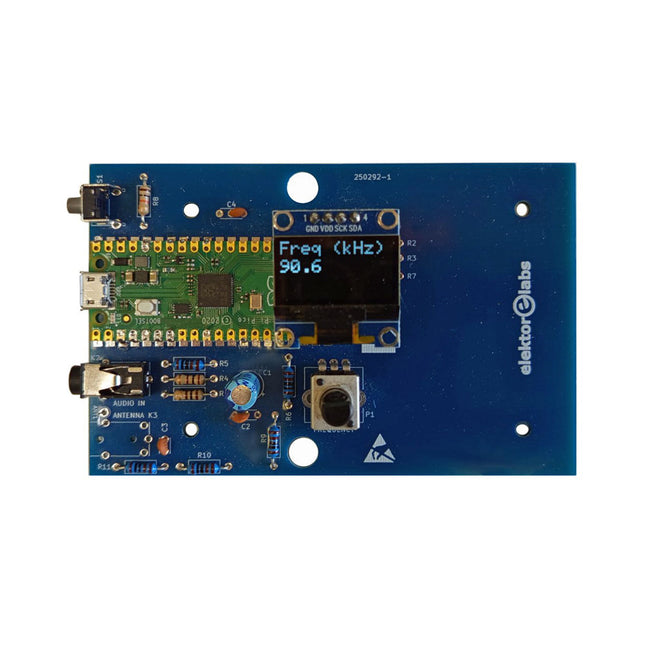
Elektor Labs Kit émetteur AM Elektor
Construisez votre propre émetteur radio vintage Le kit émetteur AM Elektor permet de diffuser de l’audio vers des récepteurs radio AM vintage. Basé sur un module microcontrôleur Raspberry Pi Pico, l’émetteur AM peut transmettre sur 32 fréquences dans la bande AM, de 500 kHz jusqu’à 1,6 MHz en 32 pas d’environ 35 kHz. La fréquence est sélectionnée à l’aide d’un potentiomètre et affichée sur un écran OLED de 0,96". Un bouton-poussoir permet de basculer le mode d’émission entre Marche et Arrêt. La portée de l’émetteur dépend de l’antenne. L’antenne intégrée offre une portée de quelques centimètres, nécessitant de placer l’émetteur AM à proximité ou à l’intérieur de la radio. Une antenne boucle externe (non incluse) peut être connectée pour augmenter la portée. Le kit émetteur AM Elektor est livré en kit de pièces que vous devez souder vous-même sur la carte. Caractéristiques La carte est compatible avec un boîtier Hammond 1593N (non inclus).Une alimentation 5 VDC avec connecteur micro-USB (par exemple, un ancien chargeur de téléphone) est nécessaire pour alimenter le kit (non incluse). Consommation de courant : 100 mA. Le logiciel Arduino (nécessitant le package RP2040 Boards d’Earle Philhower) pour le kit émetteur AM Elektor ainsi que plus d’informations sont disponibles sur la page Elektor Labs de ce projet. Liste des composants Résistances R1, R4 = 100 Ω R2, R3, R8 = 10 kΩ R5, R6, R9, R10, R11 = 1 kΩ R7 = optionnelle (non incluse) P1 = potentiomètre 100 kΩ, linéaire Condensateurs C1 = 22 µF 16V C2, C4 = 10 nF C3 = 150 pF Divers K1 = barrette 4×1 broches K2, K3 = prise 3,5 mm Raspberry Pi Pico Bouton-poussoir, montage en angle Afficheur OLED I²C monochrome 0,96" PCB 150292-1
€ 29,95
Meilleur prix
-
Elektor Digital Raspberry Pi 5 Essentials (E-book)
Program, build, and master over 60 projects with Python The Raspberry Pi 5 is the latest single-board computer from the Raspberry Pi Foundation. It can be used in many applications, such as in audio and video media centers, as a desktop computer, in industrial controllers, robotics, and in many domestic and commercial applications. In addition to the well-established features found in other Raspberry Pi computers, the Raspberry Pi 5 offers Wi-Fi and Bluetooth (classic and BLE), which makes it a perfect match for IoT as well as in remote and Internet-based control and monitoring applications. It is now possible to develop many real-time projects such as audio digital signal processing, real-time digital filtering, real-time digital control and monitoring, and many other real-time operations using this tiny powerhouse. The book starts with an introduction to the Raspberry Pi 5 computer and covers the important topics of accessing the computer locally and remotely. Use of the console language commands as well as accessing and using the desktop GUI are described with working examples. The remaining parts of the book cover many Raspberry Pi 5-based hardware projects using components and devices such as LEDs and buzzers LCDs Ultrasonic sensors Temperature and atmospheric pressure sensors The Sense HAT Camera modules Example projects are given using Wi-Fi and Bluetooth modules to send and receive data from smartphones and PCs, and sending real-time temperature and atmospheric pressure data to the cloud. All projects given in the book have been fully tested for correct operation. Only basic programming and electronics experience are required to follow the projects. Brief descriptions, block diagrams, detailed circuit diagrams, and full Python program listings are given for all projects described.
€ 32,95
Membres : € 29,66
-

Elecrow Elecrow Kit de démarrage AI pour Jetson Orin Nano
Plateforme tout-en-un d'apprentissage et de développement en IA pour l'Edge Intelligence Ce kit de démarrage IA basé sur NVIDIA Jetson est une plateforme polyvalente pour l'apprentissage, le développement et l'expérimentation pratique de l'IA en périphérie (Edge AI). Conçu pour être utilisé avec le NVIDIA Jetson Orin Nano, le kit associe un écran IPS de 11,6 pouces, une caméra motorisée (pan-tilt) de 8 mégapixels et un système d'interaction vocale basé sur l'IA. Il comprend 30 modules fonctionnels et 38 cours Python soigneusement élaborés, allant du niveau débutant au niveau avancé. Le contenu pédagogique couvre les fondamentaux de Python, la technologie des capteurs, la vision par IA et la reconnaissance d'images. Grâce à des exercices pratiques étape par étape — allant de la programmation de base aux applications concrètes de vision par ordinateur — ce kit constitue une plateforme idéale pour les étudiants, les makers, les développeurs et toute personne souhaitant explorer l'intelligence artificielle et l'Edge Computing. Remarque : Le NVIDIA Jetson Orin Nano n'est pas inclus. Caractéristiques Conçu pour le NVIDIA Jetson Orin Nano Module d'interaction vocale par IA Caméra 8 MP avec contrôle panoramique et inclinaison Prend en charge le suivi d'objets et de visages Aucune soudure ni câblage complexe requis Écran IPS intégré de 11,6 pouces 30 modules fonctionnels 38 leçons Python étape par étape Interfaces d'extension I²C, UART et GPIO Mallette de transport incluse Spécifications Processeur principal Jetson Orin Nano Nombre de capteurs 30 Conception de la carte de capteurs Carte de capteurs intégrée ; aucune soudure ni câblage complexe requis Écran Écran IPS de 11,6 pouces Résolution de l'écran 1366 x 768 Caméra IMX219 8 MP Interfaces d'extension 2x I²C, 1x UART, 1x IO D13, 1x IO D12 Environnement de programmation Basé sur Python Nombre de tutoriels 38 tutoriels créatifs Public cible Étudiants, enseignants, passionnés de matériel informatique Scénarios d'application Idéal pour apprendre la programmation d'IA et les bases de la Jetson Orin Nano Dimensions 300 x 200 x 100 mm Liste des modules Module Quantité Capteur de température et d'humidité 1 pièce Bouton-poussoir 4 pièces Capteur de distance à ultrasons 1 pièce Capteur de luminosité 1 pièce Potentiomètre linéaire 1 pièce Buzzer 1 pièce Écran LCD 1 pièce Télécommande infrarouge 1 pièce Relais 1 pièce Module NFC 1 pièce Capteur de mouvement PIR 1 pièce Joystick 1 pièce Afficheur 4 chiffres 1 pièce LED 1 pièce Microphone 1 pièce Haut-parleur 1 paire Moteur vibrant 1 pièce Capteur tactile 1 pièce Matrice RVB 8x8 1 pièce Capteur de pression atmosphérique 1 pièce Capteur d'inclinaison 1 pièce Moteur pas à pas 1 pièce Accéléromètre et gyroscope 1 pièce Capteur de gaz (MQ2) 1 pièce Capteur à effet Hall 1 pièce Encodeur rotatif 1 pièce Commutateur photoélectrique en U 1 pièce Thermistance NTC 1 pièce Servomoteur 2 pièces Caméra monoculaire 1 pièce Inclus 1x Elecrow Kit de démarrage AI pour Jetson Orin Nano 1x Télécommande infrarouge 1x Carte NFC 1x Carte SD 128 Go 1x Câble GPIO 40 broches 2x Câble FPC 22 broches 2x Câble FPC 24 broches 1x Carte adaptateur Jetson DP et USB Non inclus NVIDIA Jetson Orin Nano Téléchargements Manual Wiki OpenClaw Install and Config Guide
€ 249,00
Membres : € 224,10
-
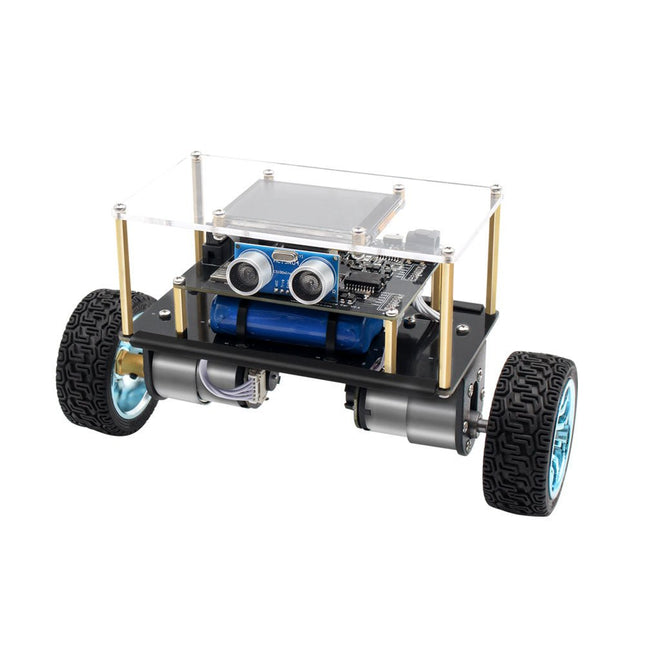
Elektor Labs Elektor Mini-Wheelie Robot auto-équilibrant
Robot à équilibrage sur deux roues compatible Arduino et alimenté par ESP32 L'Elektor Mini-Wheelie est une plateforme robotique expérimentale autonome et auto-équilibrée. Basé sur un microcontrôleur ESP32-S3, le robot auto-équilibré est entièrement programmable à l'aide de l'environnement Arduino et de bibliothèques open source. Ses capacités sans fil lui permettent d'être contrôlé à distance via Wi-Fi, Bluetooth ou ESP-NOW ou de communiquer avec un utilisateur ou même un autre robot. Un transducteur à ultrasons est disponible pour détecter les obstacles. Son écran couleur peut être utilisé pour afficher de jolies expressions faciales ou, pour les utilisateurs les plus terre-à-terre, des messages de débogage énigmatiques. Le robot est livré en kit complet avec des pièces à assembler soi-même. Tout est inclus, même un tournevis. Remarque : Le Mini-Wheelie est une plateforme de développement pédagogique destinée à l'apprentissage, à l'expérimentation et au développement de la robotique. Il n'est pas considéré comme un jouet pour enfants, et ses caractéristiques, sa documentation et le public auquel il s'adresse reflètent cet objectif. Le produit est destiné aux étudiants, aux éducateurs et aux développeurs qui souhaitent explorer la robotique, la programmation et l'intégration de matériel dans un cadre éducatif. Spécifications Microcontrôleur ESP32-S3 avec Wi-Fi et Bluetooth MPU6050 unité de mesure inertielle (IMU) à 6 axes Deux moteurs électriques 12 V à commande indépendante avec tachymètre Transducteur à ultrasons Écran couleur TFT 2,9 pouces (320 x 240) Emplacement pour carte MicroSD Moniteur de puissance de la batterie Batterie Li-Po rechargeable 3S (11,1 V/2200 mAh) Chargeur de batterie inclus Logiciel Open Source basé sur Arduino Dimensions (L x L x H) : 23 x 8 x 13 cm Inclus 1x Carte mère ESP32-S3 + module MPU6050 1x Carte LCD (2,9 pouces) 1x Capteur à ultrasons 1x Batterie (2200 mAh) 1x Chargeur de batterie 1x Kit de pneus moteur 1x Tableau de caisse 1x Tableau acrylique 1x Tournevis 1x Bande de protection 1x Câble flexible B (8 cm) 1x Câble flexible A (12 cm) 1x Câble flexible C 4x Colonnes A en cuivre (25 mm) 4x Colonnes B en cuivre (55 mm) 4x Colonnes C en cuivre (5 mm) 2x Colonnes en plastique et nylon 8x Vis A (10 mm) 24 Vis B (M3x5) 8x Noix 24x Rondelles métalliques 2x Attaches zippées 1x Carte MicroSD (32 Go) Téléchargements Documentation
€ 89,95
Membres : € 80,96
-
Elektor Digital Explore the Raspberry Pi in 45 Electronics Projects (3rd Edition | E-book)
3rd Edition – Fully updated for Raspberry Pi 4 The Raspberry Pi is a very cheap but complete computer system that allows all sorts of electronics parts and extensions to be connected. This book addresses one of the strongest aspects of the Raspberry Pi: the ability to combine hands-on electronics and programming. Combine hands-on electronics and programming After a short introduction to the Raspberry Pi you proceed with installing the required software. The SD card that can be purchased in conjunction with this book contains everything to get started with the Raspberry Pi. At the side of the (optional) Windows PC, software is used which is free for downloading. The book continues with a concise introduction to the Linux operating system, after which you start programming in Bash, Python 3 and Javascript. Although the emphasis is on Python, the coverage is brief and to the point in all cases – just enabling you to grasp the essence of all projects and start adapting them to your requirements. All set, you can carry on with fun projects. The book is ideal for self-study No fewer than 45 exciting and compelling projects are discussed and elaborated in detail. From a flashing lights to driving an electromotor; from processing and generating analog signals to a lux meter and a temperature control. We also move to more complex projects like a motor speed controller, a web server with CGI, client-server applications and Xwindows programs. Each project has details of the way it got designed that way The process of reading, building, and programming not only provides insight into the Raspberry Pi, Python, and the electronic parts used, but also enables you to modify or extend the projects any way you like. Also, feel free to combine several projects into a larger design.
€ 32,95
Membres : € 29,66
-

Elektor Digital PID-based Practical Digital Control with Raspberry Pi and Arduino Uno (E-book)
The Arduino Uno is an open-source microcontroller development system encompassing hardware, an Integrated Development Environment (IDE), and a vast number of libraries. It is supported by an enormous community of programmers, electronic engineers, enthusiasts, and academics. The libraries in particular really smooth Arduino programming and reduce programming time. What’s more, the libraries greatly facilitate testing your programs since most come fully tested and working. The Raspberry Pi 4 can be used in many applications such as audio and video media devices. It also works in industrial controllers, robotics, games, and in many domestic and commercial applications. The Raspberry Pi 4 also offers Wi-Fi and Bluetooth capability which makes it great for remote and Internet-based control and monitoring applications. This book is about using both the Raspberry Pi 4 and the Arduino Uno in PID-based automatic control applications. The book starts with basic theory of the control systems and feedback control. Working and tested projects are given for controlling real-life systems using PID controllers. The open-loop step time response, tuning the PID parameters, and the closed-loop time response of the developed systems are discussed together with the block diagrams, circuit diagrams, PID controller algorithms, and the full program listings for both the Raspberry Pi and the Arduino Uno. The projects given in the book aim to teach the theory and applications of PID controllers and can be modified easily as desired for other applications. The projects given for the Raspberry Pi 4 should work with all other models of Raspberry Pi family. The book covers the following topics: Open-loop and closed-loop control systems Analog and digital sensors Transfer functions and continuous-time systems First-order and second-order system time responses Discrete-time digital systems Continuous-time PID controllers Discrete-time PID controllers ON-OFF temperature control with Raspberry Pi and Arduino Uno PID-based temperature control with Raspberry Pi and Arduino Uno PID-based DC motor control with Raspberry Pi and Arduino Uno PID-based water level control with Raspberry Pi and Arduino Uno PID-based LED-LDR brightness control with Raspberry Pi and Arduino Uno
€ 32,95
Membres : € 29,66
-

FNIRSI FNIRSI LC1020E LCR-mètre haute précision
Le LCR-mètre haute précision FNIRSI LC1020E avec testeur ESR est une solution portable et intelligente pour tester les composants électroniques, offrant une précision de base allant jusqu'à 0,3%. Il est idéal pour les ingénieurs, les techniciens et les makers. L'appareil prend en charge les mesures L/Q, C/D et R/D à l'aide de modèles de circuits équivalents en série et en parallèle, et dispose d'un écran couleur TFT de 2,8 pouces. Grâce à ses seuils préréglés et à ses alertes audiovisuelles, il permet une évaluation rapide de la conformité, ce qui le rend parfait pour les tests par lots et le contrôle qualité. Prenant en charge des fréquences de test allant jusqu'à 100 kHz, il est parfaitement adapté à l'analyse haute fréquence des inductances, des condensateurs et des résistances. Caractéristiques Précision de ±0,05% avec une résolution de 4,5 chiffres Identification automatique des composants R/L/C pour des mesures rapides 5 fréquences de test (100 Hz–100 kHz) et 3 niveaux de tension (0,1–0,6 V) Double affichage : L/C/R/Z + X/D/Q/θ/ESR Mode de tri et tension de polarisation pour les tests par lots Double port (3/5 bornes) avec prise en charge Kelvin à 4 fils Maintien et enregistrement des données pour un flux de travail efficace Compact, rechargeable (3000 mAh) – idéal pour une utilisation en laboratoire et sur le terrain Spécifications Généralités Fréquences de test 100 Hz, 120 Hz, 1 kHz, 10 kHz, 100 kHz Précision de base 0,3% Affichage Écran LCD TFT 2,8 pouces Chiffres d'affichage Paramètre principal : 4,5 chiffres Paramètre secondaire : 4,5 chiffres Paramètres de mesure Paramètres principaux : AUTO/R/C/L/Z Paramètres secondaires : X/D/Q/θ/ESR Plage de mesure L : 0-100 H C : 0-100 mF R : 0-10 M Biais interne 0,0 V, 0,5 V Niveau de test 0,1 V, 0,3 V, 0,6 V Fonctions d'étalonnage Étalonnage en circuit ouvert, étalonnage en court-circuit Fonction de comparaison Permet de calculer l'erreur relative entre la valeur de mesure du composant et la valeur nominale, affichée en pourcentage, et fournit des résultats filtrés. Les valeurs nominales et la tolérance peuvent être définies, la plage de tolérance étant réglable de 0,1% à 99,9% Enregistrement des fonctions Vérifie si les données mesurées du composant correspondent à la valeur nominale et à la tolérance définies, en enregistrant le nombre de mesures réussies et échouées Configuration des bornes de test Trois bornes, cinq bornes Impédance de sortie 100 Ω Interface USB-C (port série virtuel) Autres Paramètres de langue, luminosité de l'écran, paramètres audio, mise hors tension automatique, paramètres de calibrage, informations système Batterie Batterie au lithium de 3000 mAh Dimensions 18,5 x 8,5 x 3,5 cm Poids 680 g Capacité (C) Plage : 1mF-100mF 100 Hz : 5% ±5 chiffres 1 kHz : 3% ±5 chiffres 10 kHz : / 100 kHz : / Plage : 1uF-1mF 100 Hz : 1% ±4 chiffres 1 kHz : 0,5% ±5 chiffres 10 kHz : 2% ±5 chiffres 100 kHz : 3% ±4 chiffres Plage : 1nF-1uF 100 Hz : / 1 kHz : 0,3% ±2 chiffres 10 kHz : 0,4% ±2 chiffres 100 kHz : 1% ±4 chiffres Plage : 1pF-1nF 100 Hz : / 1 kHz : 2% ±2 chiffres 10 kHz : 1,5% ±2 chiffres 100 kHz : 2% ±4 chiffres Inductance (L) Plage : 1H-100H 100 Hz : 2% ±5 chiffres 1 kHz : 2% ±5 chiffres 10 kHz : / 100 kHz : / Plage : 1mH-1H 100 Hz : 0,4% ±5 chiffres 1 kHz : 0,3% ±2 chiffres 10 kHz : 0,4% ±3 chiffres 100 kHz : 2,5% ±5 chiffres Plage : 10uH-1mH 100 Hz : 3% ±5 chiffres 1 kHz : 0,5% ±4 chiffres 10 kHz : 0,5% ±3 chiffres 100 kHz : 1,5% ±5 chiffres Plage : 1uH-10uH 100 Hz : / 1 kHz : 2% ±5 chiffres 10 kHz : 2% ±5 chiffres 100 kHz : 4% ±5 chiffres Résistance (R) Plage : 1MΩ-10MΩ 100 Hz : 5% ±4 chiffres 1 kHz : 3% ±3 chiffres 10 kHz : / 100 kHz : / Plage : 1KΩ-1MΩ 100 Hz : 0,4% ±4 chiffres 1 kHz : 0,2% ±2 chiffres 10 kHz : 0,3% ±3 chiffres 100 kHz : 0,6% ±5 chiffres Plage : 1Ω-1KΩ 100 Hz : 1,5% ±4 chiffres 1 kHz : 0,3% ±2 chiffres 10 kHz : 0,3% ±3 chiffres 100 kHz : 0,6% ±5 chiffres Plage : 10mΩ-1Ω 100 Hz : 4% ±4 chiffres 1 kHz : 2% ±5 chiffres 10 kHz : 2% ±5 chiffres 100 kHz : 5% ±5 chiffres Inclus 1x FNIRSI LC1020E LCR-mètre 1x Pince de mesure Kelvin 2x Cordons de mesure (1x noir, 1x rouge) 1x Plaque de court-circuit 1x Câble USB-C 1x Manuel Téléchargements Manual Firmware V1.1
€ 69,95
Meilleur prix
-

SDRplay SDRplay RSPdx-R2 Récepteur SDR 14 bits à syntoniseur simple (1 kHz à 2 GHz)
Le SDRplay RSPdx-R2 est un récepteur SDR 14 bits à large bande et à syntoniseur simple qui couvre l'ensemble du spectre RF de 1 kHz à 2 GHz, avec une visibilité du spectre allant jusqu'à 10 MHz. Il contient trois ports d'antenne, dont deux utilisent des connecteurs SMA et fonctionnent sur l'ensemble de la gamme de 1 kHz à 2 GHz et le troisième utilise un connecteur BNC qui fonctionne jusqu'à 200 MHz. Le RSPdx-R2 est une version améliorée du RSPdx, dotée de nouvelles améliorations de conception pour une utilisation à des fréquences inférieures à 2 MHz. Logé dans un boîtier en acier robuste, le RSPdx-R2 offre, en plus des fonctionnalités du RSP1B, trois entrées d'antenne sélectionnables par logiciel et une entrée d'horloge externe. Il offre d'excellentes performances sur les fréquences HF et VHF jusqu'à 2 GHz. Le RSPdx-R2 prend également en charge un mode HDR optimisé pour les conditions de réception radio exigeantes en dessous de 2 MHz. Utilisé avec le logiciel SDRplay, le RSPdx-R2 propose un mode HDR (High Dynamic Range) spécial pour la réception dans certaines bandes inférieures à 2 MHz. Ce mode HDR offre de meilleures performances d'intermodulation et réduit les réponses parasites sur ces bandes difficiles. Caractéristiques Couvre toutes les fréquences de 1 kHz à 2 GHz, en passant par les bandes VLF, LF, MW, HF, VHF, UHF et L, sans aucune lacune Réception, contrôle et enregistrement jusqu'à 10 MHz de spectre à la fois Performances nettement améliorées en dessous de 2 MHz – plage dynamique et sélectivité accrues Choix de 3 ports d'antenne sélectionnables par logiciel Capacité accrue à gérer des signaux extrêmement forts Entrée d'horloge externe à des fins de synchronisation, ou connexion à l'horloge de référence GPS pour une plus grande précision de la fréquence Excellente gamme dynamique pour les conditions de réception difficiles Utilisation gratuite du logiciel SDRuno basé sur Windows, qui offre un ensemble de fonctions de plus en plus complet. Réseau d'assistance logicielle solide et en pleine expansion Mesure étalonnée du S-mètre/de la puissance RF et du SNR avec SDRuno (y compris l'enregistrement des données dans un fichier .CSV) API documentée permettant le développement de démodulateurs ou d'applications sur de multiples plates-formes. Applications (amateur) Écoute des ondes courtes Radio diffusion DX (AM/FM/TV) Panadaptor Avions (ADS-B et ATC) TV à balayage lent Surveillance des bandes multi amateurs WSPR et modes numériques Fax météo (HF et satellite) Surveillance des satellites Satellites environnementaux géostationnaires Radio à ressources partagées Surveillance des services publics et des services d'urgence Comparaison rapide et efficace des antennes Applications (Industrie) Analyseur de spectre Surveillance Surveillance des microphones sans fil Surveillance RF Chaîne de réception IoT Enregistrement des signaux Détection RFI/EMC Surveillance de l'intégrité de la diffusion Surveillance du spectre Mesure de la puissance Applications (éducatives/scientifiques) Enseignement Conception de récepteurs Radioastronomie Radar passif Ionosonde Analyseur de spectre Récepteur pour les projets de capteurs IoT Recherche sur les antennes Specifications Gamme de fréquences 1 kHz – 2 GHz Connecteur d'antenne SMA Impédance de l'antenne 50 Ω Consommation de courant (typique) 190 mA @ >60 MHz (excl. Bias-T)120 mA @ <60 MHz (excl. Bias-T) Connecteur USB USB-B Puissance d'entrée maximale +0 dBm en continu+10 dBm Courte durée Taux d'échantillonnage de l'ADC 2-10,66 MSPS Nombre de bits du CAN 14 bits 2 - 6.048 MSPS12 bits 6,048 - 8,064 MSPS10 bits 8.064 - 9.216 MSPS8 bits >9,216 MSPS Bias-T 4.7 V100 mA garanti Référence 0,5ppm TCXO 24 MHz.Erreur de fréquence réglable à 0,01 ppm. Plage de température de fonctionnement −10°C à +60°C Dimensions 113 x 94 x 35 mm Poids 315 g Téléchargements Datasheet Software RSPdx-R2 vs RSPduo RSPdx-R2 RSPduo Couverture continue de 1 kHz à 2 GHz ✓ ✓ Largeur de bande visible jusqu'à 10 MHz ✓ ✓ Technologie silicium ADC 14 bits et multiples filtres d'entrée haute performance ✓ ✓ Filtres coupe-bande AM/FM et DAB sélectionnables par logiciel ✓ ✓ Bias-T de 4,7 V pour l'alimentation de l'amplificateur d'antenne distant externe ✓ ✓ Alimentation par le câble USB avec une simple prise de type B ✓ ✓ Entrée(s) d'antenne SMA 50Ω pour un fonctionnement de 1 kHz à 2 GHz (sélectionnable par logiciel) 2 2 Entrée Hi-Z supplémentaire sélectionnable par logiciel pour un fonctionnement jusqu'à 30 Mhz ✓ Entrée BNC 50Ω supplémentaire sélectionnable par logiciel pour un fonctionnement jusqu'à 200 MHz ✓ Filtre LF/VLF supplémentaire pour les fréquences inférieures à 500 kHz ✓ Entrée horloge de référence 24 MHz (+ sortie sur RSPduo) ✓ ✓ Deux syntoniseurs permettant la réception sur 2 plages de 2 MHz totalement indépendantes ✓ Deux syntoniseurs permettant la réception en diversité à l'aide de SDRuno ✓ Boîtier robuste en acier peint en noir ✓ ✓ Performances globales en dessous de 2 MHz pour les ondes hectométriques et kilométriques ++ + Applications multiples simultanées + ++ Performance dans des conditions d'évanouissement difficiles (*en utilisant la syntonisation en diversité) + *++
€ 260,83
-
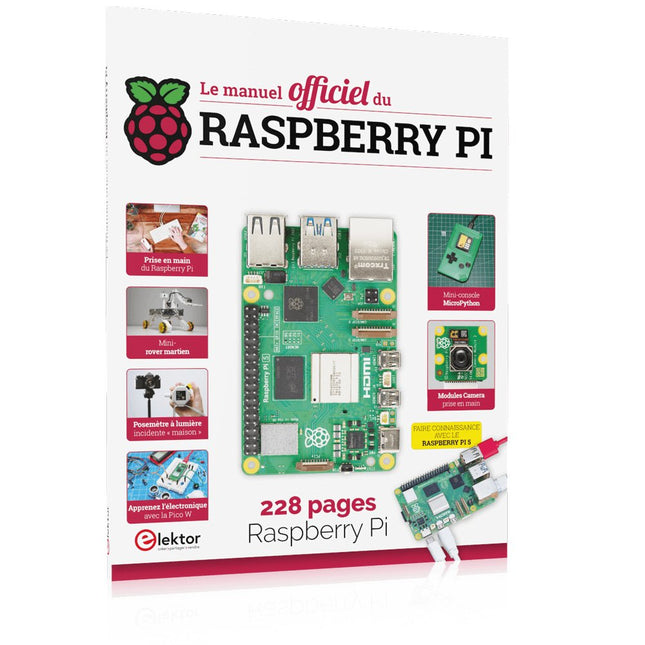
Elektor Publishing Le manuel officiel du Raspberry Pi
Réalisés par les créateurs du MagPi, le magazine officiel de Raspberry Pi Démarrez avec le Raspberry Pi 5, le dernier-né et le plus performant de la famille des nano-ordinateurs Raspberry Pi. Apprenez à coder et à réaliser des projets avec cet ordinateur étonnant. Dans ce manuel dédié au Raspberry Pi 5, nous vous proposons aussi de nombreuses idées de projets également réalisables avec le Raspberry Pi 4, le Raspberry Pi Zero 2 W et le Raspberry Pi Pico W. Avec des tutoriels, des projets pratiques, des essais techniques, des guides et bien plus encore, il s’agit de la ressource ultime pour le Raspberry Pi ! 228 pages sur le Raspberry Pi Tout ce que vous devez savoir sur le Raspberry Pi 5 Prise en main de tous les Raspberry Pi Amusez-vous et apprenez l’électronique avec le Pico W Des projets inspirants pour vous donner des idées de réalisations Apprenez μPython en construisant une mini-console Démarrez avec le module caméra Raspberry Pi Intelligence artificielle, codage de son propre agent ChatGP
€ 34,95
Membres : € 31,46
-
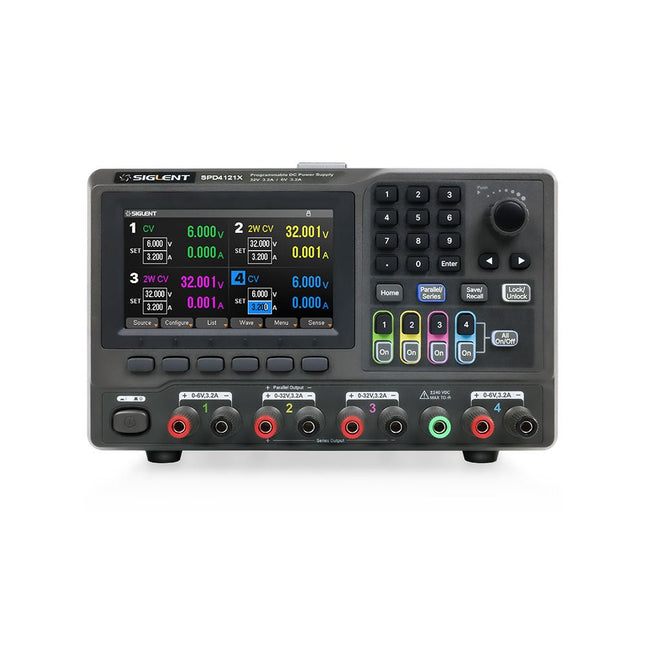
Siglent Siglent SPD4121X Alimentation 4 canaux (285 W)
The Siglent SPD4121X is a 4-channel DC Linear Programmable Power Supply equipped with a 4.3-inch TFT-LCD display, friendly human-machine interface, and excellent performance indicators. Real-time waveform display provides engineers with an informative user interface. SPD4121X offers a total output power of 285 W with a resolution of 1 mV/1 mA. The maximum voltage and current for each channel are as follows: CH1: 15 V/1.5 A CH2: 12 V/10 A CH3: 12 V/10 A CH4: 15 V/1.5 A Caractéristiques Rated output power: 285 W Rated voltage: 32 V, 12 V, 30 V Up to four high-precision power supplies with independent controllable outputs, supporting CH2 and CH3 series and parallel connections Clear graphical interface with waveform and timer display modes 5-digit voltage and current display with minimum resolution of 1 mV, 1 mA Fast output response time: <50us The high current channel support remote voltage compensation sense function. The maximum compensation voltage is 0.6 V Overvoltage protection and overcurrent protection or safe and accurate operation Equipped with a 4.3-inch TFT-LCD display (480 x 272 resolution) USB and LAN standard communication USB-GPIB module is optional Excellent channel density with up to 4 channels in a 3U half rack package Internal data storage for setups and parameters Embedded Web Server with instrument communication that doesn’t require software installation Fully SCPI programming command set support as well as a LabView driver for remote control and system automation Spécifications SPD4323X SPD4121X SPD4306X Channel Output CH1: Voltage 0 to 6 V Current 0 to 3.2 ACH2: Voltage 0 to 32 V Current 0 to 3.2 ACH3: Voltage 0 to 32 V Current 0 to 3.2 ACH4: Voltage 0 to 6 V Current 0 to 3.2 A CH1: Voltage 0 to 15 V Current 0 to 1.5 ACH2: Voltage 0 to 12 V Current 0 to 10 ACH3: Voltage 0 to 12 V Current 0 to 10 ACH4: Voltage 0 to 15 V Current 0 to 1.5 A CH1: Voltage 0 to 15 V Current 0 to 1.5 ACH2: Voltage 0 to 30 V Current 0 to 6 ACH3: Voltage 0 to 30 V Current 0 to 6 ACH4: Voltage 0 to 15 V Current 0 to 1 A Resolution 1 mV, 1 mA 1 mV, 1 mA 1 mV, 1 mA Setting Accuracy Voltage: ±(0.03% of reading+10) mV, Current: ±(0.3% of reading+10) mA Voltage: ±(0.03% of reading+10) mV, Current: ±(0.3% of reading+10) mA Voltage: ±(0.03% of reading+10) mV, Current: ±(0.3% of reading+10) mA Readback Accuracy Voltage: ±(0.03% of reading+10) mV, Current: ±(0.3% of reading+10) mA Voltage: ±(0.03% of reading+10) mV, Current: ±(0.3% of reading+10) mA Voltage: ±(0.03% of reading+10) mV, Current: ±(0.3% of reading+10) mA Display 4.3" TFT-LCD 5-digit voltage and current display 4.3" TFT-LCD 5-digit voltage and current display 4.3" TFT-LCD 5-digit voltage and current display Output power 240 W 285 W 400 W Inclus 1x Siglent SPD4121X Power Supply 1x Power cord (EU) 1x Output test cord (3 A) 1x USB cable 1x Quick start guide Téléchargements Datasheet Manual Quick start
€ 864,00
-

Elektor Publishing Raspberry Pi Pico W (Book)
Program, build, and master 60+ projects with the Wireless RP2040 The Raspberry Pi Pico and Pico W are based on the fast, efficient, and low-cost dual-core ARM Cortex M0+ RP2040 microcontroller chip running at up to 133 MHz and sporting 264 KB of SRAM and 2 MB of Flash memory. Besides spacious memory, the Pico and Pico W offer many GPIO pins, and popular peripheral interface modules like ADC, SPI, I²C, UART, PWM, timing modules, a hardware debug interface, and an internal temperature sensor. The Raspberry Pi Pico W additionally includes an on-board Infineon CYW43439 Bluetooth and Wi-Fi chipset. At the time of writing this book, the Bluetooth firmware was not yet available. Wi-Fi is however fully supported at 2.4 GHz using the 802.11b/g/n protocols. This book is an introduction to using the Raspberry Pi Pico W in conjunction with the MicroPython programming language. The Thonny development environment (IDE) is used in all of the 60+ working and tested projects covering the following topics: Installing the MicroPython on Raspberry Pi Pico using a Raspberry Pi or a PC Timer interrupts and external interrupts Analogue-to-digital converter (ADC) projects Using the internal temperature sensor and external sensor chips Using the internal temperature sensor and external temperature sensor chips Datalogging projects PWM, UART, I²C, and SPI projects Using Bluetooth, WiFi, and apps to communicate with smartphones Digital-to-analogue converter (DAC) projects All projects are tried & tested. They can be implemented on both the Raspberry Pi Pico and Raspberry Pi Pico W, although the Wi-Fi-based subjects will run on the Pico W only. Basic programming and electronics experience are required to follow the projects. Brief descriptions, block diagrams, detailed circuit diagrams, and full MicroPython program listings are given for all projects.
€ 44,95
Meilleur prix


