
Résultats de la recherche pour "arduino OR pro OR portenta OR machine OR control"
-

Elektor Digital Elektor March/April 2025 (PDF) EN
Elektor GREEN and GOLD members can download their digital edition here. Not a member yet? Click here. The RISC-V Open-Source Processor Architecture16 Boards and MCUs You Should Know An FPGA-Based Audio Player with Equalizer (1)Mixing Digital Audio with an Arduino MKR Vidor 4000 Laser Head for Pico-Based Sand ClockDrawing with Light Enter the STM32 Edge AI Contest A Multi-Sensor Environmental Monitoring System for PlantsWireless Measurement of Water Supply and Light Conditions Maixduino AI-Powered Automatic DoormanFace Detection with a Camera Embedded Electronics 2024AI Is Set to Redefine the Industry Charge-Based In-Memory Compute at EnCharge AI AI Inferencing at 10 Times Lower Power and 20 Fold Lower Cost Click Board Helps Develop and Train ML Models for Vibration Analysis The Elektor Mini-WheelieA Self-Balancing Robot Kit MCU, I See YouMCUViewer Open-Source Multiplatform Debugging Tool USB 2.0 IsolatorElectrically Isolated Connections for USB Devices Intervention Before DamagePredictive Maintenance in Practice SPoE – Electromagnetic CompatibilitySingle-Pair with Power-Over-Ethernet Through the Eyes of EMC Color TV: A Wonder of Its TimeCreating a New World ECG Graph MonitoringAn Implementation with Hexabitz Modules and an STM32CubeMonitor The Battle for AI at the Edge HaLow Hits Record 16-km Wi-Fi Distance at 900 MHz First CHERI RISC-V Embedded Chip and Early Access Programme Third-Generation Wildfire Detection Uses Satellite Links From Life’s ExperienceChoice Overload Starting Out in Electronics……Continues Filtering and Controls Tone Quasi-Analog ClockworkA Remake of an Elektor Classic A Modular Approach to Sensor TestingThe ESP32-S3-Based Sensor Evaluation Board 2025: An AI OdysseyThe Rise of Foundation Models and Their Role in Democratizing AI Raspberry Pi Standalone MIDI Synthesizer (1)Preparing a Platform for Some Edge AI Experiments Err-lectronicsCorrections, Updates, and Readers’ Letters Universal AI RISC-V Processor Does It All — CPU, GPU, DSP, FPGA CEO Interview: Ventiva’s Thin and Cool Tech Dual-Core Programming with a Raspberry Pi PicoVenture Into the World of Parallel Programming
€ 7,50
-

Elektor Digital Elektor September/Oktober 2021 (PDF)
KENNISMAKING MET NEURONEN IN NEURALE NETWERKEN (DEEL 1)Kunstmatige Neuronen EMC PRE-COMPLIANCE TEST VOOR UW DC-GEVOED PROJECT (DEEL 1)Dubbele DC-LISN ELEKTRONISCHE BELASTING VOOR DC EN ACTot 400 V en 10 A (piek) ALLE BEGIN......neemt het op tegen de spoel! BEELDVERWERKING MET DE NVIDIA JETSON NANO (DEEL 1)De Hardware en Software EEN GEDETAILLEERD ONDERZOEK NAAR NETTRANSFORMATORENIn- en uitschakelgedrag YES WE CAN MET PICAN 3Een CAN Bus HAT voor de Raspberry Pi 4 ZONNEPANELEN OP JE BALKONZelfbouw balkoncentrale = snel terugverdiend! BEELDVERWERKING EN VIDEO-STREAMING MET EEN RASPBERRY PI 4De Raspberry Pi High-Quality Camera in de praktijk DISPLAYS GEBRUIKEN IN RASPBERRY PI-PROJECTENEen hoofdstuk als voorbeeld: Organische LED-displays (OLED) KENNISMAKING MET DE PARALLAX PROPELLER 2 (DEEL 4):Tekens Versturen ELEKTOR @ 60Een terugblik op voorgaande septembers OOST WEST LAB BESTop het Friese platteland, waar de buizen bloeien... HYBRIDENVreemde onderdelen, de serie EEN KOMPASROOS MET DE GY-271Of waarom we in een acht bewegen om een sensor te kalibreren HOE GROOT IS UW VOETAFDRUK?Bereken de ecologische voetafdruk van uw elektronica CONNECTED THERMOSTAAT MET ESP32Houd uw wijn op de juiste temperatuur! MAGNETISCHE LEVITATIE OP DE DIGITALE MANIERESP32 Pico vervangt de Analoge Comparator ULTIMATE ARDUINO UNO HARDWARE MANUALEen hoofdstuk als voorbeeld: Main Microcontroller Bootloader MICROPYTHON VOOR DE ESP32 C.S. (DEEL 2)Eenvoudig Matrix Displays besturen MADMACHINE SWIFTIO BOARDModerne taal ontmoet moderne Hardware UIT HET LEVEN GEGREPENKnipperlichtrelatie HEXADOKUThe Original Elektorized Sudoku
€ 9,95
-

Elektor Digital Elektor AI Guest Edition 2024 (PDF) EN
Elektor GREEN and GOLD members can download their digital edition here. Not a member yet? Click here. The AlertAlfred AI Security SystemPowered by a Raspberry Pi 5 and the Hailo 8L Module AI in Electronics DevelopmentAn Update After Only One Year Intro to AI AlgorithmsPrompt: Which Algorithms Implement Each AI Tool? Single-Board Computers for Artificial Intelligence ProjectsBackground and Overview From Sensor Data to Machine Learning ModelsGesture Detection with an Accelerometer and Edge Impulse Build a Leaky Integrate-and-Fire Spiking NeuronArtificial Intelligence Without Software ChatGPT for Electronic DesignDoes GPT-4o Do It Any Better? Bringing AI to the Edge with ESP32-P4 Exploring Speech Functions on Raspberry Pi ZeroWhen Overclocking Gives Freedom of Speech The Growing Role of Edge AIA Trend Shaping the Future Unlocking the Power of Edge AIA Conversation with François de Rochebouët of STMicroelectronics A VHDL Clock Made with ChatGPT AI’s Real ImpactSayash Kapoor on “AI Snake Oil” and More The Latest Stuff From BeagleBoardBeagleY-AI, BeagleV-Fire, BeagleMod, BeaglePlay and BeagleConnect Freedom Mosquito Detection Using Open Datasets and Arduino Nicla Vision AI Today and Tomorrow: Insights from Espressif, Arduino, and SparkFun Artificial Intelligence Timeline BeagleY-AIThe Latest SBC for AI Applications AI in FocusPerspectives from the Elektor Community Machine Vision with OpenMVCreate a Soda Can Detector A Conversation with the Digital MindChatGPT vs Gemini Skilling Me Softly with This Bot?Is the AI Revolution in the Electronic Field Failing Due to a Lack of Social Precision?
€ 7,50
-

OWON OWON SPS6051 Alimentation CC sans ventilateur (150 W)
L'alimentation CC programmable sans ventilateur OWON SPS6051 (150 W) offre des performances ultra silencieuses et de haute précision avec une précision de 10 mV/1 mA et une dissipation thermique avancée pour une fiabilité à long terme. Doté d'une protection complète, d'une interface USB avec prise en charge SCPI pour le contrôle à distance et d'un écran LCD TFT de 2,8 pouces, c'est le choix idéal pour les laboratoires, les tests électroniques et la recherche. Caractéristiques Conception sans ventilateur : fonctionnement ultra-silencieux, réduisant le bruit de vibration et minimisant les risques de défaillance potentiels associés aux ventilateurs de refroidissement traditionnels. Excellente conception de dissipation thermique : assure une augmentation contrôlée de la température, permettant un fonctionnement à long terme dans des conditions de pleine charge et prolongeant la longévité des composants internes. Conception légère et ultra-mince. Précision de sortie jusqu'à 10 mV/1 mA. Prend en charge l'édition et la sortie de formes d'onde de liste, avec quatre paramètres de raccourci mémoire pour un accès rapide et pratique. Les fonctions de protection intégrées incluent la protection contre les surtensions, les surintensités, les surchauffes et les sous-tensions d'entrée pour une sécurité renforcée. Le circuit de décharge intégré évite les risques de haute tension résiduelle lorsque l'alimentation est coupée. Interface de communication USB avec prise en charge du protocole SCPI, permettant la programmation PC et le contrôle à distance pour une utilisation simplifiée gestion. Écran LCD TFT de 2,8 pouces Spécifications Modèle SPS6051 SPS3081 Sortie nominale (0°C-40°C) Tension 0-61 V 0-31 V Courant 0-5,1 A 0-8,1 A Puissance 150 W 120 W Régulation de charge Tension ≤30 mV Courant ≤20 mA Régulation de puissance Tension ≤30 mV Courant ≤20 mA Définition de la résolution Tension 10 mV Courant 1 mA Résolution de relecture Tension 10 mV Courant 1 mA Précision de réglage (25°C ±5°C) Tension ≤0,05% ±20 mV ≤0,1% ±20 mV Courant ≤0,05% ±20 mA ≤0,2% ±20 mA Précision de relecture (25°C ±5°C) Courant ≤0,05% ±20 mV ≤0,1% ±20 mV Tension ≤0,05% ±20 mV ≤0,2% ±20 mA Ondulation/Bruit Tension ≤30 mVp-p ≤30 mVp-p Tension ≤4 mVrms ≤5 mVrms Courant ≤10 mAp-p ≤30 mAp-p Coefficient de température de sortie (0°C-40°C) Tension 100 ppm/°C Courant 200 ppm/°C Relecture du coefficient de température Tension 100 ppm/°C Courant 200 ppm/°C Temps de réponse (charge nominale de 50 à 100%) ≤1,0 ms Stockage 4 groupes de données Température de fonctionnement 0-40°C Écran Écran LCD couleur de 2,8 pouces Interface USB Dimensions (L x H x P) 82 x 142 x 226 mm Poids 1,8 kg Inclus 1x OWON SPS6051 Alimentation 2x Fils de test 1x Cordon d'alimentation 1x Manuel Téléchargements Datasheet User Manual Programming Manual PC Software
€ 133,20
-

Elektor Digital Elektor May/June 2020 (PDF) EN
Open-Network Weather Station Mk.2Part 1: Introduction and hardware elements Artificial Intelligence for Beginners (1)Object recognition using the Maixduino board Universal Triac Control Module with ATmegaSwitch and dim a variety of loads GitHub For DummiesHow to download something from GitHub My IoT Button: A Button for the WebPart 2: Prototyping with board and cloud TMS0280 Speech SynthesizerPeculiar Parts, the series InteractiveCorrections & Updates || Questions & Answers BASIC for the ESP32/ESP8266 (2)An hourglass with the ESP8266 and Annex WiFi RDS Developer's ZoneTips & Tricks, Best Practices and Other Useful Information BalBot: a Self-Balancing RobotModern acceleration sensors ease the construction process Starting Out in Electronics (3)Easier than imagined! Small Circuits RevivalCapita Selecta from the Elektor Project Suggestions Box Tamper-Evident BoxSend data securely through postal services Elektor New Precise Nixie Clock RevisitedAn engineering bulletin for enthusiastic users new and old Practical ESP32 Multitasking (3)Software timers SigFox and the IoT (4)Setting up a dashboard Start-Up Update: The Elektor Investment Program Review: Joy-IT HD35 Electronic USB LoadTest & verify USB power performance CAN Bus + Arduino for Solar PV Cell MonitoringDetect and locate serviceable panels in large arrays Analogue Electronics Design (3)Case Study #1 — Section 3: Preamplifier response optimization and trade-offs Inexpensive E-ScooterHow does Lidl's "road approved" 300 euro E-scooter perform? Steeped in ElectronicsLead-free soldering and EU regulatory zeal Lab, Sweet LabA glimpse of The Holy Place — no unauthorized entry. Review: The PeakTech 6080 A Lab Power SupplyA neat lab PSU for not much money A Big ChallengeSafe products in the IoT era Elektor 1.2 GHz Multifunction Frequency Meter (1992/93)Crossing the magic 1 GHz border Hexadoku
€ 7,50
-

Elektor November/December 2025 (EN)
Elektor GREEN and GOLD members can download their digital edition here. Not a member yet? Click here. Relio v1.0 - Presence Detection and Remote ControlA Matter-Enabled Smart Controller for AC Appliances Designing Better PCBsA Practical Guide for Professionals and Makers KiCad 9Top New and Updated Features Precision Picoammeter (1)With Curve Tracer Functionality Down to the pA range! Christmas Star 2025A Star Is Soldered 100 mV Continuity Tester Who’s Pushing the Boundaries of European Electronics?Companies to Watch productronica 2025: What’s New in Electronics Development and Production Automation to Tackle Reshoring Manufacturing, Tariffs and Labour Shortages Beyond Future ProofCircularity in Electronics Passive ComponentsLow-Loss Inductors Enabling High-Efficiency DC/DC Converters How Desktop Manufacturing Machines Are Democratizing PCB Production Starting Out in Electronics...Needs Power UHD Displays Driven with EaseYour Guide to Easily Put Various TFT-LCDs Into Operation Quickly Soldering in 2025Practical Soldering Tips Straight from the Workbench SimulIDEAn All-in-One Tool for Circuit Prototyping 2025: An AI OdysseyFrom Autocomplete to Colleague Wordy Christmas TreeA Festive Electronics Project with a Linguistic Twist Err-lectronicsCorrections, Updates, and Readers’ Letters Analog Pipeline DistortionA Cool Audio Effect For Guitars and Other Instruments ESP32 Audio Transceiver Board (Part 3)Stereo Transmission and Dual Radio
€ 14,90
-

Elektor Digital Elektor 09-10/2023 (PDF)
Diese Ausgabe steht allen GOLD- und GREEN-Mitgliedern auf der ElektorMagazine-Website zum Download bereit! Sie sind noch kein Mitglied? Hier klicken! Raspberry Pi Pico als Spektrum-AnalyserFFTs auf preiswerter Hardware-Basis ±40 V Linearer SpannungsreglerEine alternative Stromversorgung für die Fortissimo-100-Endstufe... und andere! Drahtlose MCU-Kommunikation flexibel gemachtEEPROM eröffnet Netzwerk-Perspektiven für drahtlose MCUs 5.000 € zu gewinnen!Machen Sie mit beim STM32 Wireless Innovation Design Contest! 2023: Odyssee in der KILoslegen mit dem Code-Interpreter von ChatGPT LoRa, ein Schweizer TaschenmesserTeil 1: Das LoRa-Protokoll und seine Vorteile Einstellbare Stromsenke mit integriertem TaktgeberZum Testen von Netzteilen, Spannungswandlern und Batterien Zwei neue Arduino UNO R4 Boards: Minima und WiFi Logarithmische PotentiometerSie sind exponentiell! Motortreiber-Breakout-BoardEin BoB für einen 5-A-Treiber für DC-Motoren mit einer Größe von 3×3 mm Aus dem Leben gegriffenGefährliche Elektronik Ist Mobilfunk die energiesparendste Option für das IoT?LTE-M und NB-IoT: Energieanforderungen in LPWAN-Implementierungen Kabellose Kommunikation in IoT-Systemen mit Modulen MKR von ArduinoKommunikationsstandards der Arduino-Module für IoT AC-Verluste in magnetischen BauteilenVermeiden Sie heiße Induktivitäten! Messungen für eine optimale Cloud-Implementierung Matter-Implementierung: Was braucht es, um Matter-Geräte einzusetzen? Neue 2,4 GHz-Funkeinheiten von Circuit DesignPrädestiniert für Fernsteuerung und Überwachung PIC o’Clock – am Puls der ZeitDesign eines SDR-Zeitzeichen-Empfängers Due Diligence DirectiveBusiness as Usual Will Not Do Aller Anfang...Ist gar nicht schwer: Spannungsverstärkung Infraschall-Rekorder mit dem Arduino Pro MiniEin Beispielprojekt aus dem Elektor-Buch „Arduino & Co.“ Cloud-basierter EnergiezählerMit ESP32-Modul und PZEM-004T-Spannungs-/ Stromsensor Eine Anleitung zur Bare-Metal-ProgrammierungTeil 2: Exaktes Timing, UART und Debugging
€ 11,90
-

Siglent Siglent SDS1104X-E Oscilloscope à 4 canaux (100 MHz)
Le Siglent SDS1104X-E utilise une nouvelle génération de technologie SPO (Super Phosphor Oscilloscope) qui offre une excellente fidélité des signaux et des performances. Le bruit du système est également inférieur à celui des produits similaires de l'industrie. Il est doté d'une plage d'entrée verticale minimale de 500 µV/div, d'un système de déclenchement numérique innovant à haute sensibilité et faible gigue, et d'un taux de capture de forme d'onde de 400 000 images/seconde (mode séquence). Le SDS1104X-E est doté d’un affichage à 256 niveaux d'intensité et d'un mode d'affichage à température de couleur que l'on ne trouve pas dans les autres modèles de cette catégorie. Le dernier né des oscilloscopes SIGLENT supporte de nombreux modes de déclenchement puissants, y compris le déclenchement par bus série. Le décodage est une configuration standard incluant I²C, SPI, UART, CAN, LIN. L'enregistrement de l'historique des formes d'ondes et le déclenchement séquentiel permettent un enregistrement et une analyse étendus des formes d'ondes. La nouvelle fonction mathématique FFT 1 Mpt est un autre ajout puissant qui confère au SDS1104X-E une très haute résolution de fréquence lors de l'observation des spectres de signaux. Caractéristiques Déclenchement intelligent : Bord, pente, largeur d'impulsion, fenêtre, course, intervalle, délai d'attente (Dropout) et motif. Déclenchement et décodage libre du bus série : I²C, SPI, UART, RS232, CAN et LIN Déclenchements vidéo et prise en charge de la HDTV Faible bruit de fond et échelles de tension de 500 μV / div à 10 V / div 10 types de raccourcis à un bouton, prise en charge de la configuration automatique, du défaut, des curseurs, de la mesure, du roulement, de l'historique, de l'affichage/de la persistance, de l'effacement du balayage, du zoom et de l'impression. Mode d'acquisition segmentée (séquence), divisant la longueur maximale de l'enregistrement en plusieurs segments (jusqu'à 80 000), en fonction des conditions de déclenchement définies par l'utilisateur, avec un très petit segment de temps mort pour capturer l'événement qualifiant. Fonction d'enregistrement de la forme d'onde historique (historique), la longueur maximale de la forme d'onde enregistrée est de 80 000 images. Fonction de mesure automatique de 38 paramètres, prenant en charge les statistiques, les mesures de déclenchement, les mesures mathématiques, les mesures d'historique et les mesures de réf. 1 Mpts FFT Les mesures réelles et mathématiques peuvent utiliser les 14 Mpts de la mémoire. Les touches de préréglage peuvent être personnalisées pour les réglages de l'utilisateur ou les valeurs par défaut de l'usine. Mode d'effacement de sécurité Fonction de passage/échec à grande vitesse basée sur le matériel Grand écran TFT-LCD de 7 pouces avec une résolution de 800 x 480 Plusieurs types d'interface : USB Host, USB Device (USB-TMC), LAN (VXI-11), Pass / Fail, Trigger Out Prise en charge des commandes de contrôle à distance SCPI Affichage multilingue et aide intégrée Contrôle par navigateur/page web embarquée pour une surveillance sans logiciel (modèles à 4 canaux uniquement) Inclus 1x Oscilloscope Siglent SDS1104X-E 4x Sondes 100 MHz 1x Carte de garantie 1x Cordon d'alimentation 1x Câble USB 1x Guide de démarrage rapide Téléchargements Datasheet Manual Programming Guide
€ 504,51
-

OWON Oscilloscope USB 2-ch OWON VDS1022I (25 MHz)
L'oscilloscope USB 2 voies OWON VDS1022I (25 MHz) est un oscilloscope à utiliser avec un ordinateur. Il est alimenté par USB et a une petite taille, ce qui permet de l'emporter facilement avec soi. L'oscilloscope est très économique. Il dispose d'une connexion USB blindée, ce qui réduit les interférences et protège l'ordinateur contre les surtensions. Le port multiple de l'oscilloscope peut être utilisé pour le déclenchement externe, la sortie de déclenchement ou la sortie Pass / Fail. Caractéristiques Largeur de bande de 25 MHz, et taux d'échantillonnage en temps réel de 1 Géch/s maximum Longueur d'enregistrement de 10 Méch Interface utilisateur conviviale : FFT, ou X-Y, et forme d'onde 2 vues affichées sur le même écran Option de déclenchement multiple : front, vidéo, pente, impulsion et alternatif. Isolation USB - moins d'interférence de signal, plus de protection du PC Alimentation par bus USB et télécommande LAN (en option) Conception ultra-mince, facile à transporter Spécifications Bande passante 25 MHz 25 MHz Canal 2+1 (multi) Fréquence d'échantillonnage 100 Méch/s Échelle horizontale (s/div) 5 ns/div~100s/div, step by 1~2~5 Longueur des enregistrements 5K Tension d'entrée maximale 400 V (PK - PK) (DC+AC, PK - PK) 40 V (PK - PK) (DC+AC, PK - PK) Résolution verticale (A/D) 8 bits (2 canaux simultanément) Modèle VDS1022I Sensibilité verticale 5 mV/div~5 V/div Type de déclenchement Bord, impulsion, vidéo, pente et alternance Mode de déclenchement Auto, Normal, et Simple Mode d’acquisition Échantillon, détection des pics et moyenne Mathématiques +, -, ×, ÷, invert, FFT Interface de communication USB 2.0 (isolation) Multi-fonctions Interface Type de signal Niveau Standard TTL Alimentation éléctique 5,0 V/1 A Consommation éléctique ≤2,5 W Dimensions (W × H × D) 170 x 120 x 18 mm Poids 0,26 kg Inclus 1x Oscilloscope OWON VDS1022I 1x CD-ROM 1x Guide de démarrage rapide 2x Sonde d'oscilloscope 1x Outil de sonde 1x Adaptateur secteur 1x Câble USB 1x Étui de protection en silicone 1x Câble d'alimentation Téléchargements Fiche technique Manuel de l’utilisateur Protocole SCPI Pilote USB
€ 118,02
-

Elektor Digital Experimenting with Red Pitaya STEMlab Gen 2 (E-book)
Practical Projects and Programs With Experimenting with Red Pitaya STEMlab Gen 2, Red Pitaya goes beyond a versatile board. It becomes a powerful laboratory instrument for precision measurement, analysis, and control. From the fundamentals of electronic project development, monitoring, control, and design to testing, this book walks you step-by-step through everything you need to know to harness the full potential of Red Pitaya hardware and software. The book presents real-time, FPGA-based projects that are developed on a PC using the Vivado environment, then transferred to the Red Pitaya for execution and testing. You will learn about enhanced performance, expanded I/O capabilities, improved FPGA features, and advanced connectivity options that open up new frontiers for precision measurement, monitoring, and control in your embedded applications. Inside the book you will discover: A deep dive into Red Pitaya architecture and hardware design Electronic experiments using Red Pitaya for measurement and monitoring Hands-on projects using the Python programming language Practical guidance for FPGA programming using Red Pitaya Red Pitaya FPGA projects using the Verilog HDL under Vivado IDE Practical design of electronic projects including measurement and testing Step-by-step examples that bridge theory and real-world implementation Whether you are designing your own electronic circuits, developing signal analysis tools, or creating real-time control or monitoring systems, this book provides you the knowledge and confidence you need to fully learn and customize the Red Pitaya platform.
€ 32,95
Membres : € 29,66
-
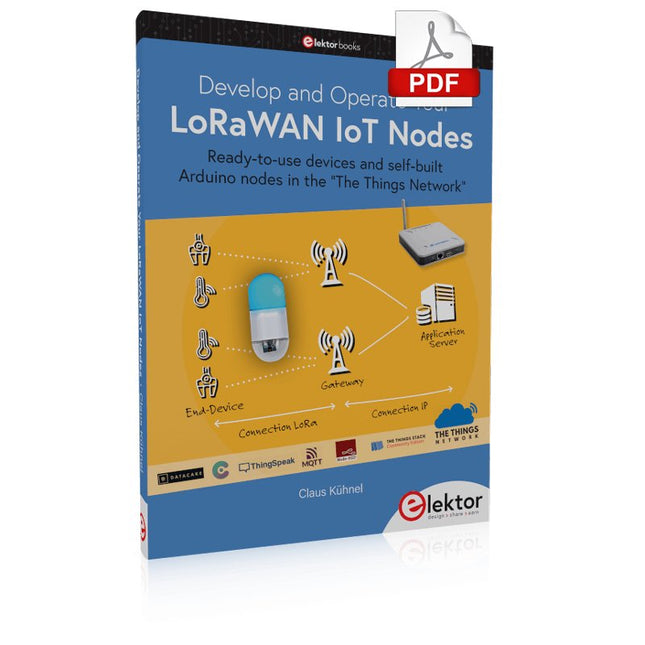
Elektor Digital Develop and Operate Your LoRaWAN IoT Nodes (E-book)
Ready-to-use devices and self-built Arduino nodes in the 'The Things Network' LoRaWAN has developed excellently as a communication solution in the IoT. The Things Network (TTN) has contributed to this. The Things Network was upgraded to The Things Stack Community Edition (TTS (CE)). The TTN V2 clusters were closed towards the end of 2021. This book shows you the necessary steps to operate LoRaWAN nodes using TTS (CE) and maybe extend the network of gateways with an own gateway. Meanwhile, there are even LoRaWAN gateways suitable for mobile use with which you can connect to the TTN server via your cell phone. The author presents several commercial LoRaWAN nodes and new, low-cost and battery-powered hardware for building autonomous LoRaWAN nodes. Registering LoRaWAN nodes and gateways in the TTS (CE), providing the collected data via MQTT and visualization via Node-RED, Cayenne, Thingspeak, and Datacake enable complex IoT projects and completely new applications at very low cost. This book will enable you to provide and visualize data collected with battery-powered sensors (LoRaWAN nodes) wirelessly on the Internet. You will learn the basics for smart city and IoT applications that enable, for example, the measurement of air quality, water levels, snow depths, the determination of free parking spaces (smart parking), and the intelligent control of street lighting (smart lighting), among others.
€ 32,95
Membres : € 29,66
-

Elektor Digital Elektor Circuit Special 2026 (PDF) FR
Le téléchargement intégral de ce numéro est disponible pour nos membres GOLD et GREEN sur le site Elektor Magazine ! Pas encore membre ? Cliquez ici. source de courant pour tester les diodes ZTest des diodes Z de 1 à 54 V sous 1 à 50 mA testeur de bracelet antistatiqueUn testeur de référence à trois états : réussite, limite ou échec testeur de réponse transitoire pour alimentationGénérateur d'échelon de charge répétable pour alimentations de labo séquenceur euclidien sans microcontrôleurMotifs de déclenchement et séquences CV avec une simple logique CMOS lampe clignotante à LED pour portails avec alerte sonore Besoin de circuits imprimés ? Le service PCB d'Elektor est fait pour vous. minuterie pour brosse à dentsAvec un petit PIC verrou combiné magnétique sans contactAvec le capteur de position angulaire AS5600 préampli à faible bruit sur pilePour micros dynamiques Arduino Nano TestLabMesure, contrôle et régulation effet lumineux au rythme des bassesAccentuez le rythme musical filtre coupe-basAucun risque d'effet larsen dans votre système audio générateur précis d’ondes carrées à 1 Hz pour plaque d’essaiA Reliable CMOS-Based Clock Source 555 à l’enversRapports cycliques jusqu’à zéro Du Halfgeleidergids aux Circuit Specials65 ans d'innovation en électronique isolation électriqueInterface CAN avec isolateur numérique et module d’alimentation isolé spongillatorUn oscillateur à éponge True Random Number GeneratorAvec test du khi carré intégré visionneuse 3D pour pages HTMLSimple, et presque sans programmation programmation avec TLScriptUn langage de script pour la mesure, les tests et le contrôle conception de circuits : conseils d'experts rétroactionqu'est-ce que c'est et pourquoi est-ce important ? une carte, des idées infinies : Arduino UNO QDu jeu rétro à la surveillance environnementale en temps réel réparation d'une antenne « donut » Standby KillerUn vrai interrupteur marche/arrêt pour votre téléviseur test d'accusMesurer les capacités de batteries avec l'Arduino Nano alimentation pour ampli audio de puissanceSans bruit secteur cartes de prototypage RFMontages rapides avec des cartes de prototypage pour RF protection contre les surtensions T3Un parafoudre de type 3 pour vos équipements sensibles thermostat d'ambiance IdO Avec le module MCU Xiao basé sur ESP32-C3/S3 du rigide au smartÉlectronique flexible et imprimée : entre vision et réalité industrielle
€ 10,95


