
Résultats de la recherche pour "designing OR audio OR power OR amplifiers OR 2nd OR edition"
-

Elektor Digital BBC micro:bit (E-book)
35 Touch Develop & MicroPython Projects The BBC micro:bit is a credit sized computer based on a highly popular and high performance ARM processor. The device is designed by a group of 29 partners for use in computer education in the UK and will be given free of charge to every secondary school student in the UK. The device is based on the Cortex-M0 processor and it measures 4 x 5 cm. It includes several important sensors and modules such as an accelerometer, magnetometer, 25 LEDs, 2 programmable push-button switches, Bluetooth connectivity, micro USB socket, 5 ring type connectors, and a 23-pin edge connector. The device can be powered from its micro USB port by connecting it to a PC, or two external AAA type batteries can be used. This book is about the use of the BBC micro:bit computer in practical projects. The BBC micro:bit computer can be programmed using several different programming languages, such as Microsoft Block Editor, Microsoft Touch Develop, MicroPython, and JavaScript. The book makes a brief introduction to the Touch Develop programming language and the MicroPython programming language. It then gives 35 example working and tested projects using these language. Readers who learn to program in Touch Develop and MicroPython should find it very easy to program using the Block Editor or any other languages. The following are given for each project: Title of the project Description of the project Aim of the project Touch Develop and MicroPython program listings Complete program listings are given for each project. In addition, working principles of the projects are described briefly in each section. Readers are encouraged to go through the projects in the order given in the book.
€ 24,95
Membres : € 22,46
-

Siglent Siglent SDS2102X Plus Oscilloscope 2-ch (100 MHz)
Les oscilloscopes numériques de la série SDS2000X Plus de Siglent sont disponibles en bandes passantes de 100 MHz, 200 MHz et 350 MHz, ont une fréquence d'échantillonnage maximale de 2 GSa/s, une longueur d'enregistrement maximale de 200 Mpts/ch, et jusqu'à 4 canaux analogiques + 16 canaux numériques de capacité d'analyse de signaux mixtes. La série SDS2000X Plus utilise la technologie SPO de Siglent avec un taux de capture de forme d'onde maximum de 120 000 wfm/s (mode normal, jusqu'à 500 000 wfm/s en mode séquence), une fonction d'affichage de 256 niveaux d'intensité et un mode d'affichage de la température de couleur. Il utilise également un système de déclenchement numérique innovant à haute sensibilité et faible gigue. Le système de déclenchement prend en charge plusieurs modes de déclenchement puissants, y compris le déclenchement par bus série. L'enregistrement de l'historique des formes d'onde, l'acquisition de séquences, les fonctions de recherche et de navigation permettent de capturer, de stocker et d'analyser des enregistrements de formes d'onde étendus. Le SDS2000X Plus dispose également d'une gamme impressionnante de capacités de mesure et de calcul, d'options pour un générateur de forme d'onde de 50 MHz, ainsi que de fonctions de décodage en série, de test de masque, de tracé de bode et d'analyse de puissance. Un mode d'acquisition 10 bits permet de satisfaire les applications qui nécessitent une résolution supérieure à 8 bits. Le grand écran tactile capacitif de 10,1 pouces prend en charge les gestes multi-touch, tandis que la commande Web à distance, la souris et le clavier externe améliorent considérablement l'efficacité opérationnelle du SDS2000X Plus. Caractéristiques Modèles 100 MHz, 200 MHz, 350 MHz (extensible à 500 MHz) Taux d'échantillonnage en temps réel jusqu'à 2 GSa/s Longueur d'enregistrement jusqu'à 200 Mpts Déclencheur et décodeur de bus série, supporte I²C, SPI, UART, CAN, LIN, CAN FD, FlexRay, I²S et MIL-STD-1553B Mode 10 bits, zoom vertical et horizontal L'écran tactile capacitif prend en charge les gestes multi-touch. Oscilloscopes Siglent SDS2000X Plus SDS2102X Plus SDS2104X Plus SDS2204X Plus SDS2354X Plus Bande passante 100 MHz 100 MHz 200 MHz 350 MHz Canaux 2 4 4 4 Taux d'échantillonnage en temps réel 2 GSa/s 2 GSa/s 2 GSa/s 2 GSa/s Taux de capture 120,000 wfm/s 120,000 wfm/s 120,000 wfm/s 120,000 wfm/s Profondeur de la mémoire 200 Mpts/ch 200 Mpts/ch 200 Mpts/ch 200 Mpts/ch Inclus Siglent SDS2102X Plus Oscilloscope Sondes passives Cordon d'alimentation Câble USB Manuel d'utilisation Téléchargements Fiche technique Manuel Guide rapide Manuel de l'utilisateur Firmware
€ 848,13
-
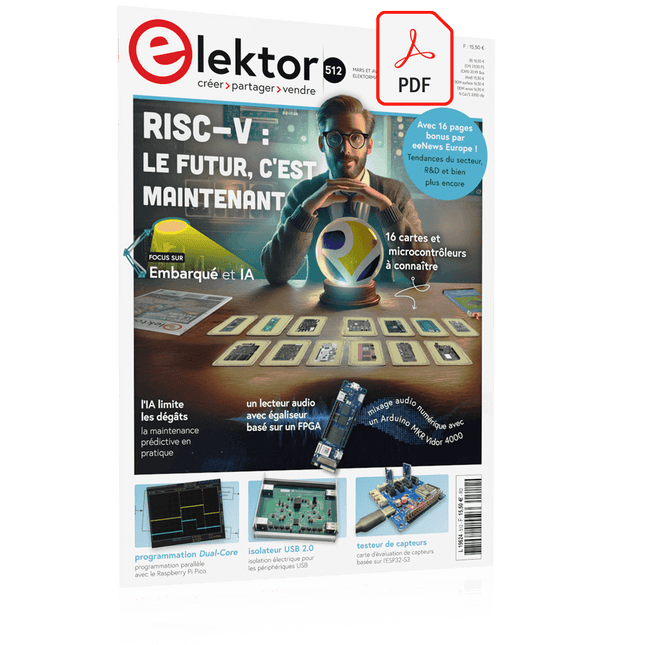
Elektor Digital Elektor Mars/Avril 2025 (PDF) FR
Le téléchargement intégral de ce numéro est disponible pour nos membres GOLD et GREEN sur le site Elektor Magazine ! Pas encore membre ? Cliquez ici. L'architecture de processeur open-source RISC-V16 cartes et MCU à connaître un lecteur audio avec égaliseur basé sur un FPGAMixage audio numérique avec un Arduino MKR Vidor 4000 tête laser pour l’horloge de sable basé sur Raspberry Pi PicoDessiner avec la lumière participez au concours STM32 Edge AI système de contrôle environnemental multi-capteurs pour les plantesMesure sans fil de l'approvisionnement en eau et de la luminosité porte automatique contrôlée par l'IA et MaixduinoReconnaissance faciale avec une caméra l’électronique embarquée en 2024L’IA va redéfinir l’industrie Calcul en mémoire basé sur la charge chez EnCharge AI des opérations d'IA avec 10 fois moins d'énergie et des coûts divisés par 20 Une carte pour le développement et l’entraînement des modèles ML d’analyse des vibrations Elektor Mini-WheelieKit robot gyropode (robot autostabilisé) MCUViewerMCUViewer outil de débogage open source multiplateforme isolateur USB 2.0Isolation éléctrique pour les périphériques USB anticipation et actionApplication pratique de la maintenance prédictive SPoE – compatibilité électromagnétiquePaire unique avec Power-over-Ethernet à travers les yeux d'EMC rétro-techCréer un monde nouveau avec la télévision couleur surveillance ECGavec des modules Hexabitz et STM32CubeMonitor la bataille pour l’IA en périphérie HaLow atteint une distance Wifi record de 16 km à 900 MHz première puce embarquée CHERI RISC-V et programme d'accès anticipé la détection des incendies de forêt de troisième génération utilise des liaisons satellites sur le vifDélices et supplices du choix démarrer en électronique......Filtrage et contrôle de la tonalité Kit d'horloge quasi-analogiqueNouvelle version d'un classique d'Elektor une approche modulaire de test des capteursCarte de test de capteurs basée sur l'ESP32-S3 2025 : une odyssée de l'IAL'essor des modèles de fondation et leur impact sur l'accessibilité de l'IA Synthétiseur MIDI autonome Raspberry Pi (1)Préparation d'une plateforme pour des expériences d’IA en périphérie projet 2.0Corrections, mises à jour et courrier des lecteurs Le RISC-V AI, un processeur à tout faire : CPU, GPU, DSP, FPGA paroles de PDG : fraîcheur, silence et finesse programmation Dual-Core avec le Raspberry Pi PicoLe monde de la programmation parallèle
€ 10,95
-

Elektor Digital Elektor Espressif Guest Edition (PDF)
Elektor GREEN and GOLD members can download their digital edition here. Not a member yet? Click here. Accelerating IoT Innovation A Color E-Ink Wi-Fi Picture Frame ESP-Launchpad TutorialFrom Zero to Flashing in Minutes ESP32 and ChatGPTOn the Way to a Self-Programming System… Walkie-Talkie with ESP-NOWNot Quite Wi-Fi, Not Quite Bluetooth! From Idea to Circuit with the ESP32-S3A Guide to Prototyping with Espressif Chips AIoT Chip InnovationAn Interview With Espressif CEO Teo Swee-Ann Simulate ESP32 with WokwiYour Project’s Virtual Twin Trying Out the ESP32-S3-BOX-3A Comprehensive AIoT Development Platform Electronics Workspace EssentialsInsights and Tips From Espressif Engineers The ESP RainMaker StoryHow We Built “Your” IoT Cloud Assembling the Elektor Cloc 2.0 KitAn Elektor Product Unboxed by Espressif Unleashing the ESP32-P4The Next Era of Microcontrollers Rust + EmbeddedA Development Power Duo Who Are the Rust-Dacious Embedded Developers?How Espressif is Cultivating Embedded Rust for the ESP32 Espressif’s Series of SoCs Building a PLC with Espressif SolutionsWith the Capabilities and Functionality of the ISOBUS Protocol The ESP32-S3 VGA BoardBitluni’s Exciting Journey Into Product Design Acoustic Fingerprinting on ESP32Song Recognition With Open-Source Project Olaf Circular Christmas Tree 2023A High-Tech Way to Celebrate the Holiday Season A Simpler and More Convenient LifeAn Amateur Project Based on the Espressif ESP8266 Module How to Build IoT Apps without Software ExpertiseWith Blynk IoT Platform and Espressif Hardware Building a Smart User Interface on ESP32 Quick & Easy IoT Development with M5Stack Prototyping an ESP32-Based Energy Meter A Value-Added Distributor for IoT and More In-Depth Insights: Interview With Arduino on the Nano ESP32Alessandro Ranellucci and Martino Facchin Discuss Espressif Collaboration Your AIoT Solution ProviderInsights From Espressif Streamlining MCU Development With ESP-IDF Privilege Separation An Open-Source Speech Recognition Server……and the ESP BOX The Thinking EyeFacial Recognition and More Using the ESP32-S3-EYE ESP32-C2-Based Coin Cell SwitchDesign and Performance Evaluation The Smart Home Leaps Forward with MatterUnlocking Smart Home IoT Potential Tech the Future: Where Is Smart Home IoT Headed?
€ 7,50
-

Elektor Digital Elektor July/August 2021 (PDF) EN
LoRa with the Raspberry Pi PicoFun with MicroPython What Is RISC-V?And Why the Industry Is So Excited About a New Processing Core! Elektor @ 60Circuits of Summer Past Versatile Power Supply for BreadboardsPositive and Negative Voltages Out of 5 V from USB Raspberry Pi Pico EssentialsSample Chapter: Wi-Fi with the Raspberry Pi Pico Magnetic Levitation the Easy Way Hands On the Parallax Propeller 2Part 3: Smart Pins and Serial Data (UART) Nucleo Boards Programming with the STM32CubeIDESample Chapter: FreeRTOS for the STM32 MCU Developer's ZoneTips & Tricks, Best Practices and Other Useful Information Miniware DT71 Digital Tweezers Wearable Wi-Fi Gadget: ESPHome Does the Job Again Starting out in ElectronicsEasier Than Imagined! This Concludes the Subject of “Capacitors” Simple Sketches Using the Qwiic Ecosystem Java on the Raspberry Pi (Part 2)Controlling GPIOs with a Spring REST Service Raspberry Pi Compute Module 4A Raspberry Pi for Industry Portable, Stand-Alone Air Quality Display for 2.5 µm ParticlesKeep(s) an Eye on Your Health From Life’s ExperienceThe Future Was Better in the Past MicroPython for the ESP32 and FriendsPart 1: Installation and Our First Programs Charge-Coupled Devices in OscilloscopesPeculiar Parts, the series ESD – The Invisible DestroyerComponents Trashed by a Bolt from the Blue Solar Power for Mowing RobotsEcological, Inexpensive, Simple! Europe’s Efforts to Tame Big Tech HexadokuThe Original Elektorized Sudoku
€ 7,50
-

Elektor Digital LEDs 5 (PDF)
Inhalt Praxis LED-KommunikatorDesign-Studie: Verwendung von handelsüblichen LEDs zur bidirektionalen Kommunikation Nachrichten-Ticker Bau eines Internet-News-Tickers ALS es Licht wurde Controller steuert Beleuchtungseinrichtungen nach Umgebungshelligkeit und Uhrzeit BULI - Button-Lichtspiele Effekte mit LED2812 und Cortex-M0+ Theorie & Anwendung DesignCorner: Schaltungen, Tipps und Kniffe- Posistor gegen den Hitzetod- High-Brightness-LEDs an Niedervolt-Stromversorgungen betreiben- Derating mit PTC-Thermistoren in LED-Treiberschaltungen- Der Umgang mit LED-Strings- LED-Treiber für unterschiedliche Wandler-Topologien- LED-Konstantstromtreiber in Schaltreglertechnik Grenzen überschreiten Ansteuerung von LEDs mit gepulstem Überstrom Ansteuerung von LED-Matrixschaltungen MultitalentController treibt LEDs, regelt Solarzellen und lädt Batterien Dimmungstechniken für LEDs Info OLED – Die FlächenlichtquelleZum Entwicklungsstand der organischen Leuchtdiode 400 LED-Lampen auf dem Prüfstand Über dem LimitLEDs mit höheren Treiberströmen ansteuern AktuellNeue LEDs, LED-Lampen, Treiber, Netzteile, Zubehör und Entwicklungs-Tools
€ 17,50
Membres : € 15,75
-

Elektor Digital Elektor Edge Impulse Guest Edition 2025 (PDF) DE
Diese Ausgabe steht allen GOLD- und GREEN-Mitgliedern auf der ElektorMagazine-Website zum Download bereit! Sie sind noch kein Mitglied? Hier klicken! Was genau ist eigentlich Edge-KI?Intelligenz direkt im Gerät Wir stellen vor: Edge Impulse StudioKI-Modelle für Edge-Geräte einfach erstellen und bereitstellen Keyword Spotting mit Edge ImpulseErfassen, Trainieren und Implementieren Intelligente Gerätesteuerung per Sprachbefehl mit Nordic Thingy:53 Edge-KISchlüsselbegriffe zum Verständnis von Edge-KI und Machine Learning Crashkurs: Einstieg in Edge ImpulseWie Sie mit dem Arduino Nano 33 BLE Sense ein ML-Modell erfassen, trainieren und bereitstellen Ein neues Kapitel für ArduinoVom Hobby-Board zur Edge-Computing-Plattform Erste Schritte mit Objekterkennung auf Edge-Geräten Fehlererkennung auf LeiterplattenComputer Vision mit dem Raspberry Pi KI-Skalierung für kleinste Geräte Optimierung der Energieeffizienz bei batteriebetriebenen Edge-KI-Geräten KI-ToasterWenn Edge-KI das Frühstück rettet Thundercomm Rubik Pi 3Raspberry Pi trifft Edge-KI Unternehmensführung, Embedded ML und die Edge-Revolution Vision-Language-Modelle für Edge-GeräteKaskadierte Modelle für höhere Zuverlässigkeit Lernen Sie Edge Impulse kennenFragen aus der Elektor-Community Projekt-Update #5: Energiemessgerät mit ESP32Haushaltsgeräte mit Edge-KI erkennen Bewegungserkennung mit Anomalie-ErkennungEin End-to-End-Tutorial Intelligentes Belüftungssystem: Verbindung von Schall- und UmweltdatenEin Dual-MCU-Ansatz mit Machine Learning für die automatische Steuerung von Fenstern und Jalousien Sprachsteuerung für Ohrhörer und Headsets Edge-KI: Intelligente Geräte auf dem Vormarsch
€ 11,90
-

BusBoard BreadBoard BB830T (830 Tie Points) Transparent
The BB830T is a solderless (plug-in) transparent breadboard with 830 connection tie-points (i.e. 830 wire insertion holes). It has 4 power rails. Solderless breadboards are great for building and testing new circuits because parts can be easily inserted and removed. They are completely re-usable. The BB830T has a 630 tie-point IC-circuit area plus four 50 tie-point power rails. Specifications 830 tie points total: 630 tie-point IC-circuit area plus two 100 tie-point distribution strips providing 4 power rails. ABS plastic/transparent body with black printed legend. Color legend on distribution strips. Contacts are Phosphor Bronze with Plated Nickel Finish, rated for 50,000 insertions. Rated at 36 Volts, 2 Amps. Insertion Wire Size is 21 to 26 AWG, 0.016 to 0.028 inches diameter (0.4 to 0.7mm diameter). Peelable adhesive tape backing provided for attaching to a surface. Metal back plate provided.
€ 10,20
-
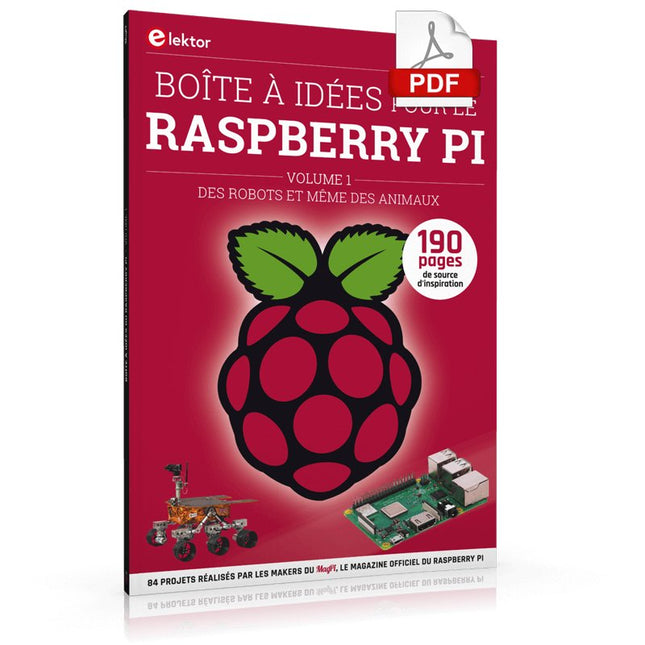
Elektor Digital Boîte à idées pour le Raspberry Pi (E-book)
Lancé en mars 2012, plus les 30 millions d'exemples nanométriques du Raspberry Pi exposés. Il s’agit d’une contribution à la révolution des technologies de l’information et d’un grand stimulant pour le développement du monde de l’électronique. Le succès de la « tarte à la framboise » (traduction littérale de Raspberry Pie) est le résultat de l'industrie micro-électronique de transformation des produits. Eben Upton, son créateur, âme à l'origine, les acheteurs étaient presque tous des makers , adultes en général. Cependant la plupart d'entre eux étaient également des ingénieurs professionnels. Rapidité, les gens sont responsables de leurs activités personnelles lors de l'utilisation du Raspberry Pi avec une plateforme informatique stable, et ils sont également adoptés pour leur métier. La Fondation Raspberry Pi édite un magazine édité par la communauté Raspberry Pi : le MagPi (en anglais). Le magazine aborde les passions selon la nature du numérique nano-ordonné et global. Il contient des bancs d'essai de nouveaux produits, de nombreux tutoriels et un grand nombre de projets. Les membres de la communauté Raspberry Pi participent à leur expérience. La maison d'édition Elektor s'associe à la Fondation Raspberry Pi pour la publication dans le magazine français MagPi. Il est conçu pour assembler 84 projets publics du MagPi en développant l'utilisation du Raspberry Pi et son inspiration. Grâce à la taille fine et aux possibilités du Raspberry Pi, les créateurs du monde sont fiers des idées des plus folles. Partez en voyage dans un monde où est faisable ! Le Raspberry Pi à toutes les sauces pour ? s'inspirateur des projets réalisés par les membres de la communauté dénicher des utilisations inouïes découvrir des accessoires et technologies diverses entrer dans une communauté intégrée et active de Raspberry Pi
€ 32,95
Membres : € 29,66
-

Elektor Digital Elektor 11-12/2023 (PDF)
Diese Ausgabe steht allen GOLD- und GREEN-Mitgliedern auf der ElektorMagazine-Website zum Download bereit! Sie sind noch kein Mitglied? Hier klicken! Der Raspberry Pi 5Gegenüber seinem Vorgänger enorm verbessert KI im ElektroniklaborSchaltungsdesign, Bauteil-Suche, Software Funktionsgenerator mit dem Arduino NanoNano + Code = Funktionsgenerator Solarbetriebene WeihnachtsgirlandeEine umweltfreundliche Lösung für die Dekoration Ihres Balkons USB-Killer-DetektorBesser sicher als traurig Ein einfaches CNC-GehäuseSchritt für Schritt mit Autodesk Fusion 360 Platinenproduktion in kleinen StückzahlenMit und ohne Bestückung IoT-Simulation vereinfacht mit WokwiEntwickler Uri Shaked über Entwicklung, Software und mehr Eine Anleitung zur Bare-Metal-ProgrammierungTeil 3: CMSIS-Header, automatische Tests und ein Webserver LoRa, ein Schweizer TaschenmesserTeil 2: Hard- und Software MEMS-MikrofoneEntwurf und Konstruktion eines Messmikrofons Werkzeuge zum Ausprobieren, bevor Sie lötenSimulations- und 3D-Modellierungstools, die kostenlos genutzt werden können Neue Tools von Microchip!Version 5 von PICkit und ICD jetzt erhältlich Rapid Prototyping von flexibler, dehnbarer ElektronikWie Voltera NOVA Innovationen bei tragbaren elektronischen Systemen beschleunigt Galvanische TrennungPhototransistor-Optokoppler erfolgreich einsetzen Die komplexe Lösung oder die Lösung von Anybus?Embedded Industrial Ethernet als Kurzstrecke statt als Marathon Ihre essentielle DFM-ChecklisteWie Sie mit dem Entwurf für die Fertigung beginnen Filamente für den 3D-DruckArten, Eigenschaften und Verwendung im Prototyping Spezialisten für eine effektive Signalauswertung von ELF bis EHF-BandAaronias neueste Echtzeit-Spektrumanalyzer der SPECTRAN® V6-Serie Herausforderungen der DFM-Analyse für Flex- und Rigid-Flex-Design Einrichten einer SMT-Fertigungsstrecke Die richtige Kombination für die zuverlässige Baugruppe Revolution in der IndustrieDer Aufstieg der Autonomen Mobilen Roboter (AMR) Für höchste Anforderungen weiterentwickeltR&S MXO 5 mit acht Kanälen ergänzt Oszilloskope der nächsten Generation Aller Anfang...... muss nicht schwer sein: Verstärkung von Unterschieden Mini-Reflow-PlatteFür die Bestückung und die Reparatur kleiner SMD-Schaltungen Starte nicht mit einem Prototyp – starte mit einem Pretotyp!Prüfe erst, ob es einen Markt für dein Produkt gibt, bevor du deinen Lötkolben vorwärmst 2023: Odyssee in die KIHilfe beim Entwerfen eines physikalischen Projekts erhalten Innovationen aus BrüsselUnterstützung für die Spitzentechnologie
€ 11,90
-
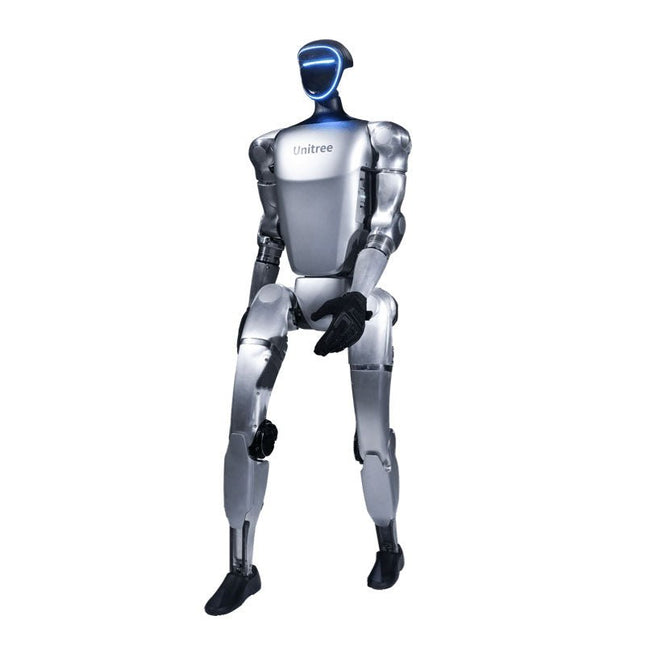
Unitree Unitree G1 Robot Humanoïde
L'Unitree G1 est un robot humanoïde moderne qui impressionne par sa flexibilité remarquable et sa technologie avancée. Avec une gamme exceptionnellement large de mouvements articulaires et jusqu'à 43 moteurs d'articulation, il dépasse l'agilité d'un humain typique. Grâce à l'apprentissage par imitation et à l'apprentissage par renforcement, ses systèmes robotiques sont continuellement développés et optimisés par l'intelligence artificielle. L'une des caractéristiques les plus impressionnantes du G1 est sa capacité à se mettre en position de marche de manière autonome dès qu'il touche le sol – aucune aide extérieure n'est nécessaire ! Il peut immédiatement commencer à se déplacer, ce qui démontre un haut niveau d'indépendance et d'adaptabilité. Le G1 est également équipé d'une main à contrôle de force, très dextre, qui fonctionne avec sensibilité et précision, grâce à sa combinaison de contrôle de force et de position. Cette main reproduit fidèlement les mouvements humains, ce qui permet de manipuler des objets avec précision. Caractéristiques Intel RealSense D435 caméra de profondeur Livox MID-360 3D LiDAR Matrice de microphones (annulation du bruit et de l'écho) Haut-parleur stéréo 5 W Batterie extra large à dégagement rapide Degrés de liberté d'un seul bras (épaule 2 + coude 2) Câblage interne des articulations de l'ensemble de la machine (pas de câbles externes) Couple maximal au niveau des articulations 120 N.m Degrés de liberté sur une jambe (hanche 3, genou 1, cheville 2) Vitesse de déplacement de 2 m/s Spécifications Hauteur, largeur et épaisseur (debout) 1320 x 450 x 200 mm Hauteur, largeur et épaisseur (plié) 690 x 450 x 300 mm Poids (avec batterie) env. 35 kg Degrés totaux de liberté (liberté conjointe 23 Degrés de liberté sur une seule jambe 6 Degrés de liberté à la taille 1 Degrés de liberté à un seul bras 5 Roulement de sortie commun Roulements à rouleaux croisés de qualité industrielle (haute précision, capacité de charge élevée) Moteur articulé PMSM (moteur synchrone à aimant permanent) à rotor interne haute vitesse à faible inertie – meilleure vitesse de réponse et dissipation thermique) Couple maximal de l'articulation du genou 90 N.m Charge maximale du bras env. 2 kg Longueur mollet + cuisse 0,6 m Envergure des bras env. 0,45 m Espace de mouvement articulaire extra large • Articulation de la taille : Z ±155°• Articulation du genou : 0~165°• Articulation de la hanche : P ±154°, R -30~+170°, Y ±158° Routage électrique creux à joint complet Oui Encodeur commun Double encodeur Système de refroidissement Refroidissement local par air Alimentation Batterie au lithium 13 cordes Puissance de calcul de base CPU hautes performances à 8 cœurs Capteur de détection Caméra de profondeur + LiDAR 3D Microphones Matrice de 4 microphones Haut-parleur Haut-parleur stéréo 5 W Sans fil WiFi 6, Bluetooth 5.2 Batterie intelligente (libération rapide) 9000 mAh Chargeur 54 V/5 A Contrôleur manuel Oui Autonomie de la batterie env. 2 heures OTA intelligent amélioré Oui
€ 24.999,00
Meilleur prix
-

Elektor Digital Elektor Arduino Guest Edition 2022 (PDF) EN
Elektor GREEN and GOLD members can download their digital edition here. Not a member yet? Click here. Arduino Portenta Machine Control and Arduino Portenta H7A CAN-to-MQTT Gateway Demo Project Unboxing the Elektor LCR Meter with David Cuartielles MicroPython Enters the World of Arduino Connected Projects, SimplifiedDive Into the Arduino Cloud Introduction to TinyMLBig Is Not Always Better Arduino K-Way Writing Arduino Sketches Just Got Better Get to Know Arduino Getting Started with the Portenta X8Manage Software Securely with Containers Build, Deploy, and Maintain Scalable, Secure ApplicationsWith Arduino Portenta X8 Featuring NXP’s i.MX 8M Mini Applications Processor and EdgeLock SE050 Secure Element How I Automated My HomeArduino CEO Fabio Violante Shares Solutions Altair 8800 SimulatorHardware Simulation of a Vintage Computer MS-DOS on the Portenta H7Run Old-School Software on Contemporary Hardware Grow It YourselfA Digitally Controlled, Single-Box Solution for Indoor Farming Save the Planet With Home Automation?MQTT on the Arduino Nano RP2040 Connect Go Professional with Arduino Pro Smart Ovens Take a Leap Into the Future Tagvance Builds Safer Construction Sites with Arduino Santagostino Breathes Easywith Remote Monitoring that Leverages AI for Predictive Maintenance Security Flies High with RIoT Secure’s MKR-Based Solution Open-Source Brings a New Generation of Water Management to the World SensoDetect Deforestation with Sound Analysis The Mozzi Arduino Library for Sound SynthesisInsights from Tim Barrass The New Portenta X8 (with Linux!) and Max Carrier Redefine What’s Possible How Using Arduino Helps Students Build Future Skills Must-Haves for Your Electronics Workspace The Importance of Robotics in Education Dependable IoT Based Upon LoRa Unboxing the Portenta Machine Control 8-Bit Gaming with Arduboy Reducing Water Usage at Horseback Riding TracksAn IoT to Constantly Monitor Soil Humidity and Temperature Levels The Panettone ProjectA sourdough starter management and maintenance system Supporting Arduino Resellers Space Invaders with Arduino Art with ArduinoInspiring Insights from Artists and Designers Arduino Product Catalogue The Future of Arduino
€ 7,50


