
Résultats de la recherche pour "elektor or esp32 or smart or kit"
-

FNIRSI FNIRSI TMP-610S (3-en-1) Multimètre (60000 points) + Oscilloscope + Générateur de signaux
Le FNIRSI TMP-610S est un instrument de test compact « 3-en-1 » combinant un multimètre True RMS, un oscilloscope de 10 MHz et un générateur de signaux DDS de 50 kHz. Il est conçu pour le dépannage électronique, le test de circuits et le développement, que ce soit en laboratoire ou sur le terrain. Le multimètre offre une résolution de 60000 points et prend en charge les mesures de tension, de courant, de résistance, de capacité, de fréquence et de température, ainsi que les tests de diode et de continuité. L'oscilloscope intégré permet une analyse des formes d'onde en temps réel jusqu'à 48 Méch/s, tandis que le générateur de signaux propose 13 types de formes d'onde avec fréquence, amplitude et rapport cyclique réglables. Doté d'un écran tactile IPS de 3,5 pouces, d'une fonction de balayage automatique intelligent, de la connectivité Bluetooth pour les fonctions multimètre, de la mémorisation des formes d'onde, de l'exportation via USB et d'une batterie rechargeable de 3000 mAh, le TMP-610S constitue un outil tout-en-un polyvalent pour les professionnels et les passionnés d'électronique. Caractéristiques Conception 3-en-1 : multimètre numérique, oscilloscope et générateur de signaux Mesure de haute précision True RMS (valeur efficace vraie) avec résolution de 60000 points Oscilloscope 10 MHz avec fréquence d'échantillonnage de 48 Méch./s Synchronisation avec application Bluetooth (fonction multimètre uniquement) Écran tactile intelligent de 3,5 pouces avec plusieurs modes d'affichage Générateur de signaux DDS 50 kHz avec 13 formes d'onde Fusible intégré pour un remplacement facile Spécifications Multimètre Fonction Plage Précision DC voltage 600mV/6V/60V/600V/1000V ±(0.03%+5d) AC voltage 600mV/6V/60V /600V/750V ±(0.3%+15d) DC current 600uA/6000uA/60mA/600mA ±(0.15%+5d) 6A/10A ±(0.2%+5d) AC current 600uA/6000uA/60mA/600mA ±(0.5%+15d) 6A/10A ±(0.75%+15d) Resistance 600Ω/6KΩ/60KΩ/600KΩ/6MΩ ±(0.1%+5d) 60MΩ ±(0.2%+10d) Capacitance 60nF/600nF/6uF/60uF ±(2.5%+30d) 600uF/6mF/60mF ±(3.5%+30d Frequency 10 Hz~60 MHz ±(0.01%+5d) Temperature -40℃~1000℃ ±(1.0%+5℃) Continuity 0Ω~1KΩ ±(0.2%+5d) Diode 0V~3.0V, 0Ω~1 Ω ±(1%+5d) AC frequency response 10KHz / Oscilloscope Real-time Sampling Rate 48 MSa/s Analog Bandwidth 10 MHz Input Impedance 1MΩ Coupling Mode AC/DC Test Voltage Range 1:1 Probe - 80Vpp (±40V) 10:1 Probe - 800Vpp (±400V) Vertical Sensitivity 10mV/div~10V/div Vertical Displacement Adjustable with indication Horizontal Time Base Range 50 ns ~ 20 s Trigger Mode Auto, Normal, Single Trigger Type Rising, Falling, 50% Trigger Level Adjustable with indication Measurement Parameters Freq, Period, +Duty, ‒Duty, +Width, ‒Width, Max, Min, P‒P, Amp, RMS, Avg Persistence Off / 500ms / 1s / ∞ Cursor Measurement Yes Waveform Screenshot Saving Yes Générateur de signaux Output Waveform Supports 13 waveform types Frequency 0~50kHz Amplitude 0.0V~3.0V Duty Cycle 0~100%, adjustable for Square and Sawtooth waves Inclus 1x FNIRSI TMP-610S Multimètre + Oscilloscope + Générateur de signaux 1x Sonde P6100 1x Adaptateur 2x Pinces crocodiles 2x Sondes multimètre Accessoires de sonde 1x Sac de rangement 1x Câble USB-C 1x Manuel Téléchargements Manual
€ 179,95€ 149,95Meilleur prix
-
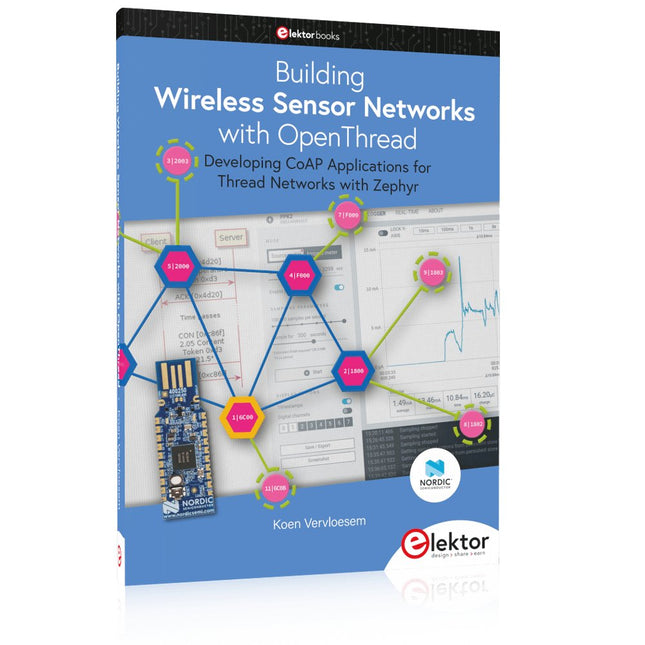
Elektor Publishing Building Wireless Sensor Networks with OpenThread
Developing CoAP applications for Thread networks with Zephyr This book will guide you through the operation of Thread, the setup of a Thread network, and the creation of your own Zephyr-based OpenThread applications to use it. You’ll acquire knowledge on: The capture of network packets on Thread networks using Wireshark and the nRF Sniffer for 802.15.4. Network simulation with the OpenThread Network Simulator. Connecting a Thread network to a non-Thread network using a Thread Border Router. The basics of Thread networking, including device roles and types, as well as the diverse types of unicast and multicast IPv6 addresses used in a Thread network. The mechanisms behind network discovery, DNS queries, NAT64, and multicast addresses. The process of joining a Thread network using network commissioning. CoAP servers and clients and their OpenThread API. Service registration and discovery. Securing CoAP messages with DTLS, using a pre-shared key or X.509 certificates. Investigating and optimizing a Thread device’s power consumption. Once you‘ve set up a Thread network with some devices and tried connecting and disconnecting them, you’ll have gained a good insight into the functionality of a Thread network, including its self-healing capabilities. After you’ve experimented with all code examples in this book, you’ll also have gained useful programming experience using the OpenThread API and CoAP.
€ 39,95
Membres : € 35,96
-

Elektor Digital Microcontrôleur 1 au format PDF (DE)
Microcontrôleur 1 au format PDF (DE)
€ 16,90
Membres : € 15,21
-

Elektor Publishing PID-basierte digitale Regelungstechnik mit Raspberry Pi und Arduino Uno
Der Arduino Uno ist ein Open-Source-Mikrocontroller-Entwicklungssystem, das Hardware, eine integrierte Entwicklungsumgebung (IDE) und eine Vielzahl von Bibliotheken umfasst. Es wird von einer riesigen Gemeinschaft von Programmierern, Elektronikern, Enthusiasten und Akademikern unterstützt. Insbesondere die Bibliotheken erleichtern die Programmierarbeit und reduzieren die Entwicklungszeiten, da sie das Erstellen von Programmen erheblich erleichtern. Der Raspberry Pi 4 kann in vielen Projekten wie Audio- und Videoanwendungen, aber auch in Industriesteuerungen, Robotik, Spielen usw. eingesetzt werden. Dazu bietet er auch WiFi- und Bluetooth-Fähigkeiten, wodurch er sich zudem hervorragend für internetbasierte Steuerungs- und Überwachungsanwendungen eignet. In diesem Buch werden sowohl der Raspberry Pi 4 als auch der Arduino Uno in PID-basierten automatischen Steuerungsanwendungen eingesetzt. Nach einer grundlegenden Theorie der Regelsysteme werden funktionierende und getestete Projekte zur Steuerung realer Systeme mit PID-Reglern vorgestellt. Die Open-Loop-Eigenschaften, die Abstimmung der PID-Parameter und das Closed-Loop-Zeitverhalten der Systeme werden zusammen mit Blockdiagrammen, Schaltplänen und PID-Regelalgorithmen ausführlich diskutiert. Vollständige Programme für den Raspberry Pi und den Arduino Uno runden die im Buch vorgestellten Projekte ab. Die Regelsysteme können problemlos auch auf andere Projekte angewendet werden und die für den Raspberry Pi 4 angegebenen Programme sollten auch mit anderen Modellen der Raspberry Pi-Familie reibungslos funktionieren. Das Buch behandelt folgende Themen: Steuer- und Regelsysteme Analoge und digitale Sensoren Übertragungsfunktionen und zeitkontinuierliche Systeme Systemantwortfunktionen erster und zweiter Ordnung Zeitdiskrete digitale Systeme Zeitkontinuierliche PID-Regler Zeitdiskrete PID-Regler Zweipunkt-Temperaturregelung mit Raspberry Pi und Arduino Uno PID-basierte Temperaturregelung mit Raspberry Pi und Arduino Uno Motorsteuerung mit Raspberry Pi und Arduino Uno Wasserstandsregelung mit Raspberry Pi und Arduino Uno PID-basierte LED-Helligkeitsregelung mit Raspberry Pi und Arduino Uno
€ 39,80
Meilleur prix
-

Elektor Publishing Wireless Power Design
From Theory to Practical Applications in Wireless Energy Transfer and Harvesting Wireless power transmission has gained significant global interest, particularly with the rise of electric vehicles and the Internet of Things (IoT). It’s a technology that allows the transfer of electricity without physical connections, offering solutions for everything from powering small devices over short distances to long-range energy transmission for more complex systems. Wireless Power Design provides a balanced mix of theoretical knowledge and practical insights, helping you explore the potential of wireless energy transfer and harvesting technologies. The book presents a series of hands-on projects that cover various aspects of wireless power systems, each accompanied by detailed explanations and parameter listings. The following five projects guide you through key areas of wireless power: Project 1: Wireless Powering of Advanced IoT Devices Project 2: Wireless Powered Devices on the Frontline – The Future and Challenges Project 3: Wireless Powering of Devices Using Inductive Technology Project 4: Wireless Power Transmission for IoT Devices Project 5: Charging Robot Crawler Inside the Pipeline These projects explore different aspects of wireless power, from inductive charging to wireless energy transmission, offering practical solutions for real-world applications. The book includes projects that use simulation tools like CST Microwave Studio and Keysight ADS for design and analysis, with a focus on practical design considerations and real-world implementation techniques.
€ 39,95
Membres : € 35,96
-

Elektor Publishing Consumer Electronics Repair, Reuse and Recycling
A Combat Guide against E-waste and Throwawayism This book is for anyone who enjoys tinkering with analog and digital hardware electronics. Regardless of the sophistication of your workspace, only basic tools are required to achieve truly satisfying results. It is intended as a reference guide among other hardware repair publications you may have in your library. However, the book goes a step further than most other repair guides in addressing issues in the modern era of discarded electronics called e-waste. E-waste should be put to good use. Producing anything new requires not just precious resources and labor, but also energy to make and deliver it to global retail shelves. Your talents and love of electronics can be put to good use by rescuing and resurrecting at least selected units from this endless stream of e-waste. Examples include either restoring through repair, or salvaging reusable electronic and mechanical components for your next project. Smart tips are provided throughout the book, and much information is tabulated for easy reference. The book expands age-old repair and hacking techniques applied for repair on the workbench into clever methods and applications to achieve effective results with discarded or “non-servicable” electronic consumer products. The final chapter provides real-life examples using all of the previously discussed content in a summarized form for each example repair type.
€ 39,95
Membres : € 35,96
-
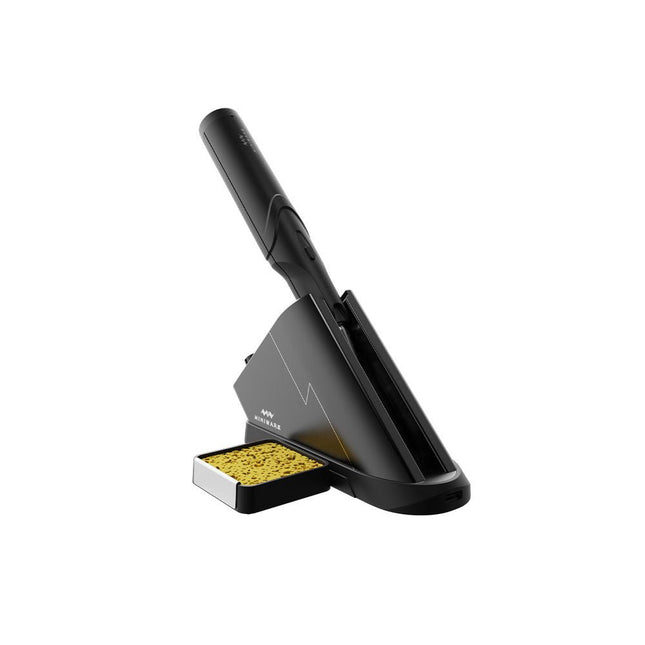
Miniware Station de soudage sans fil Miniware TS1C
La station de soudure sans fil Miniware TS1C (avec écran OLED intégré et Bluetooth) est un outil de soudure intelligent qui chauffe jusqu'à 400°C en moins de 20 secondes. Grâce à sa batterie intégrée, le fer à souder sans fil est confortable à tenir et facile à utiliser. Caractéristiques Nouvelle technologie de stockage d'énergie avec supercondensateur à haut rendement, temps de charge et de décharge de 10 000 niveaux. Conception séparée + véritable sans-fil, pour profiter de la soudure sans fil PD2 standard 20 V avec une consommation d'énergie maximale de 45 W, et jusqu'à 36 W de puissance de soudage, peut souder en continu plus de 180 joints de soudure (0805) avec une seule charge complète. Préchauffage dans la station de contrôle, pour améliorer l'efficacité du chauffage Trois emplacements d'extension pour les accessoires Station de contrôle PD2 standard 20 V avec une consommation d'énergie maximale de 45 W, protection contre les surintensités Écran OLED de 128x64 pixels, affichage en temps réel de l'état du fer à souder Préchauffage dans la station de contrôle, pour améliorer l'efficacité du chauffage Commande et réglage à distance : contrôle de la température, réglage du menu, affichage des informations et de l'état de l'appareil, etc. Fonctions de support de soudure et de station de chargeTrois emplacements d'extension pour de multiples accessoires supplémentaires, tels qu'un emplacement pour l'éponge Fer à souder Supercondensateur 750F intégré pour un stockage d'énergie à haute efficacité, pouvant être chargé via la station de contrôle (ou en cas d'urgence via l'interface USB Type-C). Puissance de chauffe maximale de 36 W, peut souder en continu plus de 180 joints de soudure (0805) avec une seule charge complète. Compatible avec les pannes à souder d'interface audio Miniware 3,5 mm (série de pannes TS80/80P) Mode Boost (maintenir le bouton du fer enfoncé) Inclus Fer à souder TS1C Station de contrôle TS1C Panne à souder (TS-B02) Câble en silicone Emplacement pour éponge avec éponge inclus Manuel
€ 166,80
-
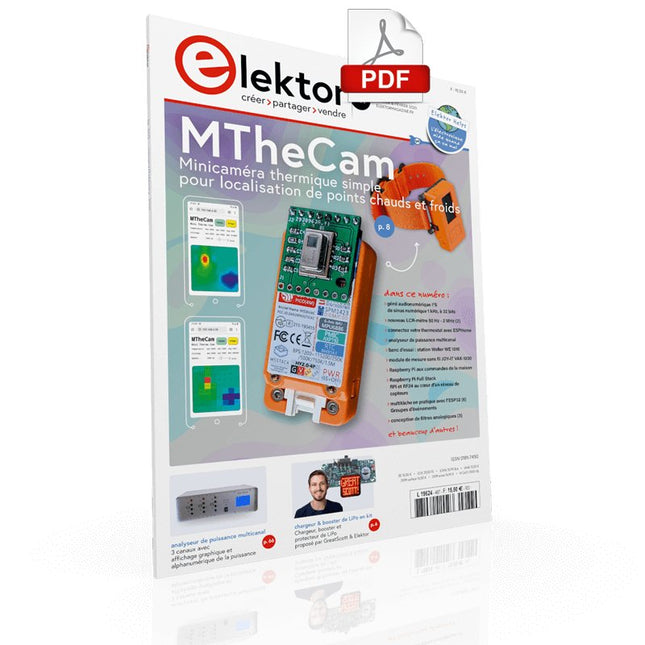
Elektor Digital Elektor Janvier/Février 2021 (PDF)
SUPERCHARGEUR LIPO EN KITChargeur, booster et protecteur LiPo proposé par GreatScott & ElektorMINI CAMÉRA THERMIQUE MTHECAMMinicaméra thermique simple pour localisation de points chauds et froidsBANC D'ESSAI : WELLER WE 1010Station de soudageGAGNANTS DU CONCOURS ELECTRONICA FAST FORWARD 2020GÉNÉ AUDIONUMÉRIQUE DE SIGNAUX DE TEST I2SSinus numérique 1 kHz, à 32 bits, échantillonné à 192 kHz, réglable de 0 à –110 dBRASPBERRY PI AUX COMMANDES DE LA MAISONRPi furète sur 433,92 MHzSIMULE TES CIRCUITS EN LIGNESUR LE VIFEntre ordre et chaosDÉBUTER EN ÉLECTRONIQUE... (5)…est moins difficile qu'on ne l'imagine !OHM SUITE OHMNi CPU ni ALU, juste un opérateur logique NOR à deux transistorsCONNECTEZ VOTRE THERMOSTAT AVEC ESPHOMEUne tentative pour faire de la domotique comme il fautBUREAU D'ÉTUDES – ZONE DD comme développement, comme débrouillardise et dur-à-cuireELLES SONT PETITES MAIS FONT DE BELLES CHOSESLes pépites d'ElektorRASPBERRY PI FULL STACKRPi et RF24 au cœur d'un réseau de capteursMULTITÂCHE EN PRATIQUE AVEC L'ESP32 (6)Groupes d'événementsANALYSEUR DE PUISSANCE MULTICANALAvec affichage graphique et alphanumérique de la puissance sur 3 canauxCONCEPTION DE FILTRES ANALOGIQUES (3)Filtres passifsBANC D'ESSAI : MODULE DE MESURE SANS FIL JOY-IT VAX-1030NOUVEAU LCR-MÈTRE 50 HZ - 2 MHZ (2)Fonctionnement, étalonnage et microprogrammeERREURS FÉCONDESConseils sur les régulateurs de tension et sur la conception des circuits imprimés, etc.CORRECTIONS, MISES À JOUR ET COURRIER DES LECTEURSJAVA SUR RASPBERRY PIEntretien avec Frank DelporteANALYSE DE DONNÉES ET INTELLIGENCE ARTIFICIELLE EN PYTHONInterpréter les données réelles avec NumPy, pandas et le scikit-learnPROPELLER 2 DE PARALLAX (1)Une découverteOBSERVATOIRE DU MATÉRIEL LIBREÉvaluation communautaire du matériel à source ouverteHEXADOKU
€ 10,95
-

€ 17,50
Membres : € 15,75
-
Elektor Digital C Programming for Embedded Microcontrollers (E-book)
Technology is constantly changing. New microcontrollers become available every year and old ones become redundant. The one thing that has stayed the same is the C programming language used to program these microcontrollers. If you would like to learn this standard language to program microcontrollers, then this book is for you! ARM microcontrollers are available from a large number of manufacturers. They are 32-bit microcontrollers and usually contain a decent amount of memory and a large number of on-chip peripherals. Although this book concentrates on ARM microcontrollers from Atmel, the C programming language applies equally to other manufacturer’s ARMs as well as other microcontrollers. Features of this book Use only free or open source software. Learn how to download, set up and use free C programming tools. Start learning the C language to write simple PC programs before tackling embedded programming - no need to buy an embedded system right away! Start learning to program from the very first chapter with simple programs and slowly build from there. No programming experience is necessary! Learn by doing - type and run the example programs and exercises. Sample programs and exercises can be downloaded from the Internet. A fun way to learn the C programming language. Ideal for electronic hobbyists, students and engineers wanting to learn the C programming language in an embedded environment on ARM microcontrollers.
€ 29,95
Membres : € 26,96
-
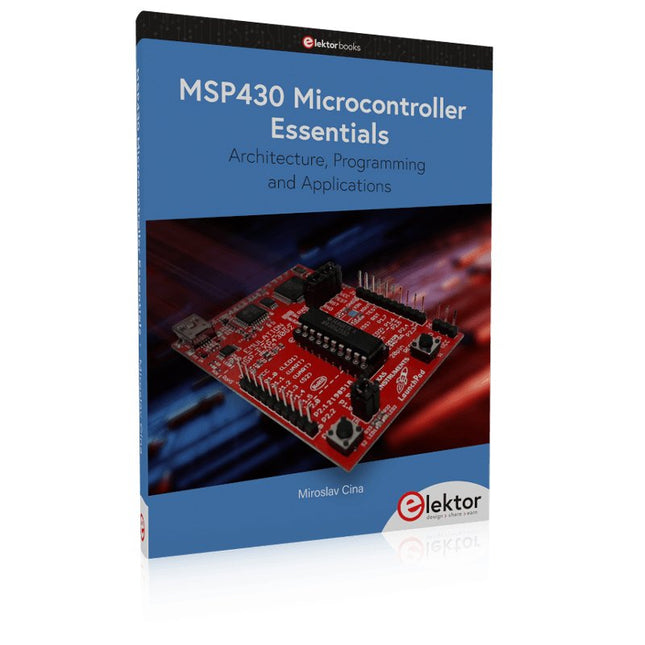
Elektor Publishing MSP430 Microcontroller Essentials
Architecture, Programming and Applications The MSP430 is a popular family of microcontrollers from Texas Instruments. In this book we will work with the smallest type, which is the powerful MSP430G2553. We will look at the capabilities of this microcontroller in detail, as it is well-suited for self-made projects because it is available in a P-DIP20 package. We will take a closer look at the microcontroller and then build, step by step, some interesting applications, including a 'Hello World' blinking LED and a nice clock application, which can calculate the day of the week based on the date. You also will learn how to create code for the MSP microcontroller in assembler. In addition to that, we will work with the MSP-Arduino IDE, which makes it quite easy to create fast applications without special in-depth knowledge of the microcontrollers. All the code used in the book is available for download from the Elektor website.
€ 39,95
Membres : € 35,96
-

Siglent Siglent SPD3303X-E Alimentation CC à 3 canaux (220 W)
L'alimentation CC linéaire programmable de la série SPD3000X est dotée d'un écran LCD TFT de 4,3 pouces. Elle permet la programmation et l'affichage d'ondes en temps réel, ce qui apporte une nouvelle expérience aux utilisateurs. Elle possède trois sorties isolées : deux canaux réglables et un canal sélectionnable de 2,5 V, 3,3 V et 5 V. Elle dispose également d'une fonction de protection contre les courts-circuits et les surcharges, et peut être utilisé en production et en développement. Caractéristiques 3 sorties réglables indépendantes et isolées, 32V/3,2A×2, 2,5V/3,3V/5V/3,2A×1, total 220W. Affichage de la tension à 5 chiffres, du courant à 4 chiffres, résolution minimale de 10mV/10mA. Sorties de synchronisation/temporisateurs. Écran TFT LCD couleur de 4,3 pouces 480x272 pixels. 3 types de modes de sortie : indépendant, série, parallèle. Compatible 100V/120V/220V/230V pour répondre aux besoins des différents réseaux électriques. Ventilateur intelligent à température contrôlée, réduisant efficacement le bruit. Interface graphique claire, avec fonction d'affichage de la forme d'onde. Sauvegarde/rappel interne de 5 groupes de paramètres système, permettant l'extension de l'espace de stockage des données. Logiciel PC : Easypower, prend en charge les pilotes SCPI et LabVIEW. Sortie haute résolution et haute précision La résolution la plus élevée de 10mV/10mA offre une excellente précision de réglage et de lecture. Cela garantit une sortie précise même en cas de très faibles variations de tension ou de courant. Ceci est impossible avec une alimentation à faible résolution. Fonction mode série/parallèle/indépendant Les fonctions série et parallèle permettent de combiner deux canaux en une seule sortie avec une plus grande capacité de sortie de puissance, ce qui élargit le champ d'application. La puissance de chacun des trois canaux peut être activée ou désactivée indépendamment et peut également être activée ou désactivée en totalité. Le panneau affiche la sortie de synchronisation Le panneau de commande permet d'afficher 5 groupes de réglages de temporisation et de contrôle de sortie, ce qui offre aux utilisateurs une fonction simple de programmation de l'alimentation. Il est également possible d'établir une connexion avec le logiciel PC EasyPower de Siglent, ce qui permet de répondre à toutes les exigences en matière de communication et de contrôle. Sauvegarde/rappel des paramètres de réglage L'alimentation programmable de la série SPD3000X peut enregistrer ou rappeler 5 groupes de paramètres de réglage dans la mémoire interne, et permet également l'extension de la mémoire externe. Vous pouvez facilement obtenir les paramètres dont vous avez besoin.
€ 432,90


