
Résultats de la recherche pour "arduino OR pro OR portenta OR machine OR control"
-
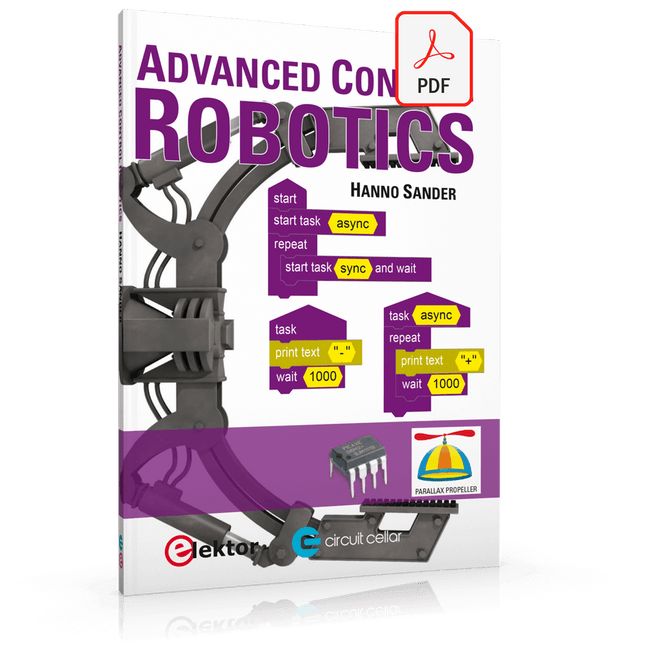
Elektor Digital Advanced Control Robotics (E-book)
If you enjoy DIY electronics, projects, software and robots, you’ll find this book intellectually stimulating and immediately useful. With the right parts and a little guidance, you can build robot systems that suit your needs more than overpriced commercial systems can. 20 years ago, robots based on simple 8-bit processors and touch sensors were the norm. Now, it’s possible to build multi-core robots that can react to their surroundings with intelligence. Today’s robots combine sensor readings from accelerometers, gyroscopes and computer vision sensors to learn about their environments. They can respond using sophisticated control algorithms and they can process data both locally and in the cloud. This book, which covers the theory and best practices associated with advanced robot technologies, was written to help roboticists, whether amateur hobbyist or professional, take their designs to the next level. As will be seen, building advanced applications does not require extremely costly robot technology. All that is needed is simply the knowledge of which technologies are out there and how best to use each of them. Each chapter in this book will introduce one of these different technologies and discuss how best to use it in a robotics application. On the hardware side, we’ll cover microcontrollers, servos, and sensors, hopefully inspiring you to design your own awe-inspiring, next-generation systems. On the software side, we’ll cover programming languages, debugging, algorithms, and state machines. We’ll focus on the Arduino, the Parallax Propeller, Revolution Education PICAXE and projects I’ve with which I’ve been involved, including the TBot educational robot, the PropScope oscilloscope, the 12Blocks visual programming language, and the ViewPort development environment. In addition, we’ll serve up a comprehensive introduction to a variety of essential topics, including output (e.g. LEDs, servo motors), and communication technologies (e.g. infrared, audio), that you can use to develop systems that interact to stimuli and communicate with humans and other robots. To make these topics as accessible as possible, handy schematics, sample code and practical tips regarding building and debugging have been included. Hanno Sander Christchurch, New Zealand
€ 24,95
Membres : € 22,46
-
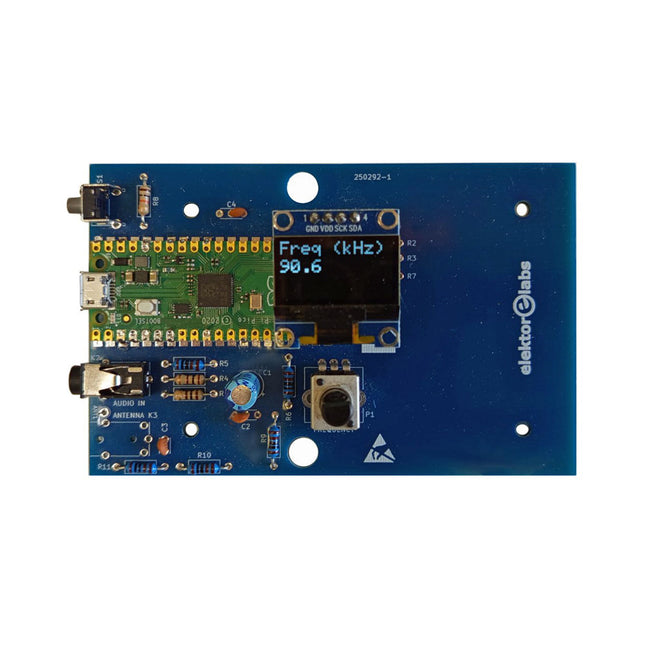
Elektor Labs Kit émetteur AM Elektor
Construisez votre propre émetteur radio vintage Le kit émetteur AM Elektor permet de diffuser de l’audio vers des récepteurs radio AM vintage. Basé sur un module microcontrôleur Raspberry Pi Pico, l’émetteur AM peut transmettre sur 32 fréquences dans la bande AM, de 500 kHz jusqu’à 1,6 MHz en 32 pas d’environ 35 kHz. La fréquence est sélectionnée à l’aide d’un potentiomètre et affichée sur un écran OLED de 0,96". Un bouton-poussoir permet de basculer le mode d’émission entre Marche et Arrêt. La portée de l’émetteur dépend de l’antenne. L’antenne intégrée offre une portée de quelques centimètres, nécessitant de placer l’émetteur AM à proximité ou à l’intérieur de la radio. Une antenne boucle externe (non incluse) peut être connectée pour augmenter la portée. Le kit émetteur AM Elektor est livré en kit de pièces que vous devez souder vous-même sur la carte. Caractéristiques La carte est compatible avec un boîtier Hammond 1593N (non inclus).Une alimentation 5 VDC avec connecteur micro-USB (par exemple, un ancien chargeur de téléphone) est nécessaire pour alimenter le kit (non incluse). Consommation de courant : 100 mA. Le logiciel Arduino (nécessitant le package RP2040 Boards d’Earle Philhower) pour le kit émetteur AM Elektor ainsi que plus d’informations sont disponibles sur la page Elektor Labs de ce projet. Liste des composants Résistances R1, R4 = 100 Ω R2, R3, R8 = 10 kΩ R5, R6, R9, R10, R11 = 1 kΩ R7 = optionnelle (non incluse) P1 = potentiomètre 100 kΩ, linéaire Condensateurs C1 = 22 µF 16V C2, C4 = 10 nF C3 = 150 pF Divers K1 = barrette 4×1 broches K2, K3 = prise 3,5 mm Raspberry Pi Pico Bouton-poussoir, montage en angle Afficheur OLED I²C monochrome 0,96" PCB 150292-1
€ 34,95€ 29,95Meilleur prix
-
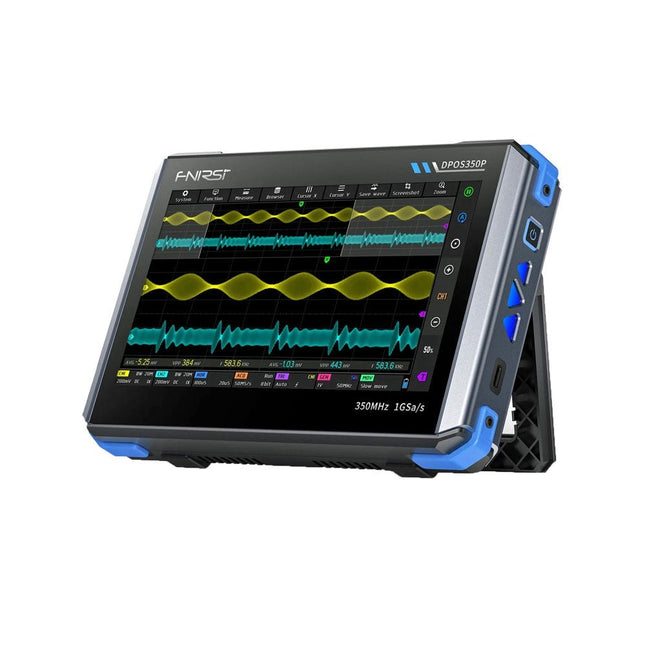
FNIRSI FNIRSI DPOS350P (4-en-1) Oscilloscope tablette à 2 canaux (350 MHz) + Générateur de signaux + Analyseur de réponse en fréquence + Analyseur de spectre
2 canaux • 350 MHz • 1 Géch/s • 50000 wfm/s • Écran tactile de 7 pouces Le FNIRSI DPOS350P est un appareil 4-en-1 élégant et puissant sous forme de tablette ! Cet appareil compact et portable offre des fonctionnalités avancées : il combine un oscilloscope à 2 canaux (350 MHz), un générateur de signaux (50 MHz), un analyseur de réponse en fréquence (50 MHz) et un analyseur de spectre (200 kHz–350 MHz), le tout dans un seul appareil. Que vous soyez en R&D, en dépannage ou en tests sur le terrain, le DPOS350P vous offre les outils nécessaires pour mesurer, générer, analyser et visualiser des signaux électroniques avec précision et clarté. Son écran tactile haute résolution réactif et ses commandes intuitives rendent l'analyse des signaux rapide, flexible et efficace. Caractéristiques Intégration multifonction puissante Oscilloscope 2 canaux 350 MHz avec échantillonnage en temps réel de 1 Géch/s Générateur de signaux 50 MHz avec 14 formes d'onde standard et personnalisées Analyseur de spectre (200 kHz–350 MHz) : Parfait pour les interférences électromagnétiques, RF et Tests HF Analyseur de réponse en fréquence (ARF) jusqu'à 50 MHz Capture de forme d'onde haute performance Fréquence de rafraîchissement de 50000 wfm/s pour une clarté du signal en temps réel Bande passante de 350 MHz (mode monocanal) Détecte les anomalies rares et à faible probabilité Affichage net et Fonctionnement fluide Écran tactile IPS 7" (résolution 1024 x 600) Basculement entre l'affichage des niveaux de gris et de la température de couleur Facilité d'utilisation dans divers environnements de test Fiable, protégé et charge rapide Protection haute tension jusqu'à 400 V Charge rapide avec QC 18 W (charge complète en 2 heures) Conçu pour un fonctionnement stable à long terme Stockage et exportation des données Enregistrement jusqu'à 500 enregistrements de formes d'onde + 90 captures d'écran Exportation USB pour faciliter la création de rapports et l'analyse hors ligne Spécifications Général Écran 7 pouces (IPS plein angle de vision) Résolution 1024 x 600 pixels Mode interaction Écran tactile capacitif Consommation totale 10 W Configuration à la mise sous tension 5 préréglages Chargement QC 18 W, 12 V/1,5 A (USB-C) Batterie Batterie au lithium 3,7 V, 8000 mAh Autonomie de la batterie Environ 3 heures en fonctionnement, 5 heures en veille Dissipation thermique Refroidissement par air Interface d'extension Port de données USB Arrêt automatique 15 à 60 minutes / arrêt Mise à jour du micrologiciel Prise en charge de la mise à niveau des images ISO Langues Anglais / Portugais / Russe / Chinois Dimensions 190 x 128 x 37 mm Oscilloscope Voies analogiques 2 Bande passante analogique 350 MHz Temps de montée 1 ns Fréquence d'échantillonnage en temps réel 1 Géch/s Profondeur mémoire 60 Kpts Impédance d'entrée 1 MΩ / 14PF Plage de base de temps 5 ns ~ 50 s Base de temps de défilement 50 ms ~ 50 s Sensibilité verticale 2 mV ~ 20 V (1X) Plage verticale 16 mV ~ 160 V (1X) Précision CC ±2% Temps Précision ±0,01% Couplage d'entrée CC / CA Atténuation de la sonde 1X / 10X / 100X Limite de bande passante matérielle 150 Mbit/s / 20 Mbit/s Mode haute résolution 8 bits ~ 16 bits Mesures de paramètres 12 types Mesure du curseur Temps, période, fréquence, niveau, tension Détection du déclencheur Déclenchement numérique Canal de déclenchement CH1 / CH2 Mode de déclenchement Auto / Simple / Normal Front de déclenchement Rising edge / Falling edge Suppression du déclencheur L1 ~ L3 Niveau de déclenchement Manuel / automatique 10% ~ 90% Stockage de captures d'écran 90 images Stockage de formes d'onde 500 groupes Grille d'arrière-plan Afficher / Masquer Mouvement de la forme d'onde Réglage grossier / réglage fin Protection contre les surtensions Tension de tenue 400 V Luminosité de la forme d'onde Réglable Affichage FFT simple Oui Fluorescence numérique Oui Affichage de la température de couleur Oui Mode X-Y Oui Base de temps ZOOM Oui Réglage automatique par simple pression sur une touche Oui Remise à zéro par simple pression sur une touche Oui Navigateur de données Oui Générateur de signaux Types de formes d'onde 14 fonctions standard + forme d'onde capturée Fréquence 0 à 50 MHz (onde sinusoïdale uniquement, autres formes d'onde jusqu'à 10M/5M/3M) Amplitude 0 à 5 VPP Décalage -2,5 V à +2,5 V Utilité Cycle 0,1~99,9% Résolution en fréquence 1 Hz Résolution en amplitude 1 mV Résolution du décalage 1 mV Résolution du rapport cyclique 0,1% Forme d'onde capturée personnalisable 500 groupes Analyseur de réponse en fréquence (ARF) Fréquence du signal d'excitation 100 Hz ~ 50 MHz Amplitude du signal d'excitation 0~5 VPP Décalage du signal d'excitation -2,5 V ~ +2,5 V Nombre de fréquences d'excitation 20~500 Mesure du curseur Fréquence / gain / Phase Mode de fonctionnement Simple / cyclique Calibrage du système Oui Analyseur de spectre Méthode de conversion FFT Longueur FFT 4K ~ 32K Gamme de fréquences 200 KHz ~ 350 MHz Plage de niveaux -60 dBmV ~ +260 dBmV Mesure du curseur Fréquence / amplitude Paramètre de marquage Harmoniques d'énergie maximale Graphique en cascade Oui Graphique en cascade 3D Oui Ajustement automatique Oui Calibrage du système Oui Inclus 1x FNIRSI DPOS350P (4-en-1) 2x Sondes de 350 MHz 1x Chargeur rapide QC 18 W (UE) 1x Câble de données USB 1x Pince crocodile 1x Sac de rangement 1x Manuel Téléchargements Manual Firmware
€ 309,00€ 259,00Meilleur prix
-

Great Scott Gadgets Great Scott Gadgets HackRF Pro SDR (100 kHz – 6 GHz) + E-book GRATUIT
OFFRE SPÉCIALE : Commandez le HackRF Pro maintenant et recevez gratuitement le nouvel e-book « SDR with HackRF One & HackRF Pro » d’une valeur de 20 € ! Le HackRF Pro est la toute dernière radio logicielle (Software Defined Radio, SDR) de Great Scott Gadgets et le puissant successeur du légendaire HackRF One. Avec une plage de fréquences allant de 100 kHz à 6 GHz, il couvre un spectre immense pour l'émission et la réception de signaux radio. Conçu comme une plateforme matérielle open-source, le HackRF Pro est l'outil idéal pour l'analyse et le développement des technologies sans fil modernes. Il peut être utilisé de manière flexible comme périphérique USB ou programmé pour un fonctionnement autonome. Spécifications Fréquence : 100 kHz à 6 GHz Réglable de 0 Hz à 7,1 GHz Émetteur-récepteur semi-duplex Jusqu'à 20 millions d'échantillons par seconde Échantillonnage en quadrature 8 bits (8 bits I et 8 bits Q) Compatible avec GNU Radio, SDR# et autres Gain RX et TX et filtre de bande de base configurables par logiciel Alimentation du port RF contrôlée par logiciel (50 mA à 3,3 V) Connecteur RF SMA Entrée et sortie d'horloge SMA pour la synchronisation et le déclenchement Boutons pratiques pour la programmation Connecteurs internes pour Extension USB 2.0 haute vitesse avec connecteur USB-C Alimentation par USB Matériel open source Par rapport à son prédécesseur, HackRF Pro offre une variété de fonctionnalités nouvelles, notamment : Plage de fréquences de fonctionnement étendue Performances RF améliorées avec une réponse en fréquence plus linéaire Connecteur USB-C Oscillateur à cristal TCXO intégré pour une stabilité de synchronisation supérieure Mise à niveau logique d'un CPLD vers un FPGA écoénergétique Élimination du pic de tension continue Mode de précision étendue avec échantillons 16 bits pour les faibles fréquences d'échantillonnage (ENOB typique : 9-11) Mode de demi-précision avec échantillons 4 bits jusqu'à 40 Méch./s Davantage de RAM et de mémoire flash pour un firmware personnalisé Blindage installé autour de la section radio Entrées et sorties de déclenchement accessibles via des connecteurs d'horloge Découpe dans le circuit imprimé offrant de l'espace pour de futurs ajouts Consommation électrique améliorée Gestion Protection renforcée des ports RF Possibilité de désactiver matériellement le mode d'émission Compatibilité totale : Grâce à son architecture éprouvée, les logiciels existants pour le HackRF One peuvent également être utilisés directement avec le HackRF Pro. Le HackRF Pro offre une compatibilité descendante transparente tout en offrant des performances nettement améliorées. Remarque : L'antenne n'est sont pas inclus. Nous recommandons l'antenne ANT500 pour une mise en service optimale. Inclus HackRF Pro SDR avec boîtier en plastique Nouvel e-book : SDR with HackRF One & HackRF Pro (prix normal : 20 €) Téléchargements Documentation GitHub
€ 489,00€ 429,00Meilleur prix
-

Elektor Digital Controller Area Network Projects with ARM and Arduino (E-book)
This book details the use of the ARM Cortex-M family of processors and the Arduino Uno in practical CAN bus based projects. Inside, it gives a detailed introduction to the architecture of the Cortex-M family whilst providing examples of popular hardware and software development kits. Using these kits helps to simplify the embedded design cycle considerably and makes it easier to develop, debug, and test a CAN bus based project. The architecture of the highly popular ARM Cortex-M processor STM32F407VGT6 is described at a high level by considering its various modules. In addition, the use of the mikroC Pro for ARM and Arduino Uno CAN bus library of functions are described in detail. This book is written for students, for practising engineers, for hobbyists, and for everyone else who may need to learn more about the CAN bus and its applications. The book assumes that the reader has some knowledge of basic electronics. Knowledge of the C programming language will be useful in later chapters of the book, and familiarity with at least one microcontroller will be an advantage, especially if the reader intends to develop microcontroller based projects using CAN bus. The book should be useful source of reference to anyone interested in finding an answer to one or more of the following questions: What bus systems are available for the automotive industry? What are the principles of the CAN bus? What types of frames (or data packets) are available in a CAN bus system? How can errors be detected in a CAN bus system and how reliable is a CAN bus system? What types of CAN bus controllers are there? What are the advantages of the ARM Cortex-M microcontrollers? How can one create a CAN bus project using an ARM microcontroller? How can one create a CAN bus project using an Arduino microcontroller? How can one monitor data on the CAN bus?
€ 32,95
Membres : € 29,66
-
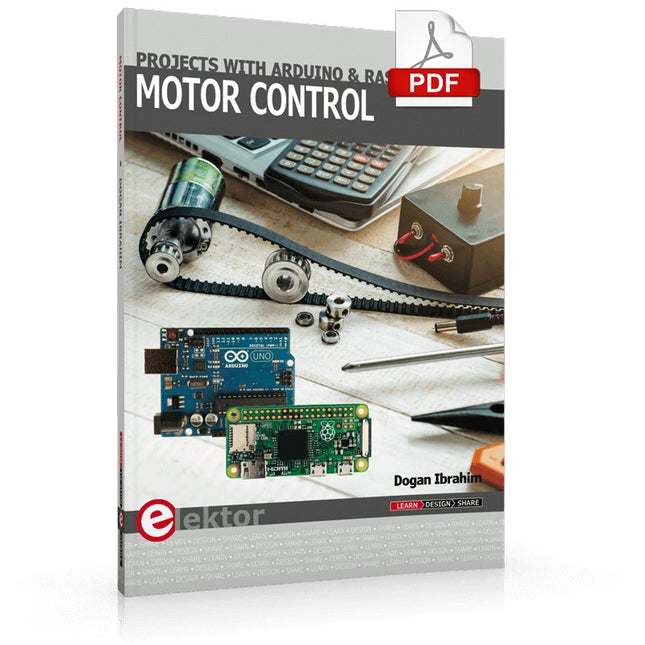
Elektor Digital Motor Control - Projects with Arduino & Raspberry Pi (E-book)
This book is about DC electric motors and their use in Arduino and Raspberry Pi Zero W based projects. The book includes many tested and working projects where each project has the following sub-headings: Title of the project Description of the project Block diagram Circuit diagram Project assembly Complete program listing of the project Full description of the program The projects in the book cover the standard DC motors, stepper motors, servo motors, and mobile robots. The book is aimed at students, hobbyists, and anyone else interested in developing microcontroller based projects using the Arduino Uno or the Raspberry Pi Zero W. One of the nice features of this book is that it gives complete projects for remote control of a mobile robot from a mobile phone, using the Arduino Uno as well as the Raspberry Pi Zero W development boards. These projects are developed using Wi-Fi as well as the Bluetooth connectivity with the mobile phone. Readers should be able to move a robot forward, reverse, turn left, or turn right by sending simple commands from a mobile phone. Full program listings of all the projects as well as the detailed program descriptions are given in the book. Users should be able to use the projects as they are presented, or modify them to suit to their own needs.
€ 29,95
Membres : € 26,96
-

Elektor Publishing PID-basierte digitale Regelungstechnik mit Raspberry Pi und Arduino Uno
Der Arduino Uno ist ein Open-Source-Mikrocontroller-Entwicklungssystem, das Hardware, eine integrierte Entwicklungsumgebung (IDE) und eine Vielzahl von Bibliotheken umfasst. Es wird von einer riesigen Gemeinschaft von Programmierern, Elektronikern, Enthusiasten und Akademikern unterstützt. Insbesondere die Bibliotheken erleichtern die Programmierarbeit und reduzieren die Entwicklungszeiten, da sie das Erstellen von Programmen erheblich erleichtern. Der Raspberry Pi 4 kann in vielen Projekten wie Audio- und Videoanwendungen, aber auch in Industriesteuerungen, Robotik, Spielen usw. eingesetzt werden. Dazu bietet er auch WiFi- und Bluetooth-Fähigkeiten, wodurch er sich zudem hervorragend für internetbasierte Steuerungs- und Überwachungsanwendungen eignet. In diesem Buch werden sowohl der Raspberry Pi 4 als auch der Arduino Uno in PID-basierten automatischen Steuerungsanwendungen eingesetzt. Nach einer grundlegenden Theorie der Regelsysteme werden funktionierende und getestete Projekte zur Steuerung realer Systeme mit PID-Reglern vorgestellt. Die Open-Loop-Eigenschaften, die Abstimmung der PID-Parameter und das Closed-Loop-Zeitverhalten der Systeme werden zusammen mit Blockdiagrammen, Schaltplänen und PID-Regelalgorithmen ausführlich diskutiert. Vollständige Programme für den Raspberry Pi und den Arduino Uno runden die im Buch vorgestellten Projekte ab. Die Regelsysteme können problemlos auch auf andere Projekte angewendet werden und die für den Raspberry Pi 4 angegebenen Programme sollten auch mit anderen Modellen der Raspberry Pi-Familie reibungslos funktionieren. Das Buch behandelt folgende Themen: Steuer- und Regelsysteme Analoge und digitale Sensoren Übertragungsfunktionen und zeitkontinuierliche Systeme Systemantwortfunktionen erster und zweiter Ordnung Zeitdiskrete digitale Systeme Zeitkontinuierliche PID-Regler Zeitdiskrete PID-Regler Zweipunkt-Temperaturregelung mit Raspberry Pi und Arduino Uno PID-basierte Temperaturregelung mit Raspberry Pi und Arduino Uno Motorsteuerung mit Raspberry Pi und Arduino Uno Wasserstandsregelung mit Raspberry Pi und Arduino Uno PID-basierte LED-Helligkeitsregelung mit Raspberry Pi und Arduino Uno
€ 39,80
Meilleur prix
-
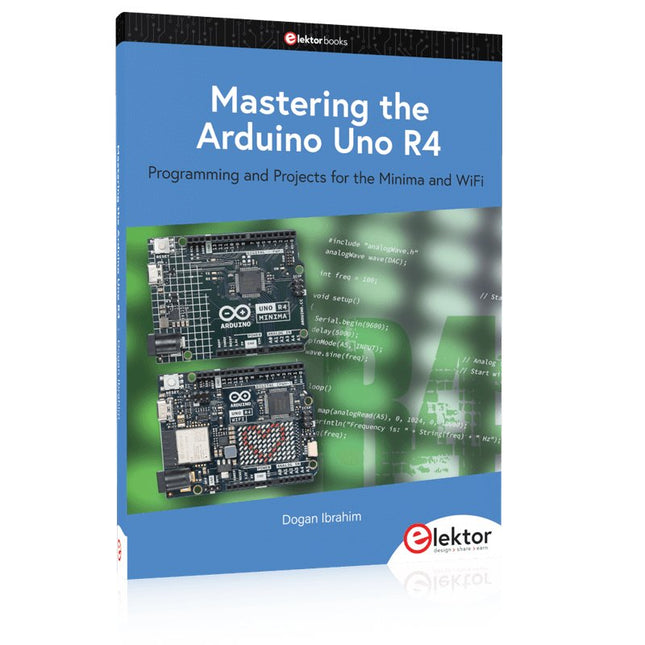
Elektor Publishing Mastering the Arduino Uno R4
Programming and Projects for the Minima and WiFi Based on the low-cost 8-bit ATmega328P processor, the Arduino Uno R3 board is likely to score as the most popular Arduino family member, and this workhorse has been with us for many years. Eleven years later, the long-overdue successor, the Arduino Uno R4, was released. It is built around a 48 MHz, 32-bit Arm Cortex-M4 microcontroller and provides significantly expanded SRAM and Flash memory. Additionally, a higher-precision ADC and a new DAC are added to the design. The Uno R4 board also supports the CAN Bus with an interface. Two versions of the board are available: Uno R4 Minima, and Uno R4 WiFi. This book is about using these new boards to develop many different and interesting projects with just a handful of parts and external modules. All projects described in the book have been fully tested on the Uno R4 Minima or the Uno R4 WiFi board, as appropriate. The project topics include the reading, control, and driving of many components and modules in the kit as well as on the relevant Uno R4 board, including LEDs 7-segment displays (using timer interrupts) LCDs Sensors RFID Reader 4x4 Keypad Real-time clock (RTC) Joystick 8×8 LED matrix Motors DAC (Digital-to-analog converter) LED matrix WiFi connectivity Serial UART CAN bus Infrared controller and receiver Simulators … all in creative and educational ways with the project operation and associated software explained in great detail.
€ 44,95
Membres : € 40,46
-

Elektor Bundles Logic Analyzer im Einsatz (Bundle)
Buch: Logic Analyzer im Einsatz Schritt-für-Schritt-Anleitungen führen Sie in die Analyse moderner Protokolle von I²C, SPI, UART, RS-232, NeoPixel, WS28xx, HD44780 und 1-Wire ein. Anhand von zahlreichen Experimentierschaltungen mit dem Raspberry Pi Pico, Arduino Uno und dem Bus Pirate üben Sie die praxisnahe Anwendung gängiger USB-Logikanalysatoren ein. Alle in diesem Buch vorgestellten Experimentierschaltungen wurden vollständig getestet und sind funktionsfähig. Die notwendigen Programmlistings sind enthalten, es sind keine besonderen Programmier- oder Elektronikkenntnisse für diese Schaltungen notwendig. Es werden die Programmiersprachen MicroPython und C mit den Entwicklungsumgebungen Thonny und Arduino IDE eingesetzt. Dieses Buch verwendet mehrere Modelle flexibler und weit verbreiteter USB-Logikanalysatoren und zeigt die Stärken und Schwächen jeder Preisklasse. Sie werden kennenlernen, welche Kriterien für Ihre Arbeit wichtig sind und in der Lage sein, das für Sie passende Gerät zu finden. Egal ob Arduino, Raspberry Pi oder Raspberry Pi Pico: Die abgebildeten Beispielschaltungen ermöglichen einen schnellen Start in die Protokollanalyse und können auch als Grundlage für eigene weitere Experimente dienen. Sie werden alle wichtigen Begriffe und Zusammenhänge kennenlernen, eigene Experimente durchführen, selbstständig Protokolle analysieren und nach der Lektüre dieses Buches – im Bereich der digitalen Signale und Protokolle – ein umfassendes Wissen aufgebaut haben. USB Logic Analyzer (8 Kanäle, 24 MHz) Dieser USB Logic Analyzer ist ein 8-Kanal-Logikanalysator, bei dem jeder Eingang doppelt für die analoge Datenaufzeichnung dient. Es eignet sich perfekt zum Debuggen und Analysieren von Signalen wie I²C, UART, SPI, CAN und 1-Wire. Dabei wird ein digitaler Eingang, der mit einem zu testenden Gerät (DUT) verbunden ist, mit einer hohen Abtastrate abgetastet. Die Verbindung zum PC erfolgt via USB. Technische Daten Kanäle 8 digitale Kanäle Maximale Abtastrate 24 MHz Maximale Eingangsspannung 0 V ~ 5 V Betriebstemperatur 0°C ~ 70°C Eingangsimpedanz 1 MΩ || 10 pF Unterstützte Protokolle I²C, SPI, UART, CAN, 1-Wire etc. PC-Verbindung USB Abmessungen 55 x 28 x 14 mm Downloads Software Dieses Bundle enthält: Buch: Logic Analyzer im Einsatz (Einzelpreis: 40 €) USB Logic Analyzer (8 Kanäle, 24 MHz) (Einzelpreis: 20 €) USB-Kabel Jumper Wire Ribbon Kabel
€ 59,95€ 49,95Meilleur prix
-

Elektor Publishing Programming Microcontrollers in C/C++ Using Arduino
With Examples for Arduino UNO, Raspberry Pi Pico and ESP32 Programming small electronic systems has never been more accessible. Tasks that once demanded expensive tools, specialized hardware, and deep electrical engineering expertise can now be tackled with low-cost development boards and approachable software. At the centre of this shift is the Arduino environment, which provides a unified and familiar way to program a wide range of microcontroller platforms—from classic AVR boards like the Arduino UNO to modern ARM-based boards such as the Raspberry Pi Pico, and powerful Wi-Fi-enabled devices like the ESP32. This book introduces embedded programming through the core idea that defines all microcontrollers: reading inputs, processing information, and controlling outputs in a predictable loop. The Arduino environment abstracts much of the hardware complexity, allowing you to focus on behaviour rather than implementation details. With just a few lines of code, you can blink LEDs, read sensors, control motors, and communicate with other devices. While the Arduino UNO, Raspberry Pi Pico, and ESP32 boards differ greatly in performance and features, they share the same fundamental building blocks: digital and analog I/O, timers, serial communication, PWM, interrupts, and power management. Learning these concepts within the Arduino framework builds skills that transfer easily across platforms and scale toward more advanced applications. By exploring multiple boards while maintaining a consistent programming approach, this book helps you progress from simple experiments to confidently produce well-structured designs—showing that embedded development can be both practical and enjoyable.
€ 29,95
Membres : € 26,96
-
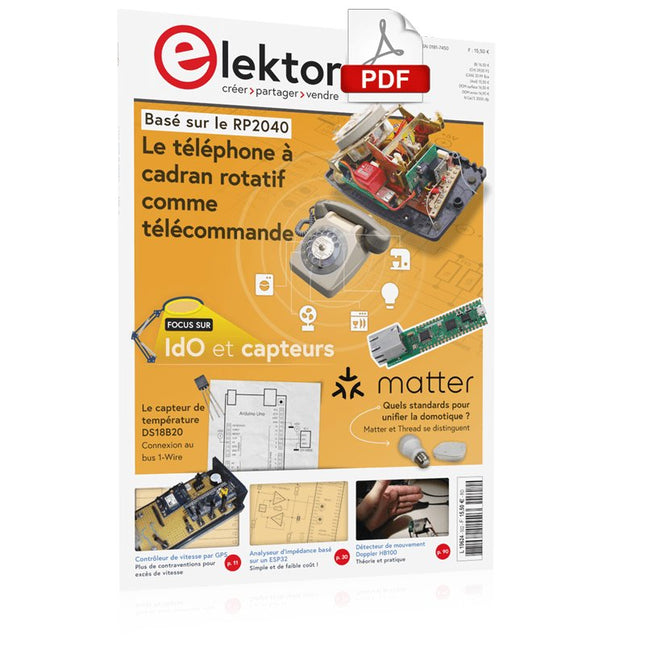
Elektor Digital Elektor juillet/août 2023 (PDF)
Le chargeur intégré est disponible pour nos clients OR et VERT sur le site d'Elektor Magazine ! Pas encore membre ? Cliquez ici . le téléphone à cadran rotatif comme télécommande pour allumer la lumière, composez le 1 ; verser la cafetière, composer les 2 régulateur de vitesse par GPS plus les contraventions pour excès de vitesse stroboscope RVB avec Arduino un instrument utile, instructif et désorientant bouton poussoir d'urgence sans fil sécuriser la force de location avec LoRa démarrer en électronique ...l'émetteur-suiveur comparateur à hystérésis à levelx indépendants simulations, calcul et algèbre analyseur basé sur un ESP32 simple, compatible avec les compositions et le faible coût ?! visite à domicile encouragez-nous pour les réalisations du personnel Carte d'apprentissage MCCAB pour Arduino Nano plateforme pour le cours « Cours pratique sur les microcontrôleurs ? sur le vif Luddisme moderne Babacapteur : le capteur de température DS18B20 connexion au bus 1-Wire quelles normes pour unifier la domotique ?? Matter et Thread se distinguent La matière, ou la concorde des objets Testez Matter avec la carte Thing Plus Matter et Simplicity Studio Infographie : IdO et capteurs Matière, ExpressLink, Rainmaker ? de quoi s'agit-il ? questions et réponses d'Amey Inamdar, directeur technique marketing chez Espressif introduction à la sélection de kits de développement de microcontrôleurs pour les applications IoT et IIoT un condensateur n?est pas toujours capacitif?! regarder NTP et CircuitPython pour l'utilisation du programme ? construire une simple sympathie IdO avec le Phambili Newt Détecteur de mouvement Doppler HB100 Théorie et pratique Guider la programmation bare-metal pour STM32 et autres microcontrôleurs revue multimètre Siglent SDM3045X microprocesseurs pour systèmes d'embarquement drôle de composants, la série la documentation des microcontrôleurs sans peine (3) schémas de principe, et autres documents station avec LoRa à faible puissance réaliser, même avec une gare avec un port long Transverter pour la bande 70 cm Ingénieurs appelant au climat Avancez vite et réparez les choses Hexadoku
€ 10,95
-

Elektor Bundles Logic Analyzers in Practice (offre groupée)
Livre : Logic Analyzers in Practice Step-by-step instructions guide you through the analysis of modern protocols such as I²C, SPI, UART, RS-232, NeoPixel, WS28xx, HD44780 and 1-Wire. With the help of numerous experimental circuits based on the Raspberry Pi Pico, Arduino Uno and the Bus Pirate, you will learn the practical application of popular USB logic analyzers. All the experimental circuits presented in this book have been fully tested and are fully functional. The necessary program listings are included – no special programming or electronics knowledge is required for these circuits. The programming languages used are MicroPython and C along with the development environments Thonny and Arduino IDE. This book uses several models of flexible and widely available USB logic analyzers and shows the strengths and weaknesses of each price range. You will learn about the criteria that matter for your work and be able to find the right device for you. Whether Arduino, Raspberry Pi or Raspberry Pi Pico, the example circuits shown allow you to get started quickly with protocol analysis and can also serve as a basis for your own experiments. After reading this book, you will be familiar with all the important terms and contexts, conduct your own experiments, analyze protocols independently, culminating in a comprehensive knowledge set of digital signals and protocols. Analyseur logique USB (8 voies, 24 MHz) Cet analyseur logique USB est un analyseur logique à 8 voies avec chaque entrée à double usage pour l'enregistrement de données analogiques. Idéal pour le débogage et l'analyse de signaux tels que I²C, UART, SPI, CAN et 1-Wire. Il fonctionne en échantillonnant une entrée numérique connectée à un dispositif en test (DUT) à une fréquence d'échantillonnage élevée. La connexion au PC se fait via USB. Spécifications Voies 8 voies numériques Fréquence d'échantillonnage maximale 24 MHz Tension d'entrée maximale 0 V ~ 5 V Température de fonctionnement 0°C ~ 70°C Impédance d'entrée 1 MΩ || 10 pF Protocoles pris en charge I²C, SPI, UART, CAN, 1-Wire, etc. Connexion au PC USB Dimensions 55 x 28 x 14 mm Télechargements Software Cette offre groupée contient : Livre 'Logic Analyzers in Practice' (prix normal : 35 €) Analyseur logique USB (8 voies, 24 MHz) (prix normal : 20 €) Câble USB Nappe de fils de liaison
€ 54,95€ 44,95Meilleur prix


