From basics to flows for sensors, automation, motors, MQTT, and cloud services
This book is a learning guide and a reference. Use it to learn Node-RED, Raspberry Pi Pico W, and MicroPython, and add these state-of-the-art tools to your technology toolkit. It will introduce you to virtual machines, Docker, and MySQL in support of IoT projects based on Node-RED and the Raspberry Pi Pico W.
This book combines several elements into a platform that powers the development of modern Internet of Things applications. These elements are a flow-based server, a WiFi-enabled microcontroller, a high-level programming language, and a deployment technology. Combining these elements gives you the tools you need to create automation systems at any scale. From home automation to industrial automation, this book will help you get started.
Node-RED is an open-source flow-based development tool that makes it easy to wire together devices, APIs, and online services. Drag and drop nodes to create a flowchart that turns on your lights at sunset or sends you an email when a sensor detects movement. Raspberry Pi Pico W is a version of the Raspberry Pi Pico with added 802.11n Wi-Fi capability. It is an ideal device for physical computing tasks and an excellent match to the Node-RED.
Quick book facts
Project-based learning approach.
Assumes no prior knowledge of flow-based programming tools.
Learn to use essential infrastructure tools in your projects, such as virtual machines, Docker, MySQL and useful web APIs such as Google Sheets and OpenWeatherMap.
Dozens of mini-projects supported by photographs, wiring schematics, and source code. Get these from the book GitHub repository.
Step-by-step instructions on everything.
All experiments are based on the Raspberry Pi Pico W. A Wi-Fi network is required for all projects.
Hardware (including the Raspberry Pi Pico W) is available as a kit.
Downloads
GitHub
Projekte mit Arduino, ESPHome, Home Assistant und Raspberry Pi & Co
Dieses E-Book enthält verschiedene Projektbeispiele und beginnt mit einer Einführung in die Elektronik. Es erklärt unter anderem, wie man Home Assistant auf einem Raspberry Pi installiert, wie man Raumklimasensoren für Temperatur und Luftfeuchtigkeit nutzt, das MQTT-Protokoll sowie weitere Schnittstellen einsetzt und ESPHome verwendet, um Sensoren und Aktoren in Home Assistant zu integrieren. Zahlreiche Video-Tutorials ergänzen das Buch.
Grundlagen der Elektrotechnik
Das Buch beginnt mit einer Einführung in die Elektrotechnik. Ihr lernt die Grundlagen von Spannung, Strom, Widerständen, Dioden und Transistoren.
Arduino und Mikrocontroller
Ein kompletter Abschnitt widmet sich dem Arduino Uno. Ihr lernt den Aufbau kennen, schreibt erste Programme und erarbeitet praktische Beispiele.
Home Assistant und Automatisierung
Ihr erfahrt, wie Home Assistant auf einem Raspberry Pi eingerichtet wird, und lernt den Umgang mit Automatisierungen, Szenen und Geräten. Zusätzlich wird auf Zigbee, MQTT und ESP-NOW eingegangen – wichtige Technologien für die Heimautomation.
ESP8266, ESP32 und ESP32-CAM
Die beliebten ESP-Mikrocontroller werden ausführlich behandelt. Nach einer theoretischen Einführung folgen praktische Projekte, die euch zeigen, wie ihr das Beste aus diesen Geräten herausholen könnt.
Sensoren und Aktoren
Das Buch erklärt die Funktionsweise und Anwendung zahlreicher Sensoren wie Temperatur- und Luftfeuchtigkeitssensoren, Bewegungsmelder und RFID-Reader. Bei den Aktoren werden Schrittmotoren, e-ink Displays, Servo-Motoren und vieles mehr beleuchtet. Zu allen Geräten gibt es praxisnahe Anwendungsbeispiele.
ESPHome
Dieses Kapitel zeigt euch, wie ihr Sensoren und Aktoren ohne Programmieraufwand in Home Assistant integriert. Ihr werdet Schritt für Schritt durch die Einrichtung mit ESPHome geführt.
LEDs und Lichttechnik
In diesem Kapitel lernt ihr verschiedene LED-Typen und deren Einsatzmöglichkeiten kennen. Grundlagen der Lichttechnik werden ebenfalls erklärt.
Node-RED
Ein eigenes Kapitel ist Node-RED gewidmet. Ihr erlernt die Grundlagen dieses leistungsstarken Tools und werdet Schritt für Schritt durch die Einrichtung und Nutzung geführt.
Integrierte Schaltkreise (ICs)
In der Elektronik gibt es zahlreiche ICs, die uns das Leben erleichtern. Ihr lernt die wichtigsten kennen und wendet das Wissen in praktischen Projekten an.
Programmieren für Profis
Fortgeschrittene Themen wie die korrekte Verwendung von Tastern, der Einsatz von Interrupts und die Nutzung eines NTP-Servers für Zeit-Synchronisation werden in diesem Kapitel detailliert behandelt.
Downloads
GitHub
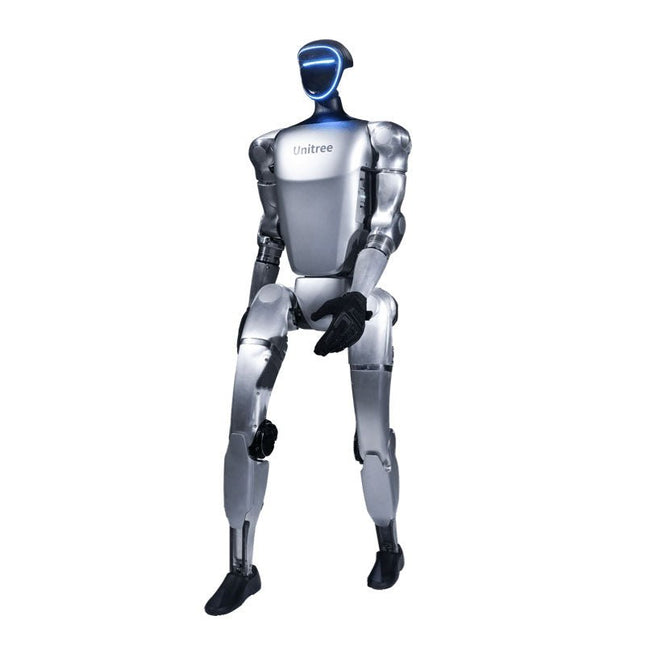
L'Unitree G1 est un robot humanoïde moderne qui impressionne par sa flexibilité remarquable et sa technologie avancée. Avec une gamme exceptionnellement large de mouvements articulaires et jusqu'à 43 moteurs d'articulation, il dépasse l'agilité d'un humain typique. Grâce à l'apprentissage par imitation et à l'apprentissage par renforcement, ses systèmes robotiques sont continuellement développés et optimisés par l'intelligence artificielle.
L'une des caractéristiques les plus impressionnantes du G1 est sa capacité à se mettre en position de marche de manière autonome dès qu'il touche le sol – aucune aide extérieure n'est nécessaire ! Il peut immédiatement commencer à se déplacer, ce qui démontre un haut niveau d'indépendance et d'adaptabilité. Le G1 est également équipé d'une main à contrôle de force, très dextre, qui fonctionne avec sensibilité et précision, grâce à sa combinaison de contrôle de force et de position. Cette main reproduit fidèlement les mouvements humains, ce qui permet de manipuler des objets avec précision.
Caractéristiques
Intel RealSense D435 caméra de profondeur
Livox MID-360 3D LiDAR
Matrice de microphones (annulation du bruit et de l'écho)
Haut-parleur stéréo 5 W
Batterie extra large à dégagement rapide
Degrés de liberté d'un seul bras (épaule 2 + coude 2)
Câblage interne des articulations de l'ensemble de la machine (pas de câbles externes)
Couple maximal au niveau des articulations 120 N.m
Degrés de liberté sur une jambe (hanche 3, genou 1, cheville 2)
Vitesse de déplacement de 2 m/s
Spécifications
Hauteur, largeur et épaisseur (debout)
1320 x 450 x 200 mm
Hauteur, largeur et épaisseur (plié)
690 x 450 x 300 mm
Poids (avec batterie)
env. 35 kg
Degrés totaux de liberté (liberté conjointe
23
Degrés de liberté sur une seule jambe
6
Degrés de liberté à la taille
1
Degrés de liberté à un seul bras
5
Roulement de sortie commun
Roulements à rouleaux croisés de qualité industrielle (haute précision, capacité de charge élevée)
Moteur articulé
PMSM (moteur synchrone à aimant permanent) à rotor interne haute vitesse à faible inertie – meilleure vitesse de réponse et dissipation thermique)
Couple maximal de l'articulation du genou
90 N.m
Charge maximale du bras
env. 2 kg
Longueur mollet + cuisse
0,6 m
Envergure des bras
env. 0,45 m
Espace de mouvement articulaire extra large
• Articulation de la taille : Z ±155°• Articulation du genou : 0~165°• Articulation de la hanche : P ±154°, R -30~+170°, Y ±158°
Routage électrique creux à joint complet
Oui
Encodeur commun
Double encodeur
Système de refroidissement
Refroidissement local par air
Alimentation
Batterie au lithium 13 cordes
Puissance de calcul de base
CPU hautes performances à 8 cœurs
Capteur de détection
Caméra de profondeur + LiDAR 3D
Microphones
Matrice de 4 microphones
Haut-parleur
Haut-parleur stéréo 5 W
Sans fil
WiFi 6, Bluetooth 5.2
Batterie intelligente (libération rapide)
9000 mAh
Chargeur
54 V/5 A
Contrôleur manuel
Oui
Autonomie de la batterie
env. 2 heures
OTA intelligent amélioré
Oui
A Project-Based Introduction to Microcontrollers and Drone Control
A Practical Introduction to Embedded Systems with the ESP32
This book is intended for readers who are new to embedded systems and looking for a structured, example-driven way to begin. If you’ve explored general-purpose electronics or Arduino-based resources but found them too broad or lacking in practical application, this guide offers a more focused alternative.
With a small, affordable set of components – such as LEDs, sensors, an OLED screen and a motion sensor – you’ll build and work with the same hardware setup throughout the book. This allows you to focus on learning and experimenting without constant reconfiguration.
Topics include:
Understanding and programming the ESP32 microcontroller
Using the Arduino IDE to write and deploy code
Exploring cyber-physical systems, culminating in basic drone control
No prior experience with Arduino or embedded development is required. Each section includes hands-on examples and mini-projects designed to reinforce core concepts and encourage deeper exploration. By the end, you’ll be equipped not only to reproduce the book’s examples, but also to extend them toward your own ideas and applications.
Whether your interest is in learning embedded programming, building interactive systems, or exploring educational drone control, this book provides a clear and practical path to getting started.
Le nRSP-ST est un récepteur radio en réseau à couverture générale pour des fréquences de 1 kHz à 2 GHz avec une visibilité spectrale allant jusqu'à 10 MHz. Le nRSP-ST est votre propre SDR personnel accessible à distance qui peut également être partagé avec un petit nombre d'amis ou de collègues de confiance.
Le nRSP-ST répond aux besoins des passionnés de radio qui souhaitent une solution « plug-and-play » pour la réception à distance. En plus d'y parvenir, nous avons résolu les limitations typiques de la bande passante Internet avec la création d'un nouveau mode IQ Lite, qui fournit efficacement des canaux de données IQ. Nous introduisons également la possibilité de contrôler et de stocker les enregistrements IQ sur un site distant. Le nRSP-ST est idéal pour tous ceux qui souhaitent un récepteur distant à large bande sans avoir besoin de compétences informatiques ni d'heures de configuration et de maintenance continue sur le site distant.
Caractéristiques
Récepteur de couverture générale en réseau intégré « Plug and Play » :
Combine un récepteur, un ordinateur hôte et bien plus encore, le tout dans un seul boîtier !
Mettez sous tension et connectez-vous à Internet (Ethernet ou Wi-Fi) : le nRSP-ST est automatiquement accessible de n'importe où
Le logiciel SDRconnect multiplateforme prend en charge le fonctionnement local ou l'accès à distance sur les plates-formes Windows, MacOS ou Linux
Le nRSP-ST & SDRconnect est configurable pour la bande passante réseau disponible :
En mode Full IQ, le nRSP-ST assure le transfert de données IQ de la bande passante du spectre visible (par exemple, pour un réseau local haut débit ou une connectivité Internet ultrarapide)
En mode IQ Lite, le nRSP-ST fournit des données IQ sur des canaux jusqu'à 192 kHz de large (par exemple, pour le décodage numérique par le client)
En mode Compact, le nRSP-ST fournit un son compressé (idéal pour les connexions Internet plus lentes)
Prend en charge plusieurs connexions client avec une combinaison simultanée de modes de connexion : un outil d'administration vous permet d'attribuer des noms d'utilisateur et des délais d'expiration à des amis ou collègues de confiance.
Tous les modes prennent en charge la visualisation d'une bande passante spectrale allant jusqu'à 10 MHz
Deux options de connexion à distance :
Utilisez un client SDRconnect distant ou
Utilisez le serveur Web intégré pour accéder à distance à partir de n'importe quel appareil compatible avec la navigation Web, y compris les tablettes et téléphones Android/iOS
Le nRSP-ST offre la possibilité d'enregistrer des fichiers IQ et audio sur un périphérique NAS (stockage en réseau) s'il est disponible sur le réseau local.
Le récepteur SDR large bande ADC 14 bits couvre toutes les fréquences de 1 kHz à 2 GHz en passant par VLF, LF, MW, HF, VHF, UHF et L-band, sans interruption.
Surveillez à distance jusqu'à 10 MHz de spectre à la fois à partir d'un choix de 3 antennes
Flash évolutif pour de futures améliorations de fonctionnalités
Inclus
1x nRSP-ST récepteur
1x Antenne WLAN
1x Bloc d'alimentation
1x Manuel
Téléchargements
Release notes
Software
Der Arduino Uno ist ein Open-Source-Mikrocontroller-Entwicklungssystem, das Hardware, eine integrierte Entwicklungsumgebung (IDE) und eine Vielzahl von Bibliotheken umfasst. Es wird von einer riesigen Gemeinschaft von Programmierern, Elektronikern, Enthusiasten und Akademikern unterstützt. Insbesondere die Bibliotheken erleichtern die Programmierarbeit und reduzieren die Entwicklungszeiten, da sie das Erstellen von Programmen erheblich erleichtern.
Der Raspberry Pi 4 kann in vielen Projekten wie Audio- und Videoanwendungen, aber auch in Industriesteuerungen, Robotik, Spielen usw. eingesetzt werden. Dazu bietet er auch WiFi- und Bluetooth-Fähigkeiten, wodurch er sich zudem hervorragend für internetbasierte Steuerungs- und Überwachungsanwendungen eignet.
In diesem Buch werden sowohl der Raspberry Pi 4 als auch der Arduino Uno in PID-basierten automatischen Steuerungsanwendungen eingesetzt. Nach einer grundlegenden Theorie der Regelsysteme werden funktionierende und getestete Projekte zur Steuerung realer Systeme mit PID-Reglern vorgestellt. Die Open-Loop-Eigenschaften, die Abstimmung der PID-Parameter und das Closed-Loop-Zeitverhalten der Systeme werden zusammen mit Blockdiagrammen, Schaltplänen und PID-Regelalgorithmen ausführlich diskutiert.
Vollständige Programme für den Raspberry Pi und den Arduino Uno runden die im Buch vorgestellten Projekte ab. Die Regelsysteme können problemlos auch auf andere Projekte angewendet werden und die für den Raspberry Pi 4 angegebenen Programme sollten auch mit anderen Modellen der Raspberry Pi-Familie reibungslos funktionieren.
Das Buch behandelt folgende Themen:
Steuer- und Regelsysteme
Analoge und digitale Sensoren
Übertragungsfunktionen und zeitkontinuierliche Systeme
Systemantwortfunktionen erster und zweiter Ordnung
Zeitdiskrete digitale Systeme
Zeitkontinuierliche PID-Regler
Zeitdiskrete PID-Regler
Zweipunkt-Temperaturregelung mit Raspberry Pi und Arduino Uno
PID-basierte Temperaturregelung mit Raspberry Pi und Arduino Uno
Motorsteuerung mit Raspberry Pi und Arduino Uno
Wasserstandsregelung mit Raspberry Pi und Arduino Uno
PID-basierte LED-Helligkeitsregelung mit Raspberry Pi und Arduino Uno
ModbusRTU and ModbusTCP examples with the Arduino Uno and ESP8266
Introduction to PLC programming with OpenPLC, the first fully open source Programmable Logic Controller on the Raspberry Pi, and Modbus examples with Arduino Uno and ESP8266
PLC programming is very common in industry and home automation. This book describes how the Raspberry Pi 4 can be used as a Programmable Logic Controller. Before taking you into the programming, the author starts with the software installation on the Raspberry Pi and the PLC editor on the PC, followed by a description of the hardware.
You'll then find interesting examples in the different programming languages complying with the IEC 61131-3 standard. This manual also explains in detail how to use the PLC editor and how to load and execute the programs on the Raspberry Pi. All IEC languages are explained with examples, starting with LD (Ladder Diagram) over ST (Structured Control Language) to SFC (Special Function Chart). All examples can be downloaded from the author's website.
Networking gets thorough attention too. The Arduino Uno and the ESP8266 are programmed as ModbusRTU or ModbusTCP modules to get access to external peripherals, reading sensors and switching electrical loads. I/O circuits complying with the 24 V industry standard may also be of interest for the reader.
The book ends with an overview of commands for ST and LD. After reading the book, the reader will be able to create his own controllers with the Raspberry Pi.
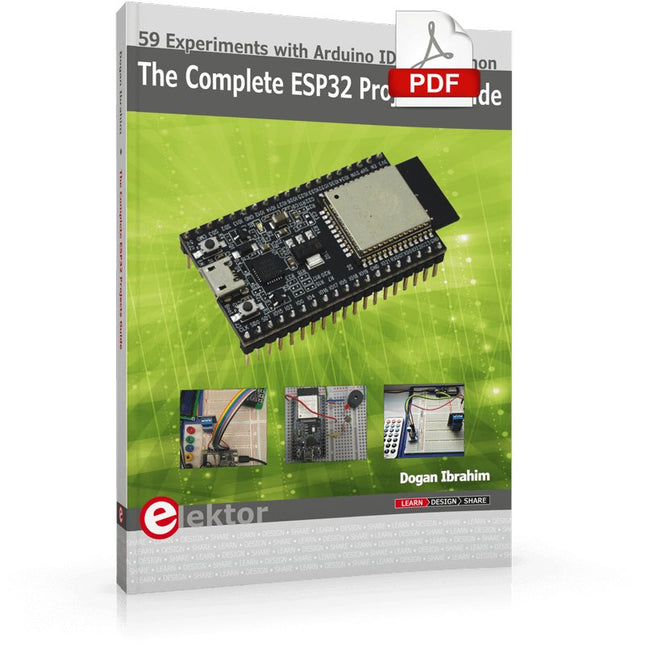
59 Experiments with Arduino IDE and Python
The main aim of this book is to teach the Arduino IDE and MicroPython programming languages in ESP32 based projects, using the highly popular ESP32 DevKitC development board. Many simple, basic, and intermediate level projects are provided in the book using the Arduino IDE with ESP32 DevKitC. All projects have been tested and work. Block diagrams, circuit diagrams, and complete program listings of all projects are given with explanations. In addition, several projects are provided for programming the ESP32 DevKitC using MicroPython. The projects provided in this book are designed to teach the following features of the ESP32 processor:
GPIOs
Touch sensors
External interrupts
Timer interrupts
I²C and I²S
SPI
PWM
ADC
DAC
UART
Hall sensor
Temperature sensor
Infrared controller
Reading and writing to SD card
Reading and writing to flash memory
RTC timer
Chip ID
Security and encryption
Wi-Fi and network programming
Bluetooth BLE programming
Communication mobile devices
Low power design
ESP-IDF programming
The projects have been organized with increasing levels of difficulty. Readers are encouraged to tackle the projects in the order given. A specially prepared hardware kit (SKU 18305) is available from Elektor. With the help of this hardware, it should be easy and fun to build the projects in this book.
Le Joy-Pi Note 2 est une plateforme tout-en-un, portable, dédiée à l'apprentissage et à l'expérimentation en électronique ; elle est entièrement compatible avec les Raspberry Pi 4 et 5. Alliant un écran IPS de 11,6 pouces, un clavier sans fil détachable et un boîtier compact et robuste, elle offre un environnement flexible pour le développement électronique, la programmation et l'enseignement.
Grâce à plus de 45 cours et projets pratiques, le Joy-Pi Note 2 facilite l'apprentissage et l'expérimentation autour de Python, de Scratch, de la robotique et des applications liées à l'Internet des objets (IoT). Sa plateforme pédagogique intégrée propose des instructions étape par étape, ce qui la rend idéale pour les débutants, les étudiants, les enseignants et les passionnés d'électronique expérimentés.
Le système intègre plus de 22 capteurs et modules, notamment des capteurs de température, de luminosité, de mouvement et de distance, ainsi que des affichages LED et des interfaces pour moteurs. Des options de connectivité supplémentaires, incluant des ports USB-C et des interfaces d'extension GPIO, permettent aux utilisateurs de développer et de tester leurs propres projets.
Grâce à sa compatibilité avec le Raspberry Pi 5, le Joy-Pi Note 2 bénéficie également d'une puissance de traitement et de performances graphiques accrues, s'imposant comme une plateforme polyvalente pour l'enseignement de l'électronique, le prototypage et l'expérimentation avancée.
Caractéristiques
Kit complet d'expérimentation électronique
Plateforme tout-en-un d'apprentissage et d'expérimentation
Compatible avec Raspberry Pi 4 et 5
Plateforme d'apprentissage interactive préinstallée
Clavier sans fil détachable
Compartiment de rangement intégré pour batterie externe et accessoires
Spécifications
Écran
Écran LCD 11,6"
Caméra
2 MP
Plateforme d'apprentissage
Plus de 45 cours et projets
Écrans
Afficheur 7 segments, écran 16x2, écran TFT 1,8", écran OLED 0,96", matrice RVB 8x8
Alimentation
5 V/5 A, USB-C
Écrans
Afficheur 7 segments, module LCD 16x2, matrice RVB 8x8
Capteurs
Capteur de température et d'humidité DHT, capteur d'inclinaison, capteur de mouvement, capteur sonore, capteur tactile, module RFID, capteur de luminosité, capteur à ultrasons
Moteurs
Interface pour servomoteur, interface pour moteur pas à pas, moteur vibrant
Système de contrôle
Joystick, matrice de boutons 4x4, commutateur de connexion (Raspberry Pi/PC), réglage de sensibilité (capteur de mouvement, capteur sonore), réglage de luminosité (module LCD 16x2)
Divers
Relais, ventilateur, extension GPIO, indicateur LED GPIO, plaque d'essai (breadboard), interface d'extension (E/S, ADC, I²C, UART), interface pour capteur infrarouge, buzzer, contrôleur d'affichage
Accessoires
Puce RFID, carte RFID, bloc d'alimentation, servomoteur, moteur pas à pas, récepteur infrarouge, télécommande infrarouge, moteur CC avec ventilateur, tournevis, carte microSD (32 Go), lecteur de carte SD, accessoires électroniques, souris sans fil, clavier sans fil
Dimensions
291 x 190 x 46 mm
Poids
1,3 kg
Inclus
Joy-Pi Note 2 ordinateur portable
Raspberry Pi 5 (8 Go de RAM)
Accessoires
Bloc d'alimentation USB-C
Guide de démarrage rapide
Téléchargements
Joy-Pi website
Fiche technique
Open-Source-Code mit Arduino IDE und PlatformIO
Autonomes Fahren: GPS, Accelerometer, Gyroskop
PS3-Controller
Mikrocontroller wie der Arduino und Einplatinenrechner wie der Raspberry Pi haben sich zu beliebten Komponenten entwickelt. Dritter im Bunde ist der ESP32 der Firma Espressif. Mikrocontroller dieser Baureihe zeichnen sich durch eine Vielzahl implementierter Funktionen aus, die bei einem Arduino konventioneller Prägung mit einem Atmel-AVR-Mikrocontroller erst mit weiterer Hardware möglich sind. Prominentes Beispiel sind hier die WiFi- und Bluetooth-Funktionalitäten. Gegenüber einem Raspberry Pi zeichnen sie sich durch einen deutlich geringeren Preis aus.
Allgemeine Informationen für die Realisierung eines Roboterauto-Projekts mit dem ESP32 sind leicht zu finden. Dabei handelt es sich aber oft nur um Ausführungen zu einem Teilaspekt, ohne inhaltliche oder funktionale Abstimmung. So ist nicht nur die Beschaffung der benötigten Informationen mühselig und zeitaufwändig, sie kann auch außerordentlich fehlerträchtig sein.
Ansatzpunkt dieses Buches ist, diese Lücke zu schließen. Es geht auf verschiedene Möglichkeiten eines Chassis ein, vermittelt nötige Kenntnisse und führt schrittweise von einer einfachen Motorsteuerung zu einem komplexen sensor- und sprachgesteuerten Roboterauto. Hacks rund um GPS und eine PlayStation 3 runden die Sache ab.
Inhalt
Bei der Reihenfolge der Kapitel wurde versucht – beginnend bei der Darstellung von grundlegenden Informationen – über die Lösung einfacher Aufgaben zu etwas anspruchsvolleren Techniken zu führen.
Der Mikrocontroller ESP32
Die Software erstellen
Die Stromversorgung
Rund um die Hardware
Das Chassis
Der Gleichstrommotor
Kabellose Steuerung über WiFi
Mit Sensoren Hindernisse erkennen
Eine eigene Roboterauto-App
Servo und Lichtsensor
GPS
Accelerometer / Gyroskop
PS3-Controller
Roboterauto-App
Hinweis zur Software
Die Dateien haben das Suffix (.cpp). Grund ist die Entwicklung mit PlatformIO. Mit Copy & Paste sollten sie auch in der Arduino-IDE verwendet werden können.
Le chargeur intégré est disponible pour nos clients OR et VERT sur le site d'Elektor Magazine !
Pas encore membre ? Cliquez ici .
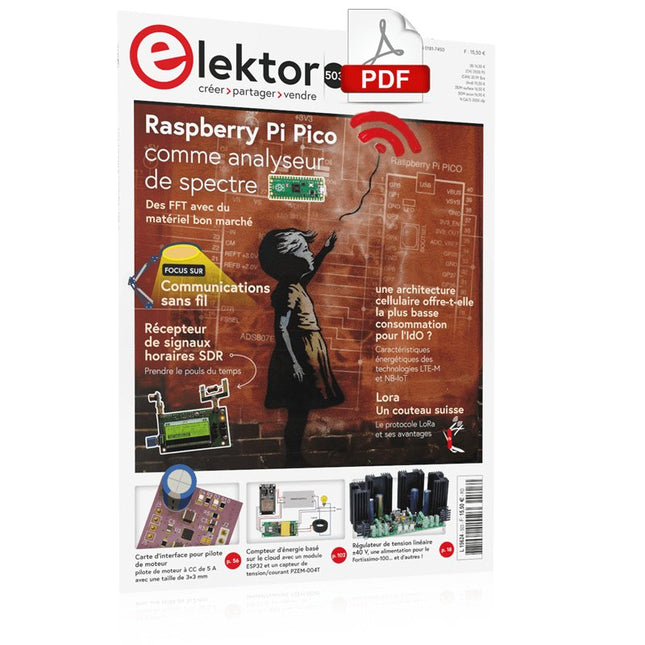
Raspberry Pi Pico comme analyseur de spectre des FFT avec du matériel bon marché
régulateur de tension linéaire ±40 V une alimentation de qualité pour l'amplification du Fortissimo-100... et d'autres !
la communication sans fil des microcontrôleurs devient flexible l'EEPROM du point de vue de la mise en réseau pour les microcontrôleurs sans fil
5000 ? à gagner! participez au concours de conception d'innovation sans fil STM32
2023 : l'odyssée de l'IA en savoir plus sur le code ChatGPT
LoRa, un couteau suisse (1) le protocole LoRa et ses avantages
du courant réglable avec générateur de montre intégré testez vos alimentations, convertisseurs de tension et batteries
les nouvelles cartes Arduino UNO R4 Minima et WiFi
des potentiomètres logarithmiques qui sont exponentielles !
Carte d'interface pour pilote de moteur Un BoB pour un pilote continu de 5 A avec une taille de 3×3 mm
sur le vif danger de l'électronique
une architecture cellulaire de plus d'une consommation pour l'Internet des objets (IdO) ? Caractéristiques des technologies LTE-M et NB-IoT pour le développement de la basse consommation (LPWAN)
communication sans utilisation de systèmes et d'aides IoT dans les modules Arduino MKR normes de communication pour les modules Arduino pour l'IoT
pertes en courant alternatif dan les composants magnétiques évitez la surchauffe des inductances !
optimiser son déploiement cloud grâce aux équipements de mesure
mise en œuvre de Matter : à quoi sert le déploiement des équipements de Matter ?
le YARD Stick One en utilisant la méthode de test pour les fréquences de 1 GHz
relais à verrouillage drôle de composant, la série
PIC O?Horloge ? prendre le pouls du temps conception d'un récepteur de signaux horaires SDR
Directive sur le devoir de diligence Le statu quo ne suffira pas
démarrer en électronique ?amplificateur de tension
activateur d'infrasons avec l'Arduino Pro Mini un projet extrait du livre 'Arduino & Co.' d'Elektor
compteur d'énergie base sur le cloud avec un module ESP32 et un capteur tension/courant PZEM-004T
guide de programmation Bare-Metal (2) timer précis, UART et débogage
Hexadoku
Design IoT Projects with Raspberry Pi, Arduino and ESP32 The Internet of Things (IoT) is becoming a major application area for embedded systems. As a result, more and more people are becoming interested in learning about embedded design and programming. Technical colleges and universities are moving away from legacy 8 and 16-bit microcontrollers and are introducing 32-bit embedded microcontrollers to their curriculums. Many IoT applications demand precision, high processing power, and low power consumption. Produced by IBM, Node-RED is an open-source visual editor for wiring the Internet of Things. Node-RED comes with a large number of nodes to handle a multitude of tasks. The required nodes are selected and joined together to perform a particular task. Node-RED is based on flow type programming where nodes are configured and joined together to form an application program. There are nodes for performing complex tasks, including web access, Twitter, E-mail, HTTP, Bluetooth, MQTT, controlling GPIO ports, etc. One particularly nice aspect of Node-RED is that the programmer does not need to learn how to write complex programs. For example, an email can be sent by simply joining nodes together and writing only a few lines of code. The aim of this book is to teach how Node-RED can be used in projects. The main hardware platform used with most of the projects in this book is Raspberry Pi 4. Chapters are included to show how Node-RED can be also be used with Arduino Uno, ESP32 DevKitC, and the ESP8266 NodeMCU microcontroller development boards.