
Résultats de la recherche pour "using OR displays OR in OR raspberry OR pi OR projects"
-

Andonstar Andonstar Max Station Upgrade Set pour les modèles AD409
Faites évoluer votre Andonstar AD409, AD409 Pro ou AD409 Pro-ES vers le modèle Max grâce à ce kit d'amélioration. La nouvelle station Max surdimensionnée offre un vaste espace de travail, ce qui la rend idéale pour les projets de plus grande envergure et pour les tâches de soudure professionnelles. Inclus 1x Support avec 2 LED 1x Tapis de réparation 1x Porteur 1x Colonne 1x Porte-outil 1x Coups de main à souder
€ 59,50
-
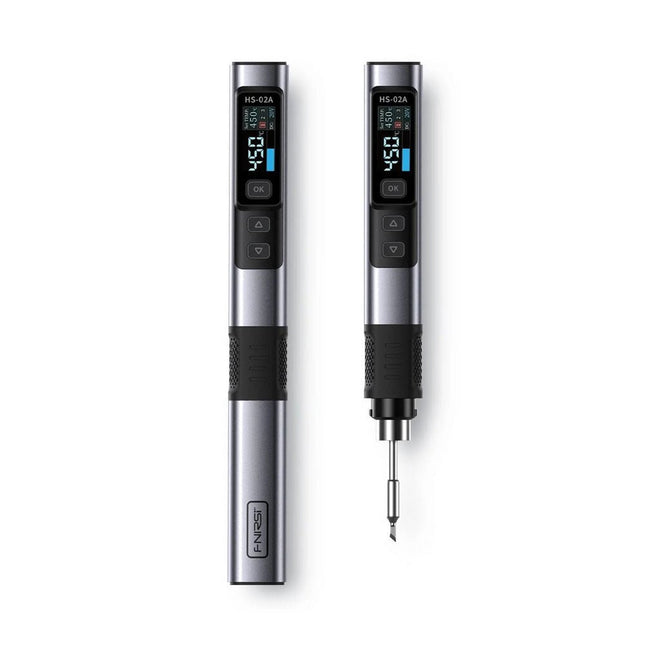
FNIRSI FNIRSI HS-02A Fer à souder intelligent (avec 6 pointes de soudure)
Le FNIRSI HS-02A est une version améliorée du fer à souder HS-01 avec une meilleure prise en main et une pointe plus courte pour plus de confort et de précision lors de l'utilisation. Il dispose d'un écran couleur IPS HD plus grand de 0,96 pouces qui permet une meilleure visibilité des paramètres et de l'état. Avec une puissance de sortie de 100 W, le HS-02A chauffe rapidement et atteint sa température de fonctionnement en 2 secondes environ. La température est réglable dans une plage de 100 à 450°C pour répondre aux différentes exigences de soudure. Caractéristiques Température : 100 à 450°C Réglage et contrôle précis de la température Chauffage rapide Coque métallique CNC Puissance adaptative 100 W haute puissance Protocoles: PD, QC Spécifications Plage de température 100-450°C Tension de fonctionnement 9-20 V Écran Écran couleur IPS HD de 0,96 pouces Alimentation USB-C Protocoles de charge rapide PD/CQ Puissance 100 W (maximum) Dimensions 180 x 20 mm Poids 61 g Inclus 1x FNRISI HS-02A fer à souder intelligent 6x Pannes de fer à souder (HS02A-KU, HS02A-K, HS02A-JS, HS02A-I, HS02A-C2, HS02A-B) 1x Mini support pour fer à souder 1x Manuel Téléchargements Manual Firmware V1.7
€ 61,44
-

Weller Weller WE1010 Station de soudage numérique (70 W)
High-quality soldering station with the most important tools and consumables, ideal for universal soldering applications. Features 1-Channel Power Unit, digital, 70 W Power unit, 1 channel with soldering iron WEP 70 and safety rest PH 70 70W solder iron with ergonomic handle and providing toolless tip change ESD safe station, iron and heat-resistant silicon cable for safe handling Using ET soldering tips Standby mode and auto setback conserves energy, protects equipment Password-protected to preserve settings Specifications Dimensions: 150 x 120 x 98 mm Weight: 1.4 kg Display: Digital LC Display Temperature range: Adjustable from 100°C - 450°C (200°F - 850°F) Voltage: 230 V Channels: 1 Temperature range (depends on tool) °C: 100-450 Temperature range (depends on tool) °F: 200-850 Temperature accuracy °C: Average tip temperature can be „offset“ to +/- 5°C at idle with no load Temperature accuracy °F: Average tip temperature can be „offset“ to +/- 9°F at idle with no load Temperature stability °C: ±6 Temperature stability °F: ±10 Heat-up time (ca) in seconds (50-350°C / 120-660°F): 28 sec. Heating output: 85 W
€ 156,30
-
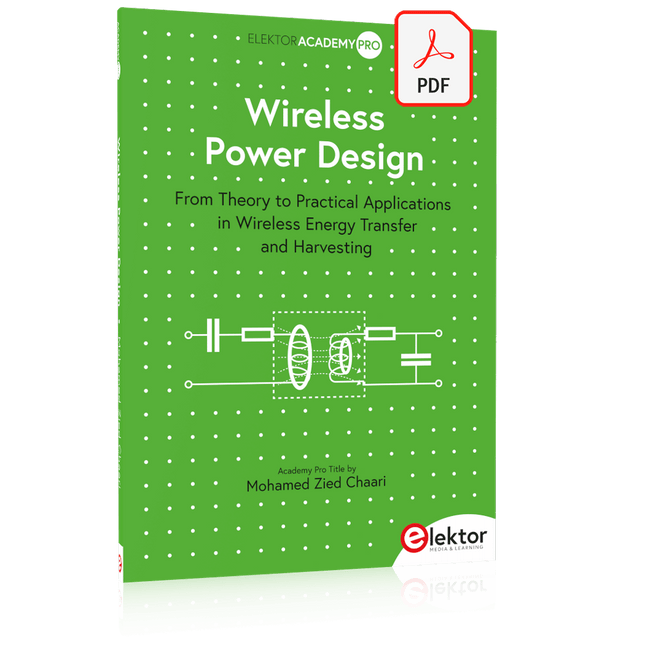
Elektor Digital Wireless Power Design (E-book)
From Theory to Practical Applications in Wireless Energy Transfer and Harvesting Wireless power transmission has gained significant global interest, particularly with the rise of electric vehicles and the Internet of Things (IoT). It’s a technology that allows the transfer of electricity without physical connections, offering solutions for everything from powering small devices over short distances to long-range energy transmission for more complex systems. Wireless Power Design provides a balanced mix of theoretical knowledge and practical insights, helping you explore the potential of wireless energy transfer and harvesting technologies. The book presents a series of hands-on projects that cover various aspects of wireless power systems, each accompanied by detailed explanations and parameter listings. The following five projects guide you through key areas of wireless power: Project 1: Wireless Powering of Advanced IoT Devices Project 2: Wireless Powered Devices on the Frontline – The Future and Challenges Project 3: Wireless Powering of Devices Using Inductive Technology Project 4: Wireless Power Transmission for IoT Devices Project 5: Charging Robot Crawler Inside the Pipeline These projects explore different aspects of wireless power, from inductive charging to wireless energy transmission, offering practical solutions for real-world applications. The book includes projects that use simulation tools like CST Microwave Studio and Keysight ADS for design and analysis, with a focus on practical design considerations and real-world implementation techniques.
€ 32,95
Membres : € 29,66
-

Elektor Digital Elektor May/June 2026 (PDF) EN
Elektor GREEN and GOLD members can download their digital edition here. Not a member yet? Click here. PbMonitor v2.0 UpdateBattery Monitoring with Improved Analog Design Audio Latency MeasurementA Standalone Tool for Evaluating Errors and Latency in Audio Transmission Square Wave vs. Bode PlotChecking the Performances of an Audio Device embedded world 2026 Clever Coding with AIAI in Software Development for Electronics Engineers QA403 Audio AnalyzerAffordable Precision for Audio Professionals and Hobbyists EasyGimbalAutonomous Camera Tracking with AI, Stepper and Servo Motors Sigfox Breakout Board (2)Sending Messages Circuit ProtectionControlling Overvoltages with TVS Diodes Emerging Battery Testing ApproachesA New Era of Diagnostics AudiotronicsA First Preamplifier CANopenTermAn Open-Source Tool That Brings CAN to Makers and Engineers Alike Stabilization of Operational AmplifiersAvoiding Feedback Instability Err-lectronicsCorrections, Updates, and Readers’ Letters Signal ConditioningTips and Tricks to Fit Voltage Ranges TDR Attachment for OscilloscopesLength, Short Circuit, Mismatch: Measure Cables Using Reflections! From Life's ExperienceLED It Be Speaker Oscillator and Resonance TesterA Fully Experimental Project for Your Speakers Elektor Community Perspectives on Test and Measurement ESP32 Audio Transceiver Board (Part 5)Audio Processing and Remote Control 2026: An AI OdysseyAI Has a Context Problem Battery Storage for Balcony Power PlantsSmall Batteries, Big Impact
€ 9,50
-

Elektor Digital 303 Circuits (E-book) EN
Like its predecessors in the 300 series of electronics projects books, 303 Circuits is aimed at the active electronics enthusiast, professional or amateur. Since the series was started in the early 1980s, many thousands of readers have found in these books that new approach, new concept, or new circuit they were looking for. In 303 Circuits you will find new ideas, new concepts and new circuits covering the gamut of electronics. The book is arranged in subject sections to make it easier for you to find the circuit or idea you are looking for.
€ 29,95
Membres : € 26,96
-

Sensepeek Sensepeek 6024 SQ500 (sonde d'oscilloscope mains libres 500 MHz)
Les sondes mains libres de la série SQ de Sensepeek ont un point de gravité plus bas, ce qui les rend encore plus stables que les sondes mains libres de la série SP. Toutes les sondes de la série SQ sont également isolées et peuvent être utilisées à la main comme n'importe quelle sonde traditionnelle, mais leur plein potentiel est utilisé lors des mesures en mains libres. La série SQ de sondes d'oscilloscope comprend également plus d'options de mise à la terre, dispose d'une protection de l'extrémité de la sonde, d'un câble plus long et d'un support pour les oscilloscopes avec mise à l'échelle automatique (10:1). Toutes les caractéristiques appréciées de la mesure en mains libres, l'aiguille de test à ressort à pas fin interchangeable, les supports de câble à code couleur et le design minimaliste sont maintenus pour rendre obsolètes les sondes de taille et de main traditionnelles. La longueur et le poids des sondes SQ sont parfaitement équilibrés pour être utilisés avec les supports de circuits imprimés et la plaque de base PCBite, qui sont indispensables pour la fonction mains libres. Caractéristiques Sonde passive 10:1 avec support pour oscilloscopes avec mise à l'échelle automatique Aiguille de test à ressort pour les mesures au pas fin Plusieurs options de mise à la terre Porte-câbles à code couleur Protection de l'extrémité de la sonde Isolé, peut être utilisé à la main Support de sonde amélioré pour les mesures en mains libres lorsqu'il est utilisé avec les supports de circuits imprimés PCBite. Inclus 1x SQ500 Sonde 500 MHz avec aiguille de test à ressort 1x Support de sonde SQ pour les mesures en mains libres 1x Crochet de test avec câbles détachables (5 cm et 10 cm) pour une connexion pratique à la terre. 1x Câble crocodile pour une connexion pratique à la terre 1x Ressort de masse standard, pour des mesures en main libres à la largeur de bande nominale 1x Ressort de masse unique, pour les mesures en mains libres à la largeur de bande nominale 1x Jeu de supports de câbles à code couleur (4 couleurs) 1x Protection de l'extrémité de la sonde 1x Aiguille de test supplémentaire Téléchargements Guide de l’utilisateur SQXX0 Rev1.1
€ 130,80
-

Elektor Digital Consumer Electronics Repair, Reuse and Recycling (E-book)
A Combat Guide against E-waste and Throwawayism This book is for anyone who enjoys tinkering with analog and digital hardware electronics. Regardless of the sophistication of your workspace, only basic tools are required to achieve truly satisfying results. It is intended as a reference guide among other hardware repair publications you may have in your library. However, the book goes a step further than most other repair guides in addressing issues in the modern era of discarded electronics called e-waste. E-waste should be put to good use. Producing anything new requires not just precious resources and labor, but also energy to make and deliver it to global retail shelves. Your talents and love of electronics can be put to good use by rescuing and resurrecting at least selected units from this endless stream of e-waste. Examples include either restoring through repair, or salvaging reusable electronic and mechanical components for your next project. Smart tips are provided throughout the book, and much information is tabulated for easy reference. The book expands age-old repair and hacking techniques applied for repair on the workbench into clever methods and applications to achieve effective results with discarded or “non-servicable” electronic consumer products. The final chapter provides real-life examples using all of the previously discussed content in a summarized form for each example repair type.
€ 32,95
Membres : € 29,66
-
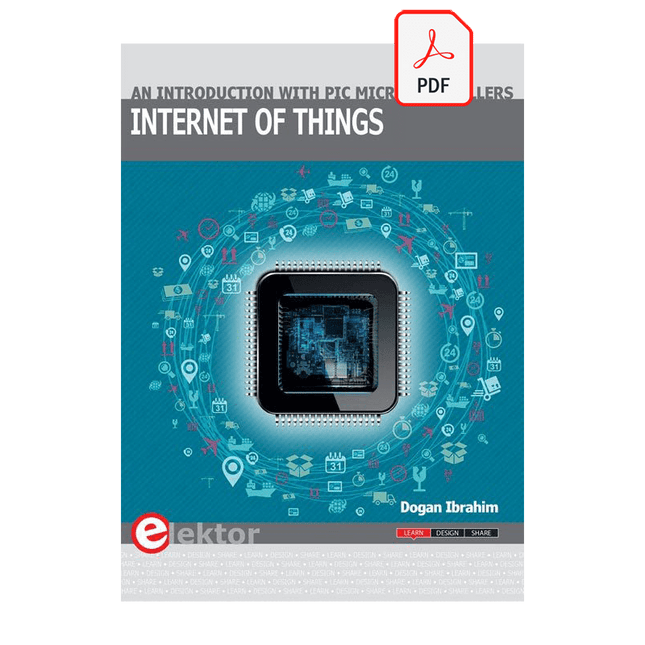
Elektor Digital Internet of Things (E-book)
The Internet of Things (IoT) is a new concept in intelligent automation and intelligent monitoring using the Internet as the communications medium. The “Things” in IoT usually refer to devices that have unique identifiers and are connected to the Internet to exchange information with each other. Such devices usually have sensors and/or actuators that can be used to collect data about their environments and to monitor and control their environments. The collected data can be processed locally or it can be sent to centralized servers or to the cloud for remote storage and processing. For example, a small device at the size of a matchbox can be used to collect data about the temperature, relative humidity and the atmospheric pressure. This data can be sent and stored in the cloud. Anyone with a mobile device can then access and monitor this data at any time and from anywhere on Earth provided there is Internet connectivity. In addition, users can for example, adjust the central heating remotely using their mobile devices and accessing the cloud. This book is written for students, for practising engineers and for hobbyists who want to learn more about the building blocks of an IoT system and also learn how to setup an IoT system using these blocks. Chapter 1 is an introduction to the IoT systems. In Chapter 2, the basic concepts and possible IoT architectures are discussed. The important parts of any IoT system are the sensors and actuators and they are described briefly in Chapter 3. The devices in an IoT system usually communicate with each other and the important aspect of IoT communication is covered in Chapter 4. Chapter 5 proceeds with the features of some of the commonly used development kits. One of these, the Clicker 2 for PIC18FJ manufactured by mikroElektronika, can be used as a processor in IoT systems and its features are described in detail in Chapter 6. A popular microcontroller C language, mikroC Pro for PIC gets introduced in Chapter 7. Chapter 8 covers the use of a click board with the Clicker 2 for PIC18FJ development kit. Similarly, the use of a sensor click board is described as a project in Chapter 9, and an actuator board in Chapter 10. Chapters 11 and 12 cover Bluetooth and Wi-Fi technologies in microcontroller based systems, and the remaining chapters of the book demo the creation of a simple Wi-Fi based IoT system with cloud-based data storage. This book has been written with the assumption that the reader has taken a course on digital logic design and has been exposed to writing programs using at least one high-level programming language. Knowledge of the C programming language will be very useful. Also, familiarity with at least one member of the PIC series of microcontrollers (e.g. PIC16 or PIC18) will be an advantage. The knowledge of assembly language programming is not required because all the projects in the book are based on using the C language. If you are a total beginner in programming you can still access the e-book, but first you are advised to study introductory books on microcontrollers.
€ 34,95
Membres : € 31,46
-
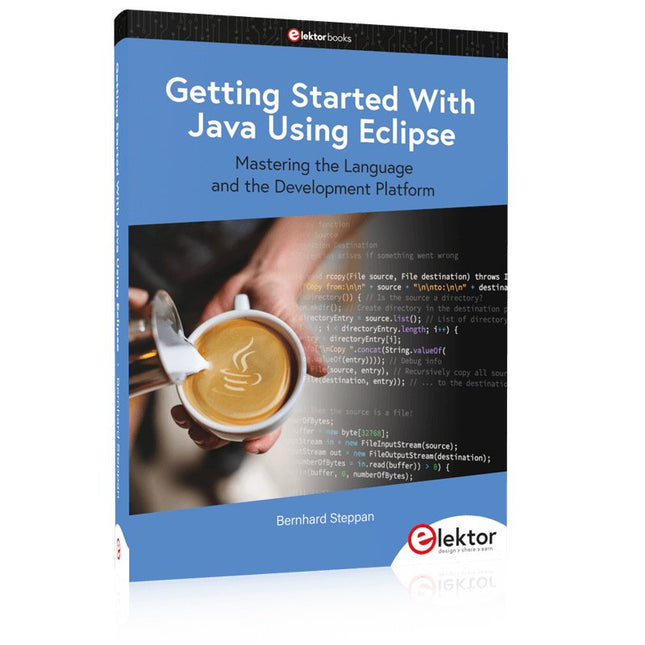
Elektor Publishing Getting Started With Java Using Eclipse
Mastering the Language and the Development Platform Many people would like to learn Java but getting started is not easy since programming with Java requires at least two things: mastering the programming language and the development environment. With the help of many examples, this book shows how the language is structured. In addition, it employs the Eclipse development environment as an example of a powerful tool to teach developing Java programs. In Basics, the first part of the book, you acquire your Java and Eclipse basic knowledge. This part lays the programming foundations, gives you an overview of Java technology, and shows you what is special about object-oriented programming. In the second part called Java Language, everything revolves around the subtleties of the Java language and this is where the first small Java applications are created, aided by a fine blend of the knowledge part and practical exercises. Java Technology is both the name and the focus of the third part which also introduces you to the rules to observe when programming, what class libraries are and what advantages they have. In addition, you will learn how to test programs, what algorithms are, and how to program them. The fourth part, Java Projects, enables you to apply all the previous elements in an application with a graphical user interface. The project shows how to develop a larger application piece by piece with the Eclipse development environment. The Appendix concludes with a section on frequent errors that can occur when working with Eclipse, and a Glossary.
€ 44,95
Membres : € 40,46
-

OWON Alimentation électrique CC OWON SPE6103 (300 W)
OWON SPE6103 est une alimentation électrique CC à 1 canal (300 W) dans un petit boîtier doté de fonctionnalités telles que la protection contre les surtensions et les surintensités. Elle possède une haute résolution de 10 mV/1 mA. L'écran LCD de 2,8 pouces affiche les informations suivantes (sortie de tension constante, sortie de courant constant, temps de fonctionnement cumulatif, puissance de sortie réelle, statut de sortie du canal, sortie de tension réelle, sortie de courant réelle). Caractéristiques Petit boîtier pour un transport facile Haute résolution : 10 mV/1 mA Liste d'édition de forme d'onde de sortie, fonction de sortie de minutage éditable pour 10 groupes Faible ondulation/bruit Protection contre les surtensions / surintensités Fonction de surveillance des courbes de tension et de courant de sortie Refroidissement intelligent par ventilateur à contrôle de température Écran LCD TFT de 2,8 pouces Interface de communication USB, prise en charge SCPI Spécifications Modèle SPE6102 SPE6103 Sortie nominale (0-40°C) Tension 0-60 V 0-60 V Courant 10 A 10 A Puissance de sortie 200 W 300 W Sortie USB 5 V/1 A (Série SPE) ou prise en charge des protocoles de charge rapide QC2.0, QC3.0, BC1.2, Apple, Huawei, Samsung (en option) Régulation de charge Tension ≤30 mV Courant ≤20 mA Régulation de puissance Tension ≤30 mV Courant ≤20 mA Résolution de réglage Tension 10 mV Courant 1 mA Résolution de lecture Tension 10 mV Courant 1 mA Résolution de la valeur (dans les 12 mois) (25 ±5°C) Tension ≤0,1% ±30 mV ≤0,1% ±30 mV Courant ≤0,05% ±10 mA Résolution de la valeur de lecture (25 ±5°C) Tension ≤0,1% ±30 mV ≤0,1% ±30 mV Courant Ondulation/bruit Tension (Vp-p) ≤50mVp-p ≤50mVp-p Tension (rms) ≤5mVrms ≤5mVrms Courant (rms) ≤30mAp-p Coefficient de température de sortie (0-40°C) Tension 100ppm/°C Courant 200ppm/°C Coefficient de température de lecture Tension 100ppm/°C Courant 200ppm/°C Temps de réponse (charge nominale 50-100%) ≤1,0ms Stockage 4 groupes de données Température de fonctionnement 0-40°C Inclus 1x OWON SPE6102 1x Cordon d'alimentation 1x Guide rapide 1x Câble USB 1x Fusible Téléchargements Manuel d'utilisation Manuel de programmation Logiciel
€ 123,97
-
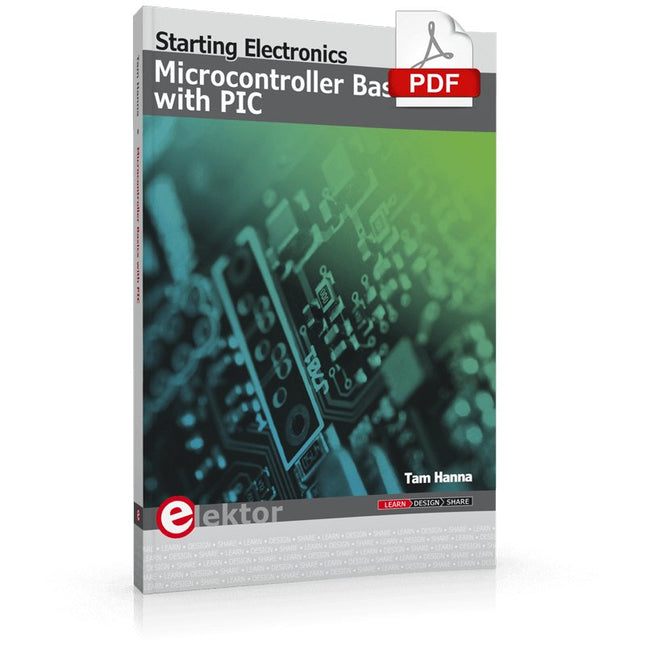
Elektor Digital Microcontroller Basics with PIC (E-book)
In this book the author presents all essential aspects of microcontroller programming, without overloading the reader with unnecessary or quasi-relevant bits of information. Having read the book, you should be able to understand as well as program, 8-bit microcontrollers. The introduction to microcontroller programming is worked out using microcontrollers from the PIC series. Not exactly state-of-the-art with just 8 bits, the PIC micro has the advantage of being easy to comprehend. It is offered in a DIP enclosure, widely available and not overly complex. The entire datasheet of the PIC micro is shorter by decades than the description of the architecture outlining the processor section of an advanced microcontroller. Simplicity has its advantages here. Having mastered the fundamental operation of a microcontroller, you can easily enter into the realms of advanced softcores later. Having placed assembly code as the executive programming language in the foreground in the first part of the book, the author reaches a deeper level with ‘C’ in the second part. Cheerfully alongside the official subject matter, the book presents tips & tricks, interesting measurement technology, practical aspects of microcontroller programming, as well as hands-on options for easier working, debugging and faultfinding.
€ 32,95
Membres : € 29,66


