
Résultats de la recherche pour "elektor or 11 or 12 or 2020 or de"
-

Elektor November/December 2025 (EN)
Elektor GREEN and GOLD members can download their digital edition here. Not a member yet? Click here. Relio v1.0 - Presence Detection and Remote ControlA Matter-Enabled Smart Controller for AC Appliances Designing Better PCBsA Practical Guide for Professionals and Makers KiCad 9Top New and Updated Features Precision Picoammeter (1)With Curve Tracer Functionality Down to the pA range! Christmas Star 2025A Star Is Soldered 100 mV Continuity Tester Who’s Pushing the Boundaries of European Electronics?Companies to Watch productronica 2025: What’s New in Electronics Development and Production Automation to Tackle Reshoring Manufacturing, Tariffs and Labour Shortages Beyond Future ProofCircularity in Electronics Passive ComponentsLow-Loss Inductors Enabling High-Efficiency DC/DC Converters How Desktop Manufacturing Machines Are Democratizing PCB Production Starting Out in Electronics...Needs Power UHD Displays Driven with EaseYour Guide to Easily Put Various TFT-LCDs Into Operation Quickly Soldering in 2025Practical Soldering Tips Straight from the Workbench SimulIDEAn All-in-One Tool for Circuit Prototyping 2025: An AI OdysseyFrom Autocomplete to Colleague Wordy Christmas TreeA Festive Electronics Project with a Linguistic Twist Err-lectronicsCorrections, Updates, and Readers’ Letters Analog Pipeline DistortionA Cool Audio Effect For Guitars and Other Instruments ESP32 Audio Transceiver Board (Part 3)Stereo Transmission and Dual Radio
€ 14,90
-

Elektor Circuit Special 2026 (DE)
Diese Ausgabe steht allen GOLD- und GREEN-Mitgliedern auf der ElektorMagazine-Website zum Download bereit! Sie sind noch kein Mitglied? Hier klicken! Stromquelle zum Testen von (Z-)DiodenPrüfen von Z-Dioden von 1 bis 54 V bei 1 bis 50 mA ESD-Armband-TesterEin Tool zur Funktionsprüfung von Erdungsarmbändern Transientenmesser für LabornetzteileEin reproduzierbarer Lastsprung-Generator für Labornetzteile 3D-Viewer für HTML-SeitenEinfach und fast ohne Code LED-Blinkleuchte für Tore und mehr mit akustischem Alarm Benötigen Sie Leiterplatten? Der Elektor-Leiterplattenservice ist für Sie da. Zahnbürsten-TimerMit einem kleinen PIC Ein berührungsloses magnetisches Kombinationsschlossmit dem AS5600-Drehpositionssensor Rauscharmer, batteriebetriebener Vorverstärkerfür dynamische Mikrofone Das Arduino Nano TestLabMessen, Steuern, Regeln Rhythmische BassleuchteBetonen Sie den Rhythmus Ihrer Musik Low-cut-FilterKein Risiko von Audio-Rückkopplungen in Ihrem System Präziser 1-Hz-Rechteckwellengenerator für SteckbrettEine zuverlässige CMOS-basierte Taktquelle 555 auf den Kopf gestelltTastverhältnisse bis hinunter auf Null Vom „Halfgeleidergids“ zu Circuit Specials65 Jahre Elektronik-Innovation Galvanische TrennungCAN-Schnittstelle mit Digitalisolator und Powermodul SpongillatorEin schwammbasierter Oszillator Echter Zufallszahlengeneratormit integriertem Chi-Quadrat-Test Euklidischer Sequencer ohne MikrocontrollerTrigger-Pattern und CV-Sequenzen mit einfacher CMOS-Logik Programmieren mit TLScriptEine Skriptsprache zum Messen, Testen und Steuern Schaltungsdesign: Tipps von Experten RückkopplungWas ist das und warum ist sie wichtig? Ein Board, endlose Ideen: Arduino UNO QVon Retro-Gaming zur Echtzeit-Umweltüberwachung So bringen Sie eine Donut-Antenne in Ordnung Standby-KillerEin echter Ein-/Ausschalter für den Fernseher Akkus im TestAkkus vermessen mit dem Arduino Nano Stromversorgung für Audio-EndstufenEin gutes Netzteil ohne Netzbrummen Lochrasterplatinen für HFSchnelle Aufbauten mit DIY-Prototyping-Boards T3-ÜberspannungsschutzEin Typ-3-Schutzmodul für empfindliche Geräte IoT-Raumthermostat-Platinemit dem Xiao-MCU-Modul auf Basis des ESP32-C3/S3 Von starr zu smartFlexible und gedruckte Elektronik – zwischen Vision und industrieller Realität
€ 15,90
-
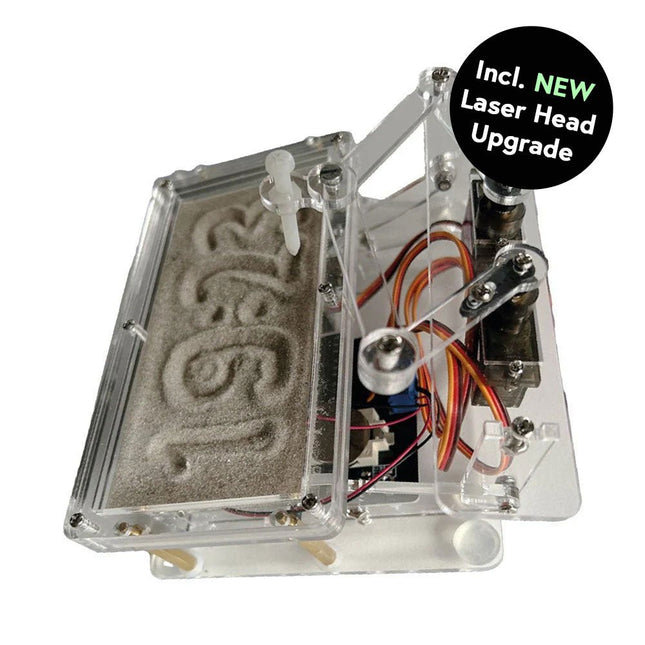
Elektor Labs Horloge de sable Elektor pour Raspberry Pi Pico (avec upgrade tête laser)
Cette offre groupée contient le populaire horloge de sable Elektor pour Raspberry Pi Pico et la nouvelle upgrade tête laser Elektor, offrant encore plus d'options d'affichage de l'heure. Non seulement vous pouvez « graver » l'heure actuelle dans le sable, mais vous pouvez désormais également l'écrire sur une feuille phosphorescente ou créer des dessins verts. Contenu de l'offre groupée Horloge de sable Elektor pour Raspberry Pi Pico (prix normal : 50 €) Upgrade tête laser Elektor pour horloge de sable (prix normal : 35 €) Horloge de sable Elektor pour Raspberry Pi Pico (Accroche-regard basé sur le Raspberry Pi) Une horloge à sable standard ne fait qu'indiquer le temps qui passe. En revanche, cette horloge à sable contrôlée par le Raspberry Pi Pico indique l'heure exacte en 'gravant' les quatre chiffres de l'heure et des minutes dans la couche de sable. Après un temps réglable, le sable est aplati par deux moteurs vibrants et tout recommence. Au cœur de l'horloge de sable se trouvent deux servomoteurs qui entraînent un stylo dans un mécanisme de pantographe. Un troisième servomoteur soulève le stylo de haut en bas. Le bac à sable est équipé de deux moteurs vibrants qui aplatissent le sable. La partie électronique de l'horloge des sables se compose d'un Raspberry Pi Pico et d'une carte RTC/driver avec une horloge en temps réel, ainsi que des circuits de commande pour les servomoteurs. Un manuel de construction détaillé peut être téléchargé. Caractéristiques Dimensions: 135 x 110 x 80 mm Temps de construction : environ. 1,5 à 2 heures Inclus 3x Feuilles acryliques prédécoupées avec toutes les pièces mécaniques 3x Mini servomoteurs 2x moteurs de vibration 1x Raspberry Pi Pico 1x Carte RTC/pilote avec les pièces assemblées Ecrous, boulons, entretoises et fils pour l'assemblage Sable blanc à grains fins Upgrade tête laser Elektor pour horloge de sablee La nouvelle tête laser Elektor transforme l'horloge de sable dans une horloge qui écrit l'heure sur un film qui brille dans le noir au lieu de sable. En plus d’afficher l’heure, il peut également être utilisé pour créer des dessins éphémères. Le pointeur laser de 5 mW, avec une longueur d'onde de 405 nm, produit des dessins vert vif sur le film qui brille dans le noir. Pour de meilleurs résultats, utilisez le kit dans une pièce faiblement éclairée. Attention : ne regardez jamais directement dans le faisceau laser ! Le kit comprend tous les composants nécessaires, mais la soudure de trois fils est nécessaire. Remarque : Ce kit est également compatible avec l'horloge de sable d'origine basée sur Arduino de 2017. Pour plus de détails, voir Elektor 1-2/2017 et Elektor 1-2/2018.
€ 84,95€ 69,95Meilleur prix
-

Elektor Digital Practical MOSFET Electronics (E-book)
Theory, LTspice Simulation, and Hands-On Projects MOSFETs are essential components in modern electronics, used in switching, amplification, motor control, power conversion, digital logic, and audio circuits. This book offers a practical introduction to MOSFET technology, combining clear explanations with LTspice simulations and hands-on projects. Starting with semiconductor fundamentals, you will learn how MOSFETs operate, how they compare with BJTs, and how to apply them in real circuits. The book then progresses from basic switching applications to more advanced designs. You will learn how to: Understand N-channel and P-channel MOSFET operation Work with cutoff, triode, and saturation regions Simulate and analyze circuits using LTspice Build switching circuits for LEDs, relays, buzzers, sensors, and motors Create sensor circuits for light, temperature, touch, tilt, reed switches, and PIR motion detection Control motors and fans using PWM and H-bridge circuits Design MOSFET small-signal amplifiers Build astable, Colpitts, Hartley, phase-shift, and Pierce oscillators Experiment with MOSFET digital logic Explore buck and boost DC-DC converters Understand the basics of MOSFET audio power amplifiers Written for engineers, students, and experienced makers, this book connects theory with simulation and practical construction, giving you the knowledge and experience to design and experiment with MOSFET circuits with confidence.
€ 29,95
Membres : € 26,96
-
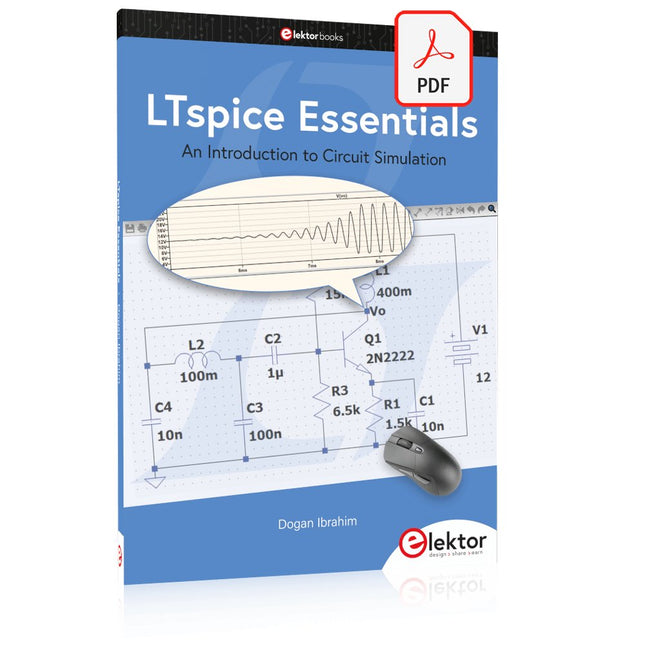
Elektor Digital LTspice Essentials (E-book)
An Introduction to Circuit Simulation LTspice, developed by Analog Devices, is a powerful, fast, and free SPICE simulator, schematic capture, and waveform viewer with a large database of components supported by SPICE models from all over the world. Drawing a schematic in LTspice is easy and fast. Thanks to its powerful graphing features, you can visualize the voltages and currents in a circuit, and also the power consumption of its components and much more. This book is about learning to design and simulate electronic circuits using LTspice. Among others, the following topics are treated: DC and AC circuits Signal diodes and Zener diodes Transistor circuits including oscillators Thyristor/SCR, diac, and triac circuits Operational amplifier circuits including oscillators The 555 timer IC Filters Voltage regulators Optocouplers Waveform generation Digital logic simulation including the 74HC family SPICE modeling LTspice is a powerful electronic circuit simulation tool with many features and possibilities. Covering them all in detail is not possible in a book of this size. Therefore, this book presents the most common topics like DC and AC circuit analysis, parameter sweeping, transfer functions, oscillators, graphing, etc. Although this book is an introduction to LTspice, it covers most topics of interest to people engaged in electronic circuit simulation. The book is aimed at electronic/electrical engineers, students, teachers, and hobbyists. Many tested simulation examples are given in the book. Readers do not need to have any computer programming skills, but it will help if they are familiar with basic electronic circuit design and operation principles. Readers who want to dive deeper can find many detailed tutorials, articles, videos, design files, and SPICE circuit models on the Internet. All the simulation examples used in the book are available as files at the webpage of this book. Readers can use these example circuits for learning or modify them for their own applications.
€ 32,95
Membres : € 29,66
-
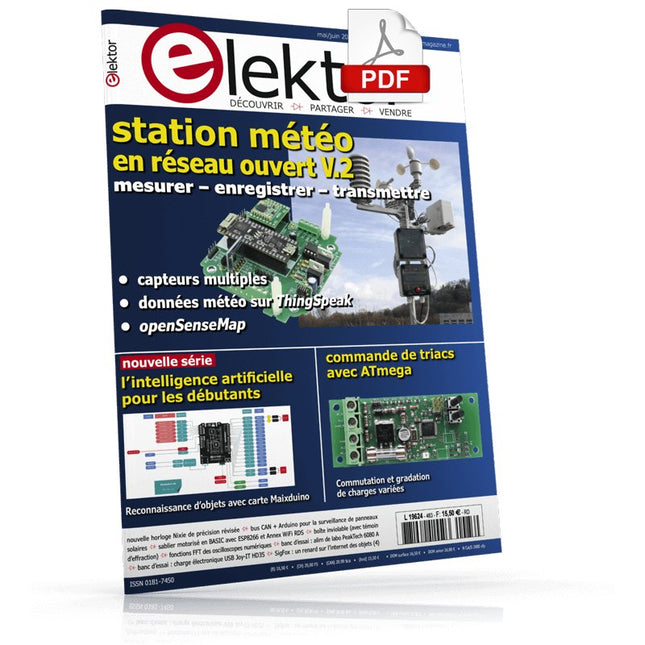
Elektor Digital Elektor Mai/Juin 2020 (PDF)
station météo en réseau ouvert V.21ère partie : présentation et matérielintelligence artificielle pour débutants (1)Reconnaissance d'objets à l'aide de la carte Maixduinocommande universelle de triacs avec ATmegaCommutation et gradation de charges variéesGitHub pour les ±nulsComment télécharge-t-on depuis GitHub ?dessine-moi un bouton pour l'IdOBoutonnière nº 2 : Prototypage entre la matière et◦le nuageMC14500B : microprocesseur CMOS à un seul bitdrôle(s) de composant(s)corrections et mises à jourQuestions et réponsessablier motorisé en BASIC avec ESP8266 et Annex WiFi RDSavec ESP8266 et Annex WiFi RDSbureau d'études – Zone DD comme développement, débrouille et dur-à-cuire ! | Trucs et astuces, bonnes pratiques et autres informations utilesmicrocontrôleurs TMS1000drôle(s) de composant(s)démarrer en électronique (3)… est plus facile qu'on ne l'imagine !le retour des petits circuits... et des bonnes petites pétites d'Elektorboîte inviolable protégée par un témoin d'effractionEnvoyer des données en toute sécurité par la postenouvelle horloge Nixie réviséeUn projet porté par l'enthousiasme de ses utilisateurs, nouveaux et anciensmultitâche en pratique avec l'ESP32 (3)Temporisateurs logicielsSigFox : un renard sur l'internet des objets (4)Composition d'un tableau de bordTMS0280 : synthèse vocaledrôle(s) de composant(s)banc d'essai : Charge électronique USB JOY-iT HD35Pour tester la capacité de charge des ports USBbus CAN + Arduino pour la surveillance des cellules solairesDétecter et localiser les panneaux défectueux dans les grands réseaux photovoltaïquesélectronique analogiqueÉtude de cas n° 1 - section 3 : Optimisation de la réponse du préamplificateur et compromisbruits de laboOscilloscopes anciens et modernesAnalyse de protocole et du décodage de données série à l'aide d'un oscilloscopefonction FFT des oscilloscopesReprésentation du signal dans le domaine spectral avec les oscilloscopes à mémoire numériquedis-moi comment tu ranges ton labo...Visite guidée dans le saint des saintsBanc d'essai : alim de labo PeakTech 6080 AUne alimentation nourrissante à tout petit budgetgrand défi : internet des objets ou internet des déchets ?Des produits sûrs pour l'IdOfréquencemètre 1,2 GHz & générateur de signaux carrés d'Elektor (1992/93)Il a franchi le mur du gigahertzStart-ups : Le programme d'investissement ElektorOser d'abord, doser ensuite – Enregistrez votre start-up !hexadΩku – casse-tête pour elektΩrniciens
€ 10,95
-
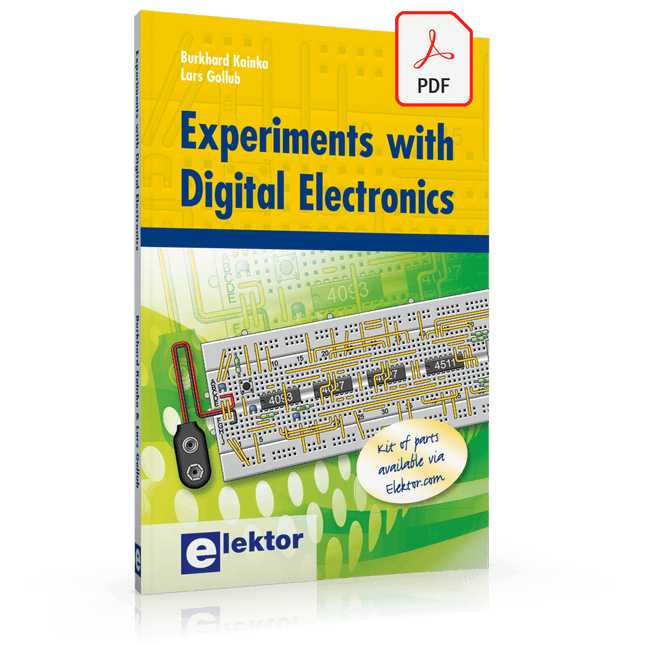
Elektor Digital Experiments with Digital Electronics (E-book)
The field of digital electronics is central to modern technology. This e-book presents fundamental circuits using gates, flip-flops and counters from the CMOS 4000 Series. Each of the 50 experiments has a circuit diagram as well as a detailed illustration of the circuit’s construction on solderless breadboard. Learning these fundamentals is best done using practical experiments. Building these digital circuits will improve your knowledge and will be fun to boot. Many of the circuits presented here have practical real-life applications. With a good overview of the field, you’ll be well equipped to find simple and cost-effective solutions for any application. The e-book is targeted essentially at students, trainees and anyone with an interest in and requiring an introduction to digital control electronics. Moreover, the knowledge gleaned here is the foundation for further projects in the field of microcontrollers and programming.
€ 24,95
Membres : € 22,46
-

Elektor Circuit Special 2026 (NL)
Elektor GREEN en GOLD leden kunnen deze uitgave hier downloaden. Nog geen lid? Klik hier om een lidmaatschap af te sluiten. Een stroombron voor het testen van Z-diodesControle van Z-diodes van 1 tot 54 V bij 1 tot 50 mA ESD polsbandtesterEen testapparaat met indicatie voor ‘goed’, ‘grensgeval’ en ‘afgekeurd’ Testapparaat voor de respons op piekbelastingen van voedingenEen generator voor repeterende stapsgewijze belasting voor laboratoriumvoedingen Euclidische sequencer zonder microcontrollerTriggerpatronen en CV-sequenties met eenvoudige CMOS-logica LED-knipperlicht voor heksystemen en meer, inclusief geluidssignaal Printen nodig? De Elektor PCB-service staat voor u klaar Tandenborstel-timerMet een kleine PIC Een contactloos magnetisch combinatieslotMet de AS5600 rotatie-positie sensor Batterijgevoede ruisarme voorversterkervoor dynamische microfoons Het Arduino Nano testLabMeten, sturen en regelen Rhythmische basverlichtingBenadruk het ritme van je muziek Low-cut filterGeen risico op audio-terugkoppeling op uw systeem Nauwkeurige 1 Hz blokgolfgenerator voor breadboardsEen betrouwbare klokpuls op basis van CMOS 555 onderstebovenDutycycles tot nul Van Halfgeleidergids tot Circuit Specials65 jaar innovatie op het gebied van elektronica Elektrische isolatieCAN-interface met digitale isolator en voedingsmodule SpongillatorEen sponsgebaseerde oscillator Echte willekeurige getallengeneratorMet geïntegreerde chi-kwadraattoets 3D-viewer voor HTML-pagina'sEenvoudig en vrijwel zonder code Programmeren met TLScriptEen scripttaal voor metingen, tests en besturing Schakelingsontwerp: tips van experts FeedbackWat is het en waarom is het belangrijk? Eén board, eindeloze ideeën: Arduino UNO QVan retro-gaming tot realtime milieumonitoring Hoe u een donut-antenne repareert Standby-KillerEen echte aan/uit-schakelaar voor uw tv Batterijen testenBatterijen meten met de Arduino Nano Voeding voor audioversterkersEen goede voeding zonder netbrom HF prototype printplatenMaak zelf snel een prototype printplaat Type 3-overspanningsbeveiligingEen type 3-overspanningsbeveiliging voor uw gevoelige apparatuur IoT-kamerthermostaat boardMet een op ESP32-C3/S3 gebaseerde Xiao MCU-module Van star naar slimFlexibele en gedrukte elektronica, tussen visie en industriële realiteit
€ 15,95
-
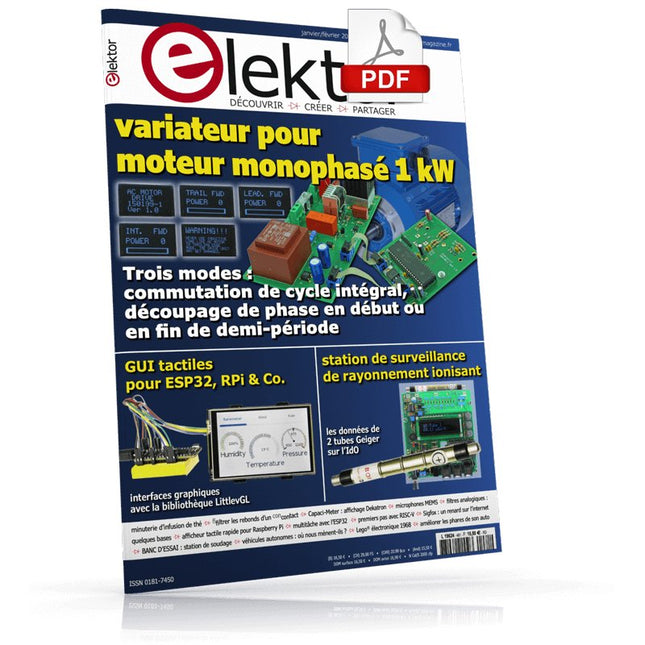
Elektor Digital Elektor Janvier/Février 2020 (PDF)
GUI tactiles – pour ESP32, RPi & Co.interfaces graphiques utilisateur avec la bibliothèque LittlevGL« pas seulement un projet comme un autre »Entretien avec Gábor Kiss-Vámosi, le développeur de LittlevGLCapaci-Meteraffichage à LED de type Dekatron sur deux chiffresCocomment fifiltrer les rerebonds d'un concontact mémécanique ?Un interrupteur est soit ouvert, soit fermé, n'est-ce pas ?filtres analogiques : quelques basesla magie des réseaux de filtrage est l'un des phénomènes les plus saisissants de l'électroniquebureau d'études - zone DDéveloppement en coursstation de surveillance de rayonnement ionisantPublie les données de 2 tubes Geiger sur les plates-formes IdOmultitâche en pratique avec l'ESP32programmation de tâches avec FreeRTOS et l'EDI Arduinomises au point & mises à jourCorrections – questions – réponsesaméliorer soi-même les phares de son auto ?Légal ou illégal, ce n'est pas égal !BANC D'ESSAI : station de soudage numérique ToolcraftArduino Pro IDE : mes premières impressionsComparaison de deux caméras de vision thermiqueexpérience vécueinstaller un labo et un atelier d'électroniqueélectronique analogiqueÉtude de cas nº 1 - Section 1 : microphone MEMS... 1-2-3 test 1-2-3minuterie d'infusion de théExercice de récupération d'énergie avec convertisseur thermoélectriquevariateur pour moteur monophasé 1 kWTrois modes de fonctionnement : commutation de cycle intégral, découpage de phase en début ou en fin de demi-périodeafficheur tactile 3,5 pouces rapide pour Raspberry PiParfait pour la vidéo, mais pas plus cherce labo-ci n'est pas ce labo-làmontre-moi ton labo, je te dirai qui tu es.Premiers pas avec RISC-VEssai de la carte LoFiveun géotraceur LoRa défie Elektor LabsPetits tracas du concepteur avec leur solution en geléeSigfox : un renard sur l'internet des objets (2)Inscription au réseau Sigfoxdémarrer en électronique... est plus facile qu'on ne l'imagine !retour des petits circuits…et des bonnes petites idées de projets Elektorvéhicules autonomes : où nous mènent-ils ?L'état de l'art (abrégé)Innovation 4.0 : dialogue d'innovateurs et d'entrepreneursCoffret Lego électronique, millésime 1968Les jouets électroniques fascinent encore 50 ans plus tardça dépasse l'électroniqueJauger un pont pour jauger la villeHexadoku – casse-tête pour elektorniciens
€ 10,95
-
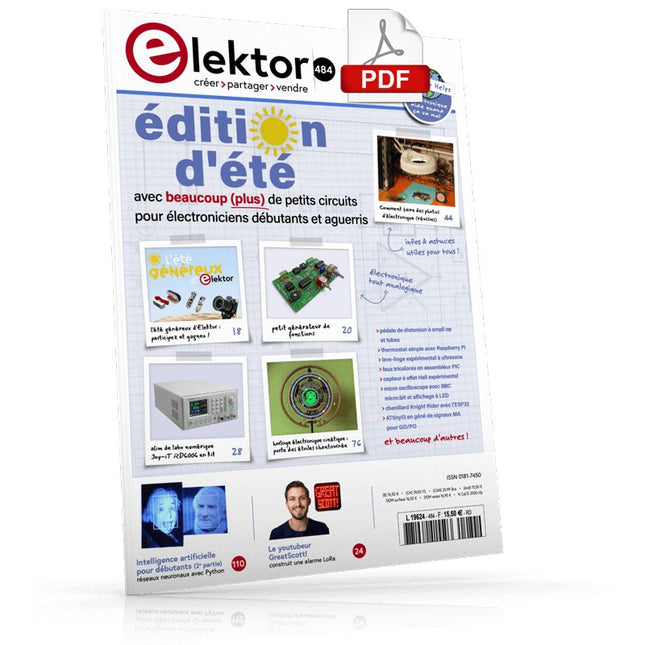
Elektor Digital Elektor juillet/août 2020 (PDF)
ELEKTOR AIDE L'aide électronique quand ça va mal SYSTÈME PRIVÉ D'INFORMATION DOMESTIQUE Avec Windows sur Raspberry Pi PRIX ET PRINCIPAL LE NODE ROUGE Programmation de visuels en blocs à code overt, façon Lego® L'ÉTÉ GÉNÉREUX D'ELEKTOR Des dons pour les doués PETIT GÉNÉRATEUR DE FONCTIONS circulation du signal à contresens GREATSCOTT ! CONSTRUIRE UN SYSTEME D'ALARME LORA BANC D'ESSAI : ALIM DE LABO NUMÉRIQUE JOY-IT RD6006 ET KIT le 0 à 60 V et le 0 à 6 A BANC D'ESSAI : CARTE D'INTERFACE GREATFET ONE Farfouiller sous les jupes de l'USB... à cause de la gêne ? RETOUR DES PETITS CIRCUITS ? XXL Quelques bonnes petites pépites ANTENNE WI-FI 2.4 GHZ EXTERNE DU PAUVRE THERMOSTAT SIMPLE AVEC RASPBERRY PI COMMENTAIRE (BIEN) PHOTOGRAPHIER L'ÉLECTRONIQUE montrez vos montages sous leur meilleur jour BANC D'ESSAI : I²CDRIVER l'I²C passe par l'USB BANC D'ESSAI : ÉCRAN TACTILE PORTABLE JOY-VIEW 13 DE  JOIE-LE CONVERTISEUR ÉLÉVATEUR À LED POUR ?C Amusez-vous bien! LAVE-LINGE EXPÉRIMENTAL À ULTRASONS BANC D'ESSAI : GÉNÉRATEUR DE SIGNAUX JOY-IT JDS2915 2 voix + fréquencemètre FEUX TRICOLORES ET ASSEMBLEUR PIC CLIGNOTANT ÉTERNEL?EKTOR CAPTEUR À EFFET HALL EXPÉRIMENTAL DÉBUSQUER DES COURTS CIRCUITS À L'ESR-MÈTRE OU AU MILLI-OHMMÈTRE BANC D'ESSAI : KIT PRATIQUE ELEKTOR SDR La radio logicielle : loisir passionnant et chronophage DANSE LES TUYAUX KICK-STARTER ÉLECTRIQUE Hein ?, quelle est la prochaine étape ? AT-ON VRAIMENT BESOIN DE TOUT CE BAZAR ? Oui, car c'est la que je passe le plus clair de mon temps sur des projets électroniques REGARDER ÉLECTRONIQUE CINÉTIQUE Porte des étoiles chantournée BONJOUR LE MONDE! ELEKTOR EST ACTIF AUSSI SUR LES RÉSEAUX SOCIAUX M4 + 2XA7 + GPU : ÉQUIPE DE RÊVE OU PRESQUE ! Nouveau SoC STM32MP1 : pour exigences les plus élevées PORTE-PIC POUR 16F18877 ET AUTRES GROS PICS TRAFIC ENTRE ?C PAR LE BUS SPI ET L'ATMEGA328P SIX VARIANTES D'OSCILLATEURS ET LA CAPA DE MILLER MICRO OSCILLOSCOPE AVEC BBC MICRO:BIT AVEC POSTER À LED CHENILLARD KNIGHT RIDER AVEC L'ESP32 ATTINY13 EN GÉNÉ DE SIGNAUX MA POUR GO/PO DIP MÈTRE MINIMALISTE TROTTINETTE ÉLECTRIQUE BON MARCHÉ Que diriez-vous d'une trottinette homologuée vendue 300 ? par Lidl ? AIDE AU STATIONNEMENT EN MARCHE AR PAR ULTRASONS AVEC ARDUINO UNO PÉDALE DE DISTORSION À AMPLI OP ET TUBES L'ÉTABLI DE L'ÉLECTRONICIEN : L'ESSENTIEL HEXAD?KU ? CASSE-TÊTE POUR ÉLECTRICIENS INTELLIGENCE ARTIFICIELLE POUR DÉBUTANTS (2) Réseaux de neurones avec Linux et Python
€ 10,95
-

Elektor Digital The Book of 555 Timer Projects (E-book)
Over 45 Builds for the Legendary 555 Chip (and the 556, 558) The 555 timer IC, originally introduced by the Signetics Corporation around 1971, is sure to rank high among the most popular analog integrated circuits ever produced. Originally called the IC Time Machine, this chip has been used in many timer-related projects by countless people over decades. This book is all about designing projects based on the 555 timer IC. Over 45 fully tested and documented projects are presented. All projects have been fully tested by the author by constructing them individually on a breadboard. You are not expected to have any programming experiences for constructing or using the projects given in the book. However, it’s definitely useful to have some knowledge of basic electronics and the use of a breadboard for constructing and testing electronic circuits. Some of the projects in the book are: Alternately Flashing Two LEDs Changing LED Flashing Rate Touch Sensor On/Off Switch Switch On/Off Delay Light-Dependent Sound Dark/Light Switch Tone Burst Generator Long Duration Timer Chasing LEDs LED Roulette Game Traffic Lights Continuity Tester Electronic Lock Switch Contact Debouncing Toy Electronic Organ Multiple Sensor Alarm System Metronome Voltage Multipliers Electronic Dice 7-Segment Display Counter Motor Control 7-Segment Display Dice Electronic Siren Various Other Projects The projects given in the book can be modified or expanded by you for your very own applications. Electronic engineering students, people engaged in designing small electronic circuits, and electronic hobbyists should find the projects in the book instructive, fun, interesting, and useful.
€ 29,95
Membres : € 26,96
-

Elektor Digital Elektor 07-08/2020 en PDF (DE)
Elektor 07-08/2020 en PDF (DE)
€ 11,90


