The short-wave technique has a very particular appeal: It can easily bridge long distances. By reflecting short-wave signals off the conductive layers of the ionosphere, they can be received in places beyond the horizon and therefore can reach anywhere on earth. Although technology is striving for ever higher frequencies, and radio is usually listened to on FM, DAB+, satellite or the Internet, modern means of transmission require extensive infrastructure and are extremely vulnerable. In the event of a global power outage, there is nothing more important than the short-wave. Amateur radio is not only a hobby, it’s also an emergency radio system!
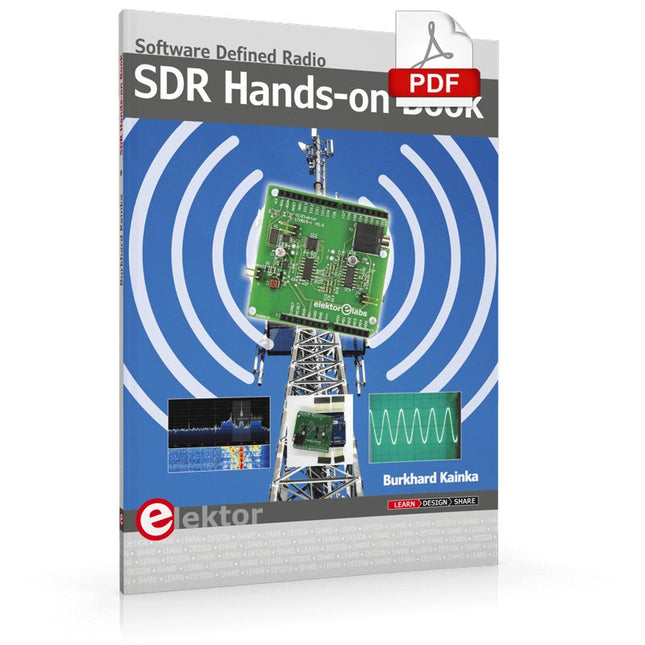
Elektor’s SDR-Shield is a versatile shortwave receiver up to 30 MHz. Using an Arduino and the appropriate software, radio stations, morse signals, SSB stations, and digital signals can be received.
In this book, successful author and enthusiastic radio amateur, Burkhard Kainka describes the modern practice of software defined radio using the Elektor SDR Shield. He not only imparts a theoretical background but also explains numerous open source software tools.
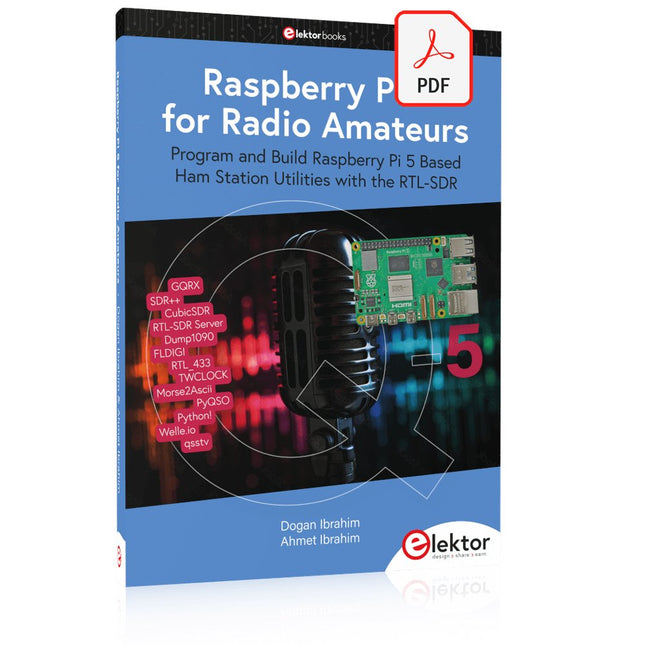
Program and Build Raspberry Pi 5 Based Ham Station Utilities with the RTL-SDR
The RTL-SDR devices (V3 and V4) have gained popularity among radio amateurs because of their very low cost and rich features. A basic system may consist of a USB based RTL-SDR device (dongle) with a suitable antenna, a Raspberry Pi 5 computer, a USB based external audio input-output adapter, and software installed on the Raspberry Pi 5 computer. With such a modest setup, it is possible to receive signals from around 24 MHz to over 1.7 GHz.
This book is aimed at amateur radio enthusiasts and electronic engineering students, as well as at anyone interested in learning to use the Raspberry Pi 5 to build electronic projects. The book is suitable for both beginners through experienced readers. Some knowledge of the Python programming language is required to understand and eventually modify the projects given in the book. A block diagram, a circuit diagram, and a complete Python program listing is given for each project, alongside a comprehensive description.
The following popular RTL-SDR programs are discussed in detail, aided by step-by-step installation guides for practical use on a Raspberry Pi 5:
SimpleFM
GQRX
SDR++
CubicSDR
RTL-SDR Server
Dump1090
FLDIGI
Quick
RTL_433
aldo
xcwcp
GPredict
TWCLOCK
CQRLOG
klog
Morse2Ascii
PyQSO
Welle.io
Ham Clock
CHIRP
xastir
qsstv
flrig
XyGrib
FreeDV
Qtel (EchoLink)
XDX (DX-Cluster)
WSJT-X
The application of the Python programming language on the latest Raspberry Pi 5 platform precludes the use of the programs in the book from working on older versions of Raspberry Pi computers.
Elektor GREEN and GOLD members can download their digital edition here.
Not a member yet? Click here.
High-End from the Elektor Lab
Fortissimo-100 High-End AmplifierFully symmetrical audio output stage and 100/190 W
Checking the Frequency of Tuned Circuits and CrystalsTips & Tricks, Best Practices and Other Useful Information
PCB Tips and Tricks
Soldering – So What?A Closer Look at Current Soldering Technology
Low-Latency Bluetooth Garage Door ControlTake Control with Short BLE Messages from a Smartphone
Ideal Diode ControllerDiode Circuits with Low Power Dissipation
LED Garlands with ESP32 and FreeRTOSFlashing and Variable Brightness
Starting Out in Electronics……Cheerfully Continues Zenering
FM/DAB+ ReceiverThe Best of Both Worlds
From Life’s ExperienceElectronica Obscura
Tracing the Cause of Software Bugs WirelesslyCircular Buffer and Webserver on the ESP32
Did Covid Cause a Boost in Engineering Innovation?Innovative Components and Solutions from 2022
Ersa i-CON TRACE – The IoT Soldering Station for Makers
Infographics
What Are We Going to Do with All This Compute?
How to Drive Ynvisible’s E-Paper Display
All-Time Innovation with InnoFaithQ&A with Walter Arkesteijn
Industrial AutomationEasy and scalable IoT-Retrofitting
Next Generation Oscilloscopes for Accelerated InsightRohde & Schwarz introduces the R&S MXO 4 series
Low Profile Linear Connectors Solve Multi-Signal Data Management
Smart – Innovative – Cost-EfficientGateMate FPGAs Developed and Manufactured in Germany
Tools to Support Low-Cost Sensor Development
PolyfusesPeculiar Parts, the Series
Isolated Analog Output for Arduino Uno
HomeLab Tours... Discovers the Theremin
electronica fast forward 2022 - powered by ElektorLineup and Timetable
Radio Direction FindingTracking Down Lost Wireless Weather Sensors
Estimate an IC's Internal NoiseA Simple Method
Ethics in ActionPowered by WEEF
No Ethics, No Sustainable BusinessAn Interview with Professor Stefan Heinemann
The 2023 WEEF Index
Filter SoftwareDesign Tools for Analog Filters
TV-B-Gone!... Or At Least B-OFF
RP2040-Based Air Quality Measurement
elekterminal
Kickstart to Python 3Sample Chapter: Digital Image Processing and Wand Library
SOLARPUNKA Brighter Future Ahead
Hexadoku
Elektor GREEN and GOLD members can download their digital edition here.
Not a member yet? Click here.
The ESP-BLASTA Mini ESP32 Rocket Drone That Flies 100 km/h+
Wireless Workshop (1)Radio Modules Unlocked: 433 MHz CC1101 Sub-GHz Transceiver
AM TransmitterWith Square/Sine Wave Generator on Raspberry Pi Pico
STM32Cube Innovation ChallengeCompete with Your Best STM32C5 Design
CoffeeCallerHow a Long Hallway Led to a Custom Mesh-Networked PCB
AudiotronicsTotal Harmonic Distortion
Elektor at 65Projects from Septembers and Octobers Past
Bluetooth Channel Sounding for Asset TrackingCentimeter-Level Precision Ranging for Next-Generation IoT
2026: An AI OdysseyQuantum Computing Is Not the Next GPU
Protecting the Cloud Demands Security at the Edge
First Experiences with the HackRF ProPractical Tests with the New SDR Hardware
Modem Upgrade from GPRS/2G to LTE/4GUsing a Wireless Alarm Control Panel as an Example
Loop Antenna with RF BricksPart 1: A DIY Shortwave Antenna with Adjustable Directivity
Internet Radio to AM ConverterUsing an ESP32-S3 as Transmitter
Err-lectronics
mioty — An OverviewFraunhofer’s Approach to LPWAN
Workbench WisdomPractical Tips from Experts
Walter, the Compact IoT ModulePart 2: Accessing Weather and Data Services
Mit dem Elektor Arduino Nano Trainingsboard (MCCAB) eigene Projekte realisieren
Der Mikrocontroller ist das wohl faszinierendste Teilgebiet der Elektronik, denn aufgrund der Vielzahl von Funktionen, die er auf seinem Chip vereinigt, ist er für den Entwickler ein universelles Multi-Tool zur Realisierung seiner Projekte. Praktisch jedes Gerät des täglichen Gebrauchs wird heute von einem Mikrocontroller gesteuert. Für einen elektronischen Laien blieb es aufgrund der Komplexität bisher allerdings ein Wunschtraum, eigene Ideen mit einem Mikrocontroller zu realisieren. Das Arduino-Konzept hat den Einsatz von Mikrocontrollern weitgehend vereinfacht, sodass jetzt auch Laien eigene Elektronik-Ideen mit einem Mikrocontroller verwirklichen können.
Buch & Hardware im Bundle: 'Learning by Doing'
Dieses im Bundle mitgelieferte Buch (im großen A4-Format) zeigt, wie man auch ohne große Erfahrung in Elektronik und Programmiersprachen eigene Projekte mit einem Mikrocontroller realisieren kann. Es ist ein Mikrocontroller-Praxiskurs für Einsteiger, denn nach einem Überblick über die Interna des Mikrocontrollers und einer Einführung in die Programmiersprache C liegt der Schwerpunkt des Kurses auf den praktischen Übungen. Der Leser eignet sich die erforderlichen Kenntnisse durch 'Learning by Doing' an: in dem umfangreichen Praxisteil mit 12 Projekten und 46 Übungen wird das im vorderen Teil des Buches Gelernte mit vielen Beispielen unterlegt. Die Übungen sind dabei so aufgebaut, dass der Bearbeiter eine Aufgabenstellung erhält, die er mit seinem im Theorieteil des Buches aufgebauten Wissen löst. Für jede Übung gibt es anschließend eine ausführlich erklärte und kommentierte Musterlösung, die dem Bearbeiter bei Problemen weiterhilft und die er mit seiner eigenen Lösung vergleichen kann.
Arduino IDE
In der Arduino IDE, einer Software-Entwicklungsumgebung, die kostenlos auf den eigenen PC heruntergeladen werden kann und die das gesamte Softwarepaket enthält, das für ein eigenes Mikrocontroller-Projekt benötigt wird, schreibt der Bearbeiter mit dem Editor der IDE seine Programme („Apps“) in der Programmiersprache C. Der in die Arduino IDE integrierte Compiler übersetzt sie in die Bits und Bytes, die der Mikrocontroller versteht und die dann über ein USB-Kabel in den Speicher des Mikrocontrollers auf dem Elektor Arduino Nano Trainingsboard (MCCAB) geladen werden.
Externe Sensoren, Motoren oder Baugruppen abfragen oder steuern
Das Elektor Arduino Nano Trainingsboard (MCCAB) enthält neben einem Mikrocontrollermodul Arduino Nano alle für die Übungen benötigten Bauteile wie Leuchtdioden, Schalter, Taster, akustische Signalgeber usw. Auch externe Sensoren, Motoren oder Baugruppen können mit diesem Mikrocontroller-Übungssystem abgefragt oder gesteuert werden.
Technische Daten (Arduino Nano Trainingsboard MCCAB)
Stromversorgung
Über die USB-Verbindung des zur Erstellung der Programme sowieso angeschlossenen PCs oder ein externes Netzteil (nicht im Lieferumfang enthalten)
Betriebsspannung
+5 Vcc
Eingangsspannung
Alle Eingänge
0 V bis +5 V
VX1 und VX2
+8 V bis +12 V (nur bei Verwendung eines externen Netzteils)
Mikrocontrollermodul
Arduino Nano
Hardwareperipherie
LCD
2x16 Zeichen
Potenziometer P1 & P2
JP3: Auswahl der Betriebsspannung von P1 & P2
Verteiler
SV4: Verteiler für die BetriebsspannungenSV5, SV6: Verteiler für die Ein-/Ausgänge des Mikrocontrollers
Schalter und Taster
RESET-Taster auf dem Arduino Nano-Modul6x Tastschalter K1 … K66x Schiebeschalter S1 … S6JP2: Verbindung der Schalter mit den Eingängen des Mikrocontrollers
Summer
Piezo-Summer Buzzer1 mit Steckbrücke auf JP6
Leuchtanzeigen
LED L auf dem Arduino Nano-Modul, verbunden mit GPIO D1311x LED: Zustandsanzeige für die Ein-/AusgängeJP6: Verbindung der LEDs LD10 … LD20 mit den GPIOs D2 … D12
Serielle SchnittstellenSPI & I²C
JP4: Auswahl des Signals an Pin X der SPI-Steckerleiste SV12SV9 bis SV12: SPI-Interface (3,3 V/5 V) bzw. I²C-Interface
Schaltausgang für externe Geräte
SV1, SV7: Schaltausgang (maximal +24 V/160 mA, extern zugeführt)SV2: 2x13 Pins zum Anschluss externer Module
3x3 LED-Matrix (9 rote LEDs)
SV3: Spalten der 3x3 LED-Matrix (Ausgänge D6 … D8)JP1: Verbindung der Reihen mit den GPIOs D3 … D5
Software
Library MCCABLib
Steuerung der Hardware-Komponenten (Schalter, Taster, Leuchtdioden, 3x3 LED-Matrix, Summer) auf dem MCCAB Trainingsboard
Betriebstemperatur
bis +40 °C
Abmessungen
100 x 100 x 20 mm
Technische Daten (Arduino Nano)
Mikrocontroller
ATmega328P
Architektur
AVR
Betriebsspannung
5 V
Flashspeicher
32 KB, davon 2 KB vom Bootloader belegt
SRAM
2 KB
Taktfrequenz
16 MHz
Analoge IN-Pins
8
EEPROM
1 KB
DC-Strom pro I/O-Pin
40 mA an einem I/O-Pin, insgesamt maximal 200 mA an allen Pins gemeinsam
Eingangsspannung
7-12 V
Digitale I/O-Pins
22 (6 davon sind PWM-fähig)
PWM-Ausgänge
6
Stromverbrauch
19 mA
Abmessungen
18 x 45 mm
Gewicht
7 g
Lieferumfang
Elektor Arduino Nano MCCAB Trainingsboard
Arduino Nano
Buch: Mikrocontroller-Praxiskurs für Arduino-Einsteiger
Diese Ausgabe steht allen GOLD- und GREEN-Mitgliedern auf der ElektorMagazine-Website zum Download bereit!
Sie sind noch kein Mitglied? Hier klicken!
High-End aus dem Elektor-Labor
High-End-Verstärker Fortissimo-100Vollsymmetrische Audio-Endstufe mit 100/190 W
Frequenzbestimmung unbekannter Schwingkreise und QuarzeTips & Tricks, Best Practices and Other Useful Information
Platinen entwerfenTipps aus der Praxis
Löten ….na und?Ein etwas genauerer Blick auf die heutige Löttechnik
Bluetooth-Garagentorsteuerung mit niedriger LatenzSteuerung mit kurzen BLE-Nachrichten über ein Smartphone
Ideal Diode Controller„Dioden“ mit geringer Verlustleistung
LED-Girlanden mit ESP32 und FreeRTOSBlinken und variable Helligkeit
Aller Anfang ...... muss nicht schwer sein: Es geht weiter mit den Z-Dioden
UKW/DAB+-EmpfängerDas Beste aus beiden Welten
Aus dem Leben gegriffenElectronica Obscura
Software-Fehlern drahtlos auf der SpurZirkularer Puffer und Webserver auf dem ESP32
Hat Covid einen Innovationsschub im Ingenieurwesen ausgelöst?Innovative Bauteile, Komponenten und Lösungen 2022
Ersa i-CON TRACE – die IoT-Lötstation für Praktiker
Infographics
Was wollen wir mit all diesen Daten machen?
Ansteuerung des E-Paper-Displays von Ynvisible
Immer innovativ mit InnoFaithF&A mit Walter Arkesteijn
Industrielle AutomatisierungEinfache und skalierbare IoT-Nachrüstungen
Das Oszilloskop der nächsten Generation für schnellere EinblickeRohde & Schwarz präsentiert die R&S MXO 4 Serie
Linear-Steckverbinder mit niedrigem Profil lösen Aufgaben im Multi-Signal-Datenmanagement
Smart – Innovativ – KosteneffizientGateMate-FPGAs entwickelt und hergestellt in Deutschland
Vom Layout zum Prototypen an einem Tag4-Lagen-PCBs im Elektronik-Labor
Tools für die kostengünstige Sensorentwicklung
Isolierter Analogausgang für Arduino Uno
Betreten für Unbefugte verboten!Herr Karenovics entdeckt das Theremin
electronica fast forward 2022 - powered by ElektorLine-up und Zeitplan
SenderpeilungVerlorene Funk-Wettersensoren wiederfinden
Das interne Rauschen eines ICs abschätzenMit einer einfachen Methode
Ethik in AktionUnterstützt vom WEEF
Ohne Ethik kein nachhaltiges GeschäftEin Interview mit Professor Stefan Heinemann
Der WEEF-Index 2023
Filter-SoftwareDesign-Tools für analoge Filter
TV-B-Gone!... oder zumindest: B-OFF
RP2040-basierte Luftgütemessung
Kickstart zu Python 3Ein Beispiel-Kapitel: Digitale Bildverarbeitung und Wand-Bibliothek
PolyfusesBemerkenswerte Bauteile
Hexadoku
Apprenez, construisez et maîtrisez l'électronique – avec Elektor
Projets, savoir-faire d'experts, accès aux archives et réductions exclusives – le tout dans un seul abonnement
Vous souhaitez apprendre l’électronique, développer vos propres circuits et mieux comprendre les technologies modernes ? Depuis 65 ans, Elektor Magazine compte parmi les principales sources d’information pour les ingénieurs en électronique, les développeurs, les start-up et les entreprises. Avec un Abonnement Elektor Green, vous bénéficiez de :
✅ Le magazine international d'électronique Elektor (en format numérique)
✅ Accès aux archives d’Elektor avec 65 ans de savoir-faire en électronique
✅ Projets DIY, circuits testés, analyses approfondies et tutoriels
✅ Réductions exclusives réservées aux membres sur Elektor.fr
Pourquoi Elektor ?
Depuis 65 ans, Elektor est synonyme de connaissances approfondies en électronique, de projets concrets et de technologies innovantes.
Des microcontrôleurs et systèmes embarqués à Raspberry Pi, Arduino et ESP32, jusqu’à l’IdO (IoT), l’IA, la mesure, l’audio, la RF et la robotique, Elektor couvre les principales plateformes et domaines d’application de l’électronique moderne.
Que vous soyez débutant, maker ou professionnel, Elektor vous aide à passer au niveau supérieur.
À qui s'adresse l'abonnement ?
Débutants – Plongez dans l'univers de l'électronique grâce à des bases claires et à vos premiers projets
Makers – Découvrez de nouveaux projets, des idées et de l'inspiration pour vos propres créations
Professionnels et ingénieurs – Restez à la pointe des technologies modernes et approfondissez vos connaissances spécialisées
Vos avantages en un coup d'œil
Magazine (numérique) – Recevez chaque numéro en version numérique directement dans votre boîte mail
65 ans de savoir-faire en électronique – Accédez à tout moment aux vastes archives d'Elektor
Pratique & projets – Concrétisez vos propres idées grâce à des instructions, des schémas de circuits et des tutoriels
Réductions exclusives – Économisez sur chaque achat sur Elektor.fr
Débloquez tous les avantages Elektor !
Abonnement Free
Abonnement Green
❌ 8× magazine Elektor (édition numérique) au format PDF
✅ 8× magazine Elektor (édition numérique) au format PDF
❌ 12 mois d’accès aux archives complètes d’Elektor
✅ 12 mois d’accès aux archives complètes d’Elektor
❌ Accès à plus de 5 000 fichiers Gerber
✅ Accès à plus de 5 000 fichiers Gerber
❌ 10% de réduction pour les membres sur Elektor.fr
✅ 10% de réduction pour les membres sur Elektor.fr
✅ Lisez Elektor chaque vendredi matin
✅ Lisez Elektor chaque vendredi matin
ℹ️ Vous préférez lire Elektor en version papier ? Découvrez ici tout ce qu'il faut savoir sur l'abonnement Elektor Gold (version papier).
3K5 circuits mémorables (1975-2026)
Cette clé USB contient plus de 3500 circuits mémorables dans tous les domaines de l'électronique (audio et vidéo, jeux et modélisme, domestique, processeur et microcontrôleur, test et mesure, alimentation et batteries) publiés dans Elektor Magazine depuis 1975. La plupart des circuits proviennent des éditions Elektor Summer Circuits.
Une puissante fonction de recherche dans le texte intégral des articles permet de retrouver instantanément le contenu qui vous intéresse. Les résultats sont des documents PDF. Parcourez les articles un à un avec Adobe Reader ou cherchez partout les mots et les expressions de votre choix grâce à la fonction de recherche intégrée.
Veuillez noter qu'aucune édition de Summer Circuits n'a été publiée entre 2014 et 2022, ces années ne sont donc pas incluses dans l'annuaire.
Spécifications
Stockage
16 Go
Connecteurs
1x USB-A1x USB-C
La soudeuse par points portative FNIRSI SWM-20 est un outil de soudage performant, convivial et facile à transporter. Elle intègre la technologie de soudage par points à double impulsion, garantissant des soudures plus stables et fiables, et dispose également d'une fonction de batterie externe pratique.
Dotée d'un écran haute définition de 2,4 pouces, la SWM-20 offre une utilisation claire et intuitive. Sa molette de réglage rotative permet un ajustement rapide et précis des paramètres, facilitant ainsi la configuration des réglages de soudage et améliorant l'expérience utilisateur.
Caractéristiques
2-en-1 : poste de soudage par points et batterie externe de 5000 mAh
Puissance de sortie élevée de 1200 A pour des soudures robustes et fiables
Technologie à double impulsion pour une soudure plus propre et plus stable
Deux batteries de qualité A avec 8 protections de sécurité
Capacité de soudage multi-matériaux de 0,1 à 0,5 mm
Plus de 10000 niveaux de réglage de précision pour un contrôle professionnel
Écran TFT de 2,4 pouces avec surveillance des données en temps réel
Spécifications
Courant de soudage max.
1200 A
Capacité de la batterie
5000 mAh
Charge
5 V/2,1 A
Décharge
5 V/2,1 A
Matériaux de soudage
Nickel, fer, acier inoxydable
Épaisseur de soudure
0,1 à 0,5 mm
Niveau
4 combinaisons prédéfinies Niveaux
Inclus
1x FNIRSI SWM-20 Poste de soudage par points
2x Stylos à souder
2x Conseils de remplacement
1x Bande de nickel
1x Câble USB-C
1x Manuel
Téléchargements
Manual
Points forts
Fréquence de sortie (sinusoïdale) : 100 MHz
Fréquence de sortie (carré) : 25 MHz
Canaux : 2
Longueur de forme d'onde arbitraire : 16 Mpts
Caractéristiques
Technologie unique SiFi II (Signal Fidelity II) : génère les formes d'onde arbitraires point par point ; récupérer le signal sans distorsion ; taux d'échantillonnage précis et réglable ; gigue de toutes les formes d'onde de sortie (y compris sinusoïdale, impulsionnelle, etc.) aussi faible que 200 ps
Profondeur de mémoire de 16 Mpts par canal pour les formes d'onde arbitraires
Double canal standard avec les mêmes performances, équivalent à deux sources de signaux indépendantes
Stabilité haute fréquence : ±1 ppm ; faible bruit de phase : -105 dBc/Hz
Générateur d'harmoniques d'ordre élevé intégré (au maximum des harmoniques d'ordre 8)
Compteur de fréquence complet intégré à 7 chiffres/s, bande passante de 240 MHz
Jusqu'à 160 formes d'onde arbitraires intégrées, couvrant les signaux courants dans les applications d'ingénierie, l'électronique médicale, l'électronique automobile, le traitement mathématique et d'autres domaines divers
Taux d'échantillonnage jusqu'à 250 MSa/s, résolution verticale 16 bits
Fonction d'édition de séquence de forme d'onde arbitraire disponible ; des formes d'onde arbitraires peuvent également être générées via le logiciel PC
Diverses fonctions de modulation analogiques et numériques : AM, FM, PM, ASK, FSK, PSK et PWM.
Fonction de combinaison de formes d'onde standard, capable de produire des formes d'onde spécifiées combinées avec les formes d'onde de base
Fonction de suivi de canal standard, lorsqu'elle est activée, tous les paramètres des deux canaux sont mis à jour en fonction des configurations des utilisateurs
Interface standard : hôte et périphérique USB et LAN (appareil LXI Core 2011) ; Fonction USB GPIB prise en charge
Écran TFT 4,3''
Inclus
1x Rigol DG2102 Fonction/Générateur de forme d'onde arbitraire
1x cordon d'alimentation
1x câble USB