
Résultats de la recherche pour "elektor OR cloc OR 2 OR 0 OR kit"
-

Elektor Digital Stromversorgungen in der Praxis (PDF)
Stromversorgungen in der Praxis (E-book)
€ 39,80
Membres : € 35,82
-

OWON Générateur d'ondes arbitraires OWON XDG2035 à 2 canaux (35 MHz)
L'OWON XDG2035 à 2 canaux est un générateur de fonctions/formes d'onde capable de générer des signaux avec une fréquence maximale de 35 Hz. Le générateur a une résolution de 1 µHz et un taux d'échantillonnage de 500 MSa/s. L'OWON XDG2035 est capable de générer 6 formes d'onde standard et 150 formes d'onde arbitraires. Avec le logiciel inclus, vous pouvez écrire des fonctions avancées jusqu'à 10 millions de points. Les formes d'onde peuvent être enregistrées dans la mémoire interne du générateur de fonctions à l'aide d'un PC via USB ou LAN. L'OWON XDG2035 prend également en charge les commandes SCPI et LabView. Le générateur de fonctions est doté d'un compteur de fréquence de haute qualité intégré, qui peut fonctionner de 100 à 200 MHz. Caractéristiques Sortie de fréquence maximale de 35 MHz Taux d'échantillonnage de 500 MSa/s, résolution verticale de 1 μHz Résolution verticale de 14 bits, longueur de forme d'onde de 10 Mpts Sortie de formes d'onde complètes : 6 formes d'onde de base et 150 formes d'onde arbitraires intégrées Fonctions de modulation complètes : AM, FM, PM, FSK, 3FSK, 4FSK, PSK, OSK, ASK, BPSK, PWM, balayage et rafale Compteur de fréquence de haute précision intégré, plage prise en charge de 100 à 200 MHz Prise en charge des commandes SCPI et LabVIEW Écran tactile multipoint de 7 pouces (800 x 480 pixels) Spécifications Canal 2 Fréquence de sortie 35 MHz Taux d'échantillonnage 500 MSa/s Résolution verticale 14 bits Forme d'onde Forme d'onde standard sinus, carré, impulsion, rampe, bruit et harmonique Forme d'onde arbitraire montée exponentielle, chute exponentielle, sin(x)/x, onde carrée, et autres, un total de 150 formes d'onde intégrées et une forme d'onde arbitraire définie par l'utilisateur Fréquence (résolution 1 μHz) Sinus 1 µHz à 100 MHz Carré 1 µHz à 30 MHz Impulsion 1 µHz à 25 MHz Rampe 1 µHz à 3 MHz Bruit (-3 dB, typique) 100 MHz Forme d'onde arbitraire 1 µHz à 15 MHz Harmonique 1 µHz à 50 MHz Précision ±2 ppm, 25°C ±5°C Longueur de forme d'onde 2 points - 10M points Amplitude Pour une charge de 50Ω 1 mVpp à 10Vpp (≤25 MHz) ; 1 mVpp à 5Vpp (≤60 MHz) ; 1 mVpp à 2.5Vpp (≤100 MHz) Modulation Type AM, DSB-AM, FM, PM, ASK, FSK, PSK, BPSK, QPSK, 3FSK, 4FSK, OSK, PWM, SUM Compteur de fréquence Fonction Fréquence, période, largeur positive, largeur négative, cycle de marche positif et cycle de marche négatif Plage de fréquence 100 ~ 200 MHz Résolution de fréquence 7 chiffres Entrée/Sortie Mode d'entrée compteur de fréquence, entrée de modulation externe, entrée de déclenchement externe, sortie d'horloge interne, entrée/sortie d'horloge de référence externe Interface de communication Hôte USB, Périphérique USB, LAN, RS232 (en option) Spécifications mécaniques Dimensions 340 x 177 x 90 mm Poids 2,3 kg Inclus 1x OWON XDG2035 1x Cordon d'alimentation 1x CD-ROM 1x Guide de démarrage rapide 1x Câble USB 1x Câble BNC-BNC Téléchargements Guide Rapide
€ 336,20
-

€ 32,80
Membres : € 29,52
-
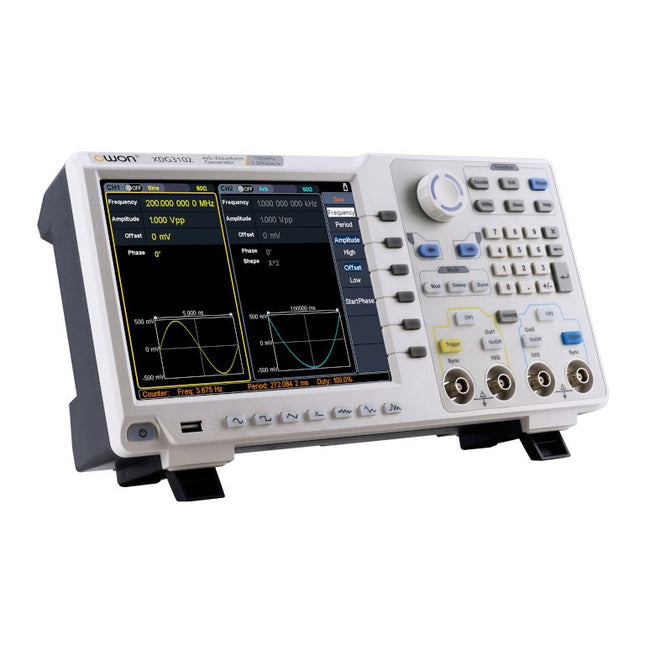
OWON OWON XDG3102 Générateur de formes d'onde arbitraires à 2 canaux (100 MHz)
Caractéristiques Technologie DDS avancée, sortie de fréquence jusqu'à 250 MHz Taux d'échantillonnage de 1,25 GS/s et résolution de fréquence de 1 μHz Jusqu'à 1 M de longueur de forme d'onde arbitraire Résolution verticale : 14 bits Sortie de forme d'onde complète : 6 groupes de formes d'onde et 152 groupes de formes d'onde arbitraires intégrées Options de modulation complètes : AM, FM, PM, FSK, 3FSK, 4FSK, PSK, OSK, ASK, BPSK, PWM, balayage et rafale Fréquencemètre intégré de haute précision, allant de 100 MHz à 200 MHz SCPI et LabVIEW pris en charge Écran LCD tactile 8'' 800 x 600 pixels Spécifications XDG3102 Canal 2 Sortie de fréquence 100MHz Taux d'échantillonnage 1,25 Géch/s Résolution verticale 14 bits Forme d'onde Forme d'onde standard sinus, carré, impulsion, rampe, bruit et harmonique Forme d'onde arbitraire montée exponentielle, chute exponentielle, sin(x)/x, onde progressive et autres,total de 150 formes d'onde intégrées et forme d'onde arbitraire définie par l'utilisateur Fréquence (résolution 1μHz) Sinus 1µHz - 100MHz Carré 1µHz - 40MHz Impulsion 1µHz - 25MHz Catastrophe 1μHz - 5MHz Harmonique 1µHz - 50MHz Bruit 120 MHz (-3 dB, typique) Forme d'onde arbitraire forme d'onde intégrée : 1uHz - 15MHzForme d'onde définie par l'utilisateur : 1 uHz - 50 MHz Précision ±1 ppm, 0°C - 40°C Amplitude Amplitude (50Ω) 1 mVpp - 10 Vpp (≤40 MHz) ; 1 mVpp - 5 Vpp (≤80 MHz)1 mVpp - 2,5 Vpp (≤120 MHz) ; 1 mVpp - 1Vpp (≤250 MHz) Amplitude (haute impédance) 2 mVpp - 20 Vpp (≤40 MHz) ; 2 mVpp - 10 Vpp (≤80 MHz) ;2 mVpp - 5Vpp (≤120 MHz) ; 2 mVpp - 2Vpp (≤250 MHz) Résolution 1mV ou 4 chiffres Décalage CC Plage (50Ω) ±(5 Vpk - Amplitude Vpp/2) Plage (Z élevé, circuit ouvert) ±(10 Vpk - Amplitude Vpp/2) Précision ±(1 % de |réglage| + 1 mV + Amplitude Vpp x 0,5 %) Résolution 1mV ou 4 chiffres Impédance de charge 50Ω (typique) Précision ±(1 % du réglage + 1 mVpp) (typique, sinusoïdal de 1 kHz, décalage de 0 V) Pureté du spectre d'onde sinusoïdale Distorsion harmoniqueTypique (0dB) C.C - 1 MHz : <-65 dBc1 MHz - 10 MHz : <-60 dBc10 MHz - 120 MHz : <-50 dBc120 MHz - 200 MHz : <-45 dBc Distorsion harmonique totale <0,05 %, 10 Hz à 20 kHz, 1 Vc.c. Parasitaire (non harmonique),Typique (0dB) ≤10MHz : <-70dBc>10MHz : <-70dBc + 6dB/octave Bruit de phaseTypique (0 dBm, déviation de 10 kHz) 10 MHz : ≤-110 dBc/Hz Carré Temps de montée/descente <5ns Dépasser <3% Cycle de service 50,0% (fixe) Gigue (rms) 300ps + 100ppm Impulsion Largeur d'impulsion 12ns - 996875s Temps de front montant/fin ≧7ns Dépasser <3% Gigue (rms) 300ps + 100ppm Catastrophe Linéarité ≤1 % de la sortie maximale (typique, 1 kHz, 1 Vpp, 50 % de symétrie) Symétrie 0% à 100% Harmonique Ordre Harmonique ≤16 Type harmonique pair, impair, tout, utilisateur Amplitude harmonique pourrait être réglé pour toutes les harmoniques Phase harmonique Arbitraire Longueur de la forme d'onde 2 points - 1 million de points Résolution verticale 14 bits Temps minimum de montée/descente <7ns Gigue (rms) 3ns Modulation Taper AM, FM, PM, PWM, FSK, 3FSK, 4FSK, PSK, OSK, ASK, BPSK, balayage et rafale SUIS Forme d'onde porteuse sinusoïdal, carré, rampe et arbitraire (sauf DC) Source interne externe Forme d'onde modulante sinusoïdal, carré, rampe, bruit et arbitraire Profondeur 0,0% - 100,0% Fréquence de modulation 2 MHz - 100 kHz FM Forme d'onde porteuse sinusoïdal, carré, rampe et arbitraire (sauf DC) Source interne externe Forme d'onde modulante sinusoïdal, carré, rampe, bruit et arbitraire Fréquence de modulation 2 MHz - 100 kHz P.M. Forme d'onde porteuse sinusoïdal, carré, rampe et arbitraire (sauf DC) Source interne externe Forme d'onde modulante sinusoïdal, carré, rampe, bruit et arbitraire Déviation de phase 0° - 180° Fréquence de modulation 2 MHz - 100 kHz MLI Forme d'onde porteuse impulsion Source interne externe Forme d'onde modulante sinusoïdal, carré, rampe, bruit et arbitraire Écart de largeur 0 ~ minimum (rapport d'impulsions, 100 % - rapport d'impulsions) Fréquence de modulation 2 MHz - 100 kHz FSK/3FSK/4FSK Forme d'onde porteuse sinusoïdal, carré, rampe et arbitraire (sauf DC) Source interne externe Forme d'onde modulante carré avec un rapport cyclique de 50 % Fréquence clé 2 MHz - 1 MHz PSK Forme d'onde porteuse sinusoïdal, carré, rampe et arbitraire (sauf DC) Source interne externe Forme d'onde modulante carré avec un rapport cyclique de 50 % Fréquence clé 2 MHz - 1 MHz OSK Forme d'onde porteuse sinusoïdal, carré, rampe et arbitraire (sauf DC) Source interne Temps d'oscillation carré avec un rapport cyclique de 50 % Fréquence clé 2 MHz - 1 MHz DEMANDER Forme d'onde porteuse sinusoïdal, carré, rampe et arbitraire (sauf DC) Source interne externe Forme d'onde modulante carré avec un rapport cyclique de 50 % Fréquence clé 2 MHz - 1 MHz BPSK Forme d'onde porteuse sinusoïdal, carré, rampe et arbitraire (sauf DC) Source interne Forme d'onde modulante carré avec un rapport cyclique de 50 % Fréquence clé 2 MHz - 1 MHz Balayer Forme d'onde porteuse sinusoïdal, carré, rampe et arbitraire (sauf DC) Taper linéaire et log Direction haut et bas Temps de balayage 1 ms à 500 s, ± 0,1 % Source de déclenchement interne, externe et manuel Éclatement Forme d'onde porteuse sinusoïdal, carré, rampe, impulsion et arbitraire (sauf DC) Nombre de rafales 1 à 50 000 périodes, infini, gate Période interne 10 ns - 500 s Source fermée déclencheur externe Compteur de fréquence Fonction période de fréquence, +largeur, -largeur, +devoir et -devoir Gamme de fréquences 100 MHz - 200 MHz Résolution de fréquence 7 chiffres Entrée sortie Afficher Écran LCD tactile 8" 800 x 600 pixels Taper fréquencemètre, entrée de modulation externe,entrée de déclenchement externe,entrée/sortie d'horloge de référence externe Interface de Communication Hôte USB, périphérique USB et réseau local Dimension 340 x 177 x 90 mm Poids (sans colis) 2,50 kg
€ 644,63
-

Elektor Digital Mikrocontroller-Module (PDF)
Grundlagen und Selbstbau Weshalb nicht damit beginnen, Mikrocontroller-Module selbst zu entwickeln, zumindest aber sich in Gedanken mit solchen Aufgaben zu beschäftigen? Wie Mikrocontroller-Module aufgebaut sind und wozu sie verwendet werden, soll in 'Mikrocontroller-Module – Grundlagen und Selbstbau' dargestellt werden. Das vorliegende Buch beleuchtet Mikrocontroller-Module, die vor allem zum Experimentieren, zum Lernen und zum Einarbeiten in die Entwicklung und Programmierung von Embedded Systems gedacht sind. Die Entwurfsgrundsätze, Lösungsvorschläge und Projekte, die in diesem Buch beschrieben werden, sind aus zwei Ideen hervorgegangen: Erstens können neue Entwicklungen zwischen den weit verbreiteten kostengünstigen Mikrocontroller-Modulen und der industriellen Computer- und Steuerungstechnik ihren Platz finden und zweitens ist es eine Herausforderung an sich, solche Module zu entwickeln und einzusetzen. In den ersten sieben Kapiteln dieses Buches werden die technischen Grundlagen diskutiert und anhand eigener Entwicklungen veranschaulicht. Das achte Kapitel gibt einen Überblick über diesen Modulbaukasten. Alle Fotos aus dem Buch können hier vierfarbig heruntergeladen werden.
€ 32,80
Membres : € 29,52
-

Elektor Digital RFID (E-book)
RFID technology has conquered many areas in which barcodes, magnetic strips and contact smartcards were used previously. Everyday applications, such as electronic ticketing, access cards, debit cards and electronic identity documents would not be possible without this technology. MIFARE is the most widely used RFID technology, and this book provides a practical and comprehensive introduction to it. Among other things, the initial chapters cover physical fundamentals, relevant standards, RFID antenna design, security considerations and cryptography. The complete design of a reader’s hardware and software is described in detail. The reader’s firmware and the associated PC software support programming using any .NET language. The specially developed PC program, “Smart Card Magic.NET”, is a simple development environment that supports sending commands to a card at the click of a mouse, as well as the ability to create C# scripts. Alternatively, one may follow all of the examples using Visual Studio 2010 Express Edition. Finally, the major smart card reader API standards are introduced. The focus is on programming contactless smartcards using standard PC/SC readers using C/C++, Java and C#.
€ 34,95
Membres : € 31,46
-

Elektor Digital The BeagleY-AI Handbook (E-book)
A Practical Guide to AI, Python, and Hardware Projects Welcome to your BeagleY-AI journey! This compact, powerful, and affordable single-board computer is perfect for developers and hobbyists. With its dedicated 4 TOPS AI co-processor and a 1.4 GHz Quad-core Cortex-A53 CPU, the BeagleY-AI is equipped to handle both AI applications and real-time I/O tasks. Powered by the Texas Instruments AM67A processor, it offers DSPs, a 3D graphics unit, and video accelerators. Inside this handbook, you‘ll find over 50 hands-on projects that cover a wide range of topics—from basic circuits with LEDs and sensors to an AI-driven project. Each project is written in Python 3 and includes detailed explanations and full program listings to guide you. Whether you‘re a beginner or more advanced, you can follow these projects as they are or modify them to fit your own creative ideas. Here’s a glimpse of some exciting projects included in this handbook: Morse Code Exerciser with LED or BuzzerType a message and watch it come to life as an LED or buzzer translates your text into Morse code. Ultrasonic Distance MeasurementUse an ultrasonic sensor to measure distances and display the result in real time. Environmental Data Display & VisualizationCollect temperature, pressure, and humidity readings from the BME280 sensor, and display or plot them on a graphical interface. SPI – Voltmeter with ADCLearn how to measure voltage using an external ADC and display the results on your BeagleY-AI. GPS Coordinates DisplayTrack your location with a GPS module and view geographic coordinates on your screen. BeagleY-AI and Raspberry Pi 4 CommunicationDiscover how to make your BeagleY-AI and Raspberry Pi communicate over a serial link and exchange data. AI-Driven Object Detection with TensorFlow LiteSet up and run an object detection model using TensorFlow Lite on the BeagleY-AI platform, with complete hardware and software details provided.
€ 34,95
Membres : € 31,46
-
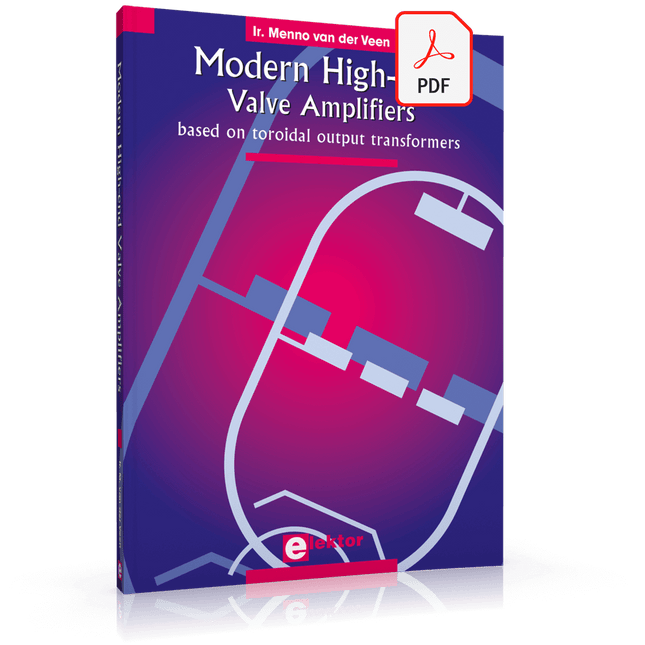
Elektor Digital Modern High-End Valve Amplifiers (E-book)
Valve Amplifiers are regarded by many to be the ne plus ultra when it comes to processing audio signals. The combination of classical technology and modern components has resulted in a revival of the valve amplifier. The use of toraidal-core output transformers, developed by the author over the past 15 years, has contributed to this revival. The most remarkable features of these transformers are their extremely wide frequency ranges and their very low levels of linear and nonlinear distortion. This book explains the whys and wherefores of toroidal output transformers at various technical levels, starting with elementary concepts and culminating in complete mathematical descriptions. In all of this, the interactions of the output valves, transformer and loudspeaker form the central theme. Next come the practical aspects. The schematic diagram of a valve amplifier often appears to be very simple at first glance, but anyone who has built a modern valve amplifier knows that a lot of critical details are hidden behind this apparent simplicity. These are discussed extensively, in connection with designs for amplifiers with output powers ranging from 10 to 100 watts. Finally, the author gives some attention to a number of special valve amplifiers, and to the theory and practice of negative feedback. In summary, this book offers innovative solutions for achieving perfect audio quality. Do-it-yourself builders, as well as persons who want to gain a deeper technical understanding of the complex world of audio transformers, valve amplifiers and audio signal processing, will find this book a rich and useful source of information.
€ 34,95
Membres : € 31,46
-

Elektor Digital LEDs 5 (PDF)
Inhalt Praxis LED-KommunikatorDesign-Studie: Verwendung von handelsüblichen LEDs zur bidirektionalen Kommunikation Nachrichten-Ticker Bau eines Internet-News-Tickers ALS es Licht wurde Controller steuert Beleuchtungseinrichtungen nach Umgebungshelligkeit und Uhrzeit BULI - Button-Lichtspiele Effekte mit LED2812 und Cortex-M0+ Theorie & Anwendung DesignCorner: Schaltungen, Tipps und Kniffe- Posistor gegen den Hitzetod- High-Brightness-LEDs an Niedervolt-Stromversorgungen betreiben- Derating mit PTC-Thermistoren in LED-Treiberschaltungen- Der Umgang mit LED-Strings- LED-Treiber für unterschiedliche Wandler-Topologien- LED-Konstantstromtreiber in Schaltreglertechnik Grenzen überschreiten Ansteuerung von LEDs mit gepulstem Überstrom Ansteuerung von LED-Matrixschaltungen MultitalentController treibt LEDs, regelt Solarzellen und lädt Batterien Dimmungstechniken für LEDs Info OLED – Die FlächenlichtquelleZum Entwicklungsstand der organischen Leuchtdiode 400 LED-Lampen auf dem Prüfstand Über dem LimitLEDs mit höheren Treiberströmen ansteuern AktuellNeue LEDs, LED-Lampen, Treiber, Netzteile, Zubehör und Entwicklungs-Tools
€ 17,50
Membres : € 15,75
-

€ 29,95
Membres : € 26,96
-

Elektor Digital Elektronicavoedingen zonder stress (E-book)
Eén ding hebben alle elektronische schakelingen en apparaten gemeen: de werking ervan staat of valt met de voeding. Alleen al daarom verdient deze deelschakeling speciale aandacht. Dit boek behandelt principes en schakelingen uit de praktijk van de voedingstechniek. Geheel in overeenstemming met de huidige trend gaat de auteur in het bijzonder in op 'mobiele' voedingen en op de techniek van schakelende voedingen. Ook wordt aandacht besteed aan het feit dat constante-stroombronnen ten opzichte van spanningsbronnen een steeds belangrijker rol gaan spelen. Naast de vereiste theoretische achtergronden en principes voor het ontwerpen en bouwen van eigen voedingsschakelingen biedt dit boek ook praktische toepassingsvoorbeelden, zoals het vervangen van defecte nettransformatoren, de voeding voor elektronica tijdens fietstochten of het aansturen van LED‘s in de verlichtingstechniek. Auteur Franz Peter Zantis is afgestudeerd als ingenieur communicatietechniek en houdt zich als elektronicus bezig met energie-installaties. Tijdens een onderzoeksproject heeft hij zich grondig verdiept in de stroomvoorziening van zelfstandig werkende apparaten en hij heeft talrijke artikelen over schakelende voedingen gepubliceerd.
€ 34,95
Membres : € 31,46
-
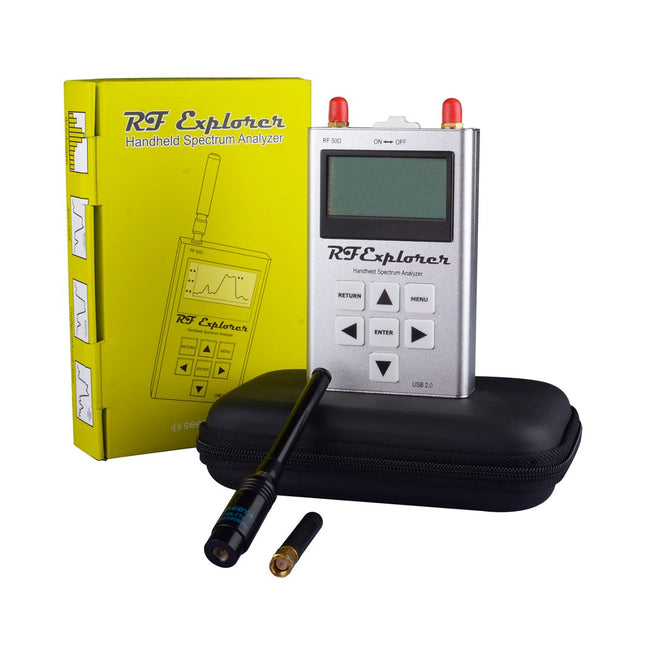
Seeed Studio Seeed Studio RF Explorer 3G Combo analyseur de spectre
The Seeed Studio RF Explorer 3G Combo is a handheld digital spectrum analyzer and an affordable tool for working across a wide range of popular frequency bands. It is based on a highly integrated frequency synthesizer and a double-balanced mixer, providing high performance, compact dimensions, low power consumption, and excellent value. Designed for both indoor and outdoor use, the RF Explorer 3G Combo can also be connected to a PC via a standard Mini-USB 2.0 connector for additional functionality. This model combines a WSUB1G base unit with an RFEMWSUB3G expansion module, supplied fully assembled and tested. It features two SMA connectors and includes two antennas: a dual-band 144/430 MHz telescopic antenna for sub-GHz frequencies and a helical whip antenna for the 2.4 GHz band. Additional frequency-specific antennas may be required for optimal performance in certain supported frequency ranges. This combination provides the wide frequency coverage of the WSUB3G module together with the high sensitivity and fast response of the WSUB1G unit in the commonly used sub-1 GHz frequency range. Caractéristiques Pocket size and light weight Solid aluminum metal case Includes a transport EVA carry case for RF Explorer Spectrum Analyzer mode with Peak Max and Hold, Normal, Overwrite and Averaging modes Lifetime free firmware upgrades available, open to community requested features High capacity Lipo for 16+ hours of continuous run, rechargeable by USB Windows PC client Open Source Can be extended with internal Expansion Modules for additional band and functionality Wide band coverage to all popular RF frequencies, starting at 15 MHz and going up to 2.7 GHz. This includes very interesting frequency areas such as 2 m HAM radio, all VHF and UHF, FM radio, GPS, WiFi and WiMax, Bluetooth, etc. Firmware: RF Explorer 3G Combo is delivered with upgraded firmware v1.09. Note some of the features and operation accuracy will be improved in upcoming free firmware revisions. Spécifications Battery Lithium Cells / Batteries contained in equipment UN3481 - PI967 Frequency band 15-2700 MHz Frequency span 112 KHz - 600 MHz Graphics LCD 128 x 64 pixels, great visibility outdoors PC Windows client Supports Windows (32 and 64 bits) Backlight For great indoor visibility 2 standard SMA 50 ohms connector, One for Sub-GHz wideband Nagoya NA-773 telescopic antenna included and another 2.4 GHz one for 15-2700 MHz band with helical antenna included. Amplitude resolution 0.5 dBm Dynamic range Left SMA port (WSUB1G) -115 dBm to 0 dBm Right SMA port (WSUB3G) -110 dBm to -10 dBm Absolute Max input power Left SMA port (WSUB1G) +5 dBm Right SMA port (WSUB3G) +30 dBm Average noise level (typical) -110 dBm Frequency stability and accuracy (typical) ±10 ppm Amplitude stability and accuracy (typical) ±6 dBm Frequency resolution 1 KHz Resolution bandwidth (RBW) Automatic 3 KHz to 600 KHz Weight 185 g Dimensions 113 x 70 x 25 mm Inclus Seeed Studio RF Explorer 3G Combo Spectrum Analyzer Nagoya NA-773 wideband telescopic antenna 2.4 GHz band antenna EVA Case Documentation For more info and to get started with your RF Explorer, visit the start page. For questions and support, please visit https://support.rf-explorer.com
€ 277,64


