
Résultats de la recherche pour "kits"
-
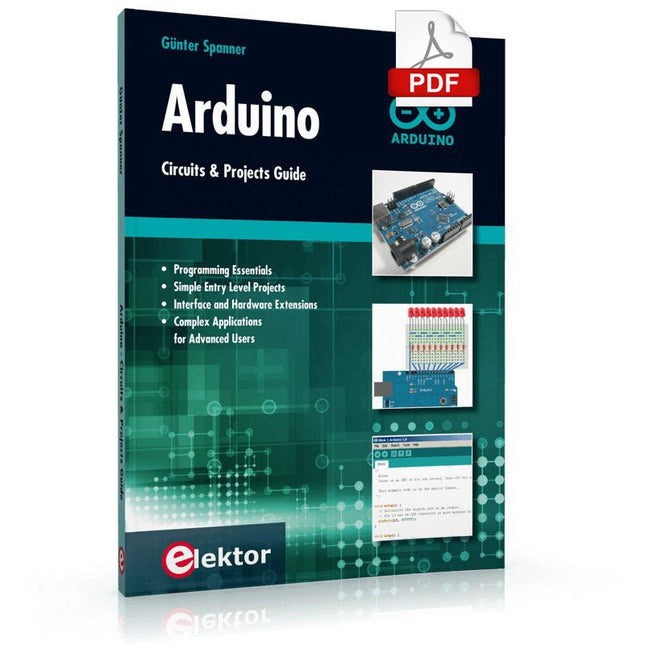
Elektor Digital Arduino – Circuits & Projects Guide (E-book)
Two reasons can be identified for the immense success of the Arduino platform. First, the cheap, ready to go processor board greatly simplifies the introduction to hardware. The second success factor is the free and open-source programming suite that does not require an installation procedure. Simple entry-level examples ensure rapid successes. Complex selection procedures for parameters like the microprocessor version or interface settings are not required. The first sample programs can be uploaded to the Arduino board, and tested, in a matter of minutes. The Arduino user is supported by an array of software libraries. However, the daily increasing volume of libraries poses initial problems to the newcomer, and the way ahead may be uncertain after a few entry-level examples. In many cases, detailed descriptions are missing, and poorly described projects tend to confuse rather than elucidate. Clear guidance and a single motto are missing, usually owing to the projects having been created by several different persons—all with different aims in mind. This book represents a different approach. All projects are presented in a systematical manner, guiding into various theme areas. In the coverage of must-know theory great attention is given to practical directions users can absorb, including essential programming techniques like A/D conversion, timers and interrupts—all contained in the hands-on projects. In this way readers of the book create running lights, a wakeup light, fully functional voltmeters, precision digital thermometers, clocks of many varieties, reaction speed meters, or mouse controlled robotic arms. While actively working on these projects the reader gets to truly comprehend and master the basics of the underlying controller technology.
€ 29,95
Membres : € 26,96
-
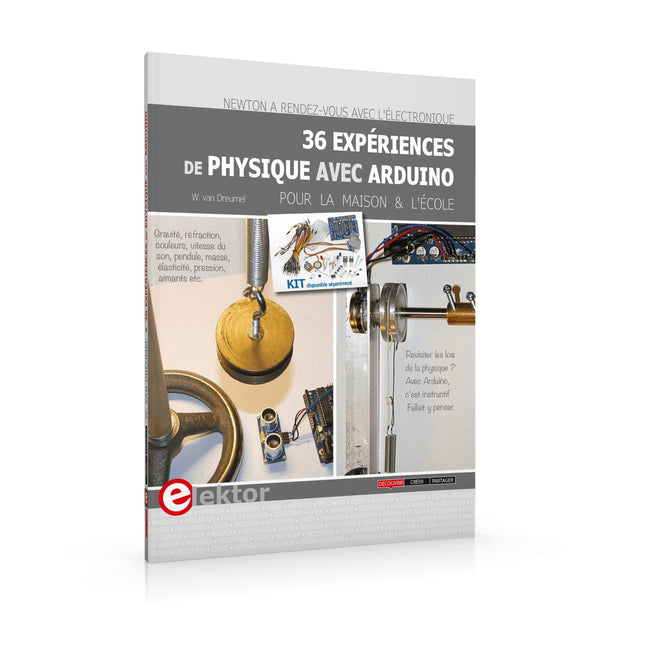
Elektor Digital 36 Expériences de Physique avec Arduino (E-book)
Points forts Un peu d'électronique et beaucoup d'experimentation : un livre ludique ! Gravité, réfraction, couleurs, vitesse du son, pendule, masse, élasticité, pression, aimants : une approche nouvelle et créative des leçons de physique Matériel peu coûteux et facilement disponible Logiciels gratuits Kit disponible séparément La rencontre de la physique et du microcontrôleur ne devrait plus étonner personne. Il existe d’excellents enregistreurs de données, ainsi que de nombreux programmes pour les traiter et les présenter sous forme de graphiques colorés et attrayants. La physique rébarbative, c’est fini ! J’ai choisi l’Arduino, car cette plate-forme est d’un accès facile et sa documentation abondante. La famille Arduino offre des ressources extraordinaires à un prix dérisoire. Ajoutez-y le logiciel gratuit CoolTerm, et vous pouvez enregistrer toutes les données de mesure pour les retravailler sous Excel et créer aisément des tableaux ou des graphiques. Ce livre n’est pas un manuel de physique. Vous n’y trouverez ni équations différentielles ni courbes abstraites. Nous étudierons des phénomènes physiques de la vie de tous les jours. Sans chercher à être exhaustif, mon modeste ouvrage apporte aux leçons de physique une approche nouvelle et créative grâce aux techniques modernes de mesure et de traitement des données. L’électronique utilisée est simple, et constitue une belle démonstration des possibilités.
€ 19,95
Membres : € 17,96
-

Elektor Digital Elektor January/February 2023 (PDF)
Elektor GREEN and GOLD members can download their digital edition here. Not a member yet? Click here. For Eyes and Ears Video Output with Microcontrollers (1)Composite Video electronica 2022News from the world’s leading electronics trade show ESP32 CameraSo Simple, It Doesn’t Even Have to Use Wi-Fi ATX Power Supply for Raspberry Pi 32 Ω Headphone AmplifierSimple But High-Quality 3-Chip Solution SDR Radio-Controlled clocksFive Time Signals, Six Displays Starting Out in ElectronicsSpecial Diodes From Life's ExperienceMusings on the Quality of Things Reverse-Engineering a Bluetooth Low Energy LED BadgeHow to Control a BLE Device with a Python Script MakePython ESP32 Development KitEverything in a Box THD Measurement with an Oscilloscope and FFTEasily Calculate the Distortion Factor All-Seeing MachinesThe Technology Behind Today’s Industrial Vision Systems Infographics The Evolution of Voice and Audio Control for Electronic Devices WEEF 2022 in Review FFWD electronica 2022 in ReviewInnovators Did Not Fail to Impress The TubeAn Unusual Tube Amplifier Biomaterial in Electronics: Ready or Not Opera Cake Antenna Switch for HackRF OneConnect Up To Eight Antennas To Your SDR Engineering with Arduino and MoreAn Interview with Author Ashwin Pajankar LiDAR Precision GaugeMeasure up to 12 Meters Audio Signals and the ESP32The ESP-ADF Environment in Practice Elektor Fortissimo-100 Power Amplifier Kit Using Light for Sound EffectsLDR-Based Voltage-Controlled 24 dB/oct Synthesizer Filter Elektor High-Power AF AmplifierThe Loudest of Them All! HomeLab ToursA Volumetric Display Made in Canada Err-lectronicsCorrections, Updates and Readers’ Letters Hexadoku
€ 7,50
-

Elektor Digital Elektor May/June 2021 (PDF) EN
DIY LiPo Supercharger KitFrom Handcrafted to Mass Market Elektor @ 60Reflections on Six Decades of Electronics Siglent Bench Multimeter SDM3045X DC Current-Sense ClampHall Sensor + Ferrite Core + Arduino Soldering Station 2021Easy to build! Hands On the Parallax Propeller 2Part 2: The Development Environment and Code Wi-Fi for LoRa SwitchIntegrated in Home Assistant with ESPHome Do Not Fear the Cellular Module! Tracking Time with ESP32 and TogglWorking with the M5Stack Get to Know the Raspberry Pi Pico Board and RP2040 MicroPython for MicrocontrollersSmall-Format Screens 12-to-200-V DC/DC Converter for Valve Amplifiers Heat SeekerThe Seek Shot Pro Thermal Imaging Camera Object-Oriented Programming: A Short Primer Using C++ HomeLab ToursHome Lab and an Analogue Synthesiser by Kurt Diedrich Java on the Raspberry PiPart 1: GPIOs DIP SwitchesPeculiar Parts, the series Project 2.0Corrections, Updates and Readers’ Letters Whose Product Is It Anyway?Right to Repair Gains Momentum From Life's ExperienceThe Great Book of Blunders Micro-ProfessorLearning Assembly Language on a Z80 Starting out in ElectronicsEasier Than Imagined! Even When It Is About Capacitors HexadokuThe Original Elektorized Sudoku
€ 7,50
-

Elektor Digital Red Pitaya for Test and Measurement (E-book)
The Red Pitaya (STEMlab) is a credit card-sized, open-source test and measurement board that can be used to replace most measurement instruments used in electronics laboratories. With a single click, the board can transform into a web-based oscilloscope, spectrum analyser, signal generator, LCR meter, Bode plotter, and microcontroller. The Red Pitaya (STEMlab) can replace the many pieces of expensive measurement equipment found at professional research organisations and teaching laboratories. The device, that based on Linux, includes an FPGA, digital signal processing (DSP), dual core ARM Cortex processor, signal acquisition and generation circuitry, micro USB socket, microSD card slot, RJ45 socket for Ethernet connection, and USB socket – all powered from an external mains adaptor. This book is an introduction to electronics. It aims to teach the principles and applications of basic electronics by carrying out real experiments using the Red Pitaya (STEMlab). The book includes many chapters on basic electronics and teaches the theory and use of electronic components including resistors, capacitors, inductors, diodes, transistors, and operational amplifiers in electronic circuits. Many fun and interesting Red Pitaya (STEMlab) experiments are included in the book. The book also makes an introduction to visual programming environment. The book is written for college level and first year university students studying electrical or electronic engineering.
€ 29,95
Membres : € 26,96
-
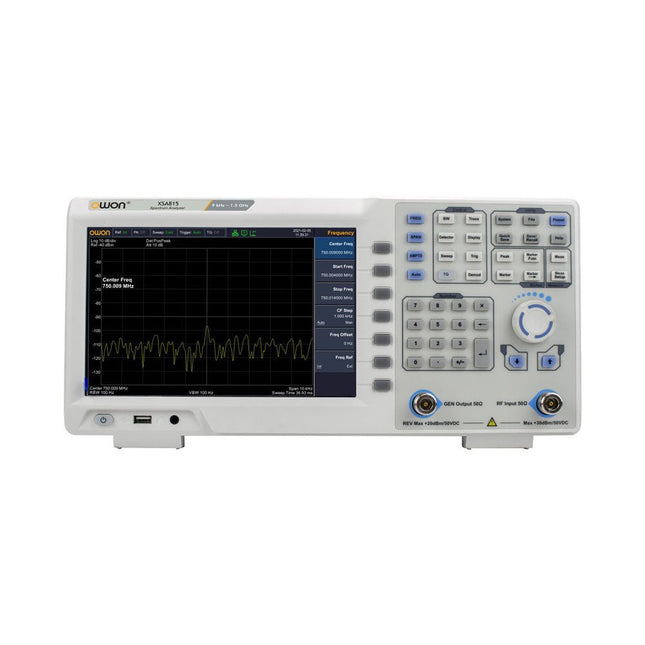
OWON OWON XSA815-TG Spectrum Analyzer (9 kHz – 1.5 GHz)
L'OWON XSA815-TG de 9 kHz à 1,5 GHz est un analyseur de spectre économique avec générateur de poursuite inclus et une résolution de fréquence de 1 Hz. Caractéristiques Plage de fréquence de 9 kHz à 1,500009 GHz Écran de 9 pouces Niveau moyen d'affichage du bruit (DANL) de -95 dBm de 9 kHz à 1 MHz, -140 dBm (typique), Phase bruit -10 kHz 100 kHz 1 MHz Bande passante de résolution (-3 dB) : de 1 Hz à 1 MHz, selon une séquence de 1-3-5-10 Kit de générateur de poursuite : de 100 kHz à 1,500009 GHz Spécifications Plage de fréquence 9 kHz à 500.009 MHz Résolution de fréquence 1 Hz Étendue de fréquence 9 kHz à 1,500009 GHz Plage d'étendue 0 Hz, de 100 Hz à la fréquence maximale de l'instrument Incertitude de l'étendue ± étendue / (points de balayage - 1) Phase bruit SSB (20°C à 30°C, fc=1 GHz) Décalage du porteuse 10 kHz Bande passante de résolution (-3 dB) de 1 Hz à 1 MHz, selon une séquence de 1-3-5-10 Précision de la bande passante de résolution Facteur de forme du filtre de résolution (60 dB : 3 dB) Bande passante vidéo (-3 dB) de 10 Hz à 1 MHz, selon une séquence de 1-3-5-10 Plage de mesure d'amplitude DANL à +10 dBm, de 100 kHz à 10 MHz, préamplificateur désactivé DANL à +20 dBm, de 10 MHz à 1,5 GHz, préamplificateur désactivé Niveau de référence -80 dBm à +30 dBm, 0,01 dB par étape Préamplificateur 20 dB, nominal, de 100 kHz à 1,5 GHz Atténuateur d'entrée de 0 à 40 dB, 1 dB par étape Niveau moyen d'affichage du bruit (DANL) Atténuation d'entrée = 0 dB, RBW = VBW = 100 Hz, détecteur d'échantillonnage, moyenne de trace ≥ 50, de 20°C à 30°C, impédance d'entrée = 50 Ω) Préamplificateur désactivé de 9 kHz à 1 MHz -95 dBm (typique), Préamplificateur désactivé de 1 MHz à 500 MHz -140 dBm (typique), Préamplificateur activé de 100 kHz à 1 MHz -135 dBm (typique), Préamplificateur activé de 1 MHz à 500 MHz -160 dBm (typique), Générateur de poursuite (en option) Plage de fréquence de 100 kHz à 1,500009 GHz Plage de niveau de puissance de sortie de -40 dBm à 0 dBm Résolution de niveau de sortie 1 dB Platitude de sortie Par rapport à 50 MHz | ±3 dB Spurious du générateur de poursuite Parasite harmonique -30 dBc (Puissance de sortie du générateur de poursuite -10 dBm) Parasite non-harmonique -40 dBc (Puissance de sortie du générateur de poursuite -10 dBm) Isolation entre le générateur de poursuite et la borne d'entrée -60 dB (Puissance de sortie du générateur de poursuite 0 dBm) Isolation entre le générateur de poursuite et la borne d'entrée -60 dB (Puissance de sortie du générateur de poursuite 0 dBm) Isolation entre le générateur de poursuite et la borne d'entrée -60 dB (Puissance de sortie du générateur de poursuite 0 dBm) Dimensions 375 x 185 x 120 mm Poids 3,7 kg Inclus 1x XSA815-TG 1x Câble d'alimentation 220 V AC 1x Câble USB 1x Guide de démarrage rapide Téléchargements Guide Rapide Spécifications
€ 900,00
-

Elektor Digital Elektor July/August 2022 (PDF)
Measuring Does Not Have to be Expensive Low-Cost Audio TesterUsing PC-Based Software and a USB Audio Interface AC Grid Frequency MeterMonitor Mains Frequency and Voltage A Modest Inductance MeterAn Affordable Solution for Your Workbench Acoustic Wave HoveringA Look at the Makerfabs Acoustic Levitation Kit Starting Out in ElectronicsRectifiers E-FFWD: Looking Ahead Again! Get Started With Your OscilloscopeFind Your Way Through the Knobs and Buttons Raspberry Pi Pico Makes an MSF-SDRDecode a Time Signal with a Pi Pico SDR Moisture Sensors for Watering SystemsAutomatic Watering Disruption in Test and Measurement EquipmentInnovation from the Smaller Players Infographics 7-8/2022 Inspiration, That’s What It’s All AboutInterview with Entrepreneur Walter Arkesteijn, InnoFaith Beauty Sciences Minimizing EMC Interference from Storage Chokes GUIs with Python (Part 5)Tic-Tac-Toe Reed RelaysPeculiar Parts, the series Simple Analog ESR Meter With Moving-Coil Meter Precision Sigfox CO2 Traffic LightNo Wi-Fi Network Needed! Women in Tech“It's All About Merit Until Merit Has Tits” Low-Budget Tablet Oscilloscope ADS1013DGood Value for Money? Smart Plug TeardownWhich Ones Are Hacker-Friendly? Skin Impedance and Skin CapacitanceSmall Experiments From Life’s ExperienceNo Local Business Pokit Meter ReviewA Swiss army knife of test gear HexadokuThe Original Elektorized Sudoku
€ 7,50
-
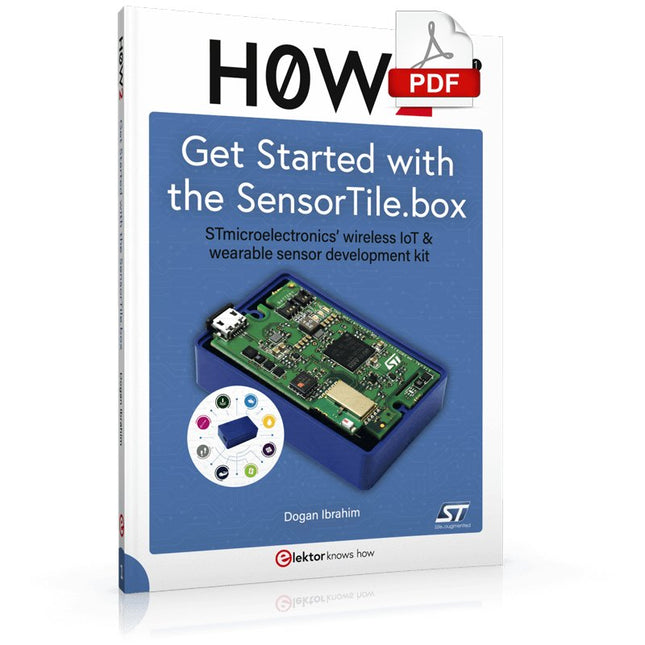
Elektor Digital H0W2: Get Started with the SensorTile.box (E-book)
STmicroelectronics’ wireless IoT & wearable sensor development kit ‘SensorTile.box’ is a portable multi-sensor circuit board housed in a plastic box and developed by STMicroelectronics. It is equipped with a high-performance 32-bit ARM Cortex-M4 processor with DSP and FPU, and various sensor modules, such as accelerometer, gyroscope, temperature sensor, humidity sensor, atmospheric pressure sensor, microphone, and so on. SensorTile.box is ready to use with wireless IoT and Bluetooth connectivity that can easily be used with an iOS or Android compatible smartphone, regardless of the level of expertise of the users. SensorTile.box is shipped with a long-life battery and all the user has to do is connect the battery to the circuit to start using the box. The SensorTile.box can be operated in three modes: Basic mode, Expert mode, and Pro mode. Basic mode is the easiest way of using the box since it is pre-loaded with demo apps and all the user has to do is choose the required apps and display or plot the measured data on a smartphone using an app called STE BLE Sensor. In Expert mode users can develop simple apps using a graphical wizard provided with the STE BLE Sensor. Pro mode is the most complex mode allowing users to develop programs and upload them to the SensorTile.box. This book is an introduction to the SensorTile.box and includes the following: Brief specifications of the SensorTile.box; description of how to install the STE BLE Sensor app on an iOS or Android compatible smartphone required to communicate with the box. Operation of the SensorTile.box in Basic mode is described in detail by going through all of the pre-loaded demo apps, explaining how to run these apps through a smartphone. An introduction to the Expert mode with many example apps developed and explained in detail enabling users to develop their own apps in this mode. Again, the STE BLE Sensor app is used on the smartphone to communicate with the SensorTile.box and to run the developed apps. The book then describes in detail how to upload the sensor data to the cloud. This is an important topic since it allows the sensor measurements to be accessed from anywhere with an Internet connection, at any time. Finally, Pro mode is described in detail where more experienced people can use the SensorTile.box to develop, debug, and test their own apps using the STM32 open development environment (STM32 ODE). The Chapter explains how to upload the developed firmware to the SensorTile.box using several methods. Additionally, the installation and use of the Unicleo-GUI package is described with reference to the SensorTile.box. This PC software package enables all of the SensorTile.box sensor measurements to be displayed or plotted in real time on the PC.
€ 29,95
Membres : € 26,96
-

iFixit iFixit iOpener Toolkit
Les appareils électroniques sont de plus en plus souvent équipés d'écrans et de batteries collés. Et si le joint adhésif sert de protection contre la saleté et l'eau, il complique la procédure d'ouverture de l'appareil et donc sa réparation. L'iOpener : Réchauffez-le, décollez la colle ! Grâce à notre iOpener, vous pouvez facilement et rapidement décoller l'adhésif sans risquer d'endommager votre appareil à cause d'une surchauffe avec un pistolet thermique. Conçu à l'origine pour ouvrir les iPad d'Apple, l'iOpener convient tout aussi bien aux tablettes Samsung, aux smartphones Sony et aux appareils de tout autre fabricant qui préfère l'adhésif aux vis. Comment ça marche ? Chauffez l'iOpener et placez-le sur votre appareil : il suffit de chauffer l'iOpener au micro-ondes ou dans une casserole d'eau bouillante et de le placer sur le bord de votre appareil. La chaleur va ramollir l'adhésif sans endommager votre gadget afin que vous puissiez insérer un pic d'ouverture entre l'écran et le boîtier. Répétez cette procédure pour toutes les zones collées, l'iOpener est réutilisable un nombre illimité de fois. Utilisez les outils d'ouverture pour enlever les résidus d'adhésif : avec les bons outils, vous êtes maintenant prêt à ouvrir votre appareil sans problème. Les outils d'ouverture sont suffisamment tranchants pour couper les bandes adhésives. Complétez la procédure d'ouverture en faisant levier sur le boîtier avec un outil d'ouverture ou soulevez votre écran avec une ventouse ou un iSclack. Un outil indispensable pour les réparations électroniques La partie la plus ennuyante de votre réparation est faite, le reste sera presque un jeu d'enfant. Que vous soyez débutant ou professionnel, l'iOpener devrait faire partie intégrante de toute boîte à outils digne de ce nom. Vos avantages Détachement des fixations adhésives Simple à réchauffer au micro-ondes ou à l'eau bouillante Réutilisable Disponible en option avec des outils d'ouverture Contient de la glycérine de qualité alimentaire Économise de l'argent et protège la planète Inclus iOpener Spatule antistatique Outil d'ouverture iFixit 6x Pics d'ouverture iFixit Aiguille d'isolation de batterie iFixit Cartes en plastique Ventouse Pince à épiler coudée Tournevis en plastique avec embout magnétique (4 mm), poignée caoutchoutée et capuchon pivotant Embouts de précision (4 mm) Phillips #00 Tête plate 2,5 mm
€ 24,74
-

Elektor Digital Elektronik-Grundlagen und Einsteiger-Projekte (livre électronique)
Elektronik-Grundlagen und Einsteiger-Projekte (livre électronique)
€ 32,80
Membres : € 29,52
-

Raspberry Pi Foundation Câble de caméra FPC pour Raspberry Pi 5 (500 mm)
Raspberry Pi 5 fournit deux connecteurs MIPI à quatre voies, chacun pouvant prendre en charge une caméra ou un écran. Ces connecteurs utilisent le même format FPC « mini » à 22 voies au pas de 0,5 mm que le kit de développement de module de calcul et nécessitent des câbles adaptateurs pour se connecter aux connecteurs au format « standard » à 15 voies au pas de 1 mm du Raspbery Pi actuel. produits d'appareil photo et d'affichage. Ces câbles adaptateurs mini vers standard pour caméras et écrans (notez qu'un câble de caméra ne doit pas être utilisé avec un écran, et vice versa) sont disponibles en longueurs de 200 mm, 300 mm et 500 mm.
€ 3,95€ 1,95Meilleur prix
-

Elektor Digital Elektor 05-06/2023 PDF (DE)
Diese Ausgabe steht allen GOLD- und GREEN-Mitgliedern auf der ElektorMagazine-Website zum Download bereit! Sie sind noch kein Mitglied? Hier klicken! Super-Servo-TesterBis zu vier Servos einzeln oder eingebaut testen Analoge Signale und der MikrocontrollerADCs, DACs, Strommessung und mehr embedded world 2023 Sub-Nyquist-Sampling in der PraxisHöhere Frequenzen mittels Unterabtastung sicher erfassen Hier Android-Smartphone, dort ESP32?Praxisprojekt mit der Android WiFi-API Aktives 1-kHz-Filter für VerzerrungsmessungenBessere Messungen durch Optimierung des Messsignals Aller Anfang...muss nicht schwer sein: Wir multivibrieren weiter! Projekt 2.0Korrekturen, Updates und Leserbriefe Das neue I3C-ProtokollWürdiger I2C-Nachfolger oder viel Rauch um Nichts? BlueRC: IR-Fernsteuerung mit Smartphone und ESP32Anpassungsfähig und universell Mikrocontroller-Dokumentationen verstehenTeil 2: Register und Blockschaltbilder Automatisierung der Prüf- und MesstechnikProgrammieren von Prüfgeräten, damit sie tun, was Sie wollen Infografik: Messen und Testen Überspannungsschutz für sicheren BetriebTransientenschutz für nicht-isolierte DC/DC-Leistungsmodule Mess- und Prüfgeräte von WihaInstallationstester und Messgeräte, auf die Sie sich verlassen können Automatisierung von Tests und Zusammenarbeit bei Testergebnissen Aus dem Leben gegriffenElektronik auf hohem Niveau EnergieloggerEnergie messen und aufzeichnen Aufgebaut: Das 4tronix M.A.R.S. Rover Kit Parkscheibe mit E-Paper DisplayEin innovativer digitaler Ersatz eCO2-Telegram-BotLuftqualitätsmessung mit Telegram-Anbindung Hinter den Kulissen von High-End-Audio im EigenbauElektor-Ingenieur Ton Giesberts im Interview über die hohe Kunst des Analogdesigns Das besondere ProjektEs gibt noch viel zu tun! RFID-Tag lesen und RFID-TürschlossProjektbeispiele aus dem Arduino-Experimentierpaket von Elektor Oszilloskop-Stromsonde für HFHochfrequenz-Strommessung leichtgemacht Nichts für Anfänger – Makerfabs 6 DOF Robot ArmMit Raspberry Pi Pico und MicroPython Generative KIWer hat das eigentlich gemacht? Hexadoku
€ 11,90


