
Résultats de la recherche pour "mains OR outage OR detector OR kit OR 160372 OR 91"
-
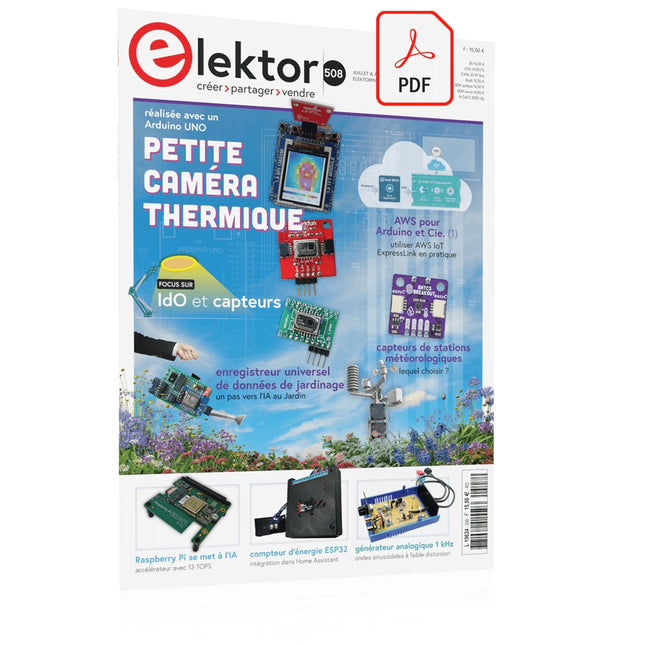
Elektor Digital Elektor Juillet/Août 2024 (PDF)
Le téléchargement intégral de ce numéro est disponible pour nos membres GOLD et GREEN sur le site Elektor Magazine ! Pas encore membre ? Cliquez ici. petite caméra thermiqueréalisée avec un Arduino UNO mise à jour du projet #3 : compteur d'énergie basé sur l'ESP32intégration et test avec Home Assistant 2024 : l'odyssée de l'IAaméliorer la détection d'objets : intégration de techniques avancées Raspberry Pi se met à l'IAun nouveau kit comprenant un accélérateur IA matériel et un adaptateur M.2 HAT+ capteurs de stations météorologiqueslequel choisir ? Relevé des compteurs d'eau basé sur l'IA (1)intégrez votre ancien compteur dans l'IdO ! une alarme GSMun module GSM protège votre garage à distance optimisation et contrôle des appareils Thread à faible consommation d'énergiefaible consommation... peu d’effort ? sur le vifmontrez-moi là où ça fait mâle chambre à brouillard à faire soi-mêmevisualiser les rayonnements invisibles SparkFun Thing Plus Mattercarte de développement IdO polyvalente basée sur Matter Rétroéquipement IoTAdaptation des machines à interface RS232 à l'industrie 4.0 ajouter l’IoT grâce aux microcontrôleurs 8 bits la technologie au service du développement durableles avancées technologiques favorisent une utilisation plus efficace de l’énergie dans de nombreuses applications AWS pour Arduino et Cie. (1)utiliser AWS IoT ExpressLink en pratique détecteur de flux d'air Arduinoaucun capteur externe n'est nécessaire ! détecteur de fuite d'eauconnecté à l’Arduino Cloud le quartzdrôle de composant, la série enregistreur universel de données de jardinageun pas vers l’Intelligence Artificielle au Jardin. un générateur analogique 1 kHzondes sinusoïdales à faible distorsion Miletus : utiliser les applications Web hors ligneaccès aux fonctions de l’appareil et du système de la 4G à la 5Gest-ce une étape si facile à franchir ? démarrer en électronique…connexions symétriques
€ 10,95
-

Elektor Digital Elektor January/February 2023 (PDF)
Elektor GREEN and GOLD members can download their digital edition here. Not a member yet? Click here. For Eyes and Ears Video Output with Microcontrollers (1)Composite Video electronica 2022News from the world’s leading electronics trade show ESP32 CameraSo Simple, It Doesn’t Even Have to Use Wi-Fi ATX Power Supply for Raspberry Pi 32 Ω Headphone AmplifierSimple But High-Quality 3-Chip Solution SDR Radio-Controlled clocksFive Time Signals, Six Displays Starting Out in ElectronicsSpecial Diodes From Life's ExperienceMusings on the Quality of Things Reverse-Engineering a Bluetooth Low Energy LED BadgeHow to Control a BLE Device with a Python Script MakePython ESP32 Development KitEverything in a Box THD Measurement with an Oscilloscope and FFTEasily Calculate the Distortion Factor All-Seeing MachinesThe Technology Behind Today’s Industrial Vision Systems Infographics The Evolution of Voice and Audio Control for Electronic Devices WEEF 2022 in Review FFWD electronica 2022 in ReviewInnovators Did Not Fail to Impress The TubeAn Unusual Tube Amplifier Biomaterial in Electronics: Ready or Not Opera Cake Antenna Switch for HackRF OneConnect Up To Eight Antennas To Your SDR Engineering with Arduino and MoreAn Interview with Author Ashwin Pajankar LiDAR Precision GaugeMeasure up to 12 Meters Audio Signals and the ESP32The ESP-ADF Environment in Practice Elektor Fortissimo-100 Power Amplifier Kit Using Light for Sound EffectsLDR-Based Voltage-Controlled 24 dB/oct Synthesizer Filter Elektor High-Power AF AmplifierThe Loudest of Them All! HomeLab ToursA Volumetric Display Made in Canada Err-lectronicsCorrections, Updates and Readers’ Letters Hexadoku
€ 7,50
-
Elektor Digital Internet of Things (E-book)
The Internet of Things (IoT) is a new concept in intelligent automation and intelligent monitoring using the Internet as the communications medium. The “Things” in IoT usually refer to devices that have unique identifiers and are connected to the Internet to exchange information with each other. Such devices usually have sensors and/or actuators that can be used to collect data about their environments and to monitor and control their environments. The collected data can be processed locally or it can be sent to centralized servers or to the cloud for remote storage and processing. For example, a small device at the size of a matchbox can be used to collect data about the temperature, relative humidity and the atmospheric pressure. This data can be sent and stored in the cloud. Anyone with a mobile device can then access and monitor this data at any time and from anywhere on Earth provided there is Internet connectivity. In addition, users can for example, adjust the central heating remotely using their mobile devices and accessing the cloud. This book is written for students, for practising engineers and for hobbyists who want to learn more about the building blocks of an IoT system and also learn how to setup an IoT system using these blocks. Chapter 1 is an introduction to the IoT systems. In Chapter 2, the basic concepts and possible IoT architectures are discussed. The important parts of any IoT system are the sensors and actuators and they are described briefly in Chapter 3. The devices in an IoT system usually communicate with each other and the important aspect of IoT communication is covered in Chapter 4. Chapter 5 proceeds with the features of some of the commonly used development kits. One of these, the Clicker 2 for PIC18FJ manufactured by mikroElektronika, can be used as a processor in IoT systems and its features are described in detail in Chapter 6. A popular microcontroller C language, mikroC Pro for PIC gets introduced in Chapter 7. Chapter 8 covers the use of a click board with the Clicker 2 for PIC18FJ development kit. Similarly, the use of a sensor click board is described as a project in Chapter 9, and an actuator board in Chapter 10. Chapters 11 and 12 cover Bluetooth and Wi-Fi technologies in microcontroller based systems, and the remaining chapters of the book demo the creation of a simple Wi-Fi based IoT system with cloud-based data storage. This book has been written with the assumption that the reader has taken a course on digital logic design and has been exposed to writing programs using at least one high-level programming language. Knowledge of the C programming language will be very useful. Also, familiarity with at least one member of the PIC series of microcontrollers (e.g. PIC16 or PIC18) will be an advantage. The knowledge of assembly language programming is not required because all the projects in the book are based on using the C language. If you are a total beginner in programming you can still access the e-book, but first you are advised to study introductory books on microcontrollers.
€ 34,95
Membres : € 31,46
-

Elektor Digital Elektor November/December 2024 (PDF)
Elektor GREEN en GOLD leden kunnen deze uitgave hier downloaden. Nog geen lid? Klik hier om een lidmaatschap af te sluiten. Audio DSP FX Processor Boarddeel 1: eigenschappen en ontwerp 50 jaar Elektor in het Engels KiCad 8belangrijkste nieuwe en vernieuwde functies Elektor @ elektronica 2024electronica Fast Forward 2024, Experts on Stage, Influencer Forums, Live Elektor Lab Talk Shows en meer Elektor MultiCalculator KitArduino-gebaseerde DHZ-calculator voor elektronici Goedkope GNSS RTK-systemenmet centimeter-nauwkeurigheid Printlayout en veiligheidtips voor een veilig en duurzaam ontwerp van uw printen Opamp-testervoor audio en andere toepassingen Project-update #4: ESP32-gebaseerde energiemeterenergiemonitoring met MQTT Real-time spectrumanalyzer met golfgeleider-technologie en multi-interface PC’sAaronia introduceert nieuw productsegment en presenteert eerste prototypes op electronica in München SMT-spoelenspoelen en ferrieten – selectie gemakkelijk gemaakt EMC-conformiteit bereiken met EMI-afscherming De perfecte tool voor elke elektronicaliefhebbereindeloze mogelijkheden met Red Pitaya en 1.000+ Click Boards™ HDI in het middeneen nieuwe kosteneffectieve PCB-poolingservice voor kleine BGA’s Uitdagingen van DFM-analyse voor flex- en rigid-flex-ontwerpen Open source-toolsantennesimulator, componentenbeheer, rekenmachine en meer Elektor infographicprototyping en productie Uit het leven gegrepenmicrotechnofobie 3D-kerstboomdriedimensionale print met een goedkope 32 bit-microcontroller Alle begin......houdt nog lang niet op(amp)! Autonome sensor-node (project-update #1)RTC en voedingsschakelaar 2024: een AI-odysseeeen terugblik op de toekomst LED-displays met de MAX7219aan de slag met een grandioze chip Project 2.0correcties, updates en brieven van lezers Vibrotactiele handschoenendoorbraak voor Parkinson-patiënten
€ 9,95
-

Elektor Digital Elektor Maart/April 2025 (PDF) NL
Elektor GREEN en GOLD leden kunnen deze uitgave hier downloaden. Nog geen lid? Klik hier om een lidmaatschap af te sluiten. De open-source processorarchitectuur RISC-V16 boards en MCU's die je moet kennen Een FPGA-gebaseerde audiospeler met equalizer (1)Digitaal audio mixen met een Arduino MKR Vidor 4000 Laserkop voor pico-gebaseerde zandklokTekenen met licht Doe mee aan de STM32 Edge AI Contest Een multi-sensor plantenmonitor-systeemdraadloze meting van watertoevoer en lichtomstandigheden Maixduino AI-gestuurde automatische portiergezichtsdetectie met een camera Embedded Electronics 2024AI gaat de industrie opnieuw vormgeven Lading-gebaseerde in-Memory computing bij EnCharge AI AI-Inferentie met 10 Keer Lager Energieverbruik en 20 Keer Lagere Kosten Click board ondersteunt het ontwikkelen en trainen van ML-modellen voor trillingsanalyse De Elektor Mini-WheelieEen kit voor een zelfbalancerende robot MCU, ik zie jeMCUViewer: open-source multiplatform debugging-tool USB 2.0-isolatorelektrisch geïsoleerde USB-aansluiting Voorkomen is betervoorspellend onderhoud in de praktijk SPoE – Elektromagnetische compatibiliteitSingle pair met Power-over-Ethernet door de ogen van EMC Retro techEen nieuwe wereld met kleurentelevisie ECG-monitorimplementatie met Hexabitz-modules en een STM32CubeMonitor De strijd om AI aan de edge Met HaLow Wi-Fi is een record afstand bereikt van 16 km op 900 MHz Eerste CHERI RISC-V Embedded Chip en Early Access programma Derde generatie bosbranddetectie maakt gebruik van satellietverbindingen Uit het leven gegrepenkeuzestress Alle begin......filtert verder en regelt tonen Quasi-analoog uurwerkwedergeboorte van een Elektor-klassieker Een modulaire sensortesterSensor-evaluatieboard met ESP32-S3 2025: Een AI-OdysseeDe opkomst van foundation modellen en hun rol in het democratiseren van AI Raspberry Pi standalone MIDI-synthesizer (1)voorbereiding van een platform voor enkele edge-AI-experimenten Err-lectronicsCorrecties, updates en brieven van lezers Universele AI RISC-V processor doet ze allemaal - CPU, GPU, DSP, FPGA Interview met de CEO: Ventiva's dunne en coole technologie Dual-core programmeren met een Raspberry Pi Picoduik in de wereld van parallel programmeren
€ 9,95
-

Elektor Special: Robotik und Automatisierung
KI in der Praxis Tauchen Sie ein in die faszinierende Welt der Robotik und Automatisierung! Dieses Elektor Special zeigt, wie Sie mit Kreativität, etwas Know-how und günstiger Technik eigene Roboter bauen können. Vom ersten DIY-Projekt mit Arduino oder Raspberry Pi bis hin zu intelligenten Systemen mit KI – dieses Heft macht moderne Robotik verständlich und greifbar. Entdecken Sie praxisnahe Anleitungen, inspirierende Projekte und spannende Einblicke in die Maker-Szene. Lernen Sie, wie aus Experimentierfreude, Gemeinschaft und Offenheit echte Innovation entsteht – und warum Robotik weit mehr ist als nur ein technisches Hobby. Inhalt Phantasie wird Realität Arduino-controlled Drawing Robot GalaxyRVR Mars Rover Kit for Arduino YDLIDAR X4Pro Lidar xHuskyLens AI Camera DOF Robot Arm mit Raspberry Pi Pico Fertigungsroboter mit Fischertechnik Pneumatischer Industrieroboter Warum bauen wir immer wieder Roboterhunde? Elektor Mini-Wheelie Roboterfahrzeuge und autonomes Fahren
€ 15,90
Membres : € 14,31
-
Elektor Digital ARM Microcontroller Projects (E-book)
It is becoming important for microcontroller users to quickly learn and adapt to new technologies and architecture used in high performance 32-bit microcontrollers. Many manufacturers now offer 32-bit microcontrollers as general purpose processors in embedded applications. ARM provide 32 and 64-bit processors mainly for embedded applications. These days, the majority of mobile devices including mobile phones, tablets, and GPS receivers are based on ARM technology. The low cost, low power consumption, and high performance of ARM processors makes them ideal for use in complex communication and mixed signal applications. This book makes use of the ARM Cortex-M family of processors in easy-to-follow, practical projects. It gives a detailed introduction to the architecture of the Cortex-M family. Examples of popular hardware and software development kits are described. The architecture of the highly popular ARM Cortex-M processor STM32F107VCT6 is described at a high level, taking into consideration its clock mechanisms, general input/output ports, interrupt sources, ADC and DAC converters, timer facilities, and more. The information provided here should act as a basis for most readers to start using and programming the STM32F107VCT6 microcontroller together with a development kit. Furthermore, the use of the mikroC Pro for ARM integrated development environment (IDE) has been described in detail. This IDE includes everything required to create a project; namely an editor, compiler, simulator, debugger, and device programmer. Although the book is based on the STM32F107VCT6 microcontroller, readers should not find it difficult to follow the projects using other ARM processor family members.
€ 34,95
Membres : € 31,46
-

UFactory UFactory uArm Swift Pro
Le uArm Swift Pro est un bras robotique de haute qualité qui peut être utilisé dans un large éventail d'applications. Le uArm Swift Pro a été développé et optimisé pour une utilisation dans l'enseignement, ce qui signifie que de nombreux packages sont déjà disponibles pour les plateformes open source telles que ROS. Le uArm Swift Pro a une répétabilité de position de 0,2 mm et est également équipé d'un moteur pas à pas et d'un encodeur 12 bits. Ce ne sont là que quelques-unes des raisons qui font du uArm Swift Pro un excellent choix pour une utilisation pédagogique. Le kit d'impression 3D, qui permet de convertir le uArm Swift Pro en imprimante 3D en moins d'une minute, est une autre caractéristique intéressante. L'uArm peut être utilisé avec les plateformes/systèmes de développement suivants : SDK UFACTORY Arduino Python ROS GRABCAD OpenMV Application pour smartphone L'application pour smartphone iOS est déjà disponible dans l’App Store et permet de contrôler et de surveiller facilement le bras robotique. L'application pour Android est en cours de développement et sera bientôt disponible. Un exemple de vision industrielle Le GIF suivant montre l'uArm en combinaison avec l'OpenMV Machine Vision Cam M7 et les applications de reconnaissance faciale qui peuvent être mises en œuvre en MicroPython. Spécifications Degrés de liberté : 4 Répétabilité : Jusqu'à 0,2 mm Charge utile : 500 g Plage de travail : 50-320 mm Vitesse de positionnement : 100 m/s Retour de position : codeur 12 bits Dimensions : 150 x 140 x 281 mm 150 x 140 x 281 mm Poids : 2,2 kg Inclus UFactory uArm Swift Pro Body Bluetooth & Pince à vide Téléchargements Fiche technique
€ 939,00
Meilleur prix
-
Elektor Digital EAGLE V6 Getting Started Guide (E-book)
Whether you are an electronics enthusiast or engineering professional, this book provides the reader with an introduction to the use of the CadSoft’s EAGLE PCB design software package. EAGLE is a user-friendly, powerful and affordable software package for the efficient design of printed circuit boards. It offers the same power and functionality to all users, at a smaller cost than its competitors. A free version of EAGLE is available to enthusiasts for their own use. EAGLE can be used on the main computing platforms including: Microsoft Windows (XP, Vista or Windows 7); Linux (based on kernel 2.6 or above) and Apple Mac OS X (Version 10.6 or higher). Any hardware that supports these software platforms will run the EAGLE application. The book is intended for anyone who wants an introduction to the capabilities of EAGLE. The reader may be a novice at PCB design or a professional wanting to learn about EAGLE, with the intention of migrating from another CAD package. This book will quickly allow you to: obtain an overview of the main modules of EAGLE: the schematic editor; layout editor and autorouter in one single interface; learn to use some of the basic commands in the schematic and layout editor modules of EAGLE; apply your knowledge of EAGLE commands to a small project; learn more about some of the advanced concepts of EAGLE and its capabilities; understand how EAGLE relates to the stages of PCB manufacture; create a complete project, from design through to PCB fabrication. The project discussed in the book is a popular, proven design from the engineering team at Elektor. After reading this book while practicing some of the examples, and completing the projects, the reader should feel confident about taking on more challenging endeavors.
€ 29,95
Membres : € 26,96
-
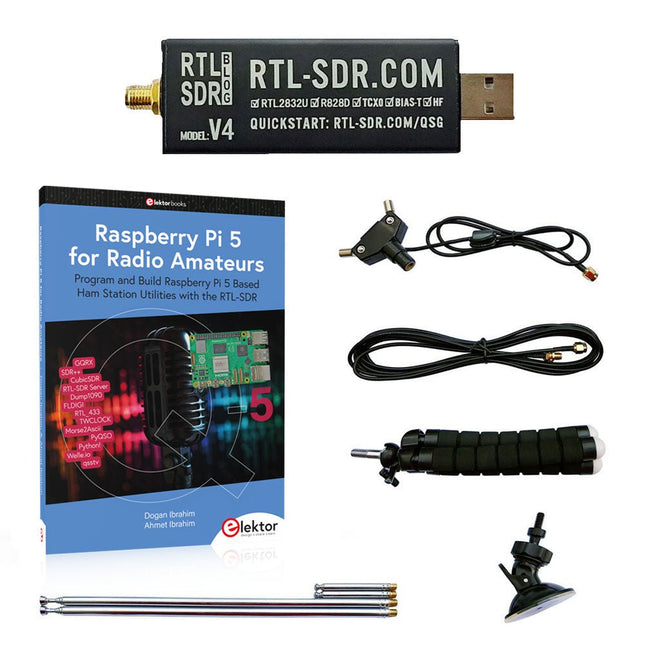
Elektor Bundles Raspberry Pi 5 RTL-SDR V4 (offre groupée)
Programmez et construisez des utilitaires, des outils et des instruments de station radio amateur basés sur Raspberry Pi ! La version améliorée du RTL-SDR V4 permet de recevoir des signaux radio entre 500 kHz et 1,75 GHz provenant de stations utilisant différentes bandes (notamment la diffusion en ondes courtes (SW), moyennes (MW) et longues (LW)), de services de radiodiffusions, de services publics de contrôle du trafic aérien, de PMR, de SRD, d'ISM, de CB, de satellites météorologiques et de radioastronomie. Le livre Raspberry Pi 5 for Radio Amateurs présente en détail l'utilisation du kit RTL-SDR avec un Raspberry Pi. Cette offre groupée contient : RTL-SDR V4 (avec kit d'antenne dipôle) (prix normal : 75 €) Raspberry Pi 5 for Radio Amateurs (prix normal : 40 €) RTL-SDR V4 (Software Defined Radio) avec kit antenne dipôle La clé RTL-SDR est un appareil au coût abordable qui peut être utilisé comme scanner radio associé à un ordinateur, pour recevoir les signaux radio locaux entre 500 kHz et 1,75 GHz. La version RTL-SDR V4 apporte plusieurs améliorations par rapport aux appareils de marques génériques, en particulier l’utilisation d’un chip tuner R828D, la présence d’un filtre d’entrée triplexé, d’un filtre coupe-bande, de composants aux tolérances améliorées, d’un oscillateur compensé en température à stabilité de 1 PPM (TCXO), d’un connecteur SMA F, d’un boitier en aluminium avec refroidissement passif, d’un circuit d’injection de tension continue en T, d’une alimentation améliorée, et d’un convertisseur HF élévateur. RTL-SDR V4 est fourni avec un kit antenne dipôle portable. C’est un atout pour débuter, car elle permet la réception des stations terrestres et des satellites. Son installation à l’extérieur est facile, elle est conçue pour un usage portable temporaire à l’extérieur. Caractéristiques Réception HF améliorée : V4 utilise maintenant un convertisseur élévateur au lieu d’un circuit échantillonneur direct. Cela évite le phénomène de fréquence de repli de Nyquist se situant vers 14,4 MHz, une meilleure sensibilité et un gain HF ajustable. Tout comme pour V3, la fréquence limite basse de réception est de 500 kHz, et un signal reçu très fort nécessite l’utilisation d’un filtre atténuateur en entrée. Filtrage amélioré : La V4 utilise le circuit de réception R828D qui possède trois entrées. L’entrée munie d’un connecteur SMA a été triplexée en 3 bandes : HF, VHF et UHF. Les trois bandes sont ainsi isolées, ce qui minimise la diminution de la sensibilité et la présence de fréquences images, provoquées par les interférences dues aux stations de radiodiffusions puissantes en dehors de la bande reçue. Filtrage x2 amélioré : En plus du triplexage, une broche d’entrée aboutissant à un drain ouvert peut être utilisée, permettant l’ajout d’un filtre coupe-bande pour éliminer les interférences sur les bandes de radiodiffusion AM, FM ou DAB. Un tel filtre permet d’obtenir une atténuation limitée à quelques décibels, mais demeure efficace. Amélioration du bruit de phase sur les signaux puissants : La conception améliorée de l’alimentation permet de réduire le bruit de phase provenant de celle-ci. Dissipation calorifique réduite : Autre avantage résultant de l’amélioration du circuit d’alimentation, la consommation électrique est réduite, minimisant de fait la génération de chaleur, par rapport à la V3. Inclus 1x Clé RTL-SDR V4 (R828D RTL2832U 1PPM TCXO SMA) 2x Antennes télescopiques de 23 cm à 1 m 2x Antennes télescopiques de 5 cm à 13 cm 1x Embase d’antenne équipée d’un câble RG174 de 60 cm 1x Câble prolongateur RG174 de 3 m 1x Trépied de montage flexible 1x Ventouse de fixation Téléchargements Datasheet User Guide Quick Start Guide SDR# User Guide Dipole Antenna Guide Livre : Raspberry Pi 5 for Radio Amateurs Les dispositifs RTL-SDR (V3 et V4) ont gagné en popularité parmi les radioamateurs en raison de leur faible coût et de leurs nombreuses fonctionnalités. Un système de base peut consister en un dispositif RTL-SDR USB (dongle) avec une antenne appropriée, un ordinateur Raspberry Pi 5, un adaptateur d'entrée-sortie audio externe USB et un logiciel installé sur l'ordinateur Raspberry Pi 5. Avec une installation aussi modeste, il est possible de recevoir des signaux allant d'environ 24 MHz à plus de 1,7 GHz. Ce livre s'adresse aux radioamateurs et aux étudiants en ingénierie électronique, ainsi qu'à toute personne souhaitant apprendre à utiliser le Raspberry Pi 5 pour construire des projets électroniques. Le livre convient aussi bien aux débutants qu'aux lecteurs expérimentés. Une certaine connaissance du langage de programmation Python est nécessaire pour comprendre et éventuellement modifier les projets présentés dans le livre. Chaque projet est accompagné d'un schéma fonctionnel, d'un schéma de circuit et d'une liste complète de programmes Python, ainsi que d'une description détaillée. Les programmes RTL-SDR populaires suivants sont examinés en détail et accompagnés de guides d'installation étape par étape pour une utilisation pratique sur un Raspberry Pi 5: SimpleFM GQRX SDR++ CubicSDR RTL-SDR Server Dump1090 FLDIGI Quick RTL_433 aldo xcwcp GPredict TWCLOCK CQRLOG klog Morse2Ascii PyQSO Welle.io Ham Clock CHIRP xastir qsstv flrig XyGrib FreeDV Qtel (EchoLink) XDX (DX-Cluster) WSJT-X L'application du langage de programmation Python sur la dernière plateforme Raspberry Pi 5 empêche l'utilisation des programmes du livre sur les versions plus anciennes des ordinateurs Raspberry Pi.
-

SunFounder Kit SunFounder Kepler (Kit de démarrage ultime pour Raspberry Pi Pico W)
Votre passerelle vers la programmation IoT et microcontrôleurs Avec plus de 450 composants et 117 projets en ligne, ce kit complet stimule votre créativité. Les tutoriels de Paul McWhorter rendent l'apprentissage agréable pour les débutants et les utilisateurs avancés. Ce kit prend en charge MicroPython, C/C++ et Piper Make, offrant ainsi diverses options de programmation. Explorez les capteurs, les actionneurs, les DEL et les écrans à cristaux liquides pour des possibilités de projets infinies. De la domotique à la robotique, ce kit vous accompagne dans votre voyage technologique. Caractéristiques Kit de démarrage IoT pour les débutants : Ce kit offre une riche expérience d'apprentissage de l'IoT pour les débutants. Avec plus de 450 composants, 117 projets et des leçons vidéo dirigées par des experts, ce kit rend l'apprentissage de la programmation des microcontrôleurs et de l'IoT attrayant et accessible. Leçons vidéo guidées par des experts : Le kit comprend 27 tutoriels vidéo réalisés par l'éducateur de renom Paul McWhorter. Son style engageant simplifie les concepts complexes, garantissant une expérience d'apprentissage efficace de la programmation des microcontrôleurs. Large gamme de matériel : Le kit comprend un large éventail de composants tels que des capteurs, des actionneurs, des LED, des LCD, etc., vous permettant d'expérimenter et de créer une variété de projets avec le Raspberry Pi Pico W. Prise en charge de plusieurs langues : Le kit offre une polyvalence avec la prise en charge de trois langages de programmation – MicroPython, C/C++ et Piper Make, offrant une expérience d'apprentissage de la programmation diversifiée. Assistance dédiée : Bénéficiez de notre assistance permanente, notamment d'un forum communautaire et d'une aide technique opportune pour une expérience d'apprentissage sans faille. Inclus Raspberry Pi Pico W Carte de montage Fils de liaison Résistance Transistor Condensateur Diode Module chargeur Li-Po 74HC595 TA6586 – Puce de pilote de moteur LED LED RVB Graphique à barres LED Affichage à 7 segments Affichage à 4 chiffres et 7 segments Matrice de points LED I²C LCD1602 Bande WS2812 RVB 8 LED Avertisseur sonore Moteur à courant continu Servomoteur Pompe à eau CC Relais Bouton Micro-interrupteur Interrupteur à glissière Potentiomètre Récepteur infrarouge Module de manette Clavier 4x4 Module MPR121 Module CRFM522 Photorésistance Thermistance Commutateur d'inclinaison Commutateur à lames Module de capteur de mouvement PIR Module de capteur de niveau d'eau Module à ultrasons Capteur d'humidité DHT11 Module MPU6050 Documentation Tutoriels en ligne en 3 langues (EN, DE et JP)


