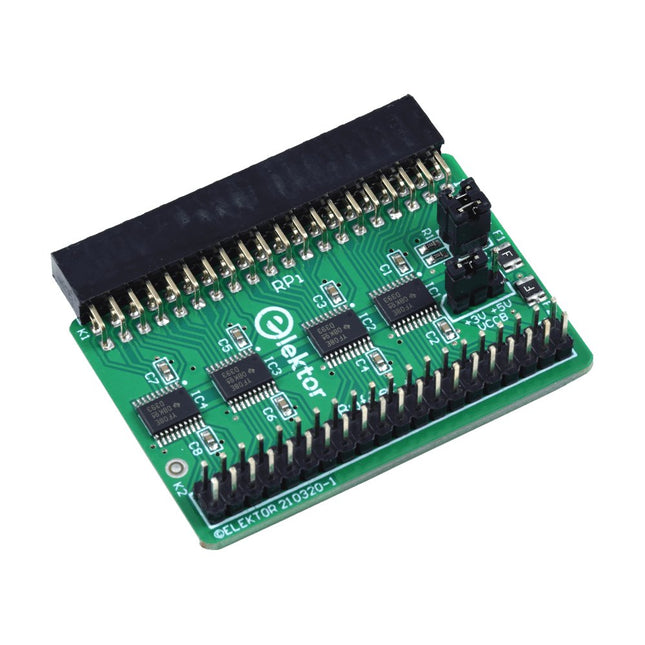
Lorsque vous expérimentez régulièrement avec le Raspberry Pi et que vous connectez une variété de matériel externe au port GPIO via le connecteur, il se peut que vous ayez causé des dommages par le passé. La carte tampon Raspberry Pi d'Elektor est là pour éviter cela ! La carte est compatible avec les Raspberry Pi Zero, Zero 2 (W), 3, 4, 5, 400 et 500.
Les 26 GPIO sont protégées par des convertisseurs de tension bidirectionnels afin de protéger le Raspberry Pi lors de l'expérimentation de nouveaux circuits. Le circuit imprimé est destiné à être inséré à l'arrière du Raspberry Pi 400/500. Le connecteur à connecter au Raspberry Pi est un réceptacle 40 voies à angle droit (2x20). La platine est seulement un peu plus large. Un câble plat à 40 voies avec des connecteurs 2x20 appropriés peut être connecté au connecteur de sortie du tampon pour expérimenter avec par exemple un circuit sur une plaque d’expérimentation ou sur une platine.
Le circuit utilise 4x circuits intégrés TXS0108E de Texas Instruments. Le circuit imprimé peut également être monté sur un Raspberry Pi.
Téléchargements
Schematics
Layout
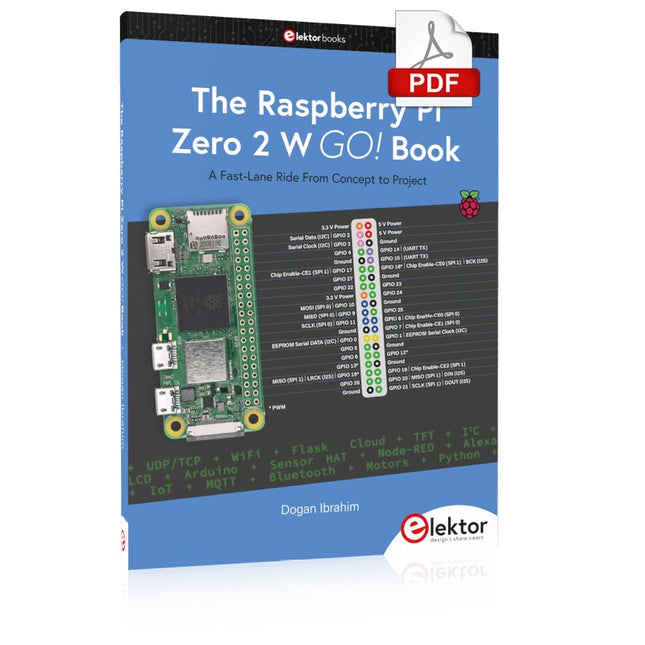
A Fast-Lane Ride From Concept to Project
The core of the book explains the use of the Raspberry Pi Zero 2 W running the Python programming language, always in simple terms and backed by many tested and working example projects. On part of the reader, familiarity with the Python programming language and some experience with one of the Raspberry Pi computers will prove helpful. Although previous electronics experience is not required, some knowledge of basic electronics is beneficial, especially when venturing out to modify the projects for your own applications.
Over 30 tested and working hardware-based projects are given in the book, covering the use of Wi-Fi, communication with smartphones and with a Raspberry Pi Pico W computer. Additionally, there are Bluetooth projects including elementary communication with smartphones and with the popular Arduino Uno. Both Wi-Fi and Bluetooth are key features of the Raspberry Pi Zero 2 W.
Some of the topics covered in the book are:
Raspberry Pi OS installation on an SD card
Python program creation and execution on the Raspberry Pi Zero 2 W
Software-only examples of Python running on the Raspberry Pi Zero 2 W
Hardware-based projects including LCD and Sense HAT interfacing
UDP and TCP Wi-Fi based projects for smartphone communication
UDP-based project for Raspberry Pi Pico W communication
Flask-based webserver project
Cloud storage of captured temperature, humidity, and pressure data
TFT projects
Node-RED projects
Interfacing to Alexa
MQTT projects
Bluetooth-based projects for smartphone and Arduino Uno communications
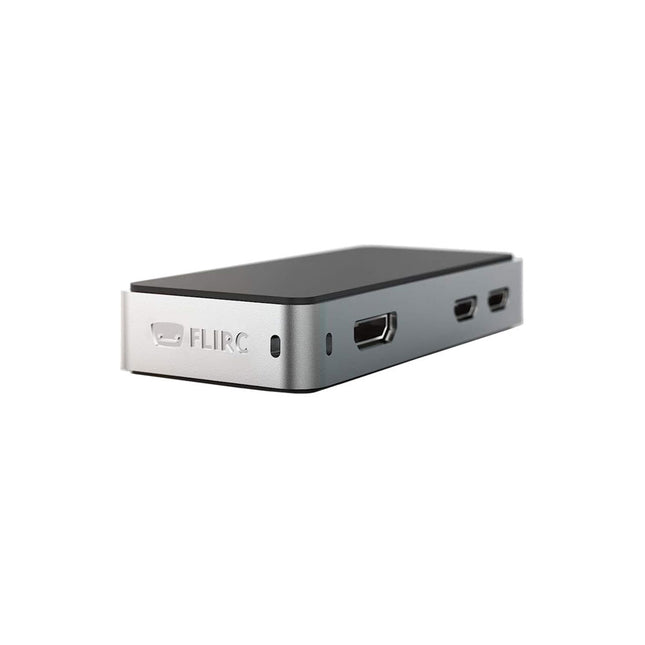
The FLIRC Raspberry Pi Zero Case is compatible with Raspberry Pi Zero W and the newer Raspberry Pi Zero 2 W.
The design of the FLIRC Zero Case is based on the original FLIRC case. As with the original, the aluminum housing serves as protection and, thanks to the contact point on the processor, as a passive cooler. Ideal for silent operation.
In addition to a normal cover that encloses and protects the Raspberry Pi Zero, there is a second cover that allows access to the GPIO pins through a small opening.
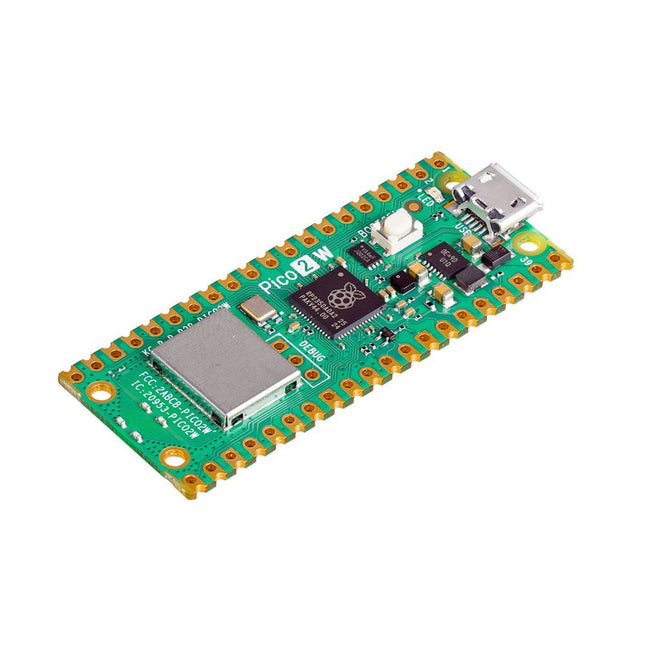
Le Raspberry Pi Pico 2 W est une carte microcontrôleur basée sur le RP2350 doté d'un réseau local sans fil 802.11n à 2,4 GHz et de Bluetooth 5.2. Il vous offre encore plus de flexibilité dans la conception de vos produits IoT ou intelligents et étend les possibilités de vos projets.
Le RP2350 fournit une architecture de sécurité complète construite autour d'Arm TrustZone pour Cortex-M. Il intègre un démarrage signé, 8 Ko d'OTP antifusible pour le stockage des clés, une accélération SHA-256, un TRNG matériel et des détecteurs de problèmes rapides.
La capacité unique à double cœur et à double architecture du RP2350 permet aux utilisateurs de choisir entre une paire de cœurs Arm Cortex-M33 standard et une paire de cœurs Hazard3 RISC-V à matériel ouvert. Programmable en C/C++ et Python, et pris en charge par une documentation détaillée, le Raspberry Pi Pico 2 W est la carte microcontrôleur idéale pour les passionnés et les développeurs professionnels.
Spécifications
Processeur
Processeurs Dual Arm Cortex-M33 ou double RISC-V Hazard3 à 150 MHz
Sand fil
Infineon CYW43439 monobande 2,4 GHz sans fil 802.11n et Bluetooth 5.2
Mémoire
520 Ko de SRAM sur puce ; Flash QSPI intégré de 4 Mo
Interfaces
26 broches GPIO polyvalentes, dont 4 pouvant être utilisées pour AD
Périphériques
2x UART
2x Contrôleurs SPI
2x Contrôleurs I²C
24x Canaux PWM
1x Contrôleur USB 1.1 et PHY, avec prise en charge des hôtes et des périphériques
12x Machines à états PIO
Puissance d'entrée
1,8-5,5 V CC
Dimensions
21 x 51 mm
Téléchargements
Datasheet
Pinout
Schematic
Le câble officiel Raspberry Pi mini-HDMI vers HDMI (A/M) conçu pour tous les modèles Raspberry Pi Zero.
HDMI Type D(M) 19 broches vers HDMI Type A(M) 19 broches
Câble de 1 m (blanc)
Bouchons nickelés
Conforme 4Kp60
Conforme RoHS
Isolation 3 Mohm 300 V DC , résiste à 300 V DC pendant 0,1 s
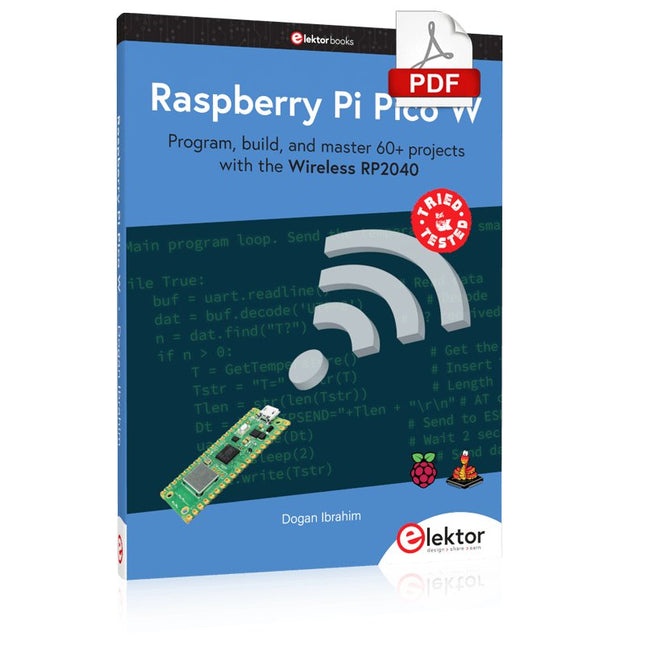
Program, build, and master 60+ projects with the Wireless RP2040
The Raspberry Pi Pico and Pico W are based on the fast, efficient, and low-cost dual-core ARM Cortex M0+ RP2040 microcontroller chip running at up to 133 MHz and sporting 264 KB of SRAM and 2 MB of Flash memory. Besides spacious memory, the Pico and Pico W offer many GPIO pins, and popular peripheral interface modules like ADC, SPI, I²C, UART, PWM, timing modules, a hardware debug interface, and an internal temperature sensor.
The Raspberry Pi Pico W additionally includes an on-board Infineon CYW43439 Bluetooth and Wi-Fi chipset. At the time of writing this book, the Bluetooth firmware was not yet available. Wi-Fi is however fully supported at 2.4 GHz using the 802.11b/g/n protocols.
This book is an introduction to using the Raspberry Pi Pico W in conjunction with the MicroPython programming language. The Thonny development environment (IDE) is used in all of the 60+ working and tested projects covering the following topics:
Installing the MicroPython on Raspberry Pi Pico using a Raspberry Pi or a PC
Timer interrupts and external interrupts
Analogue-to-digital converter (ADC) projects
Using the internal temperature sensor and external sensor chips
Using the internal temperature sensor and external temperature sensor chips
Datalogging projects
PWM, UART, I²C, and SPI projects
Using Bluetooth, WiFi, and apps to communicate with smartphones
Digital-to-analogue converter (DAC) projects
All projects are tried & tested. They can be implemented on both the Raspberry Pi Pico and Raspberry Pi Pico W, although the Wi-Fi-based subjects will run on the Pico W only. Basic programming and electronics experience are required to follow the projects. Brief descriptions, block diagrams, detailed circuit diagrams, and full MicroPython program listings are given for all projects.
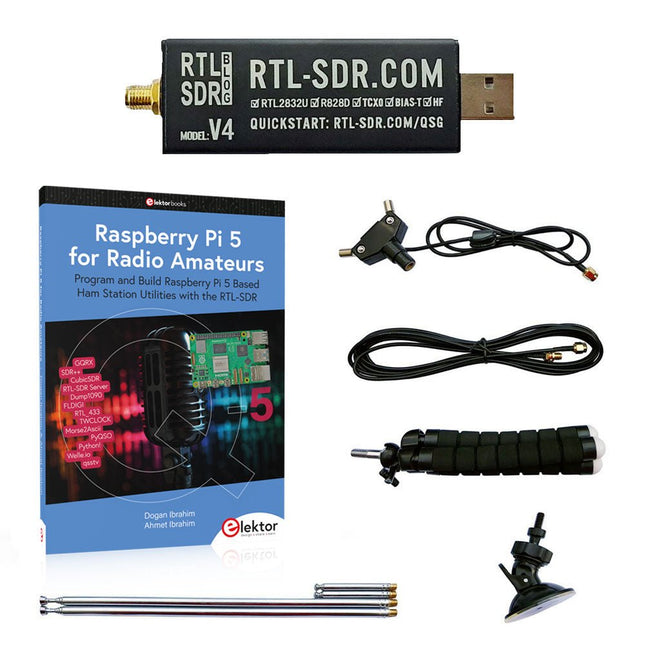
Programmez et construisez des utilitaires, des outils et des instruments de station radio amateur basés sur Raspberry Pi !
La version améliorée du RTL-SDR V4 permet de recevoir des signaux radio entre 500 kHz et 1,75 GHz provenant de stations utilisant différentes bandes (notamment la diffusion en ondes courtes (SW), moyennes (MW) et longues (LW)), de services de radiodiffusions, de services publics de contrôle du trafic aérien, de PMR, de SRD, d'ISM, de CB, de satellites météorologiques et de radioastronomie.
Le livre Raspberry Pi 5 for Radio Amateurs présente en détail l'utilisation du kit RTL-SDR avec un Raspberry Pi.
Cette offre groupée contient :
RTL-SDR V4 (avec kit d'antenne dipôle) (prix normal : 65 €)
Raspberry Pi 5 for Radio Amateurs (prix normal : 40 €)
RTL-SDR V4 (Software Defined Radio) avec kit antenne dipôle
La clé RTL-SDR est un appareil au coût abordable qui peut être utilisé comme scanner radio associé à un ordinateur, pour recevoir les signaux radio locaux entre 500 kHz et 1,75 GHz.
La version RTL-SDR V4 apporte plusieurs améliorations par rapport aux appareils de marques génériques, en particulier l’utilisation d’un chip tuner R828D, la présence d’un filtre d’entrée triplexé, d’un filtre coupe-bande, de composants aux tolérances améliorées, d’un oscillateur compensé en température à stabilité de 1 PPM (TCXO), d’un connecteur SMA F, d’un boitier en aluminium avec refroidissement passif, d’un circuit d’injection de tension continue en T, d’une alimentation améliorée, et d’un convertisseur HF élévateur.
RTL-SDR V4 est fourni avec un kit antenne dipôle portable. C’est un atout pour débuter, car elle permet la réception des stations terrestres et des satellites. Son installation à l’extérieur est facile, elle est conçue pour un usage portable temporaire à l’extérieur.
Caractéristiques
Réception HF améliorée : V4 utilise maintenant un convertisseur élévateur au lieu d’un circuit échantillonneur direct. Cela évite le phénomène de fréquence de repli de Nyquist se situant vers 14,4 MHz, une meilleure sensibilité et un gain HF ajustable. Tout comme pour V3, la fréquence limite basse de réception est de 500 kHz, et un signal reçu très fort nécessite l’utilisation d’un filtre atténuateur en entrée.
Filtrage amélioré : La V4 utilise le circuit de réception R828D qui possède trois entrées. L’entrée munie d’un connecteur SMA a été triplexée en 3 bandes : HF, VHF et UHF. Les trois bandes sont ainsi isolées, ce qui minimise la diminution de la sensibilité et la présence de fréquences images, provoquées par les interférences dues aux stations de radiodiffusions puissantes en dehors de la bande reçue.
Filtrage x2 amélioré : En plus du triplexage, une broche d’entrée aboutissant à un drain ouvert peut être utilisée, permettant l’ajout d’un filtre coupe-bande pour éliminer les interférences sur les bandes de radiodiffusion AM, FM ou DAB. Un tel filtre permet d’obtenir une atténuation limitée à quelques décibels, mais demeure efficace.
Amélioration du bruit de phase sur les signaux puissants : La conception améliorée de l’alimentation permet de réduire le bruit de phase provenant de celle-ci.
Dissipation calorifique réduite : Autre avantage résultant de l’amélioration du circuit d’alimentation, la consommation électrique est réduite, minimisant de fait la génération de chaleur, par rapport à la V3.
Inclus
1x Clé RTL-SDR V4 (R828D RTL2832U 1PPM TCXO SMA)
2x Antennes télescopiques de 23 cm à 1 m
2x Antennes télescopiques de 5 cm à 13 cm
1x Embase d’antenne équipée d’un câble RG174 de 60 cm
1x Câble prolongateur RG174 de 3 m
1x Trépied de montage flexible
1x Ventouse de fixation
Téléchargements
Datasheet
User Guide
Quick Start Guide
SDR# User Guide
Dipole Antenna Guide
Livre : Raspberry Pi 5 for Radio Amateurs
Les dispositifs RTL-SDR (V3 et V4) ont gagné en popularité parmi les radioamateurs en raison de leur faible coût et de leurs nombreuses fonctionnalités. Un système de base peut consister en un dispositif RTL-SDR USB (dongle) avec une antenne appropriée, un ordinateur Raspberry Pi 5, un adaptateur d'entrée-sortie audio externe USB et un logiciel installé sur l'ordinateur Raspberry Pi 5. Avec une installation aussi modeste, il est possible de recevoir des signaux allant d'environ 24 MHz à plus de 1,7 GHz.
Ce livre s'adresse aux radioamateurs et aux étudiants en ingénierie électronique, ainsi qu'à toute personne souhaitant apprendre à utiliser le Raspberry Pi 5 pour construire des projets électroniques. Le livre convient aussi bien aux débutants qu'aux lecteurs expérimentés. Une certaine connaissance du langage de programmation Python est nécessaire pour comprendre et éventuellement modifier les projets présentés dans le livre. Chaque projet est accompagné d'un schéma fonctionnel, d'un schéma de circuit et d'une liste complète de programmes Python, ainsi que d'une description détaillée.
Les programmes RTL-SDR populaires suivants sont examinés en détail et accompagnés de guides d'installation étape par étape pour une utilisation pratique sur un Raspberry Pi 5:
SimpleFM
GQRX
SDR++
CubicSDR
RTL-SDR Server
Dump1090
FLDIGI
Quick
RTL_433
aldo
xcwcp
GPredict
TWCLOCK
CQRLOG
klog
Morse2Ascii
PyQSO
Welle.io
Ham Clock
CHIRP
xastir
qsstv
flrig
XyGrib
FreeDV
Qtel (EchoLink)
XDX (DX-Cluster)
WSJT-X
L'application du langage de programmation Python sur la dernière plateforme Raspberry Pi 5 empêche l'utilisation des programmes du livre sur les versions plus anciennes des ordinateurs Raspberry Pi.
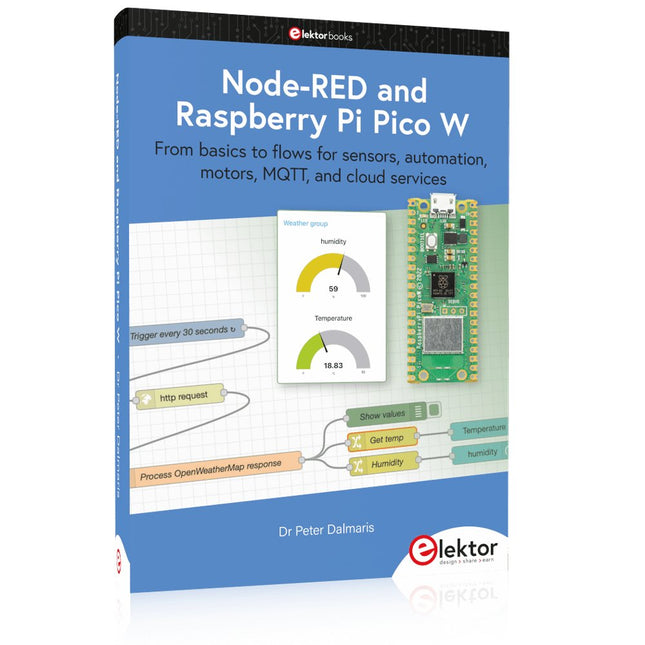
From basics to flows for sensors, automation, motors, MQTT, and cloud services
This book is a learning guide and a reference. Use it to learn Node-RED, Raspberry Pi Pico W, and MicroPython, and add these state-of-the-art tools to your technology toolkit. It will introduce you to virtual machines, Docker, and MySQL in support of IoT projects based on Node-RED and the Raspberry Pi Pico W.
This book combines several elements into a platform that powers the development of modern Internet of Things applications. These elements are a flow-based server, a WiFi-enabled microcontroller, a high-level programming language, and a deployment technology. Combining these elements gives you the tools you need to create automation systems at any scale. From home automation to industrial automation, this book will help you get started.
Node-RED is an open-source flow-based development tool that makes it easy to wire together devices, APIs, and online services. Drag and drop nodes to create a flowchart that turns on your lights at sunset or sends you an email when a sensor detects movement. Raspberry Pi Pico W is a version of the Raspberry Pi Pico with added 802.11n Wi-Fi capability. It is an ideal device for physical computing tasks and an excellent match to the Node-RED.
Quick book facts
Project-based learning approach.
Assumes no prior knowledge of flow-based programming tools.
Learn to use essential infrastructure tools in your projects, such as virtual machines, Docker, MySQL and useful web APIs such as Google Sheets and OpenWeatherMap.
Dozens of mini-projects supported by photographs, wiring schematics, and source code. Get these from the book GitHub repository.
Step-by-step instructions on everything.
All experiments are based on the Raspberry Pi Pico W. A Wi-Fi network is required for all projects.
Hardware (including the Raspberry Pi Pico W) is available as a kit.
Downloads
GitHub
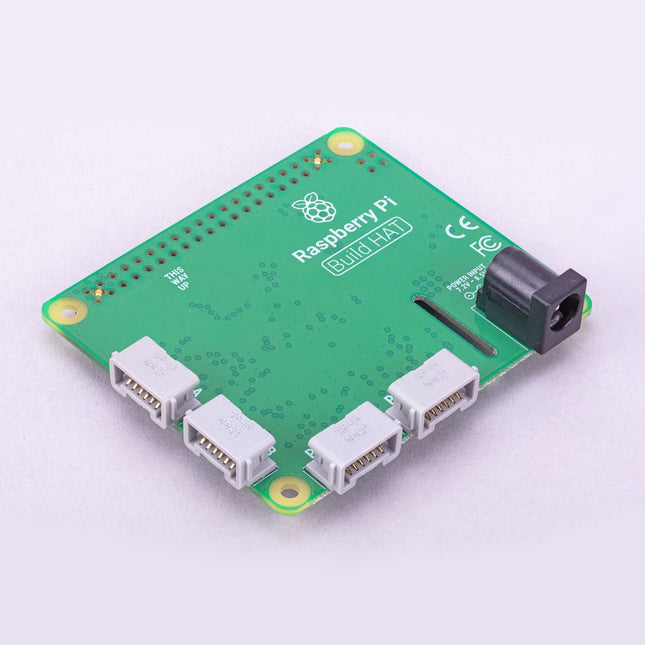
Construisez des machines robustes et intelligentes qui combinent la puissance de calcul du Raspberry Pi avec des composants LEGO.
Le Raspberry Pi Build HAT fournit quatre connecteurs pour les moteurs et capteurs LEGO Technic du portefeuille SPIKE. Les capteurs disponibles comprennent un capteur de distance, un capteur de couleur et un capteur de force polyvalent. Les moteurs angulaires sont disponibles dans une gamme de tailles et comprennent des encodeurs intégrés qui peuvent être interrogés pour trouver leur position.
Le Build HAT s'adapte à tous les ordinateurs Raspberry Pi dotés d'un connecteur GPIO à 40 broches, y compris – avec l'ajout d'un câble ruban ou d'un autre périphérique d'extension – le Raspberry Pi 400. Les appareils LEGO Technic connectés peuvent facilement être contrôlés en Python, aux côtés des accessoires Raspberry Pi standard. tel qu'un module de caméra.
Caractéristiques
Contrôle jusqu'à 4 moteurs et capteurs
Alimente le Raspberry Pi (lorsqu'il est utilisé avec un bloc d'alimentation externe approprié)
Facile à utiliser depuis Python sur le Raspberry Pi
Program, build, and master 60+ projects with the Wireless RP2040
The Raspberry Pi Pico and Pico W are based on the fast, efficient, and low-cost dual-core ARM Cortex M0+ RP2040 microcontroller chip running at up to 133 MHz and sporting 264 KB of SRAM and 2 MB of Flash memory. Besides spacious memory, the Pico and Pico W offer many GPIO pins, and popular peripheral interface modules like ADC, SPI, I²C, UART, PWM, timing modules, a hardware debug interface, and an internal temperature sensor.
The Raspberry Pi Pico W additionally includes an on-board Infineon CYW43439 Bluetooth and Wi-Fi chipset. At the time of writing this book, the Bluetooth firmware was not yet available. Wi-Fi is however fully supported at 2.4 GHz using the 802.11b/g/n protocols.
This book is an introduction to using the Raspberry Pi Pico W in conjunction with the MicroPython programming language. The Thonny development environment (IDE) is used in all of the 60+ working and tested projects covering the following topics:
Installing the MicroPython on Raspberry Pi Pico using a Raspberry Pi or a PC
Timer interrupts and external interrupts
Analogue-to-digital converter (ADC) projects
Using the internal temperature sensor and external sensor chips
Using the internal temperature sensor and external temperature sensor chips
Datalogging projects
PWM, UART, I²C, and SPI projects
Using Bluetooth, WiFi, and apps to communicate with smartphones
Digital-to-analogue converter (DAC) projects
All projects are tried & tested. They can be implemented on both the Raspberry Pi Pico and Raspberry Pi Pico W, although the Wi-Fi-based subjects will run on the Pico W only. Basic programming and electronics experience are required to follow the projects. Brief descriptions, block diagrams, detailed circuit diagrams, and full MicroPython program listings are given for all projects.
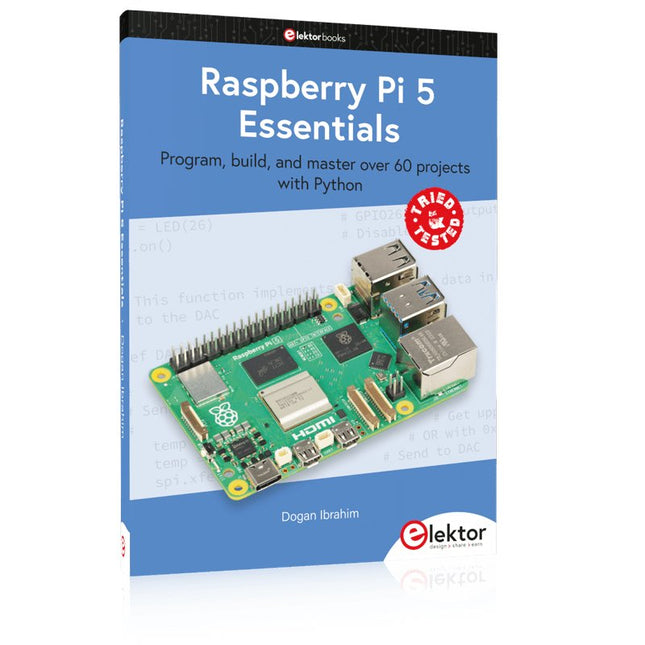
Program, build, and master over 60 projects with Python
The Raspberry Pi 5 is the latest single-board computer from the Raspberry Pi Foundation. It can be used in many applications, such as in audio and video media centers, as a desktop computer, in industrial controllers, robotics, and in many domestic and commercial applications. In addition to the well-established features found in other Raspberry Pi computers, the Raspberry Pi 5 offers Wi-Fi and Bluetooth (classic and BLE), which makes it a perfect match for IoT as well as in remote and Internet-based control and monitoring applications. It is now possible to develop many real-time projects such as audio digital signal processing, real-time digital filtering, real-time digital control and monitoring, and many other real-time operations using this tiny powerhouse.
The book starts with an introduction to the Raspberry Pi 5 computer and covers the important topics of accessing the computer locally and remotely. Use of the console language commands as well as accessing and using the desktop GUI are described with working examples. The remaining parts of the book cover many Raspberry Pi 5-based hardware projects using components and devices such as
LEDs and buzzers
LCDs
Ultrasonic sensors
Temperature and atmospheric pressure sensors
The Sense HAT
Camera modules
Example projects are given using Wi-Fi and Bluetooth modules to send and receive data from smartphones and PCs, and sending real-time temperature and atmospheric pressure data to the cloud.
All projects given in the book have been fully tested for correct operation. Only basic programming and electronics experience are required to follow the projects. Brief descriptions, block diagrams, detailed circuit diagrams, and full Python program listings are given for all projects described.