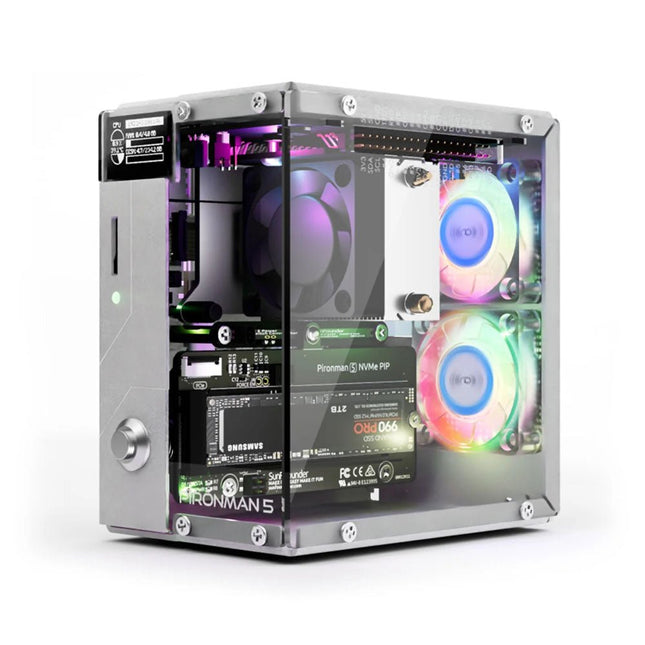
Améliorez votre Raspberry Pi 5 avec le Pironman 5, construit en aluminium robuste, avec un refroidissement supérieur, un support SSD NVMe M.2, un écran OLED, un éclairage RVB, des ports HDMI standard x2 et un interrupteur d'alimentation sécurisé. Il est parfait pour les NAS, Home Assistant, Media et Game Centers. Le Pironman 5 n'est pas seulement un boîtier ; il s'agit d'une mise à niveau qui transforme votre Raspberry Pi 5 en un appareil puissant, efficace et élégant.
Le Pironman 5 comprend le Pi 5 NVMe PIP (PCIe Peripheral Board), une carte adaptateur PCIe spécialement conçue pour les disques SSD NVMe. Cette carte prend en charge quatre tailles de SSD NVMe : 2230, 2242, 2260 et 2280, qui peuvent tous être installés dans un emplacement pour clé M.2 M. La connexion est certifiée pour les vitesses Gen 2.0 (5 GT/sec), mais peut être forcée à Gen 3.0 (10 GT/sec) pour des performances plus rapides.
Emplacement SSD NVMe M.2 extensible
Améliorez les performances de votre Raspberry Pi 5 avec l'emplacement SSD NVMe M.2 du Pironman 5, prenant en charge plusieurs tailles (2230, 2242, 2260, 2280) pour un stockage accru et une réponse plus rapide du système.
Système de refroidissement avancé
Gardez votre Raspberry Pi 5 au frais et élégant avec le refroidisseur tour du Pironman 5 et ses deux ventilateurs RVB, dotés de filtres anti-poussière pour un fonctionnement durable et nécessitant peu d'entretien.
Écran OLED pour des informations instantanées
Le Pironman 5 comprend un écran OLED de 0,96 pouces, fournissant des mises à jour immédiates sur l'utilisation du processeur et de la RAM, la température, l'adresse IP, etc.
Fonctionnalité et sécurité améliorées
Le Pironman 5 sécurise votre Raspberry Pi 5 avec des fonctionnalités telles qu'un arrêt sécurisé, des LED RVB personnalisables, des ports HDMI, un récepteur IR et un prolongateur GPIO externe, améliorant ainsi la fonctionnalité et la connectivité.
Caractéristiques
Mini PC Raspberry Pi 5
Écran OLED de 0,96" affichant l'utilisation du processeur, la température, l'utilisation du disque, l'adresse IP, l'utilisation de la RAM, etc. du Raspberry Pi.
Le refroidisseur tour peut refroidir une charge CPU à 100% Pi à 39°C à une température ambiante de 25°C
2 ventilateurs RVB, avec contrôle GPIO
1 ventilateur PWM sur le refroidisseur tour est contrôlé par le système Raspberry Pi.
Prend en charge quatre tailles de SSD NVMe M.2 (PCIe Gen 2.0/PCIe Gen 3.0) : 2230, 2242, 2260 et 2280.
4 LED RVB adressables WS2812 illuminent l'ensemble du boîtier avec un effet de lumière cool
Récepteur IR pour centre multimédia comme Kodi ou Volumio
Bouton d'alimentation rétro en métal pour un arrêt en toute sécurité
Rallonge GPIO externe avec étiquette de nom de code PIN, pour un accès facile
Équipé d'un support à ressort pour un retrait facile de la carte
Corps principal en aluminium avec panneau latéral en acrylique transparent
Comprend deux ports HDMI standards
Téléchargements
Documentation
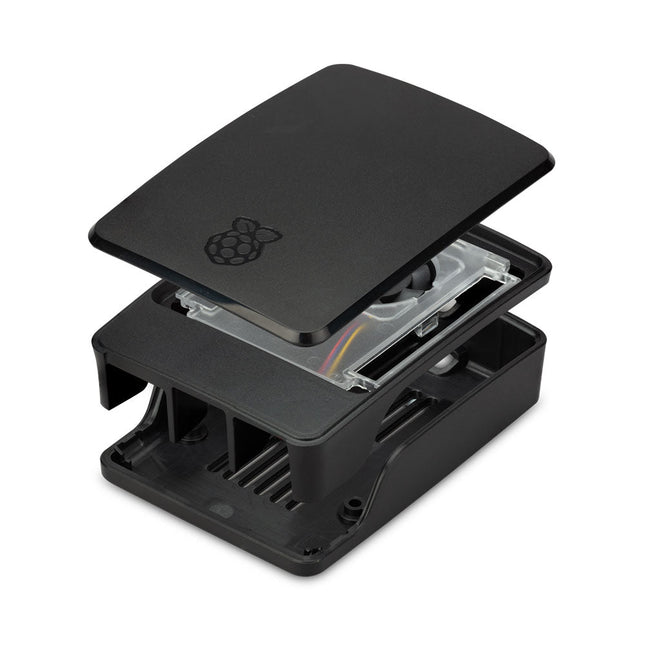
Le boîtier Raspberry Pi 5 est une amélioration du boîtier Raspberry Pi 4 avec des caractéristiques thermiques améliorées pour prendre en charge la consommation d'énergie maximale plus élevée du Raspberry Pi 5. Il intègre un ventilateur à vitesse variable qui est alimenté et contrôlé via un connecteur dédié sur le Raspberry Pi 5.
Ce boîtier en acrylique transparent est le boîtier officiel pour la carte HackRF One/Pro. Il peut remplacer le boîtier en plastique noir standard de la HackRF One.
Instructions de montage
Utilisez un médiator de guitare ou un spudger pour extraire le circuit de la carte HackRF One/Pro du boîtier en plastique noir.
Insérez une vis longue dans chaque coin du panneau inférieur en acrylique. Fixez chaque vis longue avec un entretoise courte (5 mm) de l'autre côté du panneau.
Placez le circuit de la carte HackRF One/Pro (face vers le haut) sur le dessus du panneau inférieur, en faisant passer les extrémités des vis longues à travers les trous de montage des coins de la carte.
Fixez le circuit avec une entretoise longue (6 mm) dans chaque coin.
Placez le panneau en acrylique supérieur sur le dessus de la carte, en alignant les découpes avec les connecteurs d'extension de la carte.
Fixez chaque coin avec une vis courte.
Remarque : Ne serrez pas trop fort ! Serrez uniquement à la main à chaque étape.
Offre groupée complète de matériel et de livres pour le microcontrôleur RP2040 avec plus de 80 projets
Débloquez le potentiel de la technologie de contrôleur moderne avec le Raspberry Pi Pico dans cette offre groupée. Parfait pour les utilisateurs débutants et expérimentés, ce guide facile à suivre vous emmène des bases de l'électronique aux complexités du traitement du signal numérique. Avec le Raspberry Pi Pico, le kit matériel dédié et la programmation MicroPython, vous apprendrez les principes clés de la conception de circuits, de la collecte de données et du traitement.
Mettez en pratique plus de 80 projets, comme un chronomètre avec écran OLED, un télémètre laser et un ventilateur servocommandé. Ces projets sont conçus pour vous aider à appliquer ce que vous avez appris dans des scénarios réels. Le livre couvre également des sujets avancés tels que la technologie RFID sans fil, la détection d'objets et l'intégration de capteurs pour la robotique.
Que vous cherchiez à développer vos compétences en électronique ou à vous plonger plus profondément dans les systèmes embarqués, cet ensemble est la ressource idéale pour vous aider à explorer tout le potentiel du Raspberry Pi Pico.
Contenu de l'offre groupée
1x Livre de projet (273 pages)
1x Kit de voiture intelligente
Composants électroniques
2x Planches à pain sans soudure (400 trous)
1x Planche à pain sans soudure (170 trous)
5x LED colorées de 5 mm (verte, rouge, bleue, jaune et blanche)
1x Émetteur laser
1x Buzzer passif
1x Câble micro-USB (30 cm)
1x 65 fils de liaison
1x Câble Dupont mâle vers femelle de 20 cm
1x Étui transparent
1x Aimant (diamètre : 8 mm, épaisseur : 5 mm)
1x Potentiomètre rotatif
10x Résistances de 2 KΩ
2x Piliers en cuivre M2,5x30 mm
10x Vis à tête cylindrique Phillips
10x Écrous hexagonaux M2,5 en nickel
1x Tournevis double usage de 2 pouces
Modules
1x Module RVB
1x Servomoteur 9G
1x Module joystick XY à deux axes
1x Module RFID RC522
1x Module d'affichage LED numérique 4 bits
1x Module d'affichage des feux de circulation
1x Module d'encodeur rotatif
1x Module d'affichage LCD 1602 (bleu)
1x Module de photorésistance
1x Moteur à courant continu avec fil Dupont mâle
1x Pale de ventilateur
1x Module Gouttes de Pluie
1x Module OLED
1x Clavier à interrupteur à membrane
1x Mini module à ressort magnétique
1x Télécommande infrarouge
1x Module récepteur infrarouge
1x Carte pilote de moteur pas à pas CC
1x Bouton
Capteurs
1x Capteur de vibrations
1x Capteur d'humidité du sol
1x Capteur de son
1x Mini capteur de mouvement PIR
1x Capteur de température et d'humidité
1x Capteur de flamme
2x Capteurs de collision
2x Capteurs de suivi
1x Capteur à ultrasons
Robot à équilibrage sur deux roues compatible Arduino et alimenté par ESP32
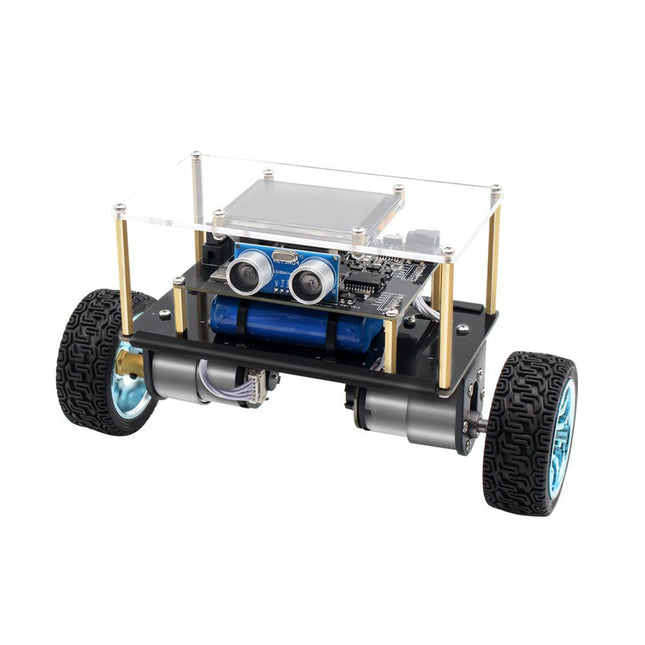
L'Elektor Mini-Wheelie est une plateforme robotique expérimentale autonome et auto-équilibrée. Basé sur un microcontrôleur ESP32-S3, le robot auto-équilibré est entièrement programmable à l'aide de l'environnement Arduino et de bibliothèques open source. Ses capacités sans fil lui permettent d'être contrôlé à distance via Wi-Fi, Bluetooth ou ESP-NOW ou de communiquer avec un utilisateur ou même un autre robot.
Un transducteur à ultrasons est disponible pour détecter les obstacles. Son écran couleur peut être utilisé pour afficher de jolies expressions faciales ou, pour les utilisateurs les plus terre-à-terre, des messages de débogage énigmatiques.
Le robot est livré en kit complet avec des pièces à assembler soi-même. Tout est inclus, même un tournevis.
Remarque : Le Mini-Wheelie est une plateforme de développement pédagogique destinée à l'apprentissage, à l'expérimentation et au développement de la robotique. Il n'est pas considéré comme un jouet pour enfants, et ses caractéristiques, sa documentation et le public auquel il s'adresse reflètent cet objectif. Le produit est destiné aux étudiants, aux éducateurs et aux développeurs qui souhaitent explorer la robotique, la programmation et l'intégration de matériel dans un cadre éducatif.
Spécifications
Microcontrôleur ESP32-S3 avec Wi-Fi et Bluetooth
MPU6050 unité de mesure inertielle (IMU) à 6 axes
Deux moteurs électriques 12 V à commande indépendante avec tachymètre
Transducteur à ultrasons
Écran couleur TFT 2,9 pouces (320 x 240)
Emplacement pour carte MicroSD
Moniteur de puissance de la batterie
Batterie Li-Po rechargeable 3S (11,1 V/2200 mAh)
Chargeur de batterie inclus
Logiciel Open Source basé sur Arduino
Dimensions (L x L x H) : 23 x 8 x 13 cm
Inclus
1x Carte mère ESP32-S3 + module MPU6050
1x Carte LCD (2,9 pouces)
1x Capteur à ultrasons
1x Batterie (2200 mAh)
1x Chargeur de batterie
1x Kit de pneus moteur
1x Tableau de caisse
1x Tableau acrylique
1x Tournevis
1x Bande de protection
1x Câble flexible B (8 cm)
1x Câble flexible A (12 cm)
1x Câble flexible C
4x Colonnes A en cuivre (25 mm)
4x Colonnes B en cuivre (55 mm)
4x Colonnes C en cuivre (5 mm)
2x Colonnes en plastique et nylon
8x Vis A (10 mm)
24 Vis B (M3x5)
8x Noix
24x Rondelles métalliques
2x Attaches zippées
1x Carte MicroSD (32 Go)
Téléchargements
Documentation
Plateforme tout-en-un d'apprentissage et de développement en IA pour l'Edge Intelligence
Ce kit de démarrage IA basé sur NVIDIA Jetson est une plateforme polyvalente pour l'apprentissage, le développement et l'expérimentation pratique de l'IA en périphérie (Edge AI).
Conçu pour être utilisé avec le NVIDIA Jetson Orin Nano, le kit associe un écran IPS de 11,6 pouces, une caméra motorisée (pan-tilt) de 8 mégapixels et un système d'interaction vocale basé sur l'IA.
Il comprend 30 modules fonctionnels et 38 cours Python soigneusement élaborés, allant du niveau débutant au niveau avancé. Le contenu pédagogique couvre les fondamentaux de Python, la technologie des capteurs, la vision par IA et la reconnaissance d'images.
Grâce à des exercices pratiques étape par étape — allant de la programmation de base aux applications concrètes de vision par ordinateur — ce kit constitue une plateforme idéale pour les étudiants, les makers, les développeurs et toute personne souhaitant explorer l'intelligence artificielle et l'Edge Computing.
Remarque : Le NVIDIA Jetson Orin Nano n'est pas inclus.
Caractéristiques
Conçu pour le NVIDIA Jetson Orin Nano
Module d'interaction vocale par IA
Caméra 8 MP avec contrôle panoramique et inclinaison
Prend en charge le suivi d'objets et de visages
Aucune soudure ni câblage complexe requis
Écran IPS intégré de 11,6 pouces
30 modules fonctionnels
38 leçons Python étape par étape
Interfaces d'extension I²C, UART et GPIO
Mallette de transport incluse
Spécifications
Processeur principal
Jetson Orin Nano
Nombre de capteurs
30
Conception de la carte de capteurs
Carte de capteurs intégrée ; aucune soudure ni câblage complexe requis
Écran
Écran IPS de 11,6 pouces
Résolution de l'écran
1366 x 768
Caméra
IMX219 8 MP
Interfaces d'extension
2x I²C, 1x UART, 1x IO D13, 1x IO D12
Environnement de programmation
Basé sur Python
Nombre de tutoriels
38 tutoriels créatifs
Public cible
Étudiants, enseignants, passionnés de matériel informatique
Scénarios d'application
Idéal pour apprendre la programmation d'IA et les bases de la Jetson Orin Nano
Dimensions
300 x 200 x 100 mm
Liste des modules
Module
Quantité
Capteur de température et d'humidité
1 pièce
Bouton-poussoir
4 pièces
Capteur de distance à ultrasons
1 pièce
Capteur de luminosité
1 pièce
Potentiomètre linéaire
1 pièce
Buzzer
1 pièce
Écran LCD
1 pièce
Télécommande infrarouge
1 pièce
Relais
1 pièce
Module NFC
1 pièce
Capteur de mouvement PIR
1 pièce
Joystick
1 pièce
Afficheur 4 chiffres
1 pièce
LED
1 pièce
Microphone
1 pièce
Haut-parleur
1 paire
Moteur vibrant
1 pièce
Capteur tactile
1 pièce
Matrice RVB 8x8
1 pièce
Capteur de pression atmosphérique
1 pièce
Capteur d'inclinaison
1 pièce
Moteur pas à pas
1 pièce
Accéléromètre et gyroscope
1 pièce
Capteur de gaz (MQ2)
1 pièce
Capteur à effet Hall
1 pièce
Encodeur rotatif
1 pièce
Commutateur photoélectrique en U
1 pièce
Thermistance NTC
1 pièce
Servomoteur
2 pièces
Caméra monoculaire
1 pièce
Inclus
1x Elecrow Kit de démarrage AI pour Jetson Orin Nano
1x Télécommande infrarouge
1x Carte NFC
1x Carte SD 128 Go
1x Câble GPIO 40 broches
2x Câble FPC 22 broches
2x Câble FPC 24 broches
1x Carte adaptateur Jetson DP et USB
Non inclus
NVIDIA Jetson Orin Nano
Téléchargements
Manual
Wiki
OpenClaw Install and Config Guide
La soudeuse par points portative FNIRSI SWM-20 est un outil de soudage performant, convivial et facile à transporter. Elle intègre la technologie de soudage par points à double impulsion, garantissant des soudures plus stables et fiables, et dispose également d'une fonction de batterie externe pratique.
Dotée d'un écran haute définition de 2,4 pouces, la SWM-20 offre une utilisation claire et intuitive. Sa molette de réglage rotative permet un ajustement rapide et précis des paramètres, facilitant ainsi la configuration des réglages de soudage et améliorant l'expérience utilisateur.
Caractéristiques
2-en-1 : poste de soudage par points et batterie externe de 5000 mAh
Puissance de sortie élevée de 1200 A pour des soudures robustes et fiables
Technologie à double impulsion pour une soudure plus propre et plus stable
Deux batteries de qualité A avec 8 protections de sécurité
Capacité de soudage multi-matériaux de 0,1 à 0,5 mm
Plus de 10000 niveaux de réglage de précision pour un contrôle professionnel
Écran TFT de 2,4 pouces avec surveillance des données en temps réel
Spécifications
Courant de soudage max.
1200 A
Capacité de la batterie
5000 mAh
Charge
5 V/2,1 A
Décharge
5 V/2,1 A
Matériaux de soudage
Nickel, fer, acier inoxydable
Épaisseur de soudure
0,1 à 0,5 mm
Niveau
4 combinaisons prédéfinies Niveaux
Inclus
1x FNIRSI SWM-20 Poste de soudage par points
2x Stylos à souder
2x Conseils de remplacement
1x Bande de nickel
1x Câble USB-C
1x Manuel
Téléchargements
Manual
La série FNIRSI DLA associe une analyse logique USB 3.0 hautes performances à une capture de signaux multicanaux flexible, idéale pour le débogage et l'analyse de circuits numériques et de systèmes embarqués. Cette gamme se décline en deux versions : le DLA-16 Plus, doté de 16 canaux numériques, et le DLA-32 Plus, équipé de 32 canaux numériques.
Les deux modèles offrent des fréquences d'échantillonnage allant jusqu'à 1 Géch./s, une mémoire intégrée de 4 Gbits et la prise en charge de plus de 120 décodeurs de protocoles. Grâce aux modes d'acquisition Buffer, Stream et Roll, ils conviennent aussi bien à l'analyse de signaux à haute vitesse qu'à la surveillance à long terme.
Optez pour le DLA-16 Plus si vous recherchez des fréquences d'échantillonnage plus élevées lors de l'utilisation de tous les canaux, ou pour le DLA-32 Plus si vous avez besoin d'un nombre de canaux plus important ainsi que de fonctionnalités avancées de déclenchement série et parallèle.
Caractéristiques
Disponible avec 16 ou 32 canaux d'entrée numérique
Fréquence d'échantillonnage jusqu'à 1 Géch./s
DLA-16 Plus : jusqu'à 500 Méch./s sur les 16 canaux
DLA-32 Plus : jusqu'à 250 Méch./s sur les 32 canaux
Mémoire interne de 4 Gbits
Interface USB 3.0 haut débit
Modes d'acquisition : Buffer, Stream et Roll
Prise en charge de plus de 120 décodeurs de protocoles
Options de déclenchement avancées
4 sorties PWM avec une plage de fréquence de 1 Hz à 20 MHz
Exportation de données aux formats CSV et BIN
Spécifications
DLA-16 Plus
DLA-32 Plus
Canaux numériques
16
32
Fréquence d'échantillonnage max.
1 Géch./s
Fréquence d'échantillonnage (1 voie)
1 Géch./s
Fréquence d'échantillonnage (8 voies)
1 Géch./s
Échantillonnage max. Buffer
16 voies à 500 Méch./s
32 voies à 250 Méch./s
Échantillonnage max. Stream
16 voies à 125 Méch./s
32 voies à 50 Méch./s
Mémoire matérielle
4 Gbit
Interface
USB 3.0 / USB-C
Max. Débit de transfert USB
5 Gbit/s
Modes d'acquisition
Mémoire tampon / Flux / Défilement
Décodeurs de protocoles
Plus de 120
Prise en charge de protocoles personnalisés
Oui
Modes de déclenchement
Front montant, front descendant, niveau haut, niveau bas, tout front
Déclenchement avancé
Déclenchement standard
Série et parallèle
Étages de déclenchement parallèle
–
Jusqu'à 16
Sorties PWM
4
Tension de sortie PWM
3,3 V
Fréquence PWM
1 Hz – 20 MHz
Exportation de données
CSV, BIN
Dimensions
90 x 81 x 11,5 mm
Inclus
1x FNIRSI DLA-16/32 Plus Analyseur logique
4 Jeux de 5 câbles blindés
18x Mini-crochets de test pour CI (version haute configuration)
1x Câble de données USB 3.0
10x Crochets de test pour CI
1x Étui de rangement transparent pour crochets de test
1x Sac de rangement
1x Manual
Téléchargement
Manual
La boîte à outils Pro Tech est la seule chose dont tout bricoleur, réparateur, hacker, amateur et professionnel a besoin pour accomplir n'importe quel travail.
Chaque outil du Pro Tech Toolkit a été repensé pour être meilleur. Du kit de pilotes 64 bits aux choix d'ouverture iFixit, chaque outil est spécialement conçu et sélectionné pour maximiser vos capacités de réparation.
Au cœur de ce kit se trouve le kit de pilotes iFixit 64 bits, conçu à partir de recherches approfondies sur les types de fixations actuellement utilisés dans l'industrie de l'électronique grand public et sur les fixations existantes toujours demandées par les consommateurs. De l'Apple Watch avec ses nouvelles minuscules vis Tri-Point aux consoles de jeux Nintendo vintage avec attaches gamebit, le kit 64 bits les couvre toutes avec des bits usinés CNC de la plus haute qualité. Même le boîtier robuste a été soigneusement conçu, sans charnières ni loquets susceptibles de se briser, et comporte un plateau de tri à l'intérieur du couvercle fixé magnétiquement.
Kit d'outils haute performance pour toutes sortes de réparations.
Parfait pour les professionnels de la réparation ainsi que les bricoleurs.
Contient les outils nécessaires antistatiques pour visser, ouvrir, fouiller, piquer et soulever pendant la réparation et l'entretien des appareils électroniques grand public.
Complètement revisité pour ne contenir que les outils nécessaires et rien d'inutile.
Inclus
Bracelet antistatique – pour protéger les appareils électroniques des dégâts dus aux décharges électrostatiques (DES)
Petite ventouse – ventouse pour les objets difficiles à saisir
3x iFixit Opening Tool – outils en plastique souple pour ouvrir et fouiller
6x iFixit Opening Picks – médiators fins pour ouvrir les appareils électroniques
Pincette croisée avec pointes en nylon – pour tenir votre travail
Pincette antistatique courbée – avec mâchoire dentelée pour une meilleure prise
Pincette antistatique arrondie – avec mâchoire dentelée pour une meilleure prise
Plastic Spudger – spatules solides et antistatiques
Halberd Spudger – cette spatule antistatique dispose d'un crochet pour creuser, gratter, et tirer
Metal Spudger – spatule en métal pour le cas plus durs
Jimmy – outil pratique pour ouvrir les appareils
Support magnétique – pour tenir en place les composants et les vis minuscules lors de la réparation
Trousse rouleau – compacte et durable
Mako Precision Bit Set – tous les embouts nécessaires pour la réparation des petits appareils électroniques
Le Mako Precision Bit Set inclut :
Tournevis 64 embouts
Extension flexible de 150 mm
Embouts de tournevis de 4 mm
64 embouts aux tailles suivantes :
Embouts cruciformes (Phillips) n° 000, 00, 0, 1, 2
Embouts plats 1, 1.5, 2, 2.5, 3, 4 mm
Embouts Torx T2, T3, T4, T5
Embouts Torx Security TR6, TR7, TR8, TR9, TR10, TR15, TR20, TR25
Embouts Pentalobe P2, P5, P6
Embouts JIS J000, J00, J0, J1
Embouts hexagonaux 0.7, 0.9, 1.3, 1.5, 2, 2.5, 3, 3.5, 4, 4.5, 5 mm
Embouts Tri-point Y000, Y00, Y0, Y1
Tourne-écrous 2.5, 3, 3.5, 4, 5, 5.5 mm
Embouts carrés 1, 2
Embouts Gamebit 3.8, 4.5 mm
Embouts Spanner 6, 8
Embouts triangulaires 2, 3 mm
Standoff Bit pour iPhone
Oval Bit
Embout magnétique pour attraper les petits composants
Embout éjecteur de carte SIM
Adaptateur tournevis 1/4" à 4 mm
,
par Udo Bormann
Le Pironman 5 est-il le meilleur boîtier pour Raspberry Pi 5 en termes de refroidissement et de performances ? Un bilan détaillé
Le Raspberry Pi 5 est un concentré de puissance dans un boîtier minuscule, mais comme pour toute carte axée sur les performances, le refroidissement et...
,
par Lobna Belarbi
Top 5 des livres indispensables que tout ingénieur devrait posséder
Découvrez la sélection experte d’Elektor des 5 meilleurs livres d’ingénierie — idéale aussi bien pour les passionnés d’électronique que pour les ingénieurs professionnels. De la...