
Résultats de la recherche pour "raspberry OR pi OR 500 OR us"
-

DER EE LCR-mètre (100 kHz) DER EE DE-5000
Le testeur DE-5000 est un appareil de mesure des composants LCR (inductances, condensateurs et résistances), intelligent, de haute précision, portable, d’utilisation facile et flexible. Il permet la vérification automatique des composants LCR et la mesure des résistances selon la méthode Kelvin à 4 fils. Il possède un écran rétroéclairé de 19999/1999 incréments, de multiples modes de mesure et permet la sélection de la fréquence de test (100 Hz, 120 Hz, 1 kHz, 10 kHz ou 100 kHz). Le LCR-mètre DE-5000 est un appareil apportant une aide significative aux ingénieurs et techniciens. Caractéristiques Vérification automatique des composants L.C.R. Mesures Ls/Lp/Cs/Cp/Rs/Rp/DCR avec D/Q/θ/ESR Mesures selon la méthode Kelvin à 4 fils Afficheurs 20000 / 2000 incréments Rétroéclairage Mode relatif Modes Série / Parallèle Fonctionnalité de tri de composants Indicateur de pile faible Arrêt automatique Spécifications Fréquence de test 100 Hz / 120 Hz / 1 kHz / 10 kHz / 100 kHz Gamme de résistance 20,000 Ω – 200,0 MΩ Gamme DCR 200,00 Ω – 200,0 MΩ Gamme capacitance 200,00 pF – 20,00 mF Gamme inductance 20,000 µH – 2,000 KH Afficheur LCD rétroéclairé 19999 / 1999 incréments Tolérance sélectionnable ±0,25%, ±0,5%, ±1%, ±2%, ±5%, ±10%, ±20% Alimentation Pile 9 V Dimensions 188 x 95 x 52 mm Poids 350 g (sans la pile) Inclus LCR-mètre DE-5000 Étui des fils de tests avec pinces crocodiles (TL-21) Adaptateur CA/CC Ligne de protection (TL-23) Brucelles CMS (TL-22) Pile 9 V Étui de transport Notice Téléchargements Datasheet
€ 190,80
-
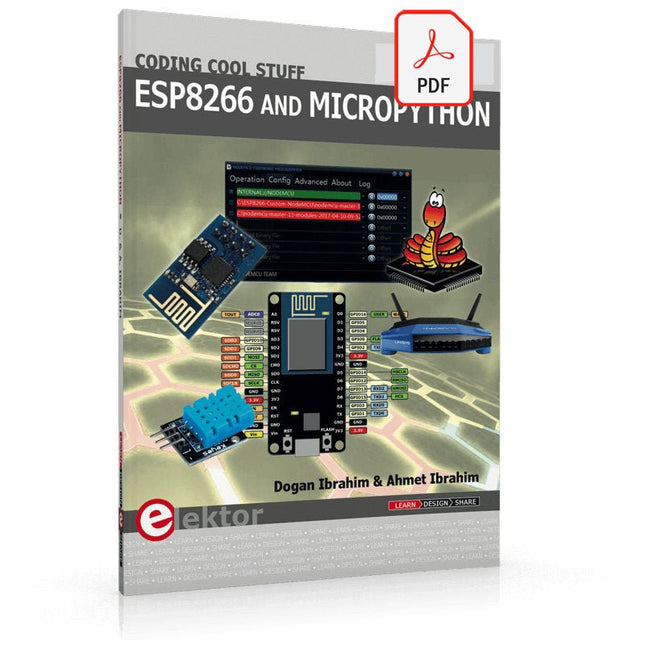
Elektor Digital ESP8266 and MicroPython (E-book)
Recently, the development of a tiny chip called the ESP8266 has made it possible to interface any type of microcontroller to a Wi-Fi AP. The ESP8266 is a low-cost tiny Wi-Fi chip having fully built-in TCP/IP stack and a 32-bit microcontroller unit. This chip, produced by Shanghai based Chinese manufacturer Espressif System, is IEEE 802.11 b/g/n Wi-Fi compatible with on-chip program and data memory, and general purpose input-output ports. Several manufacturers have incorporated the ESP8266 chip in their hardware products (e.g. ESP-xx, NodeMCU etc) and offer these products as a means of connecting a microcontroller system such as the Android, PIC microcontroller or others to a Wi-Fi. The ESP8266 is a low-power chip and costs only a few Dollars. ESP8266 and MicroPython – Coding Cool Stuff is an introduction to the ESP8266 chip and describes the features of this chip and shows how various firmware and programming languages such as the MicroPython can be uploaded to the chip. The main aim of the book is to teach the readers how to use the MicroPython programming language on ESP8266 based hardware, especially on the NodeMCU. Several interesting and useful projects are given in the e-book (pdf) to show how to use the MicroPython in NodeMCU type ESP8266 hardware: Project “What shall I wear today?”: You will be developing a weather information system using a NodeMCU development board together with a Text-to-Speech processor module. Project “The Temperature and Humidity on the Cloud”: You will be developing a system that will get the ambient temperature and humidity using a sensor and then store this data on the cloud so that it can be accessed from anywhere. Project “Remote Web Based Control”: You will be developing a system that will remotely control two LEDs connected to a NodeMCU development board using an HTTP Web Server application.
€ 29,95
Membres : € 26,96
-

Elektor Publishing Learning Digital Electronics
With 20+ Practical Projects in Logic and Circuit Design This book is a practical guide to digital electronics, covering the essential components of modern digital systems: number systems, logic gates, Boolean algebra, combinational and sequential logic, and more. Through more than 20 structured projects, you’ll design and build digital systems using real-world components such as logic gates, multiplexers, decoders, flip-flops, counters, and shift registers. The projects range from basic LED logic circuits to digital locks, display systems, traffic light controllers, and timing-based designs. Selected projects introduce the use of tools such as CircuitVerse for circuit simulation, while several designs make use of 74HC-series logic devices, commonly used in digital hardware prototyping. Inside, you’ll find: Clear coverage of number systems and binary arithmetic Logic gate fundamentals and universal gate implementations Step-by-step projects using flip-flops, counters, and registers Real-world design with 74HC-series logic chips Techniques for designing combinational and sequential systems This book takes a design-first, application-driven approach to digital electronics—built around working circuits, tested logic, and hands-on experimentation.
€ 29,95
Membres : € 26,96
-

Siglent Siglent SDS1104X-E Oscilloscope à 4 canaux (100 MHz)
Le Siglent SDS1104X-E utilise une nouvelle génération de technologie SPO (Super Phosphor Oscilloscope) qui offre une excellente fidélité des signaux et des performances. Le bruit du système est également inférieur à celui des produits similaires de l'industrie. Il est doté d'une plage d'entrée verticale minimale de 500 µV/div, d'un système de déclenchement numérique innovant à haute sensibilité et faible gigue, et d'un taux de capture de forme d'onde de 400 000 images/seconde (mode séquence). Le SDS1104X-E est doté d’un affichage à 256 niveaux d'intensité et d'un mode d'affichage à température de couleur que l'on ne trouve pas dans les autres modèles de cette catégorie. Le dernier né des oscilloscopes SIGLENT supporte de nombreux modes de déclenchement puissants, y compris le déclenchement par bus série. Le décodage est une configuration standard incluant I²C, SPI, UART, CAN, LIN. L'enregistrement de l'historique des formes d'ondes et le déclenchement séquentiel permettent un enregistrement et une analyse étendus des formes d'ondes. La nouvelle fonction mathématique FFT 1 Mpt est un autre ajout puissant qui confère au SDS1104X-E une très haute résolution de fréquence lors de l'observation des spectres de signaux. Caractéristiques Déclenchement intelligent : Bord, pente, largeur d'impulsion, fenêtre, course, intervalle, délai d'attente (Dropout) et motif. Déclenchement et décodage libre du bus série : I²C, SPI, UART, RS232, CAN et LIN Déclenchements vidéo et prise en charge de la HDTV Faible bruit de fond et échelles de tension de 500 μV / div à 10 V / div 10 types de raccourcis à un bouton, prise en charge de la configuration automatique, du défaut, des curseurs, de la mesure, du roulement, de l'historique, de l'affichage/de la persistance, de l'effacement du balayage, du zoom et de l'impression. Mode d'acquisition segmentée (séquence), divisant la longueur maximale de l'enregistrement en plusieurs segments (jusqu'à 80 000), en fonction des conditions de déclenchement définies par l'utilisateur, avec un très petit segment de temps mort pour capturer l'événement qualifiant. Fonction d'enregistrement de la forme d'onde historique (historique), la longueur maximale de la forme d'onde enregistrée est de 80 000 images. Fonction de mesure automatique de 38 paramètres, prenant en charge les statistiques, les mesures de déclenchement, les mesures mathématiques, les mesures d'historique et les mesures de réf. 1 Mpts FFT Les mesures réelles et mathématiques peuvent utiliser les 14 Mpts de la mémoire. Les touches de préréglage peuvent être personnalisées pour les réglages de l'utilisateur ou les valeurs par défaut de l'usine. Mode d'effacement de sécurité Fonction de passage/échec à grande vitesse basée sur le matériel Grand écran TFT-LCD de 7 pouces avec une résolution de 800 x 480 Plusieurs types d'interface : USB Host, USB Device (USB-TMC), LAN (VXI-11), Pass / Fail, Trigger Out Prise en charge des commandes de contrôle à distance SCPI Affichage multilingue et aide intégrée Contrôle par navigateur/page web embarquée pour une surveillance sans logiciel (modèles à 4 canaux uniquement) Inclus 1x Oscilloscope Siglent SDS1104X-E 4x Sondes 100 MHz 1x Carte de garantie 1x Cordon d'alimentation 1x Câble USB 1x Guide de démarrage rapide Téléchargements Datasheet Manual Programming Guide
€ 504,51
-

Siglent Siglent SDS2102X Plus Oscilloscope 2-ch (100 MHz)
Les oscilloscopes numériques de la série SDS2000X Plus de Siglent sont disponibles en bandes passantes de 100 MHz, 200 MHz et 350 MHz, ont une fréquence d'échantillonnage maximale de 2 GSa/s, une longueur d'enregistrement maximale de 200 Mpts/ch, et jusqu'à 4 canaux analogiques + 16 canaux numériques de capacité d'analyse de signaux mixtes. La série SDS2000X Plus utilise la technologie SPO de Siglent avec un taux de capture de forme d'onde maximum de 120 000 wfm/s (mode normal, jusqu'à 500 000 wfm/s en mode séquence), une fonction d'affichage de 256 niveaux d'intensité et un mode d'affichage de la température de couleur. Il utilise également un système de déclenchement numérique innovant à haute sensibilité et faible gigue. Le système de déclenchement prend en charge plusieurs modes de déclenchement puissants, y compris le déclenchement par bus série. L'enregistrement de l'historique des formes d'onde, l'acquisition de séquences, les fonctions de recherche et de navigation permettent de capturer, de stocker et d'analyser des enregistrements de formes d'onde étendus. Le SDS2000X Plus dispose également d'une gamme impressionnante de capacités de mesure et de calcul, d'options pour un générateur de forme d'onde de 50 MHz, ainsi que de fonctions de décodage en série, de test de masque, de tracé de bode et d'analyse de puissance. Un mode d'acquisition 10 bits permet de satisfaire les applications qui nécessitent une résolution supérieure à 8 bits. Le grand écran tactile capacitif de 10,1 pouces prend en charge les gestes multi-touch, tandis que la commande Web à distance, la souris et le clavier externe améliorent considérablement l'efficacité opérationnelle du SDS2000X Plus. Caractéristiques Modèles 100 MHz, 200 MHz, 350 MHz (extensible à 500 MHz) Taux d'échantillonnage en temps réel jusqu'à 2 GSa/s Longueur d'enregistrement jusqu'à 200 Mpts Déclencheur et décodeur de bus série, supporte I²C, SPI, UART, CAN, LIN, CAN FD, FlexRay, I²S et MIL-STD-1553B Mode 10 bits, zoom vertical et horizontal L'écran tactile capacitif prend en charge les gestes multi-touch. Oscilloscopes Siglent SDS2000X Plus SDS2102X Plus SDS2104X Plus SDS2204X Plus SDS2354X Plus Bande passante 100 MHz 100 MHz 200 MHz 350 MHz Canaux 2 4 4 4 Taux d'échantillonnage en temps réel 2 GSa/s 2 GSa/s 2 GSa/s 2 GSa/s Taux de capture 120,000 wfm/s 120,000 wfm/s 120,000 wfm/s 120,000 wfm/s Profondeur de la mémoire 200 Mpts/ch 200 Mpts/ch 200 Mpts/ch 200 Mpts/ch Inclus Siglent SDS2102X Plus Oscilloscope Sondes passives Cordon d'alimentation Câble USB Manuel d'utilisation Téléchargements Fiche technique Manuel Guide rapide Manuel de l'utilisateur Firmware
€ 848,13
-

Great Scott Gadgets Boîtier en acrylique pour HackRF SDR
Ce boîtier en acrylique transparent est le boîtier officiel pour la carte HackRF One/Pro. Il peut remplacer le boîtier en plastique noir standard de la HackRF One. Instructions de montage Utilisez un médiator de guitare ou un spudger pour extraire le circuit de la carte HackRF One/Pro du boîtier en plastique noir. Insérez une vis longue dans chaque coin du panneau inférieur en acrylique. Fixez chaque vis longue avec un entretoise courte (5 mm) de l'autre côté du panneau. Placez le circuit de la carte HackRF One/Pro (face vers le haut) sur le dessus du panneau inférieur, en faisant passer les extrémités des vis longues à travers les trous de montage des coins de la carte. Fixez le circuit avec une entretoise longue (6 mm) dans chaque coin. Placez le panneau en acrylique supérieur sur le dessus de la carte, en alignant les découpes avec les connecteurs d'extension de la carte. Fixez chaque coin avec une vis courte. Remarque : Ne serrez pas trop fort ! Serrez uniquement à la main à chaque étape.
€ 19,95
Membres : € 17,96
-
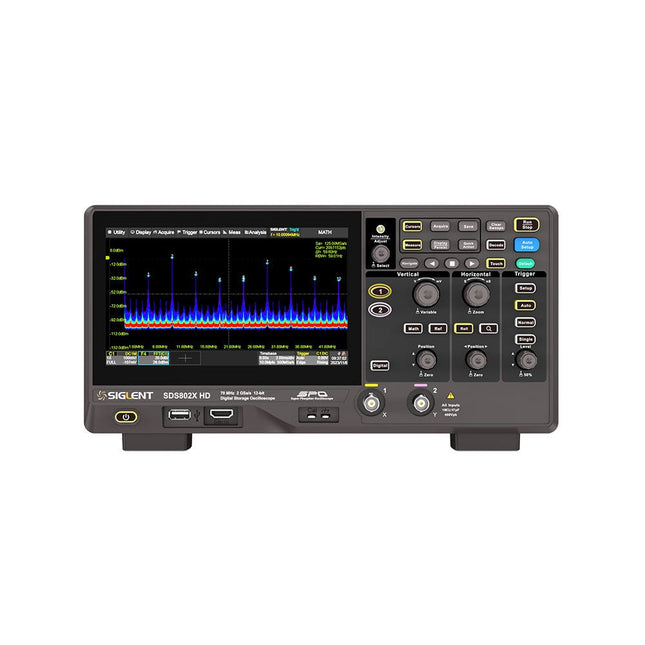
Siglent Siglent SDS822X HD Oscilloscope à 2 canaux (200 MHz)
The Siglent SDS822X HD digital storage oscilloscope is based on 2 GSa/s, 12-bit Analog-Digital Converters and front ends with excellent noise floor performance. With a 200 MHz bandwidth, and a maximum record length of 100 Mpts, and the capability to analyze 2 analog channels alongside 16 digital channels, the SDS822X HD is perfectly suited for mixed signal analysis. Caractéristiques 12-bit High Resolution 12-bit Analog-Digital Convertors with sample rate up to 2 GSa/s Front ends with 70 μVrms noise floor @ 200 MHz bandwidth 2/4 analog channels, up to 700 MHz bandwidth SPO technology Waveform capture rate up to 120,000 wfm/s (normal mode), and 500,000 wfm/s (sequence mode) Supports 256-level intensity grading and color temperature display modes. Up to 50 Mpts record length Digital trigger system Intelligent trigger: Edge, Slope, Pulse width, Window, Runt, Interval, Dropout, Pattern, Video (HDTV supported), Qualified, Nth edge, Delay, Setup/Hold time. Serial bus triggering and decoder, supports protocols I²C, SPI, UART, CAN, LIN. Segmented acquisition (Sequence) mode, dividing the maximum record length into multiple segments (up to 80,000), according to trigger conditions set by the user, with a very small dead time between segments to capture the qualifying event. History waveform record (History) function, the maximum recorded waveform length is 80,000 frames. Automatic measurements on 50+ parameters, supports statistics with histogram, track, trend, Gating measurement, and measurements on Math, History and Ref. 4 Math traces (2 Mpts FFT, addition, subtraction, multiplication, division, integration, differential, square root, etc.), supports formula editor. Abundant data analysis functions such as Search, Navigate, Counter, Bode plot and Power Analysis High Speed hardware-based Mask Test function, with Mask Editor tool for creating user-defined masks 16 digital channels (optional) 25 MHz waveform generator (optional) 7" TFT-LCD display with 1024 x 600 resolution; Capacitive touch screen supports multi-touch gestures. Interfaces include: USB Hosts, USB Device (USBTMC), LAN (VXI-11/Telnet/Socket), Pass/Fail, Trigger Out Built-in web server supports remote control over the LAN port using a web browser. Supports SCPI remote control commands. Supports external mouse and keyboard. Supports NTP. Spécifications Analog Channels 2 Bandwidth 200 MHz Vertical resolution 12-bit Sample rate (Max.) One channel mode: 100 Mpts/chTwo channel mode: Mpts/chFour channel mode: 25 Mpts/ch Memory depth (Max.) One channel mode: 50 Mpts/chTwo channel mode: 25 Mpts/ch Waveform capture rate (Max.) Normal mode: 120,000 wfm/sSequence mode: 500,000 wfm/s Trigger type Edge, Slope, Pulse width, Window, Runt, Interval, Dropout, Pattern, Video, Qualified, Nth edge, Delay, Setup/Hold time, Serial Serial trigger and decode (Standard) I²C, SPI, UART, CAN, LIN Measurement 50+ parameters, statistics, histogram, trend, and track supported Math 4 traces 2 Mpts FFT, Filter, +, -, x, ÷, ∫dt, d/dt, √, Identity, Negation, Absolute, Sign, ex, 10x, ln, lg, Interpolation, MaxHold, MinHold, ERES, Average. Supports formula editor Data analysis Search, Navigate, History, Mask Test, Counter, Bode plot, and Power Analysis Digital channel (optional) 16-channel; maximum sample rate up to 1 GSa/s; record length up to 10 Mpts USB AWG module (option) One channel, 25 MHz, sample rate of 125 MHz, wave length of 16 kpts, isolated output I/O 2x USB 2.0 Host, USB 2.0 Device, 10/100 M LAN, Auxiliary output (TRIG OUT, PASS/FAIL), SBUS (Siglent MSO) Probe (Standard) Passive probe PB470 for each channel Display 7 TFT-LCD with capacitive touch screen (1024x600) Inclus 1x Siglent SDS822X Oscilloscope 2x Passive probe (200 MHz) PP520 1x Power cord (EU) 1x USB cable 1x Certificate of calibration 1x Quick start Téléchargements Datasheet Manual Programming guide
€ 630,00
-
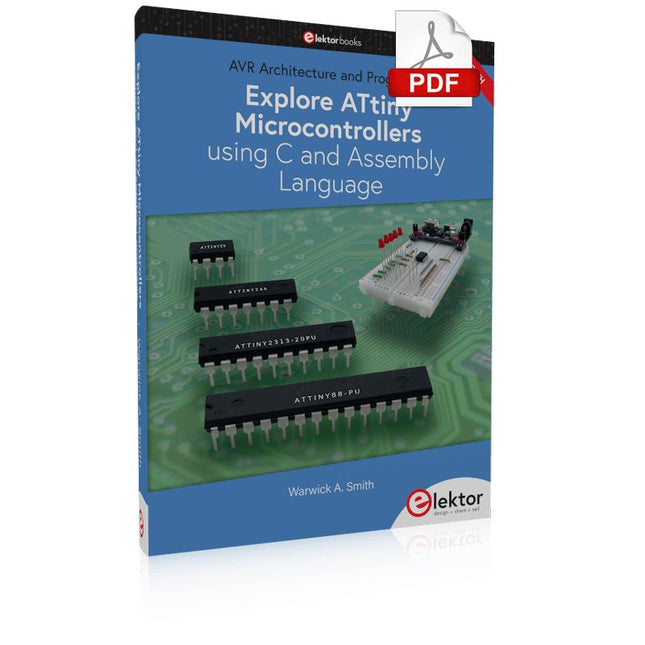
Elektor Digital Explore ATtiny Microcontrollers using C and Assembly Language (E-book)
AVR Architecture and Programming An in-depth look at the 8-bit AVR architecture found in ATtiny and ATmega microcontrollers, mainly from a software and programming point of view. Explore the AVR architecture using C and assembly language in Microchip Studio (formerly Atmel Studio) with ATtiny microcontrollers. Learn the details of how AVR microcontrollers work internally, including the internal registers and memory map of ATtiny devices. Program ATtiny microcontrollers using an Atmel-ICE programmer/debugger, or use a cheap hobby programmer, or even an Arduino Uno as a programmer. Most code examples can be run using the Microchip Studio AVR simulator. Learn to write programs for ATtiny microcontrollers in assembly language. See how assembly language is converted to machine code instructions by the assembler program. Find out how programs written in the C programming language end up as assembly language and finally as machine code instructions. Use the Microchip Studio debugger in combination with a hardware USB programmer/debugger to test assembly and C language programs, or use the Microchip Studio AVR simulator. DIP packaged ATtiny microcontrollers are used in this volume for easy use on electronic breadboards, targeting mainly the ATtiny13(A) and ATtiny25/45/85. Learn about instruction timing and clocks in AVR microcontrollers using ATtiny devices. Be on your way to becoming an AVR expert with advanced debugging and programming skills.
€ 34,95
Membres : € 31,46
-

Uni-Trend Oscilloscope UNI-T UPO1202CS à 2 canaux (200 MHz)
UNI-T UPO1202CS est un oscilloscope numérique phosphore numérique à 2 canaux multifonctionnel et peu coûteux, avec une bande passante de 200 MHz et un taux d'échantillonnage de 1 Géch/s. Il peut être largement utilisé dans les domaines de la conception électronique et électrique, du débogage, de l'éducation et de la conception industrielle. La série UPO1000CS adopte une technologie de traitement de signal numérique parallèle, ce qui améliore considérablement la vitesse de traitement des données et le taux de capture de forme d'onde. La technologie Ultra Phosphor originale peut présenter l'effet cumulatif du signal testé sous la forme d'une post-illumination multicouche. Comparé aux oscilloscopes de stockage numérique traditionnels, la persistance des oscilloscopes phosphore numérique peut présenter des données de forme d'onde tridimensionnelles d'amplitude, de temps et d'intensité de signal. La technologie Fast Acquire peut capturer avec précision les événements anormaux tels que la vidéo, le jitter, le bruit et les signaux de rupture. Spécifications UPO1102CS UPO1202CS Bande passante 100 MHz 200 MHz Canaux analogiques 2 2 Taux d'échantillonnage 1 Géch/s 1 Géch/s Profondeur de stockage 56 Mpts par canal 56 Mpts par canal Temps de montée ≤3,5 ns ≤1,8 ns Taux de capture 500 000 wfms/s 500 000 wfms/s Enregistrement de forme d'onde 100 000 images 100 000 images Fonctionnalités Écran LCD TFT 7' WVGA (800 x 480) Effet d'affichage super fluorescent Ultra Phosphor, jusqu'à 256 niveaux d'affichage en niveaux de gris Prise en charge des déclencheurs RS232, I²C, SPI, CAN et LIN Décodage matériel RS232, I²C, SPI, CAN et LIN innovant Échelle verticale : 1 mV/div à 20 V/div Faible bruit de fond : Fonction FFT améliorée de 1 million de points. Prise en charge du réglage de fréquence, du diagramme en cascade, du réglage de détection et de la mesure des marqueurs, etc. 36 types de paramètres de forme d'onde peuvent être mesurés automatiquement Nombreuses fonctions de déclenchement (front, largeur d'impulsion, vidéo, pente, rupture, dépassement, retard, délai d'expiration, durée, configuration et maintien, N-ième front et déclenchement de motif) Prise en charge de l'affichage en fluorescence de déclenchement indépendant à double canal pour plusieurs oscilloscopes Compteur de fréquence matérielle indépendant à 7 bits pour plusieurs canaux Le DVM prend en charge la mesure vraie RMS AC et DC indépendante à double canal Fonctions arithmétiques de forme d'onde (FFT, +, -, ×, ÷, filtrage numérique, opérations logiques et opérations avancées) Interfaces riches : USB Host, USB Device, LAN, EXT Trig, AUX Out (Trig Out, Pass/Fail) Prise en charge de la commande standard SCPI pour instrument programmable Prise en charge de l'accès et du contrôle WEB Téléchargements Fiche technique Manuel de programmation Manuel de l'utilisateur Guide de démarrage rapide Logiciel
€ 365,95
-

Elektor Digital The Maker’s Guide to AI Coding (E-book)
If you can describe it, you can build it AI coding assistants are changing what makers and solopreneurs can build. Tasks that once demanded weeks of learning a new language, framework, or software stack can now be delegated to an AI—provided you know how to describe the job, judge the result, and keep control of the process. The Maker’s Guide to AI Coding is a practical guide to doing exactly that. It explains how to work with AI coding tools as collaborators rather than vending machines, how much to delegate, how to write specifications that produce useful results, and how to recognise hallucinations, context drift, overconfidence, and code that runs but is still wrong. The book is built around four increasingly ambitious projects. You begin with a browser-based RC filter analyser, then develop a live serial data plotter for Arduino and other microcontrollers. Next comes a datasheet questionand- answer tool using retrieval-augmented generation (RAG), followed by a complete multi-user resource booking system with authentication, a database, external services, background jobs, and deployment. No advanced programming background is required. The emphasis is on thinking clearly, guiding the AI, testing what it produces, and preserving the skills needed to evaluate its work. Along the way, you learn development workflow designed to remain useful as tools evolve. If you can describe what you want to build, this book shows you how to turn that description into working software.
€ 29,95
Membres : € 26,96
-
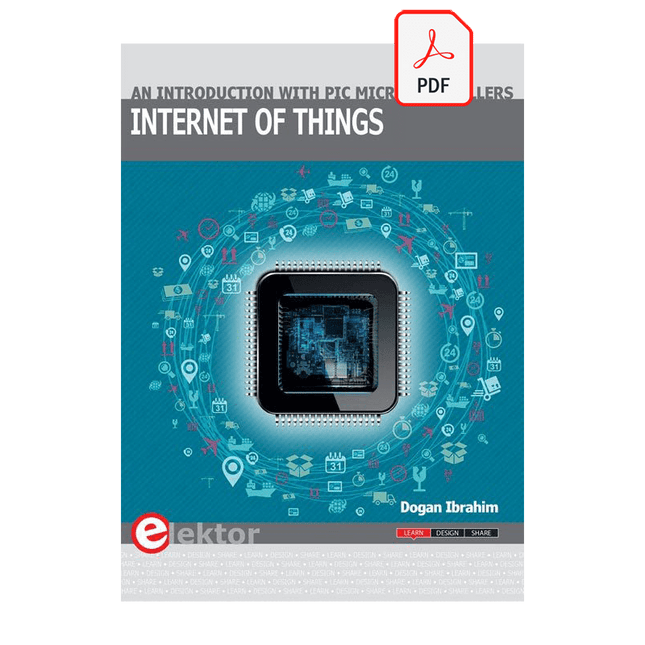
Elektor Digital Internet of Things (E-book)
The Internet of Things (IoT) is a new concept in intelligent automation and intelligent monitoring using the Internet as the communications medium. The “Things” in IoT usually refer to devices that have unique identifiers and are connected to the Internet to exchange information with each other. Such devices usually have sensors and/or actuators that can be used to collect data about their environments and to monitor and control their environments. The collected data can be processed locally or it can be sent to centralized servers or to the cloud for remote storage and processing. For example, a small device at the size of a matchbox can be used to collect data about the temperature, relative humidity and the atmospheric pressure. This data can be sent and stored in the cloud. Anyone with a mobile device can then access and monitor this data at any time and from anywhere on Earth provided there is Internet connectivity. In addition, users can for example, adjust the central heating remotely using their mobile devices and accessing the cloud. This book is written for students, for practising engineers and for hobbyists who want to learn more about the building blocks of an IoT system and also learn how to setup an IoT system using these blocks. Chapter 1 is an introduction to the IoT systems. In Chapter 2, the basic concepts and possible IoT architectures are discussed. The important parts of any IoT system are the sensors and actuators and they are described briefly in Chapter 3. The devices in an IoT system usually communicate with each other and the important aspect of IoT communication is covered in Chapter 4. Chapter 5 proceeds with the features of some of the commonly used development kits. One of these, the Clicker 2 for PIC18FJ manufactured by mikroElektronika, can be used as a processor in IoT systems and its features are described in detail in Chapter 6. A popular microcontroller C language, mikroC Pro for PIC gets introduced in Chapter 7. Chapter 8 covers the use of a click board with the Clicker 2 for PIC18FJ development kit. Similarly, the use of a sensor click board is described as a project in Chapter 9, and an actuator board in Chapter 10. Chapters 11 and 12 cover Bluetooth and Wi-Fi technologies in microcontroller based systems, and the remaining chapters of the book demo the creation of a simple Wi-Fi based IoT system with cloud-based data storage. This book has been written with the assumption that the reader has taken a course on digital logic design and has been exposed to writing programs using at least one high-level programming language. Knowledge of the C programming language will be very useful. Also, familiarity with at least one member of the PIC series of microcontrollers (e.g. PIC16 or PIC18) will be an advantage. The knowledge of assembly language programming is not required because all the projects in the book are based on using the C language. If you are a total beginner in programming you can still access the e-book, but first you are advised to study introductory books on microcontrollers.
€ 34,95
Membres : € 31,46
-

Elektor Publishing The Maker’s Guide to AI Coding
If you can describe it, you can build it AI coding assistants are changing what makers and solopreneurs can build. Tasks that once demanded weeks of learning a new language, framework, or software stack can now be delegated to an AI—provided you know how to describe the job, judge the result, and keep control of the process. The Maker’s Guide to AI Coding is a practical guide to doing exactly that. It explains how to work with AI coding tools as collaborators rather than vending machines, how much to delegate, how to write specifications that produce useful results, and how to recognise hallucinations, context drift, overconfidence, and code that runs but is still wrong. The book is built around four increasingly ambitious projects. You begin with a browser-based RC filter analyser, then develop a live serial data plotter for Arduino and other microcontrollers. Next comes a datasheet questionand- answer tool using retrieval-augmented generation (RAG), followed by a complete multi-user resource booking system with authentication, a database, external services, background jobs, and deployment. No advanced programming background is required. The emphasis is on thinking clearly, guiding the AI, testing what it produces, and preserving the skills needed to evaluate its work. Along the way, you learn development workflow designed to remain useful as tools evolve. If you can describe what you want to build, this book shows you how to turn that description into working software.
€ 34,95
Membres : € 31,46


