La plateforme ROS la plus populaire au monde
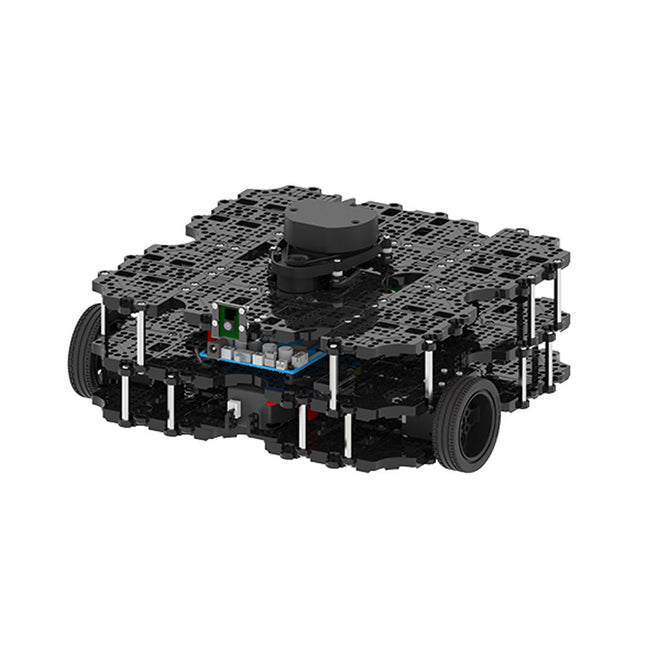
TurtleBot est le robot open source le plus populaire pour l'éducation et la recherche. La nouvelle génération de TurtleBot3 est un petit robot mobile, peu coûteux, entièrement programmable et basé sur ROS. Il est destiné à être utilisé pour l'éducation, la recherche, les loisirs et le prototypage de produits.
Coût abordable
TurtleBot a été développé pour répondre aux besoins économiques des écoles, des laboratoires et des entreprises. TurtleBot3 est le robot le plus abordable parmi les robots mobiles SLAM équipés d'un capteur de distance laser 360° LDS-01.
Norme ROS
La marque TurtleBot est gérée par Open Robotics, qui développe et maintient ROS. Aujourd'hui, ROS est devenu la plateforme de référence pour tous les roboticiens du monde. TurtleBot peut être intégré à des composants robotiques existants basés sur ROS, mais TurtleBot3 peut être une plateforme abordable pour ceux qui veulent commencer à apprendre ROS.
Extensibilité
TurtleBot3 encourage les utilisateurs à personnaliser sa structure mécanique à l'aide d'options alternatives : carte embarquée open source (en tant que carte de contrôle), ordinateur et capteurs. TurtleBot3 Waffle Pi est une plate-forme à deux roues à entraînement différentiel, mais sa structure et sa mécanique peuvent être personnalisées de nombreuses façons : voitures, vélos, remorques, etc. Développez vos idées au-delà de l'imagination avec différents SBC, capteurs et moteurs sur une structure évolutive.
Actionneur modulaire pour robot mobile
TurtleBot3 est capable d'obtenir des données spatiales précises en utilisant 2 DYNAMIXEL dans les articulations des roues. Les DYNAMIXEL de la série XM peuvent être utilisés selon l'un des 6 modes de fonctionnement (série XL : 4 modes de fonctionnement) : Mode de contrôle de la vitesse pour les roues, mode de contrôle du couple ou mode de contrôle de la position pour les articulations, etc. DYNAMIXEL peut même être utilisé pour fabriquer un manipulateur mobile qui est léger mais qui peut être contrôlé avec précision grâce au contrôle de la vitesse, du couple et de la position. DYNAMIXEL est un composant c?ur qui rend TurtleBot3 parfait. Il est facile à assembler, à entretenir, à remplacer et à reconfigurer.
Carte de contrôle ouverte pour ROS
La carte de contrôle est open-source au niveau du matériel et du logiciel pour la communication ROS. La carte de contrôle OpenCR1.0 est suffisamment puissante pour contrôler non seulement les capteurs DYNAMIXEL mais aussi les capteurs ROBOTIS qui sont fréquemment utilisés pour des tâches de reconnaissance de base de manière rentable. Différents capteurs tels que les capteurs tactiles, les capteurs infrarouges, les capteurs de couleur et bien d'autres sont disponibles. L'OpenCR1.0 possède un capteur IMU à l'intérieur de la carte afin d'améliorer la précision du contrôle pour d'innombrables applications. La carte dispose d'alimentations de 3,3 V, 5 V et 12 V pour renforcer les gammes d'appareils informatiques disponibles.
Source ouverte
Le matériel, le micrologiciel et le logiciel de TurtleBot3 sont des logiciels libres, ce qui signifie que les utilisateurs sont invités à télécharger, modifier et partager les codes sources. Tous les composants de TurtleBot3 sont fabriqués en plastique moulé par injection afin de réduire les coûts, mais les données de CAO 3D sont également disponibles pour l'impression 3D.
Spécifications
Vitesse de translation maximale
0.26 m/s
Vitesse de rotation maximale
1.82 rad/s (104.27 deg/s)
Charge utile maximale
30 kg
Taille (L x L x H)
281 x 306 x 141 mm
Poids (+ SBC + batterie + capteurs)
1.8 kg
Seuil de montée
Max 10 mm
Durée d'utilisation prévue
2 h
Temps de charge prévu
2 h 30 m
SBC (ordinateur à carte unique)
Raspberry Pi 4 (2 Go RAM)
MCU
32-bit ARM Cortex-M7 with FPU (216 MHz, 462 DMIPS)
Contrôleur à distance
RC-100B + BT-410 Set (Bluetooth 4, BLE)
Actionneur
XL430-W210
LDS (capteur de distance laser)
360 Laser Distance Sensor LDS-01 or LDS-02
Caméra
Raspberry Pi Camera Module v2.1
IMU
Gyroscope 3 axesAccelerometer 3 axes
Connecteurs d'alimentation
3.3 V/800 mA5 V/4 A12 V/1 A
Connecteurs d'extension
GPIO 18 brochesArduino 32 broches
Périphériques
3x UART, 1x bus CAN, 1x SPI, 1x I²C, 5x CAN, 4x 5-pin OLLO
Ports DYNAMIXEL
3x RS485, 3x TTL
Audio
Plusieurs séquences programmables
LED programmables
4x User LED
LED d'état
1x Board status LED1x Arduino LED1x Power LED
Boutons et interrupteurs
2x boutton poussoir, 1x bouton Reset, 2x DIPswitch
Batterie
Lithium polymer 11.1 V 1800 mAh / 19.98 Wh 5C
Connexion PC
USB
Mise à jour du micrologiciel
par USB / par JTAG
Adaptateur d'alimentation (SMPS)
Entrée: 100-240 VCA 50/60 Hz, 1.5 A @maxSortie: 12 VCC, 5 A
Téléchargements
Programmation de robots ROS
GitHub
Manuel électronique
Communauté
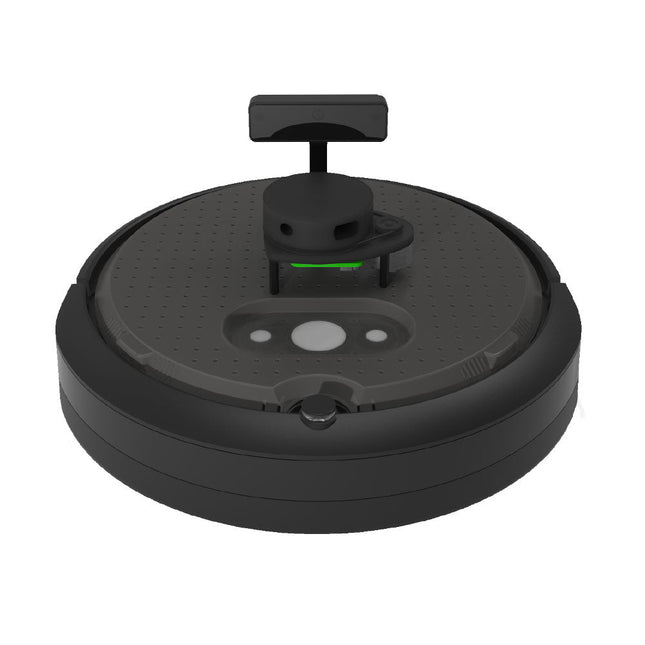
TurtleBot 4 est la nouvelle génération de la plateforme robotique open source la plus populaire au monde pour l'éducation et la recherche, offrant une meilleure puissance de calcul, de meilleurs capteurs et une expérience utilisateur de classe mondiale à un prix abordable. TurtleBot 4 Lite est équipée d'une base mobile iRobot Create3, d'un puissant Raspberry Pi 4 exécutant ROS 2, d'une caméra stéréo spatiale OAK-D AI, d'un LiDAR 2D et de bien d'autres choses encore. Tous les composants ont été intégrés de manière transparente pour offrir une plateforme de développement et d'apprentissage prête à l'emploi. Profitez de la communauté florissante de développeurs ROS open source et commencez à apprendre la robotique dès le premier jour. Spécifications Plate-forme de base iRobot Create 3 Roues (diamètre) 72 mm Garde au sol 4,5 mm Ordinateur de bord Raspberry Pi 4 (4 Go) Vitesse linéaire maximale 0,31 m/s en mode sécurisé0,46 m/s sans mode sécurisé Vitesse angulaire maximale 1,90 rad/s Charge utile maximale 9 kg Temps de fonctionnement 2h 30m - 4h selon la charge Temps de charge 2h 30m Lidar RPLIDAR A1M8 Caméra OAK-D-Lite Alimentation utilisateur VBAT @1.9 A5 V @ faible courant3,3 V @ faible courant Extension USB 2x USB 2.0 (Type A)2x USB 3.0 (Type A) LED programmables Créer 3 anneaux lumineux Boutons et interrupteurs 2x boutons d'utilisateur Create 31x bouton d'alimentation Create3 Batterie 26 Wh Lithium Ion (14,4 V nominal) Station d'accueil Inclus Taille (L x L x H) 342 x 339 x 192 mm Poids 3,3 kg Téléchargements • Manuel de l’utilisateur
Cette version améliorée 2.0 (disponible exclusivement chez Elektor) contient les changements suivantes :
Enhanced protective earthing (PE) for furnace chassis
Extra thermal insulation layer around furnace to reduce odors
Connexion à un ordinateur permettant l'édition des courbes sur un PC
Fonctionnalités telles que le contrôle constant de la température et les fonctions de temporisation
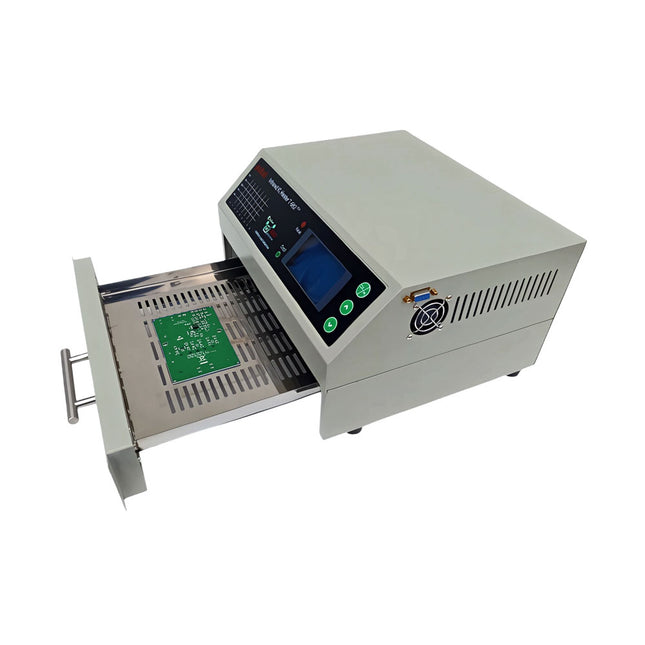
Four à refusion à infrarouge T-962 v2.0 est un four de soudure par fusion pour CI contrôlé par microprocesseur. Il peut être utilisé pour souder efficacement divers composants CMS et BGA. L’ensemble du processus de soudure est automatique et très facile à utiliser. Cette machine utilise un rayonnement infrarouge puissant et la circulation du flux d’air chaud, ce qui permet de maintenir une température très précise et uniformément répartie.
Un plaque à fentes est conçu pour contenir la pièce à traiter, et permet d’utiliser des techniques de soudure sûres et de manipuler des CMS, BGA et d’autres petites pièces électroniques montées circuits imprimes. Le T-962 v2.0 peut être utilisé pour la dessoudure afin de rectifier automatiquement les joints de soudure défectueux, pour retirer/remplacer les composants endommagés et pour achever de petits modèles ou prototypes électroniques.
Caractéristiques
Large zone de soudure infrarouge
Surface effective de soudure : 180 x 235 mm ; cela augmente considérablement la plage d’utilisation de ce dispositif et le rend un investissement économique.
Choix de différents cycles de soudure
Les paramètres de huit cycles de soudure sont prédéfinis et l’ensemble du processus peut être achevé automatiquement en commençant par le préchauffage, le trempage et la refusion jusqu’au refroidissement.
Chauffage spécifique et égalisation de la température pour tous les modèles.
Utilise jusqu’à 800 W de chauffage infrarouge économe en énergie et une circulation d’air pour refaire couler la soudure.
Design ergonomique, pratique et facile à utiliser
Une construction de qualité, mais aussi un poids léger et un faible encombrement permettent au T-962 v2.0 d’être facilement positionné sur un établi, transporté ou stocké.
Nombreuses fonctions disponibles
Le T-962 v2.0 peut souder la plupart des petits composants des circuits imprimés, par exemple CHIP, SOP, PLCC, QFP, BGA, etc. Il s’agit de la solution de réparation idéale, allant des simples fabrications à la production de petits lots.
Caractéristiques techniques
Zone de soudure (max.)
180 x 235 mm
Puissance (max.)
800 W
Plage de température
0-280°C
Mode de chauffage
Infrarouge
Temps de traitement
1 à 8 minutes
Alimentation
220 V AC/50 Hz
Écran
LCD avec rétroéclairage
Mode de contrôle
8 courbes de température intelligentes
Dimensions
310 x 290 x 170 mm
Poids
6,2 kg
Inclus
1x T-962 v2.0 Four à refusion (version Elektor)
2x Fusibles
1x Cordon d'alimentation (UE)
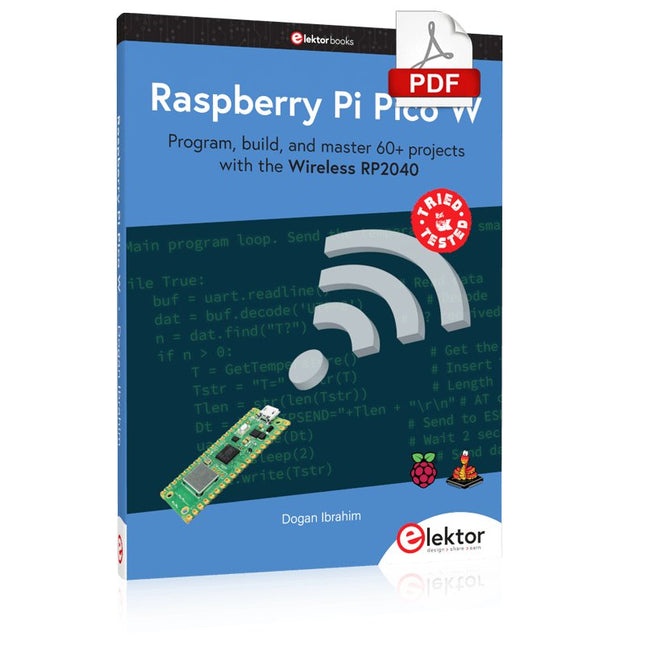
Program, build, and master 60+ projects with the Wireless RP2040
The Raspberry Pi Pico and Pico W are based on the fast, efficient, and low-cost dual-core ARM Cortex M0+ RP2040 microcontroller chip running at up to 133 MHz and sporting 264 KB of SRAM and 2 MB of Flash memory. Besides spacious memory, the Pico and Pico W offer many GPIO pins, and popular peripheral interface modules like ADC, SPI, I²C, UART, PWM, timing modules, a hardware debug interface, and an internal temperature sensor.
The Raspberry Pi Pico W additionally includes an on-board Infineon CYW43439 Bluetooth and Wi-Fi chipset. At the time of writing this book, the Bluetooth firmware was not yet available. Wi-Fi is however fully supported at 2.4 GHz using the 802.11b/g/n protocols.
This book is an introduction to using the Raspberry Pi Pico W in conjunction with the MicroPython programming language. The Thonny development environment (IDE) is used in all of the 60+ working and tested projects covering the following topics:
Installing the MicroPython on Raspberry Pi Pico using a Raspberry Pi or a PC
Timer interrupts and external interrupts
Analogue-to-digital converter (ADC) projects
Using the internal temperature sensor and external sensor chips
Using the internal temperature sensor and external temperature sensor chips
Datalogging projects
PWM, UART, I²C, and SPI projects
Using Bluetooth, WiFi, and apps to communicate with smartphones
Digital-to-analogue converter (DAC) projects
All projects are tried & tested. They can be implemented on both the Raspberry Pi Pico and Raspberry Pi Pico W, although the Wi-Fi-based subjects will run on the Pico W only. Basic programming and electronics experience are required to follow the projects. Brief descriptions, block diagrams, detailed circuit diagrams, and full MicroPython program listings are given for all projects.
Program, build, and master 60+ projects with the Wireless RP2040
The Raspberry Pi Pico and Pico W are based on the fast, efficient, and low-cost dual-core ARM Cortex M0+ RP2040 microcontroller chip running at up to 133 MHz and sporting 264 KB of SRAM and 2 MB of Flash memory. Besides spacious memory, the Pico and Pico W offer many GPIO pins, and popular peripheral interface modules like ADC, SPI, I²C, UART, PWM, timing modules, a hardware debug interface, and an internal temperature sensor.
The Raspberry Pi Pico W additionally includes an on-board Infineon CYW43439 Bluetooth and Wi-Fi chipset. At the time of writing this book, the Bluetooth firmware was not yet available. Wi-Fi is however fully supported at 2.4 GHz using the 802.11b/g/n protocols.
This book is an introduction to using the Raspberry Pi Pico W in conjunction with the MicroPython programming language. The Thonny development environment (IDE) is used in all of the 60+ working and tested projects covering the following topics:
Installing the MicroPython on Raspberry Pi Pico using a Raspberry Pi or a PC
Timer interrupts and external interrupts
Analogue-to-digital converter (ADC) projects
Using the internal temperature sensor and external sensor chips
Using the internal temperature sensor and external temperature sensor chips
Datalogging projects
PWM, UART, I²C, and SPI projects
Using Bluetooth, WiFi, and apps to communicate with smartphones
Digital-to-analogue converter (DAC) projects
All projects are tried & tested. They can be implemented on both the Raspberry Pi Pico and Raspberry Pi Pico W, although the Wi-Fi-based subjects will run on the Pico W only. Basic programming and electronics experience are required to follow the projects. Brief descriptions, block diagrams, detailed circuit diagrams, and full MicroPython program listings are given for all projects.
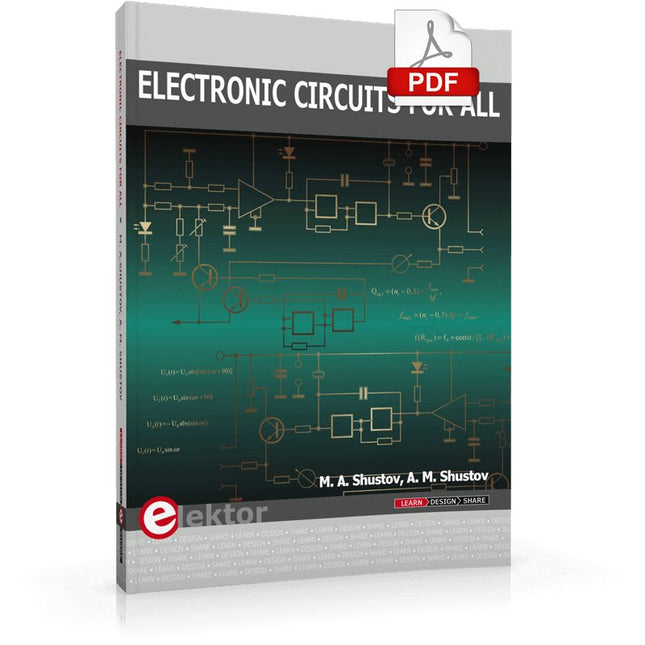
This book contains more than 400 simple electronic circuits which are developed and tested in practice by the authors. The technical solutions presented in the book are intended to stimulate the creative imagination of readers and broaden their area of thought. This should allow readers to look beyond the horizons of possibilities and use ordinary electronic items in a new way.
This book includes new and original radio electronic multipurpose circuits. The chapters of the book are devoted to power electronics and measuring equipment and contain numerous original circuits of generators, amplifiers, filters, electronic switches based on thyristors and CMOS switch elements. Wired and wireless systems as well as security and safety systems are presented.
Due to the high relevance and increased interest of readers in little-known or not readily available information, the different chapters of this book describe the use of electronic devices in industrial electronics and for research, as well as new instruments and equipment for medical use, gas-discharge and Kirlian photography.
A number of technical devices presented in this book are related to research of the mysteries of the earth, nature and human beings by using radio electronic devices. This book will be useful for both radio amateurs and professionals.
Plot, Cut, Drill, Mill and Laser with the Z99
This book covers the construction, hardware, software, and operation of the Z99 – CNC machine. This is a multifunctional 4-axis machine for home construction.
The capabilities of the Z99 machine include:
large-format schematic plotting
PCB plotting with etch-resist pens
schematic plotting with conductive-ink pens
letter cutting out of vinyl
paper cutting
PCB/substrate drilling
PCB/substrate milling
text milling
laser engraving
laser cutting of solder paste masks
By making the support software available as freeware, readers of the book are challenged and encouraged to develop new applications for the Z99.
The machine would not be of much use if the user has no option to create suitable files for the designs in mind. A large part of this book is dedicated to creating source files in a variety of freeware software packages, including Inkscape, DesignSpark PCB, KiCad, and FlatCAM.
The book is also useful for readers keen to comprehend and then master the basic structure of HPGL, Gerber, Drill, and G-code files, as well as to have a go at deciphering them using software.
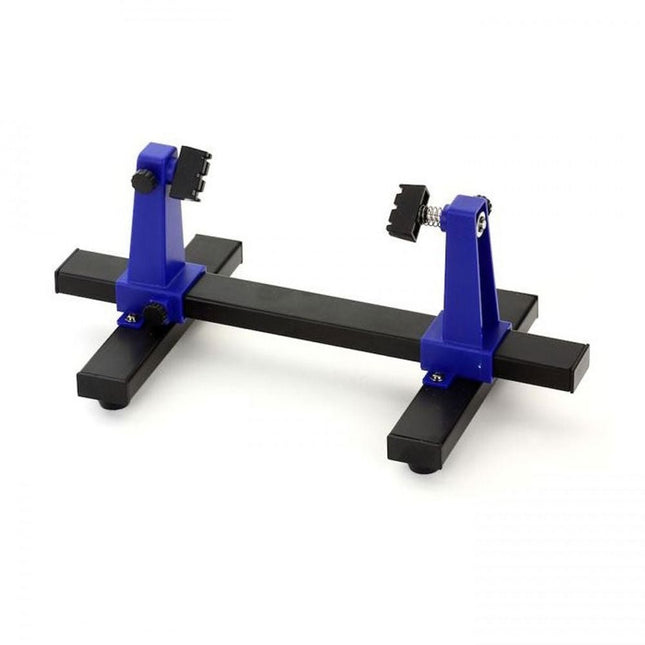
Ce support réglable pour circuits imprimés est idéal pour serrer les circuits imprimés lors des opérations de soudage, de dessoudage ou de retouche.
Caractéristiques
Il est doté de deux poignées réglables sur un support rétractable pour s'adapter à différentes tailles de circuits imprimés.
Les pinces réglables permettent au circuit imprimé de pivoter sur 360 degrés et de rester dans n'importe quelle position.
La base de ce support métallique rigide comporte quatre pieds en caoutchouc pour garantir la stabilité.
Spécifications
Taille du produit
30 x 16,5 x 12,5 cm
Taille maximale de maintien
20 x 14 cm
Poids
450 g
Les sondes mains libres de la série SQ de Sensepeek ont un point de gravité plus bas, ce qui les rend encore plus stables que les sondes mains libres de la série SP. Toutes les sondes de la série SQ sont également isolées et peuvent être utilisées à la main comme n'importe quelle sonde traditionnelle, mais leur plein potentiel est utilisé lors des mesures en mains libres.
La série SQ de sondes d'oscilloscope comprend également plus d'options de mise à la terre, dispose d'une protection de l'extrémité de la sonde, d'un câble plus long et d'un support pour les oscilloscopes avec mise à l'échelle automatique (10:1).
Toutes les caractéristiques appréciées de la mesure en mains libres, l'aiguille de test à ressort à pas fin interchangeable, les supports de câble à code couleur et le design minimaliste sont maintenus pour rendre obsolètes les sondes de taille et de main traditionnelles.
La longueur et le poids des sondes SQ sont parfaitement équilibrés pour être utilisés avec les supports de circuits imprimés et la plaque de base PCBite, qui sont indispensables pour la fonction mains libres.
Caractéristiques
Sonde passive 10:1 avec support pour oscilloscopes avec mise à l'échelle automatique
Aiguille de test à ressort pour les mesures au pas fin
Plusieurs options de mise à la terre
Porte-câbles à code couleur
Protection de l'extrémité de la sonde
Isolé, peut être utilisé à la main
Support de sonde amélioré pour les mesures en mains libres lorsqu'il est utilisé avec les supports de circuits imprimés PCBite.
Inclus
1x SQ500 Sonde 500 MHz avec aiguille de test à ressort
1x Support de sonde SQ pour les mesures en mains libres
1x Crochet de test avec câbles détachables (5 cm et 10 cm) pour une connexion pratique à la terre.
1x Câble crocodile pour une connexion pratique à la terre
1x Ressort de masse standard, pour des mesures en main libres à la largeur de bande nominale
1x Ressort de masse unique, pour les mesures en mains libres à la largeur de bande nominale
1x Jeu de supports de câbles à code couleur (4 couleurs)
1x Protection de l'extrémité de la sonde
1x Aiguille de test supplémentaire
Téléchargements
Guide de l’utilisateur SQXX0 Rev1.1
Les sondes mains libres de la série SQ de Sensepeek ont un centre de gravité plus bas, ce qui les rend encore plus stables que les sondes mains libres originales de la série SP. Toutes les sondes de la série SQ sont également isolées et peuvent être utilisées à la main comme n'importe quelle sonde traditionnelle, mais leur plein potentiel est utilisé lors des mesures mains libres.
Les sondes d'oscilloscope de la série SQ disposent également de davantage d'options de mise à la terre, d'une protection de la pointe de la sonde, d'un câble plus long et prennent en charge les oscilloscopes avec mise à l'échelle automatique (10:1). Toutes les caractéristiques populaires de mesure mains libres, de sonde de test à pointe fine à ressort interchangeable, de supports de câble à code couleur et d'un design minimaliste ont été conservées pour éliminer le besoin de sondes de taille traditionnelle et portables.
La longueur et le poids des sondes SQ sont parfaitement équilibrés pour une utilisation avec les supports de PCB et la plaque de base PCBite, indispensables pour une fonction mains libres.
Caractéristiques
Sonde passive 10:1 avec prise en charge des oscilloscopes à mise à l'échelle automatique
Sonde de test à ressort pour les mesures de pas fin
Plusieurs options de mise à la terre
Supports de câbles à code couleur
Protection de la pointe de la sonde
Isolé, peut être utilisé à la main
Support de sonde amélioré pour des mesures mains libres lorsqu'il est utilisé avec des supports de circuits imprimés PCBite
Inclus
1x sonde SQ350 350 MHz avec sonde de test à ressort
1x porte-sonde SQ pour mesures mains libres
1x crochet de test avec câbles détachables (5 cm et 10 cm) pour une connexion facile à la terre 1x câble crocodile pour une connexion facile à la terre
1x ressort de terre standard, pour mesures portables à bande passante nominale
1x Ressort de terre unique, pour des mesures entièrement mains libres à bande passante nominale
1x jeu de supports de câbles à code couleur (4 couleurs)
1x protection de pointe de sonde
1x broche de test supplémentaire
Téléchargements
Mode d'emploi SQXX0 Rev1.1
La série SQ de sondes mains libres de Sensepeek a un point de gravité plus bas, ce qui les rend encore plus stables par rapport à la série SP originale de sondes mains libres. Toutes les sondes de la série SQ sont également isolées et peuvent être utilisées à la main comme n'importe quelle sonde traditionnelle, mais leur plein potentiel est utilisé lors des mesures mains libres.
Caractéristiques
La série SQ de sondes mains libres de Sensepeek a un point de gravité plus bas, ce qui les rend encore plus stables par rapport à la série SP originale de sondes mains libres.
Toutes les sondes de la série SQ sont également isolées et peuvent être utilisées à la main comme n'importe quelle sonde traditionnelle, mais leur plein potentiel est utilisé lors des mesures mains libres. La série SQ de sondes d'oscilloscope comprend également davantage d'options de mise à la terre, une protection de la pointe de la sonde, un câble plus long et un support pour les oscilloscopes avec mise à l'échelle automatique (10:1).
Toutes les fonctionnalités appréciées de la mesure mains libres, de l'aiguille de test interchangeable à pointe à ressort à pas fin, des supports de câble à code couleur et du design minimaliste sont conservées pour rendre obsolètes les sondes portables de taille traditionnelle.
La longueur et le poids des sondes SQ sont parfaitement équilibrés pour être utilisés avec les supports de PCB PCBite et la plaque de base, indispensable pour une fonction mains libres.
Inclus
1x sonde SQ200 200 MHz avec aiguille de test à ressort
1x support de sonde SQ pour mesure mains libres
1x crochet de test avec câbles détachables (5 cm et 10 cm) pour une connexion à la terre pratique
1x câble crocodile pour une connexion à la terre pratique
1x ressort de terre standard, pour mesures portables à bande passante nominale
1x ressort de terre unique, pour des mesures mains libres totales à bande passante nominale
1x jeu de supports de câbles à code couleur (4 couleurs) 1x protection de pointe de sonde
1x aiguille de test supplémentaire
Téléchargements
Guide de l'utilisateur SQXX0 Rév1.2
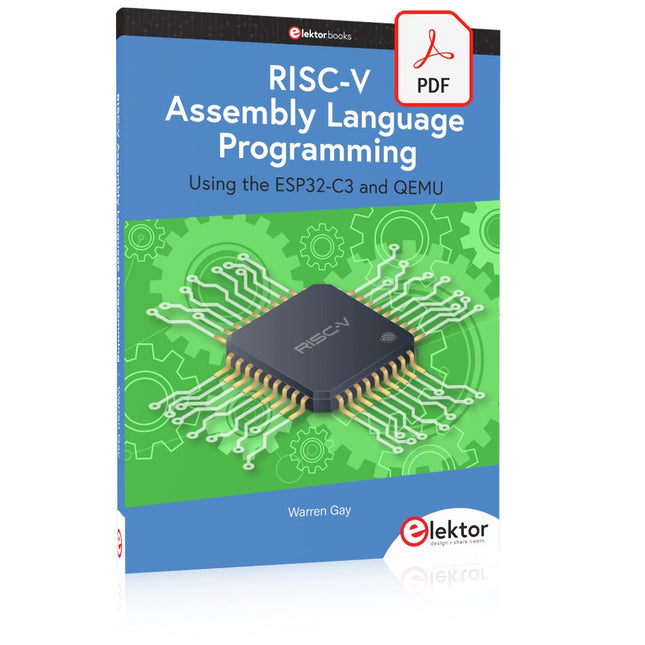
With the availability of free and open source C/C++ compilers today, you might wonder why someone would be interested in assembler language. What is so compelling about the RISC-V Instruction Set Architecture (ISA)? How does RISC-V differ from existing architectures? And most importantly, how do we gain experience with the RISC-V without a major investment? Is there affordable hardware available?
The availability of the Espressif ESP32-C3 chip provides a way to get hands-on experience with RISC-V. The open sourced QEMU emulator adds a 64-bit experience in RISC-V under Linux. These are just two ways for the student and enthusiast alike to explore RISC-V in this book.
The projects in this book are boiled down to the barest essentials to keep the assembly language concepts clear and simple. In this manner you will have “aha!” moments rather than puzzling about something difficult. The focus in this book is about learning how to write RISC-V assembly language code without getting bogged down. As you work your way through this tutorial, you’ll build up small demonstration programs to be run and tested. Often the result is some simple printed messages to prove a concept. Once you’ve mastered these basic concepts, you will be well equipped to apply assembly language in larger projects.
The Arduino Uno is an open-source microcontroller development system encompassing hardware, an Integrated Development Environment (IDE), and a vast number of libraries. It is supported by an enormous community of programmers, electronic engineers, enthusiasts, and academics. The libraries in particular really smooth Arduino programming and reduce programming time. What’s more, the libraries greatly facilitate testing your programs since most come fully tested and working.
The Raspberry Pi 4 can be used in many applications such as audio and video media devices. It also works in industrial controllers, robotics, games, and in many domestic and commercial applications. The Raspberry Pi 4 also offers Wi-Fi and Bluetooth capability which makes it great for remote and Internet-based control and monitoring applications.
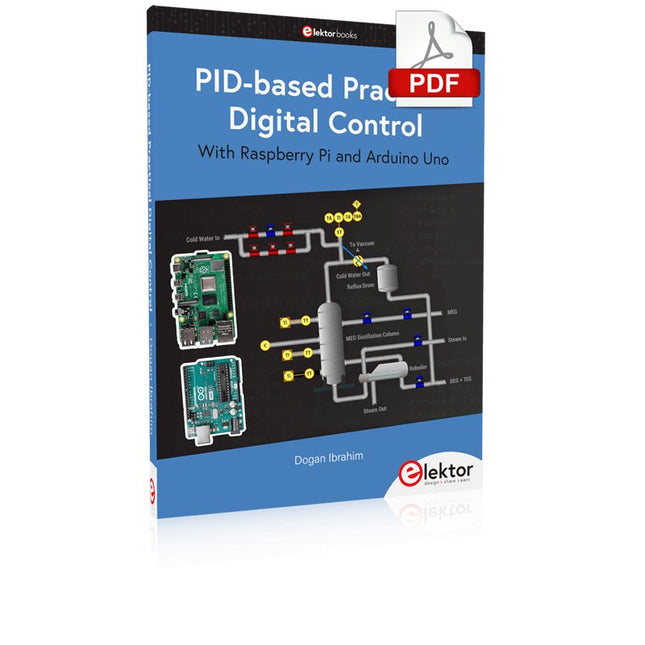
This book is about using both the Raspberry Pi 4 and the Arduino Uno in PID-based automatic control applications. The book starts with basic theory of the control systems and feedback control. Working and tested projects are given for controlling real-life systems using PID controllers. The open-loop step time response, tuning the PID parameters, and the closed-loop time response of the developed systems are discussed together with the block diagrams, circuit diagrams, PID controller algorithms, and the full program listings for both the Raspberry Pi and the Arduino Uno.
The projects given in the book aim to teach the theory and applications of PID controllers and can be modified easily as desired for other applications. The projects given for the Raspberry Pi 4 should work with all other models of Raspberry Pi family.
The book covers the following topics:
Open-loop and closed-loop control systems
Analog and digital sensors
Transfer functions and continuous-time systems
First-order and second-order system time responses
Discrete-time digital systems
Continuous-time PID controllers
Discrete-time PID controllers
ON-OFF temperature control with Raspberry Pi and Arduino Uno
PID-based temperature control with Raspberry Pi and Arduino Uno
PID-based DC motor control with Raspberry Pi and Arduino Uno
PID-based water level control with Raspberry Pi and Arduino Uno
PID-based LED-LDR brightness control with Raspberry Pi and Arduino Uno
The Arduino Uno is an open-source microcontroller development system encompassing hardware, an Integrated Development Environment (IDE), and a vast number of libraries. It is supported by an enormous community of programmers, electronic engineers, enthusiasts, and academics. The libraries in particular really smooth Arduino programming and reduce programming time. What’s more, the libraries greatly facilitate testing your programs since most come fully tested and working.
The Raspberry Pi 4 can be used in many applications such as audio and video media devices. It also works in industrial controllers, robotics, games, and in many domestic and commercial applications. The Raspberry Pi 4 also offers Wi-Fi and Bluetooth capability which makes it great for remote and Internet-based control and monitoring applications.
This book is about using both the Raspberry Pi 4 and the Arduino Uno in PID-based automatic control applications. The book starts with basic theory of the control systems and feedback control. Working and tested projects are given for controlling real-life systems using PID controllers. The open-loop step time response, tuning the PID parameters, and the closed-loop time response of the developed systems are discussed together with the block diagrams, circuit diagrams, PID controller algorithms, and the full program listings for both the Raspberry Pi and the Arduino Uno.
The projects given in the book aim to teach the theory and applications of PID controllers and can be modified easily as desired for other applications. The projects given for the Raspberry Pi 4 should work with all other models of Raspberry Pi family.
The book covers the following topics:
Open-loop and closed-loop control systems
Analog and digital sensors
Transfer functions and continuous-time systems
First-order and second-order system time responses
Discrete-time digital systems
Continuous-time PID controllers
Discrete-time PID controllers
ON-OFF temperature control with Raspberry Pi and Arduino Uno
PID-based temperature control with Raspberry Pi and Arduino Uno
PID-based DC motor control with Raspberry Pi and Arduino Uno
PID-based water level control with Raspberry Pi and Arduino Uno
PID-based LED-LDR brightness control with Raspberry Pi and Arduino Uno
Contents
Projects
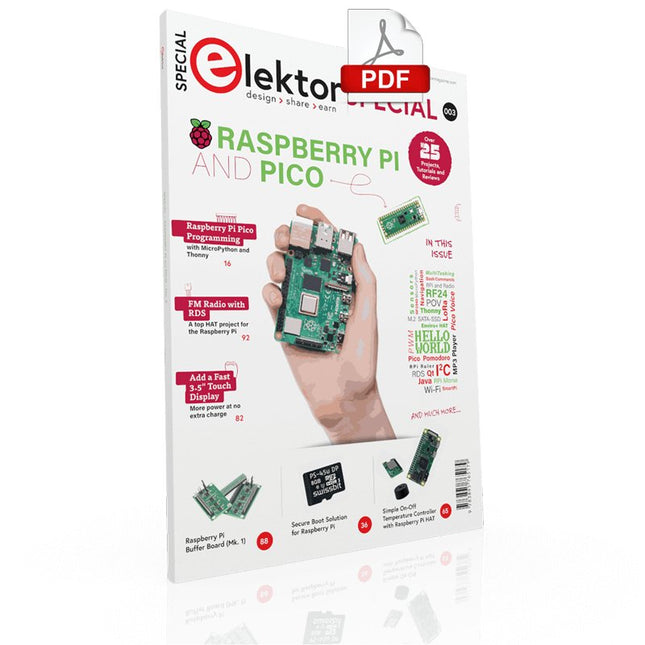
PicoVoiceVoice alienation and sound effects with the Raspberry Pi Pico
Navigation with Vibration Feedback
POV Display
Pulse Width Modulation (PWM) with the Raspberry Pi Pico
Wi-Fi with the Raspberry Pi Pico
'Hello World' from the Raspberry Pi Pico and RP2040A look at the Raspberry Pi Foundation’s first microcontroller
Simple On-Off Temperature Controller with Raspberry Pi HAT
Multitasking with the Raspberry PiShowcase: a traffic lights controller
The Raspberry Pi Ruler GadgetFun with a time-of-flight sensor
Raspberry Pi Buffer Board (Mk. 1)Never blow up the I/O again
FM radio with RDSA top HAT project for the Raspberry Pi
LoRa with the Raspberry Pi PicoFun with MicroPython!
Tutorials
Qt for the Raspberry Pi
Raspberry Pi Pico Programmingwith MicroPython and Thonny
Raspberry Pi Full StackRPi and RF24 at the heart of a sensor network
Raspberry Pi Bash Command Cheat Sheet
Community
Java on the Raspberry PiAn interview with Frank Delporte
Reviews
Introducing the New Raspberry Pi Pico W, H, and WH
Secure Boot Solution for Raspberry PiRetrofit security at a reasonable price
Review: SmartPi – Smart Meter Extension for Raspberry Pi
Review: The Enviro+ Raspberry Pi HATMeasuring environmental data with Raspberry Pi and the HAT Enviro+
Review: Meet the Raspberry Pi 4All new but still good?
Raspberry Pi Gets a Fast 3.5' Touch DisplayMore power at no extra charge
Book Launch: Raspberry Pi for Radio Amateurs
La série SQ de sondes PCBite mains libres de Sensepeek est isolée, est livrée avec des supports de câble à code couleur inclus et a un point de gravité plus bas, ce qui les rend encore plus stables par rapport à la série de sondes SP d'origine. Toutes les caractéristiques appréciées de la mesure mains libres, de l'aiguille de test échangeable à pointe à ressort à pas fin et du design minimaliste sont conservées pour rendre obsolètes les sondes de taille traditionnelle et portables.
Caractéristiques
Toutes les sondes mains libres de Sensepeek facilitent les mesures instantanées ou les longues sessions de déclenchement.
Fini les fils à souder pour connecter votre sonde ou les outils compliqués à configurer, il suffit de positionner l'aiguille de la sonde sur n'importe quel point de test ou composant dans le chemin du signal et de la relâcher.
Gain de temps et de frustration lors du développement, de la vérification et des réparations.
La conception minimaliste et l'aiguille de test à ressort permettent de mesurer simultanément des composants à pas fin et des signaux à proximité.
La longueur et le poids des sondes SQ sont parfaitement équilibrés pour être utilisés avec les supports de PCB PCBite et la plaque de base, indispensable pour une fonction mains libres.
Le porte-sonde est livré avec un aimant puissant dans la base, comme pour toutes les sondes et supports PCBite, ce qui rend la sonde facile à placer et à repositionner.
La série de sondes SQ peut être utilisée à la main sans le porte-sonde car elles sont dotées d'une poignée isolée, mais tout leur potentiel est utilisé lors des mesures mains libres.
Inclus
4x sondes SQ10 et aiguilles de test à pointe pointue (noires)
2x fils de test banane vers Dupont (rouge/noir)
5x fils de test Dupont à Dupont
1x jeu de supports de câbles (4 couleurs)
4x aiguilles de test supplémentaires
Téléchargements
Mode d'emploi
Les sondes PCBite mains libres de la série SQ de Sensepeek sont isolées, fournies avec des supports de câble à code couleur et ont un point de gravité plus bas, ce qui les rend encore plus stables que les sondes originales de la série SP. Toutes les caractéristiques appréciées de la mesure mains libres, de l'aiguille de test à ressort interchangeable à pas fin et du design minimaliste sont maintenues pour rendre obsolètes les sondes de taille traditionnelle et les sondes à main.
Caractéristiques
Toutes les sondes mains libres de Sensepeek facilitent les mesures instantanées ou les longues sessions de déclenchement.
Plus besoin de souder des fils pour connecter votre sonde ou d'outils compliqués pour l'installer, il suffit de positionner l'aiguille de la sonde sur n'importe quel point de test ou composant sur le trajet du signal et de relâcher.
Il suffit de positionner l'aiguille de la sonde sur n'importe quel point de test ou composant sur le trajet du signal et de la relâcher.
La conception minimaliste et l'aiguille de test à ressort permettent de mesurer simultanément des composants à pas fin et des signaux proches.
La longueur et le poids des sondes SQ sont parfaitement équilibrés pour être utilisés avec les supports de circuits imprimés et la plaque de base inclus, ce qui est indispensable pour la fonction mains libres.
Le support de sonde est doté d'un puissant aimant à la base, comme pour toutes les sondes et tous les supports PCBite, ce qui facilite le positionnement et le repositionnement de la sonde.
Les sondes de la série SQ peuvent être utilisées à la main sans le porte-sonde car elles ont une poignée isolée, mais leur plein potentiel est utilisé lors des mesures en mode mains libres.
Une face de la plaque de base incluse est mate et l'autre est polie miroir. La surface polie miroir permet de voir facilement les composants sur la face inférieure du circuit imprimé. Pour une protection accrue pendant les mesures, le couvercle isolant fourni peut être monté sur l'une des surfaces.
Included
4x Supports de circuits imprimés PCBite
1x Jeu de rondelles d'isolation jaunes pour les supports de circuits imprimés
1x Grand support de base (A4)
1x Couvercle d'isolation pour le support de base (A4)
1x Tissu en microfibre
4x Sondes SQ10 et aiguilles de test à pointe (noires)
2x Fils de test banane à dupont (rouge/noir)
5x Fils de test Dupont à Dupont
1x Jeu de porte-câbles (4 couleurs)
4x Aiguilles de test supplémentaires
Downloads
Guide de l'utilisateur (kit PCBite)
Guide de l'utilisateur (sondes SQ10)
La série SQ de sondes PCBite mains libres de Sensepeek est isolée, est livrée avec des supports de câble à code couleur inclus et a un point de gravité plus bas, ce qui les rend encore plus stables par rapport à la série de sondes SP d'origine. Toutes les caractéristiques appréciées de la mesure mains libres, de l'aiguille de test échangeable à pointe à ressort à pas fin et du design minimaliste sont conservées pour rendre obsolètes les sondes de taille traditionnelle et portables.
Caractéristiques
Toutes les sondes mains libres de Sensepeek facilitent les mesures instantanées ou les longues sessions de déclenchement.
Fini les fils à souder pour connecter votre sonde ou les outils compliqués à configurer, il suffit de positionner l'aiguille de la sonde sur n'importe quel point de test ou composant dans le chemin du signal et de la relâcher.
Gain de temps et de frustration lors du développement, de la vérification et des réparations.
La conception minimaliste et l'aiguille de test à ressort permettent de mesurer simultanément des composants à pas fin et des signaux à proximité. La longueur et le poids des sondes SQ sont parfaitement équilibrés pour être utilisés avec les supports de PCB PCBite et la plaque de base, indispensable pour une fonction mains libres.
Le porte-sonde est livré avec un aimant puissant dans la base, comme pour toutes les sondes et supports PCBite, ce qui rend la sonde facile à placer et à repositionner.
La série de sondes SQ peut être utilisée à la main sans le porte-sonde car elles sont dotées d'une poignée isolée, mais tout leur potentiel est utilisé lors des mesures mains libres.
Inclus
4x PCBite PCB holders
2x SQ10 probes and pin tipped test needles (red/black)
2x Banana to dupont test wires (red/black)
1x Large Base plate (A4)
1x Insulation cover for the base plate (A4)
1x Set of yellow insulation washers for the PCB holders
1x Set of cable holders (red/black)
2x Extra test needles
1x Micro fiber cloth
Téléchargements
User Guide (PCBite Kit)
User Guide (SQ10)
La série SQ de sondes PCBite mains libres de Sensepeek est isolée, est livrée avec des supports de câble à code couleur inclus et a un point de gravité plus bas, ce qui les rend encore plus stables par rapport à la série de sondes SP d'origine. Toutes les caractéristiques appréciées de la mesure mains libres, de l'aiguille de test échangeable à pointe à ressort à pas fin et du design minimaliste sont conservées pour rendre obsolètes les sondes de taille traditionnelle et portables.
Caractéristiques
Toutes les sondes mains libres de Sensepeek facilitent les mesures instantanées ou les longues sessions de déclenchement.
Fini les fils à souder pour connecter votre sonde ou les outils compliqués à configurer, il suffit de positionner l'aiguille de la sonde sur n'importe quel point de test ou composant dans le chemin du signal et de la relâcher.
Gain de temps et de frustration lors du développement, de la vérification et des réparations. La conception minimaliste et l'aiguille de test à ressort permettent de mesurer simultanément des composants à pas fin et des signaux à proximité. La longueur et le poids des sondes SQ sont parfaitement équilibrés pour être utilisés avec les supports de PCB PCBite et la plaque de base, indispensable pour une fonction mains libres.
Le porte-sonde est livré avec un aimant puissant dans la base, comme pour toutes les sondes et supports PCBite, ce qui rend la sonde facile à placer et à repositionner.
La série de sondes SQ peut être utilisée à la main sans le porte-sonde car elles sont dotées d'une poignée isolée, mais tout leur potentiel est utilisé lors des mesures mains libres.
Inclus
2x sondes SQ10 et aiguilles de test à pointe pointue (rouge/noir)
2x fils de test banane vers Dupont (rouge/noir)
1x jeu de supports de câbles (rouge/noir)
2x aiguilles de test supplémentaires
Téléchargements
Mode d'emploi
Les composants rétrécissent et deviennent de plus en plus fins d'année en année, mais vos PCB peuvent avoir augmenté en taille ou le nombre de PCB interconnectés ou le nombre de sondes PCBite mains libres nécessaires pour tester votre conception peut avoir augmenté, ce qui le rend encombré sur nos autres plus petits. plaques de base .
Caractéristiques
Avec une taille de 297 x 420 mm (DIN A3), la plaque de base extra large peut accueillir la plupart des PCB et de nombreuses sondes PCBite mains libres pour les sessions de mesures où plus de canaux que disponibles sont nécessaires.
Donc, si vous recherchez plus d'espace, une protection supplémentaire ou si vous souhaitez simplement nettoyer votre surface de travail, cet accessoire est parfait.
Conçu pour être utilisé avec la gamme de produits magnétiques PCBite Sensepeeks, notamment des supports de PCB, des sondes mains libres et une loupe.
Inclus
1x plaque de base XL (DIN A3) avec couvercle isolant prémonté
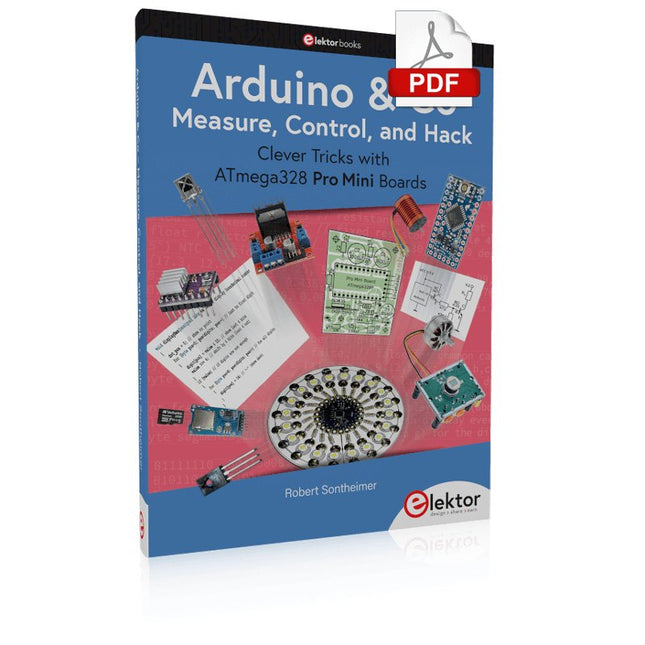
Clever Tricks with ATmega328 Pro Mini Boards
With a simple Pro Mini board and a few other components, projects that 20 or 30 years ago were unthinkable (or would have cost a small fortune) are realized easily and affordably in this book: From simple LED effects to a full battery charging and testing station that will put a rechargeable through its paces, there’s something for everyone.
All the projects are based on the ATmega328 microcontroller, which offers endless measuring, switching, and control options with its 20 input and output lines. For example, with a 7-segment display and a few resistors, you can build a voltmeter or an NTC-based thermometer. The Arduino platform offers the perfect development environment for programming this range of boards.
Besides these very practical projects, the book also provides the necessary knowledge for you to create projects based on your own ideas. How to measure, and what? Which transistor is suitable for switching a certain load? When is it better to use an IC? How do you switch mains voltage? Even LilyPad-based battery-operated projects are discussed in detail, as well as many different motors, from simple DC motors to stepper motors.
Sensors are another exciting topic: For example, a simple infrared receiver that can give disused remote controls a new lease on life controlling your home, and a tiny component that can actually measure the difference in air pressure between floor and table height!
Clever Tricks with ATmega328 Pro Mini Boards
With a simple Pro Mini board and a few other components, projects that 20 or 30 years ago were unthinkable (or would have cost a small fortune) are realized easily and affordably in this book: From simple LED effects to a full battery charging and testing station that will put a rechargeable through its paces, there’s something for everyone.
All the projects are based on the ATmega328 microcontroller, which offers endless measuring, switching, and control options with its 20 input and output lines. For example, with a 7-segment display and a few resistors, you can build a voltmeter or an NTC-based thermometer. The Arduino platform offers the perfect development environment for programming this range of boards.
Besides these very practical projects, the book also provides the necessary knowledge for you to create projects based on your own ideas. How to measure, and what? Which transistor is suitable for switching a certain load? When is it better to use an IC? How do you switch mains voltage? Even LilyPad-based battery-operated projects are discussed in detail, as well as many different motors, from simple DC motors to stepper motors.
Sensors are another exciting topic: For example, a simple infrared receiver that can give disused remote controls a new lease on life controlling your home, and a tiny component that can actually measure the difference in air pressure between floor and table height!
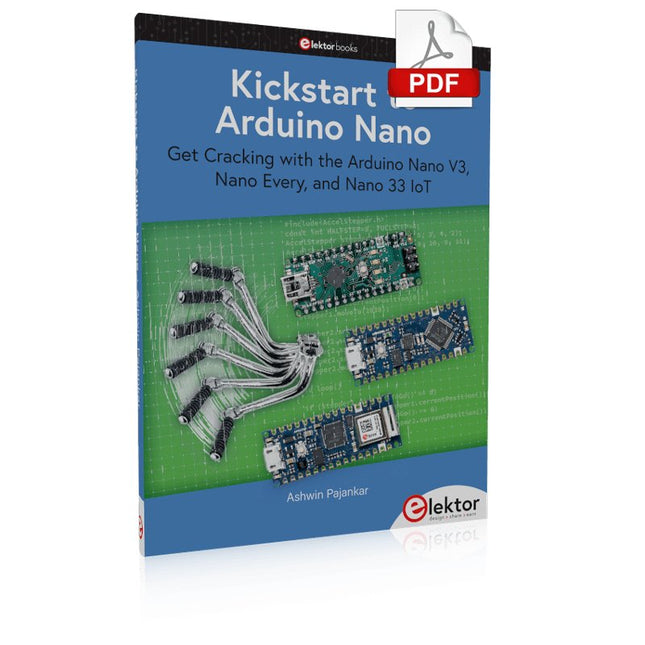
Get Cracking with the Arduino Nano V3, Nano Every, and Nano 33 IoT
The seven chapters in this book serve as the first step for novices and microcontroller enthusiasts wishing to make a head start in Arduino programming. The first chapter introduces the Arduino platform, ecosystem, and existing varieties of Arduino Nano boards. It also teaches how to install various tools needed to get started with Arduino Programming. The second chapter kicks off with electronic circuit building and programming around your Arduino. The third chapter explores various buses and analog inputs. In the fourth chapter, you get acquainted with the concept of pulse width modulation (PWM) and working with unipolar stepper motors.
In the fifth chapter, you are sure to learn about creating beautiful graphics and basic but useful animation with the aid of an external display. The sixth chapter introduces the readers to the concept of I/O devices such as sensors and the piezo buzzer, exploring their methods of interfacing and programming with the Arduino Nano. The last chapter explores another member of Arduino Nano family, Arduino Nano 33 IoT with its highly interesting capabilities. This chapter employs and deepens many concepts learned from previous chapters to create interesting applications for the vast world of the Internet of Things.
The entire book follows a step-by-step approach to explain concepts and the operation of things. Each concept is invariably followed by a to-the-point circuit diagram and code examples. Next come detailed explanations of the syntax and the logic used. By closely following the concepts, you will become comfortable with circuit building, Arduino programming, the workings of the code examples, and the circuit diagrams presented. The book also has plenty of references to external resources wherever needed.
An archive file (.zip) comprising the software examples and Fritzing-style circuit diagrams discussed in the book may be downloaded free of charge below.
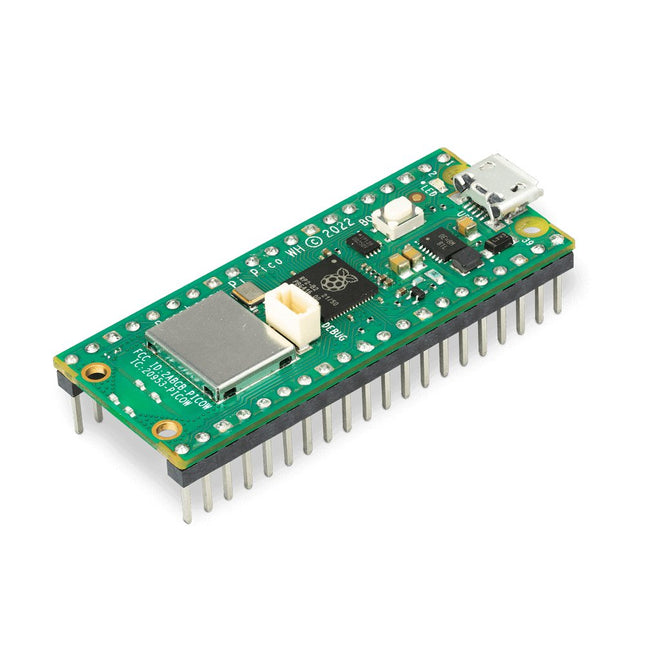
Raspberry Pi Pico WH est une carte microcontrôleur basée sur la puce microcontrôleur Raspberry Pi RP2040.
La puce microcontrôleur RP2040 ('Raspberry Silicon') offre un processeur ARM Cortex-M0+ double cœur (133 MHz), 256 Ko de RAM, 30 broches GPIO et de nombreuses autres options d'interface. De plus, il y a 2 Mo de mémoire flash QSPI intégrée pour le stockage de code et de données.
Raspberry Pi Pico WH a été conçu pour être une plateforme de développement flexible et peu coûteuse pour le RP2040 avec une interface sans fil de 2,4 GHz utilisant un Infineon CYW43439. L'interface sans fil est connectée via SPI au RP2040.
Fonctionnalités de Pico WH
Microcontrôleur RP2040 avec 2 Mo de mémoire flash
Interfaces sans fil mono-bande 2,4 GHz intégrées (802.11n)
Port Micro USB B pour l'alimentation et les données (et pour reprogrammer la mémoire flash)
Carte de circuit imprimé de style 'DIP' de 40 broches, de dimensions 21 x 51 mm et d'épaisseur 1 mm, avec broches traversantes de 0,1' et déchiquetage des bords
Expose 26 broches d'E/S polyvalentes (GPIO) de 3,3 V
23 GPIO sont uniquement numériques, dont trois peuvent également être utilisées comme entrées analogiques (ADC)
Peut être monté en surface comme module
Port de débogage à 3 broches ARM Serial Wire Debug (SWD)
Architecture d'alimentation simple mais très flexible
Différentes options pour alimenter facilement l'unité à partir d'un micro USB, de sources externes ou de batteries
Haute qualité, faible coût, disponibilité élevée
Kit de développement logiciel (SDK) complet, exemples de logiciels et documentation
Connecteurs pré-installés et connecteur de débogage à 3 broches
Fonctionnalités du microcontrôleur RP2040
Processeur Cortex M0+ double cœur pouvant atteindre 133 MHz
PLL intégrée permettant une fréquence variable du cœur
264 Ko de SRAM haute performance à plusieurs bancs
Flash Quad-SPI externe avec exécution en place (XIP) et cache intégré de 16 Ko
Bus interne de haute performance à matrice croisée complète
USB1.1 intégré (périphérique ou hôte)
30 broches GPIO polyvalentes (dont quatre peuvent être utilisées pour l'ADC)
Tension d'E/S de 1,8 à 3,3 V
Convertisseur analogique-numérique (ADC) 12 bits à 500 ksps
Divers périphériques numériques
2x UART, 2x I²C, 2x SPI, 16 canaux PWM
1x minuterie avec 4 alarmes, 1x horloge en temps réel
2x blocs d'E/S programmables (PIO), 8 machines d'état au total
Raspberry Pi Pico WH est une carte microcontrôleur basée sur la puce microcontrôleur Raspberry Pi RP2040.
La puce microcontrôleur RP2040 ('Raspberry Silicon') offre un processeur ARM Cortex-M0+ double cœur (133 MHz), 256 Ko de RAM, 30 broches GPIO et de nombreuses autres options d'interface. De plus, il y a 2 Mo de mémoire flash QSPI intégrée pour le stockage de code et de données.
Raspberry Pi Pico WH a été conçu pour être une plateforme de développement flexible et peu coûteuse pour le RP2040 avec une interface sans fil de 2,4 GHz utilisant un Infineon CYW43439. L'interface sans fil est connectée via SPI au RP2040.
Fonctionnalités de Pico WH
Microcontrôleur RP2040 avec 2 Mo de mémoire flash
Interfaces sans fil mono-bande 2,4 GHz intégrées (802.11n)
Port Micro USB B pour l'alimentation et les données (et pour reprogrammer la mémoire flash)
Carte de circuit imprimé de style 'DIP' de 40 broches, de dimensions 21 x 51 mm et d'épaisseur 1 mm, avec broches traversantes de 0,1' et déchiquetage des bords
Expose 26 broches d'E/S polyvalentes (GPIO) de 3,3 V
23 GPIO sont uniquement numériques, dont trois peuvent également être utilisées comme entrées analogiques (ADC)
Peut être monté en surface comme module
Port de débogage à 3 broches ARM Serial Wire Debug (SWD)
Architecture d'alimentation simple mais très flexible
Différentes options pour alimenter facilement l'unité à partir d'un micro USB, de sources externes ou de batteries
Haute qualité, faible coût, disponibilité élevée
Kit de développement logiciel (SDK) complet, exemples de logiciels et documentation
Connecteurs pré-installés et connecteur de débogage à 3 broches
Fonctionnalités du microcontrôleur RP2040
Processeur Cortex M0+ double cœur pouvant atteindre 133 MHz
PLL intégrée permettant une fréquence variable du cœur
264 Ko de SRAM haute performance à plusieurs bancs
Flash Quad-SPI externe avec exécution en place (XIP) et cache intégré de 16 Ko
Bus interne de haute performance à matrice croisée complète
USB1.1 intégré (périphérique ou hôte)
30 broches GPIO polyvalentes (dont quatre peuvent être utilisées pour l'ADC)
Tension d'E/S de 1,8 à 3,3 V
Convertisseur analogique-numérique (ADC) 12 bits à 500 ksps
Divers périphériques numériques
2x UART, 2x I²C, 2x SPI, 16x canaux PWM
1x minuterie avec 4 alarmes, 1x horloge en temps réel
2x blocs d'E/S programmables (PIO), 8 machines d'état au total
E/S haute vitesse flexibles et programmables par l'utilisateur
Peut émuler des interfaces telles que la carte SD et VGA
Remarque : La tension d'E/S de Raspberry Pi Pico W est fixée à 3,3 V.
Téléchargements
Fiche technique
Spécifications du connecteur de débogage à 3 broches