
Produits
-
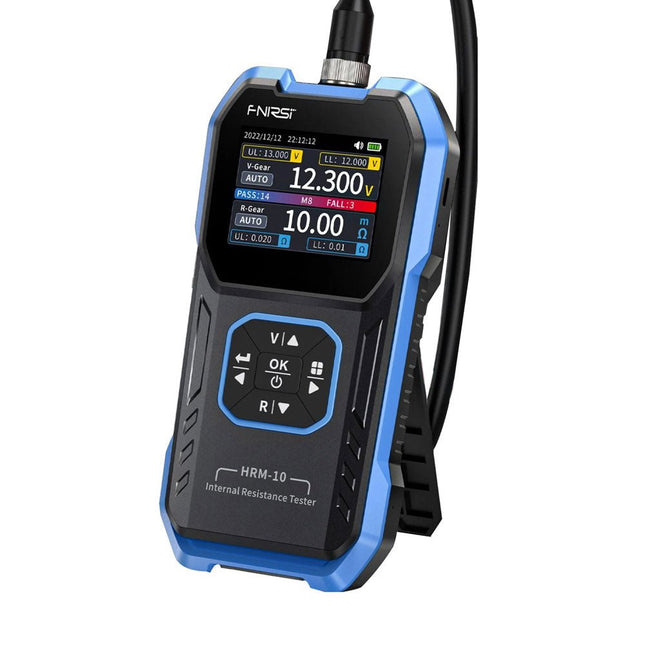
FNIRSI FNIRSI HRM-10 Testeur de tension et de résistance interne de batterie
Le FNIRSI HRM-10 est un testeur de tension et de résistance interne de batterie portable et de haute précision. Cet appareil offre une véritable mesure à quatre fils et est conçu pour la précision et la facilité d'utilisation. Il mesure automatiquement les valeurs de résistance interne et de tension simultanément, affichant les résultats sur son écran couleur HD. Les utilisateurs ont la possibilité d'ajuster manuellement les plages de tension et de résistance en fonction de leurs besoins. L'appareil comprend également un mode de tri qui filtre automatiquement les bonnes et mauvaises batteries en fonction de seuils définis par l'utilisateur. De plus, il prend en charge le stockage des données historiques et permet d'exporter des enregistrements de mesures sous forme de tableau. Caractéristiques Haute précision des mesures Exportation de données tabulaires Évaluer automatiquement les résultats des mesures 8 paramètres de seuil Écran couleur HD Support pliable Batterie au lithium de 1000 mAh Spécifications Tension Résistance Plage de mesure 0-100 V (CC) 0-200 Ω Précision ±0,5% ±0,5% Équipement Automatique, 1 V, 10 V, 100 V Automatique, 20 mΩ, 200 mΩ, 2 Ω, 20 Ω, 200 Ω Fréquence du signal de test de l'instrument 1 Khz (CA) Rechargeable USB-C (5 V/1 A) Batterie intégrée Batterie au lithium 1000 mAh Calibrage utilisateur Oui Mode de tri Oui Historique Oui Export de données enregistrées Oui Environnement de travail –10°C à +45°C, humidité relative <80% Environnement de stockage –20°C à +80°C, humidité relative <80% Dimensions 158,7 x 80,5 x 28,4 mm Poids 225 g Inclus 1x FNIRSI HRM-10 Testeur de résistance interne 1x Ligne de test de clip 1x Câble de données USB-C 1x Manuel Téléchargements Manual Firmware V0.3
€ 49,54
-
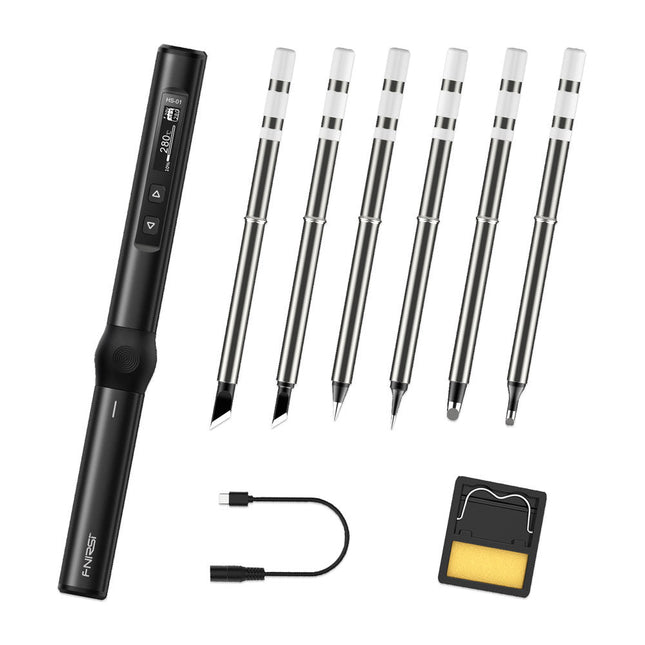
FNIRSI FNIRSI HS-01 Fer à souder intelligent (avec 6 pointes de soudure)
L'outil parfait pour des réparations rapides Le HS-01 est un puissant fer à souder intelligent réglable équipé d'un écran OLED intégré de 0,87 pouces qui atteint rapidement des températures comprises entre 80 et 420°C. L'écran affiche toutes les informations essentielles, notamment l'état du niveau de température, la température réglée, la tension d'alimentation et le pourcentage de puissance. Vous pouvez régler la tension d'entrée de 9 à 20 V directement dans le menu selon vos besoins. Le mode veille intégré éteint automatiquement le fer après 30 minutes. Caractéristiques Entrée de 96 W (CC) Puissance PD de 65 W Écran OLED Température constante et chauffage rapide Moulage intégral en métal CNC Sécurité intelligente anti-brûlure Format de poche mini Design ergonomique Matériau en aluminium Interrupteur pour main gauche/droite Évacuation de chaleur efficace Veille inductive Couleur : Noir Spécifications Puissance 65 W Écran OLED de 0,87 pouce Tension de fonctionnement 9-20 VCC Alimentation électrique USB-C Plage de température 80-420°C Protocole de charge rapide Déclenchement PD Dimensions 184 x 20 x 20 mm (7,24 x 0,79 x 0,79 pouces) Poids 56 g Sélection de la puissance Tension de fonctionnement 20 V 15 V 12 V 9 V Courant de fonctionnement ≥3,25 A ≥2,5 A ≥2 A ≥1,5 A Puissance 65 W 37,5 W 24 W 13,5 W Temps de fusion de l'étain 8 s 12 s 17 s 30 s Inclus 1x Fer à souder intelligent FNRISI HS-01 6x Embouts de fer à souder (HS01-BC2, HS01-KR, HS01-K65, HS01-B2, HS01-ILS, HS01-BC3) 1x Câble d'alimentation CC vers USB-C 1x Support de fer à souder mini 1x Manuel Requis Adaptateur secteur Câble USB-C Téléchargements Manual Firmware V0.3.s19
€ 81,32
-
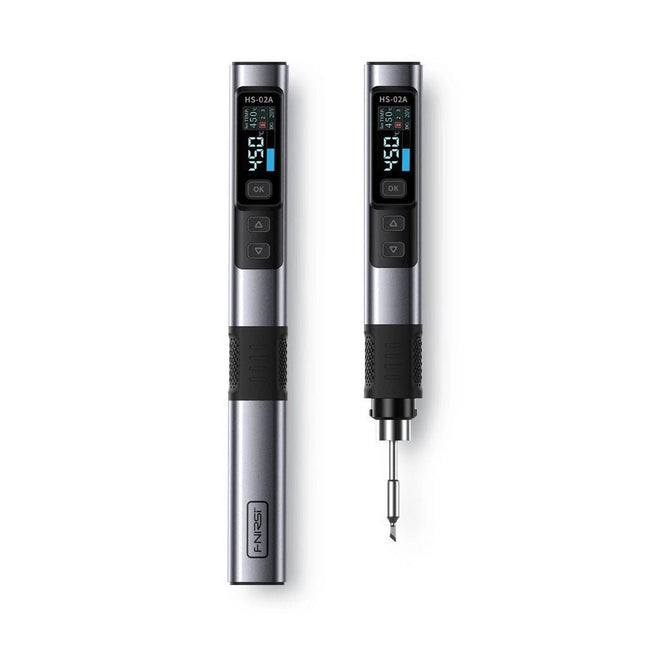
FNIRSI FNIRSI HS-02A Fer à souder intelligent (avec 6 pointes de soudure)
Le FNIRSI HS-02A est une version améliorée du fer à souder HS-01 avec une meilleure prise en main et une pointe plus courte pour plus de confort et de précision lors de l'utilisation. Il dispose d'un écran couleur IPS HD plus grand de 0,96 pouces qui permet une meilleure visibilité des paramètres et de l'état. Avec une puissance de sortie de 100 W, le HS-02A chauffe rapidement et atteint sa température de fonctionnement en 2 secondes environ. La température est réglable dans une plage de 100 à 450°C pour répondre aux différentes exigences de soudure. Caractéristiques Température : 100 à 450°C Réglage et contrôle précis de la température Chauffage rapide Coque métallique CNC Puissance adaptative 100 W haute puissance Protocoles: PD, QC Spécifications Plage de température 100-450°C Tension de fonctionnement 9-20 V Écran Écran couleur IPS HD de 0,96 pouces Alimentation USB-C Protocoles de charge rapide PD/CQ Puissance 100 W (maximum) Dimensions 180 x 20 mm Poids 61 g Inclus 1x FNRISI HS-02A fer à souder intelligent 6x Pannes de fer à souder (HS02A-KU, HS02A-K, HS02A-JS, HS02A-I, HS02A-C2, HS02A-B) 1x Mini support pour fer à souder 1x Manuel Téléchargements Manual Firmware V1.7
€ 61,44
-

FNIRSI FNIRSI LC1020E LCR-mètre haute précision
Le LCR-mètre haute précision FNIRSI LC1020E avec testeur ESR est une solution portable et intelligente pour tester les composants électroniques, offrant une précision de base allant jusqu'à 0,3%. Il est idéal pour les ingénieurs, les techniciens et les makers. L'appareil prend en charge les mesures L/Q, C/D et R/D à l'aide de modèles de circuits équivalents en série et en parallèle, et dispose d'un écran couleur TFT de 2,8 pouces. Grâce à ses seuils préréglés et à ses alertes audiovisuelles, il permet une évaluation rapide de la conformité, ce qui le rend parfait pour les tests par lots et le contrôle qualité. Prenant en charge des fréquences de test allant jusqu'à 100 kHz, il est parfaitement adapté à l'analyse haute fréquence des inductances, des condensateurs et des résistances. Caractéristiques Précision de ±0,05% avec une résolution de 4,5 chiffres Identification automatique des composants R/L/C pour des mesures rapides 5 fréquences de test (100 Hz–100 kHz) et 3 niveaux de tension (0,1–0,6 V) Double affichage : L/C/R/Z + X/D/Q/θ/ESR Mode de tri et tension de polarisation pour les tests par lots Double port (3/5 bornes) avec prise en charge Kelvin à 4 fils Maintien et enregistrement des données pour un flux de travail efficace Compact, rechargeable (3000 mAh) – idéal pour une utilisation en laboratoire et sur le terrain Spécifications Généralités Fréquences de test 100 Hz, 120 Hz, 1 kHz, 10 kHz, 100 kHz Précision de base 0,3% Affichage Écran LCD TFT 2,8 pouces Chiffres d'affichage Paramètre principal : 4,5 chiffres Paramètre secondaire : 4,5 chiffres Paramètres de mesure Paramètres principaux : AUTO/R/C/L/Z Paramètres secondaires : X/D/Q/θ/ESR Plage de mesure L : 0-100 H C : 0-100 mF R : 0-10 M Biais interne 0,0 V, 0,5 V Niveau de test 0,1 V, 0,3 V, 0,6 V Fonctions d'étalonnage Étalonnage en circuit ouvert, étalonnage en court-circuit Fonction de comparaison Permet de calculer l'erreur relative entre la valeur de mesure du composant et la valeur nominale, affichée en pourcentage, et fournit des résultats filtrés. Les valeurs nominales et la tolérance peuvent être définies, la plage de tolérance étant réglable de 0,1% à 99,9% Enregistrement des fonctions Vérifie si les données mesurées du composant correspondent à la valeur nominale et à la tolérance définies, en enregistrant le nombre de mesures réussies et échouées Configuration des bornes de test Trois bornes, cinq bornes Impédance de sortie 100 Ω Interface USB-C (port série virtuel) Autres Paramètres de langue, luminosité de l'écran, paramètres audio, mise hors tension automatique, paramètres de calibrage, informations système Batterie Batterie au lithium de 3000 mAh Dimensions 18,5 x 8,5 x 3,5 cm Poids 680 g Capacité (C) Plage : 1mF-100mF 100 Hz : 5% ±5 chiffres 1 kHz : 3% ±5 chiffres 10 kHz : / 100 kHz : / Plage : 1uF-1mF 100 Hz : 1% ±4 chiffres 1 kHz : 0,5% ±5 chiffres 10 kHz : 2% ±5 chiffres 100 kHz : 3% ±4 chiffres Plage : 1nF-1uF 100 Hz : / 1 kHz : 0,3% ±2 chiffres 10 kHz : 0,4% ±2 chiffres 100 kHz : 1% ±4 chiffres Plage : 1pF-1nF 100 Hz : / 1 kHz : 2% ±2 chiffres 10 kHz : 1,5% ±2 chiffres 100 kHz : 2% ±4 chiffres Inductance (L) Plage : 1H-100H 100 Hz : 2% ±5 chiffres 1 kHz : 2% ±5 chiffres 10 kHz : / 100 kHz : / Plage : 1mH-1H 100 Hz : 0,4% ±5 chiffres 1 kHz : 0,3% ±2 chiffres 10 kHz : 0,4% ±3 chiffres 100 kHz : 2,5% ±5 chiffres Plage : 10uH-1mH 100 Hz : 3% ±5 chiffres 1 kHz : 0,5% ±4 chiffres 10 kHz : 0,5% ±3 chiffres 100 kHz : 1,5% ±5 chiffres Plage : 1uH-10uH 100 Hz : / 1 kHz : 2% ±5 chiffres 10 kHz : 2% ±5 chiffres 100 kHz : 4% ±5 chiffres Résistance (R) Plage : 1MΩ-10MΩ 100 Hz : 5% ±4 chiffres 1 kHz : 3% ±3 chiffres 10 kHz : / 100 kHz : / Plage : 1KΩ-1MΩ 100 Hz : 0,4% ±4 chiffres 1 kHz : 0,2% ±2 chiffres 10 kHz : 0,3% ±3 chiffres 100 kHz : 0,6% ±5 chiffres Plage : 1Ω-1KΩ 100 Hz : 1,5% ±4 chiffres 1 kHz : 0,3% ±2 chiffres 10 kHz : 0,3% ±3 chiffres 100 kHz : 0,6% ±5 chiffres Plage : 10mΩ-1Ω 100 Hz : 4% ±4 chiffres 1 kHz : 2% ±5 chiffres 10 kHz : 2% ±5 chiffres 100 kHz : 5% ±5 chiffres Inclus 1x FNIRSI LC1020E LCR-mètre 1x Pince de mesure Kelvin 2x Cordons de mesure (1x noir, 1x rouge) 1x Plaque de court-circuit 1x Câble USB-C 1x Manuel Téléchargements Manual Firmware V1.1
€ 84,95€ 69,95Meilleur prix
-
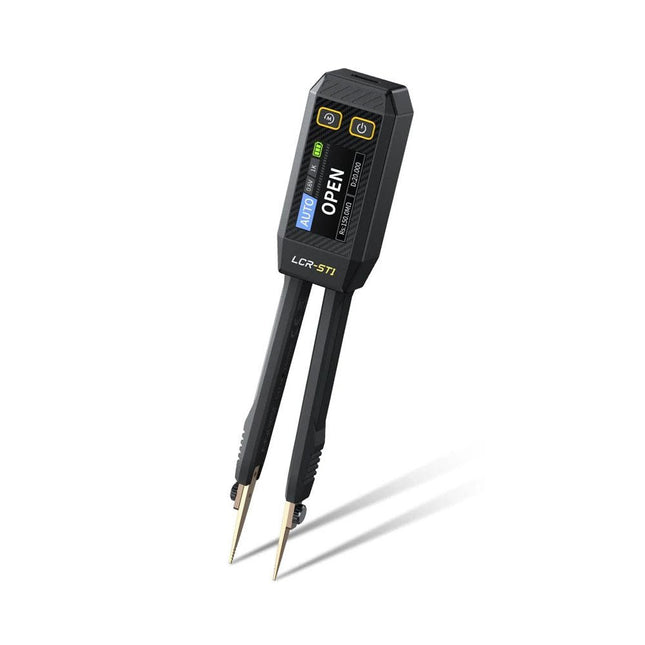
FNIRSI FNIRSI LCR-ST1 Pince de test intelligente pour CMS (LCR/ESR mètre)
Le FNIRSI LCR-ST1 est un testeur LCR compact, multifonctionnel et intelligent, qui prend en charge les mesures automatiques de résistance, de capacité, d'inductance, de test de diodes et de continuité. Son écran couleur de 1,14 pouces combiné à une fonction d'adsorption magnétique pratique améliore la facilité d'utilisation, tandis que la batterie au lithium intégrée de 250 mAh garantit des performances durables. L'appareil prend en charge trois plages de fréquences (100 Hz, 1 kHz et 10 kHz) et offre des niveaux de test RMS de 0,3 V et 0,6 V pour des applications de test polyvalentes. La conception unique en forme de pince du LCR-ST1 est idéale pour les tâches délicates dans des espaces confinés et permet des tests rapides et précis des composants électroniques. Sa conception légère et portable en fait un outil précieux pour une utilisation sur le terrain et en laboratoire. Que vous soyez un ingénieur expérimenté ou un débutant en électronique, le LCR-ST1 fournit des résultats de mesure fiables et précis, vous permettant d'accomplir vos tâches avec plus d'efficacité et de précision. Caractéristiques Fournit 3 fréquences de test (100 Hz, 1 kHz, 10 kHz) et 2 niveaux de tension de test. Comprend une identification automatique des composants pour des mesures plus rapides et plus fiables. Écran couleur haute résolution de 1,14 pouces pour des affichages clairs. Prend en charge l'enregistrement et le stockage automatiques des données. Les pointes des pinces sont en laiton plaqué or pour une durabilité et une conductivité améliorées. Spécifications Plage de résistance 10 mΩ – 10 MΩ Plage de capacité 1 pF – 22 mF Plage d'inductances 1 μh – 10 H Diode Sur tension 0,7 V Test de fréquence 100 Hz, 1 kHz, 10 kHz Test de niveau 0,3 V, 0,6 V efficace Affichage des paramètres ESR, valeur D, valeur Q, valeur Z, valeur X Écran Écran couleur HD de 1,14 pouces Interface de chargement USB-C, 5 V/1 A Alimentation Batterie au lithium intégrée de 250 mAh Mesure de reconnaissance automatique Oui Tête de pince remplaçable Oui Arrêt automatique Oui Conservation des données Oui Historique Connectez-vous au PC pour afficher et exporter Dimensions 28 x 19 x 150 mm Poids 41 g Inclus 1x LCR-ST1 pincette de test CMS 2x Embouts de crochet 1x Patch magnétique 1x Câble USB 1x Sac de rangement 1x Manuel Téléchargements Manual Firmware V1.6
€ 34,66
-
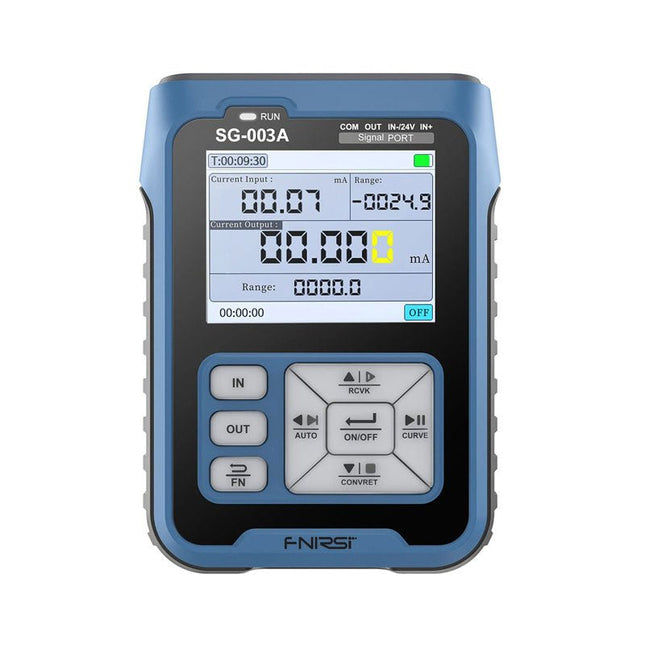
FNIRSI FNIRSI SG-003A Générateur de signaux
Le générateur de signaux multifonction FNIRSI SG-003A, également connu sous le nom de process meter/calibrator, est un générateur et un compteur de tension/courant de haute précision. Le SG-003A fournit des tensions ou des courants de référence très précis pour tester et étalonner d'autres instruments de mesure, tels que les multimètres et les oscilloscopes. En plus des tensions et des courants, le SG-003A génère également des signaux d'impulsion rectangulaires avec des fréquences et des rapports cycliques programmables avec précision. Le mode convertisseur transforme la SG-003A en une source de courant précise commandée en tension, ou en une source de tension commandée en courant, et même en un générateur de fréquence commandé en tension ou en courant. Le SG-003A est un outil très utile pour vérifier l'exactitude et la précision de votre multimètre, et pour tester les LED, par exemple. Caractéristiques Précision (tension/courant) 0,1% ±0,005 Résolution (actuelle) 0,01 mA Fréquence 0-10 kHz Résolution 5 chiffres Puissance de sortie 24 V Écran LCD TFT 2,4" (320 x 240) Dimensions 92 x 72 x 30 mm Poids 165 g Caractéristiques Signal Gamme Précision Résolution Charge maximale Alimentation externe Sortie courant active 0~24 mA ±(0,1% + 0,005) 0,01 mA 750 Ω Sortie courant passive (XMT) 0~24 mA ±(0,1% + 0,005) 0,01 mA 0~30 V Sortie de tension 0~24 V ±(0,1% + 0,005) 0,01 V Boucle 24 V 0~24 mA ±(0,1% + 0,005) 0,01 mA Sortie fréquence 0~9999 Hz ±2% 5 chiffres Entrée actuelle 0~24 mA ±(0,1% + 0,005) 0,01 mA Entrée de tension 0~30 V ±(0,1% + 0,005) 0,01 V Inclus 1x FNIRSI SG-003A Générateur de signaux 4x Pinces de test 1x Chargeur USB 1x Câble USB-C 1x Manuel Téléchargements Manual Firmware V4.3
€ 69,37
-

FNIRSI FNIRSI SWM-20 Poste de soudage par points à double impulsion
La soudeuse par points portative FNIRSI SWM-20 est un outil de soudage performant, convivial et facile à transporter. Elle intègre la technologie de soudage par points à double impulsion, garantissant des soudures plus stables et fiables, et dispose également d'une fonction de batterie externe pratique. Dotée d'un écran haute définition de 2,4 pouces, la SWM-20 offre une utilisation claire et intuitive. Sa molette de réglage rotative permet un ajustement rapide et précis des paramètres, facilitant ainsi la configuration des réglages de soudage et améliorant l'expérience utilisateur. Caractéristiques 2-en-1 : poste de soudage par points et batterie externe de 5000 mAh Puissance de sortie élevée de 1200 A pour des soudures robustes et fiables Technologie à double impulsion pour une soudure plus propre et plus stable Deux batteries de qualité A avec 8 protections de sécurité Capacité de soudage multi-matériaux de 0,1 à 0,5 mm Plus de 10000 niveaux de réglage de précision pour un contrôle professionnel Écran TFT de 2,4 pouces avec surveillance des données en temps réel Spécifications Courant de soudage max. 1200 A Capacité de la batterie 5000 mAh Charge 5 V/2,1 A Décharge 5 V/2,1 A Matériaux de soudage Nickel, fer, acier inoxydable Épaisseur de soudure 0,1 à 0,5 mm Niveau 4 combinaisons prédéfinies Niveaux Inclus 1x FNIRSI SWM-20 Poste de soudage par points 2x Stylos à souder 2x Conseils de remplacement 1x Bande de nickel 1x Câble USB-C 1x Manuel Téléchargements Manual
€ 79,95€ 67,95Meilleur prix
-

FNIRSI FNIRSI TDM-120P Multimètre à imagerie thermique
Le FNIRSI TDM-120P est un multimètre à imagerie thermique qui associe la technologie d'imagerie thermique aux fonctions traditionnelles d'un multimètre, offrant ainsi des résultats de test plus complets et intuitifs pour les essais électriques et les applications connexes. Il est largement utilisé dans des domaines tels que le génie électrique, la fabrication industrielle, la construction et la surveillance de sécurité. Le TDM-120P apporte un soutien technique fiable pour les essais d'équipements, le diagnostic de pannes et la gestion de la maintenance, contribuant ainsi à améliorer l'efficacité de la production, la qualité des produits et la sécurité globale. Caractéristiques 2-en-1 : Caméra thermique + Multimètre True RMS (19999 points) Imagerie HD 120 x 90 | Haute sensibilité thermique <60 mK Plage de température de -20°C à 400°C | Émissivité réglable (0,01–1,00) Écran tactile LCD 2,8" | 7 palettes de couleurs | Enregistrement en un clic et exportation USB Fonctions complètes de multimètre : tension AC/DC, résistance et capacité Applications variées : CVC, détection de fuites, réparations électriques et automobiles Spécifications 7 palettes de couleurs Arctique / Fer chaud / Fer rouge / Arc-en-ciel / Lave / Noir chaud / Blanc chaud Type de détecteur Oxyde de vanadium Champ de vision 50° Écran Écran tactile LCD de 2,8 pouces Fréquence d'image ≤25 Hz Résolution infrarouge 120 x 90 Affichage de la mesure de température Point central, suivi automatique des températures haute/basse Plage de température -20°C ~ 400°C (-4°F ~ 752°F) Unité de température °C / °F Précision ±2°C ou ±2% (valeur maximale mesurée) Alarme de température haute/basse Oui Émissivité Réglable de 0,01 à 1 Langues Anglais, chinois Multimètre Tension CC Gamme : 1,9999 V / 19,999 V / 199,99 V / 1000 V Précision : ±(0,5% +3) Tension CA Gamme : 1,9999 V / 19,999 V / 199,99 V / 750,0 V Précision : ±(1% +3) Résistance Gamme : 19,999 MΩ / 1,9999 MΩ / 199,99 kΩ / 19,999 kΩ Précision : ±(0,5% +3) Gamme : 1,9999 kΩ / 199,99 Ω Précision : ±(2,0% +3) Capacité Gamme : 999,9 μF / 99,99 μF / 9,999 μF / 999,9 nF / 99,99 nF / 9,999 nF Précision : ±(2,0% +5) Gamme : 9,999 mF / 99,99 mF Précision : ±(5,0% +20) Diode Oui Continuité Oui Inclus 1x FNIRSI TDM-120P multimètre à imagerie thermique 2x Fils de test pour multimètre 1x Sac de rangement 1x Câble USB 1x Manuel Téléchargements Manual Firmware v1.2.6
€ 199,95€ 179,95Meilleur prix
-

FNIRSI FNIRSI TMP-610S (3-en-1) Multimètre (60000 points) + Oscilloscope + Générateur de signaux
Le FNIRSI TMP-610S est un instrument de test compact « 3-en-1 » combinant un multimètre True RMS, un oscilloscope de 10 MHz et un générateur de signaux DDS de 50 kHz. Il est conçu pour le dépannage électronique, le test de circuits et le développement, que ce soit en laboratoire ou sur le terrain. Le multimètre offre une résolution de 60000 points et prend en charge les mesures de tension, de courant, de résistance, de capacité, de fréquence et de température, ainsi que les tests de diode et de continuité. L'oscilloscope intégré permet une analyse des formes d'onde en temps réel jusqu'à 48 Méch/s, tandis que le générateur de signaux propose 13 types de formes d'onde avec fréquence, amplitude et rapport cyclique réglables. Doté d'un écran tactile IPS de 3,5 pouces, d'une fonction de balayage automatique intelligent, de la connectivité Bluetooth pour les fonctions multimètre, de la mémorisation des formes d'onde, de l'exportation via USB et d'une batterie rechargeable de 3000 mAh, le TMP-610S constitue un outil tout-en-un polyvalent pour les professionnels et les passionnés d'électronique. Caractéristiques Conception 3-en-1 : multimètre numérique, oscilloscope et générateur de signaux Mesure de haute précision True RMS (valeur efficace vraie) avec résolution de 60000 points Oscilloscope 10 MHz avec fréquence d'échantillonnage de 48 Méch./s Synchronisation avec application Bluetooth (fonction multimètre uniquement) Écran tactile intelligent de 3,5 pouces avec plusieurs modes d'affichage Générateur de signaux DDS 50 kHz avec 13 formes d'onde Fusible intégré pour un remplacement facile Spécifications Multimètre Fonction Plage Précision DC voltage 600mV/6V/60V/600V/1000V ±(0.03%+5d) AC voltage 600mV/6V/60V /600V/750V ±(0.3%+15d) DC current 600uA/6000uA/60mA/600mA ±(0.15%+5d) 6A/10A ±(0.2%+5d) AC current 600uA/6000uA/60mA/600mA ±(0.5%+15d) 6A/10A ±(0.75%+15d) Resistance 600Ω/6KΩ/60KΩ/600KΩ/6MΩ ±(0.1%+5d) 60MΩ ±(0.2%+10d) Capacitance 60nF/600nF/6uF/60uF ±(2.5%+30d) 600uF/6mF/60mF ±(3.5%+30d Frequency 10 Hz~60 MHz ±(0.01%+5d) Temperature -40℃~1000℃ ±(1.0%+5℃) Continuity 0Ω~1KΩ ±(0.2%+5d) Diode 0V~3.0V, 0Ω~1 Ω ±(1%+5d) AC frequency response 10KHz / Oscilloscope Real-time Sampling Rate 48 MSa/s Analog Bandwidth 10 MHz Input Impedance 1MΩ Coupling Mode AC/DC Test Voltage Range 1:1 Probe - 80Vpp (±40V) 10:1 Probe - 800Vpp (±400V) Vertical Sensitivity 10mV/div~10V/div Vertical Displacement Adjustable with indication Horizontal Time Base Range 50 ns ~ 20 s Trigger Mode Auto, Normal, Single Trigger Type Rising, Falling, 50% Trigger Level Adjustable with indication Measurement Parameters Freq, Period, +Duty, ‒Duty, +Width, ‒Width, Max, Min, P‒P, Amp, RMS, Avg Persistence Off / 500ms / 1s / ∞ Cursor Measurement Yes Waveform Screenshot Saving Yes Générateur de signaux Output Waveform Supports 13 waveform types Frequency 0~50kHz Amplitude 0.0V~3.0V Duty Cycle 0~100%, adjustable for Square and Sawtooth waves Inclus 1x FNIRSI TMP-610S Multimètre + Oscilloscope + Générateur de signaux 1x Sonde P6100 1x Adaptateur 2x Pinces crocodiles 2x Sondes multimètre Accessoires de sonde 1x Sac de rangement 1x Câble USB-C 1x Manuel Téléchargements Manual
€ 179,95€ 149,95Meilleur prix
-
Raspberry Pi Foundation Câble de caméra FPC pour Raspberry Pi 5 (200 mm)
Raspberry Pi 5 fournit deux connecteurs MIPI à quatre voies, chacun pouvant prendre en charge une caméra ou un écran. Ces connecteurs utilisent le même format FPC « mini » à 22 voies au pas de 0,5 mm que le kit de développement de module de calcul et nécessitent des câbles adaptateurs pour se connecter aux connecteurs au format « standard » à 15 voies au pas de 1 mm du Raspbery Pi actuel. produits d'appareil photo et d'affichage. Ces câbles adaptateurs mini vers standard pour caméras et écrans (notez qu'un câble de caméra ne doit pas être utilisé avec un écran, et vice versa) sont disponibles en longueurs de 200 mm, 300 mm et 500 mm.
-
Raspberry Pi Foundation Câble de caméra FPC pour Raspberry Pi 5 (300 mm)
Raspberry Pi 5 fournit deux connecteurs MIPI à quatre voies, chacun pouvant prendre en charge une caméra ou un écran. Ces connecteurs utilisent le même format FPC « mini » à 22 voies au pas de 0,5 mm que le kit de développement de module de calcul et nécessitent des câbles adaptateurs pour se connecter aux connecteurs au format « standard » à 15 voies au pas de 1 mm du Raspbery Pi actuel. produits d'appareil photo et d'affichage. Ces câbles adaptateurs mini vers standard pour caméras et écrans (notez qu'un câble de caméra ne doit pas être utilisé avec un écran, et vice versa) sont disponibles en longueurs de 200 mm, 300 mm et 500 mm.
€ 2,95€ 1,18Meilleur prix
-

Raspberry Pi Foundation Câble de caméra FPC pour Raspberry Pi 5 (500 mm)
Raspberry Pi 5 fournit deux connecteurs MIPI à quatre voies, chacun pouvant prendre en charge une caméra ou un écran. Ces connecteurs utilisent le même format FPC « mini » à 22 voies au pas de 0,5 mm que le kit de développement de module de calcul et nécessitent des câbles adaptateurs pour se connecter aux connecteurs au format « standard » à 15 voies au pas de 1 mm du Raspbery Pi actuel. produits d'appareil photo et d'affichage. Ces câbles adaptateurs mini vers standard pour caméras et écrans (notez qu'un câble de caméra ne doit pas être utilisé avec un écran, et vice versa) sont disponibles en longueurs de 200 mm, 300 mm et 500 mm.
€ 3,95€ 1,58Meilleur prix
-

Raspberry Pi Foundation Câble d'affichage FPC pour Raspberry Pi 5 (200 mm)
Raspberry Pi 5 fournit deux connecteurs MIPI à quatre voies, chacun pouvant prendre en charge une caméra ou un écran. Ces connecteurs utilisent le même format FPC « mini » à 22 voies au pas de 0,5 mm que le kit de développement de module de calcul et nécessitent des câbles adaptateurs pour se connecter aux connecteurs au format « standard » à 15 voies au pas de 1 mm du Raspbery Pi actuel. produits d'appareil photo et d'affichage. Ces câbles adaptateurs mini vers standard pour caméras et écrans (notez qu'un câble de caméra ne doit pas être utilisé avec un écran, et vice versa) sont disponibles en longueurs de 200 mm, 300 mm et 500 mm.
-

Raspberry Pi Foundation Câble d'affichage FPC pour Raspberry Pi 5 (300 mm)
Raspberry Pi 5 fournit deux connecteurs MIPI à quatre voies, chacun pouvant prendre en charge une caméra ou un écran. Ces connecteurs utilisent le même format FPC « mini » à 22 voies au pas de 0,5 mm que le kit de développement de module de calcul et nécessitent des câbles adaptateurs pour se connecter aux connecteurs au format « standard » à 15 voies au pas de 1 mm du Raspbery Pi actuel. produits d'appareil photo et d'affichage. Ces câbles adaptateurs mini vers standard pour caméras et écrans (notez qu'un câble de caméra ne doit pas être utilisé avec un écran, et vice versa) sont disponibles en longueurs de 200 mm, 300 mm et 500 mm.
€ 2,95€ 1,18Meilleur prix
-
Raspberry Pi Foundation Câble d'affichage FPC pour Raspberry Pi 5 (500 mm)
Raspberry Pi 5 fournit deux connecteurs MIPI à quatre voies, chacun pouvant prendre en charge une caméra ou un écran. Ces connecteurs utilisent le même format FPC « mini » à 22 voies au pas de 0,5 mm que le kit de développement de module de calcul et nécessitent des câbles adaptateurs pour se connecter aux connecteurs au format « standard » à 15 voies au pas de 1 mm du Raspbery Pi actuel. produits d'appareil photo et d'affichage. Ces câbles adaptateurs mini vers standard pour caméras et écrans (notez qu'un câble de caméra ne doit pas être utilisé avec un écran, et vice versa) sont disponibles en longueurs de 200 mm, 300 mm et 500 mm.
€ 3,95€ 1,58Meilleur prix
-
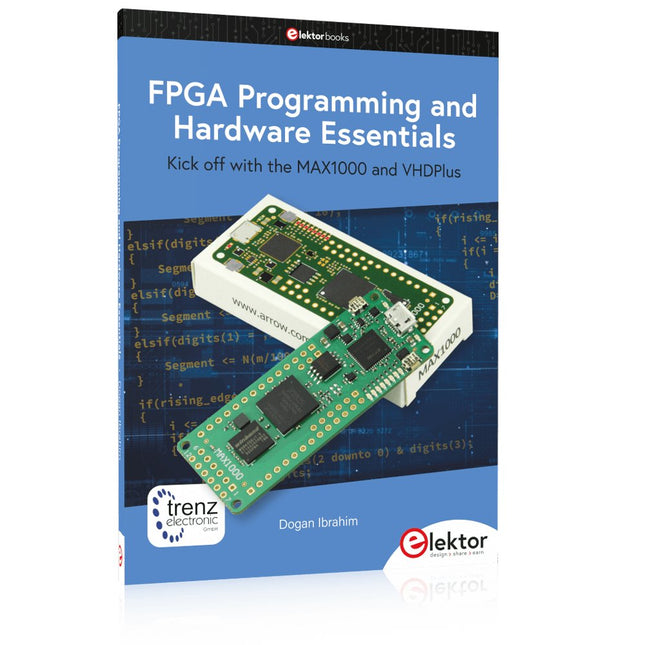
Elektor Publishing FPGA Programming and Hardware Essentials
Kick off with the MAX1000 and VHDPlus Ready to Master FPGA Programming? In this guide, we’re diving into the world of Field Programmable Gate Arrays (FPGAs) – a configurable integrated circuit that can be programmed after manufacturing. Imagine bringing your ideas to life, from simple projects to complete microcontroller systems! Meet the MAX1000: a compact and budget-friendly FPGA development board packed with features like memory, user LEDs, push-buttons, and flexible I/O ports. It’s the ideal starting point for anyone wanting to learn about FPGAs and Hardware Description Languages (HDLs). In this book, you’ll get hands-on with the VHDPlus programming language – a simpler version of VHDL. We’ll work on practical projects using the MAX1000, helping you gain the skills and confidence to unleash your creativity. Get ready for an exciting journey! You’ll explore a variety of projects that highlight the true power of FPGAs. Let’s turn your ideas into reality and embark on your FPGA adventure – your journey starts now! Exciting Projects You’ll Find in This Book Arduino-Driven BCD to 7-Segment Display Decoder Use an Arduino Uno R4 to supply BCD data to the decoder, counting from 0 to 9 with a one-second delay Multiplexed 4-Digit Event Counter Create an event counter that displays the total count on a 4-digit display, incrementing with each button press PWM Waveform with Fixed Duty Cycle Generate a PWM waveform at 1 kHz with a fixed duty cycle of 50% Ultrasonic Distance Measurement Measure distances using an ultrasonic sensor, displaying the results on a 4-digit 7-segment LED Electronic Lock Build a simple electronic lock using combinational logic gates with push buttons and an LED output Temperature Sensor Monitor ambient temperature with a TMP36 sensor and display the readings on a 7-segment LED Téléchargements Software
€ 39,95
Membres : € 35,96
-

Elektor Digital FPGA Programming and Hardware Essentials (E-book)
Kick off with the MAX1000 and VHDPlus Ready to Master FPGA Programming? In this guide, we’re diving into the world of Field Programmable Gate Arrays (FPGAs) – a configurable integrated circuit that can be programmed after manufacturing. Imagine bringing your ideas to life, from simple projects to complete microcontroller systems! Meet the MAX1000: a compact and budget-friendly FPGA development board packed with features like memory, user LEDs, push-buttons, and flexible I/O ports. It’s the ideal starting point for anyone wanting to learn about FPGAs and Hardware Description Languages (HDLs). In this book, you’ll get hands-on with the VHDPlus programming language – a simpler version of VHDL. We’ll work on practical projects using the MAX1000, helping you gain the skills and confidence to unleash your creativity. Get ready for an exciting journey! You’ll explore a variety of projects that highlight the true power of FPGAs. Let’s turn your ideas into reality and embark on your FPGA adventure – your journey starts now! Exciting Projects You’ll Find in This Book Arduino-Driven BCD to 7-Segment Display Decoder Use an Arduino Uno R4 to supply BCD data to the decoder, counting from 0 to 9 with a one-second delay Multiplexed 4-Digit Event Counter Create an event counter that displays the total count on a 4-digit display, incrementing with each button press PWM Waveform with Fixed Duty Cycle Generate a PWM waveform at 1 kHz with a fixed duty cycle of 50% Ultrasonic Distance Measurement Measure distances using an ultrasonic sensor, displaying the results on a 4-digit 7-segment LED Electronic Lock Build a simple electronic lock using combinational logic gates with push buttons and an LED output Temperature Sensor Monitor ambient temperature with a TMP36 sensor and display the readings on a 7-segment LED Téléchargements Software
€ 32,95
Membres : € 29,66
-
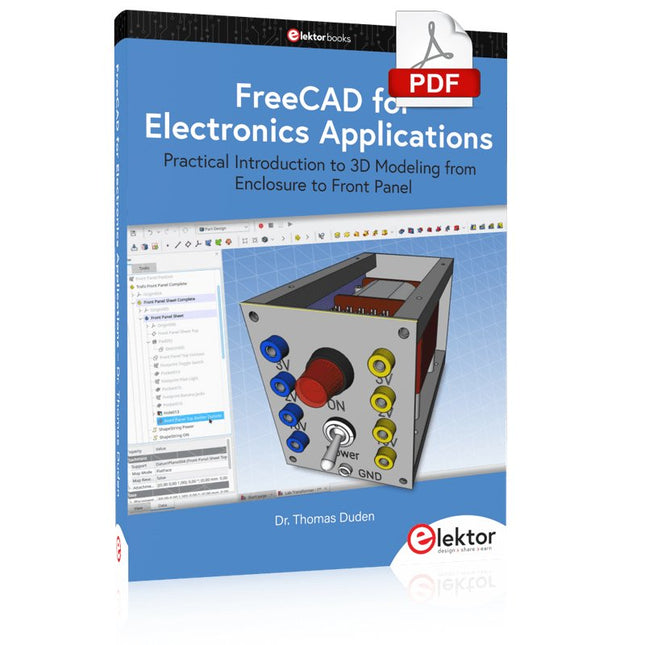
Elektor Digital FreeCAD for Electronic Applications (E-book)
Practical Introduction to 3D Modeling from Enclosure to Front Panel Embedding a vintage component, creating a professional looking home for a circuit board, or even designing a complex apparatus complete with a chassis – these and many other challenges turn into a stimulating pleasure with FreeCAD. Once you have internalized the basic processes, there are virtually no limits to your imagination. Starting to use a new software is never straightforward – especially with a tool as versatile as FreeCAD. Manageable, but at the same time easily usable individual components provide the starting point in this book. Putting these components together later results in assemblies. In the FreeCAD universe, a workable trajectory is demonstrated. The described procedure is illustrative so the examples are easily applied to custom tasks. The devices were made by the author and illustrated with photos. Creating a 3D design is requiring some effort but the initial investment pays off soon. Besides the impressive spatial representation of the projects, the extracted drawings yield a solid base for documentation and production. Extended FreeCAD capabilities like the unfolding of sheet metal parts enormously add to efficiency and pushes models forward into practical assembly. Soon you will definitely not want to do without FreeCAD!
€ 34,95
Membres : € 31,46
-
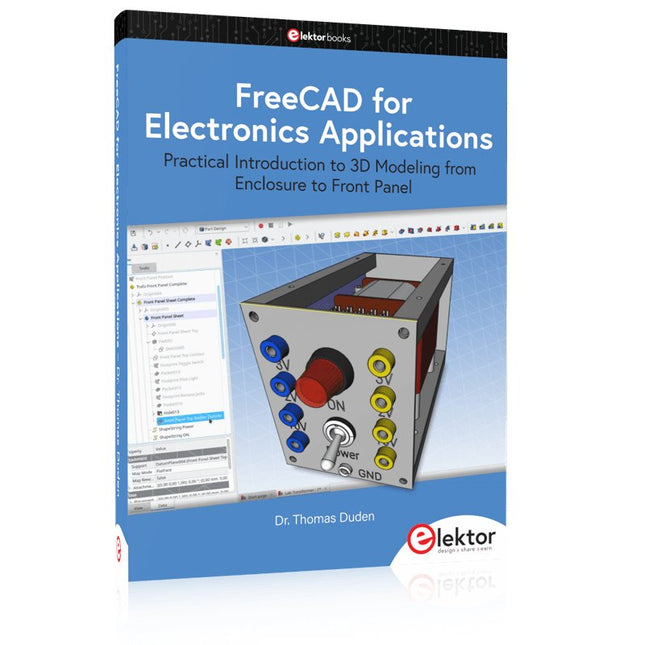
Elektor Publishing FreeCAD for Electronics Applications
Practical Introduction to 3D Modeling from Enclosure to Front Panel Embedding a vintage component, creating a professional looking home for a circuit board, or even designing a complex apparatus complete with a chassis – these and many other challenges turn into a stimulating pleasure with FreeCAD. Once you have internalized the basic processes, there are virtually no limits to your imagination. Starting to use a new software is never straightforward – especially with a tool as versatile as FreeCAD. Manageable, but at the same time easily usable individual components provide the starting point in this book. Putting these components together later results in assemblies. In the FreeCAD universe, a workable trajectory is demonstrated. The described procedure is illustrative so the examples are easily applied to custom tasks. The devices were made by the author and illustrated with photos. Creating a 3D design is requiring some effort but the initial investment pays off soon. Besides the impressive spatial representation of the projects, the extracted drawings yield a solid base for documentation and production. Extended FreeCAD capabilities like the unfolding of sheet metal parts enormously add to efficiency and pushes models forward into practical assembly. Soon you will definitely not want to do without FreeCAD!
€ 44,95
Membres : € 40,46
-
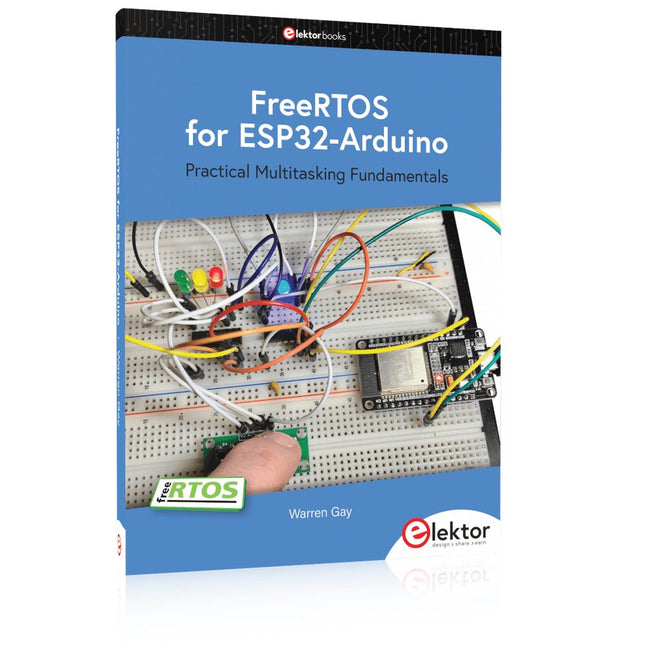
Elektor Publishing FreeRTOS for ESP32-Arduino
Practical Multitasking Fundamentals Programming embedded systems is difficult because of resource constraints and limited debugging facilities. Why develop your own Real-Time Operating System (RTOS) as well as your application when the proven FreeRTOS software is freely available? Why not start with a validated foundation? Every software developer knows that you must divide a difficult problem into smaller ones to conquer it. Using separate preemptive tasks and FreeRTOS communication mechanisms, a clean separation of functions is achieved within the entire application. This results in safe and maintainable designs. Practicing engineers and students alike can use this book and the ESP32 Arduino environment to wade into FreeRTOS concepts at a comfortable pace. The well-organized text enables you to master each concept before starting the next chapter. Practical breadboard experiments and schematics are included to bring the lessons home. Experience is the best teacher. Each chapter includes exercises to test your knowledge. The coverage of the FreeRTOS Application Programming Interface (API) is complete for the ESP32 Arduino environment. You can apply what you learn to other FreeRTOS environments, including Espressif’s ESP-IDF. The source code is available from GitHub. All of these resources put you in the driver’s seat when it is time to develop your next uber-cool ESP32 project. What you will learn: How preemptive scheduling works within FreeRTOS The Arduino startup “loopTask” Message queues FreeRTOS timers and the IDLE task The semaphore, mutex, and their differences The mailbox and its application Real-time task priorities and its effect Interrupt interaction and use with FreeRTOS Queue sets Notifying tasks with events Event groups Critical sections Task local storage The gatekeeper task
€ 49,95
Membres : € 44,96
-

Elektor Digital FreeRTOS for ESP32-Arduino (E-book)
Practical Multitasking Fundamentals Programming embedded systems is difficult because of resource constraints and limited debugging facilities. Why develop your own Real-Time Operating System (RTOS) as well as your application when the proven FreeRTOS software is freely available? Why not start with a validated foundation? Every software developer knows that you must divide a difficult problem into smaller ones to conquer it. Using separate preemptive tasks and FreeRTOS communication mechanisms, a clean separation of functions is achieved within the entire application. This results in safe and maintainable designs. Practicing engineers and students alike can use this book and the ESP32 Arduino environment to wade into FreeRTOS concepts at a comfortable pace. The well-organized text enables you to master each concept before starting the next chapter. Practical breadboard experiments and schematics are included to bring the lessons home. Experience is the best teacher. Each chapter includes exercises to test your knowledge. The coverage of the FreeRTOS Application Programming Interface (API) is complete for the ESP32 Arduino environment. You can apply what you learn to other FreeRTOS environments, including Espressif’s ESP-IDF. The source code is available from GitHub. All of these resources put you in the driver’s seat when it is time to develop your next uber-cool ESP32 project. What you will learn: How preemptive scheduling works within FreeRTOS The Arduino startup “loopTask” Message queues FreeRTOS timers and the IDLE task The semaphore, mutex, and their differences The mailbox and its application Real-time task priorities and its effect Interrupt interaction and use with FreeRTOS Queue sets Notifying tasks with events Event groups Critical sections Task local storage The gatekeeper task
€ 39,95
Membres : € 35,96
-

Raspberry Pi Foundation Get Started with MicroPython on Raspberry Pi Pico (2nd Edition)
Fully updated for Raspberry Pi Pico W, this book gets you started with Raspberry Pi Pico – whether you’re using Raspberry Pi Pico for a home project, industrial automation, or learning (or teaching!) electronics and programming. Microcontrollers, like the RP2040 chip at the heart of Raspberry Pi Pico, are computers stripped back to their bare essentials. You don’t use monitors or keyboards with them – instead, you program them over USB to take their input from (and send their output to) on-board input/output pins. Using these programmable connections, you can light LEDs, make noises, send text to screens, and much more. In this book, you will learn how to use the beginner-friendly MicroPython language to write programs, and you’ll connect up hardware to make your Raspberry Pi Pico interact with the world around it. Using these skills, you can create your own electromechanical projects, whether for fun or to make your life easier. Fully updated for Raspberry Pi Pico W and the latest version of MicroPython, this book shows you how to: Get started with Raspberry Pi Pico and Pico W Work with various electronic components Create your own programmable electronic contraptions Turn Raspberry Pi Pico W into a network-connected node for the Internet of Things Link your Pico W to your smartphone, tablet, or another Pico W with Bluetooth Low Energy (BLE) Whether you’re using Raspberry Pi Pico for a home project, industrial automation, or learning (or teaching!) electronics and programming, this book will show you how.
-

Elektor Digital Get Started with the Raspberry Pi AI Kit (E-book)
A Beginner's Guide to AI and Edge Computing Artificial Intelligence (AI) is now part of our daily lives. With companies developing low-cost AI-powered hardware into their products, it is now becoming a reality to purchase AI accelerator hardware at comparatively very low costs. One such hardware accelerator is the Hailo module which is fully compatible with the Raspberry Pi 5. The Raspberry Pi AI Kit is a cleverly designed hardware as it bundles an M.2-based Hailo-8L accelerator with the Raspberry Pi M.2 HAT+ to offer high speed inferencing on the Raspberry Pi 5. Using the Raspberry Pi AI Kit, you can build complex AI-based vision applications, running in real-time, such as object detection, pose estimation, instance segmentation, home automation, security, robotics, and many more neural network-based applications. This book is an introduction to the Raspberry Pi AI Kit, and it is aimed to provide some help to readers who are new to the kit and wanting to run some simple AI-based visual models on their Raspberry Pi 5 computers. The book is not meant to cover the detailed process of model creation and compilation, which is done on an Ubuntu computer with massive disk space and 32 GB memory. Examples of pre-trained and custom object detection are given in the book. Two fully tested and working projects are given in the book. The first project explains how a person can be detected and how an LED can be activated after the detection, and how the detection can be acknowledged by pressing an external button. The second project illustrates how a person can be detected, and how this information can be passed to a smart phone over a Wi-Fi link, as well as how the detection can be acknowledged by sending a message from the smartphone to your Raspberry Pi 5.
€ 29,95
Membres : € 26,96
-
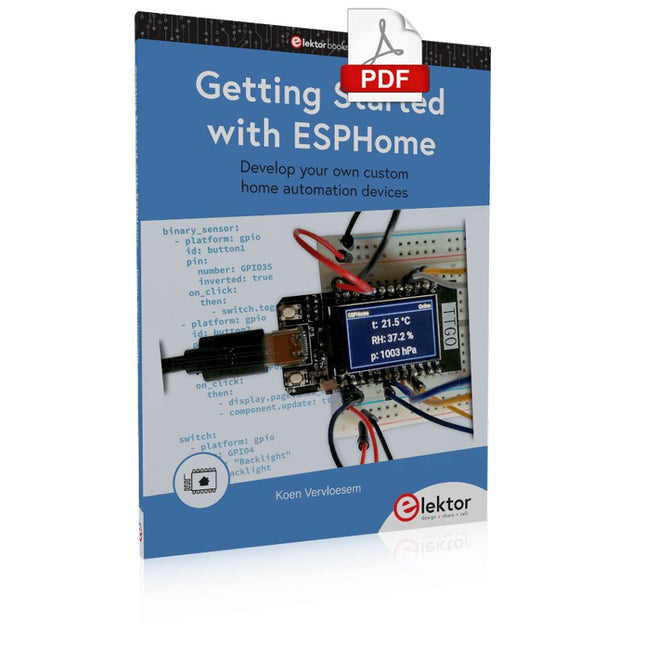
Elektor Digital Getting Started with ESPHome (E-book)
Develop your own custom home automation devices Espressif's ESP8266 and ESP32 microcontrollers have brought DIY home automation to the masses. However, not everyone is fluent in programming these microcontrollers with Espressif's C/C++ SDK, the Arduino core, or MicroPython. This is where ESPHome comes into its own: with this project, you don’t program your microcontroller but configure it. This book demonstrates how to create your own home automation devices with ESPHome on an ESP32 microcontroller board. You’ll learn how to combine all kinds of electronic components and automate complex behaviours. Your devices can work completely autonomously, and connect over Wi-Fi to your home automation gateways such as Home Assistant or MQTT broker. By the end of this book, you will be able to create your own custom home automation devices the way you want. Thanks to ESPHome and the ESP32, this is within everyone’s grasp. Set up an ESPHome development environment and create maintainable configurations Use buttons and LEDs Sound a buzzer and play melodies Read measurements from various types of sensors Communicate over a short distance with NFC, infrared light, and Bluetooth Low Energy Show information on various types of displays Downloads Software
€ 29,95
Membres : € 26,96


