
Physical Products
-

Raspberry Pi Foundation Raspberry Pi USB 3.0 Hub
Le hub USB 3 Raspberry Pi étend la connectivité de votre appareil en convertissant un seul port USB-A en quatre ports USB 3.0. Avec une entrée d'alimentation USB-C externe en option, il peut prendre en charge des périphériques haute puissance, tandis que les périphériques moins gourmands fonctionnent sans alimentation supplémentaire. Le hub USB 3 est entièrement testé pour une compatibilité transparente avec tous les produits Raspberry Pi. Caractéristiques Connexion en amont unique : connecteur USB 3.0 Type-A avec un câble de 8 cm Quatre ports en aval : ports USB 3.0 Type-A pour les connexions de plusieurs appareils Transfert de données haut débit : prend en charge des vitesses allant jusqu'à 5 Gbit/s Compatibilité : fonctionne avec les ports hôtes USB 3.0 Type-A et est rétrocompatible avec les ports USB 2.0 Téléchargements Datasheet
-
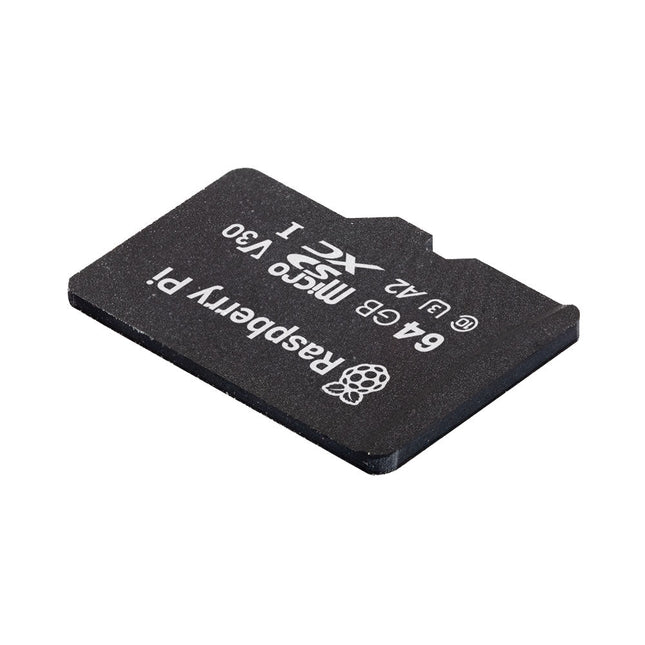
Raspberry Pi Foundation Raspberry Pi carte SD A2 préinstallée avec Raspberry Pi OS (64 Go)
SD card quality is crucial for a good Raspberry Pi experience. Raspberry Pi's A2 microSD cards support higher bus speeds and command queuing, improving random read performance and narrowing the gap with NVMe SSDs. These cards are rigorously tested for optimal performance with Raspberry Pi models. Caractéristiques Capacity: 64 GB Support for DDR50 and SDR104 bus speeds and command queueing (CQ) extension Speed Class: C10, U3, V30, A2 Random 4 KB read performance: 3,200 IOPS (Raspberry Pi 4, DDR50) 5,000 IOPS (Raspberry Pi 5, SDR104) Random 4 K write performance: 1,200 IOPS (Raspberry Pi 4, DDR50) 2,000 IOPS (Raspberry Pi 5, SDR104) Shock-proof, X-ray–proof, and magnet-proof microSDHC/microSDXC formats Téléchargements Datasheets
-
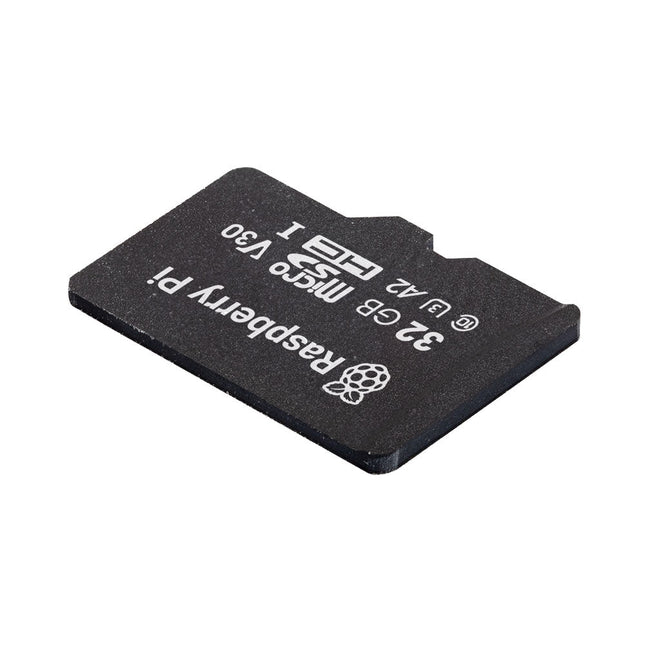
Raspberry Pi Foundation Raspberry Pi carte SD A2 préinstallée avec Raspberry Pi OS (32 Go)
SD card quality is crucial for a good Raspberry Pi experience. Raspberry Pi's A2 microSD cards support higher bus speeds and command queuing, improving random read performance and narrowing the gap with NVMe SSDs. These cards are rigorously tested for optimal performance with Raspberry Pi models. Caractéristiques Capacity: 32 GB Support for DDR50 and SDR104 bus speeds and command queueing (CQ) extension Speed Class: C10, U3, V30, A2 Random 4 KB read performance: 3,200 IOPS (Raspberry Pi 4, DDR50) 5,000 IOPS (Raspberry Pi 5, SDR104) Random 4 K write performance: 1,200 IOPS (Raspberry Pi 4, DDR50) 2,000 IOPS (Raspberry Pi 5, SDR104) Shock-proof, X-ray–proof, and magnet-proof microSDHC/microSDXC formats Téléchargements Datasheets
-

Raspberry Pi Foundation Raspberry Pi caméra AI
La caméra Raspberry Pi AI est un module de caméra compact basé sur le capteur de vision intelligent Sony IMX500. L'IMX500 combine un capteur d'image CMOS de 12 MP avec une accélération d'inférence intégrée pour divers modèles de réseaux neuronaux courants, ce qui permet aux utilisateurs de développer des applications d'IA sophistiquées basées sur la vision sans nécessiter d'accélérateur séparé. La caméra AI améliore les images fixes ou vidéo capturées avec des métadonnées tensorielles, tout en laissant le processeur du Raspberry Pi libre pour d'autres tâches. La prise en charge des métadonnées tensorielles dans les bibliothèques libcamera et Picamera2, ainsi que dans la suite d'applications rpicam-apps, garantit la facilité d'utilisation pour les débutants tout en offrant une puissance et une flexibilité inégalées pour les utilisateurs avancés. La caméra Raspberry Pi AI est compatible avec tous les modèles de Raspberry Pi. Caractéristiques Capteur de vision intelligent Sony IMX500 12 MP Modes du capteur : 4056 x 3040 (@ 10fps), 2028 x 1520 (@ 30fps) Taille des cellules de 1,55 x 1,55 µm Champ de vision de 78° avec mise au point réglable manuellement RP2040 intégré pour la gestion du réseau neuronal et du micrologiciel Spécifications Capteur Sony IMX500 Résolution 12,3 MP (4 056 x 3 040 pixels) Taille du capteur 7,857 mm (type 1/2,3) Taille des pixels 1,55 x 1,55 μm Filtre anti-IR Intégré Autofocus Mise au point réglable manuellement Plage de mise au point 20 cm – ∞ Longueur focale 4,74 mm Champ de vue horizontal 66 ±3° Champ de vue vertical 52,3 ±3° Rapport focal (F-stop) F1.79 Sortie Image (Bayer RAW10), sortie FAI (YUV/RGB), ROI, métadonnées Taille maximale du tenseur d'entrée 640 x 640 (H x V) Taux de rafraîchissement • 2 x 2 regroupés : 2028 x 1520 10 bits, 30 ips• Pleine résolution : 4056 x 3040, 10 bits, 10 ips Longueur du câble ruban 20 cm Connecteur de câble 15 x 1 mm FPC ou 22 x 0,5 mm FPC Dimensions 25 x 24 x 11,9 mm Téléchargements Datasheet Documentation
-

Raspberry Pi Foundation Raspberry Pi Zero 2 WH (avec connecteur)
Le Raspberry Pi Zero 2 WH est le successeur du révolutionnaire Raspberry Pi Zero W(H). La carte intègre un processeur Arm Cortex-A53 64 bits à quatre cœurs, cadencé à 1 GHz. Son cœur est un système en boîtier (SiP) Raspberry Pi RP3A0, intégrant une puce Broadcom BCM2710A1 avec 512 Mo de SDRAM LPDDR2. Le processeur amélioré offre au Raspberry Pi Zero 2 WH 40% de performances supplémentaires en mode monotâche et cinq fois plus de performances en mode multithread que le Raspberry Pi Zero à cœur unique d'origine. Caractéristiques Processeur quad-core 64 bits GPU VideoCore IV 512 MB LPDDR2 DRAM 802.11b/g/n LAN sans fil Bluetooth 4.2 / Bluetooth à basse consommation (BLE) Slot pour carte MicroSD Ports Mini HDMI et USB 2.0 OTG Alimentation Micro USB Avec connecteur à 40 broches monté Broches de vidéo composite et de reset via des points de test Connecteur de caméra CSI Spécifications SoC Broadcom BCM2710A1 CPU 64-bit ARM Cortex-A53 (4x 1 GHz) GPU Broadcom VideoCore VI RAM 512 MB LPDDR2 Wireless LAN 2.4 GHz IEEE 802.11b/g/n Bluetooth Bluetooth 4.2, BLE USB 1x micro USB (pour les données)1x micro USB (pour l‘alimentation) GPIO Connecteur à 40 broches compatible avec HAT Vidéo & Audio 1080P HD vidéo & stereo audio via un connecteur mini-HDMI Carde SD microSD (pour le système d'exploitation et le stockage) Alimentation 5 VDC / 2,5 A (alimenté par un connecteur micro USB) Dimensions 65 x 30 x 5 mm L’empreinte du Raspberry Pi Zero 2 WH est compatible avec les modèles Zero antérieurs.
-

Raspberry Pi Foundation Raspberry Pi 5 (2 Go de RAM)
Le Raspberry Pi 5 offre plus de performances que jamais. Grâce à un CPU, un GPU et une RAM plus rapides, le Raspberry Pi 5 est jusqu'à 3 fois plus rapide que son prédécesseur déjà rapide. En plus de l'augmentation de la vitesse, le Raspberry Pi 5 (qui intègre la nouvelle puce Raspberry Pi RP1 pour des capacités d'E/S avancées) offre également pour la première fois les fonctionnalités suivantes : RTC, un bouton marche/arrêt et une interface PCIe. Caractéristiques Processeur ARM Cortex-A76 quadricœur 64 bits (2,4 GHz) GPU VideoCore VII (800 MHz) 2 Go de RAM LPDDR4X (4267 MHz) Contrôleur d'E/S Raspberry Pi RP1 Horloge temps réel (RTC) Bouton marche/arrêt PCIe 2.0 Connecteur UART Connecteur de ventilateur Spécifications SoC Broadcom BCM2712 CPU ARM Cortex-A76 (ARM v8) 64 bits Fréquence d'horloge 4x 2,4 GHz GPU VideoCore VII (800 MHz) RAM 2 Go de RAM LPDDR4X (4267 MHz) WiFi IEEE 802.11b/g/n/ac (2,4 GHz/5 GHz) Bluetooth Bluetooth 5.0, BLE Ethernet Gigabit Ethernet (avec support PoE+) USB 2x USB-A 3.0 (5 GBit/s)2x USB-A 2.0 PCI Express 1x PCIe 2.0 GPIO Embase GPIO standard à 40 broches Vidéo 2x ports micro-HDMI (4K60)2x MIPI à 4 voies (DSI/CSI) Multimédia H.265 (décodage 4K60)OpenGL ES 3.1, Vulkan 1.2 Carte SD microSD Alimentation 5 V/5 A (via USB-C)Power over Ethernet (PoE+) Raspberry Pi 4 vs Raspberry Pi 5 Raspberry Pi 4 Raspberry Pi 5 SoC Broadcom BCM2711 Broadcom BCM2712 CPU ARM Cortex-A72 (ARM v8) 64 bit ARM Cortex-A76 (ARM v8) 64 bit Fréquence d'horloge 4x 1,5 GHz 4x 2,4 GHz Cache L2 1 Mo partagé 4x 512 Ko Cache L3 N/A 2 Mo partagés GPU VideoCore VI (500 MHz) VideoCore VII (800 MHz) RAM 2 Go LPDDR4 (3200 MHz) 2 Go LPDDR4X (4267 MHz) WiFi IEEE 802.11b/g/n/ac (2,4 GHz/5 GHz) IEEE 802.11b/g/n/ac (2,4 GHz/5 GHz) Bluetooth Bluetooth 5.0, BLE Bluetooth 5.0, BLE Ethernet Gigabit Ethernet (avec support PoE) Gigabit Ethernet (avec support PoE+) USB 2x USB-A 3.02x USB-A 2.0 2x USB-A 3.0 (5 GBit/s)2x USB-A 2.0 Contrôleur d'E/S N/A Silicium Raspberry Pi RP1 PCI Express N/A 1x PCIe 2.0 Horloge temps réel (RTC) N/A RTC embarquée avec connecteur pour batterie Bouton marche/arrêt N/A Bouton d'alimentation intégré Refroidissement N/A Connecteur de ventilateur GPIO Embase GPIO standard à 40 broches Embase GPIO standard à 40 broches UART via GPIO 1x connecteur UART Carte SD Emplacement microSD (DDR50) Emplacement microSD (SDR104) Vidéo 2 ports micro-HDMI (4K60)1x port MIPI DSI à 2 voies (écran)1x port MIPI CSI à 2 voies (caméra) 2x ports micro-HDMI (4K60)2x MIPI à 4 voies (DSI/CSI) Audio Prise audio à 4 pôles de 3,5 mm (audio stéréo et vidéo composite) N/A Multimédia H.265 (décodage 4K60)H.264 (décodage 1080p60, codage 1080p30)Graphiques OpenGL ES 3.0 H.265 (décodage 4K60)OpenGL ES 3.1, Vulkan 1.2 Alimentation 5 V/3 A (15 W)Power over Ethernet (PoE+) 5 V/5 A (25 W), USB PDPower over Ethernet (PoE+) Raspberry Pi 5 4 Go de RAM 8 Go de RAM 16 Go de RAM Téléchargements Datasheet Unboxing the Raspberry Pi 5 First Insights
-
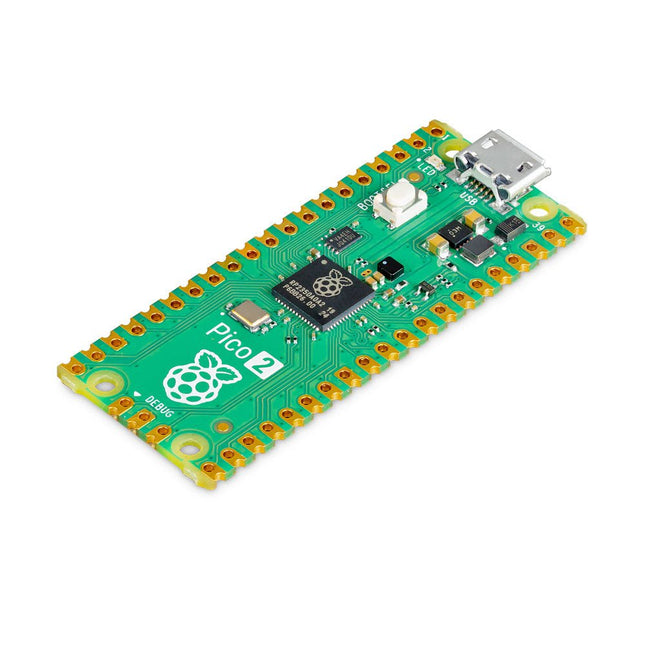
Raspberry Pi Foundation Raspberry Pi Pico 2
Le Raspberry Pi Pico 2 est une nouvelle carte microcontrôleur de la Raspberry Pi Foundation, basée sur le RP2350. Il présente une vitesse d'horloge de cœur plus élevée, le double de la SRAM sur puce, le double de la mémoire flash intégrée, des cœurs Arm plus puissants, des cœurs RISC-V en option, de nouvelles fonctionnalités de sécurité et des capacités d'interface améliorées. Le Raspberry Pi Pico 2 offre une amélioration significative des performances et des fonctionnalités tout en conservant la compatibilité matérielle et logicielle avec les membres précédents de la série Raspberry Pi Pico. Le RP2350 fournit une architecture de sécurité complète construite autour d'Arm TrustZone pour Cortex-M. Il intègre un démarrage signé, 8 Ko d'OTP antifusible pour le stockage des clés, une accélération SHA-256, un TRNG matériel et des détecteurs de problèmes rapides. La capacité unique à double cœur et à double architecture du RP2350 permet aux utilisateurs de choisir entre une paire de cœurs Arm Cortex-M33 standard et une paire de cœurs Hazard3 RISC-V à matériel ouvert. Programmable en C/C++ et Python, et pris en charge par une documentation détaillée, le Raspberry Pi Pico 2 est la carte microcontrôleur idéale pour les passionnés et les développeurs professionnels. Spécifications Processeur Processeurs Dual Arm Cortex-M33 ou double RISC-V Hazard3 à 150 MHz Mémoire 520 Ko de SRAM sur puce ; Flash QSPI intégré de 4 Mo Interfaces 26 broches GPIO polyvalentes, dont 4 pouvant être utilisées pour AD Périphériques 2x UART 2x Contrôleurs SPI 2x Contrôleurs I²C 24x Canaux PWM 1x Contrôleur USB 1.1 et PHY, avec prise en charge des hôtes et des périphériques 12x Machines à états PIO Puissance d'entrée 1,8-5,5 V CC Dimensions 21 x 51 mm Téléchargements Datasheet (Pico 2) Datasheet (RP2350)
-

Elektor Publishing The Book of 555 Timer Projects
Over 45 Builds for the Legendary 555 Chip (and the 556, 558) The 555 timer IC, originally introduced by the Signetics Corporation around 1971, is sure to rank high among the most popular analog integrated circuits ever produced. Originally called the IC Time Machine, this chip has been used in many timer-related projects by countless people over decades. This book is all about designing projects based on the 555 timer IC. Over 45 fully tested and documented projects are presented. All projects have been fully tested by the author by constructing them individually on a breadboard. You are not expected to have any programming experiences for constructing or using the projects given in the book. However, it’s definitely useful to have some knowledge of basic electronics and the use of a breadboard for constructing and testing electronic circuits. Some of the projects in the book are: Alternately Flashing Two LEDs Changing LED Flashing Rate Touch Sensor On/Off Switch Switch On/Off Delay Light-Dependent Sound Dark/Light Switch Tone Burst Generator Long Duration Timer Chasing LEDs LED Roulette Game Traffic Lights Continuity Tester Electronic Lock Switch Contact Debouncing Toy Electronic Organ Multiple Sensor Alarm System Metronome Voltage Multipliers Electronic Dice 7-Segment Display Counter Motor Control 7-Segment Display Dice Electronic Siren Various Other Projects The projects given in the book can be modified or expanded by you for your very own applications. Electronic engineering students, people engaged in designing small electronic circuits, and electronic hobbyists should find the projects in the book instructive, fun, interesting, and useful.
-
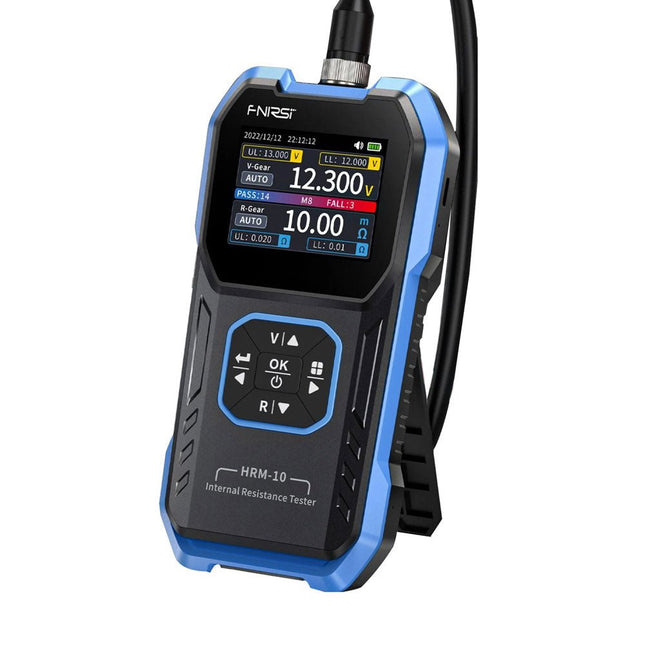
FNIRSI FNIRSI HRM-10 Testeur de tension et de résistance interne de batterie
Le FNIRSI HRM-10 est un testeur de tension et de résistance interne de batterie portable et de haute précision. Cet appareil offre une véritable mesure à quatre fils et est conçu pour la précision et la facilité d'utilisation. Il mesure automatiquement les valeurs de résistance interne et de tension simultanément, affichant les résultats sur son écran couleur HD. Les utilisateurs ont la possibilité d'ajuster manuellement les plages de tension et de résistance en fonction de leurs besoins. L'appareil comprend également un mode de tri qui filtre automatiquement les bonnes et mauvaises batteries en fonction de seuils définis par l'utilisateur. De plus, il prend en charge le stockage des données historiques et permet d'exporter des enregistrements de mesures sous forme de tableau. Caractéristiques Haute précision des mesures Exportation de données tabulaires Évaluer automatiquement les résultats des mesures 8 paramètres de seuil Écran couleur HD Support pliable Batterie au lithium de 1000 mAh Spécifications Tension Résistance Plage de mesure 0-100 V (CC) 0-200 Ω Précision ±0,5% ±0,5% Équipement Automatique, 1 V, 10 V, 100 V Automatique, 20 mΩ, 200 mΩ, 2 Ω, 20 Ω, 200 Ω Fréquence du signal de test de l'instrument 1 Khz (CA) Rechargeable USB-C (5 V/1 A) Batterie intégrée Batterie au lithium 1000 mAh Calibrage utilisateur Oui Mode de tri Oui Historique Oui Export de données enregistrées Oui Environnement de travail –10°C à +45°C, humidité relative <80% Environnement de stockage –20°C à +80°C, humidité relative <80% Dimensions 158,7 x 80,5 x 28,4 mm Poids 225 g Inclus 1x FNIRSI HRM-10 Testeur de résistance interne 1x Ligne de test de clip 1x Câble de données USB-C 1x Manuel Téléchargements Manual Firmware V0.3
€ 49,54
-
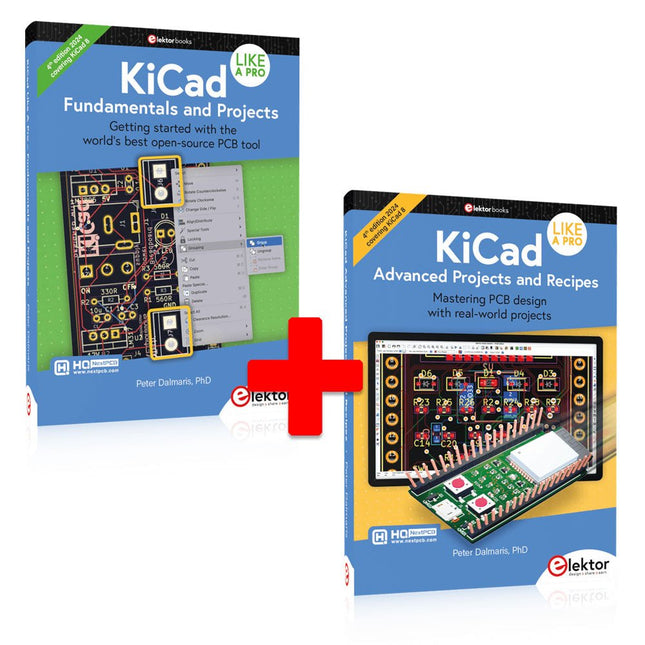
Elektor Bundles KiCad Like A Pro (offre groupée)
Cette offre groupée contient les deux volumes de « KiCad Like a Pro » (4e édition 2024). Dans Fundamentals and Projects (prix normal : 49,95 €), vous apprendrez à utiliser KiCad grâce à une approche pratique, vous aidant à devenir rapidement productif et à commencer à concevoir vos propres cartes. Advanced Projects and Recipes (prix normal : 44,95 €) vous permet de mettre en pratique vos nouvelles compétences KiCad en vous mettant au défi avec une série de projets réels. La dernière version de KiCad, le meilleur outil gratuit de CAO au monde, est dotée de fonctionnalités que l'on ne trouve généralement que dans les outils de CAO commerciaux coûteux. Cette suite d'applications multiplateformes moderne, construite autour d'éditeurs de schémas et de conception, avec des applications auxiliaires, est un outil PCB stable et mature. KiCad 8 est parfait pour les ingénieurs et les créateurs en électronique. Voici les améliorations et fonctionnalités les plus importantes de KiCad 8, à la fois en surface et sous le capot : Interface utilisateur moderne, entièrement repensée par rapport aux versions précédentes Vérificateurs de règles électriques et de conception améliorés et personnalisables Éditeur de thèmes vous permettant de personnaliser KiCad sur votre écran Possibilité d'importer des projets depuis Eagle, CADSTART, etc. API de script Python Simulateur de circuit SPICE intégré amélioré Schémas multi-feuilles Les filtres définissent les éléments sélectionnables Le routeur interactif amélioré vous aide à dessiner des pistes simples et des paires différentielles avec précision Des outils nouveaux ou améliorés pour dessiner des pistes, mesurer des distances, régler les longueurs de piste, etc. Interactif avancé routeur Générateur de nomenclature intégré Visionneuse 3D réaliste avec fonction de lancer de rayons Gouttes d'eau personnalisables Gestionnaire de plug-ins pour une installation rapide de thèmes, de bibliothèques et de fonctionnalités telles que les autorouteurs et les générateurs de nomenclature Le premier livre KiCad Like A Pro – Fundamentals and Projects vous apprendra à utiliser KiCad grâce à une approche pratique. Il vous aidera à devenir productif rapidement et à commencer à concevoir vos propres cartes. Des exemples de projets illustrent les fonctionnalités de base de KiCad, même si vous n'avez aucune connaissance préalable de la conception de PCB. L'auteur décrit l'intégralité du flux de travail, de la saisie des schémas aux subtilités de la finalisation des fichiers pour la production de PCB, et offre des conseils judicieux sur le processus. Le deuxième livre KiCad Like A Pro – Advanced Projects and Recipes vous aidera à mettre en pratique vos nouvelles compétences KiCad en vous mettant au défi dans une série de projets du monde réel. Les projets sont soutenus par un ensemble complet de recettes avec des instructions détaillées sur la façon de réaliser une variété de tâches simples et complexes. Concevez les PCB pour une alimentation solaire, une matrice de LED, un enregistreur de données alimenté par Arduino et une carte ESP32 personnalisée. Comprenez les détails les plus fins du routeur interactif, comment gérer les équipes de projet KiCad avec Git, comment utiliser un autorouter sur des PCB à 2 et 4 couches, et bien plus encore.
€ 104,95€ 89,95Meilleur prix
-
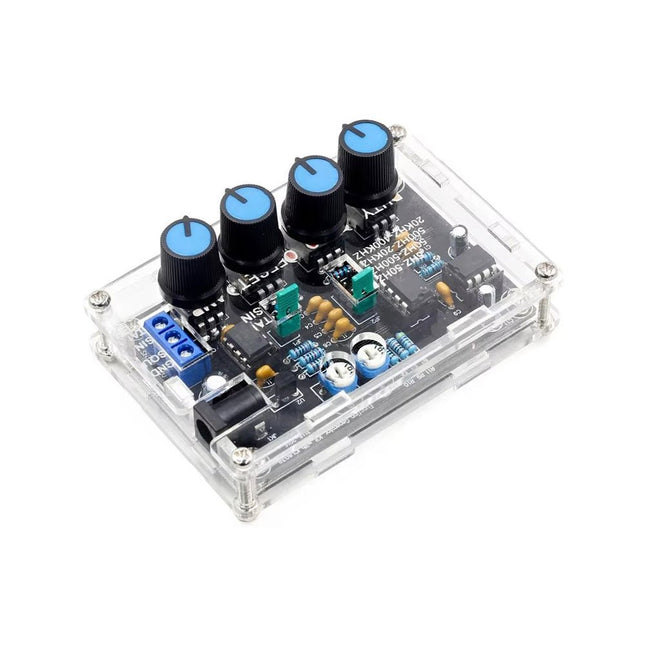
Generic ICL8038 Kit de générateur de signaux DIY (5 Hz – 400 kHz)
Le générateur de signaux ICL8038 fournit des formes d'onde polyvalentes, notamment sinusoïdales, triangulaires, carrées et en dents de scie avant/arrière, ce qui le rend adapté à une large gamme d'applications. Alimenté par la puce ICL8038 et des amplificateurs opérationnels à grande vitesse, il garantit une précision et une stabilité du signal exceptionnelles. Avec une plage de fréquences de 5 Hz à 400 kHz, il prend en charge les applications allant de l'audio aux fréquences radio. Son cycle de service réglable, allant de 2% à 95%, permet une personnalisation précise de la forme d'onde pour répondre à divers besoins. Le kit DIY est adapté aux débutants et comprend des composants traversants pour un assemblage facile. Il comprend toutes les pièces nécessaires, une coque en acrylique et un manuel détaillé, fournissant tout le nécessaire pour construire et utiliser efficacement le générateur de signaux. Spécifications Plage de fréquence 5 Hz~400 KHz (réglable) Tension d'alimentation 12 V~15 V Plage de cycles de service 2%~95% (réglable) Onde sinusoïdale à faible distorsion 1% Dérive à basse température 50 ppm/°C Linéarité de l'onde triangulaire de sortie 0,1% Plage de polarisation CC −7,5 V~7,5 V Plage d'amplitude de sortie 0,1 V~11 VPP (tension de fonctionnement 12 V) Dimensions 89 x 60 x 35 mm Poids 81 g Inclus PCB inclus. tous les composants nécessaires Boîtier en acrylique Manuel
-
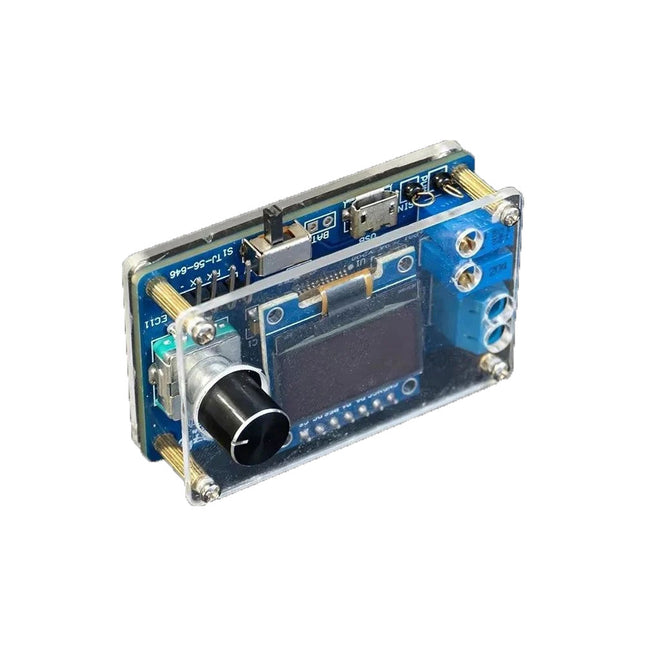
Generic Kit mini oscilloscope numérique DIY
Le kit DIY Mini Digital Oscilloscope (avec boîtier) est un kit facile à construire pour un minuscule oscilloscope numérique. Outre l'interrupteur d'alimentation, il ne comporte qu'une seule autre commande, un encodeur rotatif avec bouton-poussoir intégré. Le microcontrôleur du kit est préprogrammé. L'écran OLED de 0,96 pouces a une résolution de 128 x 64 pixels. L'oscilloscope dispose d'une voie qui peut mesurer des signaux jusqu'à 100 kHz. La tension d'entrée maximale est de 30 V, la tension minimale de 0 V. Le kit se compose de composants à trous traversants (THT) et de dispositifs de montage en surface (SMD). Par conséquent, l'assemblage du kit implique de souder des pièces SMD, ce qui nécessite une certaine expérience en matière de soudure. Spécifications Plage verticale : 0 à 30 V Plage horizontale : 100 µs à 500 ms Type de déclencheur : automatique, normal et unique Front de déclenchement : montant et descendant Niveau de déclenchement : 0 à 30 V Mode Exécution/Arrêt Mesure automatique de la fréquence Alimentation : micro-USB 5 V Sortie sinusoïdale 10 Hz, 5 V Sortie d'onde carrée de 9 kHz, 0 à 4,8 V Affichage : écran OLED de 0,96 pouce Dimensions : 57 x 38 x 26 mm Téléchargements Documentation
-
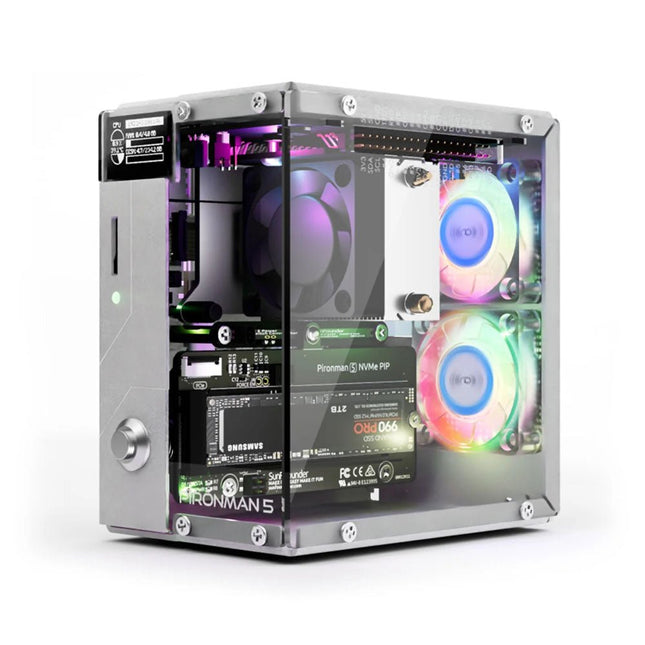
SunFounder Pironman 5 NVMe M.2 SSD PCIe Mini PC Boîtier pour Raspberry Pi 5
Améliorez votre Raspberry Pi 5 avec le Pironman 5, construit en aluminium robuste, avec un refroidissement supérieur, un support SSD NVMe M.2, un écran OLED, un éclairage RVB, des ports HDMI standard x2 et un interrupteur d'alimentation sécurisé. Il est parfait pour les NAS, Home Assistant, Media et Game Centers. Le Pironman 5 n'est pas seulement un boîtier ; il s'agit d'une mise à niveau qui transforme votre Raspberry Pi 5 en un appareil puissant, efficace et élégant. Le Pironman 5 comprend le Pi 5 NVMe PIP (PCIe Peripheral Board), une carte adaptateur PCIe spécialement conçue pour les disques SSD NVMe. Cette carte prend en charge quatre tailles de SSD NVMe : 2230, 2242, 2260 et 2280, qui peuvent tous être installés dans un emplacement pour clé M.2 M. La connexion est certifiée pour les vitesses Gen 2.0 (5 GT/sec), mais peut être forcée à Gen 3.0 (10 GT/sec) pour des performances plus rapides. Emplacement SSD NVMe M.2 extensible Améliorez les performances de votre Raspberry Pi 5 avec l'emplacement SSD NVMe M.2 du Pironman 5, prenant en charge plusieurs tailles (2230, 2242, 2260, 2280) pour un stockage accru et une réponse plus rapide du système. Système de refroidissement avancé Gardez votre Raspberry Pi 5 au frais et élégant avec le refroidisseur tour du Pironman 5 et ses deux ventilateurs RVB, dotés de filtres anti-poussière pour un fonctionnement durable et nécessitant peu d'entretien. Écran OLED pour des informations instantanées Le Pironman 5 comprend un écran OLED de 0,96 pouces, fournissant des mises à jour immédiates sur l'utilisation du processeur et de la RAM, la température, l'adresse IP, etc. Fonctionnalité et sécurité améliorées Le Pironman 5 sécurise votre Raspberry Pi 5 avec des fonctionnalités telles qu'un arrêt sécurisé, des LED RVB personnalisables, des ports HDMI, un récepteur IR et un prolongateur GPIO externe, améliorant ainsi la fonctionnalité et la connectivité. Caractéristiques Mini PC Raspberry Pi 5 Écran OLED de 0,96" affichant l'utilisation du processeur, la température, l'utilisation du disque, l'adresse IP, l'utilisation de la RAM, etc. du Raspberry Pi. Le refroidisseur tour peut refroidir une charge CPU à 100% Pi à 39°C à une température ambiante de 25°C 2 ventilateurs RVB, avec contrôle GPIO 1 ventilateur PWM sur le refroidisseur tour est contrôlé par le système Raspberry Pi. Prend en charge quatre tailles de SSD NVMe M.2 (PCIe Gen 2.0/PCIe Gen 3.0) : 2230, 2242, 2260 et 2280. 4 LED RVB adressables WS2812 illuminent l'ensemble du boîtier avec un effet de lumière cool Récepteur IR pour centre multimédia comme Kodi ou Volumio Bouton d'alimentation rétro en métal pour un arrêt en toute sécurité Rallonge GPIO externe avec étiquette de nom de code PIN, pour un accès facile Équipé d'un support à ressort pour un retrait facile de la carte Corps principal en aluminium avec panneau latéral en acrylique transparent Comprend deux ports HDMI standards Téléchargements Documentation
€ 79,95
Membres : € 71,96
-
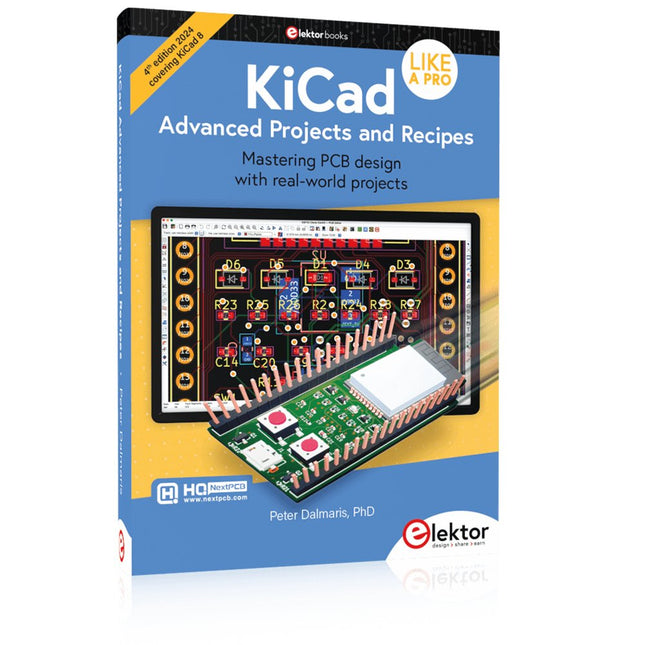
Elektor Publishing KiCad Like A Pro – Advanced Projects and Recipes
Mastering PCB design with real-world projects This book builts on KiCad Like a Pro – Fundamentals and Projects and aims to help you practice your new KiCad skills by challenging you in a series of real-world projects. The projects are supported by a comprehensive set of recipes with detailed instructions on how to achieve a variety of simple and complex tasks. Design the PCBs for a solar power supply, an LED matrix array, an Arduino-powered datalogger, and a custom ESP32 board. Understand the finer details of the interactive router, how to manage KiCad project teams with Git, how to use an autorouter on 2 and 4-layer PCBs, and much more. KiCad 8 is a modern, cross-platform application suite built around schematic and design editors. This stable and mature PCB tool is a perfect fit for electronic engineers and makers. With KiCad 8, you can create PCBs of any complexity and size without the constraints associated with the commercial packages. Here are the most significant improvements and features in KiCad 8, both over and under the hood: Modern user interface, completely redesigned from earlier versions Improved and customizable electrical and design rule checkers Theme editor allowing you to fully customize the look of KiCad on your screen Ability to import projects from Eagle, CADSTART, and more An improved and tightly integrated SPICE circuit simulator Autorouting with the Freerouting plugin Filters define which elements of a layout are selectable Enhanced interactive router helps you draw single tracks and differential pairs with precision New or enhanced tools to draw tracks, measure distances, tune track lengths, etc. Enhanced tool for creating filled zones A customizable coordinate system facilitates data exchange with other CAD applications Realistic ray-tracing capable 3D viewer Differential pair routing Rich repositories of symbol, footprint, and 3D shape libraries Python scripting API for programmatic customization and extensions Improved footprint wizard for fast custom footprints
€ 49,95
Membres : € 44,96
-
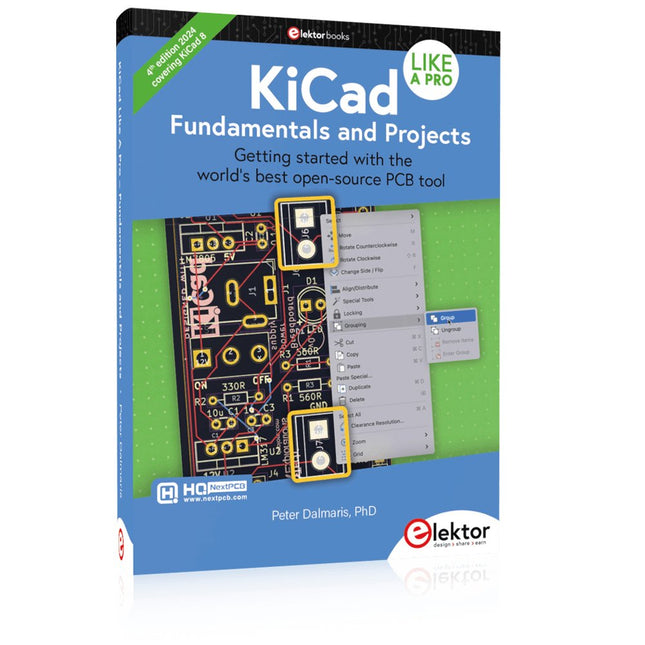
Elektor Publishing KiCad Like A Pro – Fundamentals and Projects
Getting started with the world’s best open-source PCB tool The latest iteration of KiCad, the world’s best free-to-use Printed Circuit Board tool, is packed with features usually found only in expensive commercial CAD tools. This modern, cross-platform application suite built around schematic and design editors, with auxiliary applications is a stable and mature PCB tool. KiCad 8 is a perfect fit for electronic engineers and makers. Here are the most significant improvements and features in KiCad 8, both over and under the hood: Modern user interface, completely redesigned from earlier versions Improved and customizable electrical and design rule checkers Theme editor allowing you to customize KiCad on your screen Ability to import projects from Eagle, CADSTART, and more Python scripting API Improved integrated SPICE circuit simulator Multi-sheet schematics Filters define selectable elements Enhanced interactive router helps you draw single tracks and differential pairs with precision New or enhanced tools to draw tracks, measure distances, tune track lengths, etc. Advanced interactive router Built-in bill of materials generator Realistic ray-tracing capable 3D viewer Customizable teardrops Plug-in manager for quick installation of themes, libraries and functionalities such as autorouters and BOM generators This book will teach you to use KiCad through a practical approach. It will help you become productive quickly and start designing your own boards. Example projects illustrate the basic features of KiCad, even if you have no prior knowledge of PCB design. The author describes the entire workflow from schematic entry to the intricacies of finalizing the files for PCB production and offers sound guidance on the process. Further full-fledged projects, of incremental difficulty, will be presented in a second book, together with a variety of advanced recipes.
€ 54,95
Membres : € 49,46
-
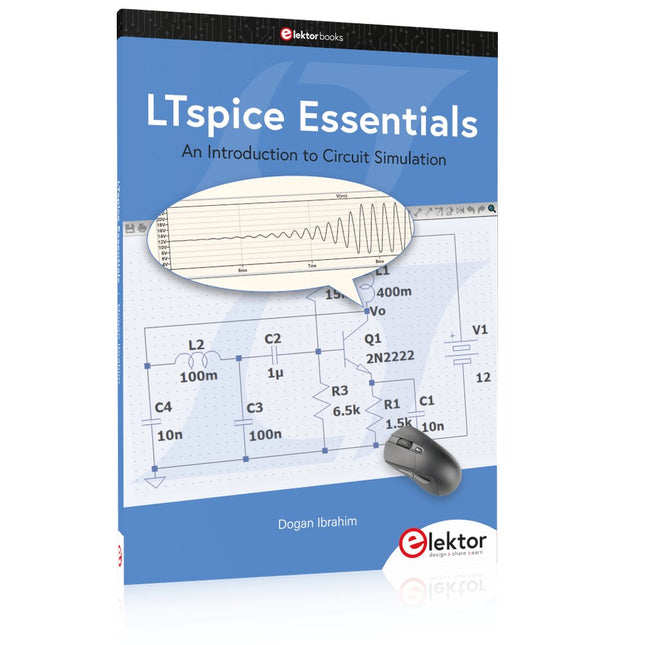
Elektor Publishing LTspice Essentials
An Introduction to Circuit Simulation LTspice, developed by Analog Devices, is a powerful, fast, and free SPICE simulator, schematic capture, and waveform viewer with a large database of components supported by SPICE models from all over the world. Drawing a schematic in LTspice is easy and fast. Thanks to its powerful graphing features, you can visualize the voltages and currents in a circuit, and also the power consumption of its components and much more. This book is about learning to design and simulate electronic circuits using LTspice. Among others, the following topics are treated: DC and AC circuits Signal diodes and Zener diodes Transistor circuits including oscillators Thyristor/SCR, diac, and triac circuits Operational amplifier circuits including oscillators The 555 timer IC Filters Voltage regulators Optocouplers Waveform generation Digital logic simulation including the 74HC family SPICE modeling LTspice is a powerful electronic circuit simulation tool with many features and possibilities. Covering them all in detail is not possible in a book of this size. Therefore, this book presents the most common topics like DC and AC circuit analysis, parameter sweeping, transfer functions, oscillators, graphing, etc. Although this book is an introduction to LTspice, it covers most topics of interest to people engaged in electronic circuit simulation. The book is aimed at electronic/electrical engineers, students, teachers, and hobbyists. Many tested simulation examples are given in the book. Readers do not need to have any computer programming skills, but it will help if they are familiar with basic electronic circuit design and operation principles. Readers who want to dive deeper can find many detailed tutorials, articles, videos, design files, and SPICE circuit models on the Internet. All the simulation examples used in the book are available as files at the webpage of this book. Readers can use these example circuits for learning or modify them for their own applications.
€ 39,95
Membres : € 35,96
-
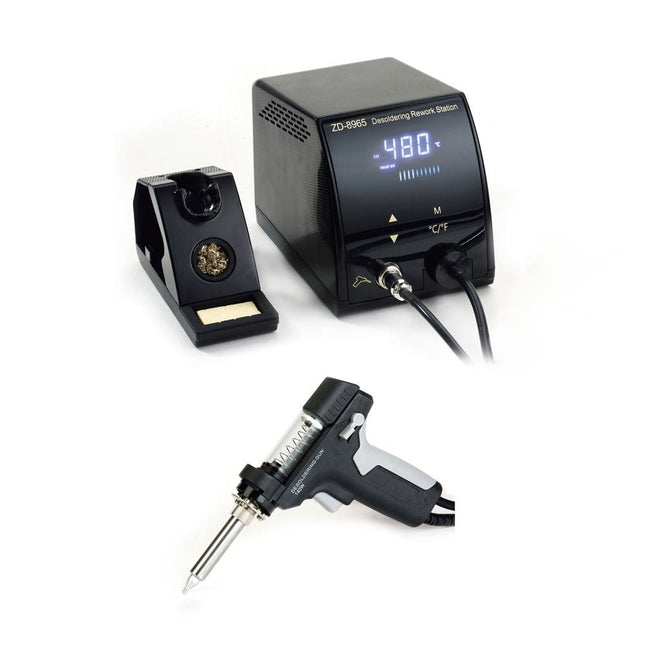
Zhongdi ZD-8965 Station de dessoudage
Le ZD-8965 est une station de dessoudage numérique à température contrôlée équipée d'une protection de mise à la terre et d'un écran LCD pour l'affichage de la température. Sa conception, à la fois compacte et robuste, rend cette station de dessoudage haute performance facile à manipuler d'une seule main. Le ZD-8965 est doté d'un pistolet à souder avec un filtre intégré qui capture tout matériau extrait, permettant un fonctionnement continu en remplaçant simplement les filtres. De plus, un capteur de température est intégré dans la pointe, permettant une réponse rapide aux fluctuations de température pour des performances constantes. Caractéristiques Réglez facilement la température entre 160°C et 480°C à l'aide des boutons haut/bas pratiques sur le panneau avant. Affichage LED pour indiquer la température en °C/°F Comprend une poignée pistolet ergonomique avec une gâchette pour une élimination rapide et efficace des déchets de soudure. Le pistolet à souder amélioré comprend une gâchette arrière, ce qui le rend exceptionnellement pratique pour remplacer et nettoyer les composants. Livré avec un pistolet à souder de haute qualité et un support robuste. Équipé d'un chauffage robuste qui garantit des performances de dessoudage optimales à chaque fois. Spécifications Station Alimentation en tension 220-240 V Puissance 140 W Pression sous vide 600 mm HG Pistolet à dessouder Puissance 140 W (18 V DC)Indice de chauffe : 140 W Température 160-480°C Élément chauffant Chauffage en céramique Inclus 1x ZD-8965 Station de dessoudage 2x Pannes à souder de rechange 3x Aiguilles de nettoyage pour pannes à dessouder 3x Filtre de rechange pour pistolet à dessouder 1x Filtre de rechange pour station de dessoudage 1x Manuel
€ 98,18
-

Electron Plus Picoampèremètre à source Electron Plus SPA100
Ce picoampèremètre source très sensible est conçu pour mesurer et enregistrer de très faibles courants jusqu'à la gamme des pA, ce qui en fait un instrument idéal pour les applications scientifiques et de recherche, notamment en physique, en science des matériaux et en microscopie électronique. Doté de toutes les fonctionnalités à un prix abordable, le SPA100 allie sensibilité, précision et stabilité pour permettre aux utilisateurs de mesurer de faibles courants avec une grande précision et d'obtenir facilement des tensions de polarisation pour l'expérimentation. Le SPA100 peut également servir de mesureur de résistance ultra-haute, mesurant avec précision jusqu'à la gamme des téraohms. Le SPA100 se connecte à un PC via USB et utilise le logiciel complémentaire SPA, qui permet aux utilisateurs de mesurer, de tracer des graphiques et de capturer des lectures avec des horodatages et des informations sur la stabilité de la mesure. Spécifications Entrée : ±2 mA à ±200 pA sur 8 plages Précision et résolution (2 Hz) : Plage ±2 mA : ±0,1%, résolution <20 nA Plage ±200 uA : ±0,1%, résolution <2 nA Plage ±20 uA : ±0,2%, résolution <200 pA Plage ±2 uA : ±0,2%, résolution <20 pA Plage ±200 nA : ±0,5%, résolution <2 pA Plage ±20 nA : ±0,5%, résolution <200 fA Plage ±2nA : ±1,0%, résolution <20 fA Plage de ±200 pA : ±1,5%, résolution <2 fA Taux d'échantillonnage : 2 Hz (18 bits) ou 10 Hz (16 bits) Filtre réglable : 1 échantillon à 64 échantillons Tension de sortie : -40 V à +40 V (par incréments de 1 V), résistance de sortie 2,7 Kohms Mesure de la résistance : ~1 Kohms à 40 Tohms (par exemple, source de 40 V, mesure de 1 pA) Précision : > ±0,5%, 1 Mohm à 1 Tohm Alimenté via USB 2.0 (l'instrument utilise jusqu'à 0,3 A lorsqu'il est utilisé) Inclus 1x Picoampèremètre à source SPA100 1x Câble USB Téléchargements Manual Software
€ 262,80
-
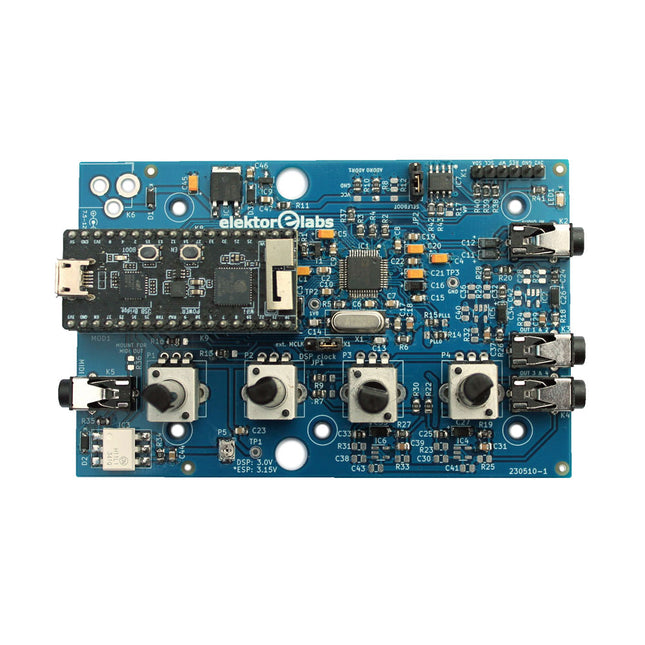
Elektor Labs Elektor Audio DSP FX Processor (Nouvelle Révision)
Le Elektor Audio DSP FX Processor combine un microcontrôleur ESP32 et un DSP Audio ADAU1701 d'Analog Devices. Outre un noyau DSP programmable par l'utilisateur, l'ADAU1701 intègre des convertisseurs analogique-numérique et numérique-analogique de haute qualité et dispose d'un port I²S. Cela le rend approprié comme interface audio de haute qualité pour l'ESP32. Les programmes pour l'ESP32 peuvent être créés avec Arduino, Platform IO, CMake ou en utilisant Espressif IDF d'une autre manière. Les programmes pour les DSP audio ADAU7101 sont créés avec l'outil de programmation visuelle gratuit SigmaStudio en glissant et déposant des blocs d'algorithmes prédéfinis sur un canevas. Applications Sink audio Bluetooth/Wi-Fi (par ex. haut-parleur) et source Pédale d'effet guitare (stomp box) Synthétiseur musical Générateur de sons/fonctions Filtre cross-over programmable pour haut-parleurs Processeur d'effets audio avancé (réverbération, chorus, pitch shifting, etc.) Appareil audio connecté à Internet Plate-forme d'expérimentation DSP MIDI sans fil Convertisseur MIDI vers CV et bien d'autres... Spécifications Processeur audio numérique ADAU1701 28/56 bits, 50 MIPS prenant en charge des taux d'échantillonnage allant jusqu'à 192 kHz Microcontrôleur double cœur ESP32 32 bits avec Wi-Fi 802.11b/g/n et Bluetooth 4.2 BR/EDR et BLE 2 entrées audio 24 bits (2 V RMS, 20 kΩ) 4 sorties audio 24 bits (0,9 V RMS, 600 Ω) 4x potentiomètres de contrôle Entrée et sortie MIDI Port d'extension I²C Fonctionnement multimode Alimentation : USB 5 V CC ou 7,5-12 V CC (prise cylindrique, broche centrale GND) Consommation de courant (moyenne) : 200 mA Inclus 1x Carte Audio DSP FX Processor (assemblée) 1x ESP32-PICO-KIT 2x Cavaliers 2x Connecteurs à 18 broches (female) 4x Potentiomètres de 10 Ko Téléchargements Documentation GitHub
€ 99,95€ 84,95Meilleur prix
-
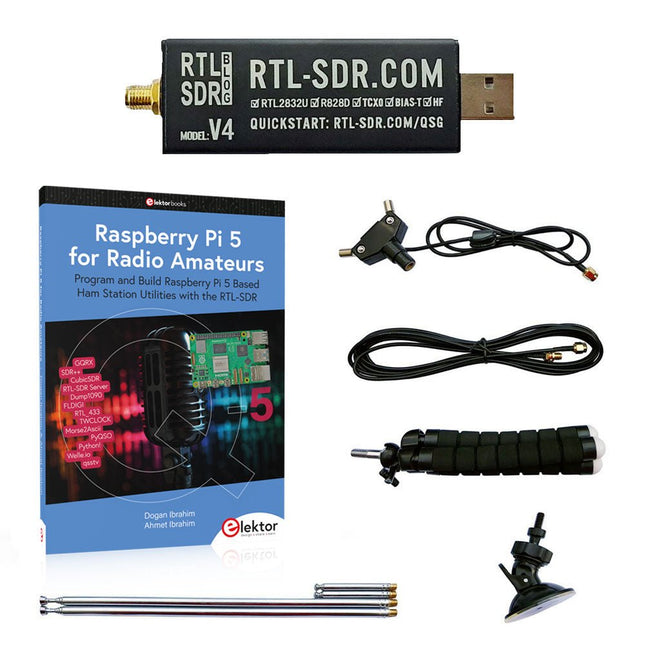
Elektor Bundles Raspberry Pi 5 RTL-SDR V4 (offre groupée)
Programmez et construisez des utilitaires, des outils et des instruments de station radio amateur basés sur Raspberry Pi ! La version améliorée du RTL-SDR V4 permet de recevoir des signaux radio entre 500 kHz et 1,75 GHz provenant de stations utilisant différentes bandes (notamment la diffusion en ondes courtes (SW), moyennes (MW) et longues (LW)), de services de radiodiffusions, de services publics de contrôle du trafic aérien, de PMR, de SRD, d'ISM, de CB, de satellites météorologiques et de radioastronomie. Le livre Raspberry Pi 5 for Radio Amateurs présente en détail l'utilisation du kit RTL-SDR avec un Raspberry Pi. Cette offre groupée contient : RTL-SDR V4 (avec kit d'antenne dipôle) (prix normal : 75 €) Raspberry Pi 5 for Radio Amateurs (prix normal : 40 €) RTL-SDR V4 (Software Defined Radio) avec kit antenne dipôle La clé RTL-SDR est un appareil au coût abordable qui peut être utilisé comme scanner radio associé à un ordinateur, pour recevoir les signaux radio locaux entre 500 kHz et 1,75 GHz. La version RTL-SDR V4 apporte plusieurs améliorations par rapport aux appareils de marques génériques, en particulier l’utilisation d’un chip tuner R828D, la présence d’un filtre d’entrée triplexé, d’un filtre coupe-bande, de composants aux tolérances améliorées, d’un oscillateur compensé en température à stabilité de 1 PPM (TCXO), d’un connecteur SMA F, d’un boitier en aluminium avec refroidissement passif, d’un circuit d’injection de tension continue en T, d’une alimentation améliorée, et d’un convertisseur HF élévateur. RTL-SDR V4 est fourni avec un kit antenne dipôle portable. C’est un atout pour débuter, car elle permet la réception des stations terrestres et des satellites. Son installation à l’extérieur est facile, elle est conçue pour un usage portable temporaire à l’extérieur. Caractéristiques Réception HF améliorée : V4 utilise maintenant un convertisseur élévateur au lieu d’un circuit échantillonneur direct. Cela évite le phénomène de fréquence de repli de Nyquist se situant vers 14,4 MHz, une meilleure sensibilité et un gain HF ajustable. Tout comme pour V3, la fréquence limite basse de réception est de 500 kHz, et un signal reçu très fort nécessite l’utilisation d’un filtre atténuateur en entrée. Filtrage amélioré : La V4 utilise le circuit de réception R828D qui possède trois entrées. L’entrée munie d’un connecteur SMA a été triplexée en 3 bandes : HF, VHF et UHF. Les trois bandes sont ainsi isolées, ce qui minimise la diminution de la sensibilité et la présence de fréquences images, provoquées par les interférences dues aux stations de radiodiffusions puissantes en dehors de la bande reçue. Filtrage x2 amélioré : En plus du triplexage, une broche d’entrée aboutissant à un drain ouvert peut être utilisée, permettant l’ajout d’un filtre coupe-bande pour éliminer les interférences sur les bandes de radiodiffusion AM, FM ou DAB. Un tel filtre permet d’obtenir une atténuation limitée à quelques décibels, mais demeure efficace. Amélioration du bruit de phase sur les signaux puissants : La conception améliorée de l’alimentation permet de réduire le bruit de phase provenant de celle-ci. Dissipation calorifique réduite : Autre avantage résultant de l’amélioration du circuit d’alimentation, la consommation électrique est réduite, minimisant de fait la génération de chaleur, par rapport à la V3. Inclus 1x Clé RTL-SDR V4 (R828D RTL2832U 1PPM TCXO SMA) 2x Antennes télescopiques de 23 cm à 1 m 2x Antennes télescopiques de 5 cm à 13 cm 1x Embase d’antenne équipée d’un câble RG174 de 60 cm 1x Câble prolongateur RG174 de 3 m 1x Trépied de montage flexible 1x Ventouse de fixation Téléchargements Datasheet User Guide Quick Start Guide SDR# User Guide Dipole Antenna Guide Livre : Raspberry Pi 5 for Radio Amateurs Les dispositifs RTL-SDR (V3 et V4) ont gagné en popularité parmi les radioamateurs en raison de leur faible coût et de leurs nombreuses fonctionnalités. Un système de base peut consister en un dispositif RTL-SDR USB (dongle) avec une antenne appropriée, un ordinateur Raspberry Pi 5, un adaptateur d'entrée-sortie audio externe USB et un logiciel installé sur l'ordinateur Raspberry Pi 5. Avec une installation aussi modeste, il est possible de recevoir des signaux allant d'environ 24 MHz à plus de 1,7 GHz. Ce livre s'adresse aux radioamateurs et aux étudiants en ingénierie électronique, ainsi qu'à toute personne souhaitant apprendre à utiliser le Raspberry Pi 5 pour construire des projets électroniques. Le livre convient aussi bien aux débutants qu'aux lecteurs expérimentés. Une certaine connaissance du langage de programmation Python est nécessaire pour comprendre et éventuellement modifier les projets présentés dans le livre. Chaque projet est accompagné d'un schéma fonctionnel, d'un schéma de circuit et d'une liste complète de programmes Python, ainsi que d'une description détaillée. Les programmes RTL-SDR populaires suivants sont examinés en détail et accompagnés de guides d'installation étape par étape pour une utilisation pratique sur un Raspberry Pi 5: SimpleFM GQRX SDR++ CubicSDR RTL-SDR Server Dump1090 FLDIGI Quick RTL_433 aldo xcwcp GPredict TWCLOCK CQRLOG klog Morse2Ascii PyQSO Welle.io Ham Clock CHIRP xastir qsstv flrig XyGrib FreeDV Qtel (EchoLink) XDX (DX-Cluster) WSJT-X L'application du langage de programmation Python sur la dernière plateforme Raspberry Pi 5 empêche l'utilisation des programmes du livre sur les versions plus anciennes des ordinateurs Raspberry Pi.
€ 114,95€ 99,95Meilleur prix
-

Generic Kit LC-mètre
Ce kit LC-mètre est un projet de bricolage facile à construire, éducatif et divertissant pour mesurer l'inductance (L) des bobines et des inductances, la capacité (C) des condensateurs, d'autres composants passifs et la fréquence des signaux. Spécifications Alimentation USB CC 5 V Plage de mesure de capacité des petits condensateurs non polarisés 1 pF~2200 pF Plage de mesure de capacité des condensateurs électrolytiques 1 µF~12000 µF Plage de mesure d'inductance 1 µH~1 H Plage de mesure de fréquence 20 Hz~400 kHz Dimensions (platine) 91 x 80 mm Dimensions (boîtier) 106 x 91 x 28 mm Inclus Platine double face Tous les composants requis, y compris l'écran LCD Six plaques acryliques transparentes prédécoupées Vis et écrous
-
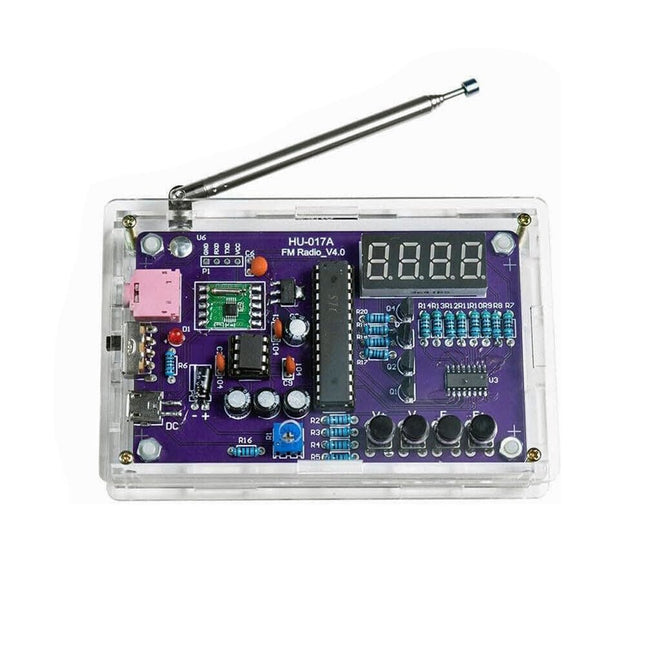
Generic Kit radio FM
Ce kit à monter soi-même (HU-017A) est un récepteur radio FM sans fil possédant un affichage à 4 chiffres et 7 segments. Il fonctionne dans la bande de fréquence mondiale de réception FM de 87,0-108,0 MHz, ce qui permet de l'utiliser dans n'importe quel pays ou région. Le kit offre deux modes d'alimentation, ce qui vous permet de l'utiliser à la maison comme aussi en extérieur. Ce montage électronique fait maison vous aidera à comprendre les circuits et à perfectionner vos compétences en matière de soudage. Caractéristiques Radio FM 87,0-108,0 MHz : Processeur de données FM RDA5807 intégré avec une bande de fréquence de réception FM standard. La fréquence FM peut être réglée à l'aide des touches F+ et F-. Réglage du volume : Deux méthodes de réglage du volume – bouton et potentiomètre. Ils proposent 15 niveaux de volume. Sortie audio active et passive : Le kit dispose d'un amplificateur de puissance intégré de 0,5 W pour alimenter directement des haut-parleurs de 8 Ω. Il émet également des signaux audio vers des casques ou des haut-parleurs dotés d'interfaces AUX, ce qui permet une écoute personnelle ou public de l'audio FM. Equipé d'une antenne FM dédiée de 25 cm et d'un afficheur (en rouge) à 4 chiffres et 7 segments pour l'affichage en temps réel de la fréquence radio FM. Le boîtier transparent acrylique protège le circuit imprimé interne. Deux méthodes d'alimentation sont prises en charge : 5 V USB et 2 piles de 1,5 V (AA). Soudage à la main : Le kit est livré avec divers composants qui doivent être installés manuellement. Ceci permet d'exercer et de perfectionner ses compétences en matière de soudure, et est également adapté aux amateurs d'électronique, aux débutants ainsi qu'à des fins d'éducation. Spécifications Tension d'exploitation DC 3 V/5 V Impédance de sortie 8 Ω Puissance de sortie 0,5 W Canal de sortie Mono Fréquence de réception 87.0 MHz~108.0 MHz Précision de la féquence 0.1 MHz Température d'exploitation −40°C à +85°C Taux d'humidité d'exploitation 5% à 95% d'humidité relative Dimensions 107 x 70 x 23 mm IMPORTANT : Retirez les piles lorsque vous alimentez la radio via USB ! Inclus 1x circuit imprimé 1x récepteur FM RDA5807M 1x microcontrôleur STC15W404AS 1x socle pour IC 1x registreà décalage 74HC595D 1x amplificateur TDA2822M 1x socle pour IC 1x convertisseur de tension 3,3 V AMS1117 18x résistances à film métallique 1x potentiomètre 4x condensateurs céramiques 5x condensateurs électrolytiques 4x transistors S8550 1x DEL rouge 1x afficheur à 4 chiffres et 7 segments 1x interrupteur à bascule 1x prise CMS Micro USB 1x antenne radio 1x prise audio AUX 4x boutons noirs 4x capuchons de bouton 1x haut-parleur 0,5 W/8 Ω 1x fil rouge/noir 2x adhésifs doubles face 1x boîtier pour piles AA 1x câble USB 6x plaquettes acryliques 4x vis entretoises en nylon 4x vis M3 4x écrous M3 4x vis M2x22 mm 1x vis M2x6 mm 5x écrous M2
-

Andonstar Andonstar Max Station Upgrade Set pour les modèles AD409
Faites évoluer votre Andonstar AD409, AD409 Pro ou AD409 Pro-ES vers le modèle Max grâce à ce kit d'amélioration. La nouvelle station Max surdimensionnée offre un vaste espace de travail, ce qui la rend idéale pour les projets de plus grande envergure et pour les tâches de soudure professionnelles. Inclus 1x Support avec 2 LED 1x Tapis de réparation 1x Porteur 1x Colonne 1x Porte-outil 1x Coups de main à souder
€ 59,50
-
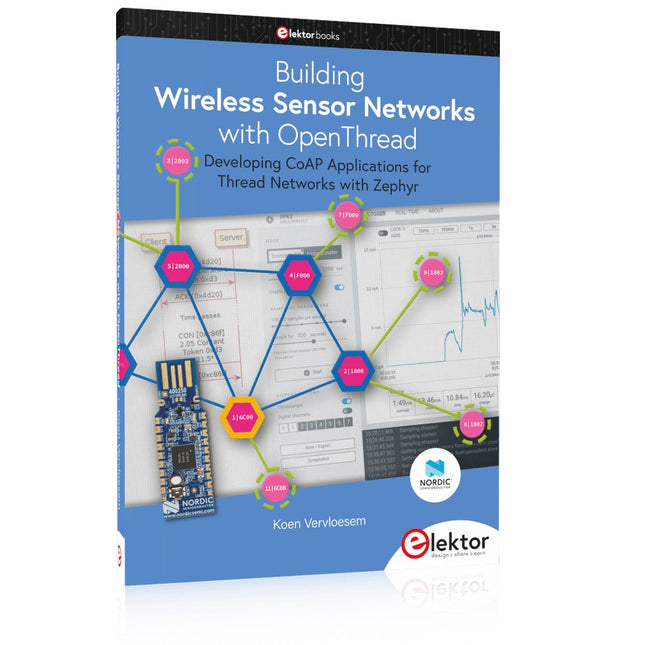
Elektor Publishing Building Wireless Sensor Networks with OpenThread
Developing CoAP applications for Thread networks with Zephyr This book will guide you through the operation of Thread, the setup of a Thread network, and the creation of your own Zephyr-based OpenThread applications to use it. You’ll acquire knowledge on: The capture of network packets on Thread networks using Wireshark and the nRF Sniffer for 802.15.4. Network simulation with the OpenThread Network Simulator. Connecting a Thread network to a non-Thread network using a Thread Border Router. The basics of Thread networking, including device roles and types, as well as the diverse types of unicast and multicast IPv6 addresses used in a Thread network. The mechanisms behind network discovery, DNS queries, NAT64, and multicast addresses. The process of joining a Thread network using network commissioning. CoAP servers and clients and their OpenThread API. Service registration and discovery. Securing CoAP messages with DTLS, using a pre-shared key or X.509 certificates. Investigating and optimizing a Thread device’s power consumption. Once you‘ve set up a Thread network with some devices and tried connecting and disconnecting them, you’ll have gained a good insight into the functionality of a Thread network, including its self-healing capabilities. After you’ve experimented with all code examples in this book, you’ll also have gained useful programming experience using the OpenThread API and CoAP.
€ 39,95
Membres : € 35,96


